I-360 Widow Petition: Guide for Surviving Spouses
For non-citizen surviving spouses of U.S. citizens in Florida, the I-360 Widow Petition offers a vital pathway to permanent residency. This self-petition allows eligible individuals to apply for a green card independently, without requiring another sponsor. You must generally file within two years of your spouse's death, prove a bona fide marriage, and ensure you have not remarried. As of 2026, understanding the strict eligibility criteria, detailed filing process, and potential costs is crucial. Florida Immigration Lawyers provides expert guidance, helping you gather necessary documentation, navigate USCIS requirements, and address any complexities, ensuring your application is strong and complete for a secure future in Florida.

The I-360 Widow Petition, officially known as the Petition for Amerasian, Widow(er), or Special Immigrant, allows certain surviving spouses of U.S. citizens to self-petition for a green card without a relative's sponsorship. As of 2026, you must generally file within two years of your spouse's death, prove your marriage was bona fide, and demonstrate your U.S. citizen spouse was not separated from you at the time of their passing. This crucial immigration pathway offers hope and stability for eligible individuals in Florida seeking permanent residency after a tragic loss.
- File Form I-360 within two years of your U.S. citizen spouse's death.
- Prove a valid, good-faith marriage that ended only by death.
- You must not have remarried at the time of filing.
- The process can lead to permanent residency (a green card).
- Seeking legal guidance from Florida Immigration Lawyers is highly recommended.
Losing a loved one is an incredibly difficult experience, and when that loss involves a U.S. citizen spouse, it can create immense uncertainty regarding your immigration status. For many non-citizen surviving spouses in Florida, the dream of permanent residency may seem to vanish along with their partner. However, U.S. immigration law provides a critical pathway for certain individuals through the I-360 Widow Petition. This self-petition allows you to pursue a green card independently, without needing another family member to sponsor you. Understanding the requirements and process for the I-360 Widow Petition in Florida is essential to secure your future.
At Florida Immigration Lawyers, we understand the emotional toll and legal complexities involved. Our dedicated team is here to guide you through every step, ensuring your application is strong and complete. We serve clients across the state, including in Hialeah and the surrounding communities, providing compassionate and effective legal representation. Don't navigate this challenging process alone. Call Florida Immigration Lawyers at 1-844-967-3536 for a free consultation today and let us help you understand your options.
What is the I-360 Widow Petition and Who Can File It?
The I-360 Widow Petition is a humanitarian provision under U.S. immigration law that allows certain surviving spouses of U.S. citizens to petition for permanent residency (a green card) on their own behalf. This means you do not need an employer or another family member to sponsor you. This pathway is specifically designed for individuals who were married to a U.S. citizen at the time of their spouse's death and meet specific criteria outlined in the Immigration and Nationality Act (INA). The legal basis for this petition is found in INA Section 204(a)(1)(A)(ii), which is further detailed in 8 U.S.C. 1154 and 8 CFR 204.2(b).
To be eligible for an I-360 Widow Petition, you must generally meet several key requirements. First, you must have been legally married to a U.S. citizen. Second, your U.S. citizen spouse must have passed away within two years of you filing the I-360 petition. Third, you must not have remarried. If you remarry before the I-360 is approved, you lose eligibility. Fourth, you must prove that the marriage was legitimate and entered into in good faith, not solely for immigration purposes. Lastly, your U.S. citizen spouse must have been a U.S. citizen at the time of their death and not legally separated from you. For many in Hialeah and throughout Florida, this petition offers a vital path to stability after an unimaginable loss.
The I-360 petition is a crucial option for individuals who might otherwise lose their chance at a green card. For instance, if your U.S. citizen spouse had already filed an I-130 Petition for Alien Relative on your behalf before their death, the I-360 allows you to convert that petition into a self-petition. This ensures that the progress made on your immigration journey is not lost. Understanding these nuances is vital, and an experienced immigration attorney can help determine your specific eligibility and guide you through the process, especially given the complexities of Florida's diverse immigrant population.
Am I Eligible to File an I-360 Widow Petition in Florida?
To file an I-360 Widow Petition in Florida, you must meet specific eligibility criteria set by USCIS. You must have been legally married to a U.S. citizen, your spouse must have passed away within the last two years, you must not have remarried, and you must prove the marriage was bona fide. Additionally, you must be admissible to the United States.
Determining eligibility for the I-360 Widow Petition requires a careful review of your circumstances. Here are the primary factors USCIS considers: Marriage to a U.S. Citizen: You must have been legally married to a U.S. citizen. The marriage must have been valid where it took place. U.S. Citizenship of Deceased Spouse: Your spouse must have been a U.S. citizen at the time of their death. Timely Filing: You must file Form I-360 within two years of your U.S. citizen spouse's death. This deadline is strict, so immediate action is often necessary. If your spouse filed Form I-130 for you before their death, and you were living in the U.S. at the time, you might have more flexibility, but consulting an attorney is crucial. No Remarriage: You must not have remarried since your U.S. citizen spouse passed away. Remarriage before the I-360 is approved will disqualify you. Bona Fide Marriage: You must prove that your marriage was legitimate and not entered into solely for immigration purposes. This is a critical component and requires substantial evidence, such as joint bank accounts, shared property, insurance policies, and photos together. Admissibility: You must be admissible to the United States. Certain criminal convictions, previous immigration violations, or health issues can make you inadmissible, potentially requiring a waiver. Our firm frequently assists individuals in Florida, including those in areas like Miami, Orlando, and Tampa, in assessing their eligibility and preparing comprehensive petitions.
Given the strict requirements, especially the two-year filing deadline and the need to prove a bona fide marriage, it is highly advisable to seek legal counsel. An experienced immigration lawyer can evaluate your specific situation, help gather the necessary documentation, and ensure your petition meets all USCIS requirements. This is particularly important in Florida, where USCIS field offices in Miami, Orlando, and Tampa process numerous such petitions, each with its unique challenges. Understanding these rules is crucial for anyone considering this self-petition path.
How Do I File an I-360 Self-Petition? A Step-by-Step Guide for Florida Residents
Filing an I-360 self-petition involves several critical steps, from gathering documents to attending interviews. Meticulous preparation is key to a successful outcome. This process can be complex, and errors can lead to delays or denials, making legal assistance invaluable for Florida residents.
Here is a step-by-step guide to filing your I-360 Widow Petition:
- Gather Essential Documents: This is the most crucial initial step. You will need proof of your U.S. citizen spouse's citizenship (e.g., birth certificate, naturalization certificate, U.S. passport), your marriage certificate, your spouse's death certificate, and evidence of a bona fide marriage. This evidence can include joint bank statements, property deeds, utility bills in both names, photographs, affidavits from friends and family, and birth certificates of any children you share.
- Complete Form I-360, Petition for Amerasian, Widow(er), or Special Immigrant: Fill out the form accurately and completely. Pay close attention to all sections, ensuring no information is omitted or incorrect. Any discrepancies can cause significant delays.
- Prepare Supporting Evidence: Organize all your gathered documents. Create a cover letter outlining the contents of your petition. Make copies of everything and keep the originals safe. All foreign language documents must be accompanied by a certified English translation.
- File with USCIS: Mail your completed Form I-360, along with all supporting evidence and the applicable filing fee (as of 2026, check the USCIS website for current fees), to the correct USCIS lockbox facility. The filing address depends on where you live and the type of petition, so verify this on the USCIS website.
- Receive Receipt Notice: After USCIS accepts your petition, you will receive a Form I-797C, Notice of Action, confirming receipt. This notice will include a receipt number you can use to track your case status online.
- Attend Biometrics Appointment: USCIS will send you an appointment notice for a biometrics screening at an Application Support Center (ASC) in Florida (e.g., in Miami, Orlando, or Jacksonville). At this appointment, your fingerprints, photograph, and signature will be collected for background checks.
- Respond to Requests for Evidence (RFEs): If USCIS determines that your petition is missing information or requires further clarification, they will issue an RFE. It is critical to respond to RFEs promptly and comprehensively, providing all requested documentation.
- Attend Interview (if required): While not all I-360 self-petitioners are required to attend an interview, USCIS may schedule one at a local field office in Florida. This interview is an opportunity for USCIS to verify the information in your petition and assess the bona fides of your marriage.
- Decision on I-360 and Adjustment of Status: If your I-360 petition is approved, you can then proceed with applying for adjustment of status (Form I-485) if you are in the U.S. and eligible, or consular processing if you are abroad.
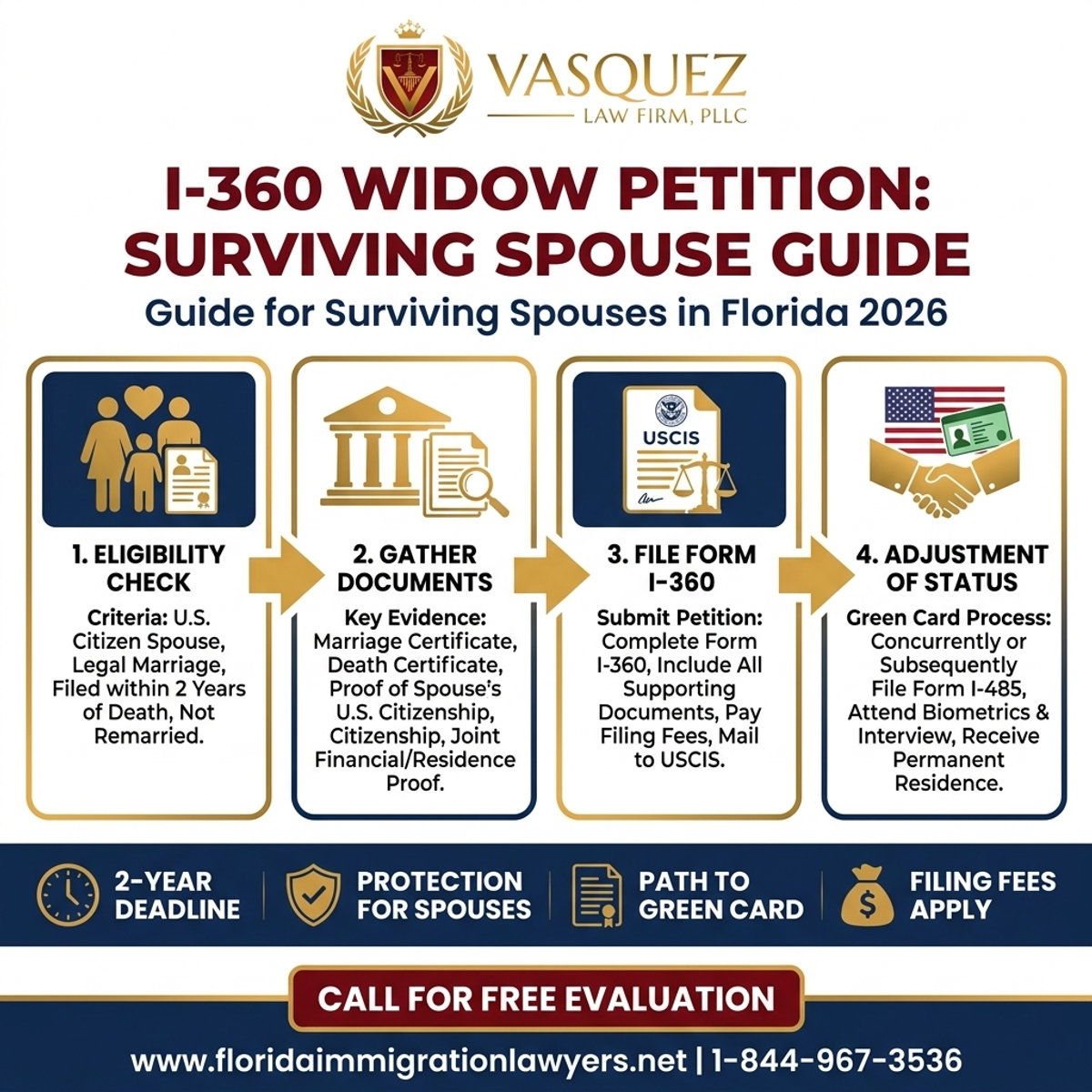
Step-by-Step Process — I-360 Widow Petition: Guide for Surviving Spouses in Florida 2026
Each step requires meticulous attention to detail. For many residents in Hialeah and across Florida, ensuring all forms are correctly filled and all evidence is properly submitted can be overwhelming. An experienced immigration attorney can provide invaluable assistance, helping you navigate these complex requirements and advocating on your behalf.
What is the Processing Timeline for an I-360 Widow Petition in 2026?
As of 2026, the processing timeline for an I-360 Widow Petition can vary significantly based on factors like the specific USCIS service center, caseloads, and the completeness of your application. Typically, you can expect a wait time of several months to over a year for initial I-360 approval, followed by additional time for adjustment of status.
Understanding the expected timeline for your I-360 Widow Petition is crucial for planning your future. While USCIS aims for efficiency, various factors influence processing times. As of 2026, the general stages and their typical timeframes are:
| Stage | Typical Timeframe | Notes |
|---|---|---|
| I-360 Filing to Receipt Notice | 2-4 weeks | Confirmation that USCIS received your petition. |
| Biometrics Appointment Scheduling | 3-5 weeks after receipt | Scheduled at a local Application Support Center (ASC) in Florida. |
| I-360 Petition Processing | 6-18 months | Varies by service center (e.g., Vermont, Nebraska) and caseload. Check USCIS processing times online. |
| Request for Evidence (RFE) Response | Varies (typically 60-90 days given to respond) | Can add several months to the overall processing if issued. |
| I-360 Approval | After processing and RFE response (if any) | The petition is approved, allowing you to proceed to the next step. |
| Adjustment of Status (Form I-485) Processing | 6-24 months (after I-360 approval) | If filed concurrently or subsequently; varies by local USCIS field office (e.g., Miami, Orlando). |
| Green Card Interview (if required) | Scheduled during I-485 processing | Conducted at a local USCIS field office. |
| Green Card Issuance | 2-4 weeks post-approval | After I-485 approval and interview (if any). |
It's important to remember that these are average timeframes, and individual cases can be processed faster or slower. Factors such as the volume of applications at the relevant USCIS service center, the complexity of your case, and your promptness in responding to any USCIS requests can all impact the timeline. For instance, a thoroughly prepared petition with all required evidence can often avoid RFEs and streamline the process. USCIS provides online tools to check current processing times by form type and service center, which can offer a more precise estimate. Navigating these fluctuating timelines in Florida requires patience and often, the strategic advice of an immigration lawyer who can help manage expectations and proactively address potential delays.
What Are the Costs Associated with an I-360 Self-Petition?
The primary cost for an I-360 self-petition is the USCIS filing fee for Form I-360, which is generally waived for widow(er) petitions. However, you will incur fees for subsequent forms like Form I-485 (Adjustment of Status) and biometrics, along with potential costs for legal assistance, document translation, and medical examinations. These fees are subject to change, so always check the official USCIS website.
Understanding the financial aspects of filing an I-360 Widow Petition is crucial for careful planning. While the I-360 petition itself typically has no filing fee for a widow(er) self-petitioner, other associated costs can add up. As of 2026, here's a breakdown of potential expenses:
| Item | Typical Fee (as of 2026) | Notes |
|---|---|---|
| Form I-360, Petition for Amerasian, Widow(er), or Special Immigrant | $0 | Filing fee is generally waived for widow(er) self-petitions. |
| Form I-485, Application to Register Permanent Residence or Adjust Status | Varies (check USCIS website) | Required if you are adjusting status from within the U.S. Includes biometrics fee. |
| Form I-765, Application for Employment Authorization (EAD) | Varies (check USCIS website) | Often filed concurrently with I-485. Fee may be waived if filed with I-485. |
| Form I-131, Application for Travel Document (Advance Parole) | Varies (check USCIS website) | Often filed concurrently with I-485. Fee may be waived if filed with I-485. |
| Medical Examination | $200 - $500 | Required for Form I-485, conducted by a USCIS-approved civil surgeon. Costs vary by provider. |
| Document Translation Fees | Varies ($20 - $100 per page) | If any supporting documents are not in English, certified translations are required. |
| Legal Fees | Varies widely | Cost for an immigration attorney to prepare and file your petition and subsequent applications. Highly recommended for complex cases. |
| Photocopying and Postage | Minimal | Costs for making copies of all documents and mailing your application. |
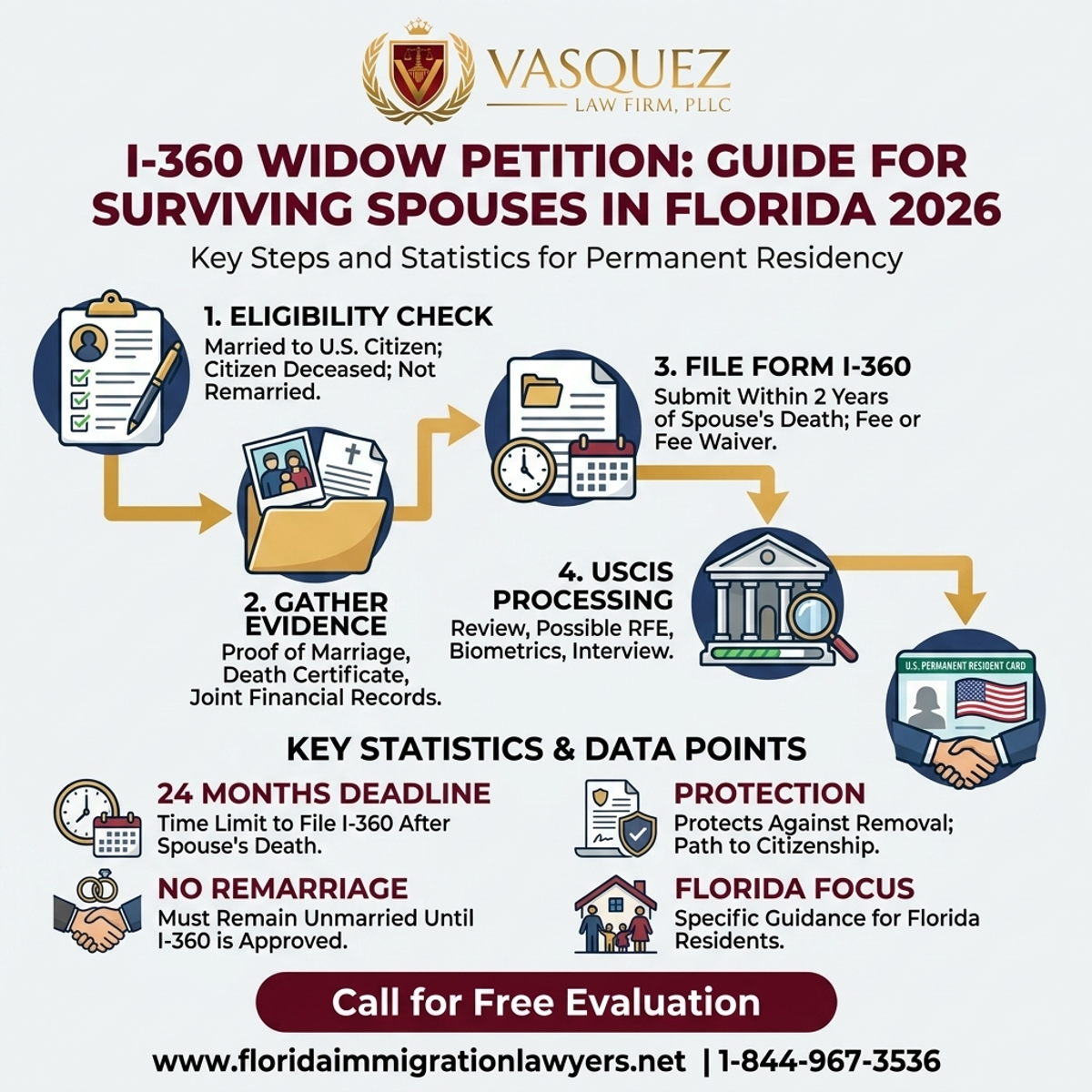
Key Statistics — I-360 Widow Petition: Guide for Surviving Spouses in Florida 2026
It is important to note that USCIS fees can change, so always verify the most current amounts directly on the USCIS website or by consulting with an immigration attorney. While the I-360 itself is often fee-exempt for widows, the subsequent steps to obtain a green card, such as filing Form I-485 for adjustment of status, will incur significant fees. For individuals in Florida, including those in Hialeah, budgeting for these costs is an important part of the immigration process. Legal fees, though an additional expense, often prove to be a worthwhile investment given the complexity of immigration law and the potential for costly errors if navigating the process alone. Florida Immigration Lawyers offers transparent fee structures and can help you understand all potential costs involved.
Navigating the I-360 Interview Process and Post-Approval Steps
After your I-360 Widow Petition is filed, you may be called for an interview, typically as part of the adjustment of status process. This interview, usually held at a local USCIS field office in Florida, is a critical step to verify the bona fides of your marriage and your eligibility. Preparing thoroughly for this interview is essential.
The interview for an I-360 Widow Petition, if required, focuses heavily on establishing the legitimacy of your marriage to your deceased U.S. citizen spouse. The USCIS officer will review your application, supporting documents, and ask questions about your relationship, shared life, and the circumstances surrounding your spouse's death. It is vital to answer truthfully and consistently with the evidence you've submitted. Bringing original documents and any additional evidence of your bona fide marriage that you may have acquired since filing is recommended. An attorney from Florida Immigration Lawyers can prepare you for potential questions and accompany you to the interview, providing crucial support. This preparation is especially important in a state like Florida, with its busy USCIS field offices in Miami, Orlando, and Tampa, where officers handle a high volume of diverse cases.
What Happens After I-360 Approval?
Once your I-360 Widow Petition is approved, the next steps depend on whether you are currently in the United States or abroad. If you are in the U.S. and eligible, you will typically file Form I-485, Application to Register Permanent Residence or Adjust Status. If you are outside the U.S., your case will proceed to consular processing through the National Visa Center (NVC) and a U.S. Embassy or Consulate abroad, often managed by the Department of State. This phase is where your eligibility for a green card is fully assessed, including medical examinations and further background checks.
For those adjusting status in Florida, the I-485 process includes another set of forms, potentially another biometrics appointment, and often a final interview at a local USCIS office. Upon approval of your I-485, you will be granted lawful permanent resident status and receive your green card. Consular processing, on the other hand, involves submitting documents to the NVC, paying fees, and attending an interview at a U.S. Embassy or Consulate in your home country. Both pathways require careful attention to detail and adherence to strict deadlines. Given the potential for delays and the complexity of the requirements, having legal representation from Florida Immigration Lawyers can significantly smooth your path to permanent residency, whether you are in Hialeah or elsewhere in the state.
Do not navigate this process alone. The complexities of immigration law, especially after such a personal loss, can be overwhelming. Contact Florida Immigration Lawyers today at 1-844-967-3536 for a free consultation. Our experienced attorneys are ready to provide the compassionate and expert guidance you deserve.
Common Mistakes to Avoid When Filing an I-360 Widow Petition
Filing an I-360 Widow Petition is a detailed process where even small errors can lead to significant delays or a denial. Avoiding these common pitfalls is crucial for a successful outcome:
- Missing the Two-Year Filing Deadline: The most critical mistake is failing to file Form I-360 within two years of your U.S. citizen spouse's death. This deadline is strict, and exceptions are rare. Missing it almost certainly leads to denial.
- Remarrying Before I-360 Approval: If you remarry before your I-360 petition is approved, you become ineligible for the widow(er) self-petition. This is a common and irreversible mistake.
- Insufficient Evidence of Bona Fide Marriage: Failing to provide compelling evidence that your marriage was legitimate and not entered into solely for immigration purposes. USCIS requires extensive documentation, such as joint bank accounts, property, shared bills, and photos.
- Incomplete or Inaccurate Forms: Submitting forms with missing information, incorrect dates, or spelling errors. Such mistakes can trigger Requests for Evidence (RFEs) or even a denial.
- Failure to Respond to RFEs Promptly: Ignoring or delaying responses to Requests for Evidence from USCIS. RFEs have strict deadlines, and missing them will result in your petition being abandoned or denied.
- Lack of Certified Translations: Submitting foreign language documents without a certified English translation. All non-English documents must be translated by a competent translator who certifies the translation's accuracy.
- Not Proving Spouse's U.S. Citizenship: Failing to provide clear and undeniable proof that your deceased spouse was a U.S. citizen at the time of their death.
- Assuming Automatic Eligibility: Believing that because you were married to a U.S. citizen, you are automatically eligible without meeting all other stringent criteria.
- Travel Abroad Without Advance Parole: If you are adjusting status in the U.S., leaving the country without obtaining Advance Parole (Form I-131) can lead to the abandonment of your I-485 application and potential inadmissibility upon return.
- Not Disclosing All Relevant Information: Hiding or misrepresenting information about your immigration history, criminal record, or previous marriages. This can lead to accusations of fraud and severe immigration consequences.
- Failing to Update Contact Information: Not notifying USCIS of any change of address. Missing important notices can lead to missed appointments or deadlines, jeopardizing your case.
- Attempting to Navigate Complexities Alone: While possible, doing so without legal experience often leads to errors that an attorney could easily prevent, especially with the unique circumstances in Florida immigration cases.
When to Call a Lawyer for Your I-360 Widow Petition in Florida
The I-360 Widow Petition process, while offering a vital pathway to a green card, is fraught with complexities and strict requirements. Deciding when to call a lawyer is often the most important decision you can make. It is highly advisable to seek legal counsel from Florida Immigration Lawyers at the earliest stage, ideally immediately after your spouse's passing, to ensure all deadlines are met and your case is handled correctly.
You should definitely call a lawyer if you:
- Are close to the two-year filing deadline: Time is critical. An attorney can help expedite the process and ensure timely submission.
- Have a complicated marital history: Previous marriages, divorces, or common-law marriages can add layers of complexity that require expert legal interpretation.
- Have limited evidence of a bona fide marriage: If you lack extensive joint financial documents, an attorney can help you gather alternative evidence and build a stronger case.
- Have an existing immigration issue: Any past overstays, deportations, criminal history, or other immigration violations will complicate your case and may require waivers.
- Received a Request for Evidence (RFE) or Notice of Intent to Deny (NOID): These notices indicate USCIS has concerns about your application. An attorney can help you formulate a comprehensive and timely response.
- Are unsure about any part of the process: From completing forms to understanding legal jargon, an attorney provides clarity and peace of mind.
- Are facing an interview with USCIS: Preparation and representation during an interview can significantly impact the outcome.
Florida Immigration Lawyers specializes in family-based immigration, including family immigration and general immigration services. We understand the unique challenges faced by immigrants in Florida, including those residing in Hialeah. Our attorneys can assess your eligibility, assist with document preparation, represent you in communications with USCIS, and advocate for your rights throughout the entire process. Don't risk your future; let our experienced team provide the support you need.
About Florida Immigration Lawyers
Florida Immigration Lawyers is a leading law firm dedicated to providing comprehensive and compassionate immigration legal services across the entire state of Florida. With a deep understanding of U.S. immigration law and its impact on individuals and families, our firm stands ready to assist you with a wide range of immigration matters, including the complex I-360 Widow Petition process. We pride ourselves on offering personalized attention, strategic legal advice, and unwavering support to our clients, from Miami to Jacksonville, Orlando to Tampa, and especially in diverse communities like Hialeah.
Our experienced attorneys are committed to achieving the best possible outcomes for our clients. We offer free consultations to discuss your specific situation, available 24/7, because we know that immigration issues don't adhere to a 9-to-5 schedule. Whether you need assistance with asylum applications, deportation defense, citizenship, or family-based petitions, our team has the expertise and dedication to guide you. When you choose Florida Immigration Lawyers, you choose a partner who will stand by you every step of the way. Visit our attorneys page to learn more about our dedicated team. Contact us today at 1-844-967-3536 or visit floridaimmigrationlawyers.net to schedule your free consultation.
Sources and References
- U.S. Citizenship and Immigration Services (USCIS) - Form I-360
- U.S. Citizenship and Immigration Services (USCIS) - Filing Fees
- Executive Office for Immigration Review (EOIR)
- U.S. Department of State - Travel.State.Gov
- 8 U.S.C. Chapter 12 - Immigration and Nationality Act (INA)
- INA Section 204(a)(1)(A)(ii) - Widowers of U.S. citizens
- 8 CFR 204.2(b) - Petitions for a spouse of a deceased United States citizen
Related services: family petition process, family-based green cards, fiancé visa (K-1), marriage-based immigration.
This article provides general legal information and is not intended as legal advice. Every case is unique, and outcomes depend on specific facts and circumstances. Contact an attorney for advice about your particular situation.
Navigating the I-360 Widow Petition process can be complex and emotionally challenging. Don't face it alone. The compassionate and experienced attorneys at Florida Immigration Lawyers are here to provide the expert guidance you need. Contact us today for a free consultation at 1-844-967-3536. Se Habla Espanol - Estamos aqui para ayudarle.
Do Not Navigate This Process Alone
Our experienced immigration attorneys are ready to fight for you. Get a free, confidential consultation today.
Se Habla Español
Or leave your details and we’ll call you:
Free Evaluation in 24 Hours
Or talk to us right now
AI voice assistant — available 24/7
FreeFrequently Asked Questions

William J. Vásquez
Founding Attorney · Vasquez Law Firm
U.S. Air Force veteran and immigration attorney with years of hands-on U.S. immigration experience. J.D., NCCU School of Law. AILA member. Admitted to the 4th, 5th, and 11th Circuit Courts.
Available 24/7 - Free Evaluations
Reviewed for legal accuracy by William J. Vásquez
Licensed in North Carolina; U.S. immigration is federal practice.
Related Legal Services
Our Florida immigration attorneys can help you with asylum protection, deportation defense and citizenship and naturalization. Call today at 1-844-967-3536 for a free consultation.
Related Links
Related Topics
Free Legal Consultation
Discuss your case with our experienced attorneys. We're available 24/7.
Se Habla Español - Estamos aquí para ayudarle.
Related Articles
Immigration Lawyer Orlando Free Consultation in 2026
Navigating U.S. immigration law in Orlando, Lakeland, and Polk County requires expert legal guidance. Florida Immigration Lawyers offers a free consultation to help you understand your options for visas, Green Cards, citizenship, or deportation defense. This comprehensive guide covers the typical process, essential documents, processing timelines for 2026, and cost factors associated with an immigration lawyer in Orlando. Learn about common mistakes to avoid and when it's crucial to seek legal assistance. Our firm provides personalized, empathetic, and strategic representation across Central Florida, ensuring you have dedicated support for your immigration journey.
I-140 Premium Processing Timeline in Florida 2026
Expediting an I-140 immigrant petition through premium processing can significantly shorten your wait time for an employment-based green card in Florida. As of 2026, USCIS guarantees a decision within 15 calendar days for eligible EB-1, EB-2, and EB-3 cases, provided Form I-907 and the associated fee are correctly filed. This guide explores the detailed timeline, eligibility requirements, necessary documents, and cost factors involved in I-140 premium processing. We also highlight crucial mistakes to avoid and underscore the importance of professional legal counsel. For employers and skilled workers in West Palm Beach and across Florida, understanding these nuances is key to a successful and timely immigration process. Florida Immigration Lawyers offers expert guidance to navigate these complex procedures effectively.
Public Charge Rule Florida: Immigrant Eligibility & Public
The public charge rule is a critical aspect of U.S. immigration law affecting non-citizens seeking green cards or visas, particularly in Florida. This rule assesses whether an individual is likely to become primarily dependent on specific government benefits, such as cash assistance for income maintenance or long-term institutional care. While many essential non-cash benefits are excluded, understanding the nuances is crucial. USCIS employs a "totality of the circumstances" test, evaluating factors like age, health, education, and financial resources. For immigrants in Tampa and across Florida, navigating this complex regulation requires careful preparation and often the guidance of an experienced attorney. This guide provides a detailed overview, common mistakes to avoid, and when to seek legal help to ensure a successful immigration journey.
SIJS in Florida: A Path for Juvenile Immigration
Discover how Special Immigrant Juvenile Status (SIJS) can help minors in Florida gain legal residency. Learn about eligibility, application steps, and common mistakes to avoid. Consult Florida Immigration Lawyers for expert guidance.