I-140 Premium Processing Timeline in Florida 2026
Explore the I-140 premium processing timelines in Florida for 2026. Learn about the application process, document requirements, and what to expect in Jacksonville. Get advice to expedite your immigration journey with our comprehensive guide.
Understanding the I-140 premium processing timeline in Florida is crucial for applicants aiming for a faster EB-2 or EB-3 visa approval. Here are key points:
- Premium processing expedites I-140 petitions, usually within 15 days.
- The process is available for EB-2 and EB-3 categories.
- Applicants in Jacksonville, Florida, can benefit from this service.
- Current regulations may affect timelines, so stay informed.
Introduction
In 2026, navigating the complexities of immigration law can feel overwhelming, especially when dealing with employment-based visas such as the EB-2 and EB-3. If you're in Jacksonville, Florida, and seeking to expedite your I-140 petition, understanding the premium processing timeline is essential. This article provides a comprehensive guide on what to expect, recent changes, and how to proceed. Call Florida Immigration Lawyers at 1-844-YO-PELEO for a free consultation.
The U.S. job market is highly competitive, and employers often need to secure top talent swiftly to meet business demands and project deadlines. For foreign professionals, a quick resolution to their immigration status can mean the difference between accepting a dream job and facing prolonged uncertainty. Premium processing for the I-140 petition offers a strategic advantage, providing a clear pathway for both employers and employees in Florida's dynamic economic landscape.
Whether you are a tech professional in Miami, a healthcare specialist in Orlando, or an academic researcher in Gainesville, understanding the nuances of premium processing can significantly impact your career trajectory and personal planning. This guide aims to demystify the process, offering practical advice and insights into how you can leverage this expedited service to achieve your immigration goals efficiently and effectively.
What is the I-140 Premium Processing Timeline?
The I-140 premium processing timeline refers to the expedited service offered by USCIS for certain employment-based immigration petitions. As of 2026, this option allows for faster processing of EB-2 and EB-3 visa categories within 15 calendar days. This service is particularly beneficial for applicants in Florida who need timely decisions.
Applicants can expect a decision or a request for evidence (RFE) within this timeframe. It's important to note that while premium processing speeds up the review, it does not guarantee approval. For more details, visit the USCIS website.
The primary advantage of premium processing extends beyond mere speed; it offers predictability. For businesses, this means quicker onboarding of essential personnel, allowing them to fill critical roles without lengthy delays. For individuals, it translates into reduced anxiety and the ability to plan their lives and careers with greater certainty, which is invaluable when making significant life decisions like relocating to Florida.
The 15-calendar-day guarantee means USCIS commits to issuing an approval, a denial, a Request for Evidence (RFE), or a Notice of Intent to Deny (NOID) within this period. If USCIS fails to meet this deadline, they are obligated to refund the premium processing fee, though they will continue to process the petition with expedited attention. This commitment provides a crucial safeguard for applicants who are investing a substantial amount for faster service. This level of expedited review is a stark contrast to standard processing times, which can often span several months or even over a year, making premium processing a vital tool for many professionals.
How to Apply for I-140 Premium Processing in Florida
To apply for I-140 premium processing in Florida, you must follow these steps:
- Complete Form I-907, Request for Premium Processing Service, along with your I-140 petition.
- Submit the required fee with your application. Check the USCIS website for the current fee schedule.
- Mail your application to the appropriate USCIS service center.
- Await confirmation and a decision from USCIS within 15 calendar days.
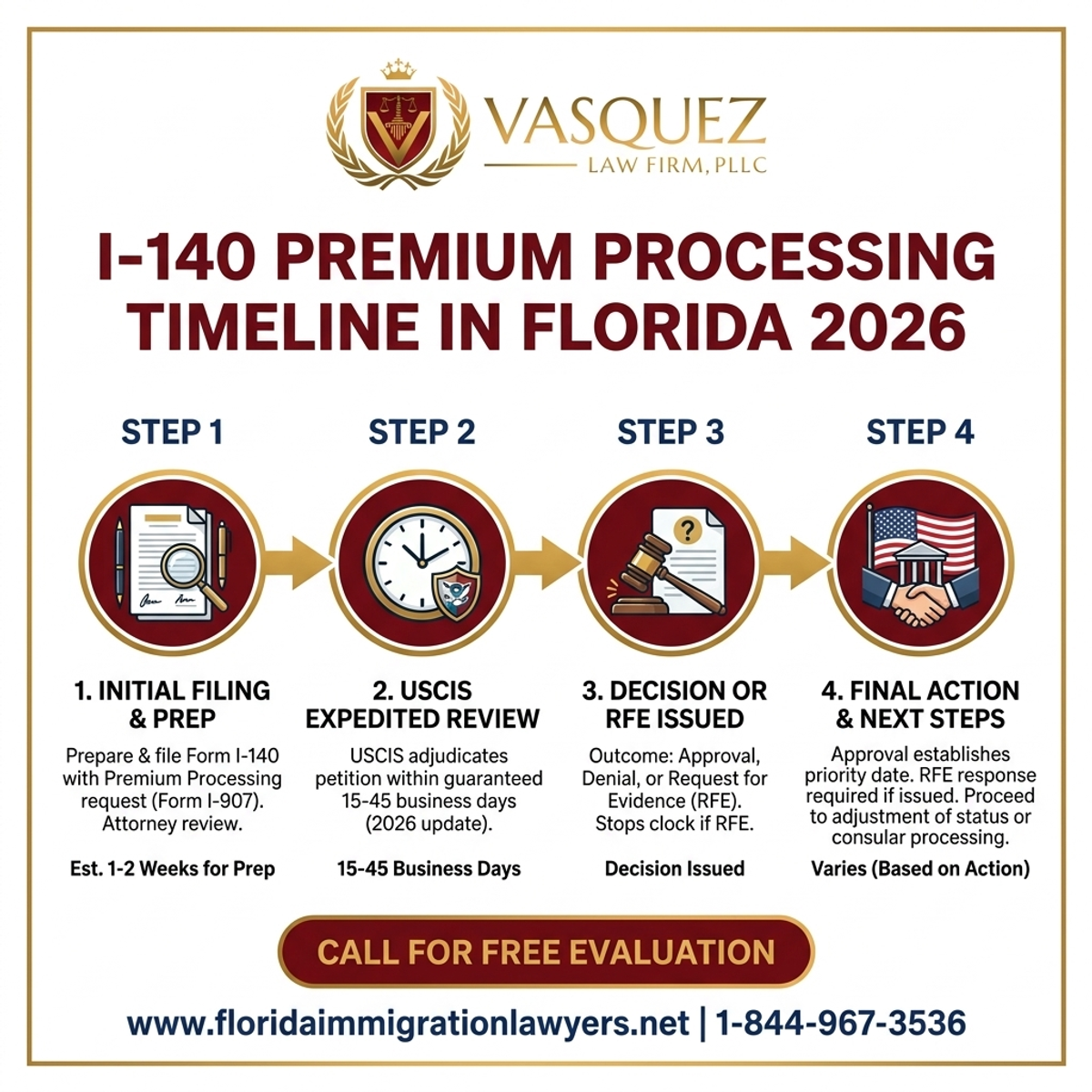
Step-by-Step Process — I-140 Premium Processing Timeline in Florida 2026
Ensure that your application is complete and accurate to avoid delays. In Jacksonville, the local USCIS office can provide additional guidance. For more support, contact Florida Immigration Lawyers.
When completing Form I-907, ensure all sections are accurately filled out, especially the receipt number of your underlying I-140 petition if it was filed previously. If filing concurrently, clearly indicate this. It is crucial to use the most current version of the form, which can be found on the USCIS website, as outdated forms can lead to immediate rejection.
Regarding the fee submission, be aware that the premium processing fee for Form I-907 must be paid separately from the I-140 filing fee. It's recommended to use two separate checks or money orders, made payable to the "U.S. Department of Homeland Security." Always double-check the exact amounts on the USCIS website just before mailing, as fees are subject to change without extensive notice. Using a trackable mail service for your application is highly advisable, as it provides proof of delivery and allows you to monitor its journey to the correct USCIS service center.
Many applicants choose to file their I-140 and I-907 concurrently, meaning both forms are sent together in one package. This typically initiates the 15-day premium processing clock immediately upon USCIS receipt. Alternatively, if your I-140 is already pending under regular processing, you can upgrade it by filing Form I-907 separately, referencing your I-140 receipt number. An experienced immigration attorney from Florida Immigration Lawyers can help you determine the best filing strategy and ensure all forms are correctly prepared and submitted, significantly reducing the risk of costly errors and delays. Call us at 1-844-YO-PELEO for personalized assistance.
Document Checklist for I-140 Premium Processing
- Completed Form I-907 and Form I-140
- Proof of employment and qualifications
- Employer's letter of support
- Proof of payment for the premium processing fee
- Any additional documentation as required by USCIS
Having a complete and thorough application helps in expediting the process. Missing documents can result in delays or a request for additional evidence.
For the **Completed Form I-907 and Form I-140**, meticulous attention to detail is paramount. Ensure all required fields are filled, signatures are present where needed, and the information is consistent across all submitted documents. Common errors like missing dates, incorrect addresses, or unsigned forms are frequent reasons for rejection or RFE.
**Proof of employment and qualifications** typically includes a comprehensive resume, official academic transcripts and diplomas (often evaluated by a U.S. credential evaluation service), professional licenses, and detailed letters of experience from previous employers. For EB-2 candidates, this might also involve evidence of exceptional ability or an advanced degree, such as publications, awards, or professional memberships.
The **Employer's letter of support** is a critical component, detailing the job offer, the necessity of the foreign worker's specialized skills, and the company's financial ability to pay the proffered wage. This letter should clearly outline the job duties, the beneficiary's qualifications, and why the position requires someone with their specific expertise. It serves as a narrative backbone for the entire petition.
**Proof of payment for the premium processing fee** requires careful attention to the correct amount and payment method. As mentioned, separate checks for the I-140 and I-907 are often recommended. Always verify the current fees on the USCIS website immediately before filing to prevent your application from being rejected due to an incorrect payment.
**Any additional documentation as required by USCIS** can vary significantly by I-140 category. For example, EB-2 National Interest Waiver (NIW) petitions require extensive evidence demonstrating the national importance of the beneficiary's work. EB-1 petitions require proof of extraordinary ability or outstanding research. For most EB-2 and EB-3 cases, this will include the certified Labor Certification (PERM) application and any related prevailing wage determinations. Organizing all these documents clearly, perhaps with tabs and a table of contents, can greatly assist USCIS officers in their review process.
Timeline and Processing Expectations
| Stage | Typical Timeframe | Notes |
|---|---|---|
| Submission of Application | 1-2 days | Ensure all forms are correctly filled |
| USCIS Receipt Notice | 1 week | Confirms receipt of application |
| Decision or RFE | 15 days | USCIS will issue a decision or RFE |
| Response to RFE | Varies | Depends on the complexity of the RFE |
These timelines are typical but can vary based on specific case circumstances and USCIS workload.
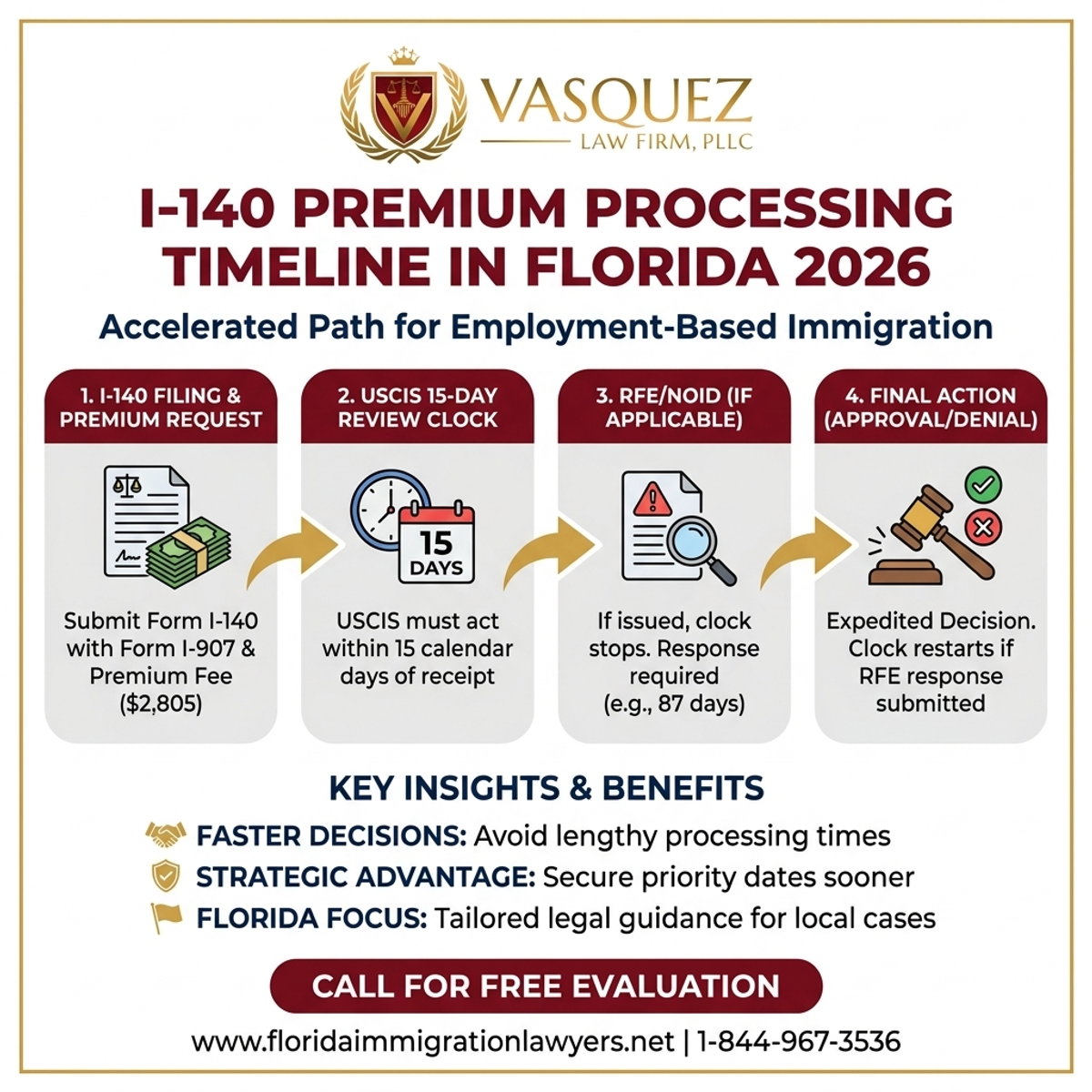
Key Statistics — I-140 Premium Processing Timeline in Florida 2026
The **Submission of Application** stage is foundational. Any errors here, such as missing signatures or incorrect fees, can lead to immediate rejection, forcing you to restart the entire process and incur further delays. It's crucial that all forms are not just filled, but filled *correctly* and completely, reflecting accurate and consistent information.
Upon successful submission, you will receive a **USCIS Receipt Notice** within approximately one week. This notice contains your unique receipt number, which is essential for tracking your case online through the USCIS website. This number is your primary reference point for all future communications and inquiries regarding your I-140 petition and premium processing request.
The most anticipated stage is the **Decision or RFE** within 15 calendar days. If a Request for Evidence (RFE) is issued, it means USCIS requires additional information or clarification to make a decision. The 15-day clock stops at this point. An RFE is not a denial, but it does require a comprehensive and timely response. Alternatively, a Notice of Intent to Deny (NOID) may be issued, which is a more serious indication of potential denial and requires immediate legal intervention.
The **Response to RFE** timeframe can vary significantly, typically allowing up to 87 days to gather and submit the requested documentation. The quality and completeness of your RFE response are critical. Once USCIS receives your response, a new 15-day premium processing clock begins for them to issue a final decision. Navigating an RFE effectively often requires the expertise of an immigration lawyer, who can help formulate a robust response and prevent further delays. Florida Immigration Lawyers can provide invaluable assistance during this critical phase.
Cost Factors and Fee Breakdown
| Item | Typical Fee | Notes |
|---|---|---|
| Form I-907 Filing Fee | Check USCIS for current fee | Required for premium processing |
| Form I-140 Filing Fee | Check USCIS for current fee | Standard filing fee |
| Attorney Fees | Varies | Optional but recommended |
Fees are subject to change, so it's advisable to verify the current amounts on the USCIS website.
The **Form I-907 Filing Fee** represents a significant investment, but it is often justified by the urgency and predictability it provides. For a professional in Jacksonville awaiting an EB-2 visa, the ability to receive a decision within 15 days can mean securing a new job opportunity or avoiding a lapse in work authorization. This fee is a direct cost for the expedited service and is non-refundable unless USCIS fails to meet its 15-day processing guarantee.
The **Form I-140 Filing Fee** is the standard cost for the immigrant petition itself, regardless of whether premium processing is requested. This fee covers the administrative costs associated with reviewing your eligibility for an employment-based visa. Both the I-140 and I-907 fees are subject to periodic adjustments by USCIS, underscoring the importance of checking the official website for the most up-to-date figures immediately before filing your application.
**Attorney Fees**, while optional, are highly recommended and represent an investment in expertise and peace of mind. Navigating complex immigration laws, preparing meticulous documentation, and responding to USCIS inquiries can be daunting. An experienced immigration lawyer, such as those at Florida Immigration Lawyers, can ensure your application is accurate, complete, and strategically presented, significantly reducing the risk of delays, RFEs, or even denials. This professional guidance can ultimately save you time, stress, and potential future costs associated with correcting errors or reapplying. Do not navigate this process alone. Contact Florida Immigration Lawyers today at 1-844-YO-PELEO for a free consultation to understand the full scope of costs and benefits.
Common Mistakes to Avoid
- Incorrectly filling out forms, leading to processing delays.
- Failing to provide all required documentation, resulting in RFEs.
- Not checking the latest fee schedule, causing application rejection.
- Overlooking the importance of employer support letters.
- Submitting applications to the wrong USCIS address.
- Misunderstanding premium processing as a guarantee of approval.
- Ignoring updates and changes in immigration laws and policies.
- Not seeking legal advice when complications arise.
- Missing deadlines for responding to RFEs.
- Underestimating the importance of maintaining accurate records.
Avoiding common pitfalls is paramount for a smooth and successful I-140 premium processing experience. With the expedited timeline, even minor errors can lead to disproportionately significant delays or even outright rejections, undermining the very purpose of paying for premium service. Proactive vigilance and meticulous attention to detail are your best defenses against these common mistakes.
Many of these errors can be easily prevented with careful preparation and, ideally, professional guidance. For instance, an attorney from Florida Immigration Lawyers can conduct a thorough review of your entire petition package before submission, catching potential issues that could trigger an RFE or denial. Remember, the goal of premium processing is not just speed, but also efficiency and accuracy, ensuring your application moves forward without unnecessary hurdles.
When to Call a Lawyer
Consider consulting an attorney if you encounter any of the following scenarios:
- Receiving an RFE or denial from USCIS.
- Uncertainty about the forms or documentation required.
- Changes in your employment status that might affect your application.
- Desiring a professional review of your application for accuracy.
Immigration law is inherently complex and constantly evolving, making the decision to seek legal counsel a wise and often necessary step for many applicants. Engaging with an attorney is not just for when problems arise, but also as a preventative measure to ensure your application is as strong and compliant as possible from the outset.
Florida Immigration Lawyers can provide guidance to help navigate these challenges effectively. For example, if you receive an RFE, our team can analyze USCIS's request, help you gather the necessary evidence, and craft a compelling legal response to maximize your chances of approval. Should there be changes in your employment, we can advise on how these might impact your I-140 and subsequent green card application. Early engagement with a firm like Florida Immigration Lawyers can prevent minor issues from escalating into major problems, saving you time, stress, and resources in the long run. Call us at 1-844-YO-PELEO for a free consultation.
About Florida Immigration Lawyers
Florida Immigration Lawyers is a leading law firm dedicated to providing comprehensive immigration services across Florida. We offer guidance on visa applications, deportation defense, and citizenship processes. Our team is available 24/7 for free consultations. Call us at 1-844-YO-PELEO or visit our website for more information.
Sources and References
- U.S. Citizenship and Immigration Services (USCIS)
- Executive Office for Immigration Review (EOIR)
- 8 U.S.C. Chapter 12 - Immigration and Nationality Act
Related services: immigration practice areas, family immigration services, citizenship and naturalization.
This article provides general legal information and is not intended as legal advice. Every case is unique, and outcomes depend on specific facts and circumstances. Contact an attorney for advice about your particular situation.
For personalized assistance, contact Florida Immigration Lawyers at 1-844-YO-PELEO. Se Habla Espanol - Estamos aqui para ayudarle.
If you need legal assistance, learn more about immigration lawyers in Florida, or call us at 1-844-YO-PELEO for a free consultation.
Do Not Navigate This Process Alone
Our experienced immigration attorneys are ready to fight for you. Get a free, confidential case review today.
Se Habla Español
Or leave your details and we’ll call you:
Free Evaluation in 24 Hours
Or talk to us right now
AI voice assistant — available 24/7
FreeFrequently Asked Questions

William J. Vásquez
Founding Attorney · Vasquez Law Firm
U.S. Air Force veteran and immigration attorney with years of hands-on U.S. immigration experience. J.D., NCCU School of Law. AILA member. Admitted to the 4th, 5th, and 11th Circuit Courts.
Available 24/7 - Free Evaluations
Reviewed for legal accuracy by William J. Vásquez
Licensed in North Carolina; U.S. immigration is federal practice.
Related Legal Services
Our Florida immigration attorneys can help you with experienced immigration attorneys, asylum protection and citizenship and naturalization. Call today at 1-844-YO-PELEO for a free case review.
Related Links
Related Topics
Free Legal Case Review
Discuss your case with our experienced attorneys. We're available 24/7.
Se Habla Español - Estamos aquí para ayudarle.
Related Articles
Immigration Lawyer Orlando Free Consultation in Florida
For individuals and families in Orlando, Florida, navigating the complexities of U.S. immigration law requires expert guidance. An immigration lawyer in Orlando offers crucial support for everything from visa applications and green card processes to naturalization and deportation defense. This comprehensive guide details what a free consultation covers, providing a step-by-step overview of immigration pathways, essential document checklists, and expected timelines in 2026. We also highlight common mistakes to avoid, discuss the critical role of legal counsel in deportation and asylum cases, and explain why choosing a local Orlando immigration attorney is beneficial. Florida Immigration Lawyers is dedicated to serving the diverse community of Orlando with compassionate, effective legal solutions, ensuring you receive personalized advice and robust representation for a successful immigration journey.
EAD Advance Parole Combo Card in Florida 2026
For individuals with a pending Form I-485, Application to Register Permanent Residence or Adjust Status, the EAD Advance Parole Combo Card is an essential document. This single card combines the authorization to work legally in the U.S. (Employment Authorization Document - EAD) with permission to travel internationally and re-enter without abandoning your green card application (Advance Parole). This guide from Florida Immigration Lawyers provides a comprehensive overview for applicants in Florida in 2026, covering eligibility, the step-by-step application process, required documents, expected processing times, and associated costs. We also highlight common mistakes to avoid and when to seek legal counsel to ensure a smooth and successful immigration journey. Understanding this vital card is key to maintaining stability while awaiting your permanent residency approval.
TN Visa for Professionals in Florida 2026
The TN visa, a vital pathway for Canadian and Mexican professionals, enables temporary work in the U.S. under the USMCA. This comprehensive guide from Florida Immigration Lawyers explores the nuances of TN visa eligibility, detailing the 63 designated professional occupations and the specific educational and licensing requirements for each. It outlines the distinct application processes for Canadian citizens at U.S. ports of entry and Mexican citizens through consular processing after an employer-filed I-129 petition. We provide a detailed document checklist, clarify processing times and validity periods, including the indefinite renewability of the TN visa for up to three years per approval. Additionally, the article breaks down associated costs, from government filing fees to attorney expenses and optional premium processing. We also address key considerations for TN visa holders in Florida, such as maintaining non-immigrant intent and understanding work restrictions. Learn about common application mistakes to avoid and when it's crucial to seek expert legal counsel to navigate complex scenarios. Florida Immigration Lawyers offers unparalleled support, ensuring your journey to working in Florida is smooth and successful.
Political Asylum Attorney: Your Guide to Asylum in Florida
Navigating the political asylum process in Florida requires a deep understanding of complex immigration laws and procedures. Whether you are fleeing persecution based on race, religion, nationality, political opinion, or membership in a particular social group, securing asylum can offer a path to safety and a new life in the United States. This guide explores the eligibility requirements, the detailed step-by-step application process, essential documentation, and expected timelines for asylum seekers in 2026. We also highlight critical mistakes to avoid and underscore the invaluable role of an experienced political asylum attorney. With USCIS offices in Orlando and Miami, and immigration courts across the state, Florida presents a unique landscape for asylum claims. Florida Immigration Lawyers stands ready to provide compassionate and strategic legal representation, ensuring your rights are protected throughout this vital journey. Contact us for a free case review.