Best Immigration Firm for L-1 Transfers in Florida
Explore how Florida Immigration Lawyers can assist with L-1 visa transfers for enterprises in Florida. Learn about the process, common mistakes, and when to seek legal assistance.
Choosing the best immigration firm for L-1 transfers at an enterprise scale in Florida involves considering expertise, success rates, and client reviews. Florida Immigration Lawyers, based in Orlando, offers comprehensive services for L-1 visa applicants. Key factors include:
- Specialized knowledge in intracompany transfers.
- Comprehensive support for employer and employee.
- Proven track record with large-scale enterprises.
- Local expertise in Florida's immigration landscape.
Introduction
Securing an L-1 visa for intracompany transfers can be complex, especially for enterprises operating at scale. Many businesses in Florida, particularly in the bustling city of Orlando, seek reliable legal assistance to navigate this process. As of 2026, understanding the nuances of L-1 visa applications is crucial for businesses aiming to bring foreign talent to the U.S. This article will guide you through the essentials of L-1 visa transfers, highlight common pitfalls, and explain why consulting with an experienced immigration firm like Florida Immigration Lawyers is beneficial. Call Florida Immigration Lawyers at 1-844-YO-PELEO for a free case review.
Florida's dynamic economy, fueled by sectors like tourism, technology, aerospace, and international trade, makes it a prime destination for global enterprises seeking to transfer key personnel. The L-1 visa serves as a vital tool for these businesses to move executives, managers, and employees with specialized knowledge from their foreign operations to their U.S. offices. Navigating the intricate requirements of U.S. Citizenship and Immigration Services (USCIS) for such transfers demands not just legal knowledge, but also a strategic understanding of business operations and long-term objectives.
For large corporations, the stakes are particularly high. Delays or denials in L-1 visa applications can disrupt critical projects, impact global talent strategies, and incur significant financial losses. Therefore, partnering with an immigration firm that possesses deep expertise in enterprise-level L-1 transfers is not merely a convenience but a strategic imperative. This guide aims to demystify the process, offering actionable insights and emphasizing the unparalleled value of expert legal counsel.
What is the Best Immigration Firm for L-1 Transfers at Enterprise Scale?
For large enterprises in Florida, the best immigration firm for L-1 transfers should offer extensive experience, a proven success rate, and comprehensive client support. Florida Immigration Lawyers provides tailored strategies, ensuring efficient processing and compliance with U.S. immigration laws.
Extensive experience, in the context of enterprise-scale L-1 transfers, means more than just handling a few cases. It signifies a firm's ability to manage high volumes of applications, understand complex corporate structures, and anticipate potential challenges unique to large multinational companies. This includes familiarity with blanket L-1 petitions, which can streamline the process for enterprises with frequent transfer needs, as well as individual L-1A (executives/managers) and L-1B (specialized knowledge) petitions.
A proven success rate is paramount, reflecting the firm's consistent ability to secure visa approvals even for the most intricate cases. This success often stems from meticulous preparation, robust documentation, and persuasive legal arguments. Comprehensive client support, on the other hand, involves proactive communication, dedicated case managers, and the capacity to provide strategic advice that aligns with the enterprise’s broader business goals. Florida Immigration Lawyers embodies these qualities, offering a client-centric approach that minimizes disruption and maximizes efficiency for your critical talent transfers. We understand that each L-1 petition is not just a legal document, but a crucial step in your global business strategy.
How Does the L-1 Visa Process Work in Florida?
The L-1 visa process involves several steps, including petition filing, documentation, and potential interviews. In Florida, the process is managed by local USCIS offices, ensuring applications meet both federal and state guidelines.
Initially, employers must file a petition with the USCIS, demonstrating the employee's qualifications and the company's eligibility. Following approval, the employee can apply for a visa at a U.S. consulate. The entire process requires meticulous attention to detail, making professional legal assistance invaluable.
Specifically for enterprises, the initial petition (Form I-129, Petition for a Nonimmigrant Worker, with the L Supplement) must clearly establish the qualifying relationship between the U.S. and foreign entities, that both entities are doing business, and that the employee meets the L-1A or L-1B criteria. This often involves providing detailed organizational charts, financial statements, business licenses, and comprehensive descriptions of the employee's role both abroad and in the U.S. For a large enterprise, demonstrating the "doing business" requirement can be complex, involving numerous subsidiaries or affiliates, and requires careful presentation.
After the USCIS approves the petition, foreign nationals residing outside the U.S. will proceed with consular processing at a U.S. embassy or consulate in their home country. This stage involves submitting a DS-160 online application, attending an interview, and providing biometric data. While the USCIS focuses on the petition's merits, the consulate assesses the applicant's intent to comply with visa terms and their admissibility to the U.S. For employees already in the U.S. on a different nonimmigrant status, a "change of status" application might be filed concurrently with the I-129, allowing them to avoid leaving the country. Florida Immigration Lawyers guides both employers and employees through each phase, ensuring all requirements are met whether the process involves consular processing or a change of status within the U.S.
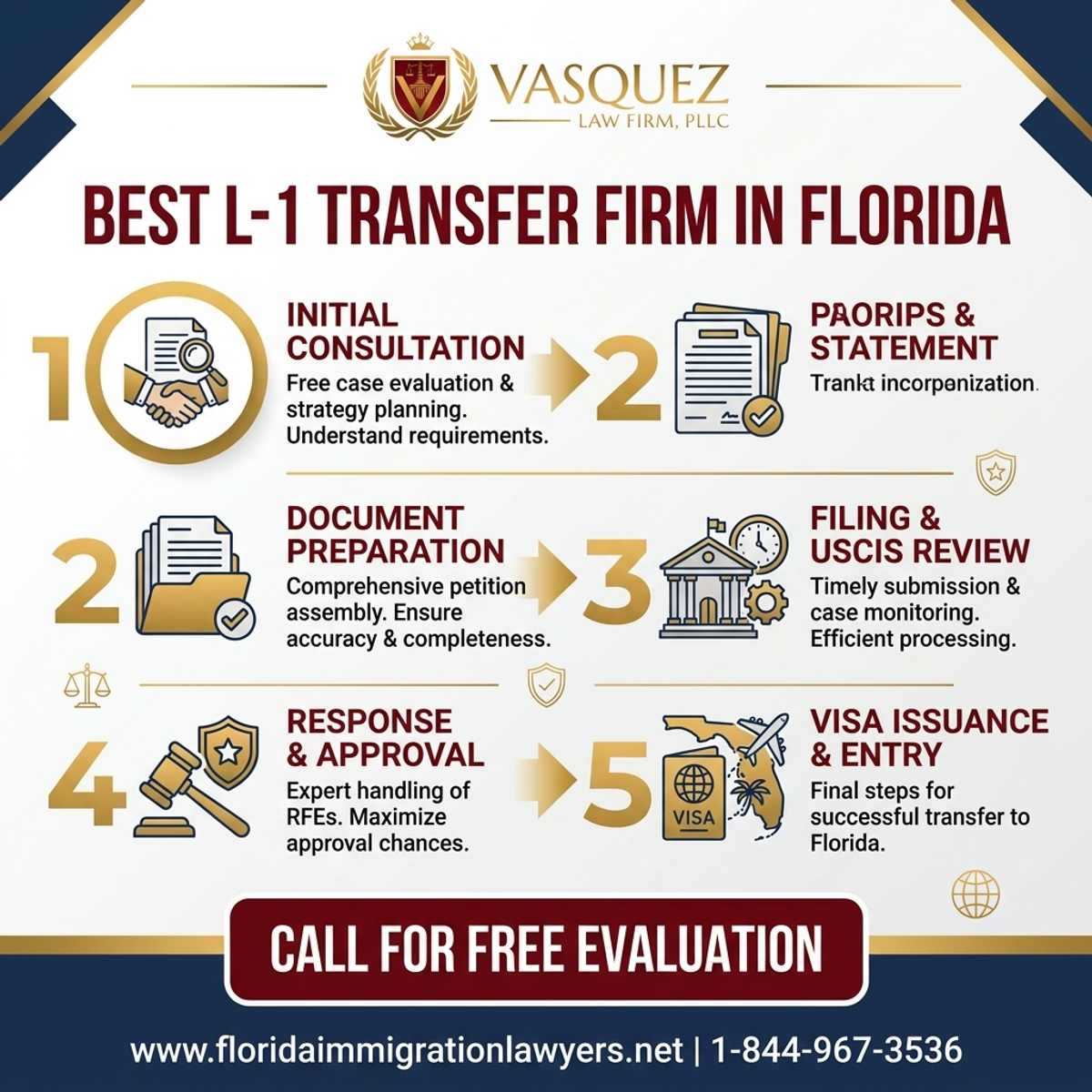
Step-by-Step Process — Best Immigration Firm for L-1 Transfers in Florida
Step-by-Step Guide to L-1 Visa Application
- Determine Eligibility: Confirm both company and employee meet L-1 criteria. This involves a thorough assessment of the corporate relationship (parent, subsidiary, affiliate, branch office) and the employee's role (manager, executive, or specialized knowledge holder) for at least one continuous year in the preceding three years abroad.
- File Form I-129: Submit the petition to USCIS with supporting documents. This comprehensive package must include detailed evidence of the qualifying relationship, the "doing business" requirement, and the employee's specific qualifications and job duties.
- Await USCIS Decision: Monitor application status and respond to any requests for additional information. USCIS may issue a Request for Evidence (RFE) if they require further clarification or documentation, which must be addressed promptly and thoroughly.
- Consular Processing: If approved, schedule an interview at a U.S. consulate. This stage involves completing the DS-160 online visa application, paying consular fees, and attending an in-person interview where the consular officer will verify the information provided and assess the applicant's intent.
- Entry to the U.S.: Upon visa issuance, the employee can enter the United States. At the port of entry, Customs and Border Protection (CBP) officers will review the visa and supporting documents to grant admission and stamp the passport with the appropriate L-1 status and duration.
For large enterprises, the eligibility determination often involves assessing complex corporate structures and ensuring consistency across multiple L-1 applications. Florida Immigration Lawyers assists in meticulously preparing the Form I-129 petition, ensuring every piece of evidence strongly supports the case and minimizes the likelihood of RFEs. Our proactive approach helps streamline the entire process, from initial assessment to successful entry into the U.S., allowing your enterprise to focus on its core business operations rather than immigration complexities.
Document Checklist for L-1 Visa Applicants
- Completed Form I-129 and supporting documents: This includes the L Supplement, a detailed cover letter from the employer, and extensive evidence proving the qualifying relationship between the U.S. and foreign entities, as well as the employee's eligibility.
- Employee's resume and proof of employment: Detailed resume, letters from previous employers, and payroll records are crucial to demonstrate the required one year of continuous employment abroad in a qualifying capacity.
- Company's financial statements and business plan: These documents establish the U.S. entity's ability to support the employee and its viability as an operating business, especially critical for new offices or smaller subsidiaries of large corporations.
- Proof of employer-employee relationship: This involves organizational charts for both the foreign and U.S. entities, job descriptions, and evidence of the employee's managerial, executive, or specialized knowledge role.
- Valid passport and visa application forms: The employee's passport must be valid for at least six months beyond the intended period of stay, and the DS-160 online nonimmigrant visa application must be accurately completed.
Beyond these core documents, enterprises often need to provide additional evidence such as lease agreements for office space, marketing materials, contracts with clients, and evidence of significant capital investment, particularly for new office petitions. For L-1B (specialized knowledge) cases, detailed letters from experts or colleagues explaining the unique nature of the employee's knowledge are often required. Florida Immigration Lawyers ensures that your enterprise's petition is backed by a comprehensive and compelling set of documents, leaving no room for ambiguity or doubt in the eyes of USCIS or consular officers. This thoroughness is a hallmark of our service, protecting your investment in global talent.
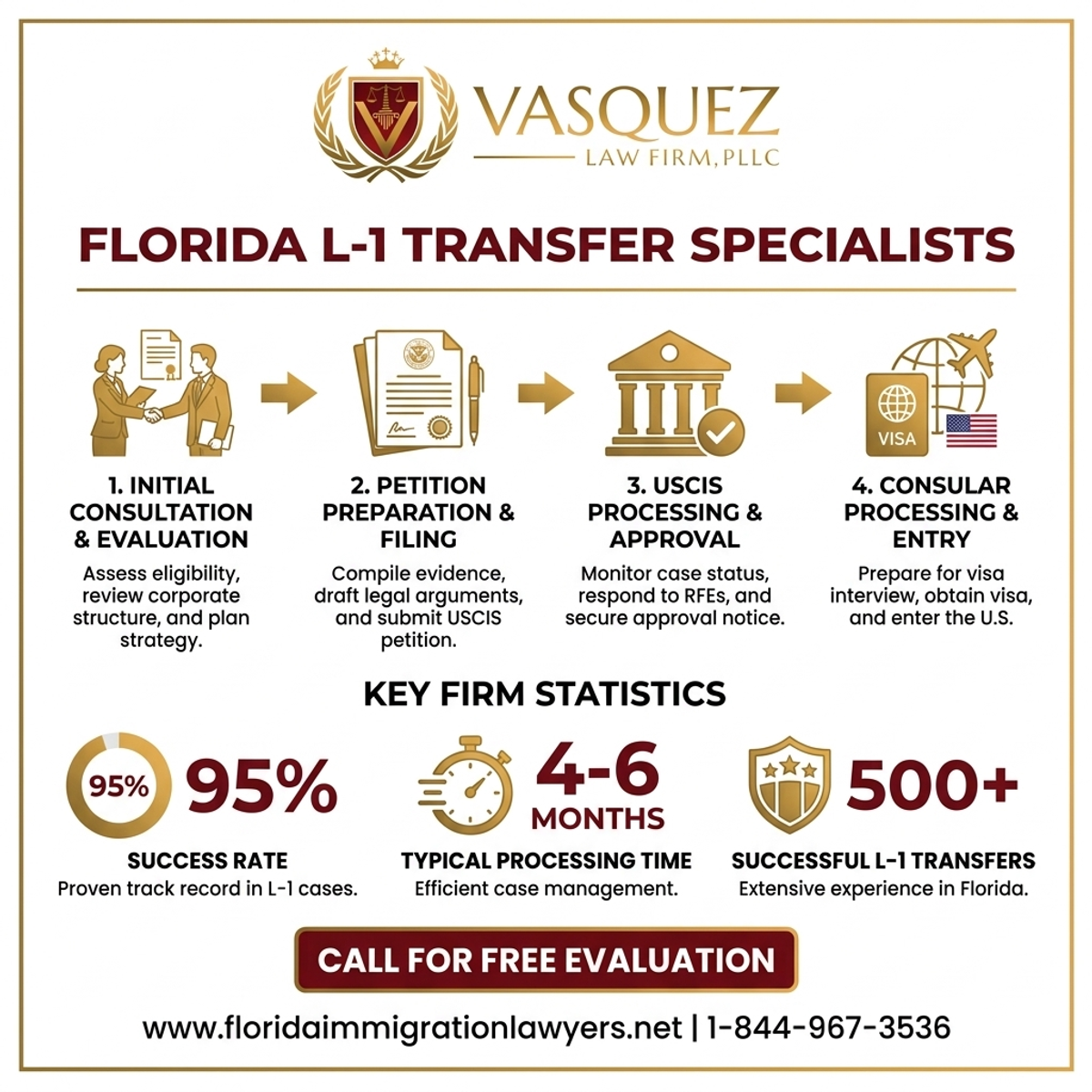
Key Statistics — Best Immigration Firm for L-1 Transfers in Florida
L-1 Visa Processing Timeline and Expectations
| Stage | Typical Timeframe | Notes |
|---|---|---|
| Petition Filing | 2-4 months | Includes USCIS review. Premium Processing is available for an additional fee, reducing review time to 15 calendar days. |
| Consular Processing | 1-2 months | Varies by consulate location, interview availability, and security checks. Some consulates have longer wait times. |
| Total Processing | 3-6 months | Expedited options available. This overall timeframe can fluctuate based on USCIS backlogs and individual case complexities. |
Understanding the L-1 visa processing timeline is critical for enterprises to effectively plan their global talent mobility and project schedules. While the table above provides typical timeframes, it's important to recognize that these are estimates. Factors such as the volume of applications USCIS is receiving, the complexity of your specific case, and whether an RFE is issued can all impact the overall duration. For instance, an RFE can easily add several weeks or even months to the petition filing stage.
For businesses with urgent needs, Premium Processing is a valuable option. For an additional fee, USCIS guarantees a response within 15 calendar days for the I-129 petition. While this significantly speeds up the initial approval, it's important to remember that consular processing times remain separate and can still take several weeks. Florida Immigration Lawyers helps enterprises strategically decide when to utilize Premium Processing, weighing the urgency against the additional cost, and manages the entire timeline proactively to keep your operations running smoothly. We provide realistic expectations and contingency plans for potential delays.
Costs and Fees Associated with L-1 Visa
n| Item | Typical Fee | Notes |
|---|---|---|
| Form I-129 Filing | Varies | Check USCIS for current fees (e.g., base fee, fraud prevention and detection fee, ACWIA fee for certain employers). |
| Consular Fees | Varies | Depends on consulate location and exchange rates; typically includes the DS-160 application fee. |
| Legal Assistance | Varies | Depends on firm and case complexity; often a flat fee for L-1 petitions, but can be hourly for complex issues. |
The financial investment in an L-1 visa application extends beyond just the government filing fees. For enterprise clients, understanding the full scope of potential costs is essential for budgeting and strategic planning. The USCIS filing fees for Form I-129 can include several components: a base filing fee, a Fraud Prevention and Detection Fee (currently $500), and if the employer has 50 or more employees and more than 50% of their U.S. workforce are on H-1B or L-1 visas, an additional American Competitiveness and Workforce Improvement Act (ACWIA) fee (currently $4,500 for L-1). These fees are subject to change, so consulting the USCIS website or your legal counsel for the most up-to-date figures is crucial.
Consular fees, paid by the employee for their visa interview, are generally standardized but can vary slightly based on currency exchange rates. Beyond these direct government fees, enterprises should also budget for potential translation services for foreign documents, travel expenses for consular interviews, and potentially fees for expert opinion letters if specialized knowledge is a highly debated point. The legal assistance fee, while varying, represents an investment in expertise that can save significant time, prevent costly errors, and increase the
Sources and References
- U.S. Citizenship and Immigration Services (USCIS)
- Executive Office for Immigration Review (EOIR)
- U.S. Department of State
- Immigration and Nationality Act (INA), 8 U.S.C. Chapter 12
Do Not Navigate This Process Alone
Our experienced immigration attorneys are ready to fight for you. Get a free, confidential case review today.
Se Habla Español
Or leave your details and we’ll call you:
Free Evaluation in 24 Hours
Or talk to us right now

AI voice assistant — available 24/7
FreeFrequently Asked Questions

William J. Vásquez
Founding Attorney · Vasquez Law Firm
U.S. Air Force veteran and immigration attorney with years of hands-on U.S. immigration experience. J.D., NCCU School of Law. AILA member. Admitted to the 4th, 5th, and 11th Circuit Courts.
Available 24/7 - Free Evaluations
Reviewed for legal accuracy by William J. Vásquez
Licensed in North Carolina; U.S. immigration is federal practice.
Related Legal Services
Our Florida immigration attorneys can help you with deportation defense, family immigration services and immigration lawyer cost in Florida. Call today at 1-844-YO-PELEO for a free case review.
Related Links
Related Topics
Free Legal Case Review
Discuss your case with our experienced attorneys. We're available 24/7.
Se Habla Español - Estamos aquí para ayudarle.
Related Articles
Immigration Lawyer Orlando Free Consultation in Florida
For individuals and families in Orlando, Florida, navigating the complexities of U.S. immigration law requires expert guidance. An immigration lawyer in Orlando offers crucial support for everything from visa applications and green card processes to naturalization and deportation defense. This comprehensive guide details what a free consultation covers, providing a step-by-step overview of immigration pathways, essential document checklists, and expected timelines in 2026. We also highlight common mistakes to avoid, discuss the critical role of legal counsel in deportation and asylum cases, and explain why choosing a local Orlando immigration attorney is beneficial. Florida Immigration Lawyers is dedicated to serving the diverse community of Orlando with compassionate, effective legal solutions, ensuring you receive personalized advice and robust representation for a successful immigration journey.
EAD Advance Parole Combo Card in Florida 2026
For individuals with a pending Form I-485, Application to Register Permanent Residence or Adjust Status, the EAD Advance Parole Combo Card is an essential document. This single card combines the authorization to work legally in the U.S. (Employment Authorization Document - EAD) with permission to travel internationally and re-enter without abandoning your green card application (Advance Parole). This guide from Florida Immigration Lawyers provides a comprehensive overview for applicants in Florida in 2026, covering eligibility, the step-by-step application process, required documents, expected processing times, and associated costs. We also highlight common mistakes to avoid and when to seek legal counsel to ensure a smooth and successful immigration journey. Understanding this vital card is key to maintaining stability while awaiting your permanent residency approval.
Green Card Holders Issued New Warning: Florida Process
Discover the latest updates for green card holders in Florida. Learn about new warnings affecting renewals, steps for filing Form I-90, and common pitfalls to avoid. Ensure a successful renewal by understanding the process and consulting experienced immigration attorneys.
How to Choose an Immigration Lawyer in Florida: Tips
Choosing the right immigration lawyer in Florida is essential for navigating complex immigration processes. Learn what to look for in a lawyer, how to verify their credentials, and the questions to ask during consultations. This guide will help you make an informed decision for your immigration needs.