Political Asylum Attorney: Your Guide to Asylum in Florida
Navigating the political asylum process in Florida requires a deep understanding of complex immigration laws and procedures. Whether you are fleeing persecution based on race, religion, nationality, political opinion, or membership in a particular social group, securing asylum can offer a path to safety and a new life in the United States. This guide explores the eligibility requirements, the detailed step-by-step application process, essential documentation, and expected timelines for asylum seekers in 2026. We also highlight critical mistakes to avoid and underscore the invaluable role of an experienced political asylum attorney. With USCIS offices in Orlando and Miami, and immigration courts across the state, Florida presents a unique landscape for asylum claims. Florida Immigration Lawyers stands ready to provide compassionate and strategic legal representation, ensuring your rights are protected throughout this vital journey. Contact us for a free case review.

Political asylum in Florida offers crucial protection to individuals who have a well-founded fear of persecution in their home country. This fear must be based on their race, religion, nationality, membership in a particular social group, or political opinion. The process typically involves filing Form I-589 with USCIS, attending a biometrics appointment, and undergoing an asylum interview, potentially followed by immigration court proceedings. Meeting the one-year filing deadline and presenting compelling evidence are critical for a successful claim. Seeking legal guidance from an experienced political asylum attorney is highly recommended to navigate the complexities and ensure all requirements are met.
- Asylum protects those fearing persecution based on specific grounds.
- Application must generally be filed within one year of arrival in the U.S.
- The process involves USCIS interviews and potentially immigration court hearings.
- Strong evidence and a credible testimony are essential for success.
- Legal representation significantly improves the chances of a favorable outcome.
For individuals fleeing persecution and seeking a new beginning, the United States offers the possibility of political asylum. This critical protection mechanism allows those who fear for their safety in their home country to find refuge and rebuild their lives here. In Florida, a state with a diverse immigrant population, understanding the requirements and navigating the complex legal landscape of asylum is paramount. Whether you are in Orlando, Central Florida, or anywhere across the state, the journey to secure asylum can be daunting, but you do not have to face it alone.
This comprehensive guide, updated for 2026, will walk you through the intricacies of applying for political asylum in Florida, from eligibility criteria and the step-by-step application process to crucial documentation, timelines, and potential costs. We will also highlight common pitfalls to avoid and explain when seeking the assistance of a knowledgeable political asylum attorney can make all the difference. Your safety and future are too important to leave to chance. Call Florida Immigration Lawyers at 1-844-YO-PELEO for a free case review and take the first step towards securing your protection.
What is Political Asylum and Who Qualifies in Florida?
Political asylum is a form of protection granted to individuals already present in the United States or at a port of entry, who have suffered persecution or fear they will suffer persecution in their home country. This fear must be "well-founded" and based on one of five specific grounds: race, religion, nationality, membership in a particular social group, or political opinion. As of 2026, these criteria remain the bedrock of asylum law, as defined by Section 101(a)(42) of the Immigration and Nationality Act (INA), codified at 8 U.S.C. § 1101(a)(42). Florida, with its vibrant and diverse communities, is home to many individuals seeking this vital protection, making a clear understanding of eligibility crucial.
To qualify, you must demonstrate either past persecution or a well-founded fear of future persecution on account of one of the protected grounds. Past persecution means you have already suffered harm that is severe enough to be considered persecution. A well-founded fear means you have a reasonable possibility of suffering persecution if you were to return to your home country. This is not merely a subjective fear; it must be objectively reasonable given the circumstances in your country of origin. For example, a journalist in their home country who has received credible death threats for criticizing the government may have a strong claim based on political opinion. Similarly, an individual targeted due to their ethnic group in a region experiencing widespread ethnic violence could qualify based on race or nationality. The U.S. government does not grant asylum for general civil unrest, economic hardship, or fear of prosecution for criminal acts; the persecution must be directly linked to one of the five protected grounds.
Understanding these specific grounds and gathering evidence to support your claim is the most critical aspect of an asylum application. The USCIS Asylum Offices in Florida, located in Orlando and Miami, serve applicants from across the state, each with its own specific procedures and caseloads. An attorney can help you articulate how your experiences fit within these legal definitions and prepare you for the rigorous interview process. They can also advise on any bars to asylum, such as having committed certain crimes or having firmly resettled in another country before arriving in the U.S.
What is the Step-by-Step Process for Applying for Political Asylum in 2026?
The political asylum process typically involves filing Form I-589, an interview with an asylum officer, and potentially a hearing before an immigration judge if the initial application is not granted. As of 2026, the general steps remain consistent, though processing times can vary significantly based on current backlogs and policy changes.
The journey to securing asylum in the U.S. is a multi-stage process that demands precision and thoroughness. Here is a detailed breakdown of the typical steps involved:
- Seek Legal Counsel: Before taking any official steps, it is highly advisable to consult with an experienced immigration attorney specializing in asylum law. They can assess your eligibility, help you gather evidence, and prepare you for the entire process. This initial consultation is crucial for understanding the nuances of your case.
- File Form I-589, Application for Asylum and for Withholding of Removal: This is the cornerstone of your application. You must generally file Form I-589 within one year of your last arrival in the United States, unless you qualify for an exception to this "one-year filing deadline." The form requires detailed information about your identity, family, travel history, and, most importantly, a narrative explaining your fear of persecution. All supporting documents must be submitted with the application, and any documents not in English must be accompanied by a certified translation.
- Biometrics Appointment: After filing Form I-589, you will receive a notice to attend a biometrics appointment at a local Application Support Center (ASC), such as those in Orlando, Tampa, or Miami. Here, your fingerprints, photograph, and signature will be collected for background and security checks. There is no fee for asylum applicants for this service.
- Asylum Interview: Following your biometrics, you will be scheduled for an interview with an Asylum Officer from U.S. Citizenship and Immigration Services (USCIS). For Florida residents, this interview typically takes place at the USCIS Asylum Office in Orlando or Miami. This is a critical stage where you will explain your claim in detail, answer questions about your fear of persecution, and provide any additional evidence. An attorney can attend this interview with you and provide crucial support.
- Decision from Asylum Officer: After the interview, the Asylum Officer will review your case and generally issue a decision. If your application is approved, you will be granted asylum. If it is not approved, or if the officer does not have jurisdiction (e.g., if you are in removal proceedings), your case will typically be referred to an Immigration Court.
- Referral to Immigration Court: If your asylum application is not granted by USCIS, and you are not already in removal proceedings, your case will be referred to an Immigration Judge within the Executive Office for Immigration Review (EOIR). For individuals in Florida, these courts are primarily located in Orlando and Miami. This initiates formal removal proceedings, where you can renew your asylum claim before an Immigration Judge.
- Immigration Court Hearings: In Immigration Court, you will have the opportunity to present your asylum claim again, with the judge hearing testimony, reviewing evidence, and making a decision. This process involves multiple hearings, including a Master Calendar Hearing and an Individual Hearing. An attorney is invaluable at this stage, presenting your case, cross-examining witnesses, and arguing legal points.
- Appeals: If an Immigration Judge denies your asylum claim, you may have the option to appeal the decision to the Board of Immigration Appeals (BIA), and potentially to the federal Circuit Courts of Appeals. This further extends the legal process but provides additional avenues for review.
Each step requires careful preparation and adherence to strict deadlines. For more detailed information on navigating this path, explore our resources on Asylum Law in Florida.
What Documents and Evidence Are Needed for a Strong Political Asylum Claim?
A robust political asylum application requires comprehensive documentation including personal identification, detailed affidavits, country conditions reports, and any verifiable evidence supporting the claim of persecution. The strength of your case often hinges on the quality and quantity of supporting evidence you can provide. Gathering these documents meticulously is crucial for establishing the credibility of your narrative and satisfying the legal burden of proof.
To present a compelling asylum claim to USCIS or an Immigration Judge, you will need to compile a thorough dossier of documents. This checklist outlines the typical types of evidence that are essential:
- Form I-589, Application for Asylum and for Withholding of Removal: This is the primary application form itself, filled out accurately and completely, with all required biographical information and your detailed narrative of persecution.
- Identity Documents: Copies of your passport, birth certificate, national identity card, travel documents, and any other official identification from your home country.
- Affidavits or Declarations: A detailed personal statement from you, the asylum seeker, describing your experiences of persecution, your fear of returning, and how these relate to one of the five protected grounds. Additional affidavits from witnesses who can corroborate your story, such as family members, friends, or colleagues, can also be very powerful.
- Country Conditions Reports: Official reports from reputable organizations detailing human rights conditions in your home country. These can include reports from the U.S. Department of State (www.state.gov), Amnesty International, Human Rights Watch, or other recognized international bodies. These reports provide objective evidence of the general situation that supports your specific claim.
- Medical and Psychological Evaluations: If you have suffered physical or psychological harm due to persecution, documentation from doctors, therapists, or psychologists can serve as crucial evidence. These evaluations can confirm injuries, trauma, or mental health conditions consistent with your narrative.
- Police Reports, Court Documents, or Official Records: Any official documentation from your home country related to arrests, detentions, legal proceedings, or official complaints you filed due to persecution.
- Photos, Videos, News Articles, and Social Media: Visual evidence or media reports that corroborate your persecution or demonstrate the conditions in your home country. Screenshots of online threats or discriminatory content can also be relevant.
- Proof of Membership: Documents proving your affiliation with a particular group (e.g., political party membership cards, religious organization letters, LGBTQ+ community involvement) if your claim is based on membership in a particular social group or political opinion.
- Any Other Relevant Evidence: Any document, no matter how small, that helps to tell your story and substantiate your claim of persecution.
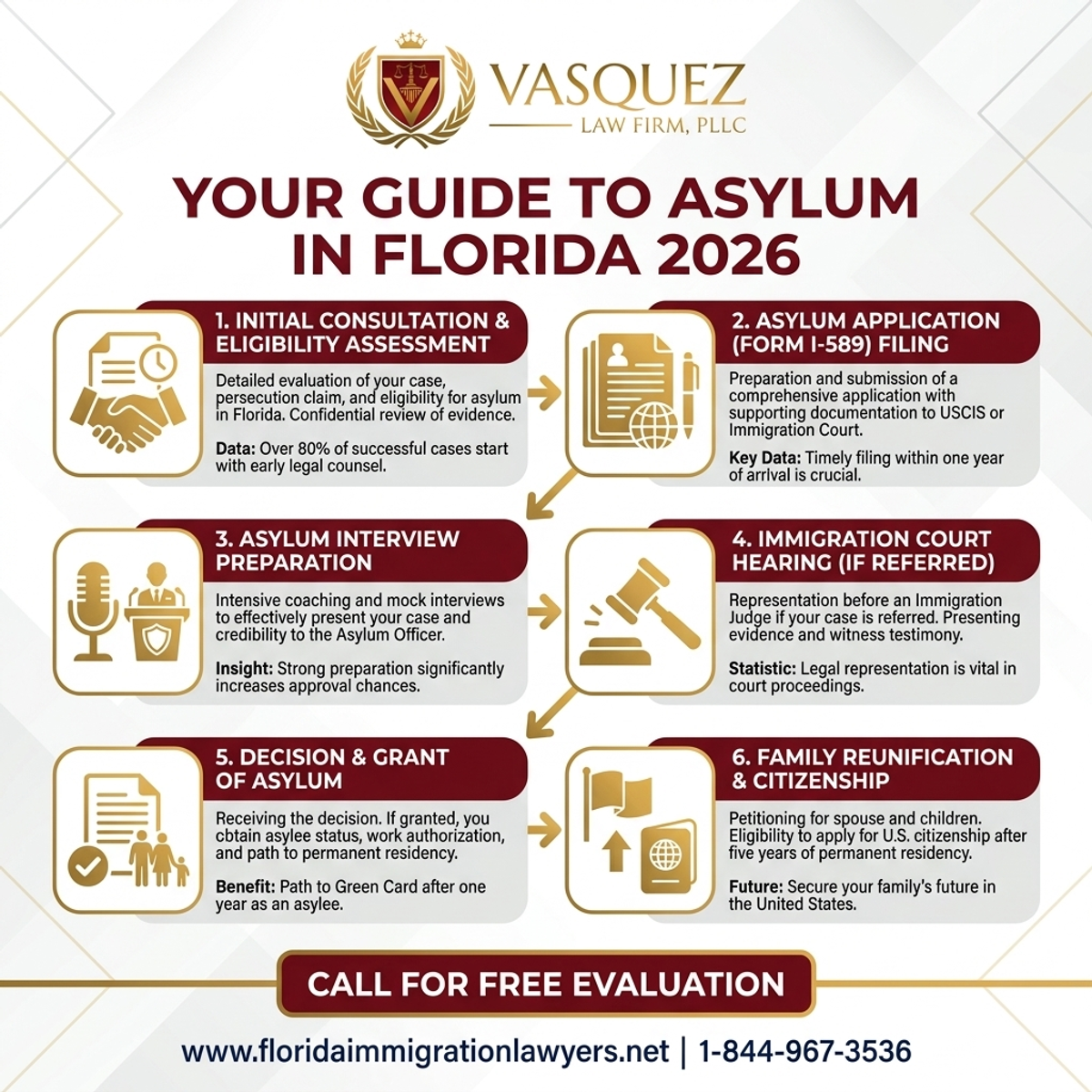
Step-by-Step Process — Political Asylum Attorney: Your Guide to Asylum in Florida 2026
Remember that all documents not in English must be accompanied by a complete and certified English translation. Organizing your evidence clearly and chronologically will significantly aid the Asylum Officer or Immigration Judge in understanding your case. For specific guidance on what evidence is most effective for your unique situation, consult with an experienced attorney.
How Long Does the Political Asylum Process Take in Florida? (2026 Timelines)
The political asylum process in Florida can vary significantly, ranging from several months for an initial interview to several years if the case proceeds through immigration court and appeals, as of 2026. This variability is due to numerous factors, including the volume of applications, staffing levels at USCIS and EOIR, and the complexity of individual cases. While USCIS aims to prioritize newly filed asylum cases for interviews, significant backlogs persist, particularly for older cases.
Understanding the potential timeline is essential for asylum seekers to manage expectations and plan for their future. Here is a general overview of typical timeframes you might expect in Florida:
| Stage | Typical Timeframe (As of 2026) | Notes |
|---|---|---|
| Filing Form I-589 to Asylum Interview | 1-3 years (for newly filed cases); 3-5+ years (for older cases) | USCIS aims to interview new cases quickly, but the overall backlog for older cases is substantial. Actual times vary by USCIS Asylum Office (Orlando/Miami). |
| Asylum Interview to Decision | Weeks to Months | Some decisions are made on the spot; others may take several weeks or months, especially if further review or investigation is needed. |
| Referral to Immigration Court (if denied by USCIS) | Months | If USCIS does not grant asylum, your case is referred to an Immigration Judge, initiating removal proceedings. |
| Immigration Court Hearings (Master Calendar & Individual) | 2-5+ years | Highly dependent on court backlog (Orlando, Miami Immigration Courts), judge's schedule, and case complexity. Multiple hearings are common. |
| Appeals (BIA, Federal Courts) | 1-3+ years per appeal level | If the Immigration Judge denies asylum, you may appeal to the Board of Immigration Appeals (BIA) and then to a federal Circuit Court. |
| Eligibility for Work Authorization (EAD) | 180 days after filing I-589 (pending status) | You can apply for work authorization (Form I-765) 150 days after filing your asylum application, and it can be granted after 180 days if your case is still pending. |
It is important to note that these are general estimates, and individual cases can fall outside these ranges. Factors such as a change in U.S. immigration policy, the volume of new applications, and the efficiency of the specific USCIS office or Immigration Court handling your case can all impact the actual timeline. Maintaining communication with your attorney and promptly responding to any requests from immigration authorities is crucial to avoid unnecessary delays. The uncertainty of waiting can be one of the most challenging aspects of the asylum process, highlighting the importance of preparing thoroughly for each stage.
What Are the Costs Associated with Seeking Political Asylum?
While USCIS does not charge a filing fee for Form I-589, applicants should anticipate various costs for legal representation, document translation, medical evaluations, and travel, which can vary widely. Understanding these potential expenses upfront helps asylum seekers prepare financially for the journey ahead. The investment in a strong case can often lead to a more favorable and timely outcome, safeguarding your future in the U.S.
Here is a breakdown of typical cost factors associated with a political asylum application:
| Item | Typical Fee (As of 2026) | Notes |
|---|---|---|
| Form I-589 Filing Fee | $0 | U.S. Citizenship and Immigration Services (USCIS) does not charge a fee to file an asylum application. |
| Biometrics Fee | $0 | There is no fee for asylum applicants to attend the biometrics appointment. |
| Attorney Fees | Varies significantly ($3,000 - $15,000+) | Legal fees depend on the complexity of your case, the attorney's experience, and whether they charge a flat fee or hourly. This is often the largest cost but can be a crucial investment. |
| Document Translation | $20-$50 per page | All documents not in English must be translated by a certified translator. Costs add up based on the volume of documents. |
| Medical/Psychological Evaluations | $300-$1,000+ | If you require evaluations from a medical doctor or psychologist to document physical or mental trauma related to your persecution. |
| Travel Costs | Varies | Expenses for traveling to USCIS offices (e.g., Orlando, Miami) for interviews, or to Immigration Courts for hearings. |
| Expert Witness Fees | Varies (potentially $1,000-$5,000+) | In complex cases, an expert witness (e.g., a country conditions expert) may be called to testify, incurring additional costs. |
| Postage and Copying | Minor | Small administrative costs for mailing applications and making copies of evidence. |
| Work Authorization (Form I-765) | Typically $410 (subject to change) | While the asylum application itself is free, there is a fee to apply for work authorization once your asylum case has been pending for 150 days. Fee waivers may be available for eligible applicants. |
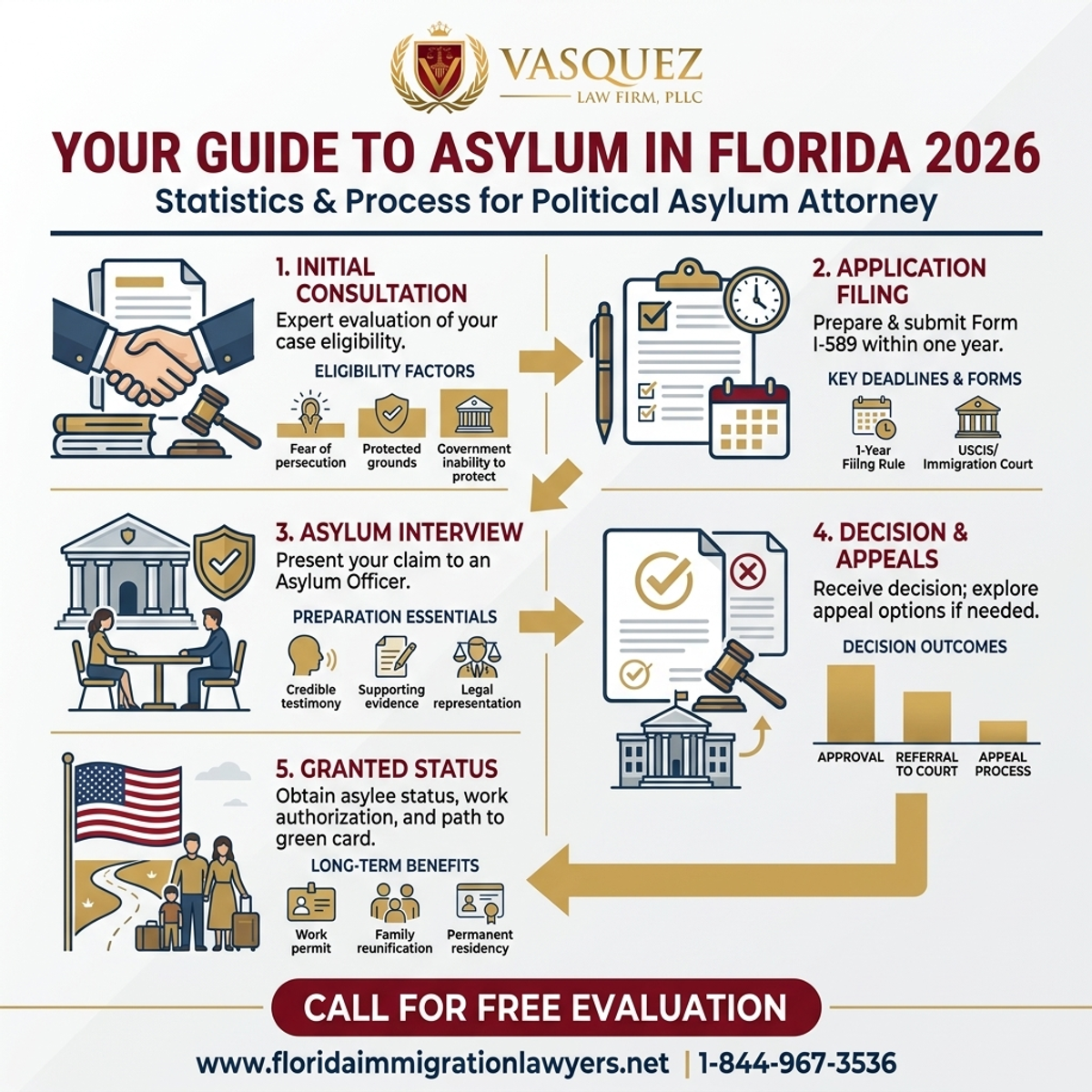
Key Statistics — Political Asylum Attorney: Your Guide to Asylum in Florida 2026
While the direct government fees for filing Form I-589 are zero, the overall expenses can be substantial. However, the cost of not having experienced legal representation can be far greater, potentially leading to denial and even deportation. Many law firms, including Florida Immigration Lawyers, offer payment plans to make legal assistance more accessible. It is important to discuss all potential costs and payment options with your attorney during your initial consultation. The investment in legal expertise is an investment in your future and safety.
Do not navigate this complex and high-stakes process alone. Contact Florida Immigration Lawyers today to ensure your asylum application is handled with the expertise and care it deserves. We are here to advocate for your right to safety and a new beginning.
Common Mistakes to Avoid When Seeking Political Asylum
The political asylum process is fraught with complexities, and even minor errors can lead to significant delays or outright denial. Being aware of these common mistakes can help you build a stronger case and avoid jeopardizing your chance at protection.
- Missing the One-Year Filing Deadline: This is one of the most critical rules. Generally, you must file your Form I-589 within one year of your last arrival in the U.S. There are limited exceptions, but failing to meet this deadline without a valid reason is often fatal to an asylum claim.
- Incomplete or Inconsistent Application: Submitting a Form I-589 with missing information, errors, or inconsistencies between your written statement and oral testimony can raise credibility concerns and lead to denial.
- Lack of Credible Evidence: A claim without strong, corroborating evidence is difficult to win. Relying solely on your testimony without external documentation (country reports, medical records, police reports) weakens your case significantly.
- Failing to Disclose All Arrests or Detentions: Attempting to conceal past arrests, even minor ones, or prior immigration history, can be seen as a misrepresentation of facts and severely damage your credibility with immigration authorities.
- Not Preparing for the Asylum Interview: The interview with a USCIS Asylum Officer is a pivotal moment. Many applicants fail to adequately prepare, leading to inconsistent answers or an inability to clearly articulate their fear of persecution.
- Traveling Internationally After Filing: Leaving the U.S. after filing for asylum, especially to your home country, can be interpreted as an indication that you no longer fear persecution, jeopardizing your case.
- Misrepresenting Facts: Any attempt to fabricate or exaggerate details in your application or during an interview will lead to a finding that you lack credibility, resulting in a denial and potentially a permanent bar from future immigration benefits.
- Trying to Navigate the Process Alone: The legal complexities of asylum law, evolving policies, and the high stakes involved make it incredibly difficult for individuals to represent themselves effectively.
- Not Understanding the Specific Grounds for Asylum: Many applicants mistakenly believe any fear of returning home qualifies. It must be a well-founded fear based on race, religion, nationality, particular social group, or political opinion.
- Failing to Update USCIS with New Address: Moving without notifying USCIS of your new address can result in missed notices, interview appointments, or court dates, leading to a denial or even an order of removal in absentia.
- Not Seeking Work Authorization: Failing to apply for work authorization (EAD) after 150 days of a pending asylum application can leave applicants without legal means to support themselves while their case is processed.
When to Call a Political Asylum Attorney in Florida
Seeking political asylum is one of the most complex and high-stakes areas of immigration law. While it is technically possible to file an application on your own, the consequences of errors or omissions are severe, often leading to denial and potential deportation. You should strongly consider contacting a knowledgeable political asylum attorney from Florida Immigration Lawyers in several key scenarios to protect your rights and maximize your chances of success.
It is particularly crucial to seek legal counsel if:
- You are facing the one-year filing deadline: If you are approaching or have already passed the one-year mark since your last arrival in the U.S., an attorney can assess if you qualify for any exceptions.
- Your case involves complex legal issues: This includes situations with criminal history, previous immigration denials, prior deportations, or if you have been detained by immigration authorities.
- You have limited English proficiency: An attorney can help prepare you for the interview and ensure proper interpretation, preventing misunderstandings that could harm your case.
- You are in removal (deportation) proceedings: If you have been placed in deportation proceedings, an asylum claim may be your only defense against removal. An attorney is essential in immigration court. Learn more about deportation defense.
- You need help gathering evidence: Lawyers have experience identifying and obtaining crucial evidence, including country conditions reports and expert witness testimony.
- You are unsure if your fear qualifies as "persecution": An attorney can help determine if your experiences align with the legal definition of persecution based on one of the five protected grounds.
- You have experienced trauma: Discussing past persecution can be incredibly difficult. An attorney provides empathetic support and helps you prepare your testimony without retraumatizing yourself.
Florida Immigration Lawyers has extensive experience representing asylum seekers in Orlando, Miami, and throughout Florida. We understand the specific challenges and nuances of the local USCIS Asylum Offices and Immigration Courts. Our team is dedicated to providing compassionate and effective legal representation, ensuring your story is heard and your rights are protected.
About Florida Immigration Lawyers
Florida Immigration Lawyers is a leading immigration law firm dedicated to serving individuals and families across the entire state of Florida. With an unwavering commitment to justice and a deep understanding of U.S. immigration laws, our experienced attorneys provide comprehensive legal services designed to meet the unique needs of each client. From our base in Central Florida, we proudly extend our expertise to every corner of the state, offering compassionate and strategic representation.
Our firm specializes in a wide array of immigration matters, including family-based immigration, business immigration, citizenship, deportation defense, and, critically, political asylum. We understand the profound impact immigration issues have on individuals' lives and futures. That is why we are available 24/7 to provide support and guidance, ensuring you always have access to expert legal advice when you need it most.
At Florida Immigration Lawyers, we believe everyone deserves a chance at safety and success in the United States. We offer free case reviews to assess your situation and explain your options without obligation. Our bilingual team is fluent in English and Spanish, ensuring clear and effective communication throughout your legal journey. Choose Florida Immigration Lawyers for a dedicated advocate who will fight tirelessly for your rights and help you achieve your immigration goals. Schedule a free consultation today.
Sources and References
- U.S. Citizenship and Immigration Services (USCIS)
- Executive Office for Immigration Review (EOIR)
- U.S. Department of State
- 8 U.S.C. § 1101(a)(42) - Immigration and Nationality Act (INA) Section 101(a)(42)
- 8 CFR § 208 - Asylum and Withholding of Removal
Related services: asylum application process, refugee status and resettlement, humanitarian protection programs.
This article provides general legal information and is not intended as legal advice. Every case is unique, and outcomes depend on specific facts and circumstances. Immigration laws are subject to change. Contact an attorney for advice about your particular situation.
If you are seeking safety and a new life in Florida, do not hesitate to reach out. The path to political asylum can be challenging, but with the right legal team by your side, you can navigate it successfully. Contact Florida Immigration Lawyers for a free case review today. Call us at 1-844-YO-PELEO. Se Habla Español - Estamos aquí para ayudarle.
Do Not Navigate This Process Alone
Our experienced immigration attorneys are ready to fight for you. Get a free, confidential case review today.
Se Habla Español
Or leave your details and we’ll call you:
Free Evaluation in 24 Hours
Or talk to us right now
AI voice assistant — available 24/7
FreeFrequently Asked Questions

William J. Vásquez
Founding Attorney · Vasquez Law Firm
U.S. Air Force veteran and immigration attorney with years of hands-on U.S. immigration experience. J.D., NCCU School of Law. AILA member. Admitted to the 4th, 5th, and 11th Circuit Courts.
Available 24/7 - Free Evaluations
Reviewed for legal accuracy by William J. Vásquez
Licensed in North Carolina; U.S. immigration is federal practice.
Related Legal Services
Our Florida immigration attorneys can help you with business immigration, deportation defense and family immigration services. Call today at 1-844-YO-PELEO for a free case review.
Related Links
Related Topics
Free Legal Case Review
Discuss your case with our experienced attorneys. We're available 24/7.
Se Habla Español - Estamos aquí para ayudarle.
Related Articles
Dual Citizenship Lawyer in Florida: What You Need to Know
For Florida residents, the concept of dual citizenship, or holding two passports, offers a compelling blend of opportunities and challenges. While the U.S. generally permits dual nationality, the path to achieving this status requires a meticulous understanding of both U.S. immigration laws and the citizenship policies of your country of origin. This guide explores the definition of dual citizenship, the detailed step-by-step process for U.S. naturalization, and the significant benefits and potential pitfalls involved. We cover essential documentation, typical timelines, and cost considerations for 2026, providing crucial insights for anyone in Orlando, Miami, or across Florida considering this important legal step. Learn about common mistakes to avoid and understand when to seek professional legal counsel to navigate this complex process successfully. Florida Immigration Lawyers is here to provide expert, bilingual support for your dual citizenship journey.
Immigration Lawyer Orlando Free Consultation in Florida
For individuals and families in Orlando, Florida, navigating the complexities of U.S. immigration law requires expert guidance. An immigration lawyer in Orlando offers crucial support for everything from visa applications and green card processes to naturalization and deportation defense. This comprehensive guide details what a free consultation covers, providing a step-by-step overview of immigration pathways, essential document checklists, and expected timelines in 2026. We also highlight common mistakes to avoid, discuss the critical role of legal counsel in deportation and asylum cases, and explain why choosing a local Orlando immigration attorney is beneficial. Florida Immigration Lawyers is dedicated to serving the diverse community of Orlando with compassionate, effective legal solutions, ensuring you receive personalized advice and robust representation for a successful immigration journey.
EAD Advance Parole Combo Card in Florida 2026
For individuals with a pending Form I-485, Application to Register Permanent Residence or Adjust Status, the EAD Advance Parole Combo Card is an essential document. This single card combines the authorization to work legally in the U.S. (Employment Authorization Document - EAD) with permission to travel internationally and re-enter without abandoning your green card application (Advance Parole). This guide from Florida Immigration Lawyers provides a comprehensive overview for applicants in Florida in 2026, covering eligibility, the step-by-step application process, required documents, expected processing times, and associated costs. We also highlight common mistakes to avoid and when to seek legal counsel to ensure a smooth and successful immigration journey. Understanding this vital card is key to maintaining stability while awaiting your permanent residency approval.
Naturalization Ceremony Locations & Schedule in Florida 2026
For those seeking U.S. citizenship in Florida, understanding the naturalization ceremony locations and schedule for 2026 is a critical final step. This guide from Florida Immigration Lawyers provides comprehensive information on the entire naturalization process, from eligibility and filing Form N-400 to preparing for your interview and attending the oath ceremony. We cover essential requirements, expected timelines, necessary documents, and associated costs. With USCIS field offices in Orlando, Miami, Tampa, and Jacksonville coordinating ceremonies, applicants will receive specific details via Form N-445. Learn how to avoid common mistakes and when to seek professional legal assistance to ensure a smooth and successful journey to becoming a U.S. citizen. Our experienced team is dedicated to guiding you through every stage, offering free case reviews and bilingual support.