BIA Remand Order: Your 2026 Guide in Florida
A BIA remand order means the Board of Immigration Appeals has sent your immigration case back to an Immigration Judge for further review. This crucial development requires immediate and strategic action, as it indicates a need to address legal errors, consider new evidence, or develop the factual record. For individuals in Florida, navigating a BIA remand can be complex, involving new hearings, strict deadlines, and the potential need for updated documentation. Understanding the reasons for the remand, preparing comprehensive evidence, and securing experienced legal representation are vital steps to achieving a favorable outcome. This guide explains the process, potential outcomes, and common mistakes to avoid in 2026, emphasizing the importance of professional legal assistance from Florida Immigration Lawyers.
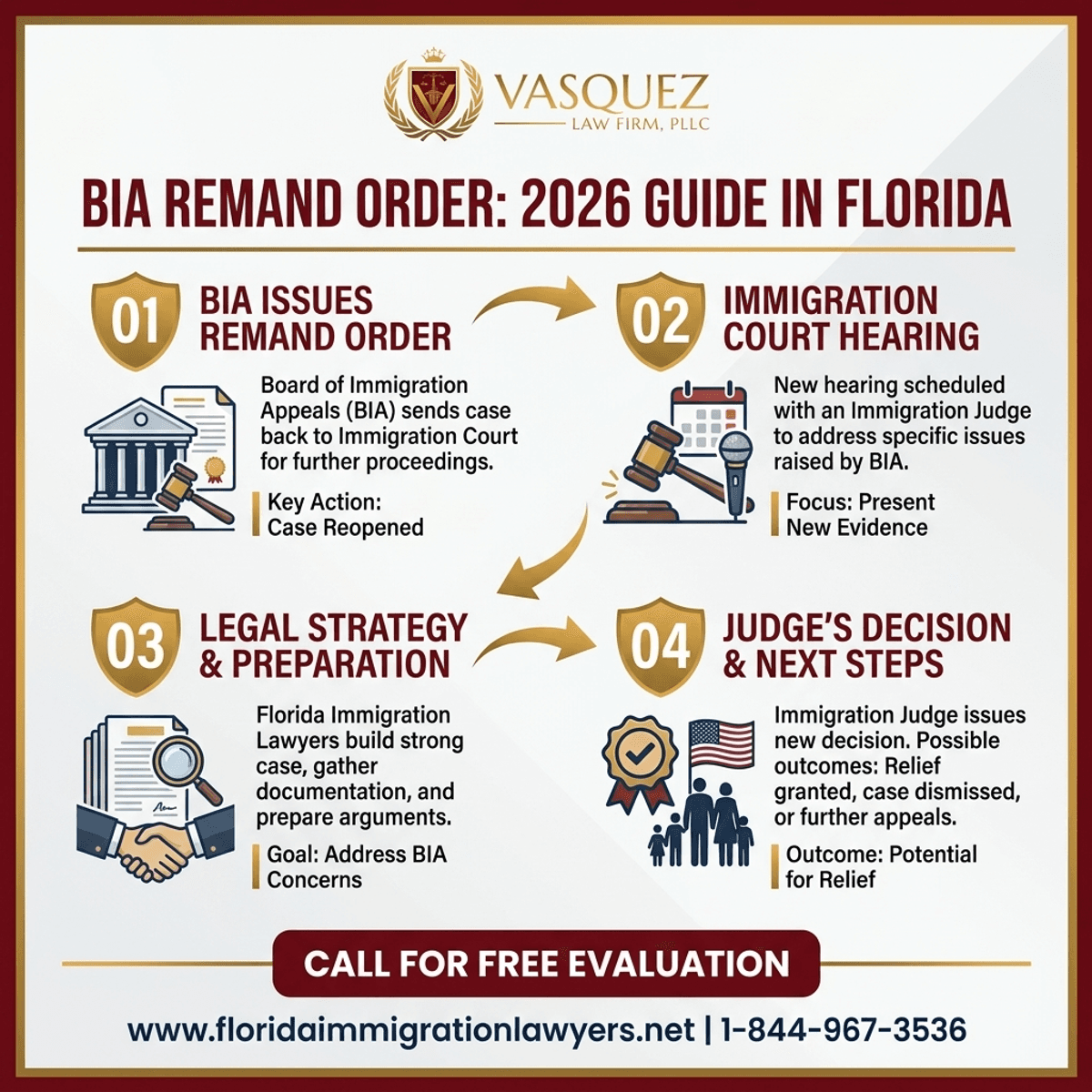
A BIA remand order occurs when the Board of Immigration Appeals (BIA) sends an immigration case back to an Immigration Judge (IJ) for further proceedings. This typically happens if the BIA finds legal error, requires additional fact-finding, or needs new evidence to be considered. For immigrants in Florida, understanding a BIA remand is critical to navigating the complex legal landscape. It means your case is not over but requires renewed attention at the trial level.
- A BIA remand sends your case back to an Immigration Judge.
- It often indicates legal error or a need for more evidence.
- The process involves further hearings and potential new evidence.
- You must act quickly to comply with new deadlines and requirements.
- Legal representation is crucial for a successful outcome in Florida.
Facing an immigration appeal can be a stressful and confusing experience. You might have received a decision from the Board of Immigration Appeals (BIA) that doesn't definitively resolve your case, but instead issues a BIA remand order. This means your case is being sent back to the Immigration Court for further action. For individuals and families throughout Florida, from Tampa to Miami, understanding what a remand order entails is crucial for protecting your rights and continuing your fight for legal status.
At Florida Immigration Lawyers, we understand the anxieties that come with these complex legal situations. Our dedicated team is here to guide you through every step of the immigration appeal process, including handling cases that have been remanded by the BIA. We provide clear, compassionate, and effective legal representation to ensure your case receives the thorough attention it deserves. Do not face this intricate process alone.
Call Florida Immigration Lawyers at 1-844-YO-PELEO for a free consultation. We are ready to discuss your specific situation and outline a strategic path forward.
What is a BIA Remand Order and Why Does It Happen?
A BIA remand order is a directive from the Board of Immigration Appeals (BIA) to an Immigration Judge (IJ), instructing the IJ to revisit and re-evaluate a specific immigration case. As of 2026, these orders are issued when the BIA determines that the Immigration Judge made a legal error, failed to consider crucial evidence, or needs to develop the factual record further. This means your case is not concluded, but rather returned to the trial level for additional proceedings.
Remands can occur for various reasons. For instance, the BIA might find that the IJ misapplied a particular section of the Immigration and Nationality Act (INA), such as INA 240 (8 U.S.C. § 1229a) concerning removal proceedings, or overlooked key evidence presented by the applicant. In other situations, new evidence might have emerged since the initial hearing that warrants consideration, or the BIA may seek further clarification on specific facts. These orders are governed by regulations like 8 CFR § 1003.1(d)(6), which outlines the BIA's authority to remand cases. Understanding the specific reasons for your remand is the first step toward building a stronger case in Florida's immigration courts, such as those in Orlando, Miami, or Bradenton.
Understanding the Immigration Appeal Process in Florida
The immigration appeal process in Florida, and nationwide, is a multi-layered system designed to review decisions made by Immigration Judges. When an Immigration Judge issues a decision, either party—the noncitizen or the Department of Homeland Security (DHS)—can appeal that decision to the Board of Immigration Appeals (BIA). The BIA, part of the Executive Office for Immigration Review (EOIR), is the highest administrative body for interpreting and applying immigration laws.
Step-by-Step Guide to the BIA Remand Process
If your case receives a BIA remand, it means it's returning to the Immigration Court. Here's a typical step-by-step guide:
- BIA Decision and Remand: The BIA issues a written decision, explaining why the case is being remanded and what issues the Immigration Judge needs to address.
- Case Returns to Immigration Court: The physical file is sent back to the Immigration Court where the original proceedings took place, often in Florida cities like Miami, Orlando, or Tampa.
- Notice of Hearing: The Immigration Court will schedule a new master calendar or individual hearing. You will receive a Notice of Hearing (Form EOIR-2), which specifies the date, time, and location. It is critical to attend this hearing.
- Further Proceedings: Depending on the BIA's instructions, the Immigration Judge may:
- Allow new evidence to be submitted.
- Hear additional testimony from you or witnesses.
- Require further legal arguments from your attorney.
- Reconsider a previously denied form of relief.
- New Decision by Immigration Judge: After addressing the BIA's directives, the Immigration Judge will issue a new decision. This decision can be appealed again to the BIA, or in some cases, directly to a U.S. Circuit Court of Appeals.
- Potential for Circuit Court Review: If the BIA affirms a removal order after a remand, you may have the option to appeal to the U.S. Court of Appeals for the Eleventh Circuit, which covers Florida.
Each step requires careful attention to detail and adherence to strict deadlines. Navigating these complexities without experienced legal counsel can be extremely challenging, especially when facing a BIA remand order.
What Documents and Evidence Are Needed for a BIA Remand Case?
For a BIA remand case, the documents and evidence required depend heavily on the specific instructions from the BIA. Generally, you will need to re-present or supplement existing evidence, and potentially introduce new materials to address the BIA's concerns. This often includes documentation that was previously submitted for your initial appeal, along with any new supporting evidence.
When a case is remanded, the BIA is often seeking to correct an error or fill a gap in the record. This means the Immigration Judge will be looking for specific types of documentation or testimony. Your attorney will help you identify what new or additional evidence is necessary to meet the BIA's directives. Gathering comprehensive and compelling evidence is paramount to strengthening your case and addressing the issues raised by the remand order.
Essential Document Checklist for a BIA Remand Case
- Original Appeal Briefs and Exhibits: Copies of all documents filed with the BIA during the initial appeal, including your brief and any attached evidence.
- BIA Remand Order: The official document from the BIA outlining the reasons for the remand and instructions for the Immigration Judge.
- New Evidence: Any documents, affidavits, or expert opinions that address the specific issues raised by the BIA. This could include updated country conditions reports for asylum cases, new medical records for hardship claims, or additional financial statements for adjustment of status applications.
- Affidavits: Sworn statements from family members, friends, employers, or community leaders in Florida who can attest to your character, ties to the community, or specific circumstances.
- Legal Briefs and Motions: New legal arguments prepared by your attorney that directly respond to the BIA's remand order and present a revised legal strategy.
- Court Orders and Transcripts: Any previous orders from the Immigration Court or transcripts of prior hearings that are relevant to the remanded issues.
- Personal Documents: Identification, birth certificates, marriage certificates, and other foundational documents that establish your identity and relationships, ensuring all information is current and accurate.

Step-by-Step Process — BIA Remand Order: Your 2026 Guide in Florida
Collecting and organizing these documents can be a daunting task. An experienced immigration attorney in Florida can help you identify precisely what is needed and ensure all submissions are timely and properly presented to the Immigration Court in cities like Orlando or Miami.
How Long Does a BIA Remand Process Typically Take in 2026?
The duration of a BIA remand process can vary significantly, depending on the complexity of the case, the specific instructions from the BIA, and the caseload of the Immigration Court. As of 2026, while the BIA aims for efficiency, the return of a case to the trial level introduces new hearings and potentially extensive evidence gathering. This means that a remanded case could take several months to over a year to reach a final resolution by the Immigration Judge.
Factors such as the availability of court dates, the need for multiple hearings, and the time required to gather new evidence all contribute to the overall timeline. Cases requiring expert testimony or extensive documentation may naturally take longer. It is important to remember that a remand offers a new opportunity to present your case, and thorough preparation is more important than speed. Florida's immigration courts, like others nationwide, operate under their own scheduling pressures, which can impact individual case timelines.
Typical Timeline for a BIA Remand Process
Below is a general overview of the stages and typical timeframes involved:
| Stage | Typical Timeframe | Notes |
|---|---|---|
| BIA Issues Remand Order | Immediate | Decision is mailed to parties and the Immigration Court. |
| Case File Transferred to Immigration Court | 1-3 months | Physical file returns to the original Immigration Court. |
| New Notice of Hearing Issued | 1-4 months after transfer | Court schedules a new master calendar or individual hearing. |
| Preparation for New Hearings | Varies (weeks to months) | Gathering new evidence, preparing legal arguments, client meetings. |
| Immigration Court Hearings | 1-6 months (multiple hearings possible) | Depending on complexity, multiple individual hearings may be required to address BIA directives. |
| Immigration Judge Issues New Decision | 1-3 months after final hearing | Written decision is prepared and mailed. |
| Potential Further Appeal to BIA | 30 days to file appeal | If either party appeals the new IJ decision. |
What Are the Potential Outcomes After a BIA Remand Order?
After a BIA remand order, your case returns to the Immigration Judge, who will then issue a new decision based on the BIA's instructions and any new evidence or arguments presented. The potential outcomes can vary widely, from a favorable grant of relief to a renewed order of removal. This stage is critical because it represents another opportunity to strengthen your case and achieve a positive result.
The Immigration Judge must carefully follow the BIA's directives. If the BIA remanded the case for the IJ to consider a specific form of relief, the IJ will do so. If the remand was due to a legal error, the IJ will re-evaluate the case under the correct legal standard. The goal is to present a compelling argument that addresses all the BIA's concerns and demonstrates your eligibility for the requested immigration benefit or protection. A successful outcome often depends on the thoroughness of preparation and the expertise of your legal counsel.
Possible Decisions from the Immigration Judge Post-Remand:
- Grant of Relief: The Immigration Judge may grant the relief you sought, such as asylum, cancellation of removal, or adjustment of status, if you successfully address the BIA's concerns and meet all eligibility requirements.
- Termination of Proceedings: In some cases, the IJ might terminate proceedings, effectively closing the case without a removal order, often due to a change in circumstances or a successful application with USCIS.
- Re-remand to BIA: In rare instances, if the IJ encounters new complex issues or believes the BIA's instructions are unclear, they might send the case back to the BIA for further clarification.
- Affirmation of Removal Order: If the Immigration Judge finds that, even after addressing the BIA's instructions, you are not eligible for relief, they may issue a new order of removal.
- Further Appeal to BIA: If either party is dissatisfied with the Immigration Judge's new decision, they typically have 30 days to file another appeal with the BIA.
- Appeal to U.S. Circuit Court: If the BIA affirms a removal order, the case may then be appealed to the U.S. Circuit Court of Appeals (for Florida, this is the Eleventh Circuit). This is a judicial appeal, distinct from the administrative appeals process.
Navigating the Costs Associated with a BIA Remand and Appeal
Understanding the costs associated with a BIA remand and the overall immigration appeal process is essential for planning and preparation. While specific filing fees are typically paid to the Board of Immigration Appeals or USCIS for initial applications, a remand primarily involves legal fees for your attorney's services, as well as potential costs for new evidence or expert witnesses. As of 2026, these costs can vary significantly based on the complexity of your case and the amount of work required.
It is important to discuss all potential fees with your attorney upfront to ensure transparency and avoid surprises. While there might not be a new government filing fee directly for the remand itself, the additional legal work needed to prepare for new hearings, gather evidence, and present arguments will incur legal costs. Investing in experienced legal counsel is often a critical factor in achieving a favorable outcome, especially when navigating the intricate requirements of a remanded case in Florida.
Typical Cost Factors and Fee Breakdown for BIA Remands
| Item | Typical Fee (Estimate) | Notes |
|---|---|---|
| Attorney Legal Fees | Varies widely ($3,000 - $10,000+) | Hourly or flat fee, depending on case complexity, time spent, and attorney experience. This is the primary cost. |
| Filing Fees (if applicable) | Varies (e.g., $110 for EOIR-29 for certain motions) | May apply if new motions are filed or if a new application for relief is submitted post-remand. Fees are subject to change by USCIS/EOIR. |
| Translation Services | $20 - $50 per page | If new documents need to be translated into English by a certified translator. |
| Expert Witness Fees | Varies ($500 - $5,000+) | If your case requires an expert (e.g., psychologist for asylum, country conditions expert) to provide testimony or reports. |
| Record Retrieval Fees | Varies ($50 - $200+) | For obtaining court transcripts, medical records, or other official documents. |
| Travel/Court Expenses | Varies | Costs for attorney travel to immigration courts in Florida (e.g., Miami, Orlando) if not local. |
Note: All fees are estimates and subject to change. Government filing fees are set by USCIS/EOIR and can be updated without notice. Attorney fees are based on individual firm policies and case specifics.
Do not navigate this process alone. Contact Florida Immigration Lawyers today to discuss your BIA remand order and ensure your case is handled with the utmost care and experience.
Common Mistakes to Avoid in a BIA Remand Case
Navigating a BIA remand order requires precision and careful adherence to legal procedures. Making mistakes at this stage can have severe consequences, potentially jeopardizing your entire immigration case. Being aware of these common pitfalls can help you avoid them and strengthen your chances of a favorable outcome in Florida.
- Ignoring the Remand Order: Believing the case is over or that nothing needs to be done. A remand means your case is active and requires immediate attention and action. Ignoring it can lead to an order of removal in absentia.
- Missing Deadlines: Failing to respond to new court notices or submit required documents by the specified deadlines. Immigration courts have strict deadlines, and missing them can result in waivers of rights or adverse decisions.
- Failing to Attend Hearings: Not showing up for scheduled master calendar or individual hearings. This can lead to an order of removal in absentia, making it very difficult to reopen your case.
- Submitting Insufficient New Evidence: Providing evidence that does not directly address the BIA's specific instructions or is not sufficiently compelling. The new evidence must be relevant and persuasive.
- Presenting Inconsistent Information: Submitting new testimony or documents that contradict previous statements without a clear explanation. Inconsistencies can damage your credibility with the Immigration Judge.
- Attempting to Represent Yourself: Trying to handle the complex legal arguments and procedural requirements of a remanded case without legal counsel. The intricacies of immigration law, especially post-remand, are best handled by an expert.
- Not Understanding the BIA's Instructions: Misinterpreting the specific reasons for the remand or what the BIA expects the Immigration Judge to do. A clear understanding is vital for effective legal strategy.
- Failing to Update Contact Information: Not informing the Immigration Court or your attorney of a change of address. This can lead to missed notices and hearings.
- Neglecting to Address Grounds of Inadmissibility or Deportability: Overlooking or failing to adequately address any underlying grounds that led to the original removal proceedings, even if the remand focuses on other issues.
- Assuming the Outcome: Becoming overly confident or despondent about the case's prospects. Each stage of a remand is an opportunity to present a stronger case, but also carries risks.
When to Call a Lawyer for Your BIA Remand Case
A BIA remand order signifies a critical juncture in your immigration journey, one that demands experienced legal guidance. While a remand offers a new chance, it also introduces new complexities and strict procedural requirements. You should contact an immigration lawyer immediately upon receiving a remand order from the Board of Immigration Appeals.
Specific scenarios where legal intervention is crucial include:
- Receiving any BIA remand order: An attorney can interpret the BIA's instructions, understand the legal implications, and formulate a strategy.
- If the BIA remanded for legal error: This requires an attorney to identify the error, research the correct legal standards, and present arguments to the Immigration Judge.
- If new evidence is required: A lawyer can help you identify, gather, and properly submit all necessary documentation and testimony.
- Facing complex factual disputes: If your case involves intricate details or conflicting evidence, an attorney can help clarify the facts and present them persuasively.
- If you have a prior removal order: A remand might offer an opportunity to reopen or reconsider previous decisions.
- Any time you feel overwhelmed or unsure: The immigration system is daunting. An attorney provides clarity, advocacy, and peace of mind.
Florida Immigration Lawyers has extensive experience with BIA remands and subsequent proceedings in Florida's immigration courts. We are dedicated to protecting your rights and fighting for the strongest possible outcome. Do not hesitate to seek professional legal advice; your future depends on it.
About Florida Immigration Lawyers
Florida Immigration Lawyers is an immigration law firm dedicated to serving individuals and families across the entire state of Florida. With a deep understanding of U.S. immigration laws and a compassionate approach, our experienced attorneys provide comprehensive legal services to clients navigating the complexities of the immigration system. We are committed to offering personalized strategies and vigorous representation, whether you are seeking a green card, fighting deportation, or appealing a difficult decision like a BIA remand order.
Our firm focuses on a wide array of immigration matters, including family immigration, employment-based visas, asylum claims, deportation defense, and naturalization. We pride ourselves on being accessible, responsive, and effective advocates for our diverse clientele. Our team is available 24/7 for support and offers free consultations to help you understand your options without financial commitment. Choose Florida Immigration Lawyers for dedicated service and a partner who will stand with you every step of the way.
Contact us today at 1-844-YO-PELEO or visit www.floridaimmigrationlawyers.net to learn how we can assist you.
Sources and References
- U.S. Citizenship and Immigration Services (USCIS)
- Executive Office for Immigration Review (EOIR)
- 8 U.S.C. Chapter 12 - Immigration and Nationality Act (INA) Sections 240, 242
- 8 CFR § 1003.1(d)(6) - Appellate Jurisdiction of the Board of Immigration Appeals
- 8 CFR § 1003.2 - Appeals from Decisions of Immigration Judges
Related services: deportation defense services, asylum and refugee protection, immigration waivers, humanitarian protection programs.
This article provides general legal information and is not intended as legal advice. Every case is unique, and outcomes depend on specific facts and circumstances. Contact an attorney for advice about your particular situation.
If you or a loved one has received a BIA remand order in Florida, don't face the uncertainty alone. Florida Immigration Lawyers is here to provide the legal guidance you need. Schedule your free consultation today by calling 1-844-YO-PELEO. Se Habla Espanol - Estamos aqui para ayudarle.
If you need legal assistance, learn more about how our immigration attorneys can help, or call us at 1-844-YO-PELEO for a free consultation.
Do Not Navigate This Process Alone
Our experienced immigration attorneys are ready to fight for you. Get a free, confidential case review today.
Se Habla Español
Or leave your details and we’ll call you:
Free Evaluation in 24 Hours
Or talk to us right now

AI voice assistant — available 24/7
FreeFrequently Asked Questions

William J. Vásquez
Founding Attorney · Vasquez Law Firm
U.S. Air Force veteran and immigration attorney with years of hands-on U.S. immigration experience. J.D., NCCU School of Law. AILA member. Admitted to the 4th, 5th, and 11th Circuit Courts.
Available 24/7 - Free Evaluations
Reviewed for legal accuracy by William J. Vásquez
Licensed in North Carolina; U.S. immigration is federal practice.
Related Legal Services
Our Florida immigration attorneys can help you with asylum protection, citizenship and naturalization and immigration practice areas. Call today at 1-844-YO-PELEO for a free case review.
Related Links
Related Topics
Free Legal Case Review
Discuss your case with our experienced attorneys. We're available 24/7.
Se Habla Español - Estamos aquí para ayudarle.
Related Articles
Immigration Lawyer Orlando Free Consultation in Florida
For individuals and families in Orlando, Florida, navigating the complexities of U.S. immigration law requires expert guidance. An immigration lawyer in Orlando offers crucial support for everything from visa applications and green card processes to naturalization and deportation defense. This comprehensive guide details what a free consultation covers, providing a step-by-step overview of immigration pathways, essential document checklists, and expected timelines in 2026. We also highlight common mistakes to avoid, discuss the critical role of legal counsel in deportation and asylum cases, and explain why choosing a local Orlando immigration attorney is beneficial. Florida Immigration Lawyers is dedicated to serving the diverse community of Orlando with compassionate, effective legal solutions, ensuring you receive personalized advice and robust representation for a successful immigration journey.
EAD Advance Parole Combo Card in Florida 2026
For individuals with a pending Form I-485, Application to Register Permanent Residence or Adjust Status, the EAD Advance Parole Combo Card is an essential document. This single card combines the authorization to work legally in the U.S. (Employment Authorization Document - EAD) with permission to travel internationally and re-enter without abandoning your green card application (Advance Parole). This guide from Florida Immigration Lawyers provides a comprehensive overview for applicants in Florida in 2026, covering eligibility, the step-by-step application process, required documents, expected processing times, and associated costs. We also highlight common mistakes to avoid and when to seek legal counsel to ensure a smooth and successful immigration journey. Understanding this vital card is key to maintaining stability while awaiting your permanent residency approval.
Immigration Lawyer Southwest Florida: What You Need to Know
Discover how an immigration lawyer in Southwest Florida can help you navigate complex immigration processes. Learn about costs, timelines, and common mistakes to avoid. Call Florida Immigration Lawyers for a free case review.
Change of Status from B-2 to F-1 in Florida: What You Need
Learn how to change your immigration status from a B-2 tourist visa to an F-1 student visa in Florida. This comprehensive guide covers the 2026 processing timelines, required documentation, and common mistakes to avoid. Call Florida Immigration Lawyers for personalized assistance.