Change of Status from B-2 to F-1 in Florida: What You Need
Learn how to change your immigration status from a B-2 tourist visa to an F-1 student visa in Florida. This comprehensive guide covers the 2026 processing timelines, required documentation, and common mistakes to avoid. Call Florida Immigration Lawyers for personalized assistance.
- Understand the 2026 processing time for I-539
- Gather necessary documentation
- Schedule an appointment at the appropriate USCIS office
Introduction
Imagine you are visiting Orlando, Florida on a B-2 tourist visa and decide you want to pursue studies here. Transitioning from a B-2 to an F-1 student visa can make this possible, but the process requires careful navigation. This blog post will guide you through the essential steps to change your status, the documents you'll need, and the potential pitfalls to avoid. Call Florida Immigration Lawyers at 1-844-YO-PELEO for a free case review.
Florida, with its vibrant culture, diverse population, and world-renowned educational institutions, attracts countless international visitors. Many, like you, discover an academic passion or career opportunity during their stay and wish to extend their time for study. While the dream of studying in the Sunshine State is attainable, the legal path to convert your tourist status to a student visa is intricate and demands meticulous attention to detail.
Navigating U.S. immigration law can be daunting, especially when dealing with complex procedures like a change of status. Understanding the specific requirements, timelines, and potential challenges is paramount to a successful application. This is where expert legal guidance becomes invaluable. Florida Immigration Lawyers are dedicated to helping individuals like you achieve their academic and immigration goals, ensuring a smooth transition from visitor to student.
What is the 2026 I-539 Processing Time for B-2 to F-1 Change of Status?
As of 2026, the processing time for Form I-539, used to change status from B-2 to F-1, can take several months, typically ranging between 3 to 9 months.
This timeframe can vary based on the volume of applications and the specific circumstances of each case. Staying informed about current processing times is crucial, and you can check the latest updates on the USCIS website.
Several factors can influence these processing times, including the specific USCIS service center handling your application, the current workload of immigration officers, and any changes in immigration policy. For instance, a sudden surge in applications or budget constraints within USCIS can lead to longer waits. Conversely, a well-prepared application with all supporting documents can sometimes avoid delays caused by Requests for Evidence (RFEs).
It's vital to apply for your change of status well before your authorized B-2 stay expires. Filing your application in a timely manner ensures that you maintain legal status while USCIS processes your request. If your B-2 status expires while your I-539 application is pending, you are generally considered to be in a "period of authorized stay" and will not accrue unlawful presence, provided you filed correctly and on time. However, any travel outside the U.S. during this period could be considered abandonment of your application.
Monitoring your application's progress is an ongoing task. While USCIS provides online tools to check your case status, understanding the nuances of these updates can be challenging. Florida Immigration Lawyers regularly assist clients in tracking their applications, interpreting USCIS notifications, and responding promptly to any inquiries, ensuring you remain informed and compliant throughout the entire processing period.
Steps to Change Status from B-2 to F-1
Transitioning from a tourist to a student visa involves several critical steps:
- Eligibility Check: Ensure that your current B-2 status has not expired and that you have a valid reason to pursue studies.
- Acceptance to a SEVP-Certified School: Obtain an acceptance letter from a school certified by the Student and Exchange Visitor Program (SEVP).
- File Form I-539: Complete and submit Form I-539 to USCIS, along with the required fee. Include a copy of your I-94 form and proof of acceptance.
- Submit Form I-20: The school will provide Form I-20, which you must include in your application.
- Wait for Approval: After submission, USCIS will process your application, during which you must remain in legal status.
Each of these steps is crucial and must be executed with precision. A single misstep or oversight can lead to significant delays or even outright denial of your application. For example, failing the initial eligibility check by applying after your B-2 status has lapsed is an automatic ground for denial. The immigration system is designed to be thorough, and applicants are expected to demonstrate strict adherence to all regulations.
Consider the scenario of a visitor named Sofia. She arrived in Florida on a B-2 visa, initially planning a short vacation. During her stay, she discovered a specialized language program at a SEVP-certified university in Miami that perfectly aligned with her career goals. To successfully change her status, Sofia first needed to secure admission to that program, obtain her Form I-20, and then meticulously prepare her Form I-539 application, ensuring all supporting documents, including her I-94, were correctly attached before her B-2 period of admission expired. Her proactive approach and careful documentation were key to her successful transition.
Furthermore, demonstrating "non-immigrant intent" is an underlying principle for B-2 and F-1 visas. While you are changing from one non-immigrant status to another, USCIS wants to ensure that your primary purpose for coming to the U.S. was genuinely for tourism and that the decision to study was made after your arrival. Providing a compelling personal statement explaining your change of circumstances and future plans can strengthen your application, showcasing your legitimate intent to study and return home after your program concludes. Florida Immigration Lawyers can help you articulate this narrative effectively.
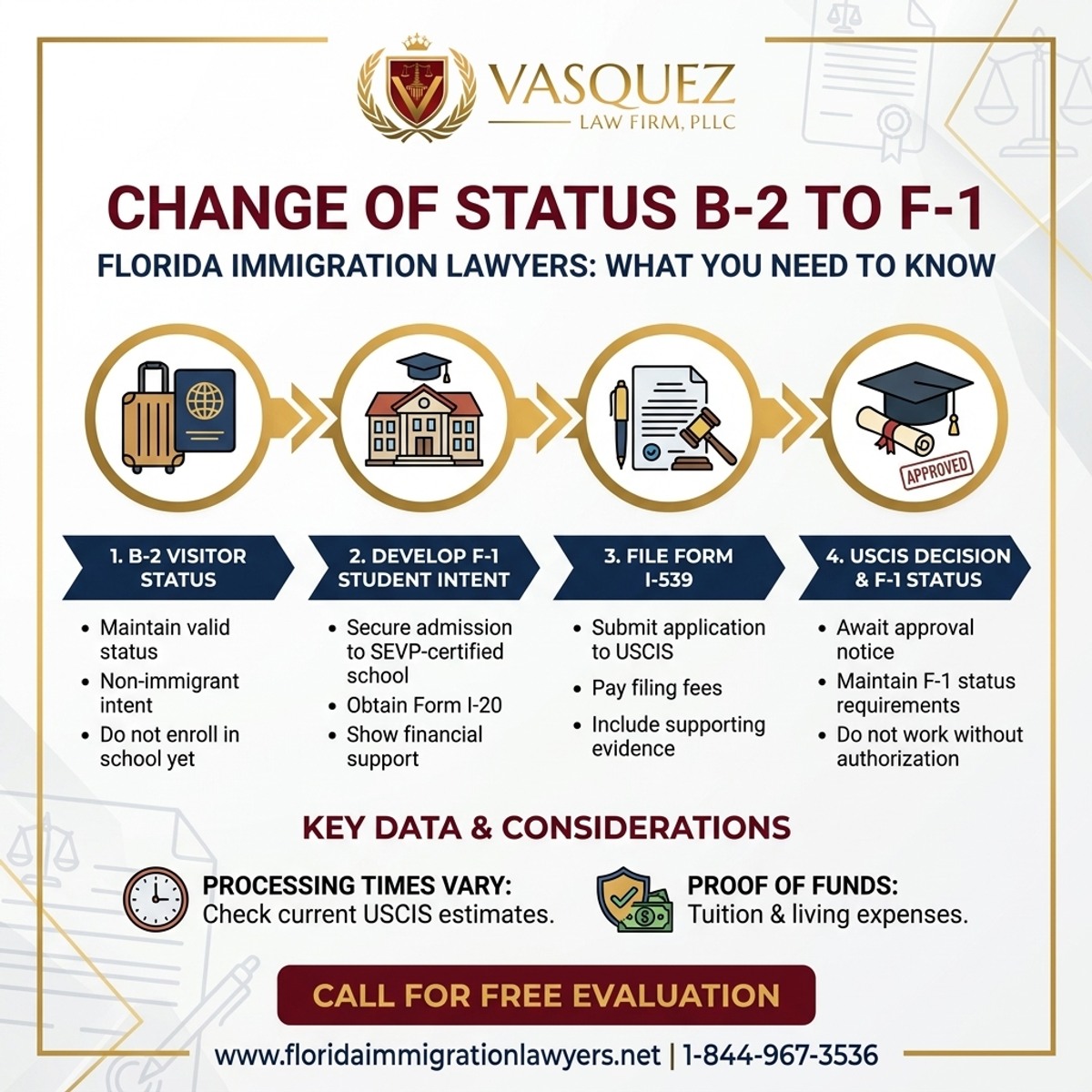
Step-by-Step Process — Change of Status from B-2 to F-1 in Florida: What You Need to Know
Document Checklist for B-2 to F-1 Change of Status
- Completed Form I-539
- Copy of I-94 Arrival/Departure Record
- Form I-20 from SEVP-certified school
- Proof of financial support
- Current B-2 visa documentation
- Letter of acceptance from the school
- Application fee payment
The importance of a comprehensive and accurate document submission cannot be overstated. Each item on this checklist serves a specific purpose in demonstrating your eligibility and intent. For instance, your I-94 record proves your legal entry and authorized period of stay, while the Form I-20 confirms your acceptance into an approved academic program and outlines your financial responsibilities. Any discrepancy or missing document can trigger a Request for Evidence (RFE), significantly extending your processing time and adding stress to the application.
Proof of financial support is often a critical hurdle for applicants. You must demonstrate that you have sufficient funds to cover your tuition, living expenses, and other costs for at least one academic year, without needing to work illegally in the U.S. This typically involves submitting bank statements, scholarship letters, or affidavits of support from sponsors. The funds must be readily available and verifiable. Inadequate financial evidence is a common reason for denial, underscoring the need for thorough preparation.
To ensure a robust application, it is highly recommended to organize all your documents meticulously. Create a master checklist, make copies of everything you send, and consider writing a cover letter that itemizes the contents of your submission. Florida Immigration Lawyers can provide invaluable assistance in reviewing your entire document package, identifying any potential weaknesses, and ensuring everything is in perfect order before submission to USCIS, thereby minimizing the risk of delays or rejection.
Timeline and Processing Expectations
| Stage | Typical Timeframe | Notes |
|---|---|---|
| Application Preparation | 1-2 weeks | Gather all documents and complete forms |
| Submission to USCIS | Immediate | Include all supporting documents |
| USCIS Processing | 3-9 months | Check status online regularly |
| Notification of Decision | Varies | Receive approval or request for more information |
During the USCIS processing period, which can span several months, it is imperative to maintain your legal non-immigrant status. This means refraining from actions that could violate your current B-2 terms, such as engaging in unauthorized employment. While your I-539 application is pending, you are generally permitted to remain in the U.S. even if your initial B-2 authorized stay expires, as long as you filed on time. However, international travel during this period is strongly discouraged, as it typically leads to the abandonment of your pending change of status application, requiring you to apply for an F-1 visa at a U.S. embassy or consulate abroad.
Be prepared for the possibility of a Request for Evidence (RFE). An RFE is a common occurrence where USCIS requires additional information or clarification to make a decision on your case. This could be anything from updated bank statements to a more detailed explanation of your intent. Responding to an RFE promptly and comprehensively is critical. Failure to do so, or providing insufficient information, can lead to denial. Florida Immigration Lawyers can guide you through responding to an RFE, ensuring your response is robust and addresses all USCIS concerns effectively.
Patience is a virtue during this waiting period, but vigilance is equally important. Regularly checking your case status online and keeping all correspondence from USCIS organized will help you stay informed. If the processing time exceeds the typical range, or if you receive a notice you don't understand, do not hesitate to contact Florida Immigration Lawyers. We can help you inquire with USCIS, escalate your case if appropriate, and provide clarity on your next steps, alleviating much of the uncertainty associated with the waiting game.
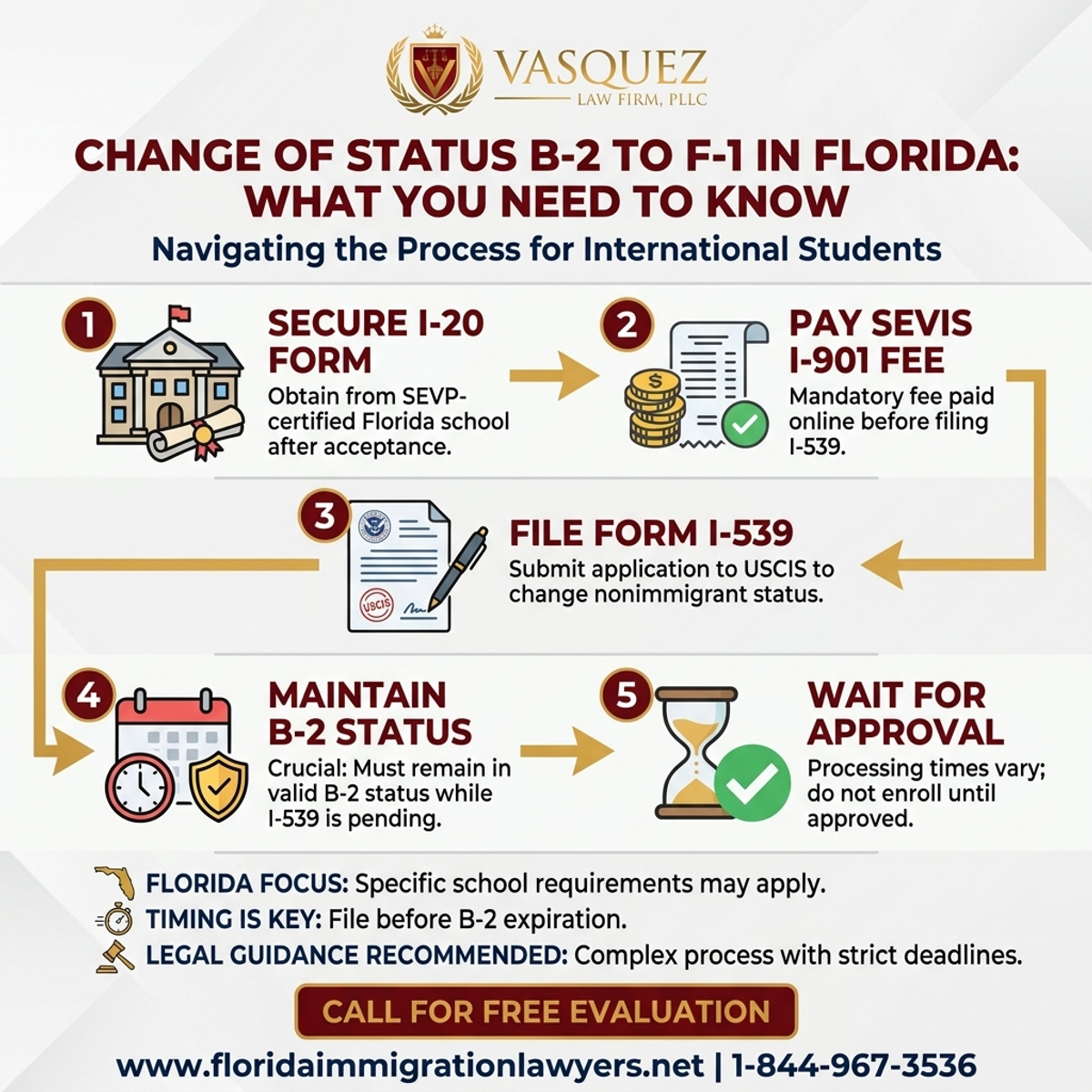
Key Statistics — Change of Status from B-2 to F-1 in Florida: What You Need to Know
Cost Factors and Fee Breakdown
| Item | Typical Fee | Notes |
|---|---|---|
| I-539 Filing Fee | Varies | Check current fee on USCIS website |
| SEVIS Fee | Varies | Payable to the school for Form I-20 |
| Additional Documentation | Varies | May require translations or notarizations |
Beyond the standard filing fees, applicants must budget for several other potential costs. These can include attorney fees for professional legal assistance, which, while an investment, can significantly increase your chances of a successful application and reduce stress. Other expenses might involve fees for obtaining certified copies of documents, translation services for non-English documents, notarization charges, and expedited shipping if necessary. It’s wise to have a contingency fund for unforeseen expenses that might arise during the application process.
The I-539 filing fee and the SEVIS I-901 fee are non-refundable, regardless of the outcome of your application. Therefore, ensuring your application is as strong as possible from the outset is crucial to avoid losing these fees. The SEVIS fee is particularly important as it registers you in the Student and Exchange Visitor Information System, which is mandatory for all F-1 students. Your school will typically provide guidance on how to pay this fee after issuing your Form I-20.
It's crucial to check the most current fee schedules directly on the USCIS website or consult with Florida Immigration Lawyers, as fees are subject to change without extensive notice. Incorrect fee payment is a common reason for applications to be rejected or delayed, requiring you to resubmit and restart the processing clock. Always use the exact payment method and amount specified by USCIS to prevent such setbacks and ensure your application proceeds smoothly.
Do not navigate this process alone. Contact Florida Immigration Lawyers today.
Common Mistakes to Avoid
- Filing after B-2 status expires: Results in automatic denial.
- Missing documentation: Can cause delays or denial.
- Not maintaining status during process: Leads to unlawful presence.
- Incorrect fee payment: Application could be rejected.
- Failure to provide financial evidence: Could result in denial.
- Applying to non-SEVP certified schools: Leads to denial.
- Ignoring USCIS requests for information: Can lead to application closure.
- Delaying the application process: Affects your legal status.
- Not consulting an attorney: Increases risk of errors.
- Overstaying visa during process: Results in bar from reentry.
- Incorrectly filled forms: Leads to processing delays.
- Not checking USCIS updates: Misses crucial information.
These common mistakes are not mere inconveniences; they can have severe, long-lasting consequences for your immigration record. For instance, accruing unlawful presence due to not maintaining status can lead to future bars from re-entry to the U.S., making it incredibly difficult to obtain any U.S. visa or green card in the future. A denial due to a simple error might force you to leave the country and apply for an F-1 visa from your home country, incurring additional costs, time, and uncertainty.
Consider the case of David, who arrived in Florida on a B-2 visa and decided to pursue a culinary arts program. He found a school and started classes, mistakenly believing he could submit his change of status application at any point. Unfortunately, he delayed filing until after his B-2 period of admission had expired. His application was automatically denied, and he was advised to leave the U.S. immediately to avoid accruing unlawful presence. This costly error could have been entirely avoided with timely action and proper legal guidance.
The best defense against these pitfalls is proactive and informed action. Consulting with an experienced immigration attorney, such as those at Florida Immigration Lawyers, can provide you with a clear roadmap, identify potential issues before they arise, and ensure that your application is meticulously prepared and submitted correctly. Our team is adept at navigating the complexities of immigration law, protecting your legal status, and maximizing your chances of a successful outcome.
When to Call a Lawyer
If you encounter any complexities, such as visa expiration, denial risks, or require assistance in documentation, seeking legal advice is crucial. Florida Immigration Lawyers are here to provide guidance through every step of the process. Our immigration practice areas cover a wide range of services tailored to your needs.
Specific scenarios that warrant immediate legal consultation include: if your B-2 status is nearing expiration with little time left to file, if you have any past immigration violations or a criminal record, if your financial documentation is complex or unconventional, or if you have previously been denied a visa or immigration benefit. These situations add layers of complexity that are best handled by a professional who understands the intricacies of immigration law and can strategize the most effective approach for your case.
Beyond addressing existing problems, engaging an attorney from the outset can prevent issues from arising. A lawyer can help you prepare a strong, error-free application, anticipate potential RFEs, and represent your interests throughout the entire process. This proactive approach provides peace of mind and significantly increases the likelihood of a successful change of status from B-2 to F-1, allowing you to focus on your academic pursuits in Florida. Call 1-844-YO-PELEO for a free case review.
About Florida Immigration Lawyers
Florida Immigration Lawyers is a dedicated team based in Orlando, providing expert immigration services across Central Florida. We offer personalized legal assistance in various areas, including family and employment-based immigration, deportation defense, and more. Contact us at 1-844-YO-PELEO for a free consultation, available 24/7. Visit our contact page to schedule an appointment.
Our firm understands the unique challenges and aspirations of international visitors and prospective students. We pride ourselves on offering comprehensive support, from initial eligibility assessments to the final approval of your change of status. Our attorneys stay current with the latest immigration policies and processing trends, ensuring that our advice is always accurate and effective. We are committed to providing compassionate and client-focused representation, making your immigration journey as smooth as possible.
Choosing Florida Immigration Lawyers means partnering with a team that genuinely cares about your future. We are not just legal advisors; we are advocates dedicated to helping you achieve your educational and personal goals in the United States. With a strong track record of success and a deep understanding of Florida's diverse immigrant communities, we are uniquely positioned to assist you with your B-2 to F-1 change of status and any other immigration needs you may have. Don't hesitate to reach out and experience the difference professional legal guidance can make.
Sources and References
- U.S. Citizenship and Immigration Services (USCIS)
- Executive Office for Immigration Review (EOIR)
- 8 U.S.C. Chapter 12 - Immigration and Nationality Act
Related services:
Do Not Navigate This Process Alone
Our experienced immigration attorneys are ready to fight for you. Get a free, confidential case review today.
Se Habla Español
Or leave your details and we’ll call you:
Free Evaluation in 24 Hours
Or talk to us right now

AI voice assistant — available 24/7
FreeFrequently Asked Questions

William J. Vásquez
Founding Attorney · Vasquez Law Firm
U.S. Air Force veteran and immigration attorney with years of hands-on U.S. immigration experience. J.D., NCCU School of Law. AILA member. Admitted to the 4th, 5th, and 11th Circuit Courts.
Available 24/7 - Free Evaluations
Reviewed for legal accuracy by William J. Vásquez
Licensed in North Carolina; U.S. immigration is federal practice.
Related Legal Services
Our Florida immigration attorneys can help you with immigration lawyer cost in Florida, experienced immigration attorneys and asylum protection. Call today at 1-844-YO-PELEO for a free case review.
Related Links
Related Topics
Free Legal Case Review
Discuss your case with our experienced attorneys. We're available 24/7.
Se Habla Español - Estamos aquí para ayudarle.
Related Articles
Immigration Lawyer Orlando Free Consultation in Florida
For individuals and families in Orlando, Florida, navigating the complexities of U.S. immigration law requires expert guidance. An immigration lawyer in Orlando offers crucial support for everything from visa applications and green card processes to naturalization and deportation defense. This comprehensive guide details what a free consultation covers, providing a step-by-step overview of immigration pathways, essential document checklists, and expected timelines in 2026. We also highlight common mistakes to avoid, discuss the critical role of legal counsel in deportation and asylum cases, and explain why choosing a local Orlando immigration attorney is beneficial. Florida Immigration Lawyers is dedicated to serving the diverse community of Orlando with compassionate, effective legal solutions, ensuring you receive personalized advice and robust representation for a successful immigration journey.
EAD Advance Parole Combo Card in Florida 2026
For individuals with a pending Form I-485, Application to Register Permanent Residence or Adjust Status, the EAD Advance Parole Combo Card is an essential document. This single card combines the authorization to work legally in the U.S. (Employment Authorization Document - EAD) with permission to travel internationally and re-enter without abandoning your green card application (Advance Parole). This guide from Florida Immigration Lawyers provides a comprehensive overview for applicants in Florida in 2026, covering eligibility, the step-by-step application process, required documents, expected processing times, and associated costs. We also highlight common mistakes to avoid and when to seek legal counsel to ensure a smooth and successful immigration journey. Understanding this vital card is key to maintaining stability while awaiting your permanent residency approval.
TN Visa for Professionals in Florida 2026
The TN visa, a vital pathway for Canadian and Mexican professionals, enables temporary work in the U.S. under the USMCA. This comprehensive guide from Florida Immigration Lawyers explores the nuances of TN visa eligibility, detailing the 63 designated professional occupations and the specific educational and licensing requirements for each. It outlines the distinct application processes for Canadian citizens at U.S. ports of entry and Mexican citizens through consular processing after an employer-filed I-129 petition. We provide a detailed document checklist, clarify processing times and validity periods, including the indefinite renewability of the TN visa for up to three years per approval. Additionally, the article breaks down associated costs, from government filing fees to attorney expenses and optional premium processing. We also address key considerations for TN visa holders in Florida, such as maintaining non-immigrant intent and understanding work restrictions. Learn about common application mistakes to avoid and when it's crucial to seek expert legal counsel to navigate complex scenarios. Florida Immigration Lawyers offers unparalleled support, ensuring your journey to working in Florida is smooth and successful.
Political Asylum Attorney: Your Guide to Asylum in Florida
Navigating the political asylum process in Florida requires a deep understanding of complex immigration laws and procedures. Whether you are fleeing persecution based on race, religion, nationality, political opinion, or membership in a particular social group, securing asylum can offer a path to safety and a new life in the United States. This guide explores the eligibility requirements, the detailed step-by-step application process, essential documentation, and expected timelines for asylum seekers in 2026. We also highlight critical mistakes to avoid and underscore the invaluable role of an experienced political asylum attorney. With USCIS offices in Orlando and Miami, and immigration courts across the state, Florida presents a unique landscape for asylum claims. Florida Immigration Lawyers stands ready to provide compassionate and strategic legal representation, ensuring your rights are protected throughout this vital journey. Contact us for a free case review.