U Visa Certification: Guide for Florida Crime Victims
For non-citizen crime victims in Florida, the U visa offers a vital pathway to protection and legal status, but it hinges on obtaining U visa certification from law enforcement. This certification, typically Form I-918 Supplement B, confirms your helpfulness in the investigation or prosecution of a qualifying crime. Navigating the varied policies of Florida law enforcement agencies, understanding eligibility criteria, and preparing a compelling request requires specialized legal knowledge. This comprehensive guide from Florida Immigration Lawyers explains the entire process, from identifying the right certifying agency in Orlando and across Florida to understanding USCIS processing times and potential costs. We also highlight common pitfalls to avoid and emphasize when legal counsel is crucial for ensuring a strong U visa petition. If you are a crime victim in Florida, learn how to secure your future and call us for a free consultation.

U visa certification is a critical step for eligible crime victims in Florida seeking U nonimmigrant status. This certification, typically provided by a Florida law enforcement agency or prosecutor's office, confirms that the victim has suffered substantial physical or mental abuse from a qualifying criminal activity and has been, is being, or is likely to be helpful in the investigation or prosecution of that crime. The form, known as Form I-918 Supplement B, is essential for demonstrating eligibility to USCIS. Navigating this process, especially with varied law enforcement policies across Florida, can be complex, making legal guidance invaluable.
- U visa certification confirms victim helpfulness to law enforcement.
- Form I-918 Supplement B is the official certification document.
- Qualifying crimes include domestic violence, sexual assault, trafficking, and more.
- Florida law enforcement agencies have discretion in issuing certifications.
- Legal assistance significantly improves the chances of successful certification and U visa approval.
Becoming a victim of a serious crime is a traumatic experience, regardless of your immigration status. For non-citizen victims in Florida, the fear of deportation or legal repercussions can often prevent them from reporting crimes or cooperating with law enforcement, leaving them vulnerable and without justice. However, the U nonimmigrant status, commonly known as the U visa, offers a beacon of hope and protection. This humanitarian visa is designed to protect victims of certain crimes who have suffered substantial abuse and are willing to assist law enforcement in the investigation or prosecution of those crimes. Crucially, obtaining U visa certification from a Florida law enforcement agency is the foundational step.
At Florida Immigration Lawyers, we understand the immense challenges and emotional toll faced by crime victims. Our dedicated team serves clients across Florida, including Orlando and surrounding communities, providing compassionate and strategic legal representation for U visa applicants. This comprehensive guide will demystify the U visa certification process, explain the role of Form I-918 Supplement B, and highlight specific considerations for victims interacting with Florida law enforcement. We aim to empower you with the knowledge needed to navigate this complex journey successfully. Do not face this process alone. Call Florida Immigration Lawyers at 1-844-967-3536 for a free consultation and let us help you protect your future.
Understanding the U Visa and Certification Process in Florida
The U nonimmigrant status was created by the Victims of Trafficking and Violence Protection Act of 2000 (VTVPA). Its purpose is twofold: to strengthen the ability of law enforcement agencies to investigate and prosecute crimes, and to offer protection to victims who cooperate. To be eligible for a U visa, a non-citizen must meet several strict requirements. These include being a victim of a qualifying criminal activity, having suffered substantial physical or mental abuse as a result of the crime, possessing information about the crime, and being helpful to law enforcement in its investigation or prosecution. The critical piece of evidence for the last requirement is the U visa certification.
In Florida, as elsewhere, the certification is provided by a certifying agency, which is typically a law enforcement agency, prosecutor's office, or certain judges. This agency must confirm that the victim was indeed helpful, is being helpful, or is likely to be helpful in the investigation or prosecution of a qualifying crime. Without this certification, the U visa petition generally cannot move forward. This process underscores the collaboration between immigration law and local criminal justice systems, aiming to protect vulnerable individuals while enhancing public safety. Understanding this synergy is vital for any victim seeking relief in Florida.
Who is Eligible for a U Visa?
Eligibility for a U visa is defined by specific criteria outlined in the Immigration and Nationality Act (INA 101(a)(15)(U)) and federal regulations (8 CFR 214.14). First, you must be the victim of a qualifying criminal activity. These crimes include, but are not limited to, domestic violence, sexual assault, trafficking, felonious assault, murder, manslaughter, abduction, blackmail, extortion, false imprisonment, hostage taking, kidnapping, torture, and witness tampering. The list is extensive and designed to cover a broad range of serious offenses that often target vulnerable populations. It is important to remember that the crime must violate U.S. law or occur in the U.S. or its territories.
Second, you must have suffered substantial physical or mental abuse as a direct result of the qualifying criminal activity. This abuse can be severe and long-lasting, impacting your daily life and well-being. Third, you must possess information about the qualifying criminal activity. This means you have knowledge that could aid in understanding or resolving the crime. Finally, and most critically for the certification, you must have been, be being, or be likely to be helpful to a certifying agency in the investigation or prosecution of the criminal activity. This helpfulness is what the law enforcement certification formally attests to, making it an indispensable component of your U visa application.
The Role of Law Enforcement in U Visa Certification
Law enforcement agencies play a pivotal role in the U visa process by issuing the certification. This document, officially Form I-918 Supplement B, is not an approval of the U visa itself, but rather an affirmation that the victim has met the cooperation requirement. In Florida, this could involve local police departments, sheriff's offices, state attorney's offices, the Florida Department of Law Enforcement (FDLE), or even certain judges. Each agency or office has the discretion to decide whether to issue a certification. Their decision is often based on internal policies and their assessment of the victim's helpfulness.
The certification is a formal statement from the certifying official describing the criminal activity investigated or prosecuted, the harm suffered by the victim, and the victim's helpfulness. For victims in Orlando, for example, this might involve working with the Orlando Police Department or the Orange County Sheriff's Office. The certification is a testament to the victim's courage and willingness to come forward, providing crucial information that aids in bringing criminals to justice. Without this cooperation, many serious crimes might go unsolved, and perpetrators might remain at large. The U visa program recognizes this vital contribution and offers a path to legal status as a result.
The I-918 Supplement B: Your Path to U Visa Certification in Florida
Form I-918 Supplement B, U Nonimmigrant Status Certification, is the official document that a certifying agency uses to confirm a victim's helpfulness. This form is standardized by USCIS to ensure consistency across jurisdictions, but the process of obtaining it can vary significantly from one Florida law enforcement agency to another. The form itself requires specific details about the crime, the victim's involvement, and the extent of their cooperation. It must be completed and signed by an authorized official from the certifying agency, such as the head of the agency, a prosecutor, or a designated official. This signature is not merely a formality; it represents the agency's official endorsement of the victim's assistance.
Understanding the nuances of Form I-918 Supplement B is crucial. It asks for information like the dates of helpfulness, a description of the criminal activity, and how the victim suffered substantial physical or mental abuse. It also asks the certifying official to specify the qualifying criminal activity under federal law. A carefully completed and thoughtfully signed Supplement B can make all the difference in a U visa application. Victims and their legal representatives must ensure that the form accurately reflects the victim's helpfulness and the severity of the crime, providing the strongest possible case to USCIS.
Identifying the Right Certifying Agency in Orlando and Florida
One of the initial challenges in seeking U visa certification is identifying the correct certifying agency. The general rule is to approach the agency that investigated the crime or is prosecuting the perpetrator. For instance, if you were a victim of domestic violence in Kissimmee, you would likely approach the Kissimmee Police Department or the Osceola County Sheriff's Office. If the case was prosecuted, the State Attorney's Office for the Ninth Judicial Circuit (serving Orange and Osceola counties) would be the appropriate contact. In larger metropolitan areas like Miami or Tampa, multiple agencies might have been involved, requiring careful consideration of which agency holds the most relevant information about your cooperation.
It is important to remember that not all government officials can sign the certification. The official must have supervisory authority over the investigation or prosecution of the qualifying criminal activity, or have direct contact with the victim. This typically means police chiefs, sheriffs, state attorneys, or designated high-ranking officials. Knowing who to contact and how to reach them within these agencies is often a significant hurdle for victims. An experienced immigration attorney can help identify the appropriate agency and official, streamlining this often-frustrating part of the process and avoiding delays in your U visa application.
Crafting an Effective Certification Request Letter
When requesting U visa certification, a well-crafted request letter is indispensable. This letter, prepared by the victim or their attorney, should accompany Form I-918 Supplement B and any supporting documentation. The letter should clearly and concisely explain why the victim is eligible for certification. It should detail the qualifying crime, the date and location of the incident, the agency's involvement, and, most importantly, how the victim was helpful in the investigation or prosecution. Specific examples of cooperation, such as providing statements, testifying, or identifying suspects, should be highlighted. It is also beneficial to explain the purpose of the U visa program and how the certification serves both the victim and law enforcement's goals.
The request letter should be professional and respectful, acknowledging the busy schedules of law enforcement officials. It should also include all necessary contact information for the victim and their attorney. For agencies in Florida that may not be fully familiar with the U visa process, including a brief explanation of the legal basis for certification (e.g., INA 101(a)(15)(U) and 8 CFR 214.14) can be helpful. A strong request letter can significantly influence an agency's willingness to review and sign the certification, setting the stage for a successful U visa petition. Our firm specializes in preparing these crucial documents, ensuring they are comprehensive and persuasive.
Step-by-Step Guide to Obtaining U Visa Certification from Florida Law Enforcement
Securing U visa certification from Florida law enforcement agencies is a multi-step process that requires patience, persistence, and often, legal expertise. Each step is vital to building a strong case for your U visa petition. Adhering to these steps carefully can significantly improve your chances of success.
-
Identify Qualifying Crime and Victim Status: First, confirm that you were a victim of a qualifying criminal activity as defined by immigration law (e.g., domestic violence, sexual assault, human trafficking). Ensure you suffered substantial physical or mental abuse. Gather any initial documentation related to the crime, such as police reports, medical records, or court documents. This foundational step is critical before engaging with law enforcement. For instance, if you were a victim of a severe assault in Jacksonville, collecting the incident report from the Jacksonville Sheriff's Office is a starting point.
-
Identify the Relevant Law Enforcement Agency: Determine which agency investigated the crime or is prosecuting the perpetrator. This could be a local police department (e.g., Miami-Dade Police Department), a county sheriff's office (e.g., Broward Sheriff's Office), a state attorney's office, or even federal agencies like the FBI if they were involved. It is crucial to identify the specific official within that agency who has the authority to sign Form I-918 Supplement B, typically a supervisor or head of the department.
-
Gather Evidence of Helpfulness: Compile all evidence demonstrating your cooperation with law enforcement. This includes statements you provided, testimony given in court, participation in interviews, identification of suspects, or any other assistance that aided the investigation or prosecution. Documenting your helpfulness is paramount, as this is the core requirement for certification. If you were a witness in a complex fraud case in Tampa, for example, records of your interviews with detectives and any grand jury testimony would be valuable.
-
Prepare a Compelling Request Packet: This packet should include a cover letter (as discussed above), a completed but unsigned Form I-918 Supplement B, and all supporting evidence of the crime and your helpfulness. The cover letter should clearly articulate why you meet the criteria for certification, referencing specific events and dates. Ensure all documents are organized, legible, and easy for the certifying official to review. An attorney can help compile a professional and persuasive packet.
-
Submit the Request: Submit the request packet to the identified certifying official or their designated contact person. This may involve mailing the packet, delivering it in person, or submitting it electronically, depending on the agency's policy. Always keep a copy of everything you submit for your records. Consider sending it via certified mail with a return receipt requested to confirm delivery.
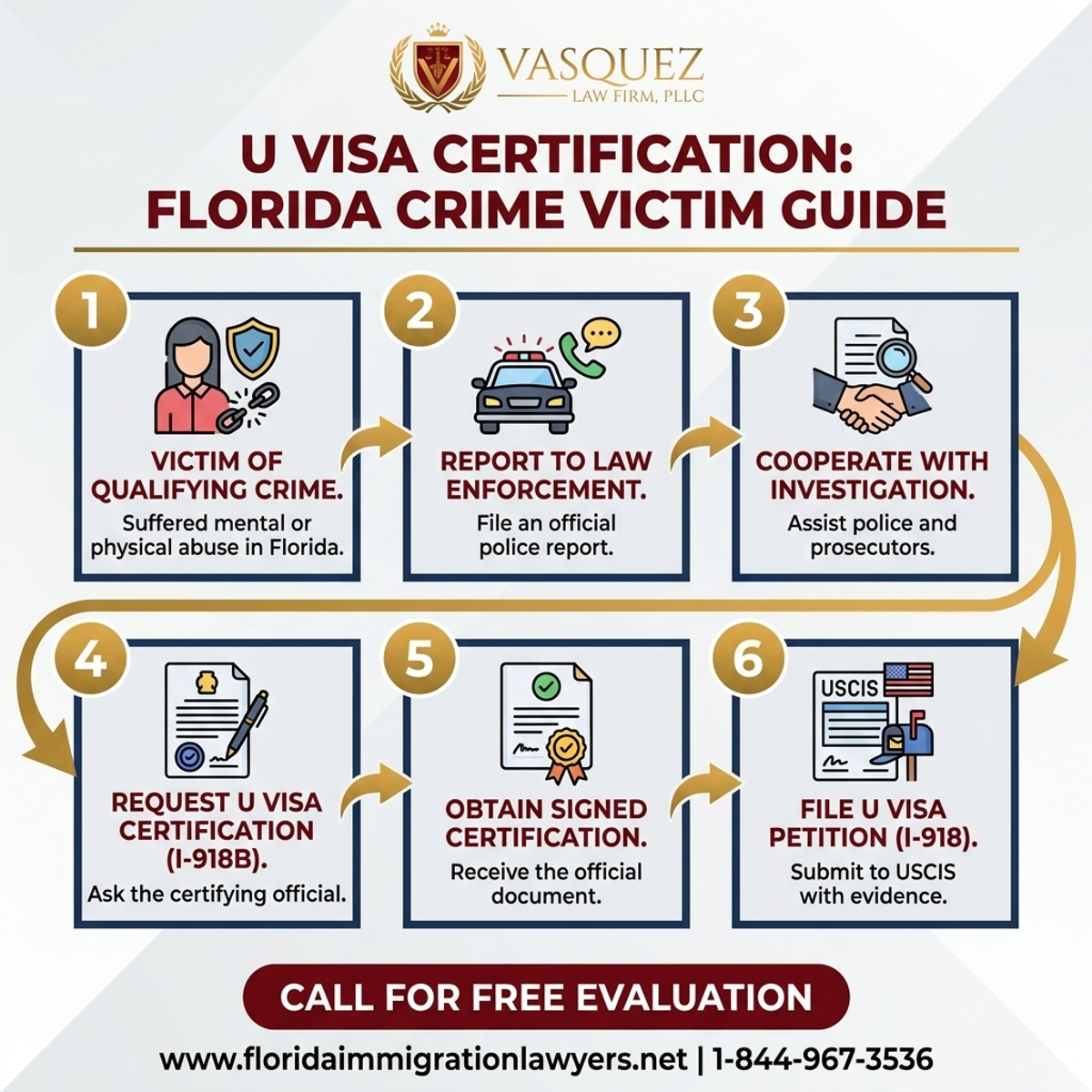
Step-by-Step Process — U Visa Certification: Guide for Florida Crime Victims
-
Follow Up Strategically: Law enforcement agencies are often busy, and processing certification requests may not be their top priority. Follow up politely and persistently, typically every few weeks, if you do not hear back within a reasonable timeframe (e.g., 30-60 days). Maintain a log of all communications, including dates, names, and summaries of conversations. Be prepared to provide additional information if requested. A lawyer can often facilitate these communications more effectively.
-
Receive Certification and File I-918 Petition: Once the certifying official signs Form I-918 Supplement B, you can then proceed to file your complete Form I-918, Petition for U Nonimmigrant Status, with USCIS. The certification must be submitted along with your petition. The U visa petition itself is a comprehensive application that includes personal information, supporting documents, and potentially applications for family members. This step marks the transition from seeking agency cooperation to seeking federal immigration relief.
What to Do If Certification is Denied
A denial of U visa certification by a Florida law enforcement agency can be disheartening, but it is not necessarily the end of the road. First, try to understand the reason for the denial. Was it due to insufficient evidence of helpfulness, a misunderstanding of the U visa program by the agency, or a policy decision? Request the denial in writing if possible. Next, consider whether there is another certifying agency involved in the case that you could approach. For example, if the local police denied it, perhaps the State Attorney's Office, which handled the prosecution, might be more amenable. Re-evaluating your evidence of helpfulness and strengthening your request can also be an option. Consulting an immigration attorney immediately after a denial is highly recommended. An attorney can review the denial, identify potential avenues for appeal or re-submission, and advocate on your behalf, often successfully clarifying the law for agencies or presenting new evidence.
Key Challenges and Florida-Specific Considerations for U Visa Certification
While the U visa program offers crucial protections, obtaining U visa certification is rarely straightforward. Victims in Florida often encounter specific challenges that can complicate their journey. These hurdles range from a lack of awareness about the U visa program among local law enforcement to varying agency policies and even outright reluctance to sign certifications. The discretionary nature of certification means that even if a victim has been incredibly helpful, an agency is not legally compelled to sign the I-918 Supplement B. This discretion can lead to inconsistent outcomes across different counties and agencies within Florida, creating a patchwork of experiences for victims.
Moreover, the political climate surrounding immigration can influence local law enforcement's willingness to engage with immigration-related matters. While the U visa is a federal program designed to aid local law enforcement, some agencies may be hesitant to appear to be assisting immigrants with legal status, especially in communities with heightened anti-immigrant sentiment. This can manifest as delays, requests for excessive documentation, or even outright refusal without a clear policy. Understanding these potential challenges is the first step in effectively navigating the process and advocating for your rights as a crime victim in Florida.
Navigating Agency Discretion and Internal Policies
The discretion afforded to certifying agencies is perhaps the biggest challenge in obtaining U visa certification. Each police department, sheriff's office, or prosecutor's office in Florida may have its own internal policies or lack thereof regarding U visa requests. Some agencies, particularly in larger, more diverse cities like Orlando, Miami, or Tampa, may have established protocols and designated personnel for handling such requests. Others, especially in smaller, rural counties, might be entirely unfamiliar with the U visa program and its requirements. This disparity means that a victim's experience can vary significantly based on where the crime occurred and which agency was involved. Successfully navigating this requires a nuanced approach: understanding the specific agency's culture, researching their policies, and presenting a clear, well-supported case that aligns with their operational goals. An attorney can often bridge this knowledge gap and effectively communicate with agency officials on your behalf.
The Impact of State and Local Immigration Policies in Florida
Florida's broader stance on immigration can indirectly impact the U visa certification process. While the U visa is a federal program, state and local policies, particularly those related to cooperation with federal immigration enforcement (e.g., ICE), can create an environment of distrust or apprehension for immigrant victims. When local law enforcement agencies are perceived as closely aligned with federal immigration enforcement, victims may be less willing to come forward, fearing detention or deportation. This fear can undermine the very purpose of the U visa program, which relies on victim cooperation. While Florida law enforcement agencies are generally encouraged to certify victims' helpfulness, the prevailing political winds can influence their approach. Staying informed about these dynamics and having legal representation that can address these concerns is vital for victims seeking relief in Florida. Recent news related to mandatory detention or changes in federal policies can heighten these anxieties, making careful legal counsel even more crucial.
Do not navigate this process alone. The complexities of obtaining U visa certification in Florida, coupled with the emotional toll of being a crime victim, can be overwhelming. Contact Florida Immigration Lawyers today for expert guidance and compassionate advocacy. Our team is ready to assist you.
Timeline, Processing Expectations, and Costs for U Visa Petitions (Post-Certification)
Once you successfully obtain your U visa certification (Form I-918 Supplement B) from Florida law enforcement, the next major step is to file the complete Form I-918, Petition for U Nonimmigrant Status, with USCIS. This marks the transition from local agency engagement to federal immigration processing. It's important to understand that the U visa process, from initial certification request to final visa approval, can be lengthy due to significant backlogs at USCIS. While the certification itself might take weeks or months to secure, the subsequent USCIS processing can take several years. This extended timeline underscores the need for meticulous preparation and ongoing legal support.
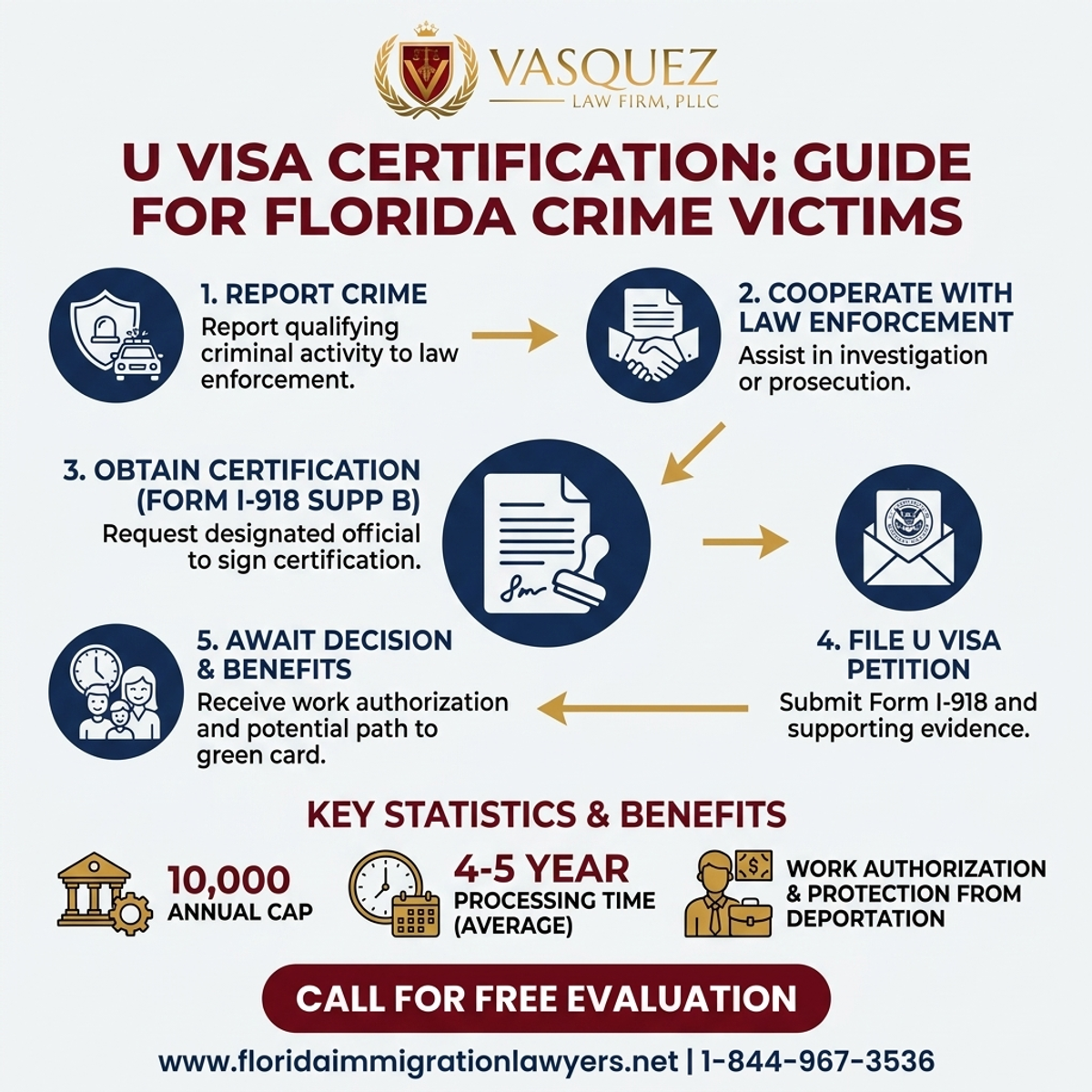
USCIS processes U visa petitions in the order they are received. Upon receipt, USCIS will issue a receipt notice (Form I-797C). After initial review, eligible applicants are placed on a waitlist due to the annual cap of 10,000 U visas. During this waitlist period, USCIS often issues a Bona Fide Determination (BFD), which allows eligible applicants to receive work authorization (Form I-765) and deferred action, protecting them from deportation while they await a final decision. This BFD process can take 3-5 years itself. Once a U visa becomes available, USCIS will resume processing, conduct interviews if necessary, and ultimately make a final decision. The entire journey from filing to approval can easily span 5-7 years, sometimes longer, highlighting the importance of patience and consistent legal counsel.
USCIS Processing for I-918 Petitions
After your U visa certification is secured and you file Form I-918 with USCIS, the federal agency undertakes a thorough review. USCIS first checks for initial eligibility, ensuring all required forms and evidence are submitted. This includes your personal documentation, evidence of the qualifying crime, proof of substantial abuse, and, of course, the signed Form I-918 Supplement B. If the petition is prima facie eligible (meaning it appears to meet all requirements on its face), you will typically receive a Bona Fide Determination (BFD) and be placed on a waitlist. This waitlist exists because Congress limits the number of U visas issued to 10,000 principal applicants per fiscal year (8 U.S.C. 1184(o)(2)). While on the waitlist with a BFD, you can apply for employment authorization and deferred action, which provides a measure of stability and protection. The actual grant of U nonimmigrant status occurs only when a visa number becomes available, which can take several years given the demand. USCIS processing times are publicly available on their website, and they are subject to change based on caseload and policy. An Orlando immigration lawyer can help you monitor these changes and understand what to expect.
Key Statistics — U Visa Certification: Guide for Florida Crime Victims
Understanding Fee Waivers and Attorney Costs
The costs associated with a U visa petition generally involve USCIS filing fees and attorney fees. USCIS fees, while subject to change, typically include fees for the I-918 petition itself, biometrics, and the application for employment authorization (Form I-765). However, a significant benefit of the U visa program is the availability of fee waivers. Victims of qualifying crimes who demonstrate an inability to pay may be eligible to have their USCIS filing fees waived, making the process more accessible. This is particularly important for victims who may have lost employment or faced financial hardship due to the crime.
Attorney fees, on the other hand, cover the comprehensive legal services provided. This includes assistance with obtaining U visa certification from Florida law enforcement, preparing the entire I-918 petition, gathering all necessary evidence, responding to Requests for Evidence (RFEs) from USCIS, and representing you throughout the lengthy process. While attorney fees are an investment, they often prove invaluable. An experienced immigration lawyer can navigate the complexities, ensure all documents are correctly filed, and significantly improve the likelihood of a successful outcome, potentially saving you from costly delays or denials. Many firms, including Florida Immigration Lawyers, offer flexible payment plans to accommodate clients' financial situations. We believe that financial constraints should not prevent crime victims from seeking the protection they deserve.
Common Mistakes to Avoid in U Visa Certification and Application
Navigating the U visa process, especially the crucial U visa certification stage, is fraught with potential pitfalls. Avoiding these common mistakes can save you significant time, stress, and potentially prevent a denial of your petition. It is essential to be meticulous and seek professional guidance to ensure every step is handled correctly.
-
Submitting Incomplete Certification Requests: Many victims or their advocates submit Form I-918 Supplement B to law enforcement without a comprehensive cover letter or sufficient supporting documentation. This can lead to delays or outright denials if the certifying official does not have all the necessary information to make a decision. Always provide a detailed explanation of the crime and your helpfulness.
-
Failing to Demonstrate Helpfulness Adequately: The core of U visa certification is proving that you have been, are being, or are likely to be helpful to law enforcement. Generic statements are not enough. You must provide specific examples of your cooperation, such as providing witness statements, identifying suspects, or testifying in court. Without clear evidence of helpfulness, agencies may refuse to sign the certification.
-
Approaching the Wrong Agency or Official: Not all law enforcement agencies or officials have the authority to sign Form I-918 Supplement B. Submitting your request to an individual who was not involved in the investigation or prosecution, or to an agency that did not have jurisdiction, will result in delays or rejections. Research and verify the appropriate certifying official beforehand.
-
Not Following Up Appropriately or Persistently: Law enforcement agencies are often overwhelmed with cases and may not prioritize U visa certification requests. Failing to follow up politely and consistently can mean your request gets lost or forgotten. However, aggressive or demanding follow-up can also be counterproductive. A strategic approach is key.
-
Missing Deadlines for Filing I-918 After Certification: While the certification itself does not expire, it must be submitted with your Form I-918 to USCIS within six months of the certifying official's signature. Missing this window can invalidate the certification, forcing you to restart the process and seek a new signature, which can be challenging.
-
Assuming Certification Guarantees U Visa Approval: Receiving a signed Form I-918 Supplement B is a significant achievement, but it does not guarantee U visa approval. USCIS still independently reviews the entire Form I-918 petition to ensure all eligibility criteria are met, including the qualifying crime, substantial abuse, and admissibility requirements. An attorney can help address potential inadmissibility issues.
-
Trying to Navigate the Process Without Legal Counsel: The U visa process, from obtaining certification to filing the petition and addressing potential inadmissibility issues, is incredibly complex. Attempting to manage it without an experienced immigration attorney often leads to critical errors, delays, or denials. Legal counsel is invaluable for maximizing your chances of success.
-
Not Understanding the Qualifying Crime Criteria: Many victims mistakenly believe any crime qualifies them for a U visa. However, immigration law specifies a limited list of qualifying criminal activities. If the crime you experienced does not fall within this list, your petition will likely be denied. Thoroughly review the criteria with an attorney.
-
Lack of Evidence of Substantial Abuse: Beyond the crime itself, applicants must demonstrate they suffered substantial physical or mental abuse. Simply stating you were abused is insufficient. Provide medical records, psychological evaluations, police reports detailing injuries, or sworn affidavits from witnesses to substantiate the severity of the harm suffered.
When to Call a Lawyer for U Visa Certification in Florida
The journey to obtaining a U visa is intricate, with the U visa certification being a particularly sensitive and challenging phase. While the U visa program is designed to help victims, the legal and administrative complexities often require professional guidance. Knowing when to seek legal counsel can make a crucial difference in the outcome of your case. At Florida Immigration Lawyers, we strongly recommend contacting an attorney at the earliest possible stage, ideally even before you approach law enforcement for certification.
You should absolutely call a lawyer if you encounter any of the following scenarios:
- Difficulty Obtaining Certification: If a Florida law enforcement agency is unresponsive, denies your request for Form I-918 Supplement B, or expresses unfamiliarity with the U visa process, an attorney can advocate on your behalf. We can educate agencies, clarify legal requirements, and present a compelling case for certification.
- Complex Criminal Case: If your criminal case involves multiple agencies, jurisdictions (e.g., federal and state), or has unusual circumstances, a lawyer can help navigate the complexities and identify the correct certifying official. This is especially true in cases involving human trafficking or organized crime, which may span across Florida counties like Orange, Palm Beach, and Miami-Dade.
- Criminal History or Admissibility Issues: If you have any past criminal convictions, immigration violations, or other issues that might make you inadmissible to the U.S., a U visa attorney can assess your situation, advise on potential waivers, and prepare a strategy to mitigate these concerns.
- Fear of Deportation or Other Immigration Consequences: If you are currently in removal proceedings or fear that cooperating with law enforcement could lead to negative immigration consequences, a lawyer can provide critical protection and guidance. Our team can help ensure your rights are protected throughout the process.
- Language Barriers or Cultural Differences: Navigating legal systems in a foreign language or different cultural context can be daunting. A bilingual attorney can ensure effective communication with both law enforcement and USCIS, and help you articulate your story clearly.
- Need for Comprehensive Petition Preparation: Beyond certification, the U visa petition itself requires extensive documentation and careful preparation. An attorney ensures that your entire Form I-918 petition, including all supporting evidence and declarations, is meticulously prepared and submitted accurately to USCIS, maximizing your chances of approval.
Florida Immigration Lawyers has extensive experience assisting crime victims across Florida in securing U visa certification and ultimately, U nonimmigrant status. Our commitment to compassionate and effective representation ensures that you have a strong advocate by your side through every challenge.
About Florida Immigration Lawyers
Florida Immigration Lawyers is a leading immigration law firm dedicated to serving individuals and families across the entire state of Florida. With a deep understanding of U.S. immigration laws and the unique challenges faced by immigrants, our firm is committed to providing exceptional legal representation and compassionate support. We specialize in a broad range of immigration matters, including U visas, asylum, deportation defense, family immigration, business immigration, and naturalization. Our experienced attorneys bring a wealth of knowledge and a personalized approach to each case, recognizing that every client's situation is unique and deserves tailored strategies.
We pride ourselves on our client-focused approach, ensuring that you feel heard, understood, and confidently represented. Our team is fluent in both English and Spanish, making our services accessible to Florida's diverse communities. From our offices, we extend our reach to all corners of the state, from Orlando and Miami to Tampa, Jacksonville, and beyond. We are available 24/7 to address urgent concerns and offer free, no-obligation consultations to help you understand your legal options. When you choose Florida Immigration Lawyers, you choose a partner who is dedicated to protecting your rights and helping you achieve your immigration goals. Call us today at 1-844-967-3536 or visit our website at floridaimmigrationlawyers.net to schedule your free consultation.
Sources and References
- U.S. Citizenship and Immigration Services (USCIS) - U Nonimmigrant Status: Official information on U visas, eligibility, and forms like I-918 and I-918 Supplement B.
- Executive Office for Immigration Review (EOIR): Provides information on immigration courts and removal proceedings, relevant for victims in deportation.
- 8 U.S.C. Chapter 12 - Immigration and Nationality Act (INA) Section 101(a)(15)(U): Defines the U nonimmigrant status.
- 8 CFR 214.14: Federal regulations governing U nonimmigrant status, detailing eligibility, application procedures, and certification requirements.
- USCIS Policy Manual, Volume 3, Part B, Chapter 5: Provides detailed guidance for USCIS officers on U nonimmigrant status eligibility and adjudication.
Related services: asylum and refugee protection, asylum application process, refugee status and resettlement.
This article provides general legal information and is not intended as legal advice. Every case is unique, and outcomes depend on specific facts and circumstances. Laws are subject to change. Contact an attorney for advice about your particular situation.
Your journey for protection and justice as a crime victim in Florida is important. Do not hesitate to seek the legal support you deserve. Contact Florida Immigration Lawyers today for a free and confidential consultation. Our experienced team is ready to guide you through every step of the U visa certification process and beyond, helping you secure a safer future. Call us now at 1-844-967-3536. Se Habla Español - Estamos aquí para ayudarle.
If you need legal assistance, learn more about learn about our immigration practice, or call us at 1-844-967-3536 for a free consultation.
Do Not Navigate This Process Alone
Our experienced immigration attorneys are ready to fight for you. Get a free, confidential consultation today.
Se Habla Español
Or leave your details and we’ll call you:
Free Evaluation in 24 Hours
Or talk to us right now

AI voice assistant — available 24/7
FreeFrequently Asked Questions

William J. Vásquez
Founding Attorney · Vasquez Law Firm
U.S. Air Force veteran and immigration attorney with years of hands-on U.S. immigration experience. J.D., NCCU School of Law. AILA member. Admitted to the 4th, 5th, and 11th Circuit Courts.
Available 24/7 - Free Evaluations
Reviewed for legal accuracy by William J. Vásquez
Licensed in North Carolina; U.S. immigration is federal practice.
Related Legal Services
Our Florida immigration attorneys can help you with asylum protection, deportation defense and citizenship and naturalization. Call today at 1-844-967-3536 for a free consultation.
Related Links
Related Topics
Free Legal Consultation
Discuss your case with our experienced attorneys. We're available 24/7.
Se Habla Español - Estamos aquí para ayudarle.
Related Articles
"Narrative of Fear" Asylum I-589 in Florida 2026
Applying for asylum in the U.S. requires a compelling "narrative of fear" – a personal statement detailing why you cannot return to your home country due to persecution. This guide provides a comprehensive overview of the I-589 asylum application process in Florida for 2026, including essential steps, required documentation, typical timelines, and associated costs. Learn how to craft a strong narrative, what evidence is crucial, and common mistakes to avoid. With specific insights into Florida's immigration landscape, from West Palm Beach to Miami, this article highlights the importance of legal counsel in navigating the intricate federal regulations and local court procedures. Florida Immigration Lawyers offers expert guidance to protect your rights and help you secure safety.
Stem OPT Immigration Lawyer: Florida Graduates 2026 Guide
For Florida graduates with STEM degrees, the 24-month OPT STEM extension offers a critical pathway to extended work authorization. This detailed guide explores eligibility requirements, the step-by-step application process, necessary documentation, and typical processing timelines for 2026. We highlight the importance of an E-Verify employer and address common pitfalls that can lead to application delays or denials. Understanding these complexities is vital for international students aiming to build their careers in Florida's dynamic economy. Florida Immigration Lawyers provides expert assistance, helping you navigate USCIS regulations and ensure a successful application, offering peace of mind and protecting your professional future.
U Visa for Crime Victims in Florida 2026 Guide
For crime victims in Florida, the U visa offers a critical pathway to immigration relief and protection. This non-immigrant visa is designed for individuals who have suffered substantial physical or mental abuse from certain qualifying crimes and are willing to assist law enforcement. As of 2026, understanding the detailed eligibility requirements, the multi-step application process, and the necessary documentation is vital. This guide covers everything from obtaining law enforcement certification to navigating processing timelines and managing costs. With specific focus on Florida, it highlights common mistakes and emphasizes when legal counsel from Florida Immigration Lawyers can make a significant difference in securing your future and safety.
ICE Locator: Understanding Check-ins in Florida 2026
Understanding ICE check-ins and the ISAP program is vital for non-detained immigrants in Florida. These mandatory appointments with U.S. Immigration and Customs Enforcement (ICE) ensure compliance with release conditions, monitor an individual's status in the U.S., and track progress in their immigration case. From preparing necessary documents to understanding supervision timelines and avoiding common mistakes, the process can be complex. Florida Immigration Lawyers provides expert attorney representation to guide you through every step, protecting your rights and advocating for your best interests. Learn about the step-by-step process, key documents, and when to seek legal counsel to navigate your ICE supervision successfully in West Palm Beach and across Florida.