TPS to Green Card Pathway in Florida for 2026
Explore the pathway from TPS to a green card for Florida residents in 2026. Understand the steps, requirements, and potential obstacles in the adjustment of status process.
TPS holders in Florida looking to adjust their status to a green card in 2026 have several steps to follow. This process involves eligibility verification, application through USCIS, and possibly an interview. Key takeaways include:
- TPS does not automatically lead to a green card.
- Applicants need an approved immigrant petition.
- Legal assistance is highly recommended.
Introduction
For many Temporary Protected Status (TPS) holders in Florida, the journey from temporary status to permanent residency is a critical goal. With the current changes and news affecting immigration policies, including significant cases being reviewed by the Supreme Court, understanding the pathway to a green card is essential. This article will guide you through the process, requirements, and potential challenges faced by TPS holders in Orlando and beyond. Call Florida Immigration Lawyers at 1-844-YO-PELEO for a free case review.
Navigating the intricate landscape of U.S. immigration law can be daunting, especially when transitioning from a temporary status like TPS to a permanent green card. The process is not automatic and requires careful planning, adherence to strict legal requirements, and often, expert legal guidance. Our aim is to demystify this pathway, providing clarity and practical advice for TPS beneficiaries across Florida who aspire to build a more secure future in the United States.
Understanding the nuances of eligibility, the documentation required, and the potential pitfalls is paramount. Florida Immigration Lawyers is committed to assisting you every step of the way, ensuring your application is robust and well-prepared. We recognize the profound impact that achieving permanent residency can have on individuals and families, and we are dedicated to helping you achieve this life-changing milestone.
What is TPS and Who Qualifies in 2026?
Temporary Protected Status (TPS) is a designation by the U.S. government that allows individuals from certain countries experiencing extreme conditions to stay in the U.S. temporarily. As of 2026, eligible countries include El Salvador, Honduras, and others affected by ongoing conflicts or natural disasters.
To qualify for TPS, applicants must meet specific criteria set by the Department of Homeland Security. These include continuous physical presence in the U.S., being a national of a TPS-designated country, and timely registration.
For current updates on TPS designations, visit the USCIS website.
The humanitarian basis for TPS allows individuals to live and work in the U.S. without fear of deportation during a period when their home country is deemed unsafe for return. However, it's crucial to remember that TPS is, by its very nature, temporary. It does not automatically grant a path to permanent residency or citizenship, making the exploration of alternative immigration avenues, such as adjustment of status, a critical next step for many beneficiaries.
Eligibility for TPS is rigorously reviewed. Beyond continuous physical presence and nationality, applicants must also demonstrate good moral character and pass security checks. Any criminal history, even minor offenses, can jeopardize TPS eligibility or future green card applications. Therefore, it is essential for all applicants to be transparent and seek legal counsel if they have any concerns about their background.
Staying informed about the latest TPS designations and re-registration periods is vital. USCIS regularly updates the list of eligible countries and extends or terminates designations based on prevailing conditions. Failure to re-register within the specified window can lead to the loss of TPS status, complicating any subsequent attempts to adjust status to a green card. Florida Immigration Lawyers can help you monitor these crucial updates and ensure you meet all re-registration requirements.
How Can TPS Holders Transition to a Green Card?
TPS holders in Florida can pursue a green card through adjustment of status or consular processing. Adjustment of status allows applicants to change their current status to permanent residency without leaving the U.S., but it requires an approved immigrant petition, typically through employment or family sponsorship.
To start this process, TPS holders must ensure they meet the eligibility requirements, such as having a lawful entry into the U.S. or being eligible under INA Section 245(i).
The preferred method for most TPS holders in Florida is adjustment of status, as it allows individuals to remain in the U.S. with their families and continue working while their application is processed. This contrasts with consular processing, which requires the applicant to leave the U.S. and attend an interview at a U.S. embassy or consulate in their home country, a process that can be risky and lead to lengthy delays or even denial of re-entry if not properly managed.
A critical component for adjustment of status is the approved immigrant petition. This typically comes in two forms: a family-based petition (Form I-130, Petition for Alien Relative), filed by a qualifying U.S. citizen or lawful permanent resident relative, or an employment-based petition (Form I-140, Immigrant Petition for Alien Worker), usually filed by a U.S. employer. Without an approved petition establishing a basis for immigration, a TPS holder cannot move forward with their green card application.
The requirement of a "lawful entry" is a significant hurdle for many TPS holders. Historically, some TPS holders who entered the U.S. without inspection were deemed ineligible for adjustment of status. However, recent legal developments, such as the Supreme Court's decision in Sanchez v. Mayorkas, and subsequent interpretations by USCIS, have clarified that TPS status itself does not constitute an "admission" for adjustment purposes. This makes the specific circumstances of your initial entry, or eligibility under INA Section 245(i), incredibly important. Section 245(i) is a vital provision that allows certain individuals who entered without inspection but had a qualifying visa petition filed on their behalf before specific dates (January 14, 1998, or April 30, 2001) to adjust status by paying a penalty fee.
Understanding whether your entry was lawful or if you qualify under 245(i) is complex and often requires a detailed review of your immigration history. Florida Immigration Lawyers at 1-844-YO-PELEO specialize in these nuanced cases, providing the expert guidance needed to determine the most viable path to a green card.
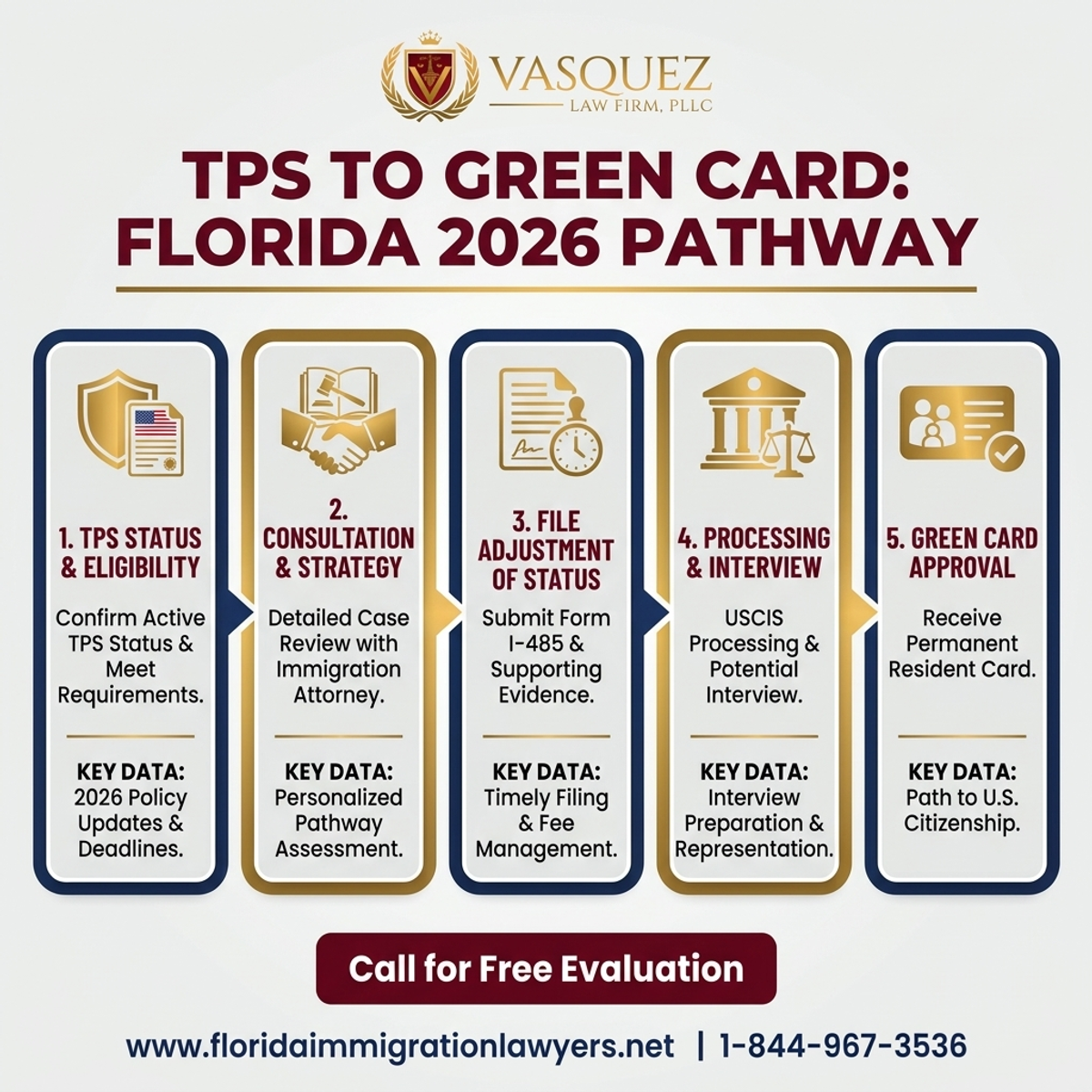
Step-by-Step Process — TPS to Green Card Pathway in Florida for 2026
Step-by-Step Guide to Adjust Status from TPS to Green Card
Embarking on the journey from Temporary Protected Status to a permanent green card requires a methodical and precise approach. Each step is critical, and any misstep can lead to significant delays or even denial of your application. This guide outlines the essential phases of the adjustment of status process for TPS holders in Florida, emphasizing the need for meticulous preparation and attention to detail.
Before initiating your adjustment of status application, it is imperative to thoroughly review your entire immigration history and personal background. This includes any past entries, departures, previous visa applications, and any encounters with law enforcement. An immigration attorney from Florida Immigration Lawyers can help you conduct this comprehensive review to identify potential issues and strategize the best course of action.
- Ensure eligibility: Check if you have an approved immigrant petition (Form I-130 or Form I-140). This is the foundational step, establishing a valid basis for you to immigrate. Without an approved petition from a qualifying family member or employer, you cannot proceed with adjustment of status.
- File Form I-485, Application to Register Permanent Residence or Adjust Status. This is the primary application form for your green card. It must be filed with all required supporting documents, including your medical examination results (Form I-693) and affidavit of support (Form I-864) if applicable.
- Attend the biometrics appointment for fingerprinting. USCIS will schedule this appointment to collect your fingerprints, photograph, and signature for background and security checks. Missing this appointment without proper rescheduling can severely delay your case.
- Prepare for and attend an interview if required by USCIS. While not all adjustment of status cases require an interview, many do. This is an opportunity for a USCIS officer to verify the information in your application, ask questions about your eligibility, and assess your credibility.
- Receive a decision on your application. After the interview (if any) and all background checks are complete, USCIS will make a decision. If approved, you will receive your permanent resident card (green card) in the mail.
Throughout this multi-stage process, maintaining your TPS status by re-registering on time is crucial. Your TPS provides a legal basis to remain in the U.S. while your green card application is pending. Should your TPS expire, your legal status could be jeopardized. Always keep copies of every document submitted and all communications received from USCIS.
Document Checklist for TPS to Green Card Application
A comprehensive and meticulously organized set of documents is the backbone of a successful green card application. Any missing or incorrect documentation can lead to delays, requests for evidence (RFEs), or even denial. This checklist outlines the essential documents typically required when adjusting status from TPS to a green card, but always be prepared for USCIS to request additional information based on your unique case.
Gathering these documents can be a time-consuming process, often requiring requests for official records from various government agencies or foreign consulates. Starting this collection early is highly recommended to avoid last-minute rushes and ensure all documents are current and properly translated if necessary. Florida Immigration Lawyers can help you compile and review your documentation to ensure completeness and accuracy.
- Form I-485, Application to Register Permanent Residence or Adjust Status. Ensure you are using the most current version of the form available on the USCIS website.
- Form I-130 or I-140 approval notice. This is the evidence of your approved immigrant petition, which establishes your eligibility for a green card through a family or employment relationship.
- Proof of lawful entry (if applicable). This could include Form I-94 Arrival/Departure Record, a visa stamp, or evidence of parole. For those relying on INA Section 245(i), documentation of the qualifying petition and payment of the penalty fee will be necessary.
- Evidence of continuous presence in the U.S. Documents such as utility bills, employment records, school records, tax returns, and bank statements can help demonstrate your continuous physical presence and residence.
- Financial support documents. Typically, an Affidavit of Support (Form I-864) from your petitioner and/or a joint sponsor, along with their tax returns and employment verification, to demonstrate that you will not become a public charge.
- Identity and civil documents (birth certificates, marriage certificates). These include your birth certificate, marriage certificate (if applicable), divorce decrees (if applicable), and valid government-issued identification. All foreign language documents must be accompanied by a certified English translation.
- Medical examination results (Form I-693). This must be completed by a USCIS-approved civil surgeon and submitted in a sealed envelope. It is crucial to ensure this exam is current at the time of your interview or decision.
- Photographs. Two passport-style photos meeting USCIS specifications.
Beyond this core list, you may also need police clearances from any country where you have lived for more than six months since age 16, or from any U.S. state where you have resided. Always make copies of all documents submitted for your own records. A well-organized and thoroughly documented application significantly increases the chances of a smooth process and a favorable outcome. For assistance with your specific document needs, contact Florida Immigration Lawyers at 1-844-YO-PELEO.
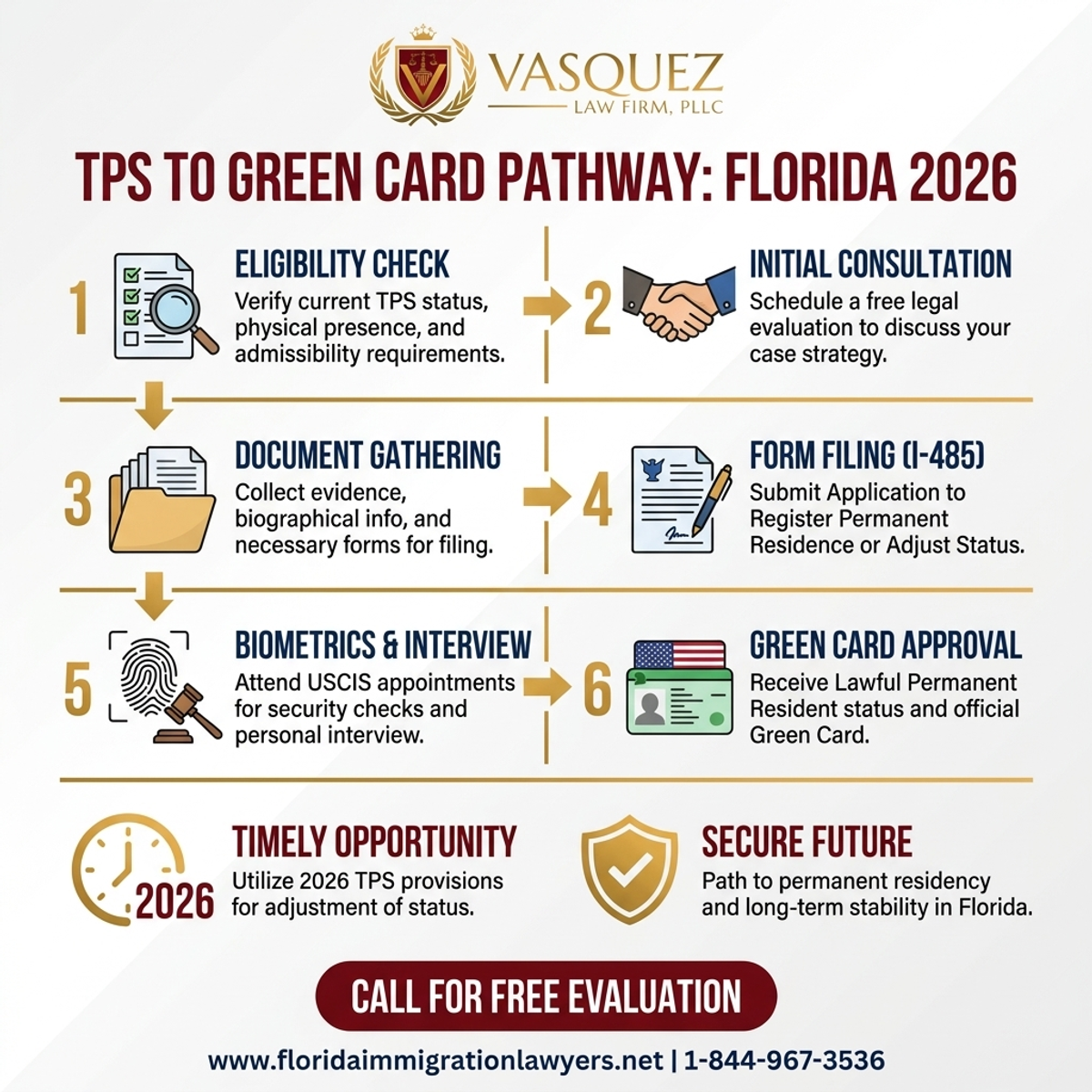
Key Statistics — TPS to Green Card Pathway in Florida for 2026
Timeline and Processing Expectations for TPS Adjustment
Understanding the timeline for adjusting status from TPS to a green card is essential for managing expectations, though it's important to recognize that these are estimates and actual processing times can vary significantly. Immigration processing is rarely a quick process, and patience, coupled with diligent follow-up, is key. Various factors can influence how long your application will take, including USCIS workload, the complexity of your case, and the completeness of your submitted documents.
These estimated timeframes reflect the stages of the adjustment process. It's also critical to note that the priority date for your immigrant petition (Form I-130 or I-140) must be current according to the Visa Bulletin before you can file your Form I-485. For some categories, especially family-based preferences, this can add several years to the overall waiting period, depending on your country of origin and relationship to the petitioner.
| Stage | Typical Timeframe | Notes |
|---|---|---|
| Eligibility verification | 1-2 months | Review of initial criteria, including lawful entry or 245(i) eligibility, and an approved immigrant petition. |
| Application submission | 3-6 months | Includes filing Form I-485, submitting supporting documents, and attending the biometrics appointment. This period also covers initial review by USCIS. |
| Interview and decision | 6-12 months | This stage encompasses the scheduling and conducting of your interview (if required), completion of background checks, and the final adjudication of your application. Times can vary greatly depending on the USCIS field office and case complexity. |
Throughout this process, it is vital to maintain your TPS status by re-registering as required. Your TPS provides you with lawful presence and work authorization while your green card application is pending. Allowing your TPS to lapse could create complications for your adjustment of status. Additionally, be prepared for potential Requests for Evidence (RFEs) from USCIS, which can extend processing times if not addressed promptly and thoroughly.
While the wait can be lengthy, staying informed and proactive is crucial. You can check your case status online using the receipt number provided by USCIS. However, for personalized updates and strategic advice on navigating potential delays or RFEs, consulting with Florida Immigration Lawyers is highly recommended. We are here to help you understand your specific timeline and prepare for each stage effectively.
Cost Factors and Fee Breakdown for TPS Adjustment
Pursuing a green card through adjustment of status from TPS involves various fees, which are an important consideration in your overall planning. These costs encompass government filing fees, biometrics fees, and potentially other expenses such as medical exams and legal representation. Understanding this financial commitment upfront can help you budget effectively and avoid unexpected hurdles.
The fees charged by USCIS are subject to change, so it's always best to check the official USCIS website for the most current fee schedule before filing any forms. These fees are typically non-refundable, regardless of the outcome of your application, underscoring the importance of submitting a complete and accurate application from the outset.
| Item | Typical Fee | Notes |
|---|---|---|
| Form I-485, Application to Register Permanent Residence or Adjust Status | Varies ($1,140 - $1,225) | Depends on age (applicants under 14 filing with a parent often pay less) and whether the biometrics fee is included. Always verify current fees on USCIS website. |
| Biometrics fee | Varies ($85) | Usually required for Form I-485. This fee covers the cost of fingerprinting and background checks. For some applicants, it may be included in the I-485 filing fee. |
| Form I-130, Petition for Alien Relative | $535 | If you are filing a family-based petition, this fee is separate from the I-485 fee. |
| Medical examination (Form I-693) | Varies ($200 - $1,000+) | This fee is paid directly to the civil surgeon and is not a USCIS fee. Costs can vary significantly by provider and required vaccinations. |
| Legal assistance | Varies (Consultation fees, Flat fees, Hourly rates) | Highly recommended for navigating complex immigration laws, preparing documents, and representing you. While an investment, it can prevent costly mistakes and delays. |
Beyond the direct filing fees, you should also factor in costs for obtaining civil documents (birth certificates, marriage licenses), translation services if documents are not in English, and potentially travel expenses for interviews or biometrics appointments. Some applicants may qualify for a fee waiver for certain USCIS forms, such as Form I-485, if they meet specific poverty guidelines. Discussing this option with Florida Immigration Lawyers can help determine your eligibility.
Do not navigate this process alone. While the costs may seem substantial, the investment in expert legal assistance from Florida Immigration Lawyers can save you time, reduce stress, and significantly increase your chances of a successful outcome. Contact Florida Immigration Lawyers today for a free case review and a clear breakdown of potential costs for your specific situation. Call us at 1-844-YO-PELEO.
Common Mistakes to Avoid
The path from TPS to a green card is fraught with potential pitfalls that can lead to delays, denials, or even jeopardize your immigration status. Being aware of these common mistakes and taking proactive steps to avoid them is crucial for a successful application. Many of these errors stem from a lack of understanding of complex immigration regulations or an underestimation of the meticulousness required by USCIS.
Even seemingly minor errors can have significant consequences. For instance, providing inconsistent information across different forms or failing to disclose a past incident can raise red flags and trigger additional scrutiny. Consulting with an experienced immigration attorney from Florida Immigration Lawyers can provide an invaluable layer of protection against these common pitfalls, ensuring your application is as robust as possible.
- Filing late: Missing deadlines can lead to application denial. This includes re-registering for TPS, responding to RFEs, or filing your I-485 when your priority date becomes current. Always mark your calendar for critical dates.
- Incorrect forms: Submitting wrong or incomplete forms can delay the process. Always download the latest version of forms directly from the USCIS website and ensure all sections are accurately and completely filled out.
- Lack of supporting documents: Insufficient evidence may result in denial. USCIS requires comprehensive proof for every claim. Ensure all required civil documents, financial records, and proof of lawful entry/presence are included.
- Not updating address: Failing to notify USCIS of address changes can lead to missed communications. USCIS sends important notices, interview appointments, and RFEs by mail. Missing these can lead to application abandonment.
- Ignoring legal advice: Attempting to navigate the process without legal guidance can result in errors. Immigration law is complex and constantly evolving; an attorney provides expertise and advocacy.
- Overlooking travel restrictions: Traveling without proper documentation can affect status. TPS holders need to apply for Advance Parole (Form I-131) before traveling internationally to ensure they can lawfully re-enter the U.S. and maintain their eligibility for adjustment of status.
- Not checking for updates: Immigration policies may change, affecting eligibility. Stay informed about legislative changes, court decisions, and USCIS policy updates that could impact your case.
To mitigate these risks, consider creating a checklist for each stage of your application, double-checking all entries, and seeking a professional review before submission. The time and effort invested in preventing these mistakes are far less than the cost and frustration of dealing with a denied application or prolonged delays. Florida Immigration Lawyers are here to help you meticulously prepare and review your application to minimize risks.
When to Call a Lawyer
If you're unsure about your eligibility, facing complex legal issues, or have had a previous immigration application denied, it's crucial to consult with an immigration lawyer. Florida Immigration Lawyers can provide the guidance and support you need to navigate the green card process effectively.
The decision to hire an immigration lawyer is an investment in your future, particularly when transitioning from TPS to a green card. You should consider reaching out to legal counsel immediately if you have any criminal history, even minor arrests or convictions, as these can have severe immigration consequences. Similarly, if you have any past immigration violations, such as overstays, previous deportation orders, or unauthorized employment, a lawyer can assess the impact and devise a strategy.
Furthermore, if your case involves unique circumstances, such as complex family relationships, eligibility through INA Section 245(i), or a history of multiple entries and exits from the U.S., the expertise of Florida Immigration Lawyers becomes indispensable. We can help you gather the necessary evidence, prepare compelling arguments, and represent you in communications with USCIS, including during interviews, ensuring your rights are protected and your case is presented in the strongest possible light. Don't hesitate to call 1-844-YO-PELEO for a free case review.
About Florida Immigration Lawyers
Florida Immigration Lawyers is a dedicated firm providing expert immigration legal services throughout Florida. Our team is experienced in handling cases involving TPS, adjustment of status, and more. We offer free case reviews and are available 24/7 to assist you with your immigration needs. Explore our immigration practice areas or schedule a free consultation.
Our firm is deeply committed to serving the diverse immigrant communities across Florida, from Orlando to Miami and beyond. We understand the hopes and anxieties that accompany the immigration journey, and we approach each case with compassion, diligence, and a profound understanding of U.S. immigration law. Our goal is not just to process paperwork, but to empower our clients with knowledge and provide a clear pathway to achieving their American dream.
With a track record of success in complex immigration matters, Florida Immigration Lawyers stands as a beacon of hope for individuals seeking permanent residency. We pride ourselves on transparent communication, personalized strategies, and unwavering advocacy for our clients. Whether you are just beginning to explore your options or are facing a challenging immigration issue, our team is ready to provide the expert guidance you deserve. Contact us today at 1-844-YO-PELEO to learn how we can help you secure your future in Florida.
Sources and References
- U.S. Citizenship and Immigration Services (USCIS)
- Executive Office for Immigration Review (EOIR)
- 8 U.S.C. Chapter 12 - Immigration and Nationality Act
- Sanchez v. Mayorkas, 141 S. Ct. 1809 (2021)
Related services: family immigration services, citizenship and naturalization, deportation defense, asylum protection.
This article provides general legal information and is not intended as legal advice. Every case is unique, and outcomes depend on specific facts and circumstances. Contact an attorney for advice about your particular situation.
For personalized legal guidance, call Florida Immigration Lawyers at 1-844-YO-PELEO. Se Habla Español - Estamos aquí para ayudarle.
If you need legal assistance, learn more about Florida immigration legal team, or call us at 1-844-967-3536 for a free case review.
Do Not Navigate This Process Alone
Our experienced immigration attorneys are ready to fight for you. Get a free, confidential case review today.
Se Habla Español
Or leave your details and we’ll call you:
Free Evaluation in 24 Hours
Or talk to us right now

AI voice assistant — available 24/7
FreeFrequently Asked Questions

William J. Vásquez
Founding Attorney · Vasquez Law Firm
U.S. Air Force veteran and immigration attorney with years of hands-on U.S. immigration experience. J.D., NCCU School of Law. AILA member. Admitted to the 4th, 5th, and 11th Circuit Courts.
Available 24/7 - Free Evaluations
Reviewed for legal accuracy by William J. Vásquez
Licensed in North Carolina; U.S. immigration is federal practice.
Related Legal Services
Our Florida immigration attorneys can help you with experienced immigration attorneys, asylum protection and citizenship and naturalization. Call today at 1-844-YO-PELEO for a free case review.
Related Links
Related Topics
Free Legal Case Review
Discuss your case with our experienced attorneys. We're available 24/7.
Se Habla Español - Estamos aquí para ayudarle.
Related Articles
DUI Immigration Consequences in Florida 2026
A DUI conviction in Florida can have severe immigration consequences, potentially leading to inadmissibility, deportation, or denial of immigration benefits. For non-citizens, a DUI is not just a traffic offense but a serious criminal matter that federal immigration law scrutinizes closely. Factors like multiple offenses, injury, or property damage can escalate a simple DUI to a Crime Involving Moral Turpitude (CIMT) or even an aggravated felony, triggering mandatory detention and removal proceedings. Understanding the specific nature of your Florida conviction and its interpretation under the Immigration and Nationality Act (INA) is crucial. This article outlines how DUIs impact immigration status, the grounds for inadmissibility and deportation, a step-by-step guide to navigating the process, essential documentation, and expected timelines for 2026. We also highlight common mistakes to avoid and when to seek legal counsel from an experienced immigration attorney. Florida Immigration Lawyers offers comprehensive support for individuals facing these challenging situations, providing expert guidance through complex legal landscapes.
Immigration Lawyer Orlando Free Consultation in Florida
For individuals and families in Orlando, Florida, navigating the complexities of U.S. immigration law requires expert guidance. An immigration lawyer in Orlando offers crucial support for everything from visa applications and green card processes to naturalization and deportation defense. This comprehensive guide details what a free consultation covers, providing a step-by-step overview of immigration pathways, essential document checklists, and expected timelines in 2026. We also highlight common mistakes to avoid, discuss the critical role of legal counsel in deportation and asylum cases, and explain why choosing a local Orlando immigration attorney is beneficial. Florida Immigration Lawyers is dedicated to serving the diverse community of Orlando with compassionate, effective legal solutions, ensuring you receive personalized advice and robust representation for a successful immigration journey.
EAD Advance Parole Combo Card in Florida 2026
For individuals with a pending Form I-485, Application to Register Permanent Residence or Adjust Status, the EAD Advance Parole Combo Card is an essential document. This single card combines the authorization to work legally in the U.S. (Employment Authorization Document - EAD) with permission to travel internationally and re-enter without abandoning your green card application (Advance Parole). This guide from Florida Immigration Lawyers provides a comprehensive overview for applicants in Florida in 2026, covering eligibility, the step-by-step application process, required documents, expected processing times, and associated costs. We also highlight common mistakes to avoid and when to seek legal counsel to ensure a smooth and successful immigration journey. Understanding this vital card is key to maintaining stability while awaiting your permanent residency approval.
EAD Advance Parole Combo Card in Florida: What You Need
An EAD advance parole combo card allows individuals with pending adjustment applications to both work and travel abroad without jeopardizing their green card application. Learn how to apply in Florida, what documents you need, and common mistakes to avoid.