Schedule A Nurse Immigration to Florida Hospitals | VLF Flor
Discover the streamlined process of Schedule A nurse immigration to Florida hospitals. Learn the necessary steps, including obtaining a VisaScreen Certificate and filing Form I-140. Find out how Florida Immigration Lawyers can assist you in navigating the complex immigration landscape effectively.

- Schedule A expedites the EB-3 visa for nurses.
- No labor certification is required.
- Florida offers diverse opportunities for healthcare professionals.
Introduction
Imagine stepping off a plane in Coral Springs, Florida, ready to start your new life as a nurse in a bustling hospital. The warm sun, vibrant community, and a promising career await. However, the path to this dream requires navigating the complex process of Schedule A nurse immigration. This article will guide you through this process, explaining the steps, requirements, and potential pitfalls. Call Florida Immigration Lawyers at 1-844-967-3536 for a free consultation and let us help you open the doors to your new career in healthcare.
The journey to becoming a U.S. registered nurse, especially through an expedited pathway like Schedule A, represents a significant professional and personal milestone. It not only offers a chance to advance your career in a dynamic healthcare environment but also provides an opportunity to contribute to a community deeply in need of skilled medical professionals. Florida, with its growing population and diverse communities, consistently faces a high demand for qualified nurses, making it an ideal destination for international healthcare workers.
This comprehensive guide aims to demystify the Schedule A process, providing clarity on each stage and offering practical advice to ensure a smooth transition. From understanding the underlying principles of Schedule A classification to preparing for the final steps of green card acquisition, we will cover all essential aspects. Our goal is to empower you with the knowledge needed to pursue your nursing career in the U.S. confidently, with the expert support of Florida Immigration Lawyers readily available.
Understanding Schedule A for Nurses
Schedule A is a list maintained by the Department of Labor (DOL) for occupations where there is a recognized shortage of U.S. workers. Registered nurses fall under this category, making it easier for them to obtain an employment-based visa, specifically the EB-3 visa. This classification bypasses the lengthy labor certification process, allowing nurses to fill critical roles in healthcare facilities across the U.S., including those in Coral Springs, Florida.
Nurses applying under Schedule A can expect a faster processing time, as the typical labor market test is waived. This is particularly beneficial in states like Florida, where the demand for healthcare professionals is high. For more information, visit the USCIS website.
The inclusion of registered nurses on Schedule A is a testament to the persistent and widespread nursing shortage across the United States. This designation acknowledges that there are not enough U.S. workers who are able, willing, qualified, and available to fill these critical positions, thereby justifying the expedited immigration pathway for foreign nurses. This means employers in Florida hospitals, from bustling urban centers to serene coastal communities, can more quickly bring in the talent they desperately need, directly benefiting patient care.
The EB-3 visa, specifically tailored for skilled workers, professionals, and other workers, becomes significantly more accessible for nurses due to the Schedule A designation. Without the need for PERM labor certification, which can add many months, if not over a year, to the immigration timeline, nurses can move from job offer to green card much more efficiently. This strategic advantage not only benefits the individual nurse seeking a new life but also provides a crucial lifeline to healthcare systems struggling with staffing challenges, particularly in high-growth states like Florida.
Step-by-Step Guide to Schedule A Nurse Immigration
Navigating the U.S. immigration system can seem daunting, but with a clear understanding of each step, the process becomes manageable. For Schedule A nurses, the path is distinctly structured to facilitate entry into the U.S. healthcare workforce. This section breaks down the critical stages you will encounter on your journey to becoming a registered nurse in Florida.
Each step requires meticulous attention to detail and adherence to specific legal requirements. Missing a document or misunderstanding a procedure can lead to significant delays or even denial. Therefore, it is highly recommended to work with experienced legal counsel, such as Florida Immigration Lawyers, throughout this entire process to ensure accuracy and compliance.
- Secure a Job Offer: Obtain a job offer from a U.S. employer, such as a hospital in Coral Springs.
This is the foundational step. Your job offer must be for a permanent, full-time position as a Registered Nurse (RN) in a healthcare facility. The employer must be willing to sponsor your immigration petition. It's crucial to ensure the offer specifies the terms of employment, salary, and location, demonstrating a legitimate need for your skills. Many Florida hospitals actively recruit international nurses due to the ongoing shortage, making this step often more accessible than for other professions.
- Obtain a VisaScreen Certificate: This certifies that you meet the necessary requirements for nursing in the U.S.
The VisaScreen certificate, issued by the CGFNS International, Inc., verifies that your nursing education, licensure, and English language proficiency meet U.S. standards. This comprehensive evaluation includes a review of your academic transcripts, professional licenses, and results from an approved English language proficiency test (e.g., IELTS, TOEFL). It is a mandatory credential for healthcare professionals seeking an occupational visa or green card in the U.S.
- File Form I-140: Your employer must file this form with USCIS to classify you as an immigrant worker.
Once you have a job offer and the VisaScreen certificate, your sponsoring employer files Form I-140, Immigrant Petition for Alien Worker, on your behalf. This petition establishes your eligibility for the EB-3 visa under Schedule A. The employer must provide evidence of their ability to pay the offered wage and your qualifications, including your VisaScreen certificate. The date USCIS receives this petition becomes your "priority date," which is critical for visa availability.
- Adjustment of Status or Consular Processing: Depending on your location, you may adjust status or apply for a visa at a U.S. consulate.
If you are already in the U.S. on a valid non-immigrant visa and your priority date is current, you may be eligible to "adjust status" by filing Form I-485 to become a lawful permanent resident without leaving the country. If you are outside the U.S. or ineligible for adjustment, you will undergo "consular processing" at a U.S. embassy or consulate in your home country, which involves an interview and final visa stamp.
- Receive Your Green Card: Once approved, you will receive your green card and can begin working legally in the U.S.
The final step involves the approval of your adjustment of status application or the issuance of your immigrant visa through consular processing. Upon entry to the U.S. with an immigrant visa or approval of your I-485, you will officially become a lawful permanent resident, receiving your physical green card in the mail. This card signifies your authorization to live and work permanently in the United States, allowing you to fully embrace your new nursing career in Florida.
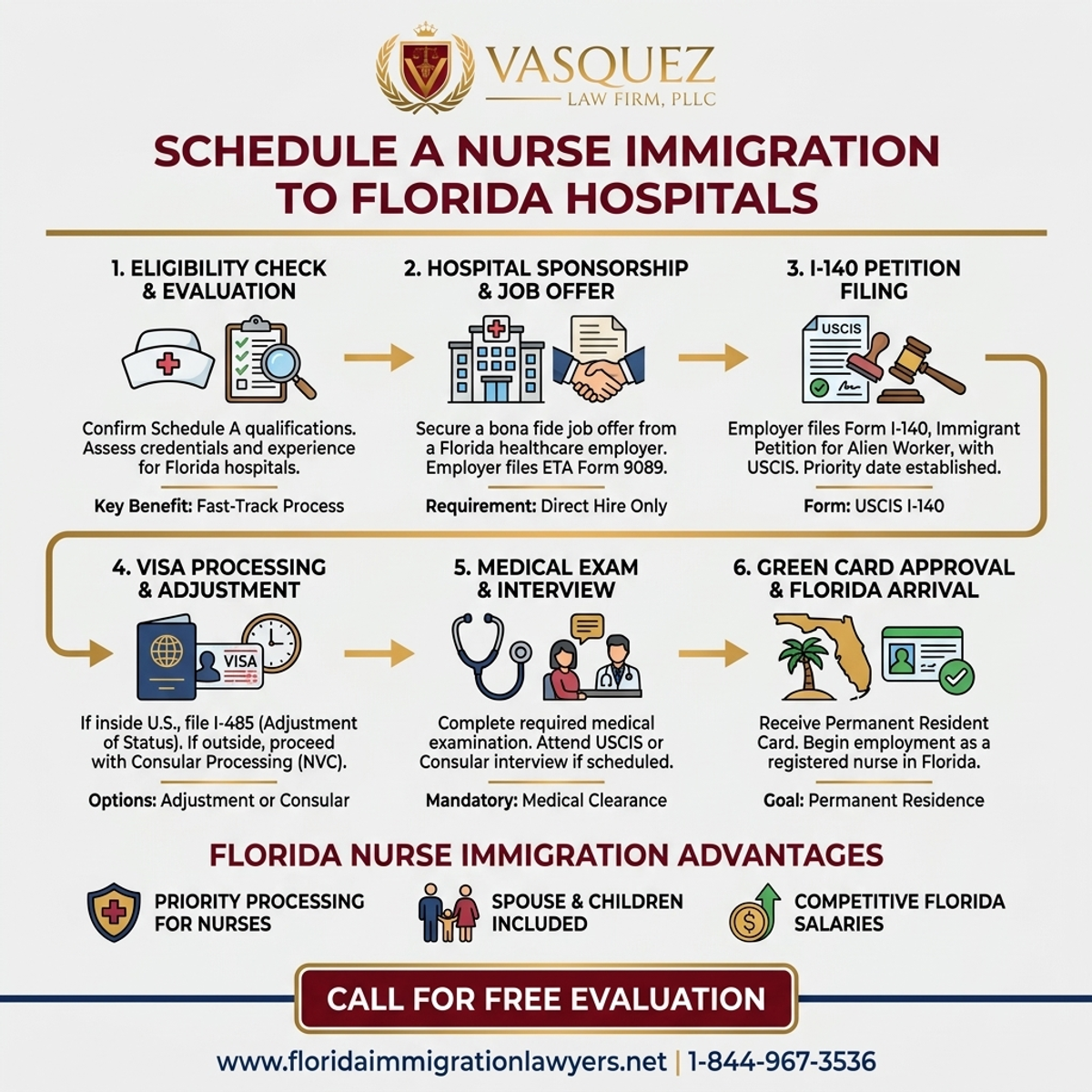
Step-by-Step Process — Schedule A Nurse Immigration to Florida Hospitals
Document Checklist for Schedule A Nurses
A successful immigration application hinges on the completeness and accuracy of your documentation. Gathering all necessary papers in advance can significantly streamline the process and prevent delays. This checklist outlines the primary documents required for Schedule A nurse immigration, but always be prepared for requests for additional evidence.
Organizing your documents meticulously, preferably in digital and physical formats, is a best practice. Ensure all foreign-language documents are accompanied by certified English translations. Consulting with Florida Immigration Lawyers can help you verify that you have all the required paperwork and that it meets USCIS standards.
- Employment offer letter from a U.S. hospital
This formal letter from your sponsoring U.S. employer must clearly state the job title (Registered Nurse), salary, job duties, and confirm that the position is permanent and full-time. It serves as proof of your legitimate job opportunity in Florida.
- VisaScreen Certificate
As discussed, this certificate from CGFNS International, Inc. is indispensable. It validates your foreign nursing credentials against U.S. standards, ensuring you are qualified to practice nursing in the United States.
- Valid passport
Your passport must be valid for at least six months beyond your intended period of stay or the expected date of green card issuance. It serves as your primary identification and proof of nationality.
- Form I-140 approval notice
Once USCIS approves your employer's immigrant petition, they will issue an I-797 approval notice. This document confirms that you have been classified as an eligible immigrant worker under Schedule A.
- Medical examination report
All applicants for permanent residency must undergo a medical examination performed by a USCIS-approved civil surgeon. This report verifies your health status and ensures you meet U.S. public health requirements.
- Supporting documentation for any dependents
If your spouse and/or unmarried children under 21 are applying with you, you'll need their passports, birth certificates, marriage certificates (if applicable), and potentially separate medical examination reports and I-485 or DS-260 applications.
Timeline and Processing Expectations
Typically, the processing time for Schedule A nurse immigration can vary based on several factors, including USCIS workload and your specific circumstances. On average, the process can take anywhere from 6 months to over a year. It's advisable to check current processing times on the USCIS website and stay in regular contact with your immigration attorney.
Several elements can influence the overall timeline. The most significant factors include the current demand for visas in your specific category (EB-3), your country of origin (due to per-country visa limits), and the efficiency of the USCIS service center processing your I-140 and I-485 applications. While Schedule A waives the labor certification, other stages, such as background checks and interview scheduling, still require time.
Applicants should also be prepared for potential Requests for Evidence (RFEs) from USCIS, which can add months to the process if not addressed promptly and accurately. Visa bulletin retrogression, where the demand for visas exceeds the supply, can also cause significant delays, particularly for individuals from certain high-demand countries. Your Florida Immigration Lawyers team will diligently monitor these factors and keep you informed, helping you navigate any unforeseen challenges.
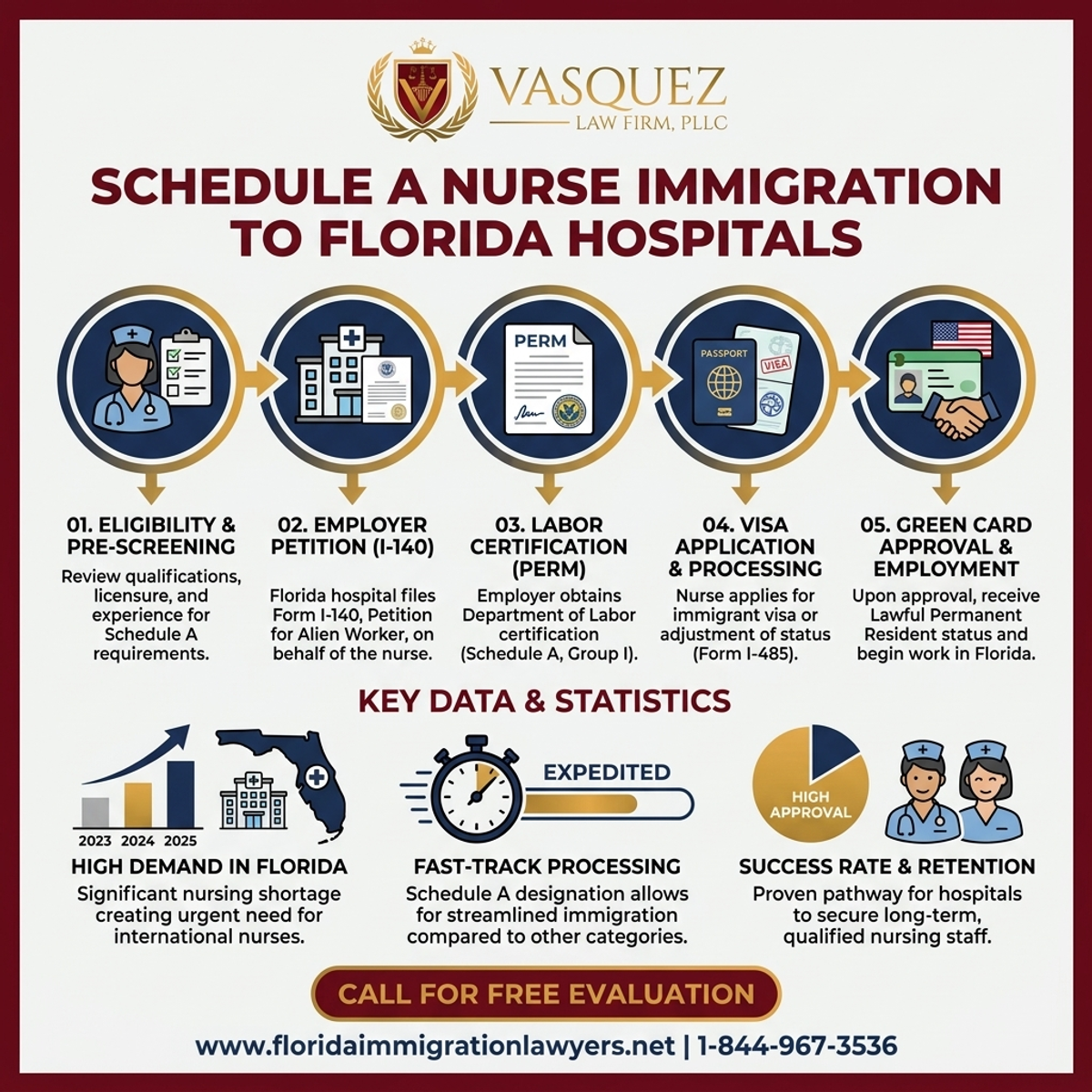
Key Statistics — Schedule A Nurse Immigration to Florida Hospitals
Cost Factors and Fee Breakdown
While the costs associated with Schedule A nurse immigration can fluctuate, they generally include USCIS filing fees, the VisaScreen certification fee, and potential legal fees if you choose
Sources and References
- U.S. Citizenship and Immigration Services (USCIS)
- Executive Office for Immigration Review (EOIR)
- U.S. Department of State - Bureau of Consular Affairs
- Immigration and Nationality Act (INA), 8 U.S.C. Chapter 12
Do Not Navigate This Process Alone
Our experienced immigration attorneys are ready to fight for you. Get a free, confidential consultation today.
Se Habla Español
Frequently Asked Questions
Florida Immigration Lawyers
Immigration Attorney | Founder, Vasquez Law Firm
U.S. Air Force veteran and immigration attorney with thousands of cases resolved. J.D., NCCU School of Law. AILA member. Admitted to the 4th, 5th, and 11th Circuit Courts.
Available 24/7 - Free Evaluations
Related Legal Services
Our Florida immigration attorneys can help you with free immigration consultation, experienced immigration attorneys and business immigration. Call today at 1-844-967-3536 for a free consultation.
Related Links
Related Topics
Free Legal Consultation
Discuss your case with our experienced attorneys. We're available 24/7.
Se Habla Español - Estamos aquí para ayudarle.
Related Articles
Parole in Place for Military Families in Florida | VLF Florida
Explore how Parole in Place assists military families in Florida, specifically in Coral Springs. Understand eligibility, application steps, and common pitfalls. Contact Florida Immigration Lawyers for a free consultation.
Understanding the Diversity Visa Lottery in Florida
Discover how the Diversity Visa Lottery can open doors to the American Dream from Pembroke Pines, Florida. Learn the steps, avoid common mistakes, and understand when to call a lawyer for assistance.
U Visa Certification: Guide for Florida Crime Victims
For non-citizen crime victims in Florida, the U visa offers a vital pathway to protection and legal status, but it hinges on obtaining U visa certification from law enforcement. This certification, typically Form I-918 Supplement B, confirms your helpfulness in the investigation or prosecution of a qualifying crime. Navigating the varied policies of Florida law enforcement agencies, understanding eligibility criteria, and preparing a compelling request requires specialized legal knowledge. This comprehensive guide from Florida Immigration Lawyers explains the entire process, from identifying the right certifying agency in Orlando and across Florida to understanding USCIS processing times and potential costs. We also highlight common pitfalls to avoid and emphasize when legal counsel is crucial for ensuring a strong U visa petition. If you are a crime victim in Florida, learn how to secure your future and call us for a free consultation.
Florida PERM Labor Certification: Your Employer Green Card Guide
Navigating PERM Labor Certification in Florida? Get our expert guide on employer-sponsored green card steps, requirements, and strategies for success. Secure
