RFE Florida Response: Expert Guide to USCIS Requests
Receiving a Request for Evidence (RFE) from USCIS can be daunting, but it's a critical opportunity to strengthen your immigration application. This comprehensive guide from Florida Immigration Lawyers explains what an RFE means, how to meticulously gather and organize your evidence, and the essential steps for a successful RFE response in Florida. We cover common mistakes to avoid, processing timelines, potential costs, and crucial scenarios where legal representation is indispensable. Whether you're in Kissimmee, Orlando, or Miami, understanding and responding correctly to an RFE is vital. Our experienced attorneys are here to provide expert guidance and support, ensuring your response is thorough, accurate, and submitted on time. Do not risk your immigration future; contact us for a free consultation.

A Request for Evidence (RFE) from USCIS means your immigration application or petition is missing crucial information or supporting documents. It is not a denial, but a critical opportunity to provide the necessary evidence to prove your eligibility. Responding to an RFE in Florida requires meticulous attention to detail, a thorough understanding of the requested items, and a timely submission. Failure to adequately address an RFE can lead to delays or even denial of your case. Seeking legal guidance from experienced Florida immigration lawyers is highly recommended to ensure a comprehensive and accurate response.
- An RFE is a request for more information, not a denial.
- Respond promptly and thoroughly to avoid delays or denial.
- Gather all requested documents and provide certified translations.
- Consider legal assistance for complex RFEs or if unsure how to proceed.
Receiving a Request for Evidence (RFE) from U.S. Citizenship and Immigration Services (USCIS) can be a moment of significant anxiety for any immigrant in Florida. It might feel like a setback, but it is actually a standard part of the immigration process, indicating that USCIS needs more information to make a decision on your application or petition. Whether you are in Kissimmee, Orlando, Miami, or any other part of the Sunshine State, understanding how to properly respond to an RFE is crucial for your immigration journey.
An RFE is not a denial of your case. Instead, it is a clear signal that USCIS has identified deficiencies or gaps in the evidence you initially submitted. This could range from missing documents to insufficient proof of eligibility for the benefit you are seeking. Your ability to provide a comprehensive, well-organized, and timely response will significantly impact the outcome of your immigration application.
This guide from Florida Immigration Lawyers will walk you through everything you need to know about preparing an effective RFE response, specifically for applicants residing in Florida. We will cover what an RFE means, how to approach gathering evidence, common pitfalls to avoid, and when professional legal assistance becomes indispensable. Do not face this complex challenge alone. Call Florida Immigration Lawyers at 1-844-967-3536 for a free consultation and let our experienced team help you navigate this critical step.
Understanding Your USCIS Request for Evidence (RFE) in Florida
A Request for Evidence (RFE) is an official communication from USCIS informing you that your application or petition lacks sufficient evidence to establish eligibility for the immigration benefit sought. According to 8 CFR § 103.2(b)(8), USCIS has the authority to request additional evidence if the initial submission does not meet the necessary legal requirements. This often occurs when the officer reviewing your case finds that certain facts are unclear, documents are missing, or the evidence provided does not fully establish a claim under the relevant sections of the Immigration and Nationality Act (INA), such as INA § 212(a) for inadmissibility grounds or INA § 204 for petition eligibility.
For individuals in Florida, receiving an RFE can pertain to a wide array of immigration matters, including family-based petitions, employment-based visas, adjustment of status applications, and naturalization requests. For instance, a family petition (Form I-130) might receive an RFE if the bona fides of the marriage are not sufficiently established, or if proof of a qualifying relationship is weak. An employment-based petition might trigger an RFE if the applicant's qualifications or the employer's ability to pay are not clearly demonstrated. In Kissimmee, where many diverse families reside, RFEs related to proving family relationships are quite common.
The RFE letter itself is highly specific. It will outline exactly what evidence is required and why. It is crucial to read every word carefully and understand the underlying legal basis for the request. Often, RFEs are issued because the initial evidence did not directly address all criteria for the immigration benefit, or because the evidence provided was not considered credible or sufficient. Understanding the precise nature of the RFE is the first and most vital step in formulating a successful response. Our team at Florida Immigration Lawyers can help you decipher complex RFE requests. Learn more about general immigration processes on our immigration practice area page.
Step-by-Step Guide to Responding to an RFE in Florida
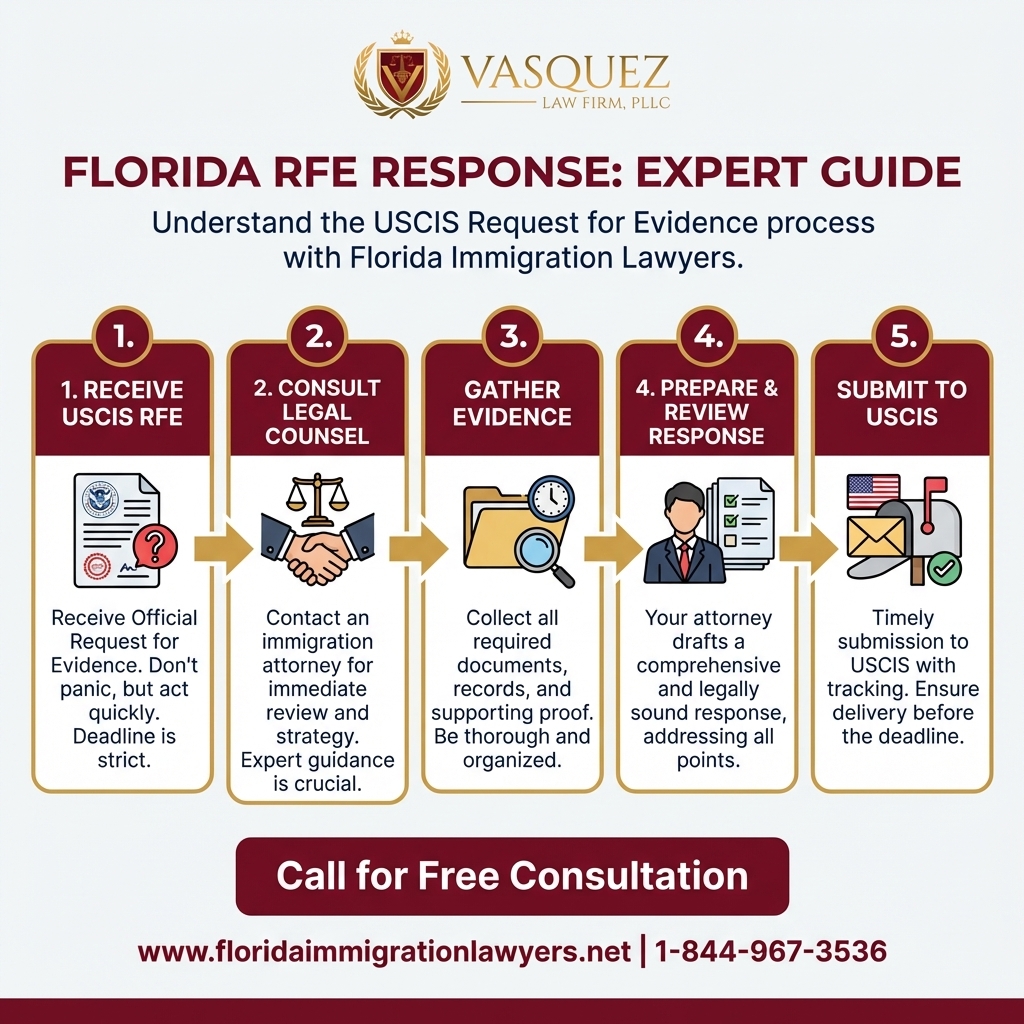
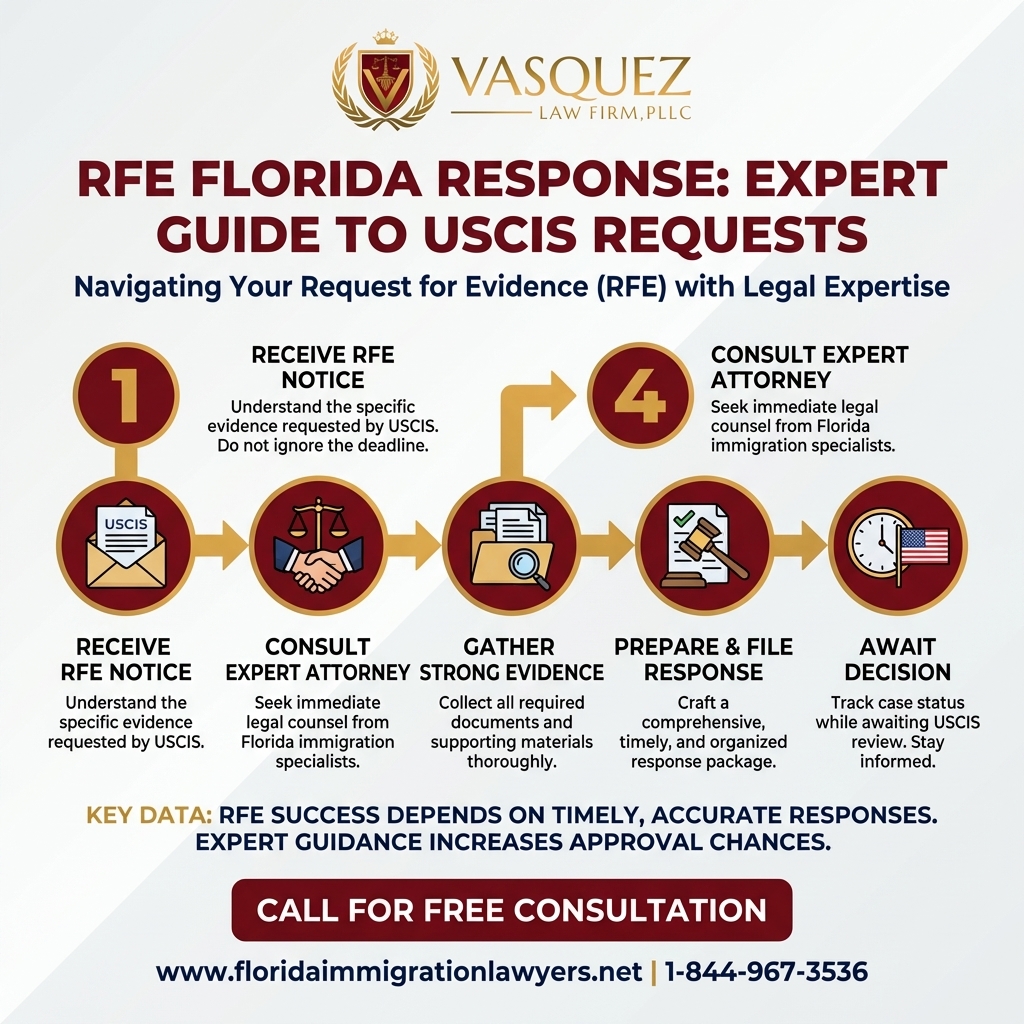
Responding to a USCIS RFE in Florida requires a methodical and precise approach. Missing any detail can lead to further delays or, worse, a denial of your application. Follow these crucial steps to ensure your RFE response is comprehensive and compelling:
-
Understand the RFE Completely: Do not just skim the letter. Read it multiple times, highlighting every specific document or piece of information requested. Identify the exact legal requirement USCIS believes you have not met. If the RFE refers to a specific section of the INA or CFR, look it up to understand the context. For applicants in Florida, especially those dealing with complex family or business immigration cases, this initial understanding is paramount. Our attorneys are skilled at interpreting intricate RFE requests.
-
Gather All Requested Documents and Evidence: This is the most critical step. Systematically collect every item listed in the RFE. If an exact document is unavailable, explain why and provide the best available secondary evidence. For example, if a birth certificate is unavailable, you might submit affidavits from individuals with personal knowledge, along with other corroborating records. Ensure all documents are current and valid. Remember, USCIS does not typically keep original documents, but for an RFE, they may request originals for review, which will be returned to you.
-
Organize Your Response Packet: A well-organized submission makes the USCIS officer's job easier and reduces the chance of misplacing documents. Create a cover letter that clearly lists each item you are submitting, cross-referencing it with the RFE's requests. Use tabs or dividers for different sections of evidence. Include a copy of the RFE notice on top of your submission. This structure is vital for any RFE response, whether you are filing from Orlando, Tampa, or Jacksonville.
-
Draft a Detailed Cover Letter: Your cover letter should serve as a roadmap for the USCIS officer. It should clearly state your name, application receipt number, and the type of application. Address each point of the RFE, explaining how the enclosed evidence satisfies the request. If you are unable to provide a specific document, explain the circumstances and present alternative evidence, citing relevant immigration law or policy. This narrative is your opportunity to clarify any ambiguities in your initial filing.
-
Review and Double-Check Everything: Before mailing, meticulously review your entire response packet. Check for completeness, accuracy, and clarity. Ensure all documents are properly translated if necessary, and that no pages are missing. Have a trusted person, or ideally, an attorney, review it as well. A small error can lead to further delays or even a denial. This final review is critical for all Florida applicants.
-
Submit Your Response Timely: RFEs come with strict deadlines, typically 60 to 90 days from the date of the RFE. The exact deadline will be printed on the RFE letter. You must mail your response by the deadline, ensuring it is postmarked on or before the due date. Missing the deadline will almost certainly result in a denial of your application. Use a reliable mailing service with tracking. For urgent assistance, contact Florida Immigration Lawyers immediately.
Essential Document Checklist for Your RFE Response
The documents requested in an RFE can vary widely depending on the specific immigration benefit and the perceived deficiency in your initial application. However, there are common categories of evidence that USCIS frequently requests. Always refer to your specific RFE letter for the exact requirements. Here is a general checklist of document types you might need to gather:
- Proof of Identity and Status: Birth certificates, passports, national ID cards, previous visa stamps, I-94 records, marriage certificates, divorce decrees.
- Financial Documentation: Tax returns (Form 1040, W-2s, 1099s), bank statements, employment verification letters, pay stubs, affidavits of support (Form I-864) with all supporting documents, proof of assets.
- Relationship Evidence (for family-based petitions): Marriage certificates, birth certificates of children, joint bank accounts, joint leases/mortgages, utility bills in both names, photographs, affidavits from friends and family, shared insurance policies, joint tax returns, evidence of cohabitation. For applicants in Kissimmee and other Florida cities, demonstrating genuine marital or familial relationships is often a key focus of RFEs.
- Educational and Professional Credentials: Diplomas, transcripts, professional licenses, letters from previous employers, résumés, skill certifications.
- Medical Records: Updated Form I-693 (Report of Medical Examination and Vaccination Record), specific test results, vaccination records.
- Criminal Records: Certified court dispositions for any arrests or convictions, police clearance certificates from all places of residence, even if charges were dismissed or expunged. This is particularly relevant in Florida where different county courts handle these records.
- Affidavits: Sworn statements from individuals who have personal knowledge of facts relevant to your case, notarized and detailed.
- Translations: All foreign language documents must be accompanied by a complete English translation certified by a competent translator. The translator must attest that they are proficient in both languages and that the translation is accurate.
- Evidence of Bona Fide Employment (for employment-based cases): Detailed job offer letters, company financial statements, organizational charts, proof of business necessity, client contracts.
Ensure that all copies are clear and legible. If USCIS requests originals, they will typically state this explicitly in the RFE. For comprehensive support with your family immigration case, visit our family immigration page.
RFE Response Timelines and Processing Expectations for Florida Applicants
The timeline for responding to an RFE is strictly enforced by USCIS. Typically, you will be given a period of 60 to 90 days from the date the RFE was issued to submit your complete response. The exact deadline will be clearly stated on your RFE letter. It is crucial to mark this deadline immediately upon receiving the RFE and begin preparing your response without delay. Do not wait until the last minute, as gathering documents and obtaining translations can take significant time.
Once USCIS receives your RFE response, the processing of your application will resume. The time it takes for USCIS to make a decision after receiving an RFE response can vary significantly. There is no set standard, and it depends on several factors, including the type of application, the USCIS service center or field office handling your case, and their current workload. You can monitor typical processing times by visiting the USCIS processing times page online. This resource provides estimated timeframes based on form type and field office or service center jurisdiction, which can be particularly helpful for Florida residents whose cases might be processed at various centers across the country.
It is important to understand that an RFE will inevitably extend the overall processing time for your application. The initial review, the time you take to respond, and the subsequent review by USCIS all add to the total duration. While frustrating, a timely and thorough RFE response is your best strategy for a positive outcome and to avoid further delays. If your case involves consular processing outside the U.S., the U.S. Department of State website also offers valuable information regarding visa processing times and procedures, which may be impacted by an RFE. Keeping track of your application status online using your receipt number is also a good practice.
Cost Factors and Fee Breakdown for RFE Responses
While USCIS does not charge a separate fee for submitting an RFE response itself, there are several indirect costs that applicants in Florida should anticipate. These expenses are in addition to the initial application filing fees you have already paid. Understanding these potential costs is important for financial planning during your immigration journey.
- Document Acquisition Fees: You might incur costs to obtain new copies of birth certificates, marriage licenses, divorce decrees, police clearance certificates, or other vital records. For instance, obtaining certified copies from Florida's Department of Health or county courthouses will involve a fee.
- Translation Services: If any of your supporting documents are in a foreign language, they must be accompanied by a certified English translation. Professional translation services can range from $20 to $100 or more per page, depending on the language and complexity.
- Medical Examination Updates: If your RFE requests an updated medical exam (Form I-693) because the previous one has expired, you will need to pay for a new exam with a USCIS-approved civil surgeon. These fees typically range from $200 to $500 or more, not usually covered by health insurance.
- Attorney Fees: This is often the most significant cost, but also one of the most valuable investments. Engaging an experienced immigration attorney to review your RFE, assist in gathering evidence, draft the response letter, and organize the packet can prevent costly mistakes and increase your chances of approval. Legal fees for RFE responses vary depending on the complexity of the RFE and the attorney's experience.
- Postage and Shipping: Sending your RFE response via certified mail with tracking or a courier service will incur costs, typically ranging from $5 to $50, depending on the service level.
It is important to budget for these potential expenses when preparing your RFE response in Florida. While some costs are unavoidable, investing in legal expertise can save you from far greater financial and emotional burdens associated with delays or denials. Our experienced attorneys at Florida Immigration Lawyers provide transparent fee structures and invaluable guidance for RFE responses.
Do not navigate this process alone. Contact Florida Immigration Lawyers today.
Common Mistakes to Avoid When Responding to an RFE
Responding to a Request for Evidence (RFE) is a critical step, and even small errors can have significant consequences. Many applicants in Florida make common mistakes that can jeopardize their immigration case. Be aware of these pitfalls:
-
Ignoring the Deadline: This is perhaps the most critical mistake. RFEs come with a strict response deadline, typically 60 to 90 days. Missing this deadline will almost always result in the denial of your application or petition, requiring you to start the entire process over and pay new filing fees. Always prioritize submitting your RFE response on time.
-
Submitting Incomplete Information: Only providing some of the requested documents or evidence is a common error. USCIS expects a complete response to every item listed in the RFE. If you cannot provide a specific document, you must clearly explain why and offer the best available secondary evidence.
-
Sending Unrequested Documents: While it might seem helpful to provide extra information, sending documents not specifically requested can confuse the USCIS officer, complicate your case, and potentially delay processing. Stick strictly to what the RFE asks for.
-
Failing to Provide Certified Translations: Any document in a foreign language must be accompanied by a complete English translation certified by a competent translator. Failing to do so will render the document unusable by USCIS and is a common reason for further RFEs or denials.
-
Not Keeping Copies: Always make and retain a complete copy of everything you send to USCIS, including the RFE notice, your cover letter, and all supporting evidence. This serves as your record and is crucial if there are any discrepancies or if you need to appeal a decision.
-
Misunderstanding the RFE's Request: Sometimes, the language in an RFE can be complex. Misinterpreting what USCIS is truly asking for can lead to providing irrelevant evidence or failing to address the core issue. Seek clarification if you are unsure, preferably from an experienced attorney.
-
Making False Statements or Submitting Fraudulent Documents: Never, under any circumstances, provide false information or fraudulent documents. This can lead to severe consequences, including permanent bars from immigration benefits, criminal charges, and deportation.
-
Assuming USCIS Has Other Evidence: Do not assume that USCIS has access to information from other applications you have filed or from other government agencies. You must provide all requested evidence as if it were a new submission.
-
Not Attaching the RFE Notice: Always include the original RFE notice (or a clear copy) on top of your response packet. This helps USCIS quickly identify your case and the specific RFE being addressed.
-
Delaying Legal Consultation: Many applicants try to handle RFEs themselves and only seek legal help when it's too late. Consulting an attorney early can prevent mistakes and significantly improve your chances of success, especially for complex RFE responses.
-
Failing to Update Contact Information: Ensure USCIS always has your current mailing address. If you move while your application is pending, update your address with USCIS promptly to avoid missing important notices like an RFE.
When to Call a Lawyer for Your RFE in Florida
While some straightforward RFEs might be manageable for diligent applicants, many situations warrant the immediate attention of an experienced immigration attorney. If you are in Florida and have received an RFE, consider seeking legal counsel from Florida Immigration Lawyers in the following scenarios:
- Complex or Vague RFEs: If the RFE is difficult to understand, refers to obscure legal codes, or requests highly technical evidence, an attorney can help decipher its meaning and formulate an appropriate strategy.
- Difficulty Obtaining Requested Documents: If you are struggling to acquire specific documents, especially from foreign countries or if records are unavailable, an attorney can advise on acceptable secondary evidence or alternative proofs.
- Previous Denials or Immigration Issues: If you have a history of immigration denials, deportations, or other legal complications, your RFE response needs to be exceptionally strong. An attorney can address these past issues proactively. Explore our deportation defense page for more information.
- Public Charge Concerns: RFEs related to the public charge rule (INA § 212(a)(4)) can be particularly complex, requiring detailed financial documentation and legal arguments.
- Short Deadlines: If the RFE has a very short response window, an attorney can help expedite the process of gathering and organizing your evidence efficiently.
- Any Uncertainty or Stress: The immigration process is inherently stressful. If the RFE is causing significant anxiety or you are unsure about any aspect of your response, a lawyer provides peace of mind and expert guidance.
- Changes in Circumstances: If your personal circumstances (e.g., marital status, employment, address) have changed since your initial application, an attorney can advise on how these changes might impact your RFE response.
An attorney from Florida Immigration Lawyers will not only help you prepare a meticulous RFE response but also ensure that your submission adheres to all legal requirements, significantly increasing your chances of a favorable outcome. We serve clients across Florida, including Kissimmee, Orlando, and Miami, with dedication and expertise.
About Florida Immigration Lawyers
Florida Immigration Lawyers is a leading immigration law firm dedicated to serving individuals and families across the entire state of Florida. Our team of highly experienced and compassionate attorneys understands the complexities and challenges of the U.S. immigration system. We are committed to providing personalized, effective, and ethical legal representation to help our clients achieve their immigration goals.
We offer a comprehensive range of immigration legal services, including family-based immigration, employment visas, deportation defense, asylum claims, citizenship applications, and assistance with various USCIS forms and processes, such as responding to a Request for Evidence (RFE). Our deep understanding of federal immigration laws, combined with our local knowledge of Florida's diverse communities, allows us to provide tailored strategies for each unique case.
Choosing Florida Immigration Lawyers means choosing a partner who will stand by you every step of the way. We pride ourselves on clear communication, meticulous preparation, and unwavering advocacy for our clients. We offer free consultations to discuss your specific situation and are available 24/7 to address your urgent needs. Our team is bilingual, and Se Habla Español, ensuring that language is never a barrier to accessing quality legal representation. Contact us today at 1-844-967-3536 or visit our website at https://www.floridaimmigrationlawyers.net to learn how we can help you with your immigration journey in Florida.
Sources and References
- U.S. Citizenship and Immigration Services (USCIS)
- Executive Office for Immigration Review (EOIR)
- U.S. Department of State
- 8 U.S.C. Chapter 12 - Immigration and Nationality Act (INA)
- 8 CFR § 103.2(b)(8) - Applications, petitions, and other documents; general requirements.
- USCIS Policy Manual
Related services: immigration practice areas, citizenship and naturalization, asylum protection.
This article provides general legal information and is not intended as legal advice. Every case is unique, and outcomes depend on specific facts and circumstances. Contact an attorney for advice about your particular situation. Immigration laws are subject to change, and this content reflects the general understanding at the time of publication.
Do not let a Request for Evidence (RFE) become a roadblock to your American dream. With the right legal support, you can navigate this challenge successfully. Our dedicated team at Florida Immigration Lawyers is ready to provide the expert guidance you need. We offer free consultations and are available 24/7 to serve you. Call us today at 1-844-967-3536. Se Habla Español - Estamos aqui para ayudarle.
Do Not Navigate This Process Alone
Our experienced immigration attorneys are ready to fight for you. Get a free, confidential consultation today.
Se Habla Español
Frequently Asked Questions

William J. Vásquez
Founding Attorney · Vasquez Law Firm
U.S. Air Force veteran and immigration attorney with thousands of cases resolved. J.D., NCCU School of Law. AILA member. Admitted to the 4th, 5th, and 11th Circuit Courts.
Available 24/7 - Free Evaluations
Related Legal Services
Our Florida immigration attorneys can help you with asylum protection, deportation defense and citizenship and naturalization. Call today at 1-844-967-3536 for a free consultation.
Related Links
Related Topics
Free Legal Consultation
Discuss your case with our experienced attorneys. We're available 24/7.
Se Habla Español - Estamos aquí para ayudarle.
Related Articles
Understanding the Asylum One-Year Deadline in Florida
The asylum one-year filing deadline is critical for those seeking refuge in the U.S. Understanding exceptions and preparing your application carefully can influence the outcome of your asylum case. Contact Florida Immigration Lawyers for expert guidance.
Citizenship Application Delay in Florida: What to Know
Facing citizenship application delays in Florida? Discover the key reasons behind N-400 processing backlogs in 2026 and learn how to navigate them effectively. Whether you're in Homestead or elsewhere in Florida, our guide provides actionable insights and tips to help manage your citizenship journey. Contact Florida Immigration Lawyers for personalized support.
F-1 Reinstatement Student Visa Process in Florida | VLF Florida
F-1 reinstatement allows students in Coral Springs, Florida, to regain their student visa status if they have fallen out of status. This comprehensive guide covers eligibility, application steps, and common pitfalls, ensuring you are well-prepared. Contact Florida Immigration Lawyers at 1-844-967-3536 for a free consultation.
U Visa for Crime Victims in Florida: Key Insights | VLF Florida
Discover how the U Visa offers critical immigration relief for crime victims in Florida. Learn about eligibility, application steps, and why professional guidance is crucial. Call Florida Immigration Lawyers for expert assistance.
