Removal Conditional Green Card in Florida 2026
For individuals in Florida, obtaining a conditional green card through marriage is the first step towards permanent residency. However, this status requires a crucial process: the removal of conditions. This involves filing Form I-751, Petition to Remove Conditions on Residence, with USCIS, typically within 90 days before your conditional green card expires. You must present compelling evidence that your marriage was entered into in good faith and remains legitimate. Failure to adhere to strict deadlines or provide sufficient documentation can lead to severe consequences, including the termination of your residency and potential deportation. This comprehensive guide details the I-751 process, required documents, timelines, and common pitfalls to avoid in 2026. Florida Immigration Lawyers offers expert assistance to ensure a smooth transition from conditional to lawful permanent resident status. Call us today for a free case review.
To remove conditions on a conditional green card in Florida, you must generally file Form I-751, Petition to Remove Conditions on Residence, with USCIS. This petition is typically filed jointly with your petitioning spouse within the 90-day period before your conditional green card expires. It demonstrates that your marriage was entered into in good faith and not solely for immigration purposes. Failure to file on time or properly can lead to serious immigration consequences, including potential deportation. Seeking legal guidance from Florida Immigration Lawyers in Orlando, Central Florida, is highly recommended to ensure a smooth process and protect your residency status.
- File Form I-751 within 90 days before your conditional green card expires.
- Provide compelling evidence of a bona fide marriage.
- Understand the potential for an interview with USCIS.
- Seek a waiver if filing jointly is not possible (e.g., divorce, abuse).
- Consult an experienced immigration lawyer in Florida to avoid common pitfalls.
Navigating the complex landscape of U.S. immigration law can be challenging, especially when your residency status hinges on specific deadlines and detailed documentation. For many individuals in Orlando and across Florida, obtaining a conditional green card through marriage is the first step towards permanent residency. However, this status is not permanent; it comes with a crucial requirement: the removal of conditions.
The process of removing these conditions is critical for maintaining your legal status and ultimately achieving a full, unrestricted green card. It involves demonstrating to U.S. Citizenship and Immigration Services (USCIS) that your marriage was legitimate and ongoing. This article will provide a comprehensive guide to understanding the conditional green card removal process in 2026, focusing on the specific requirements, timelines, and potential challenges faced by immigrants in Florida.
From filing Form I-751, Petition to Remove Conditions on Residence, to preparing for potential interviews, we will cover every essential aspect. Our goal is to equip you with the knowledge needed to successfully transition from conditional resident to lawful permanent resident. Do not navigate this intricate process alone. Call Florida Immigration Lawyers at 1-844-YO-PELEO for a free case review and expert guidance tailored to your unique situation.
What is a Conditional Green Card and Why is it Conditional?
A conditional green card, also known as a CR1 visa or conditional permanent resident card, is typically issued to foreign nationals who have been married to a U.S. citizen or lawful permanent resident for less than two years at the time their green card is approved. This status is granted for a two-year period, distinguishing it from an unrestricted, 10-year green card. The primary reason for this conditional status, as outlined in the Immigration and Nationality Act (INA) Section 216 (8 U.S.C. § 1186a), is to deter marriage fraud.
USCIS implements this measure to ensure that marriages are entered into in good faith and not solely for the purpose of circumventing immigration laws. At the end of the two-year period, conditional residents must prove that their marriage was and remains legitimate. This requirement helps USCIS verify the authenticity of the marital relationship and prevents individuals from obtaining permanent residency through fraudulent means. For those residing in Orlando or other parts of Central Florida, understanding this initial conditional status is paramount before embarking on the next phase of their immigration journey.
The conditional nature means that your right to live and work permanently in the U.S. is not yet fully secured. Both the conditional resident and their petitioning spouse share the responsibility of demonstrating the bona fide nature of their marriage. If the conditions are not properly removed, the conditional green card holder could face serious consequences, including the termination of their residency status and potential deportation. This underscores the importance of meticulously preparing and filing the necessary petition to remove conditions.
How Do I Remove Conditions on My Green Card in Florida?
To remove conditions on your conditional green card in Florida, you must primarily file Form I-751, Petition to Remove Conditions on Residence, with USCIS. This petition is typically filed jointly with your U.S. citizen or lawful permanent resident spouse.
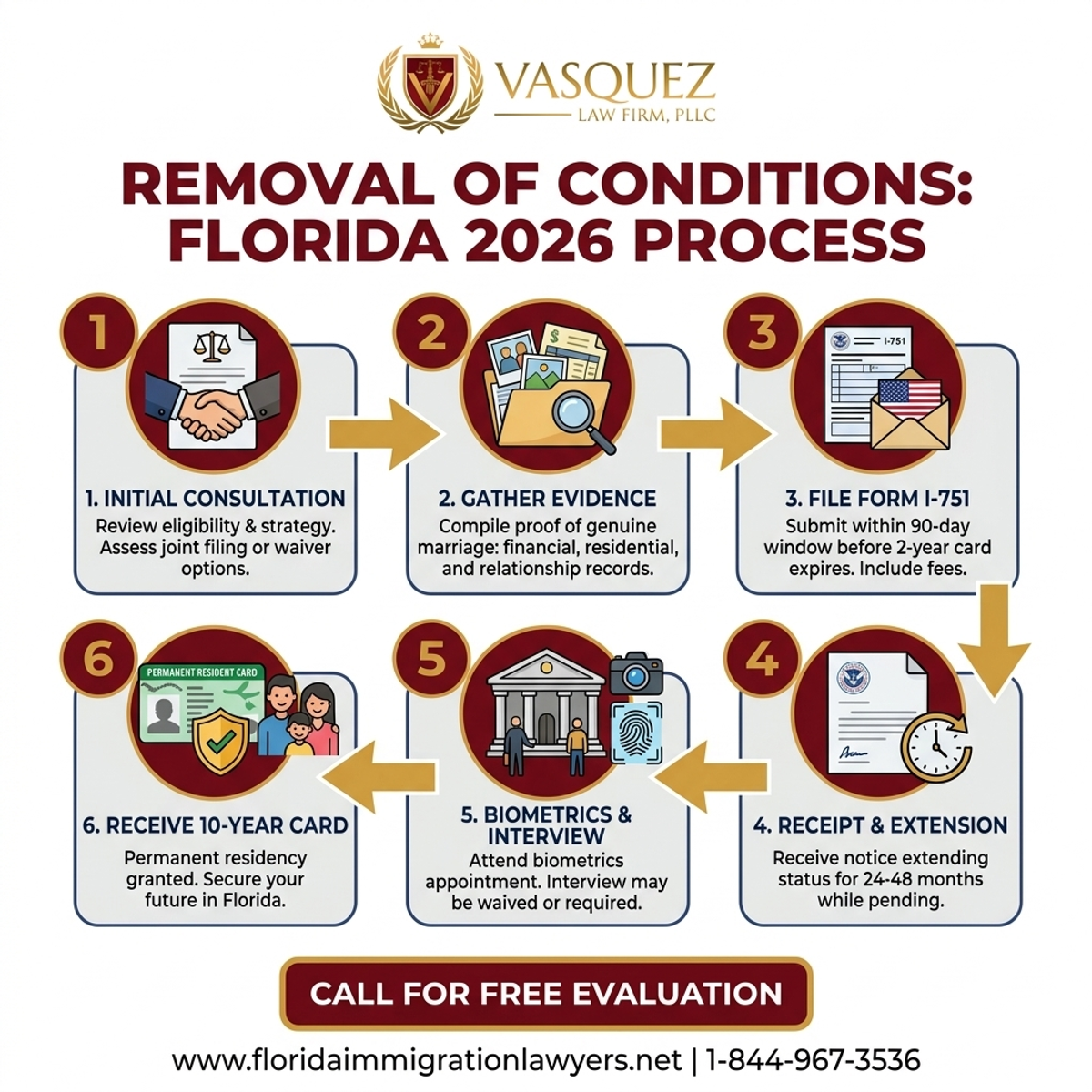
The process of removing conditions on your green card is a multi-step journey designed to prove the legitimacy of your marriage. As of 2026, the steps remain largely consistent, requiring careful attention to detail and adherence to strict deadlines. For residents in Central Florida, particularly around Orlando, understanding these steps is crucial for a successful outcome. Here is a detailed guide:
-
Determine Your Filing Eligibility and Window: You must file Form I-751 within the 90-day period immediately preceding the expiration date on your conditional green card. Filing too early or too late can result in the rejection of your petition and potentially lead to the termination of your conditional resident status. If your card has already expired, you may still be able to file with an explanation for the delay, but this complicates the process significantly. Always check your green card for the exact expiration date and mark your calendar.
-
Gather Comprehensive Supporting Evidence: This is arguably the most critical step. USCIS requires substantial evidence to prove that your marriage is bona fide and not entered into solely for immigration benefits. This includes, but is not limited to: joint financial documents (bank statements, tax returns, utility bills), joint property ownership or lease agreements, birth certificates of children born to the marriage, affidavits from friends and family, and photographs from various stages of your relationship. The more compelling and varied your evidence, the stronger your case.
-
Complete and File Form I-751: Accurately fill out Form I-751. Ensure all sections are completed and signed by both you and your petitioning spouse, if filing jointly. Attach all supporting documentation and the appropriate filing fee. You should make copies of everything you send to USCIS for your records. The form, along with instructions and mailing addresses, is available on the USCIS website.
-
Attend Biometrics Appointment: After filing, USCIS will send you a receipt notice and typically a notice for a biometrics appointment at an Application Support Center (ASC). For those in Florida, this might be the Orlando ASC or another location. You must attend this appointment to have your fingerprints, photograph, and signature taken. This data is used for background checks.
-
Respond to Requests for Evidence (RFE) or Notice of Intent to Deny (NOID): USCIS may send an RFE if they need more information or documentation to make a decision. A NOID indicates that USCIS intends to deny your petition unless you provide a strong rebuttal. Respond promptly and thoroughly to any such requests. This is often where legal counsel becomes invaluable.
-
Attend an Interview (If Required): While not all I-751 petitions require an interview, USCIS may schedule one if they have concerns about the legitimacy of the marriage or if the submitted evidence is insufficient. If an interview is scheduled, both spouses are generally required to attend. Be prepared to answer questions about your relationship, daily life, and shared experiences. Having an attorney present can provide significant support during an interview.
-
Receive a Decision: If your petition is approved, USCIS will send you a new, 10-year unrestricted green card. If it is denied, your conditional resident status will be terminated, and you may be placed in removal proceedings before an immigration judge at the Executive Office for Immigration Review (EOIR), such as the Miami or Orlando Immigration Court. In such a scenario, immediate legal action is critical.
What Documents Do I Need for Form I-751 Petition?
For your Form I-751 petition, you will need a robust collection of documents to prove your marriage's authenticity. This includes the original conditional green card, your marriage certificate, and extensive evidence of your shared life.
Successfully removing the conditions on your marriage green card requires presenting compelling evidence to USCIS. The strength of your petition largely depends on the quantity and quality of the supporting documents you provide. USCIS wants to see a clear pattern of commingled lives and shared responsibilities, indicating a genuine marital relationship. Below is a comprehensive checklist of documents typically required:
- Copy of Your Conditional Green Card (Front and Back): This is essential to prove your current status and the expiration date.
- Copy of Your Marriage Certificate: The official document proving your marriage.
- Birth Certificates of Children: If you have children born to your marriage, their birth certificates serve as strong evidence of a bona fide relationship.
- Joint Financial Documents:
- Joint bank account statements (checking, savings).
- Joint credit card statements.
- Joint tax returns (IRS transcripts are often preferred).
- Proof of joint loans (car loans, mortgages).
- Joint utility bills (electricity, water, gas, internet).
- Joint Property Ownership Documents:
- Copy of property deed or lease agreement showing both names.
- Mortgage statements or rent receipts.
Step-by-Step Process — Removal Conditional Green Card in Florida 2026
- Insurance Policies:
- Life insurance policies listing each other as beneficiaries.
- Health insurance policies covering both spouses.
- Auto insurance policies listing both spouses.
- Affidavits from Third Parties: Sworn statements from friends, family members, or employers who can attest to the legitimacy of your marriage. These should include the affiant's full name, address, date and place of birth, and relationship to you and your spouse, along with details of how they know your marriage is genuine.
- Photographs: A selection of dated photographs documenting your relationship over time, including wedding photos, family gatherings, vacations, and daily life.
- Correspondence: Joint mail, holiday cards, emails, or text messages that demonstrate ongoing communication and a shared life.
- Travel Documents: Copies of airline tickets, hotel reservations, or itineraries from joint trips.
- Other Evidence: Any other documents that can demonstrate the marital relationship, such as membership cards for organizations, clubs, or religious institutions.
- Waiver Request Documents (if applicable): If you are filing without your spouse due to divorce, annulment, abuse, or the death of your spouse, you will need specific documentation to support your waiver request. This can include divorce decrees, police reports, medical records, or a death certificate.
It is always advisable to organize your documents clearly, perhaps with tabs or an index, to make it easier for the USCIS officer to review your submission. For residents in Central Florida, our experienced family immigration lawyers can help you compile a robust package of evidence.
How Long Does the I-751 Process Take in 2026?
As of 2026, the I-751 process for removing conditions on a conditional green card can vary significantly, typically ranging from 12 to 24 months, sometimes longer, depending on the USCIS service center and individual case complexities.
The processing times for Form I-751 can be a source of anxiety for many conditional residents in Florida. While USCIS strives for efficiency, various factors can influence how long it takes to receive a final decision. These factors include the volume of applications, the thoroughness of your initial submission, whether an interview is required, and the specific USCIS service center handling your case. As of 2026, applicants should be prepared for a waiting period that can extend beyond a year.
During this waiting period, USCIS will issue a receipt notice (Form I-797C, Notice of Action) that automatically extends your conditional resident status, and your work authorization, typically for 24 months. This notice, along with your expired conditional green card, serves as proof of your continued legal status in the U.S. and allows you to travel internationally. It's crucial to keep this notice safe.
Below is a typical timeline for the I-751 process, though individual experiences may differ:
| Stage | Typical Timeframe (As of 2026) | Notes |
|---|---|---|
| File I-751 | Within 90 days before green card expires | Crucial deadline, avoid late filing. |
| Receipt Notice (I-797C) | 1-4 weeks after filing | Extends conditional status for 24 months; allows continued work and travel. |
| Biometrics Appointment | 1-3 months after filing | Scheduled at an ASC, e.g., Orlando ASC for Central Florida residents. |
| Request for Evidence (RFE) | Variable (if needed) | Requires prompt and thorough response, adds to processing time. |
| Interview (if required) | 6-18 months after filing | Not all cases require an interview; depends on case complexity and evidence. |
| Decision on I-751 | 12-24+ months after filing | Approval results in 10-year green card; denial can lead to removal proceedings. |
It's important to monitor USCIS processing times online for the specific service center handling your petition. For those living in Orlando and Central Florida, while your application may be processed at a national service center, the local USCIS field office may be involved if an interview is scheduled. Patience and meticulous record-keeping are key during this extended period.
What Are the Costs Associated with Removing Conditional Status?
The costs associated with removing conditional status primarily include the USCIS filing fee for Form I-751 and the biometrics fee. Legal fees for an immigration attorney are additional but often a worthwhile investment.
Understanding the financial aspects of the I-751 process is crucial for effective planning. The fees associated with removing the conditions on your conditional green card are subject to change, so it's always important to verify the most current amounts directly on the USCIS website or by consulting an attorney. These fees are non-refundable, regardless of the outcome of your petition.
Beyond the government filing fees, you should also consider potential costs for gathering supporting documentation, such as fees for obtaining official records (birth certificates, marriage licenses), translation services for foreign-language documents, and postage. While these might seem minor individually, they can add up.
| Item | Typical Fee (As of 2026, subject to change) | Notes |
|---|---|---|
| Form I-751 Filing Fee | Varies, check USCIS website | Required for the petition itself. |
| Biometrics Fee | Varies, check USCIS website | Required for fingerprinting and background checks. |
| Attorney Fees | Variable, depends on case complexity and firm | Covers legal advice, document preparation, and representation. |
| Translation Services | Variable, per document | If any supporting documents are not in English. |
| Document Procurement | Variable | Costs for obtaining official records (e.g., vital records, tax transcripts). |
| Postage/Shipping | Variable | For sending your petition to USCIS, certified mail recommended. |
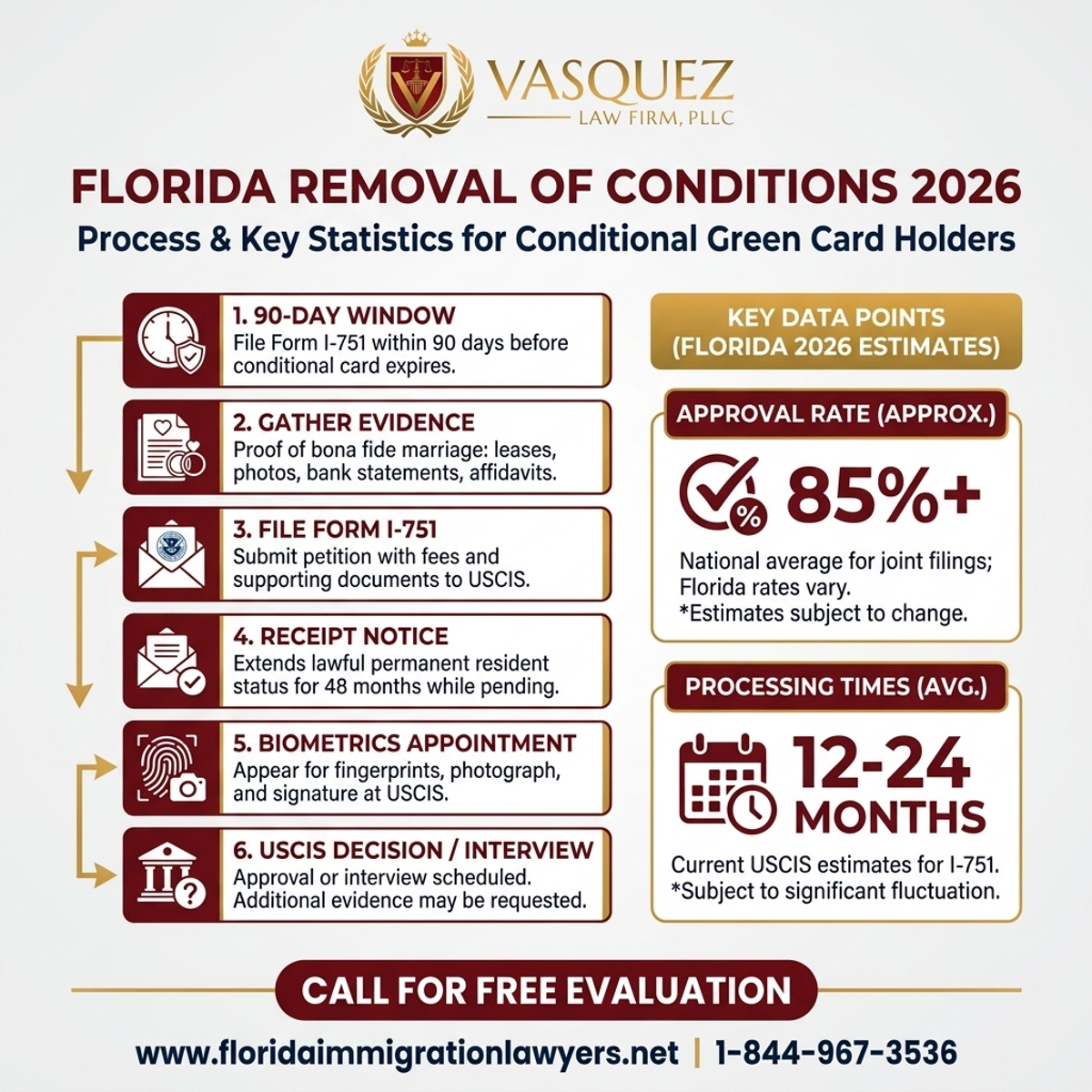
Key Statistics — Removal Conditional Green Card in Florida 2026
Investing in legal representation, while an additional cost, can significantly increase the likelihood of a successful outcome. An experienced immigration lawyer can help you prepare a strong petition, identify all necessary documents, avoid common mistakes, and represent you during an interview. For individuals and families in Orlando and throughout Central Florida, the peace of mind and security gained from professional legal assistance are often invaluable.
Do not navigate this complex process alone. Contact Florida Immigration Lawyers today for a free case review and let our experienced team guide you through every step of removing conditions on your green card.
Common Mistakes to Avoid When Removing Conditional Status
The process of removing conditions from your conditional green card is fraught with potential pitfalls that can jeopardize your immigration status. Avoiding these common mistakes is crucial for a successful outcome:
-
Failing to File on Time: The most critical mistake is not filing Form I-751 within the 90-day window before your conditional green card expires. Late filing can lead to automatic termination of your status and initiation of removal proceedings, making it much harder to recover.
-
Submitting Insufficient Evidence of a Bona Fide Marriage: Many applicants underestimate the amount and variety of evidence required. Simply stating you are married is not enough. USCIS needs compelling proof of a shared life, such as joint bank accounts, property deeds, utility bills, and extensive photographs. A weak evidence package is a primary reason for RFEs or denials.
-
Incomplete or Inaccurate Form I-751: Errors, omissions, or unanswered questions on the form can lead to delays or outright rejection. Double-check every field, ensure all required signatures are present, and verify that the information is consistent with your supporting documents.
-
Not Attending the Biometrics Appointment: Missing your scheduled biometrics appointment without proper rescheduling can severely delay your case and even lead to a denial. Always keep track of appointment notices and attend as required.
-
Ignoring Requests for Evidence (RFEs): If USCIS sends an RFE, it means they need more information. Failing to respond by the deadline, or providing an inadequate response, will almost certainly lead to a denial. Take RFEs very seriously and consider legal help to craft a comprehensive reply.
-
Believing an Interview is Never Required: While many I-751 cases are approved without an interview, assuming yours won't require one is risky. Be prepared for an interview at any point, especially if your evidence is weak or there are inconsistencies in your application. Practice discussing your relationship with your spouse.
-
Traveling Internationally Without Proof of Status Extension: After filing I-751, you'll receive a receipt notice (I-797C) extending your conditional status. Always carry this notice along with your expired conditional green card when traveling abroad to prove your continued legal status upon re-entry.
-
Failing to Seek a Waiver When Necessary: If your marriage has ended in divorce, your spouse is deceased, or you've experienced abuse, you may be eligible to file a waiver to remove conditions without your spouse. Failing to understand and apply for these waivers when appropriate can lead to denial.
-
Not Updating USCIS on Address Changes: Moving without notifying USCIS of your new address can result in missed notices, RFEs, or interview appointments, leading to delays or denial. Always file Form AR-11, Alien's Change of Address Card, promptly.
-
Misrepresenting Facts: Providing false information or misrepresenting facts about your marriage is a serious offense that can lead to immediate denial, accusations of immigration fraud, and permanent bars from future immigration benefits. Always be truthful and accurate.
When to Call a Lawyer for Conditional Green Card Removal
The process of removing conditions on your conditional green card can be complex, and certain situations make legal assistance not just helpful, but essential. Knowing when to call a lawyer can make the difference between a successful outcome and significant immigration challenges.
You should consider contacting Florida Immigration Lawyers if you:
- Are Approaching the 90-Day Filing Window: It's best to start preparing early. An attorney can help you organize documents and ensure timely submission.
- Need to File a Waiver: If your marriage has ended in divorce, your spouse is deceased, or you have suffered abuse, filing a waiver is complex and requires specific legal arguments and evidence.
- Have a Complicated Marital History: Previous divorces, short marriage duration, or past immigration issues can raise red flags for USCIS, making an attorney's guidance invaluable.
- Received a Request for Evidence (RFE) or Notice of Intent to Deny (NOID): These notices indicate that USCIS has concerns. A lawyer can help you formulate a strong, comprehensive response to address these issues effectively.
- Are Scheduled for an Interview: While not all I-751 petitions require an interview, if you receive a notice, having legal representation can provide crucial support and ensure you are well-prepared.
- Have Criminal History: Any past criminal arrests or convictions, even minor ones, can complicate your immigration case and require expert legal analysis.
- Are Concerned About Deportation: If your conditional green card has expired and you haven't filed, or if your petition has been denied, you may be placed in removal proceedings. Immediate legal intervention is critical.
- Are Unsure About Required Documentation: A lawyer can help you identify and gather all necessary evidence to build a strong case, especially for unique situations in Florida.
Florida Immigration Lawyers has extensive experience assisting individuals in Orlando and across Central Florida with their I-751 petitions. Our team understands the nuances of immigration law and can provide the personalized support you need.
About Florida Immigration Lawyers
Florida Immigration Lawyers is a leading law firm dedicated to providing comprehensive and compassionate immigration legal services to individuals and families throughout Florida. With our main office strategically located in Orlando, we are deeply committed to serving the diverse communities of Central Florida and beyond. Our team of skilled attorneys possesses a profound understanding of U.S. immigration law, offering expert guidance on a wide range of issues, including conditional green card removal, family-based petitions, asylum, citizenship, and deportation defense. We pride ourselves on our client-focused approach, ensuring that every individual receives personalized attention and strategic legal solutions tailored to their unique circumstances. We are available 24/7 and offer free case reviews, making quality legal representation accessible. Choose Florida Immigration Lawyers for a dedicated advocate in your immigration journey.
Sources and References
- U.S. Citizenship and Immigration Services (USCIS)
- Executive Office for Immigration Review (EOIR)
- U.S. Department of State
- Immigration and Nationality Act (INA) Section 216 (8 U.S.C. § 1186a) - Conditional Permanent Resident Status
- 8 Code of Federal Regulations (CFR) Part 216 - Conditional Basis of Lawful Permanent Resident Status
- USCIS Policy Manual
Related services: family petition process, family-based green cards, fiancé visa (K-1), marriage-based immigration.
This article provides general legal information and is not intended as legal advice. Every case is unique, and outcomes depend on specific facts and circumstances. Contact an attorney for advice about your particular situation.
The journey to permanent residency is a significant one, and the removal of conditions on your conditional green card is a critical step. Do not leave your future to chance. With the complexities of immigration law and the importance of timely, accurate filing, having experienced legal counsel is invaluable. Florida Immigration Lawyers is here to provide the support and representation you need to navigate this process successfully. Contact us today at 1-844-YO-PELEO for a free case review. Se Habla Español - Estamos aquí para ayudarle.
Do Not Navigate This Process Alone
Our experienced immigration attorneys are ready to fight for you. Get a free, confidential case review today.
Se Habla Español
Or leave your details and we’ll call you:
Free Evaluation in 24 Hours
Or talk to us right now

AI voice assistant — available 24/7
FreeFrequently Asked Questions

William J. Vásquez
Founding Attorney · Vasquez Law Firm
U.S. Air Force veteran and immigration attorney with years of hands-on U.S. immigration experience. J.D., NCCU School of Law. AILA member. Admitted to the 4th, 5th, and 11th Circuit Courts.
Available 24/7 - Free Evaluations
Reviewed for legal accuracy by William J. Vásquez
Licensed in North Carolina; U.S. immigration is federal practice.
Related Legal Services
Our Florida immigration attorneys can help you with citizenship and naturalization, immigration practice areas and free immigration consultation. Call today at 1-844-YO-PELEO for a free case review.
Related Links
Related Topics
Free Legal Case Review
Discuss your case with our experienced attorneys. We're available 24/7.
Se Habla Español - Estamos aquí para ayudarle.
Related Articles
DUI Immigration Consequences in Florida 2026
A DUI conviction in Florida can have severe immigration consequences, potentially leading to inadmissibility, deportation, or denial of immigration benefits. For non-citizens, a DUI is not just a traffic offense but a serious criminal matter that federal immigration law scrutinizes closely. Factors like multiple offenses, injury, or property damage can escalate a simple DUI to a Crime Involving Moral Turpitude (CIMT) or even an aggravated felony, triggering mandatory detention and removal proceedings. Understanding the specific nature of your Florida conviction and its interpretation under the Immigration and Nationality Act (INA) is crucial. This article outlines how DUIs impact immigration status, the grounds for inadmissibility and deportation, a step-by-step guide to navigating the process, essential documentation, and expected timelines for 2026. We also highlight common mistakes to avoid and when to seek legal counsel from an experienced immigration attorney. Florida Immigration Lawyers offers comprehensive support for individuals facing these challenging situations, providing expert guidance through complex legal landscapes.
Immigration Lawyer Orlando Free Consultation in Florida
For individuals and families in Orlando, Florida, navigating the complexities of U.S. immigration law requires expert guidance. An immigration lawyer in Orlando offers crucial support for everything from visa applications and green card processes to naturalization and deportation defense. This comprehensive guide details what a free consultation covers, providing a step-by-step overview of immigration pathways, essential document checklists, and expected timelines in 2026. We also highlight common mistakes to avoid, discuss the critical role of legal counsel in deportation and asylum cases, and explain why choosing a local Orlando immigration attorney is beneficial. Florida Immigration Lawyers is dedicated to serving the diverse community of Orlando with compassionate, effective legal solutions, ensuring you receive personalized advice and robust representation for a successful immigration journey.
EAD Advance Parole Combo Card in Florida: What You Need
An EAD advance parole combo card allows individuals with pending adjustment applications to both work and travel abroad without jeopardizing their green card application. Learn how to apply in Florida, what documents you need, and common mistakes to avoid.
Dual Citizenship Lawyer in Florida: What You Need to Know
For Florida residents, the concept of dual citizenship, or holding two passports, offers a compelling blend of opportunities and challenges. While the U.S. generally permits dual nationality, the path to achieving this status requires a meticulous understanding of both U.S. immigration laws and the citizenship policies of your country of origin. This guide explores the definition of dual citizenship, the detailed step-by-step process for U.S. naturalization, and the significant benefits and potential pitfalls involved. We cover essential documentation, typical timelines, and cost considerations for 2026, providing crucial insights for anyone in Orlando, Miami, or across Florida considering this important legal step. Learn about common mistakes to avoid and understand when to seek professional legal counsel to navigate this complex process successfully. Florida Immigration Lawyers is here to provide expert, bilingual support for your dual citizenship journey.