Removal Conditional Green Card: I-751 Guide for Florida 2026
If you hold a conditional green card in Florida, understanding the Form I-751 process for removing these conditions is vital for securing your permanent residency. This temporary status, granted to marriage-based green card holders whose marriage was less than two years old, requires a formal petition to USCIS. Our comprehensive guide details the step-by-step process, critical documentation, expected timelines as of 2026, and associated costs. We also highlight common mistakes to avoid and specific scenarios where legal counsel from an experienced Florida immigration lawyer is indispensable. From joint filings to complex waivers due to divorce or abuse, Florida Immigration Lawyers provides expert guidance, ensuring your petition is meticulously prepared and submitted. Protect your future in the U.S. by understanding your options and seeking professional assistance.
To remove conditions on your green card in Florida, you must generally file Form I-751, Petition to Remove Conditions on Residence, with U.S. Citizenship and Immigration Services (USCIS) within the 90-day period before your conditional green card expires. This process demonstrates that your marriage was entered into in good faith and not solely to obtain an immigration benefit. Failure to file on time or with sufficient evidence can lead to the termination of your permanent resident status and potential deportation. Seeking legal guidance from an experienced immigration attorney in Florida is highly recommended to ensure a smooth and successful outcome.
- File Form I-751 within 90 days of green card expiration.
- Provide extensive evidence of a bona fide marriage.
- Consider a waiver if filing jointly is not possible.
- Processing times can vary, often taking 12-24 months.
- Legal assistance is crucial for complex or challenging cases.
Navigating the complexities of U.S. immigration law can feel overwhelming, especially when your permanent residency status hangs in the balance. If you received a marriage-based green card less than two years after your marriage, it was issued with a conditional status. This means your residency is temporary, and you must take specific steps to remove these conditions and obtain a permanent green card. For many couples in Florida, understanding the Form I-751 process, its requirements, and potential pitfalls is a critical step toward securing their future in the United States.
This comprehensive guide from Florida Immigration Lawyers will walk you through everything you need to know about the removal of conditional green card status, with a particular focus on the unique considerations for residents in Orlando and across Florida. We'll cover eligibility, the application process, required documentation, timelines, and common mistakes to avoid. Our goal is to empower you with the knowledge needed to successfully transition from conditional to permanent residency. Do not face this intricate process alone; we are here to help. Call Florida Immigration Lawyers at 1-844-YO-PELEO for a free case review today.
What is a Conditional Green Card and Why is it Conditional?
A conditional green card is a temporary status granted to certain immigrants, primarily those who obtain their permanent residency through marriage to a U.S. citizen or lawful permanent resident, and whose marriage was less than two years old on the day they were granted permanent residence. This conditional status is established under Section 216 of the Immigration and Nationality Act (INA), found at 8 U.S.C. § 1186a. It means that while you are a lawful permanent resident, your status is not yet permanent and will expire after two years unless you take further action.
The primary reason for implementing conditional residency is to deter marriage fraud. USCIS wants to ensure that the marriage is genuine and was not entered into solely for immigration purposes. By requiring the couple to demonstrate the ongoing validity of their marriage after two years, the government aims to confirm that the marital relationship is bona fide. This two-year period allows USCIS to reassess the legitimacy of the marriage, requiring the couple to provide additional evidence of their shared life and commitment. Without successful removal of these conditions, the conditional green card holder's status will automatically terminate, potentially leading to deportation proceedings.
How Do I Remove Conditions on My Green Card in Florida?
To remove conditions on your green card in Florida, you must file Form I-751, Petition to Remove Conditions on Residence, with USCIS before the conditional green card expires. This petition must be accompanied by substantial evidence proving that your marriage was, and continues to be, bona fide.
The process of removing conditions on your green card in Florida involves several critical steps, ensuring that USCIS verifies the authenticity of your marriage. Missing a deadline or failing to provide adequate documentation can have severe consequences, including the loss of your immigration status. Here is a detailed step-by-step guide to help you navigate this essential process:
-
Determine Your Eligibility and Filing Method: Most commonly, you and your petitioning spouse will file Form I-751 jointly. This means both of you sign the petition, affirming that your marriage is ongoing and legitimate. However, there are specific circumstances where you may be eligible to file a waiver, allowing you to petition alone. These waivers are typically available if your marriage ended through divorce or annulment, if your spouse abused you, or if the termination of your status would result in extreme hardship. Understanding which method applies to your situation is the first crucial step.
-
Gather Required Documents: This is arguably the most critical part of the process. You must collect comprehensive evidence demonstrating the bona fide nature of your marriage from its inception up to the present day. This includes financial documents, evidence of cohabitation, birth certificates of any children born to the marriage, and affidavits from friends and family. The more compelling and varied your evidence, the stronger your case will be.
-
Complete Form I-751: Carefully fill out Form I-751, Petition to Remove Conditions on Residence. Ensure all sections are completed accurately and truthfully. Any discrepancies or omissions can lead to delays or a Request for Evidence (RFE). If you are filing a waiver, be sure to select the correct reason on the form and provide all necessary supporting documentation for that specific waiver category.
-
Pay Filing Fees: As of 2026, there is a USCIS filing fee for Form I-751, as well as a biometrics services fee. These fees are subject to change, so always check the USCIS website for the most current amounts before filing. You can pay by money order, personal check, cashier's check, or credit card using Form G-1450, Authorization for Credit Card Transactions.
-
Submit Your Petition: Mail your completed Form I-751, all supporting documentation, and the correct fees to the appropriate USCIS Lockbox facility. The specific mailing address depends on where you live in Florida and whether you are sending it via U.S. Postal Service or courier. Always refer to the official Form I-751 instructions on the USCIS website for the correct mailing address to avoid misdirection and delays.
-
Attend Biometrics Appointment: After USCIS accepts your petition, you will receive a receipt notice (Form I-797C, Notice of Action), which extends your conditional resident status for a specified period, typically 24 months. Shortly after, you will receive an appointment notice for biometrics (fingerprints, photograph, and signature) at a local Application Support Center (ASC), such as the one in Orlando, Florida. It is mandatory to attend this appointment.
-
Interview (If Required): While not all I-751 petitioners are required to attend an interview, USCIS may schedule one if they have questions about your petition or the bona fides of your marriage. If an interview is scheduled, it will typically take place at your local USCIS field office, such as the Orlando, FL Field Office, or another office serving your area of Florida. Both spouses must attend if filing jointly.
-
Receive Decision: Once USCIS has reviewed all evidence and conducted any necessary interviews, they will make a decision on your petition. If approved, you will receive a new permanent green card, valid for 10 years. If denied, you may be issued a Notice to Appear (NTA) in immigration court, initiating deportation proceedings. This underscores the importance of a meticulously prepared petition.
Successfully navigating these steps is crucial for securing your long-term residency. For personalized guidance throughout this process, consider consulting with a qualified attorney at Florida Immigration Lawyers, specializing in family immigration matters.
What Documents are Needed for the I-751 Petition?
You'll need extensive proof of a bona fide marriage for the I-751 petition, including joint financial documents, evidence of shared residence, birth certificates of any children born to the marriage, and notarized affidavits from friends and family who can attest to your genuine relationship.
The strength of your Form I-751 petition hinges on the quality and quantity of supporting documentation you provide to USCIS. These documents serve as tangible proof that your marriage is real and ongoing, not merely a means to obtain immigration benefits. Gathering a comprehensive collection of evidence is paramount for a successful outcome. Here is a detailed checklist of documents typically required:
- Copy of Your Conditional Green Card: Provide clear photocopies of both the front and back of your conditional permanent resident card.
- Copy of Your Marriage Certificate: A certified copy of your marriage certificate is fundamental proof of your legal union.
- Birth Certificates of Children: If you have children born of your marriage, include copies of their birth certificates. This is strong evidence of a shared life and family unit.
- Joint Financial Documents:
- Joint bank account statements (checking, savings).
- Joint credit card statements.
- Joint tax returns (federal and state) for the past two years.
- Joint utility bills (electricity, water, gas, internet) showing both names at the same address.
- Joint loan agreements (car loans, mortgages).
- Evidence of Shared Residence:
- Joint lease agreements or property deeds for your home in Florida.
- Mortgage statements or rent receipts in both names.
- Utility bills addressed to both spouses at the same address.
- Insurance Policies:
- Life insurance policies listing each other as beneficiaries.
- Health insurance policies covering both spouses.
- Auto insurance policies listing both spouses and shared vehicles.
Step-by-Step Process — Removal Conditional Green Card: I-751 Guide for Florida 2026
- Other Commingling of Assets:
- Investment accounts held jointly.
- Joint retirement accounts.
- Wills or estate planning documents naming each other as beneficiaries.
- Affidavits from Third Parties: Sworn statements (affidavits) from friends, family members, or employers who can attest to the bona fide nature of your marriage. These should include the full name and address of the person making the statement, how they know both spouses, and details about the marriage.
- Photographs: A selection of photographs showing you and your spouse together over time, with family, friends, and at significant events. Date and caption these photos to provide context.
- Travel Documents: Copies of airline tickets, hotel reservations, or itineraries from vacations taken together.
- Correspondence: Joint holiday cards, letters, or emails addressed to both spouses.
- If Filing a Waiver: Additional documents specific to your waiver request (e.g., divorce decree, police reports, medical records, or affidavits of abuse).
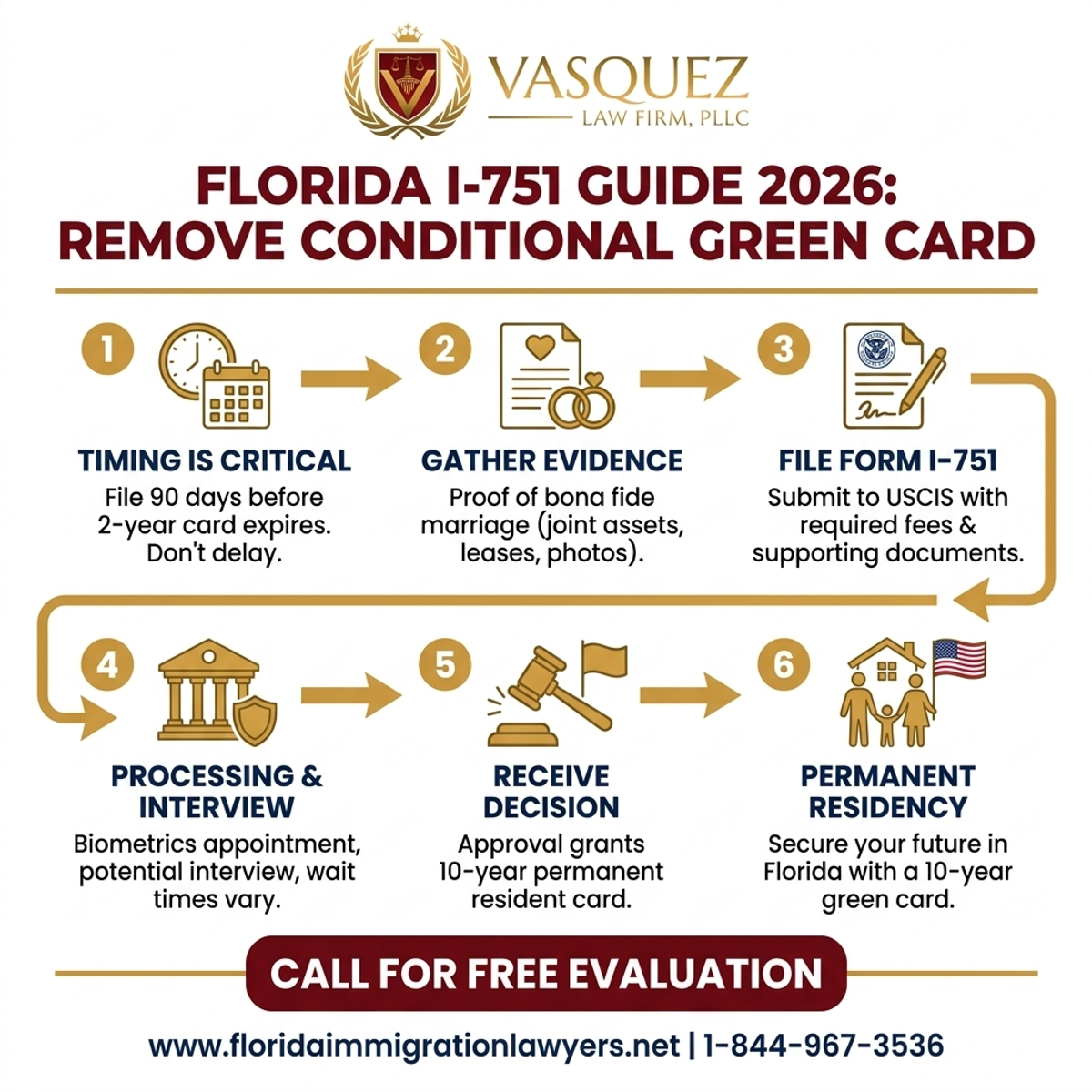
Organizing these documents thoroughly is crucial. USCIS prefers to see a wide range of evidence spanning the entire two-year conditional period. For residents in Central Florida, our attorneys can help you identify and organize the strongest evidence for your specific case.
How Long Does I-751 Processing Take in 2026?
As of 2026, I-751 processing times can vary significantly, typically ranging from 12 to 24 months, but some cases may take longer depending on the USCIS service center, the complexity of the case, and whether an interview is required.
The timeline for Form I-751 processing can be a source of anxiety for many applicants in Florida. It is important to understand that processing times are estimates and can fluctuate based on several factors, including the volume of applications at a particular USCIS service center, the thoroughness of your initial submission, and whether your case requires an interview or additional evidence. Here is a general overview of what to expect:
| Stage | Typical Timeframe (As of 2026) | Notes |
|---|---|---|
| Filing to Receipt Notice (I-797C) | 2-4 weeks | Immediately extends conditional status, allowing continued work and travel. |
| Biometrics Appointment Notice | 4-8 weeks after receipt notice | Scheduled at a local Application Support Center (ASC) in Florida. |
| Biometrics Appointment | Within 2-4 weeks of notice | Mandatory for fingerprints, photos, and signature. |
| Interview (if required) | 6-12 months after biometrics | Conducted at a local USCIS field office, such as Orlando. Not all cases require an interview. |
| Decision (Approval or RFE/NOID) | 12-24 months total from filing | Time can vary significantly. Check USCIS online tools for case status. |
| Receipt of 10-Year Green Card | 2-4 weeks after approval | The physical card is mailed to you. |
It is crucial to note that during the entire processing period, your conditional permanent resident status is typically extended by the receipt notice (Form I-797C). This notice, along with your expired conditional green card, serves as proof of your continued lawful status for employment and travel. Always check the official USCIS processing times page for the most up-to-date information, as these estimates can change. If your case is taking significantly longer than the posted processing times, it may be advisable to consult with an immigration attorney.
What are the Costs Associated with Filing Form I-751?
The main costs for Form I-751 involve the USCIS filing fee and the biometrics fee, which are subject to periodic changes. Legal fees for attorney assistance are an additional, but often invaluable, investment.
Understanding the financial commitment involved in filing Form I-751 is an important part of planning your journey to permanent residency. USCIS fees are standardized across the country, including for applicants in Florida, but they can change over time. It is essential to refer to the most current information directly from USCIS to ensure you submit the correct amount. Here's a breakdown of typical costs you can expect:
| Item | Typical Fee (As of 2026) | Notes |
|---|---|---|
| USCIS Form I-751 Filing Fee | Varies; check USCIS website | This is the fee for processing your Petition to Remove Conditions. |
| Biometrics Services Fee | Varies; check USCIS website | Required for fingerprinting and background checks for each applicant. |
| Attorney Fees | Varies significantly | For legal guidance, document preparation, representation at interviews, and responding to RFEs. |
| Translation Fees | Varies | If any supporting documents are not in English, certified translations are required. |
| Postage/Courier Fees | Minor | Costs for mailing your application package, especially if using certified mail or a courier service. |
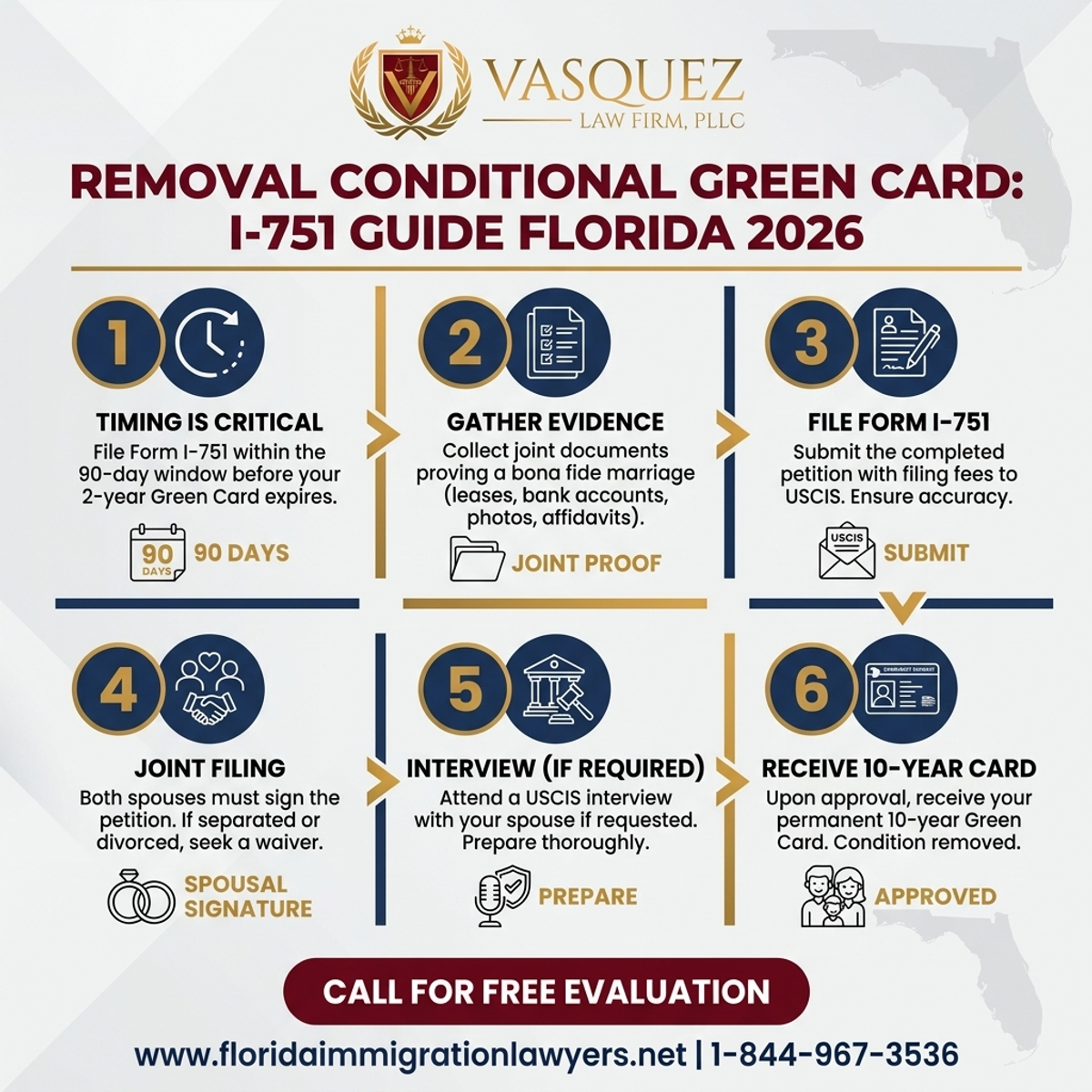
Key Statistics — Removal Conditional Green Card: I-751 Guide for Florida 2026
It is vital to always verify the most up-to-date fees directly on the USCIS website or by consulting an immigration attorney. Incorrect payment can lead to your application being rejected and returned, causing significant delays. While attorney fees are an additional expense, the peace of mind and increased likelihood of success that comes with expert legal representation can be invaluable, especially for complex cases or those involving waivers. Florida Immigration Lawyers offers free case reviews to help you understand your options.
Do not navigate this complex immigration process alone. The stakes are too high to risk errors or omissions that could jeopardize your future in the United States. Contact Florida Immigration Lawyers today for a free case review and let our experienced team guide you.
Common Mistakes to Avoid When Filing Form I-751
Filing Form I-751 is a precise process, and even minor errors can lead to significant delays, Requests for Evidence (RFEs), or even denial. For Florida residents, being aware of these common pitfalls can save you time, stress, and potential legal complications.
-
Filing Late: The most critical mistake is failing to file Form I-751 within the 90-day window before your conditional green card expires. Filing late without a compelling reason or approved waiver can result in the automatic termination of your permanent resident status and the initiation of deportation proceedings.
-
Insufficient Evidence of a Bona Fide Marriage: Many applicants underestimate the amount and variety of evidence required. Submitting only a few joint bank statements or photos is often insufficient. USCIS needs to see a comprehensive picture of your shared life over the entire two-year conditional period.
-
Failing to Update Address with USCIS: If you move within Florida or to another state, you must inform USCIS within 10 days of your new address. Failure to do so can result in missed notices, appointment letters, or RFEs, leading to significant problems with your case.
-
Ignoring Requests for Evidence (RFEs): If USCIS sends an RFE, it means they require more information or clarification. Failing to respond fully and on time can lead to a denial of your petition. It's crucial to understand what is being asked and provide it promptly.
-
Misrepresenting Facts or Providing False Information: Any attempt to deceive USCIS, provide false documents, or misrepresent facts about your marriage will lead to an immediate denial, potential criminal charges, and a permanent bar from future immigration benefits.
-
Filing Jointly After Separation or Divorce Without a Waiver: If your marriage has ended, you cannot file a joint petition. You must file with a waiver based on divorce, abuse, or extreme hardship. Filing jointly when the marriage is no longer viable is considered fraud.
-
Not Attending Biometrics or Interview: Missing your scheduled biometrics appointment or an interview without proper rescheduling can result in your petition being considered abandoned and subsequently denied.
-
Assuming Conditional Status is Permanent: Some individuals mistakenly believe their conditional green card automatically transitions to permanent status. This is incorrect; the I-751 petition is a mandatory step for almost all conditional residents.
-
Not Seeking Legal Advice for Complex Cases: If you have a criminal history, a previous immigration violation, your marriage has ended, or you have received an RFE, attempting to navigate the I-751 process alone can be extremely risky. An immigration attorney can identify potential issues and build a strong case.
When to Call a Lawyer for Your I-751 Petition
While some straightforward I-751 cases can be handled independently, many situations warrant the expertise of an experienced immigration lawyer. The consequences of errors can be severe, potentially leading to the loss of your green card and deportation. Knowing when to seek professional legal help is crucial for safeguarding your future in Florida.
You should strongly consider contacting Florida Immigration Lawyers if any of the following scenarios apply to your situation:
- Divorce or Separation: If your marriage has ended or is in the process of ending, you will need to file a waiver to the joint filing requirement. This is a complex area, and an attorney can help you determine eligibility and prepare a robust waiver petition.
- Abuse or Extreme Cruelty: If you are a victim of spousal abuse or extreme cruelty, you may be eligible for a waiver. Our compassionate attorneys can help you gather the necessary evidence and file confidentially.
- Insufficient Evidence: If you lack extensive joint documents or have difficulty demonstrating the bona fides of your marriage, an attorney can help you strategize and compile alternative forms of evidence.
- Criminal History: Any criminal record, even minor offenses, can complicate your I-751 petition and may trigger additional scrutiny or inadmissibility grounds. An attorney can assess the impact and advise on the best course of action.
- Received a Request for Evidence (RFE) or Notice of Intent to Deny (NOID): These notices indicate that USCIS has concerns about your application. An RFE or NOID is a serious matter, and a lawyer can help you craft a comprehensive and timely response.
- Long Delays in Processing: If your I-751 petition has been pending significantly longer than the posted processing times, an attorney can help inquire with USCIS and potentially expedite your case.
- Previous Immigration Issues: If you have any prior immigration violations, such as overstaying a visa or previous denials, an attorney can help address these issues in your I-751 petition.
- Fear of Interview: If you are nervous about an interview or anticipate difficult questions, an attorney can prepare you thoroughly and even attend the interview with you at the Orlando USCIS field office or other locations in Florida.
At Florida Immigration Lawyers, we understand the nuances of immigration law and are dedicated to protecting your rights and helping you achieve your immigration goals. Schedule a free consultation to discuss your I-751 case.
About Florida Immigration Lawyers
Florida Immigration Lawyers is a leading law firm dedicated to providing comprehensive and compassionate immigration legal services across the entire state of Florida. With our primary office located in Orlando, we are strategically positioned to serve clients from Central Florida and beyond, offering expert guidance on a wide range of immigration matters. Our experienced attorneys specialize in family-based immigration, business immigration, deportation defense, asylum, and citizenship, including the complex process of removing conditions on green cards.
We pride ourselves on our client-focused approach, offering personalized strategies tailored to each unique case. Our team understands the challenges and anxieties that immigrants face, and we are committed to providing accessible, high-quality legal representation. We offer free case reviews and are available 24/7 to address your urgent needs. When you choose Florida Immigration Lawyers, you choose a partner dedicated to fighting for your rights and helping you build a secure future in the United States. Call us today at 1-844-YO-PELEO to start your free case review.
Sources and References
- U.S. Citizenship and Immigration Services (USCIS)
- Executive Office for Immigration Review (EOIR)
- U.S. Department of State
- 8 U.S.C. § 1186a - Conditional permanent resident status for certain alien spouses and sons and daughters.
- 8 CFR Part 216 - Conditional Basis of Lawful Permanent Residence.
- USCIS Policy Manual - Volume 6 - Immigrants, Part G - Spouses, Children, and Parents of U.S. Citizens and Lawful Permanent Residents.
Related services: family petition process, family-based green cards, fiancé visa (K-1), marriage-based immigration.
This article provides general legal information and is not intended as legal advice. Every case is unique, and outcomes depend on specific facts and circumstances. Contact an attorney for advice about your particular situation.
Your journey to permanent residency is too important to leave to chance. Ensure your Form I-751 petition is handled with the utmost care and expertise. Contact Florida Immigration Lawyers today at 1-844-YO-PELEO for your free, confidential case review. Se Habla Espanol - Estamos aqui para ayudarle.
Do Not Navigate This Process Alone
Our experienced immigration attorneys are ready to fight for you. Get a free, confidential case review today.
Se Habla Español
Or leave your details and we’ll call you:
Free Evaluation in 24 Hours
Or talk to us right now

AI voice assistant — available 24/7
FreeFrequently Asked Questions

William J. Vásquez
Founding Attorney · Vasquez Law Firm
U.S. Air Force veteran and immigration attorney with years of hands-on U.S. immigration experience. J.D., NCCU School of Law. AILA member. Admitted to the 4th, 5th, and 11th Circuit Courts.
Available 24/7 - Free Evaluations
Reviewed for legal accuracy by William J. Vásquez
Licensed in North Carolina; U.S. immigration is federal practice.
Related Legal Services
Our Florida immigration attorneys can help you with deportation defense, family immigration services and immigration lawyer cost in Florida. Call today at 1-844-YO-PELEO for a free case review.
Related Links
Related Topics
Free Legal Case Review
Discuss your case with our experienced attorneys. We're available 24/7.
Se Habla Español - Estamos aquí para ayudarle.
Related Articles
DUI Immigration Consequences in Florida 2026
A DUI conviction in Florida can have severe immigration consequences, potentially leading to inadmissibility, deportation, or denial of immigration benefits. For non-citizens, a DUI is not just a traffic offense but a serious criminal matter that federal immigration law scrutinizes closely. Factors like multiple offenses, injury, or property damage can escalate a simple DUI to a Crime Involving Moral Turpitude (CIMT) or even an aggravated felony, triggering mandatory detention and removal proceedings. Understanding the specific nature of your Florida conviction and its interpretation under the Immigration and Nationality Act (INA) is crucial. This article outlines how DUIs impact immigration status, the grounds for inadmissibility and deportation, a step-by-step guide to navigating the process, essential documentation, and expected timelines for 2026. We also highlight common mistakes to avoid and when to seek legal counsel from an experienced immigration attorney. Florida Immigration Lawyers offers comprehensive support for individuals facing these challenging situations, providing expert guidance through complex legal landscapes.
Dual Citizenship Lawyer in Florida: What You Need to Know
For Florida residents, the concept of dual citizenship, or holding two passports, offers a compelling blend of opportunities and challenges. While the U.S. generally permits dual nationality, the path to achieving this status requires a meticulous understanding of both U.S. immigration laws and the citizenship policies of your country of origin. This guide explores the definition of dual citizenship, the detailed step-by-step process for U.S. naturalization, and the significant benefits and potential pitfalls involved. We cover essential documentation, typical timelines, and cost considerations for 2026, providing crucial insights for anyone in Orlando, Miami, or across Florida considering this important legal step. Learn about common mistakes to avoid and understand when to seek professional legal counsel to navigate this complex process successfully. Florida Immigration Lawyers is here to provide expert, bilingual support for your dual citizenship journey.
EAD Advance Parole Combo Card in Florida: What You Need
An EAD advance parole combo card allows individuals with pending adjustment applications to both work and travel abroad without jeopardizing their green card application. Learn how to apply in Florida, what documents you need, and common mistakes to avoid.
EAD Advance Parole Combo Card in Florida 2026
For individuals with a pending Form I-485, Application to Register Permanent Residence or Adjust Status, the EAD Advance Parole Combo Card is an essential document. This single card combines the authorization to work legally in the U.S. (Employment Authorization Document - EAD) with permission to travel internationally and re-enter without abandoning your green card application (Advance Parole). This guide from Florida Immigration Lawyers provides a comprehensive overview for applicants in Florida in 2026, covering eligibility, the step-by-step application process, required documents, expected processing times, and associated costs. We also highlight common mistakes to avoid and when to seek legal counsel to ensure a smooth and successful immigration journey. Understanding this vital card is key to maintaining stability while awaiting your permanent residency approval.