PERM Labor Certification Florida: Your Green Card Guide...
Navigating the PERM labor certification process in Florida is a critical step for many seeking an employer-sponsored green card. This guide for 2026 provides a comprehensive overview for both employers in Hollywood and foreign nationals across Florida. We detail the step-by-step process, essential documentation, current processing timelines, and cost factors involved. Understanding the DOL's strict requirements and avoiding common mistakes are key to a successful application. Florida Immigration Lawyers offers expert legal assistance, ensuring compliance and maximizing your chances of approval. Learn how our firm can support your journey to permanent residency in the Sunshine State. Contact us for a free consultation.

PERM labor certification in Florida is a crucial step for many foreign nationals seeking employment-based permanent residency (green cards). It involves a rigorous process where U.S. employers demonstrate to the Department of Labor (DOL) that there are no qualified U.S. workers available for a specific job opening. This certification is a prerequisite for filing an I-140 immigrant petition, laying the groundwork for a long-term future in the Sunshine State.
- PERM ensures no qualified U.S. workers are displaced.
- It's a mandatory first step for many employment-based green cards.
- The process requires extensive recruitment efforts by the employer.
- Timelines and costs can vary significantly based on individual cases.
- Legal guidance is highly recommended for successful navigation.
Are you an employer in Hollywood, Florida, or anywhere across the Sunshine State, looking to sponsor a skilled foreign worker for permanent residency? Or perhaps you are a foreign national with a job offer, dreaming of a long-term career and life in Florida? The path to an employment-based green card often begins with a critical step: the PERM labor certification Florida process.
This complex and highly regulated procedure, overseen by the U.S. Department of Labor (DOL), is designed to protect U.S. workers while allowing employers to fill essential roles with foreign talent when no qualified U.S. workers are available. Understanding each phase is vital for a successful outcome.
At Florida Immigration Lawyers, we understand the intricacies of U.S. immigration law, particularly the detailed requirements for PERM labor certification Florida. Our firm is dedicated to guiding both employers and employees through this journey, ensuring compliance and maximizing the chances of approval for your employer sponsored green card. Navigating this process alone can be daunting.
This comprehensive guide for 2026 will demystify the PERM labor certification Florida process. We will cover everything from eligibility and documentation to timelines and common pitfalls. Our goal is to provide you with the knowledge needed to confidently pursue your immigration goals in Florida. Call Florida Immigration Lawyers at 1-844-967-3536 for a free consultation and let our experienced team assist you.
Understanding PERM Labor Certification in Florida
The Program Electronic Review Management (PERM) is the system used by the Department of Labor (DOL) to process applications for permanent labor certification. This certification is a prerequisite for most employment-based immigrant visa petitions (Form I-140) under the EB-2 and EB-3 categories.
Essentially, a PERM labor certification confirms that a U.S. employer has tested the U.S. labor market and found no able, willing, qualified, and available U.S. workers for a particular job opportunity. This must be at the prevailing wage for the occupation in the area of intended employment, such as Hollywood, Florida.
Who Needs PERM Certification?
Most foreign nationals seeking an employer sponsored green card through the EB-2 (professionals holding advanced degrees or individuals of exceptional ability) or EB-3 (skilled workers, professionals, or other workers) categories will require a PERM labor certification. Certain categories, like EB-1 (extraordinary ability, outstanding professors/researchers, multinational executives) and National Interest Waivers (NIW) within EB-2, do not require PERM.
For employers in Florida, including those in vibrant economic hubs like Miami, Orlando, and Hollywood, understanding this requirement is crucial. Florida's diverse economy, spanning tourism, agriculture, aerospace, and technology, often necessitates bringing in specialized talent from abroad.
The Purpose of PERM
The primary purpose of PERM is to protect the U.S. labor market. It ensures that foreign workers are not hired to the detriment of qualified U.S. workers. The employer must genuinely attempt to recruit U.S. workers before seeking to certify a foreign national for the position.
This involves a series of mandatory recruitment steps and advertising requirements, all carefully documented and submitted to the DOL. The integrity of this recruitment process is paramount to a successful PERM labor certification Florida application.
The PERM Labor Certification Process: A Detailed Guide
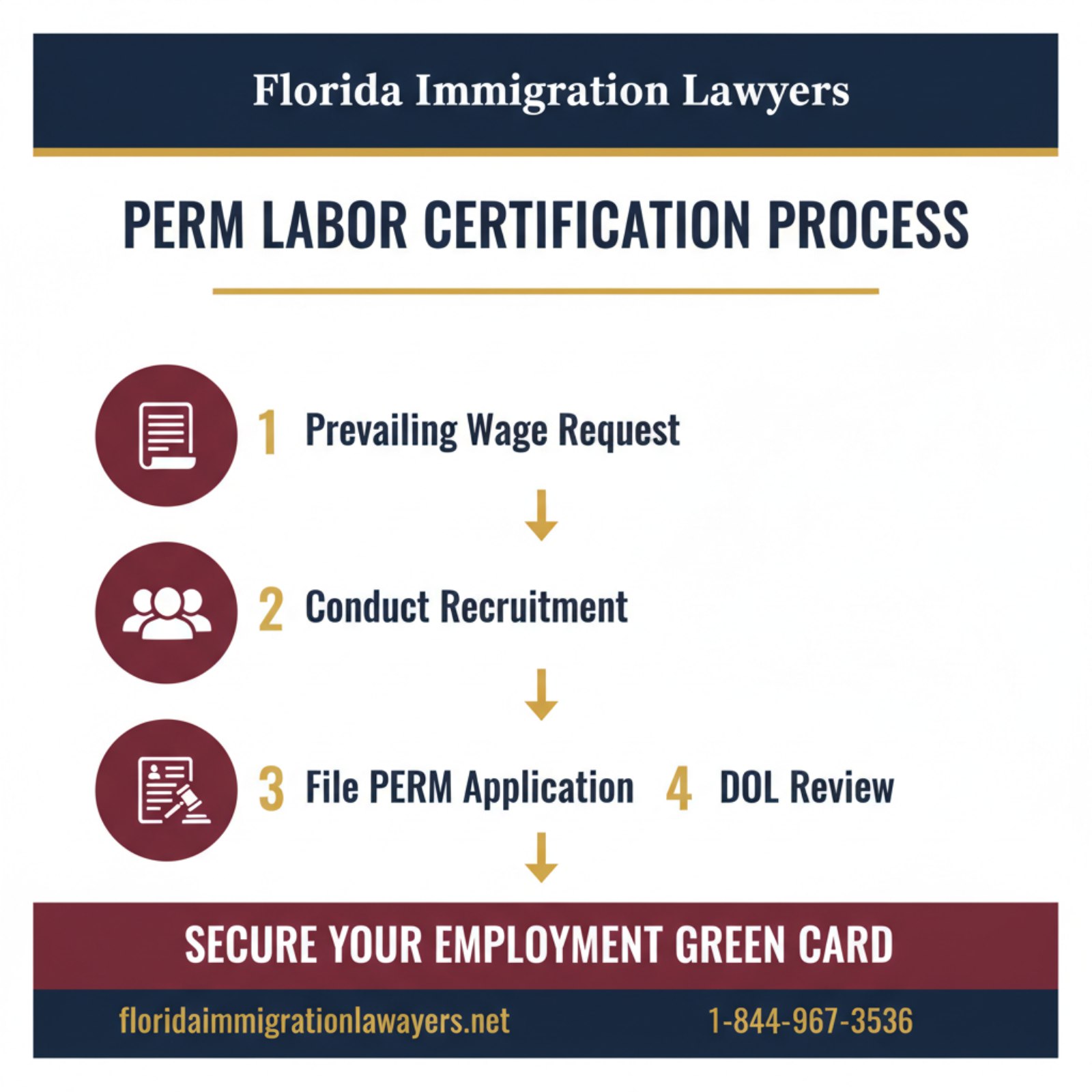
The PERM labor certification process is intricate and requires strict adherence to DOL regulations. Here is a step-by-step breakdown:
-
Determine Prevailing Wage: The employer must first request a prevailing wage determination (PWD) from the DOL's National Prevailing Wage Center (NPWC) by filing Form ETA-9141. This sets the minimum wage the employer must offer to the foreign worker, ensuring it does not adversely affect the wages of U.S. workers. The PWD is typically valid for a specific period and is crucial for subsequent recruitment.
-
Recruitment Efforts: This is the most critical phase. The employer must conduct specific recruitment activities to determine if there are any qualified U.S. workers for the position. These efforts must occur within a specific timeframe (30 to 180 days before filing the PERM application) and generally include:
- Mandatory Advertisements: Two Sunday advertisements in a newspaper of general circulation in the area of intended employment (e.g., Hollywood, Florida). For professional occupations, one job order with the State Workforce Agency (SWA) for 30 days is also mandatory, along with two additional recruitment steps from a list of options (e.g., employer's website, job search website, on-campus recruiting, trade or professional organizations, private employment firms, employee referral programs).
- Non-Professional Occupations: Require a 30-day job order with the SWA and two Sunday newspaper advertisements.
- Professional Occupations: In addition to the SWA job order and two Sunday ads, employers must choose three additional recruitment steps from a list of ten options, such as job fairs, employer's website, or professional organizations.
-
Review of Applications and Interviews: The employer must review all resumes and applications received from U.S. workers. If a U.S. worker is qualified and available for the position, the PERM process cannot proceed. Employers must document all recruitment efforts, including reasons for rejecting U.S. applicants, which must be job-related and lawful.
-
File ETA Form 9089: If no qualified U.S. workers are found, the employer can then file Form ETA-9089, Application for Permanent Employment Certification, electronically with the DOL. This form details the job requirements, the foreign worker's qualifications, and the recruitment steps undertaken. This must be filed within 180 days of the first recruitment activity.
-
DOL Review and Certification: The DOL reviews the application for completeness and compliance with regulations. This may involve an audit, where the employer is required to submit all documentation of their recruitment efforts. If approved, the DOL issues the PERM labor certification.
-
I-140 Immigrant Petition: Once PERM is certified, the employer can file Form I-140, Immigrant Petition for Alien Worker, with U.S. Citizenship and Immigration Services (USCIS). This petition seeks to classify the foreign worker as an immigrant eligible for a green card. This step is critical for moving forward with your employer sponsored green card journey.
-
Adjustment of Status or Consular Processing: After the I-140 is approved and a visa number becomes available (based on the foreign national's priority date and country of chargeability), the foreign national can either apply for adjustment of status (Form I-485) if they are in the U.S. or go through consular processing at a U.S. embassy or consulate abroad to obtain their green card.
Essential Documents for Your PERM Application
Gathering the correct documentation is vital for a smooth PERM labor certification Florida process. Both the employer and the foreign worker will need to provide specific information and evidence.
Here is a general checklist of documents and information typically required:
- Employer Information:
- FEIN (Federal Employer Identification Number)
- Company name, address, and contact information
- Nature of the employer's business
- Information about the employer's wage system and ability to pay the offered wage
- Job Offer Details:
- Detailed job description, including duties, responsibilities, and special requirements
- Minimum education, training, and experience requirements
- Proposed salary/wage (must meet or exceed the prevailing wage)
- Work location (e.g., Hollywood, Florida)
- Recruitment Evidence:
- Copies of all advertisements (newspaper, job search websites, professional journals, etc.)
- Job order placed with the State Workforce Agency (FloridaCommerce for Florida)
- Documentation of any other recruitment steps taken
- Recruitment report detailing the number of applicants, their qualifications, and the lawful, job-related reasons for rejection of U.S. applicants
- Prevailing Wage Determination (PWD) from the DOL
Step-by-Step Process Guide - Foreign Worker Information:
- Full name, date of birth, country of birth, and nationality
- Educational degrees and transcripts (evaluated for U.S. equivalency if obtained abroad)
- Employment history and letters of experience from previous employers
- Copies of current immigration documents (e.g., visa, I-94, EAD)
Maintaining meticulous records of all recruitment efforts and applicant responses is not just good practice; it's a regulatory requirement. In case of an audit, the DOL will demand to see this documentation.
PERM Processing Times and Expectations for 2026
One of the most common questions regarding PERM labor certification Florida is about processing times. It's important to understand that the overall timeline for an employer sponsored green card consists of several stages, and PERM is just the first.
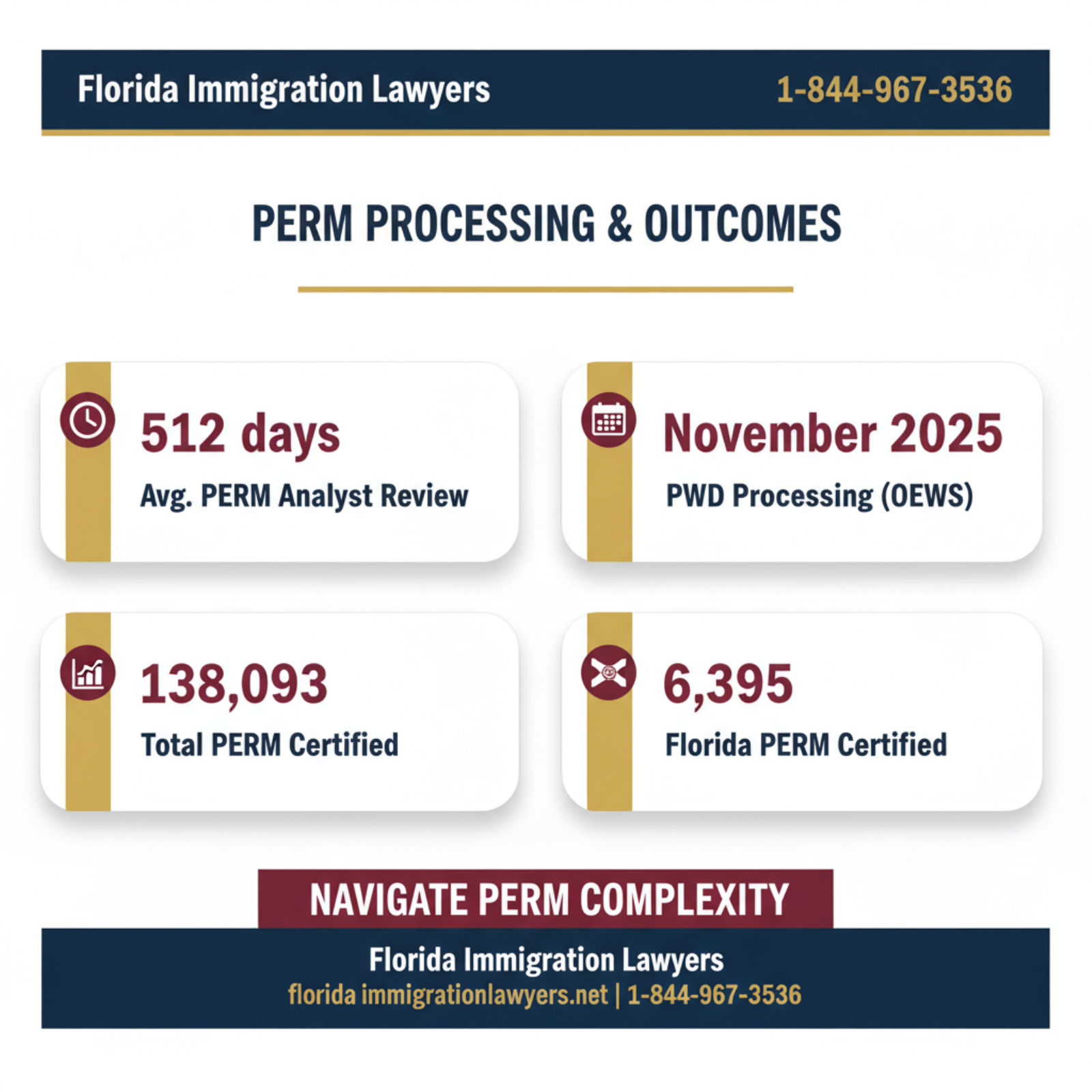
As of 2026, typical PERM processing times from the DOL can vary significantly. Factors influencing this include the volume of applications, whether an audit is issued, and the complexity of the case. Generally, you can expect the following:
- Prevailing Wage Determination (PWD): This step can take 6-10 months from the date of filing Form ETA-9141.
- Recruitment Period: This phase typically spans 1-3 months, depending on the required advertising and the 30-day waiting period after the last advertisement.
- DOL PERM Processing (ETA Form 9089): After filing, standard processing can range from 8-18 months. If your case is selected for an audit, this could extend the timeline by an additional 6-12 months or more.
It's crucial to factor in these variable timelines when planning your immigration strategy. The DOL's Foreign Labor Application Gateway (FLAG) website provides current processing times, which are regularly updated. You can also track your PERM Labor Certification Search status there.
After PERM certification, the I-140 petition with USCIS can take another 6-12 months for standard processing, or as little as 15 business days with premium processing (if available for your category). The final adjustment of status or consular processing stage depends on visa bulletin availability and USCIS/consulate processing times.
Do not navigate this process alone. Contact Florida Immigration Lawyers today. Our team can help you understand the current processing times and prepare for each stage of your PERM and green card application.
Understanding PERM Labor Certification Costs
Another significant consideration for employers and foreign nationals is the cost associated with the PERM labor certification Florida process. It's important to note that the DOL does not charge a filing fee for the ETA Form 9089 itself. However, various other expenses are incurred during the process.
Here's a breakdown of typical cost factors:
- Advertising Costs: This is often the largest direct expense for the employer. Newspaper advertisements, online job board postings, and professional journal ads can range from hundreds to several thousands of dollars, depending on the publication and duration.
- Prevailing Wage Determination: While the PWD application itself has no fee, legal fees might be incurred if an attorney assists with the application.
- Attorney Fees: Legal representation is highly recommended due to the complexity of PERM regulations. Attorney fees for a PERM application can vary widely based on the law firm's experience, location, and the complexity of the case. These fees typically cover preparing the PWD request, advising on recruitment strategies, drafting the PERM application, and responding to any audits.
- Immigrant Petition (I-140) Filing Fees: After PERM certification, the employer must pay USCIS filing fees for Form I-140. There are also additional fees if premium processing is elected.
- Adjustment of Status (I-485) or Consular Processing Fees: The foreign national will incur USCIS filing fees for Form I-485 (including biometrics) or various fees for consular processing (visa application fee, medical exam, etc.).
- Education Evaluation Fees: If the foreign worker's educational credentials are from outside the U.S., an evaluation by a credentialing service will be required, incurring additional costs.
Employers generally pay the advertising and attorney fees associated with the PERM portion, as well as the I-140 filing fee. The foreign national typically pays for the I-485 filing fee and related costs. It is illegal for an employer to ask the employee to pay for the PERM application or associated attorney fees.
Common Mistakes to Avoid in PERM Labor Certification
The PERM labor certification Florida process is fraught with potential pitfalls. A single error can lead to significant delays, an audit, or even denial, requiring the entire process to be restarted. Here are some common mistakes and their consequences:
-
Inaccurate Prevailing Wage Determination Request: Requesting a PWD with incorrect job duties or requirements can lead to an artificially high or low wage. This can either make it impossible to find a U.S. worker at the stated wage or result in a denial if the DOL finds the wage too low.
-
Insufficient Recruitment Efforts: Failing to conduct all mandatory recruitment steps, or not doing so within the specified timeframes, is a common reason for audit and denial. The DOL requires strict adherence to advertising rules.
-
Deficient Job Description or Requirements: Crafting a job description with requirements that are overly restrictive or not genuinely job-related can be seen as tailoring the position for the foreign worker. This often triggers an audit or denial, as it suggests an attempt to exclude U.S. workers.
-
Inadequate Documentation of Recruitment: Employers must keep meticulous records of all recruitment efforts, including copies of ads, interview notes, and reasons for rejection. Lack of proper documentation is a major cause of audit failure.
-
Improper Rejection of U.S. Applicants: Rejecting a U.S. applicant who is qualified and available for the position, or doing so for unlawful reasons, will lead to denial. All rejections must be job-related and clearly documented.
-
Filing ETA Form 9089 Outside the Window: The PERM application must be filed no more than 180 days and no less than 30 days after the first recruitment activity. Missing this window necessitates restarting the recruitment phase.
-
Failure to Pay the Prevailing Wage: The employer must commit to paying the prevailing wage determined by the DOL. Failure to do so, or an inability to demonstrate the financial capacity to pay, can lead to denial.
-
Employer-Employee Relationship Issues: The DOL scrutinizes the bona fide employer-employee relationship. Issues like the foreign worker having ownership in the sponsoring company can complicate or jeopardize the PERM application.
-
Lack of Specificity in Job Requirements: Vague or ambiguous job requirements can confuse applicants and raise red flags for the DOL, potentially leading to an audit or denial. Clear, concise, and measurable requirements are essential.
-
Not Understanding the Audit Process: If an audit is triggered, employers must respond promptly and comprehensively with all requested documentation. Incomplete or late responses will result in denial.
When to Call a Lawyer for PERM Labor Certification in Florida
Given the complexity and strict requirements of the PERM labor certification Florida process, seeking legal counsel is not just advisable, but often essential for success. Florida Immigration Lawyers specializes in business and employment immigration, including the full spectrum of employer sponsored green card applications.
You should consider contacting an experienced immigration attorney from our firm if:
- You are an employer considering sponsoring a foreign worker: We can help you understand your obligations, navigate the recruitment process, and ensure compliance with all DOL regulations.
- You have complex job requirements: If the position requires a unique combination of skills or advanced degrees, an attorney can help craft a compliant job description and defend it during the PERM process.
- You anticipate an audit: While audits can be random, certain factors might increase the likelihood. An attorney can prepare you for an audit and respond effectively to DOL inquiries.
- You have received a Request for Information (RFI) or Notice of Intent to Deny (NOID): These are critical junctures where expert legal intervention can make all the difference in salvaging your application.
- You need to understand the interplay between PERM and other immigration steps: We can provide comprehensive guidance on how PERM fits into the larger green card process, including I-140 petitions and adjustment of status.
- You are concerned about prevailing wage issues or market fluctuations: Our team stays updated on DOL guidelines and local market conditions in Florida, helping you make informed decisions.
Our attorneys at Florida Immigration Lawyers serve clients throughout Florida, including Hollywood, Miami, Orlando, and Tampa. We are familiar with the specific nuances of the Florida labor market and how they impact PERM applications. We are here to provide tailored advice and robust representation.
About Florida Immigration Lawyers
Florida Immigration Lawyers is a leading immigration law firm dedicated to serving individuals and businesses across the entire state of Florida. With a deep understanding of U.S. immigration laws and regulations, our experienced attorneys provide comprehensive legal services to help our clients achieve their immigration goals.
We specialize in a wide range of immigration matters, including business immigration, family-based immigration, green cards, citizenship, and deportation defense. Our commitment to client success is reflected in our personalized approach and unwavering dedication to each case. We pride ourselves on clear communication and ethical representation.
Choosing Florida Immigration Lawyers means choosing a partner who will advocate tirelessly on your behalf. We offer transparent guidance, strategic planning, and zealous representation throughout your immigration journey. Our firm is available 24/7, offering free consultations to discuss your unique situation.
Visit our website at https://www.floridaimmigrationlawyers.net or call us directly at 1-844-967-3536 to schedule your free consultation with one of our knowledgeable attorneys. Let us put our expertise to work for you.
Sources and References
- U.S. Citizenship and Immigration Services (USCIS)
- U.S. Department of Labor (DOL) - Foreign Labor Certification
- Department of Labor - Foreign Labor Application Gateway (FLAG) Processing Times
- 8 U.S.C. Chapter 12 - Immigration and Nationality Act (INA)
- 20 CFR Part 656 - Labor Certification Process for Permanent Employment of Aliens in the United States
- INA Section 212(a)(5)(A) - Labor Certification Requirements
This article provides general legal information and is not intended as legal advice. Every case is unique, and outcomes depend on specific facts and circumstances. Contact an attorney for advice about your particular situation.
The journey to an employer sponsored green card through PERM labor certification Florida can be complex, but you don't have to face it alone. Our team at Florida Immigration Lawyers is ready to provide the professional guidance and support you need.
We are committed to helping individuals and businesses navigate the intricacies of U.S. immigration law with confidence. Don't let the complexities deter you from pursuing your American dream in Florida. Call us today at 1-844-967-3536 for a free consultation. Se Habla Español - Estamos aquí para ayudarle.
Do Not Navigate This Process Alone
Our experienced immigration attorneys are ready to fight for you. Get a free, confidential consultation today.
Se Habla Español
Frequently Asked Questions
Florida Immigration Lawyers
Immigration Attorney | Founder, Vasquez Law Firm
U.S. Air Force veteran and immigration attorney with thousands of cases resolved. J.D., NCCU School of Law. AILA member. Admitted to the 4th, 5th, and 11th Circuit Courts.
Available 24/7 - Free Evaluations
Related Legal Services
Our Florida immigration attorneys can help you with immigration practice areas, free immigration consultation and experienced immigration attorneys. Call today at 1-844-967-3536 for a free consultation.
Related Links
Related Topics
Free Legal Consultation
Discuss your case with our experienced attorneys. We're available 24/7.
Se Habla Español - Estamos aquí para ayudarle.
Related Articles
Stokes Interview: Navigating Marriage Fraud in Florida
A Stokes interview is a specialized, separate interview conducted by USCIS when there are suspicions of marriage fraud in a green card application. This rigorous process involves individual questioning of spouses, focusing on inconsistencies in their testimonies to determine the authenticity of their marital bond. For couples in Florida, navigating this high-stakes interview requires meticulous preparation, extensive documentation, and often the strategic guidance of an experienced immigration lawyer. Understanding the process, preparing for detailed questions, and presenting a strong case are crucial for overcoming marriage fraud allegations and securing your immigration future. Florida Immigration Lawyers stands ready to assist you.
Immigration Attorney Gainesville: North Florida Legal Help
For those in Gainesville, Alachua County, and throughout North Florida, navigating U.S. immigration law requires expert guidance. An experienced immigration attorney can simplify complex processes, from family-based petitions and employment visas to critical asylum claims and deportation defense. This comprehensive guide outlines the essential services provided by an immigration attorney, details necessary documentation, clarifies processing timelines, and discusses associated costs. We also highlight common mistakes to avoid and crucial scenarios where legal counsel is indispensable. Florida Immigration Lawyers serves all of Florida, including Gainesville and St. Petersburg, providing dedicated legal support to help you achieve your immigration goals. Contact us for a free consultation to discuss your specific needs.
Military Naturalization Expedited at Florida Bases
Explore expedited military naturalization processes for service members at Florida bases like MacDill. Learn about eligibility, steps, and common mistakes. Contact Florida Immigration Lawyers for a free consultation.
Protect Yourself from Immigration Scams in Florida
Learn how to protect against immigration scams in Florida, focusing on St. Petersburg. This guide covers identifying scams, verifying credentials, and getting legal help. Call Florida Immigration Lawyers at 1-844-967-3536 for assistance.
