Naturalization Process Florida Timeline: Your Path to Citizenship
For Florida residents, understanding the naturalization process timeline is key to becoming a U.S. citizen. This guide covers eligibility, the N-400 application, biometrics, interviews, and the Oath of Allegiance ceremony. Learn about typical processing times in Tampa, Orlando, and Miami, and common pitfalls to avoid. Florida Immigration Lawyers offers expert guidance to streamline your path to citizenship. We provide comprehensive support, ensuring your application is meticulously prepared and submitted. Contact us for a free consultation to navigate the complexities of U.S. immigration law and achieve your American dream.

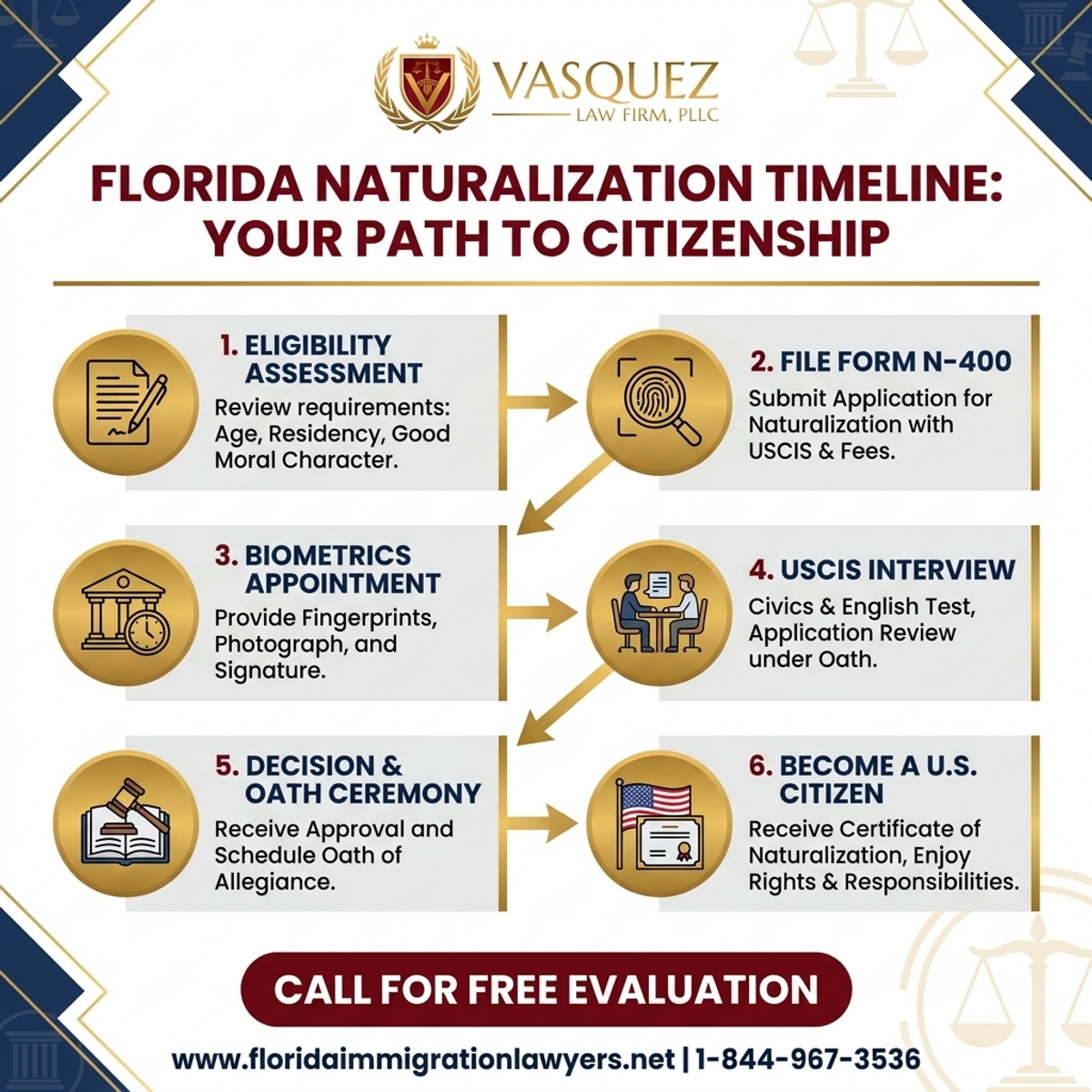
The naturalization process in Florida typically spans 8 to 14 months, though times can vary based on the specific USCIS field office (e.g., Tampa, Orlando, Miami) and case complexity. This journey begins with meeting strict eligibility criteria, including continuous residency and good moral character, followed by filing Form N-400, Application for Naturalization. Applicants then undergo fingerprinting, an interview, and an English and civics test before attending an Oath of Allegiance ceremony. Navigating this process successfully requires meticulous document preparation and a thorough understanding of immigration law.
- Eligibility for naturalization requires specific residency, age, and moral character criteria.
- The process involves filing Form N-400, biometrics, an interview, and tests.
- Processing times in Florida vary but generally range from 8 to 14 months.
- Careful preparation and legal guidance can significantly streamline your application.
- The final step is attending the Oath of Allegiance ceremony to become a U.S. citizen.
Introduction: Your Journey to U.S. Citizenship in Florida
Becoming a U.S. citizen is a profound milestone, representing the culmination of years of hard work, dedication, and integration into American society. For many lawful permanent residents across Florida, the dream of naturalization is a powerful motivator. However, the path to citizenship, particularly understanding the naturalization process Florida timeline, can seem daunting and complex. From meeting stringent eligibility requirements to navigating interviews and tests, each step demands careful attention to detail.
This comprehensive guide from Florida Immigration Lawyers is designed to demystify the naturalization process for residents throughout Florida, including those in Tampa, Orlando, and Miami. We will break down each stage, provide essential insights into timelines, and highlight crucial considerations to help you prepare effectively. Our goal is to empower you with the knowledge needed to pursue your citizenship dream with confidence.
Whether you are just starting to consider naturalization or are already deep into the application process, understanding the nuances is vital. We will cover everything from initial eligibility to the final Oath of Allegiance ceremony. If you have questions or need personalized guidance, do not hesitate to reach out. Call Florida Immigration Lawyers at 1-844-967-3536 for a free consultation and take the first step towards securing your future as a U.S. citizen.
Understanding the Naturalization Process Florida Timeline
The journey to U.S. citizenship through naturalization is governed by specific federal laws, primarily outlined in the Immigration and Nationality Act (INA). For Florida residents, the process adheres to national standards, but local USCIS field offices in Tampa, Orlando, and Miami handle applications, interviews, and ceremonies, which can influence local processing times. Generally, the entire naturalization process Florida timeline can range from 8 to 14 months, sometimes longer depending on various factors.
This timeline begins the moment you submit your Form N-400, Application for Naturalization, to USCIS. It encompasses several key stages, each with its own waiting period. These stages include the initial receipt of your application, scheduling of biometric appointments, the naturalization interview, and finally, the Oath of Allegiance ceremony. Understanding these phases and their typical durations is crucial for managing your expectations and planning your future.
Recent shifts in immigration policy and processing backlogs can sometimes extend these timelines. For instance, while the general eligibility requirements remain consistent, the efficiency of background checks or the availability of interview slots can impact how quickly your application moves forward. Florida's diverse population means a high volume of applications, which can also contribute to varying processing times. Staying informed and prepared is key, and an experienced immigration attorney can provide invaluable insights into current local trends.
It is important to remember that these are average timelines. Individual cases may proceed faster or slower based on their complexity, the completeness of the application, and any unforeseen issues that may arise during background checks or interviews. Consulting with a legal professional can help you gain a clearer picture of what to expect for your specific situation in Florida.
Eligibility Requirements for Naturalization in Florida
Before embarking on the naturalization process Florida timeline, it is essential to determine if you meet the fundamental eligibility criteria set forth by USCIS. These requirements are non-negotiable and form the bedrock of a successful application. Primarily, most applicants must be at least 18 years old and hold lawful permanent resident status (Green Card holder) for a specific period.
The general rule, as per INA § 316 (8 U.S.C. § 1427), requires you to have been a lawful permanent resident for at least five years. However, if you are married to a U.S. citizen, this period is shortened to three years, provided you have been living in marital union with your citizen spouse during that time and your spouse has been a U.S. citizen for at least three years. Additionally, you must have resided continuously in the U.S. for at least half of the required residency period. This means, for the five-year rule, you must have been physically present for at least 30 months.
Another critical requirement is demonstrating good moral character. This is assessed for the statutory period leading up to your application (five or three years, respectively). USCIS considers various factors, including your criminal record, tax compliance, and honesty in prior immigration applications. Even minor infractions can sometimes raise questions about good moral character, making legal review highly advisable. You must also be able to read, write, and speak basic English and have a fundamental understanding of U.S. history and government (civics).
Step-by-Step Process — Naturalization Process Florida Timeline: Your Path to Citizenship
Furthermore, you must reside in the state or USCIS district where you file your N-400 application for at least three months prior to filing. For Florida residents, this means having established residency in areas served by the Tampa, Orlando, or Miami USCIS field offices. These strict requirements underscore the importance of careful preparation. Any misstep in demonstrating eligibility can lead to delays or even denial of your application, highlighting why many Floridians choose to seek legal advice.
Step-by-Step Naturalization Process Florida Timeline
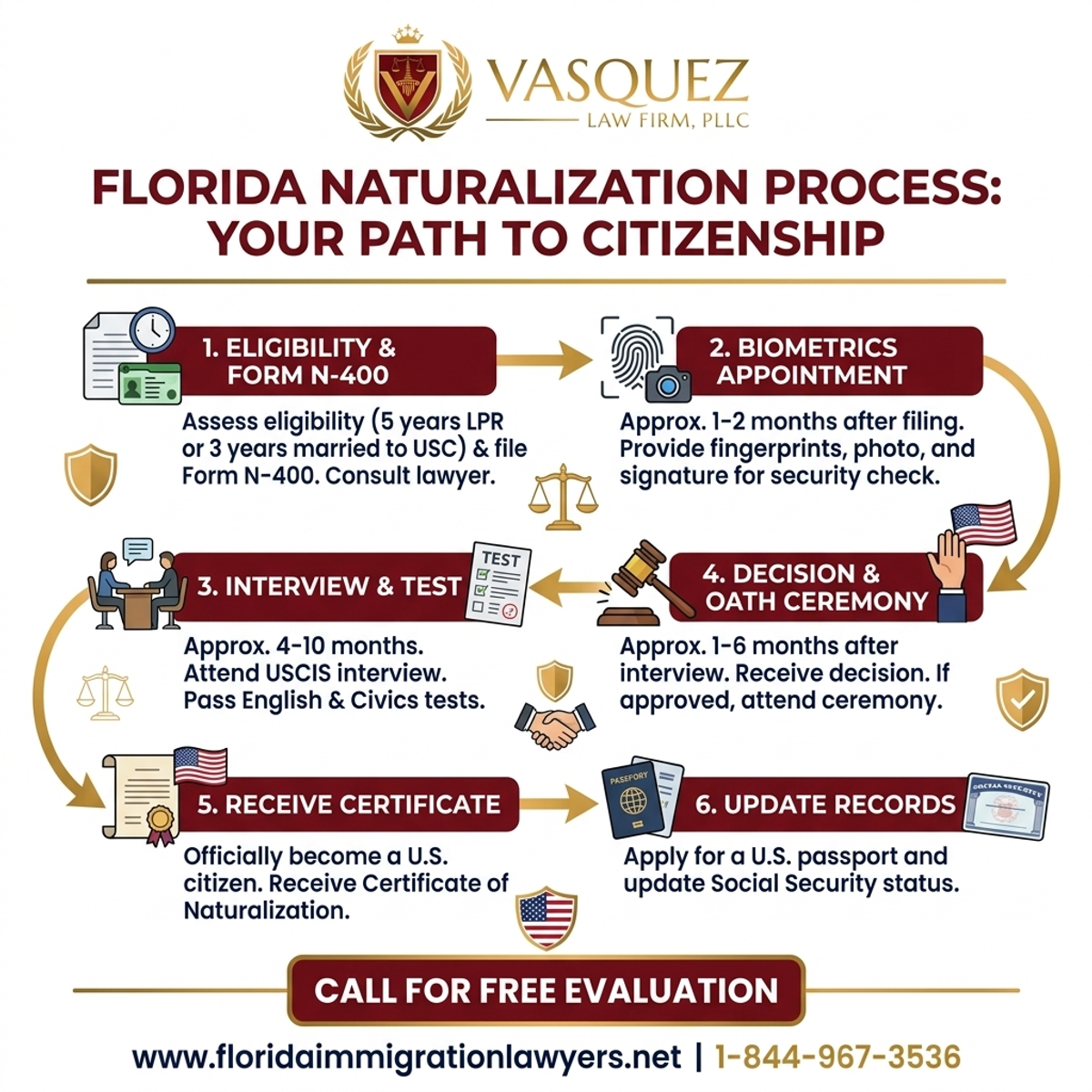
The naturalization process Florida timeline involves a structured series of steps, each critical for a successful outcome. Understanding this sequence helps applicants prepare thoroughly and anticipate what comes next. Here is a detailed breakdown of the typical journey:
-
Determine Eligibility: Before anything else, ensure you meet all the basic requirements, including age, lawful permanent residency period, continuous residence, physical presence, and good moral character. Consider any potential disqualifying factors that might affect your application. Many individuals in Florida consult with an immigration attorney at this stage to confirm their eligibility and address any concerns.
-
Prepare and File Form N-400: Complete Form N-400, Application for Naturalization, accurately and thoroughly. Gather all necessary supporting documents, such as copies of your Green Card, marriage certificate (if applicable), and any court disposition records. Pay the filing fee, or submit a fee waiver request if eligible. Your application package is then mailed to the appropriate USCIS Lockbox facility. This initiates your official naturalization timeline.
-
Biometrics Appointment: After USCIS accepts your N-400, you will receive an appointment notice for biometrics (fingerprints, photograph, and signature). This typically occurs 3-5 weeks after filing. This data is used for background checks by the FBI and other government agencies. Attending this appointment is mandatory.
-
Interview Scheduling and Preparation: Once background checks are complete, USCIS will schedule your naturalization interview. This usually happens several months after your biometrics appointment, varying by Florida USCIS office workloads. You will receive a notice with the date, time, and location (e.g., Tampa, Orlando, or Miami field office). Prepare by reviewing your N-400, studying U.S. history and government, and practicing your English.
-
The Naturalization Interview: During the interview, a USCIS officer will review your N-400 application, verify your eligibility, and test your English language ability (reading, writing, and speaking) and your knowledge of U.S. civics. Be honest and straightforward in your responses. The officer may also ask about your good moral character during the statutory period. This is a critical juncture in the process.
-
Receive Decision and Oath Ceremony: Following a successful interview, USCIS will issue a decision. If approved, you will receive a notice for the Oath of Allegiance ceremony. This ceremony is where you officially become a U.S. citizen. In Florida, these ceremonies are often held at federal courthouses or USCIS facilities. You will surrender your Green Card at this event and receive your Certificate of Naturalization. This final step typically occurs within a few weeks to a few months after your interview.
Key Documents for Your N-400 Application
A complete and accurate application package is paramount to a smooth naturalization process Florida timeline. Missing or incorrect documents can lead to delays, Requests for Evidence (RFEs), or even denial. Gathering all required documentation before filing Form N-400 is a critical first step. While the exact list can vary based on your individual circumstances, here is a general checklist of essential documents:
- A copy of your Green Card (both front and back).
- Copies of all passports, foreign and U.S., valid for the statutory period.
- Copies of marriage certificates and divorce decrees (if applicable).
- Copies of birth certificates for all children.
- Proof of selective service registration (for males aged 18-26 at the time of residency).
- Certified copies of court dispositions for any arrests or convictions, even if expunged.
- Proof of payment of federal, state, and local taxes for the last five years (or three years if married to a U.S. citizen).
- Evidence of continuous residence and physical presence (e.g., utility bills, leases, employment records, school records).
- If applying based on marriage to a U.S. citizen: copies of your spouse's birth certificate or naturalization certificate, marriage certificate, and evidence of bona fide marriage (e.g., joint bank accounts, property deeds, tax returns, children's birth certificates).
- If you have traveled outside the U.S. for six months or more, provide evidence of maintaining continuous residence (e.g., proof of employment, property ownership in the U.S.).
- Two identical passport-style photographs if filing a paper application (check current USCIS instructions, as many applications now use digital photos from biometrics).
- Form G-28, Notice of Entry of Appearance as Attorney or Accredited Representative, if you are represented by legal counsel.
Key Statistics — Naturalization Process Florida Timeline: Your Path to Citizenship
Organize these documents meticulously. Ensure all copies are clear and legible. If any document is not in English, it must be accompanied by a certified English translation. Providing complete and accurate information from the outset will prevent unnecessary complications and help keep your naturalization process Florida timeline on track.
Navigating the Naturalization Interview and Oath Ceremony
The naturalization interview is a pivotal moment in the naturalization process Florida timeline. It is your opportunity to demonstrate your eligibility, good moral character, and commitment to the United States. Held at a local USCIS field office, such as those in Tampa, Orlando, or Miami, the interview typically lasts 20-30 minutes, though it can be longer depending on the complexity of your case.
What to Expect During the Interview
During the interview, a USCIS officer will go over your Form N-400 application with you, confirming the information you provided. They will ask about your personal history, family, employment, travel, and any criminal record. The officer will also administer the English and civics tests. The English test assesses your ability to read, write, and speak basic English. The civics test consists of 10 questions from a list of 100, and you must answer at least six correctly. Be prepared to answer questions honestly and accurately. It is advisable to review your N-400 application thoroughly before the interview to ensure consistency in your answers.
Understanding Potential Delays or Requests for Evidence
Sometimes, an officer may not be able to make a decision immediately. This could happen if they need additional documents (Request for Evidence, RFE), further review of your background, or clarification on certain aspects of your application. You might receive a Notice of Continuance, requiring you to provide more information or return for another interview. These situations can extend your naturalization process Florida timeline, but they are not necessarily a sign of denial. Responding promptly and completely to any RFEs is crucial.
The Oath of Allegiance Ceremony
If your application is approved after the interview, the final step is the Oath of Allegiance ceremony. This is a formal, often moving, event where you take an oath to support the U.S. Constitution and laws. You will receive a notice (Form N-445, Notice of Naturalization Oath Ceremony) with the date, time, and location. At the ceremony, you will surrender your Green Card and receive your Certificate of Naturalization, officially making you a U.S. citizen. This certificate is your proof of citizenship and should be kept safe. Many families in Florida celebrate this significant achievement, often held at federal courthouses or USCIS facilities. The time between approval and the oath ceremony can vary from a few days to several months.
Navigating Potential Challenges and Delays in the Naturalization Process
While the naturalization process Florida timeline is generally predictable, applicants can encounter various challenges and delays that may extend their journey to citizenship. Understanding these potential hurdles can help you prepare and respond effectively, minimizing their impact on your application.
Common Reasons for Delays
One frequent cause of delay stems from incomplete or inaccurate applications. USCIS receives a high volume of Form N-400 submissions, and even minor errors or missing documents can trigger a Request for Evidence (RFE), which adds weeks or months to the processing time. Background check issues, such as discrepancies in records or complex criminal histories, can also significantly prolong the process as additional investigation is required.
Furthermore, the workload at specific USCIS field offices in Florida, like Tampa, Orlando, or Miami, can fluctuate. High application volumes or staffing shortages can lead to longer waiting periods for interview scheduling and oath ceremonies. Unforeseen policy changes or national security directives can also impact processing times across the board. For instance, an increase in scrutiny for certain categories of applicants could slow down the entire system.
Addressing Issues and Seeking Assistance
If you face a delay, the first step is to check your case status online through the USCIS website. If your case is outside normal processing times, you may submit an e-request. For more complex issues, such as an RFE or a Notice of Intent to Deny (NOID), a swift and comprehensive response is crucial. A NOID indicates that USCIS intends to deny your application unless you provide compelling evidence to overcome the stated reasons for denial. This is a serious matter that often warrants legal intervention.
Moreover, if you have a criminal record, previous immigration violations, or long absences from the U.S., these factors can complicate your application. Such issues require careful legal analysis to determine their impact on your good moral character or continuous residence requirements. An experienced Florida immigration attorney can help you gather necessary evidence, prepare persuasive arguments, and represent you effectively, potentially mitigating delays and preventing adverse outcomes.
Do not navigate this process alone. Contact Florida Immigration Lawyers today to discuss any challenges you are facing. Our team is dedicated to providing strategic legal advice and support. Call 1-844-967-3536 for a free consultation.
Cost Factors and Fee Breakdown for Naturalization
Understanding the financial aspects is a critical part of planning for the naturalization process Florida timeline. The primary cost associated with naturalization is the USCIS filing fee for Form N-400, Application for Naturalization, and the biometrics fee. These fees are subject to change, so it is crucial to check the official USCIS website for the most current amounts before filing. As of the current guidance, there is a combined fee for the application and biometrics, though fee waivers may be available for eligible applicants.
Beyond the direct USCIS fees, applicants should budget for other potential expenses. These can include costs for obtaining necessary supporting documents, such as birth certificates, marriage licenses, or court records. If any documents are not in English, you will need to pay for certified translations, which can vary in price depending on the length and complexity of the document. Additionally, passport-style photos may be required, incurring a small cost.
For many applicants in Florida, investing in legal representation is a wise decision. Attorney fees for naturalization services vary based on the complexity of the case and the services provided. A lawyer can assist with preparing the N-400, gathering documents, responding to RFEs, and representing you at the interview. While this adds to the overall cost, it can significantly increase the likelihood of a smooth process and a successful outcome, potentially saving you time and stress in the long run.
It is important to evaluate your financial situation and consider all potential costs. If you believe you may be eligible for a fee waiver, you must submit Form I-912, Request for Fee Waiver, along with your N-400 application and supporting documentation demonstrating your inability to pay. USCIS reviews these requests carefully, and eligibility is based on specific income guidelines or receipt of means-tested benefits. Planning for these costs is an integral part of successfully navigating your path to U.S. citizenship.
Common Mistakes to Avoid in Your Naturalization Application
The naturalization process Florida timeline can be derailed by common errors that applicants frequently make. Avoiding these pitfalls can save you significant time, stress, and potential denial. Here are some critical mistakes to be aware of:
-
Filing Too Early: Many applicants mistakenly file their N-400 before meeting the continuous residence or physical presence requirements. Ensure you calculate your eligibility dates precisely based on the five-year or three-year rule, including the three-month residency in your USCIS district, such as Tampa, Orlando, or Miami.
-
Incomplete or Inaccurate N-400 Form: Any blank fields, inconsistent information, or failure to disclose required details on Form N-400 can lead to delays or a Request for Evidence (RFE). Always double-check every section for accuracy and completeness.
-
Failure to Provide All Required Documents: Not submitting all necessary supporting documents, such as Green Card copies, marriage certificates, or court dispositions, will almost certainly result in an RFE or denial. Create a checklist and ensure everything is included.
-
Lack of Good Moral Character: Failing to disclose arrests, convictions, or other legal issues, even if expunged or minor, can be seen as a lack of good moral character and lead to denial. Honesty and providing certified court dispositions are paramount.
-
Insufficient English or Civics Knowledge: Underestimating the English and civics tests can lead to failure during the interview. Dedicate ample time to studying and practicing. USCIS provides study materials on its website.
-
Long Absences from the U.S.: Extended trips outside the U.S. can break your continuous residence requirement. Absences of six months to one year can create a presumption of breaking continuity, and absences over one year automatically break it unless specific exceptions apply.
-
Failing to Update USCIS on Address Changes: If you move, you must notify USCIS within 10 days using Form AR-11. Failure to do so can result in missed notices, interview appointments, and delays.
-
Not Responding to RFEs or NOIDs: Ignoring or inadequately responding to Requests for Evidence (RFEs) or Notices of Intent to Deny (NOIDs) within the specified timeframe will almost certainly lead to a denial of your application.
-
Misrepresenting Facts: Any false statements or misrepresentations on your application or during your interview can lead to a denial, and potentially, even deportation proceedings. Always be truthful.
-
Not Seeking Legal Advice for Complex Cases: If you have a criminal record, previous immigration issues, or long absences, attempting to navigate the process alone is a significant risk. Legal counsel can help mitigate these complexities.
When to Call a Florida Immigration Lawyer for Naturalization
While the naturalization process Florida timeline is designed to be straightforward for many, certain situations warrant the invaluable expertise of a qualified immigration attorney. Deciding when to seek legal counsel can significantly impact the success and efficiency of your application, potentially saving you from costly delays or denials.
You should consider contacting Florida Immigration Lawyers if any of the following scenarios apply to your situation:
- You have a criminal record, including arrests, charges, or convictions, no matter how minor or old they may seem. These can significantly impact your good moral character assessment.
- You have had extended absences from the U.S. that might affect your continuous residence or physical presence requirements. Understanding how these absences are calculated is complex.
- You have previously been placed in deportation or removal proceedings, even if your case was terminated or you received relief.
- You have concerns about your ability to meet the English or civics test requirements due to a disability or age. Waivers are available but require specific documentation.
- You have submitted an application that has been pending for an unusually long time, or you have received a Request for Evidence (RFE) or a Notice of Intent to Deny (NOID).
- You have ever made a false claim to U.S. citizenship or made any misrepresentations on previous immigration applications.
- You are unsure about any aspect of the N-400 application form or the supporting documentation required for your specific circumstances, especially if your family situation is complex.
An attorney from Florida Immigration Lawyers can provide personalized guidance, help you prepare a robust application, represent you during the interview, and advocate on your behalf with USCIS. Our legal team understands the specific nuances of the process in Florida, including the practices of the Tampa, Orlando, and Miami USCIS field offices. Do not leave your citizenship journey to chance. Contact us today for a free consultation to ensure your naturalization process is handled with the utmost care and precision.
About Florida Immigration Lawyers
Florida Immigration Lawyers is a leading law firm dedicated to providing comprehensive and compassionate legal representation to individuals and families throughout Florida. With a deep understanding of the complexities of U.S. immigration law, our experienced attorneys are committed to guiding clients through every step of their immigration journey, including the intricate naturalization process Florida timeline.
Our firm prides itself on offering personalized attention and strategic advice tailored to each client's unique situation. We assist with a wide range of immigration matters, from family-based visas and employment immigration to asylum claims and deportation defense. We understand the significance of becoming a U.S. citizen and work tirelessly to ensure our clients' naturalization applications are meticulously prepared and submitted.
Choosing Florida Immigration Lawyers means partnering with a team that is available 24/7 to address your concerns. We offer free consultations, allowing you to discuss your case without financial obligation. Our bilingual staff ensures that language is never a barrier to receiving quality legal assistance. Serving all of Florida, including Tampa, Orlando, and Miami, we are here to be your trusted advocates. Visit floridaimmigrationlawyers.net or call 1-844-967-3536 to schedule your free consultation today.
Sources and References
- U.S. Citizenship and Immigration Services (USCIS)
- USCIS - Form N-400, Application for Naturalization
- Executive Office for Immigration Review (EOIR)
- 8 U.S.C. § 1427 - Requirements for Naturalization (Immigration and Nationality Act Section 316)
- 8 C.F.R. Part 316 - General Requirements for Naturalization
- USCIS Policy Manual
Related services: immigration practice areas, experienced immigration attorneys, free immigration consultation.
This article provides general legal information and is not intended as legal advice. Every case is unique, and outcomes depend on specific facts and circumstances. Contact an attorney for advice about your particular situation.
Secure Your U.S. Citizenship with Expert Legal Guidance
The journey to becoming a U.S. citizen is a significant one, and understanding the naturalization process Florida timeline is a crucial step. With meticulous preparation, adherence to USCIS requirements, and potentially, the guidance of an experienced legal team, your dream of citizenship can become a reality. Do not let the complexities of immigration law deter you from pursuing this important goal.
Florida Immigration Lawyers stands ready to assist you at every stage of your naturalization application. From evaluating your eligibility and preparing your Form N-400 to representing you at your interview, we provide dedicated and knowledgeable support. We are committed to helping Florida residents navigate this process efficiently and successfully.
Take the definitive step towards securing your future and enjoying the full rights and responsibilities of U.S. citizenship. We offer free, no-obligation consultations to discuss your specific case and answer all your questions. Se Habla Español - Estamos aquí para ayudarle. Call Florida Immigration Lawyers today at 1-844-967-3536 to schedule your free consultation and embark on your path to U.S. citizenship with confidence.
If you need legal assistance, learn more about experienced naturalization attorneys, or call us at 1-844-967-3536 for a free consultation.
Do Not Navigate This Process Alone
Our experienced immigration attorneys are ready to fight for you. Get a free, confidential consultation today.
Se Habla Español
Frequently Asked Questions

William J. Vásquez
Founding Attorney · Vasquez Law Firm
U.S. Air Force veteran and immigration attorney with thousands of cases resolved. J.D., NCCU School of Law. AILA member. Admitted to the 4th, 5th, and 11th Circuit Courts.
Available 24/7 - Free Evaluations
Related Legal Services
Our Florida immigration attorneys can help you with asylum protection, deportation defense and citizenship and naturalization. Call today at 1-844-967-3536 for a free consultation.
Related Links
Related Topics
Free Legal Consultation
Discuss your case with our experienced attorneys. We're available 24/7.
Se Habla Español - Estamos aquí para ayudarle.
Related Articles
Biometrics Appointment in Florida: What to Expect in 2026
Navigating a biometrics appointment in Florida is crucial for your USCIS process. Learn what to expect, how to prepare, and common pitfalls to avoid. Florida Immigration Lawyers are here to help with personalized guidance and support.
Withholding of Removal Explained: Florida Defense in 2026
For those in Florida facing deportation and fearing persecution or torture in their home country, understanding withholding of removal is critical. This form of protection prevents removal to a dangerous country, though it differs significantly from asylum in its eligibility criteria and benefits. It requires proving a "more likely than not" chance of persecution based on protected grounds or torture, a higher standard than asylum's "well-founded fear." While withholding of removal does not lead to a Green Card, it offers mandatory protection if the stringent criteria are met, even for some individuals barred from asylum. The process involves complex legal proceedings before an immigration judge, often in Miami or Orlando immigration courts. A comprehensive application, detailed testimony, and robust supporting evidence, including country conditions reports and affidavits, are essential. Given the high stakes and intricate legal requirements, securing the expertise of a Florida immigration lawyer is paramount to building a strong defense and navigating the path to safety.
US Visa Policy Changes July 2026: What Students in Florida
As of July 2026, international students in Florida seeking a change of status to an F-1 student visa must prepare for potential adjustments to U.S. visa policies. This comprehensive guide from Florida Immigration Lawyers explores the anticipated policy changes, detailing their potential impact on application requirements, processing times, and eligibility criteria. We provide a step-by-step overview of the change of status process, including a document checklist, expected timelines, and cost considerations. Understanding these complexities and avoiding common mistakes is crucial for a successful application. With potential changes approaching, proactive planning and expert legal guidance are more important than ever. Our firm is dedicated to helping students in Tampa and across Florida navigate these challenges, offering tailored advice and robust representation. Learn how to protect your academic future and ensure a smooth transition to F-1 student status.
Dual Citizenship Lawyer: Your 2026 Guide to Naturalization
Achieving U.S. citizenship is a profound milestone, but the path to naturalization, especially with dual citizenship in mind, is fraught with legal intricacies and a critical interview process. This comprehensive guide from Florida Immigration Lawyers demystifies the journey, offering essential citizenship interview tips and highlighting the invaluable role of a dual citizenship lawyer. We cover eligibility, document preparation, timelines, and common pitfalls, all tailored for Florida residents in areas like Pembroke Pines. Discover how expert legal counsel can prepare you for your naturalization interview, address dual nationality concerns, and ensure a smooth, successful application. From initial assessment to interview representation, we provide the support needed to navigate USCIS requirements confidently. Call Florida Immigration Lawyers for a free consultation to start your journey.
