Parole in Place for Military Families in Florida: A 2026...
For military families in Florida, Parole in Place (PIP) offers a critical opportunity for undocumented spouses, children, and parents to gain lawful presence in the U.S. This guide from Florida Immigration Lawyers details the eligibility criteria, the step-by-step application process involving Form I-131, and the essential documents required. We cover processing timelines, potential costs, and crucial mistakes to avoid, emphasizing the discretionary nature of PIP. Learn how this benefit can pave the way for adjustment of status without leaving the country. If you're in Fort Lauderdale or anywhere in Florida, understand when to seek expert legal assistance. Contact Florida Immigration Lawyers for a free consultation to navigate this complex process.

Parole in Place (PIP) offers a crucial immigration benefit for eligible undocumented spouses, children, and parents of U.S. military service members or veterans residing in Florida. It grants lawful presence in the U.S. without needing to depart, potentially allowing them to adjust their status to a lawful permanent resident (green card holder) from within the country, avoiding the 10-year bar for unlawful presence. This process is vital for keeping military families united and supported.
- PIP grants lawful presence for qualifying military family members.
- It allows adjustment of status from within the U.S. for many.
- Eligibility requires a qualifying military relationship and good moral character.
- The application involves Form I-131 and extensive supporting documentation.
- Consulting an experienced Florida immigration lawyer is highly recommended.
Life as a military family in Florida comes with unique challenges and sacrifices. While service members dedicate their lives to protecting our nation, their families often face separate battles, sometimes including complex immigration hurdles. If your family member is serving or has served in the U.S. armed forces, and you or a loved one is living in Florida without lawful status, Parole in Place (PIP) could be a pathway to stability and peace of mind.
This comprehensive guide from Florida Immigration Lawyers will walk you through everything you need to know about Parole in Place for military families in Florida in 2026. We understand the anxieties and hopes that come with these situations, especially in areas like Fort Lauderdale, which is home to many military families. Our goal is to provide clear, actionable information to help you understand this vital immigration benefit. Call Florida Immigration Lawyers at 1-844-967-3536 for a free consultation to discuss your specific situation.
Understanding Parole in Place for Military Families in Florida
Parole in Place (PIP) is a discretionary immigration benefit provided by U.S. Citizenship and Immigration Services (USCIS). It allows certain non-citizens who entered the U.S. without inspection or overstayed their visa to be 'paroled' into the country. This means they are granted a period of lawful presence, even if they were previously considered unlawfully present.
For military families, PIP is particularly significant because it addresses a critical issue: the requirement for some individuals to leave the U.S. to obtain an immigrant visa abroad. For those who entered without inspection, leaving the country often triggers a 3-year or 10-year bar from re-entry due to unlawful presence. Parole in Place effectively 'cures' this unlawful entry or presence for adjustment of status purposes, allowing the individual to apply for a green card without having to leave the United States.
In Florida, a state with a significant military presence and diverse immigrant communities, understanding PIP is crucial. From Jacksonville to Key West, many families can benefit from this program. It's a testament to our nation's commitment to supporting those who serve, ensuring their families can remain together and pursue lawful permanent residency. The benefit is authorized under Section 212(d)(5)(A) of the Immigration and Nationality Act (INA) and further detailed in 8 CFR § 212.5.
Eligibility Requirements for Military Parole in Place
Not everyone can qualify for Parole in Place. Specific criteria must be met to be considered for this discretionary benefit. Understanding these requirements is the first step in determining if PIP is the right path for you or your loved one.
The primary eligibility revolves around your relationship to a qualifying military service member. You must be the spouse, child (unmarried, under 21), or parent of:
- An individual currently serving on active duty in the U.S. Armed Forces.
- An individual in the Ready Reserve of the U.S. Armed Forces.
- An individual who previously served in the U.S. Armed Forces or Ready Reserve and was not dishonorably discharged.
Beyond the qualifying relationship, applicants for military Parole in Place must also demonstrate good moral character. This means having no serious criminal record or other adverse factors that would make you ineligible for immigration benefits. USCIS reviews each case individually, considering all circumstances. Even minor offenses could potentially impact your eligibility, making a thorough review by an immigration attorney essential.
While there is no specific Florida residency requirement for PIP itself, demonstrating your continuous presence and ties to your community in Florida can strengthen your application. This is particularly relevant when you eventually apply for adjustment of status. Our firm, Florida Immigration Lawyers, can help you assess your specific situation and determine if you meet these crucial criteria for Parole in Place. For more information on family-based immigration, visit our Family Immigration page.
The PIP Application Process: A Step-by-Step Guide
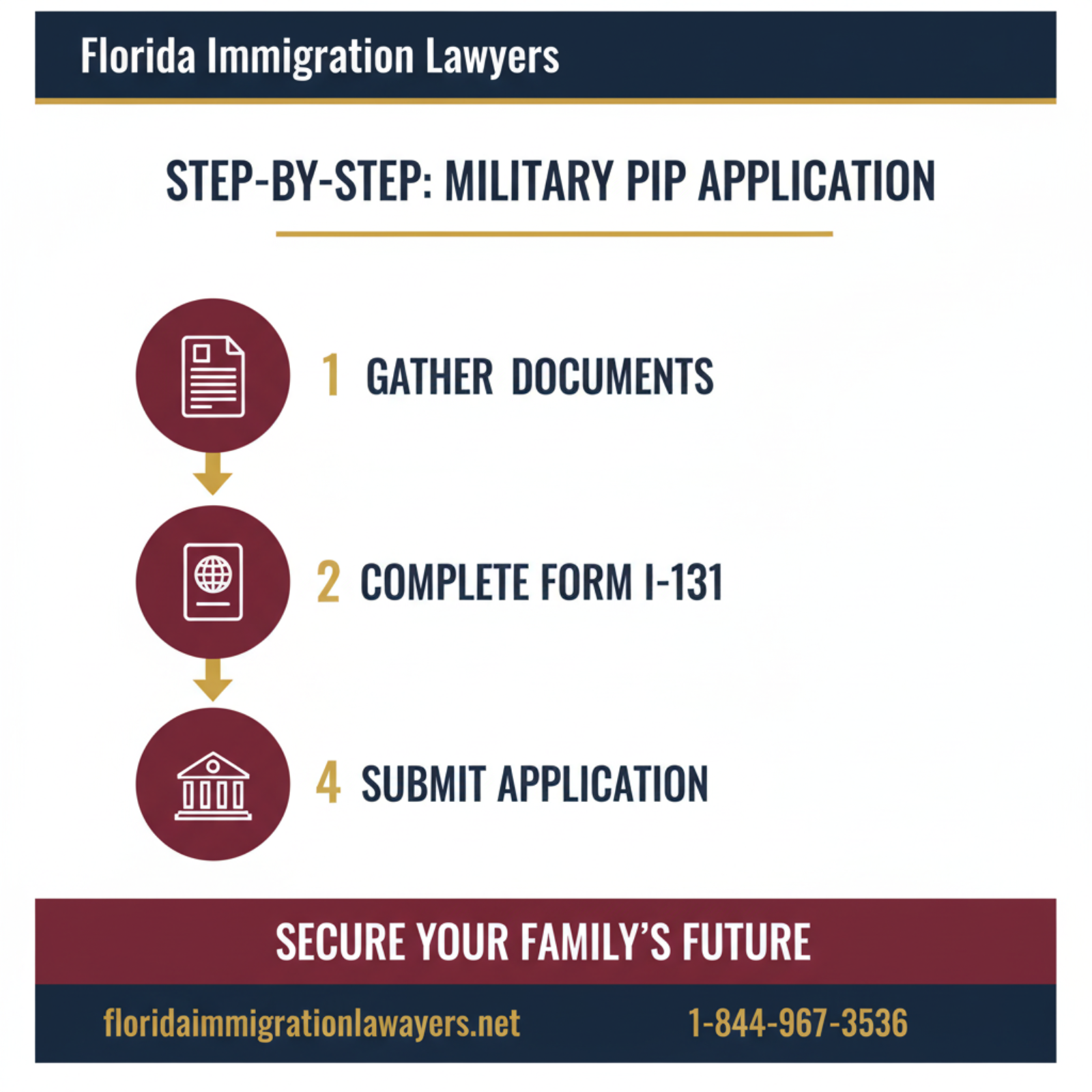
Applying for Parole in Place requires careful attention to detail and a thorough understanding of USCIS procedures. This process typically involves submitting a request to USCIS, rather than filing a standard application form. Here is a general step-by-step guide:
-
Gather Comprehensive Documentation: This is the most critical initial step. You will need to collect all documents proving your qualifying relationship, the military service of your family member, your identity, and your good moral character. Incomplete documentation is a common reason for delays or denials.
-
Prepare Form I-131, Application for Travel Document: Although Form I-131 is typically used for re-entry permits or advance parole, it is generally used for Parole in Place requests as well. You will need to clearly indicate that you are requesting Parole in Place for a military family member. Follow all instructions carefully.
-
Draft a Detailed Cover Letter: A well-written cover letter is essential. This letter should explain your eligibility, articulate the humanitarian reasons for your request, and list all submitted supporting documents. It serves as your primary argument to USCIS for exercising their discretion in your favor.
-
Submit Your Petition to the Correct USCIS Lockbox: The filing location for military Parole in Place requests can vary. It is crucial to check the most current USCIS filing instructions on their website to ensure your petition is sent to the correct address. Incorrect filing can lead to significant delays.
Step-by-Step Process Guide -
Attend Biometrics Appointment (If Required): After submitting your petition, USCIS may send you an appointment notice for biometrics (fingerprints, photos, and signature). This is a standard part of the background check process. Ensure you attend this appointment as scheduled.
-
Receive a Decision: USCIS will review your petition and supporting evidence. They may issue a Request for Evidence (RFE) if more information is needed. Eventually, you will receive a decision approving or denying your request for Parole in Place. An approval typically results in an I-94 Arrival/Departure Record, confirming your lawful parole.
Each step requires precision. Working with an experienced immigration attorney can significantly streamline this process and increase your chances of success. They can help ensure your application is complete and compelling.
Essential Documents for Your Parole in Place Petition
A strong Parole in Place petition relies heavily on comprehensive and accurate documentation. Preparing a thorough package of evidence is key to demonstrating your eligibility and good moral character. Here is a checklist of documents typically required:
- Form I-131, Application for Travel Document: Completed and signed, clearly stating the request is for military Parole in Place.
- Proof of Qualifying Military Service:
- Copy of the service member's military identification (front and back).
- Copy of the service member's birth certificate (if applying as a parent).
- Copy of the service member's DD-214, Certificate of Release or Discharge from Active Duty (if veteran).
- Letter from the service member's commanding officer or military personnel office confirming active duty status or honorable service.
- Proof of Relationship to the Service Member:
- Marriage certificate (for spouses).
- Birth certificate (for children or parents, showing both names).
- Adoption decrees (if applicable).
- Proof of Identity and Nationality:
- Copy of your passport biographical page.
- Copy of your birth certificate.
- Any previous U.S. visas or entry stamps.
- Proof of Residence in Florida:
- Utility bills, lease agreements, or property deeds showing your address.
- Bank statements or other official mail.
- Passport-Style Photographs: Two recent, identical color photographs meeting USCIS specifications.
- Evidence of Good Moral Character:
- Police clearances from all places you have lived since age 16.
- Court dispositions for any arrests or convictions (even if sealed or expunged).
- Affidavits from reputable persons attesting to your character.
- Any Previous Immigration Filings: Copies of any prior applications, petitions, or correspondence with USCIS or other immigration agencies.
This military parole in place checklist is extensive, but each item plays a vital role. Ensure all foreign language documents are accompanied by certified English translations. Consulting with Florida Immigration Lawyers can ensure your document packet is complete and persuasive.
Timeline and Processing Expectations for PIP in 2026
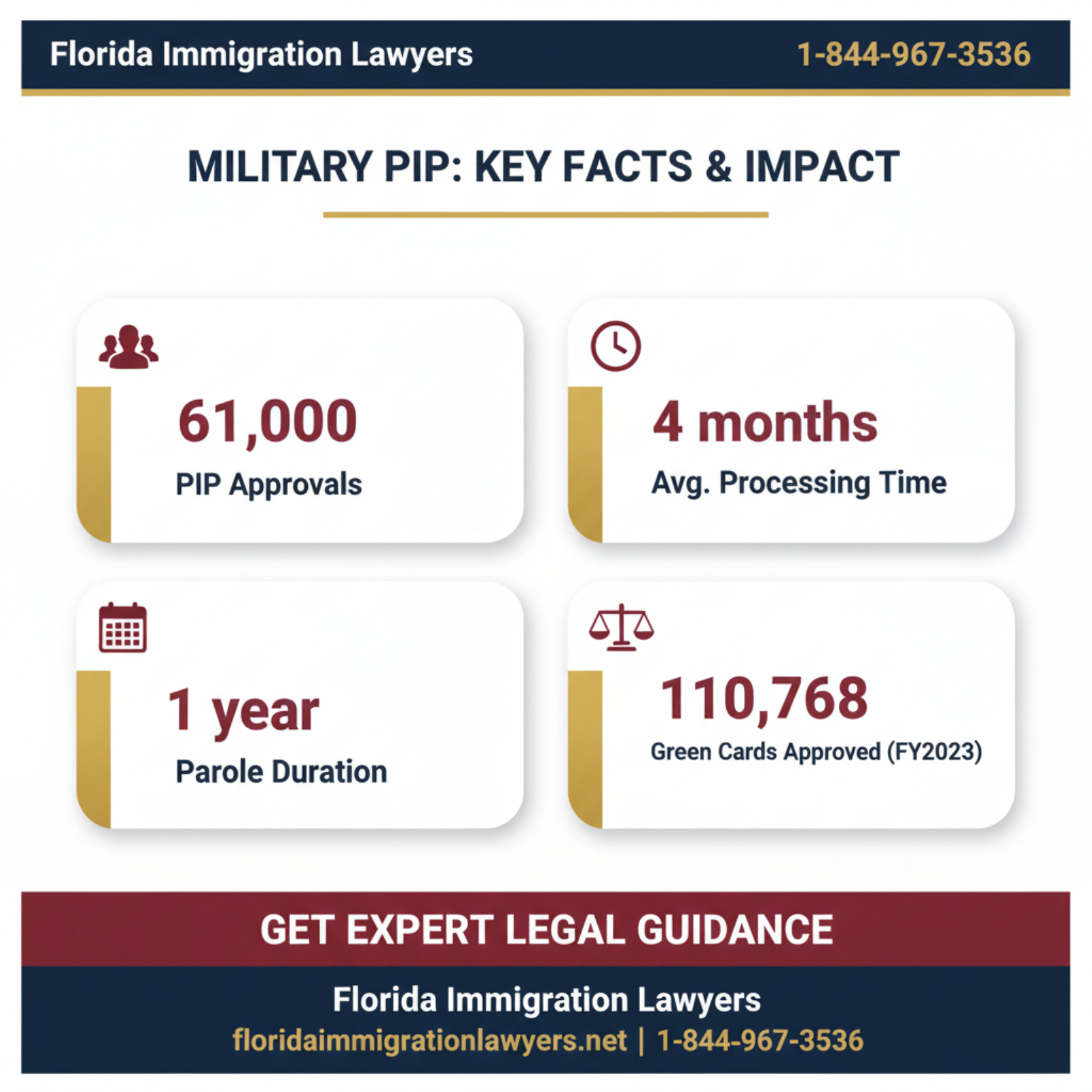
The parole in place military processing time can vary significantly based on several factors, including the specific USCIS service center or field office handling your case, the volume of applications, and the completeness of your submission. While USCIS provides general processing time estimates on their website, these are subject to change and should be viewed as guidelines rather than guarantees.
Typically, after submitting your Parole in Place request, you can expect to receive a receipt notice within a few weeks. A biometrics appointment, if required, usually follows within 1-3 months. The final decision on your PIP petition can take anywhere from a few months to over a year. Factors that can influence this timeline include:
- Completeness of Application: Incomplete applications or those missing crucial evidence will likely result in a Request for Evidence (RFE), which adds significant time to the process.
- Background Checks: Extensive background checks are standard. Any issues or discrepancies found could prolong the review period.
- USCIS Workload: The overall volume of applications USCIS is processing at any given time can impact how quickly your case moves forward.
- Discretionary Nature: Because PIP is a discretionary benefit, USCIS officers take time to carefully review each case's merits and humanitarian factors.
It is important to remain patient throughout the process. Our team at Florida Immigration Lawyers can help you track your case status and respond promptly to any USCIS requests, helping to keep your application moving efficiently. While we cannot guarantee specific processing times, we strive to manage expectations and keep you informed every step of the way.
Cost Factors and Fee Breakdown for PIP
Understanding the financial aspects of applying for Parole in Place is important for planning. While USCIS does not typically charge a filing fee for the Form I-131 when it is specifically requested for military Parole in Place, there can be other associated costs that you should anticipate.
Here's a breakdown of potential cost factors:
- USCIS Filing Fees: As mentioned, the fee for Form I-131 is generally waived for military PIP requests. However, if you pursue adjustment of status (Form I-485) after PIP approval, there will be significant USCIS filing and biometrics fees for that subsequent application. These fees are subject to change, and we recommend checking the official USCIS website for the most current fee schedule.
- Attorney Fees: Retaining an experienced immigration lawyer, such as those at Florida Immigration Lawyers, is a significant investment but often invaluable. Our fees cover the preparation of your petition, legal advice, communication with USCIS, and guidance through the entire process. We offer transparent fee structures, and we encourage you to discuss this during your free consultation.
- Document Preparation Costs: You may incur costs for obtaining certified copies of birth certificates, marriage certificates, police records, or other official documents. If any documents are not in English, you will also need to pay for certified translations.
- Travel Expenses: Depending on your location in Florida, you might have travel costs to attend biometrics appointments or meetings with your attorney.
While some costs are unavoidable, the potential benefits of obtaining lawful status through Parole in Place often outweigh the financial investment. We work with our clients to provide clear estimates and help them understand the financial commitment involved. Don't let financial concerns deter you from seeking legal advice; contact us to explore your options. You can find more contact options on our Contact Us page.
Do not navigate this process alone. Contact Florida Immigration Lawyers today.
Common Mistakes to Avoid When Applying for Parole in Place
The Parole in Place process, though beneficial, is complex. Small errors can lead to significant delays or even denial. Here are some common mistakes to avoid:
-
Submitting an Incomplete Application: Failing to include all required forms, supporting documents, or necessary photographs is a frequent pitfall. This will almost certainly result in a Request for Evidence (RFE) or a denial, significantly delaying your case.
-
Failing to Prove the Qualifying Military Relationship: Insufficient or unclear evidence of the service member's active duty, reserve status, or honorable discharge, or of your relationship to them, can lead to rejection. Ensure all military and familial documents are clear and certified.
-
Undisclosed or Misrepresented Criminal History: Attempting to hide or misrepresent any past arrests, charges, or convictions is a severe mistake. USCIS conducts thorough background checks; any discrepancies will be found and can lead to immediate denial and potential legal repercussions.
-
Not Demonstrating Good Moral Character: While criminal history is a major factor, other issues like tax fraud, repeated minor offenses, or false statements to government officials can also impact a finding of good moral character, which is essential for PIP.
-
Incorrect Filing Location: USCIS has specific lockbox addresses for different form types and request categories. Sending your USCIS parole in place military petition to the wrong address will cause delays and could result in its return without processing.
-
Ignoring Requests for Evidence (RFEs): If USCIS sends an RFE, it means they need more information. Failing to respond by the deadline or providing inadequate responses can result in denial. Always take RFEs seriously and respond comprehensively.
-
Assuming Automatic Approval: Parole in Place is a discretionary benefit, meaning USCIS has the authority to approve or deny based on their judgment. There is no guarantee of approval, even if you meet all basic eligibility criteria. A compelling humanitarian argument and strong evidence are crucial.
-
Not Understanding the Difference Between PIP and a Green Card: Approval of PIP grants lawful presence, but it is not a green card itself. It is usually a crucial first step that enables you to then apply for adjustment of status (Form I-485) to become a lawful permanent resident.
-
Failing to Seek Legal Counsel: Navigating immigration law without professional guidance is risky. An experienced attorney can identify potential issues, ensure your application is strong, and represent your best interests throughout the process.
-
Using an Outdated Form or Information: Immigration policies and forms can change. Always ensure you are using the most current version of Form I-131 and are following the latest USCIS instructions for military Parole in Place 2026.
When to Call a Florida Immigration Lawyer for Parole in Place
While this guide provides a comprehensive overview, the nuances of immigration law are vast and complex. There are specific scenarios where the expertise of a dedicated Florida immigration lawyer becomes not just helpful, but essential. Florida Immigration Lawyers are here to assist you, especially if you face any of the following:
- Complex Eligibility Questions: If you are unsure whether you meet all the criteria for Parole in Place, particularly concerning the military service member's status or your relationship to them.
- Prior Immigration Violations: If you have previous deportations, unlawful entries, or any other immigration issues in your past, these can significantly complicate your case and require expert navigation.
- Criminal History: Even minor arrests or convictions can impact your good moral character assessment. An attorney can advise on how to properly disclose these and mitigate their impact.
- Receiving a Request for Evidence (RFE): If USCIS asks for more information, a lawyer can help you understand what is needed and prepare a thorough and timely response.
- Facing a Notice of Intent to Deny (NOID): A NOID is a serious warning that USCIS intends to deny your petition. You have a limited time to respond, and legal intervention is critical at this stage.
- Concurrent Deportation Proceedings: If you or your family member are currently in removal proceedings, applying for Parole in Place concurrently requires highly specialized legal strategy. Learn more about how we can help with Deportation Defense.
- Preparing for Adjustment of Status: After PIP approval, the next step is typically applying for a green card. An attorney can guide you through this subsequent, equally complex process.
- Seeking Guidance on Humanitarian Factors: Building a strong case often involves presenting compelling humanitarian reasons. A lawyer can help you articulate these effectively to USCIS.
Florida Immigration Lawyers serves clients across the state, including Fort Lauderdale, Miami, Orlando, and Tampa. Our attorneys are deeply familiar with USCIS parole in place military policies and local immigration court procedures. We offer personalized legal strategies tailored to your unique circumstances, ensuring your family's future is protected. Visit our Attorneys page to learn more about our team.
Frequently Asked Questions About Military Parole in Place
Many military families in Florida have similar questions about Parole in Place. Here are answers to some of the most common inquiries:
Is parole in place still available for military family members?
Yes, as of 2026, Parole in Place remains an available discretionary benefit for eligible military family members. While immigration policies can change, the program has been a long-standing support for those serving our country. It's crucial to consult with an immigration attorney to confirm current eligibility and application procedures.
Does military parole in place apply to siblings?
Generally, no. Military Parole in Place is specifically limited to the immediate relatives of qualifying service members: their spouses, unmarried children under 21, and parents. Siblings, aunts, uncles, or other extended family members are typically not eligible for PIP based on their relationship to a service member.
Who is eligible for parole in place in the military?
Eligibility for Parole in Place is restricted to the spouse, child (unmarried and under 21), or parent of an individual who is currently serving on active duty in the U.S. Armed Forces, in the Ready Reserve, or who previously served in the U.S. Armed Forces or Ready Reserve and received an honorable discharge. The applicant must also demonstrate good moral character.
Can an illegal family stay in the US of a military personal?
Parole in Place can provide a pathway for an undocumented family member of military personnel to gain lawful presence in the U.S. and potentially adjust their status to a lawful permanent resident without leaving the country. It does not automatically grant permanent residency but is a critical step towards it for many who would otherwise face severe bars to re-entry. It is designed to keep military families united.
About Florida Immigration Lawyers
Florida Immigration Lawyers is a leading immigration law firm dedicated to serving the diverse needs of individuals and families across the Sunshine State. With offices strategically located to serve all of Florida, we are committed to providing compassionate, effective, and results-driven legal representation.
Our experienced team of attorneys specializes in a wide array of immigration matters, including family-based immigration, business immigration, deportation defense, asylum, and citizenship. We understand the profound impact immigration issues have on your life and your family's future, and we approach every case with the sensitivity and diligence it deserves.
Why choose Florida Immigration Lawyers? We pride ourselves on our deep understanding of U.S. immigration law, our personalized approach to client service, and our unwavering dedication to achieving the best possible outcomes. We offer free consultations, are available 24/7, and provide bilingual services (Se Habla Español) to ensure clear communication and support for all our clients.
Your journey through the U.S. immigration system can be challenging, but you don't have to face it alone. Trust Florida Immigration Lawyers to be your steadfast advocates. Visit our website at https://www.floridaimmigrationlawyers.net or call us at 1-844-967-3536 to schedule your free consultation today.
Sources and References
- U.S. Citizenship and Immigration Services (USCIS)
- USCIS Fee Schedule
- Executive Office for Immigration Review (EOIR)
- 8 U.S.C. Chapter 12 - Immigration and Nationality Act (INA) - Specifically, INA Section 212(d)(5)(A)
- 8 CFR § 212.5 - Parole of Aliens into the United States
This article provides general legal information and is not intended as legal advice. Every case is unique, and outcomes depend on specific facts and circumstances. Contact an attorney for advice about your particular situation.
Ready to discuss your family's future? The path to lawful status for military families through Parole in Place can be life-changing. Don't leave your immigration future to chance. Call Florida Immigration Lawyers today at 1-844-967-3536 for a free, confidential consultation. Se Habla Español - Estamos aquí para ayudarle.
Do Not Navigate This Process Alone
Our experienced immigration attorneys are ready to fight for you. Get a free, confidential consultation today.
Se Habla Español
Frequently Asked Questions
Florida Immigration Lawyers
Immigration Attorney | Founder, Vasquez Law Firm
U.S. Air Force veteran and immigration attorney with thousands of cases resolved. J.D., NCCU School of Law. AILA member. Admitted to the 4th, 5th, and 11th Circuit Courts.
Available 24/7 - Free Evaluations
Related Legal Services
Our Florida immigration attorneys can help you with immigration practice areas, free immigration consultation and experienced immigration attorneys. Call today at 1-844-967-3536 for a free consultation.
Related Links
Related Topics
Free Legal Consultation
Discuss your case with our experienced attorneys. We're available 24/7.
Se Habla Español - Estamos aquí para ayudarle.
Related Articles
I-601 Waiver Guide for Florida Immigrants | VLF Florida
Learn how the I-601 waiver can help you overcome inadmissibility and remain in the U.S. The guide covers eligibility, process steps, and tips for Florida immigrants. Contact Florida Immigration Lawyers for a free consultation.
Immigration Services in Kissimmee Florida | VLF Florida
Explore immigration services in Kissimmee, Florida, and learn about the comprehensive support available for individuals and families. Discover how Florida Immigration Lawyers can assist you with a free consultation.
Immigration Services Port St Lucie & Treasure Coast 2026
Seeking expert immigration services in Port St Lucie, the Treasure Coast, or anywhere in Florida? Florida Immigration Lawyers provides comprehensive legal assistance for family visas, employment petitions, naturalization, asylum, and deportation defense. With the U.S. immigration system constantly changing, having experienced legal counsel is crucial for navigating complex procedures and achieving a successful outcome. Our dedicated team serves clients in Kissimmee and across the Treasure Coast, offering personalized guidance and free consultations. Learn how we can help you with your immigration journey in 2026, ensuring compliance with all federal regulations and local requirements. Contact us today to discuss your unique situation.
DACA Work Permit Florida: Your 2026 Guide to Employment
For DACA recipients in Florida, understanding the 2026 process for obtaining or renewing a work permit (EAD) is crucial for employment and stability. This comprehensive guide covers eligibility criteria, step-by-step application procedures, essential documents, and expected timelines. Learn how to avoid common mistakes and when to seek legal assistance to ensure a successful application. Florida Immigration Lawyers provides expert guidance for DACA recipients across the state, including Orlando, helping you navigate the complex legal landscape with confidence. Contact us for a free consultation to protect your deferred action and work authorization.