DACA Work Permit Florida: Your 2026 Guide to Employment
For DACA recipients in Florida, understanding the 2026 process for obtaining or renewing a work permit (EAD) is crucial for employment and stability. This comprehensive guide covers eligibility criteria, step-by-step application procedures, essential documents, and expected timelines. Learn how to avoid common mistakes and when to seek legal assistance to ensure a successful application. Florida Immigration Lawyers provides expert guidance for DACA recipients across the state, including Orlando, helping you navigate the complex legal landscape with confidence. Contact us for a free consultation to protect your deferred action and work authorization.

Navigating the DACA work permit Florida process in 2026 involves understanding complex eligibility criteria, meticulous document preparation, and adherence to USCIS filing procedures. While DACA's future remains subject to legal challenges, renewals and initial applications (for those who previously held DACA) are generally processed for eligible individuals. Obtaining an Employment Authorization Document (EAD) allows DACA recipients in Florida, including Orlando and surrounding areas, to legally work and contribute to their communities. Consulting with an experienced immigration lawyer is crucial to ensure your application is complete and correctly submitted, minimizing potential delays or denials.
- DACA allows certain eligible noncitizens who came to the United States as children to receive deferred action from deportation.
- A DACA grant includes an Employment Authorization Document (EAD), commonly known as a work permit.
- The process in Florida requires specific forms, supporting documents, and adherence to USCIS guidelines.
- Timely renewal is essential to maintain continuous work authorization and protection from removal.
- Legal assistance is highly recommended to navigate the complexities and potential legal changes affecting DACA.
Are you a DACA recipient in Florida, perhaps in Orlando or a nearby city, wondering about your eligibility for a DACA work permit Florida? The Deferred Action for Childhood Arrivals (DACA) program has provided a pathway for thousands of young people to live and work legally in the United States. In 2026, understanding the current regulations and application procedures is more vital than ever, especially given the ongoing legal landscape surrounding DACA.
For DACA recipients, an Employment Authorization Document (EAD) is not just a piece of plastic; it is a key to opportunity, allowing you to secure stable employment, obtain a driver's license, and build a fulfilling life in the Sunshine State. However, the process can be intricate, with strict requirements and potential pitfalls. This comprehensive guide will walk you through everything you need to know about obtaining or renewing your DACA work permit in Florida.
From eligibility criteria and required documents to processing times and common mistakes, we will cover the essential details to help you navigate this important immigration process. Our goal is to empower you with accurate information so you can confidently pursue your DACA work permit. Do not navigate this complex process alone. Call Florida Immigration Lawyers at 1-844-967-3536 for a free consultation to discuss your specific situation and how we can assist you.
Understanding DACA and Your Work Permit in Florida
Deferred Action for Childhood Arrivals (DACA) was established in 2012 to protect eligible young undocumented immigrants who arrived in the U.S. as children from deportation. It grants them a renewable two-year period of deferred action and eligibility for an Employment Authorization Document (EAD). For thousands of individuals across Florida, including vibrant communities like Orlando, Miami, and Tampa, DACA has been transformative, offering a sense of stability and enabling them to pursue education and careers. The DACA program, however, has faced significant legal challenges over the years. As of 2026, while initial applications for individuals who have never held DACA are generally not being processed, USCIS continues to accept and process DACA renewal applications, as well as initial requests from individuals who previously held DACA.
An EAD, often referred to as a work permit, is a crucial component of DACA. It provides legal authorization to work in the United States, opening doors to better job opportunities, higher wages, and economic independence. Without an EAD, DACA recipients would face significant barriers to legal employment, impacting their ability to support themselves and their families. In Florida, having a valid EAD also facilitates obtaining a state driver's license, which is essential for daily life, commuting to work, and accessing services across the geographically expansive state. Understanding the current status of DACA and the importance of your EAD is the first step toward securing your future in Florida.
The legal landscape for DACA is dynamic, with ongoing litigation that could impact its future. Therefore, staying informed and seeking professional legal advice is paramount. Florida Immigration Lawyers closely monitors these developments to provide our clients in Orlando and throughout Florida with the most up-to-date and accurate guidance. We understand the anxieties and uncertainties that come with DACA, and we are here to help you understand your rights and options under current policies.
Eligibility Criteria for a DACA Work Permit in Florida
To be eligible for DACA and, consequently, a work permit in Florida, applicants must meet several specific criteria established by USCIS. These requirements apply to both initial applications (for those who previously held DACA) and renewals. It is critical to meticulously review each point to ensure you qualify before preparing your application. Meeting these criteria is the foundation of a successful DACA work permit application in Florida, whether you reside in Orlando, Fort Lauderdale, or any other part of the state.
- Came to the United States Before Turning 16: You must have been under the age of 16 when you first entered the U.S. This is a foundational requirement for DACA eligibility.
- Continuous Residence in the U.S. Since June 15, 2007: You must have continuously resided in the United States from June 15, 2007, up to the present time. Brief, casual, and innocent absences from the U.S. do not break continuous residence, but any prolonged absence could.
- Present in the U.S. on June 15, 2012, and at the Time of Application: You must have been physically present in the United States on June 15, 2012, and also at the time you submit your DACA request.
- No Lawful Status on June 15, 2012: You must not have had lawful immigration status on June 15, 2012. This means you were either undocumented or your lawful status had expired by that date.
- Currently in School, Graduated, or Obtained GED: You must currently be enrolled in school, have graduated from high school, obtained a GED certificate, or be an honorably discharged veteran of the U.S. Coast Guard or Armed Forces. This criterion emphasizes educational or military service commitment.
- No Serious Criminal Record: You must not have been convicted of a felony, a significant misdemeanor, or three or more other misdemeanors, and must not pose a threat to national security or public safety. USCIS conducts thorough background checks.
- Born After June 15, 1981 (for Initial Requests): While initial DACA applications are largely on hold, this was a previous requirement for those applying for the first time. For renewals, this specific age limit is less relevant as long as you met it initially.
- At Least 15 Years Old at the Time of Request (unless in removal proceedings): Generally, you must be at least 15 years old to request DACA, unless you are in removal proceedings, have a final order of removal, or have a voluntary departure order.
It is crucial to gather extensive documentation to prove each of these eligibility requirements. Any discrepancies or lack of evidence can lead to a Request for Evidence (RFE) or denial. Florida Immigration Lawyers can help you assess your eligibility and gather the necessary proof to support your DACA work permit application, ensuring every detail is accurate and complete.
Step-by-Step Guide to Applying for a DACA Work Permit in Florida
The process of applying for or renewing your DACA work permit Florida requires careful attention to detail. This step-by-step guide outlines the typical procedure for individuals living in Florida, from Orlando to the Keys. While the general steps are consistent nationwide, understanding the specific forms and submission methods is vital for a smooth application process.
- Determine Your Eligibility: Before starting, review all eligibility criteria. Ensure you meet every requirement for DACA, whether it's an initial request (if you previously held DACA) or a renewal. This is the most crucial first step to avoid wasted time and resources.
- Gather All Required Documents: Collect all supporting evidence. This includes proof of identity, continuous residence, educational attainment, and physical presence. Examples include passports, birth certificates, school transcripts, medical records, utility bills, and employment records. Organize these documents meticulously.
- Complete Necessary Forms: You will typically need to file Form I-821D, Consideration of Deferred Action for Childhood Arrivals, and Form I-765, Application for Employment Authorization. Additionally, Form I-765WS, Worksheet, is required to justify your economic need for employment. Ensure all forms are filled out accurately and completely, without any blank fields that should contain information.
- Prepare Supporting Evidence: Attach copies of all supporting documents. Do not send original documents unless specifically requested by USCIS. Make sure copies are clear and legible. Organize them logically, perhaps with cover sheets, to assist the USCIS officer reviewing your application.
- Pay the Filing Fees: The DACA application involves two main fees: the Form I-765 fee and the biometrics services fee. As of 2026, these fees are subject to change, so always check the USCIS website for the most current amounts. Fee waivers are extremely limited for DACA applications, but it is important to know your options.
- Mail Your Application Packet: Send your completed forms, supporting documents, and payment to the appropriate USCIS Lockbox facility. The correct address depends on your state of residence and the type of form. For Florida residents, check the USCIS website for the most current Lockbox address for DACA applications. It is recommended to use a service that provides tracking and delivery confirmation.
- Attend Biometrics Appointment: After USCIS accepts your application, you will receive an appointment notice for biometrics (fingerprints, photograph, and signature) at an Application Support Center (ASC) in Florida, such as the one in Orlando or Miami. This appointment is mandatory.
- Await a Decision: USCIS will review your application and conduct background checks. You may receive a Request for Evidence (RFE) if they need more information. Once a decision is made, you will receive a notice by mail. If approved, your EAD card will be mailed to you.
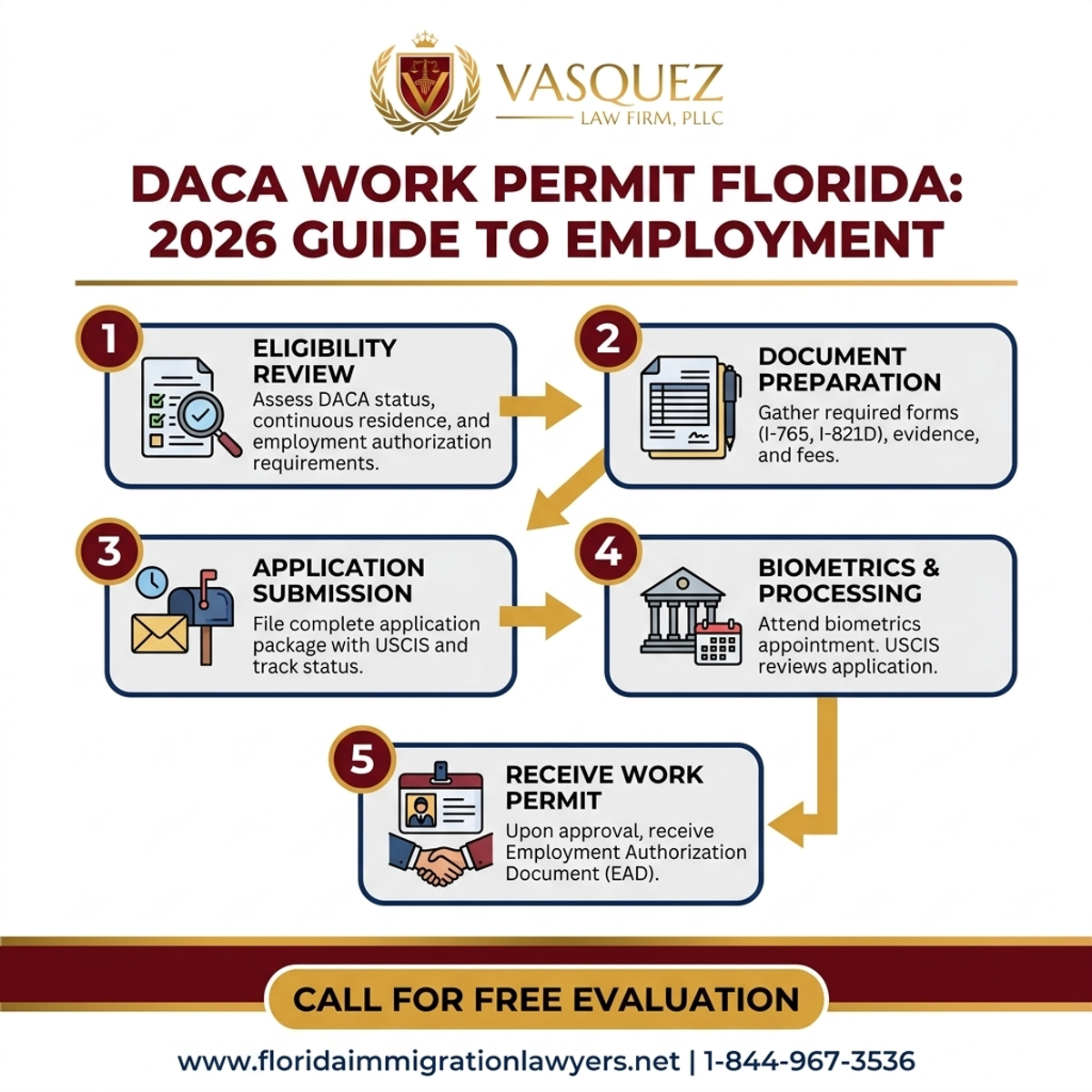
Step-by-Step Process — DACA Work Permit Florida: Your 2026 Guide to Employment
Each step requires precision. Missing information or incorrect forms can lead to delays or even denial. Florida Immigration Lawyers specializes in DACA applications and renewals, providing comprehensive support to ensure your application is strong and submitted correctly the first time.
Essential Documents Checklist for Your DACA Application
Preparing a complete and accurate set of documents is paramount for a successful DACA work permit Florida application. USCIS requires extensive proof to verify your eligibility for deferred action and an EAD. Missing or insufficient documentation is a leading cause of delays or denials. Use this checklist as a guide, but always remember that individual circumstances may require additional specific documents.
- Proof of Identity:
- Copy of your birth certificate with a certified translation (if not in English).
- Copy of your passport from your country of origin.
- Copy of any government-issued identification from your home country.
- Copy of any previous EAD card or I-94 arrival/departure record.
- Proof of Entry Before Age 16:
- School records (transcripts, report cards) from elementary or middle school.
- Medical records from childhood (vaccination records, doctor's visits).
- Religious records (baptism certificates).
- Travel documents or airline tickets from your entry.
- Proof of Continuous Residence Since June 15, 2007:
- School records from U.S. schools (transcripts, enrollment letters).
- Employment records (pay stubs, tax returns, W-2 forms).
- Bank statements showing transactions within Florida.
- Utility bills (electricity, water, gas, internet) in your name or a parent's name.
- Rental agreements or mortgage statements.
- Medical records (doctor visits, hospital stays).
- Affidavits from credible witnesses (family, friends, teachers, employers) attesting to your presence.
- Dated photographs showing you in the U.S. over time.
- Proof of Florida driver's license or state ID issuance/renewal.
- Proof of Physical Presence on June 15, 2012:
- Any document from the continuous residence list that clearly shows your presence on or around this specific date.
- Dated photographs, school attendance records, or employment records from that period.
- Proof of No Lawful Status on June 15, 2012:
- If you had a non-immigrant visa that expired, provide proof of expiration.
- If you entered without inspection, a sworn statement may be sufficient.
- Proof of Education or Military Service:
- High school diploma or GED certificate.
- Official school transcripts showing current enrollment.
- Certificate of honorable discharge from the U.S. Armed Forces or Coast Guard (Form DD-214).
- Passport-Style Photographs: Two identical, color passport-style photographs taken within 30 days of filing.
Organize your documents clearly and provide English translations for any foreign language documents, certified by a competent translator. Remember, sending too much disorganized information can be as problematic as sending too little. Our team at Florida Immigration Lawyers will help you compile a robust and well-organized application packet.
Understanding DACA Processing Times and Costs in 2026
When applying for or renewing your DACA work permit Florida, understanding the typical processing times and associated costs is essential for planning. While USCIS strives for efficiency, various factors can influence how long it takes to receive a decision. The fees are also a significant consideration for many applicants.
Typical Processing Timelines for DACA Applications
Processing times for DACA applications and renewals can fluctuate significantly based on the volume of applications, the specific USCIS service center handling your case, and the completeness of your submission. Generally, DACA renewal applications are processed faster than initial DACA requests (for those who previously held DACA). In 2026, applicants in Florida can typically expect the following:
- Receipt Notice: Within 1-3 weeks after mailing your application. This confirms USCIS has received your packet.
- Biometrics Appointment Notice: 3-8 weeks after your receipt notice. Your appointment at a Florida Application Support Center (ASC) will typically be scheduled 2-4 weeks after the notice date.
- Decision: 3-10 months from the date USCIS receives your application. Some cases may be processed faster, while others could take longer, especially if a Request for Evidence (RFE) is issued. It's crucial to file renewals 120-150 days before your current EAD expires to avoid a lapse in work authorization.
You can check your case status online using the receipt number provided by USCIS on their website. For detailed, real-time processing estimates, always refer to the USCIS processing times tool. Delays can occur due to incomplete applications, background check issues, or general backlogs. An immigration lawyer can help you monitor your case and respond to any USCIS inquiries promptly.
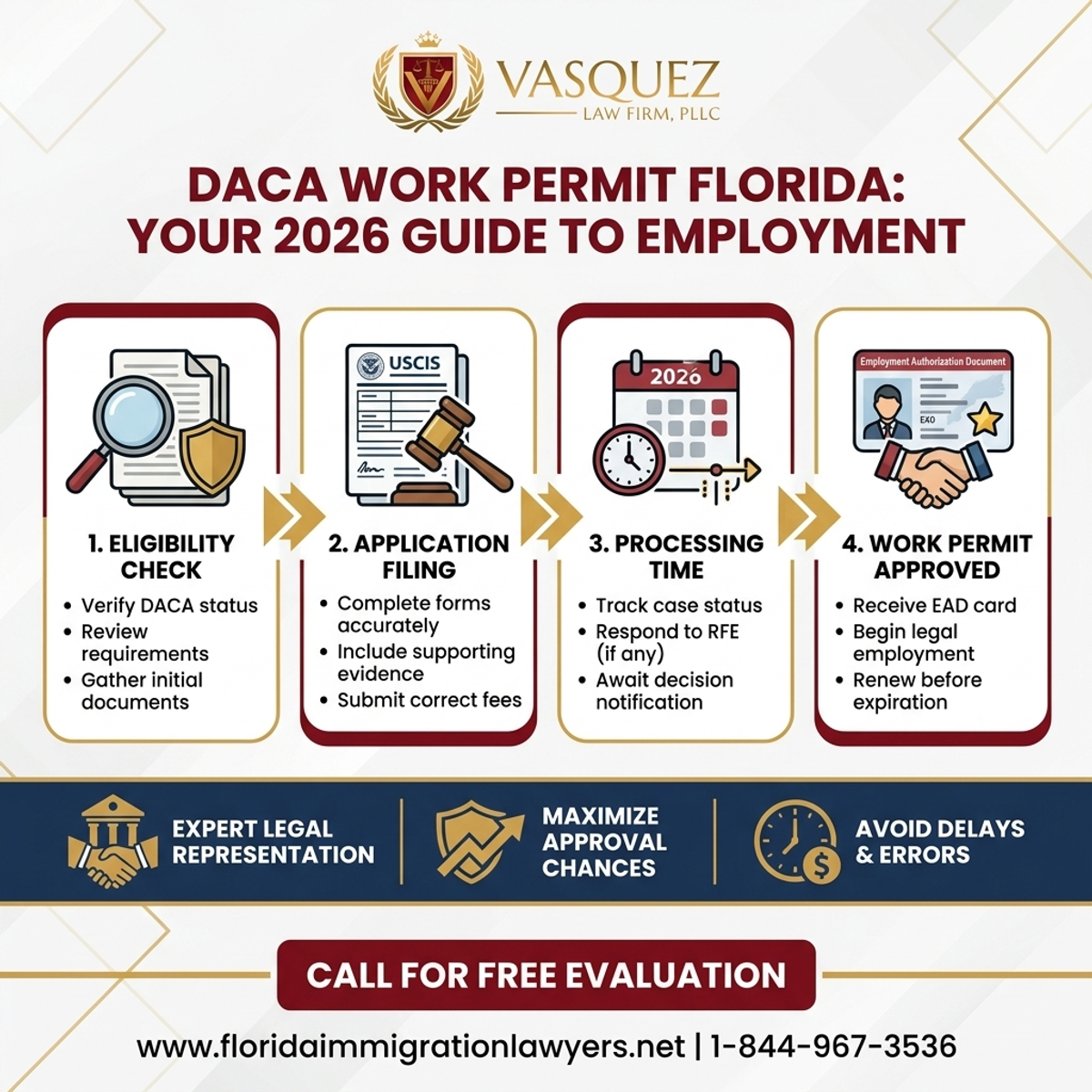
Key Statistics — DACA Work Permit Florida: Your 2026 Guide to Employment
DACA Application Costs and Fee Breakdown
The cost of a DACA application primarily consists of government filing fees. These fees are subject to change, so always verify the current amounts directly on the USCIS website or consult with an immigration attorney. As of 2026, the main components of the DACA work permit Florida application fees typically include:
- Form I-765, Application for Employment Authorization: This is the fee for your work permit.
- Biometrics Services Fee: This covers the cost of your fingerprinting, photograph, and signature.
It is important to note that fee waivers for DACA applications are extremely rare and generally not available. Applicants must typically pay the full amount. Payment must be made by money order, personal check, cashier's check, or by credit card using Form G-1450, Authorization for Credit Card Transactions. Ensure your payment is correct and made out to "U.S. Department of Homeland Security." Incorrect payment amounts or methods can lead to your application being rejected and returned, causing significant delays. Planning for these costs is an integral part of preparing your DACA application in Florida.
Navigating DACA Renewals in Florida
For many DACA recipients in Florida, the process is not a one-time event but a recurring need to renew their deferred action and work authorization. Navigating DACA work permit Florida renewals is just as important as the initial application, if not more so, to ensure continuous protection from removal and uninterrupted employment authorization. A lapse in DACA status can have severe consequences, including loss of work authorization, inability to drive, and increased risk of deportation.
USCIS recommends filing your DACA renewal application 120 to 150 days (approximately 4 to 5 months) before your current DACA and EAD expire. This timeframe allows sufficient processing time to avoid any gaps in your legal status or employment authorization. If you file too late, you risk your DACA expiring before the renewal is approved, which could impact your job and daily life. If your DACA expires for more than a year, USCIS may consider your application an initial request, which, as of 2026, is generally not being processed for new applicants.
The renewal process largely mirrors the initial application, requiring Form I-821D, Form I-765, and Form I-765WS. You will also need to pay the associated filing fees and attend a biometrics appointment. While you may not need to resubmit all the extensive supporting documentation from your initial application if your information has not changed, it is always wise to review your original application and provide any updated evidence, especially regarding continuous residence and criminal history. For example, if you moved within Florida, update your address with USCIS and provide new utility bills or lease agreements.
The key to a successful renewal is proactive planning and meticulous execution. Keeping copies of all previous DACA applications and approval notices is crucial. If you have any changes in your criminal history, even minor infractions, it is imperative to discuss them with an immigration attorney before filing. Florida Immigration Lawyers assists DACA recipients across Florida, from Jacksonville to the Florida Keys, in managing their renewal applications, ensuring they are filed timely and accurately to maintain their vital protections.
Impact of DACA on Employment and Life in Florida
The DACA work permit Florida has a profound impact on the lives of recipients, opening doors to opportunities that would otherwise be inaccessible. For young individuals in Florida, an Employment Authorization Document (EAD) translates into tangible benefits that contribute significantly to their personal growth, economic stability, and integration into the broader community.
Firstly, an EAD provides the legal authorization to work in the United States. This means DACA recipients can secure legitimate employment in various sectors, from healthcare and education to technology and hospitality, all thriving industries in Florida. With legal employment, individuals can earn higher wages, gain valuable professional experience, and contribute to the state's economy through taxes. Many DACA recipients in Florida are essential workers, contributing significantly to local economies in cities like Orlando and Miami. This ability to work legally also reduces the risk of exploitation often faced by undocumented workers, providing a safer and more stable work environment.
Beyond employment, a DACA work permit also facilitates other crucial aspects of daily life in Florida. With an EAD, DACA recipients are eligible to apply for a Florida driver's license or state identification card. This is incredibly important in a state where public transportation options can be limited, especially outside major metropolitan areas. A driver's license provides independence, allows for reliable commuting to work or school, and facilitates participation in community activities.
Furthermore, DACA recipients often find increased opportunities for higher education and professional development. While DACA does not grant federal financial aid eligibility, having legal status and a work permit can make it easier to pursue state-level aid, scholarships, or to fund education through employment. This enables DACA recipients to pursue career aspirations, leading to upward mobility and greater contributions to Florida's workforce and society. The sense of security and belonging that DACA provides allows these young Floridians to plan for their future, invest in their communities, and build stable lives without the constant fear of deportation. The legal protections offered by DACA, though currently challenged, are fundamental to the well-being and success of these individuals and their families.
Common Mistakes to Avoid in Your DACA Work Permit Application
The DACA application process, especially for a DACA work permit Florida, is fraught with complexities where even minor errors can lead to significant delays or outright denial. Being aware of these common pitfalls can help you prepare a stronger application and increase your chances of a successful outcome.
- Filing an Initial DACA Request (if you haven't had DACA before): As of 2026, USCIS is generally not processing initial DACA requests for individuals who have never held DACA. Attempting to file one will likely result in rejection and loss of filing fees.
- Submitting Incomplete Forms: Leaving fields blank or failing to answer all questions on Forms I-821D, I-765, and I-765WS is a common mistake. Every section must be addressed, even if it's to write "N/A" (Not Applicable). Incomplete forms are often rejected.
- Failing to Provide Sufficient Supporting Evidence: USCIS requires robust documentation for every eligibility criterion. Submitting only a few documents for continuous residence or physical presence can lead to a Request for Evidence (RFE) or denial. Over-documenting, within reason and organization, is better than under-documenting.
- Incorrectly Calculating or Submitting Fees: DACA applications require specific fees for Form I-765 and biometrics. Sending an incorrect amount, using an expired payment method, or making the check out to the wrong entity will cause your application to be rejected. Always verify current fees on the USCIS website.
- Filing Your Renewal Too Late: For DACA renewals, waiting until the last minute can lead to a lapse in your work authorization and protection. USCIS recommends filing 120-150 days before expiration. Filing too late means you might lose your job or ability to drive.
- Not Disclosing Criminal History: Any past arrests, charges, or convictions, no matter how minor or old, must be disclosed. Failing to do so, even if the charges were dropped or expunged, can be considered misrepresentation and lead to denial, and potentially severe immigration consequences. Provide certified court dispositions.
- Sending Original Documents: Unless specifically requested, never send original documents. Always submit clear, legible copies. USCIS is not responsible for returning original documents, and losing them can be a significant hardship.
- Not Updating Your Address with USCIS: If you move within Florida or to another state, you must inform USCIS of your new address within 10 days of moving by filing Form AR-11, Alien's Change of Address Card, or updating online. Failure to do so can result in missed notices, RFEs, or even denial without your knowledge.
- Assuming DACA Grants Legal Status: DACA provides deferred action and work authorization, but it does not grant lawful immigration status or a path to U.S. citizenship. Misunderstanding this can lead to incorrect expectations or actions.
When to Call a Florida Immigration Lawyer for Your DACA Work Permit
While some DACA recipients attempt to navigate the application or renewal process independently, there are numerous situations where the expertise of a Florida immigration lawyer is not just helpful, but absolutely essential. The legal landscape surrounding DACA is constantly evolving, making professional guidance invaluable for your DACA work permit Florida application.
You should strongly consider contacting Florida Immigration Lawyers if any of the following scenarios apply to you:
- You Have a Criminal Record: Even minor arrests, charges, or convictions can significantly impact your DACA eligibility. An attorney can assess your criminal history, advise on its implications, and help mitigate potential issues that might lead to a denial.
- You Have Had Previous Interactions with Immigration Enforcement: If you have ever been placed in removal proceedings, issued a notice to appear (NTA), or had any contact with ICE or CBP, it is crucial to consult a lawyer. These situations add layers of complexity that require expert legal analysis.
- You Have Traveled Outside the U.S. Without Advance Parole: Unauthorized travel outside the U.S. after June 15, 2007, can break your continuous residence requirement, making you ineligible for DACA. A lawyer can help determine if your absences qualify as brief, casual, and innocent.
- You Are Unsure About Your Eligibility: If you are on the fence about whether you meet all DACA criteria, especially regarding continuous residence, physical presence, or the age requirements, a lawyer can provide a thorough assessment and help you gather the necessary evidence.
- You Received a Request for Evidence (RFE) or Notice of Intent to Deny (NOID): These notices from USCIS indicate that your application is incomplete or that there are concerns about your eligibility. Responding correctly and comprehensively to an RFE or NOID is critical and often requires legal expertise to avoid denial.
- Your Previous DACA Application Was Denied: Understanding why a previous application was denied is crucial for a successful reapplication. An attorney can review the denial notice and advise on the best course of action.
- You Need Assistance with Organizing Extensive Documentation: If your case involves a large volume of documents, or if you are struggling to prove continuous residence over many years, an attorney can help you organize and present your evidence effectively.
- You Are Concerned About the Evolving Legal Landscape: With ongoing court cases and potential policy changes, an immigration attorney stays abreast of the latest developments and can provide the most current and accurate advice for your DACA application in Florida.
Our experienced team at Florida Immigration Lawyers understands the nuances of DACA law and the specific challenges faced by individuals in Florida. We offer personalized legal strategies and compassionate support to help you achieve your immigration goals.
About Florida Immigration Lawyers
Florida Immigration Lawyers is a leading immigration law firm dedicated to serving individuals and families across the entire state of Florida. With a deep understanding of U.S. immigration law and a commitment to our clients, we provide comprehensive legal services tailored to your unique needs. Our experienced attorneys specialize in a wide range of immigration matters, including DACA applications and renewals, asylum claims, deportation defense, family-based petitions, citizenship, and business immigration. We understand the profound impact immigration issues have on people's lives and approach every case with empathy, professionalism, and unwavering dedication.
Our firm is proud to offer bilingual services, ensuring that our Spanish-speaking clients receive clear, culturally appropriate, and effective legal counsel. We are available 24/7 to answer your urgent questions and offer free consultations to help you understand your options and develop a strong legal strategy. Whether you are in Orlando, Miami, Tampa, or any other Florida community, our team is here to guide you through every step of your immigration journey. Choose Florida Immigration Lawyers for reliable, compassionate, and results-driven legal representation. Call us today at 1-844-967-3536 to schedule your free consultation.
Sources and References
- U.S. Citizenship and Immigration Services (USCIS) - Deferred Action for Childhood Arrivals (DACA)
- USCIS Form I-821D, Consideration of Deferred Action for Childhood Arrivals
- USCIS Form I-765, Application for Employment Authorization
- Immigration and Nationality Act (INA) Section 274A - Unlawful Employment of Aliens: 8 U.S.C. § 1324a
- 8 Code of Federal Regulations (CFR) Part 274a - Control of Employment of Aliens
- Executive Office for Immigration Review (EOIR)
Related services: H-1B specialty occupation visas, L-1 intracompany transfer visas, work visas for professionals, investment and entrepreneur visas.
This article provides general legal information and is not intended as legal advice. Every case is unique, and outcomes depend on specific facts and circumstances. Immigration laws are subject to change. Contact an attorney for advice about your particular situation and to confirm current laws and procedures.
Securing your DACA work permit Florida is a critical step towards building a stable and prosperous future. The legal process can be daunting, but with the right guidance, you can navigate it successfully. Do not let uncertainty or complexity deter you from pursuing your dreams. Florida Immigration Lawyers is here to provide the expert legal support you need.
We offer free consultations and are available 24/7 to discuss your DACA application or renewal. Our dedicated team is committed to helping DACA recipients across Florida achieve their immigration goals. Call us today at 1-844-967-3536 to schedule your free consultation. Se Habla Español - Estamos aquí para ayudarle.
If you need legal assistance, learn more about speak with a business immigration lawyer, or call us at 1-844-967-3536 for a free consultation.
Do Not Navigate This Process Alone
Our experienced immigration attorneys are ready to fight for you. Get a free, confidential consultation today.
Se Habla Español
Or leave your details and we’ll call you:
Free Evaluation in 24 Hours
Or talk to us right now
AI voice assistant — available 24/7
FreeFrequently Asked Questions

William J. Vásquez
Founding Attorney · Vasquez Law Firm
U.S. Air Force veteran and immigration attorney with years of hands-on U.S. immigration experience. J.D., NCCU School of Law. AILA member. Admitted to the 4th, 5th, and 11th Circuit Courts.
Available 24/7 - Free Evaluations
Reviewed for legal accuracy by William J. Vásquez
Licensed in North Carolina; U.S. immigration is federal practice.
Related Legal Services
Our Florida immigration attorneys can help you with asylum protection, deportation defense and citizenship and naturalization. Call today at 1-844-967-3536 for a free consultation.
Related Links
Related Topics
Free Legal Consultation
Discuss your case with our experienced attorneys. We're available 24/7.
Se Habla Español - Estamos aquí para ayudarle.
Related Articles
Military Naturalization Expedited in Florida Bases
Explore military naturalization options for families at Florida bases, including parole in place benefits in Miami. Learn how to expedite your application with expert guidance from Florida Immigration Lawyers.
Immigration Lawyer Orlando Free Consultation 2026
Discover how an immigration lawyer in Orlando can help you through a free consultation. Learn about the services offered, costs, and recent immigration policy updates affecting your case.
How to Get a Work Permit in Florida for 2026
Learn how to obtain a work permit in Florida through the PERM labor certification process. This guide covers everything from job descriptions to filing the necessary forms. Contact Florida Immigration Lawyers for expert advice.
Stokes Interview for Marriage-Based Green Cards in 2026
A Stokes interview is a rigorous, separate interview conducted by USCIS when marriage fraud is suspected in a green card application. This intense process involves detailed questioning of both spouses to uncover inconsistencies. If you're in Florida and facing a Stokes interview, understanding the process, preparing meticulously with comprehensive documentation, and seeking expert legal counsel are critical steps. A finding of marriage fraud can lead to severe consequences, including deportation and permanent bars from future immigration benefits. Florida Immigration Lawyers specializes in guiding individuals through these challenging interviews, offering strategic preparation and robust representation to protect your rights and help prove the legitimacy of your marriage. Don't face USCIS alone; learn how to navigate this complex process effectively.