Green Card Holders Issued New Warning: Renewal Process in
Green card holders in Florida face new warnings and considerations for their 2026 renewal process. This comprehensive guide from Florida Immigration Lawyers details the Form I-90 application, necessary documents, processing timelines, and associated costs. Learn how to avoid common mistakes, understand the importance of timely filing, and protect your permanent resident status amidst evolving immigration policies. We provide specific advice for residents in Kissimmee and throughout Florida, emphasizing the critical need for accurate information and, when necessary, expert legal counsel. Ensure your green card remains valid and secure your future in the U.S. with our expert guidance.

Green card holders, especially those in Florida, should be aware of important considerations for green card renewal in 2026, including potential policy changes and the critical need to maintain valid documentation. While the controversial 'public charge' rule of 2019 was largely rescinded, staying informed about evolving immigration laws is crucial to protect your permanent resident status. Renewing your green card involves filing Form I-90 with USCIS, a process that requires careful attention to detail and adherence to deadlines. Failing to renew can lead to significant complications, including issues with employment, travel, and even deportation defense challenges.
- Always renew your green card before it expires, typically within six months of the expiration date.
- The primary form for renewal is Form I-90, Application to Replace Permanent Resident Card.
- Be vigilant about policy changes; consult official USCIS sources or an attorney.
- Gather all necessary documents, including your expiring green card and personal identification.
- Seek legal counsel from Florida Immigration Lawyers if your case is complex or you have concerns.
As a permanent resident in Florida, maintaining a valid green card is essential for proving your legal status, working, traveling, and accessing various benefits. However, with immigration policies continually evolving, green card holders have been issued new warnings to remain vigilant and proactive. Recent years have seen significant shifts, such as the now-rescinded 'public charge' rule, which created uncertainty and fear among immigrant communities. While that specific warning has passed, the overarching message remains: staying informed and compliant is paramount to safeguarding your future in the United States.
This comprehensive guide from Florida Immigration Lawyers will walk you through the intricate process of green card renewal in 2026, specifically focusing on the steps and considerations for residents across Florida, including Kissimmee and surrounding areas. We will cover everything from understanding when to renew, filing Form I-90, compiling necessary documents, to anticipating processing times and potential costs. Our goal is to empower you with the knowledge needed to navigate this crucial process smoothly and confidently. Do not risk your hard-earned status due to misinformation or delay.
For personalized guidance on your green card renewal, do not hesitate to reach out. Call Florida Immigration Lawyers at 1-844-967-3536 for a free consultation today. Our experienced team is ready to assist you.
What is the Green Card Renewal Process in Florida for 2026?
The green card renewal process in Florida for 2026 primarily involves filing Form I-90, Application to Replace Permanent Resident Card, with USCIS. This applies to most permanent residents whose 10-year green card is expiring or has already expired. The process is critical to maintaining your lawful status and avoiding complications with employment, travel, and other essential aspects of life in the U.S. As of 2026, the fundamental steps remain consistent, focusing on timely submission and accurate documentation.
Living in Florida, particularly in diverse communities like Kissimmee, means you are part of a vibrant immigrant population that regularly engages with immigration law processes. The state hosts several USCIS field offices, including those in Orlando, Miami, and Tampa, which may handle aspects of your case, such as biometrics appointments. Understanding the specific requirements for your situation is vital. For instance, if your green card was issued with a 10-year validity period, renewal is mandatory. If you received a conditional green card through marriage or investment, you must instead file Form I-751 (Petition to Remove Conditions on Residence) or Form I-829 (Petition by Investor to Remove Conditions on Permanent Resident Status), respectively, not Form I-90.
Navigating these distinctions can be challenging, and any errors could lead to delays or even denial. The Immigration and Nationality Act (INA) Section 264(e) (8 U.S.C. § 1304(e)) requires all permanent resident aliens to carry their green card at all times. An expired green card, while not automatically revoking your status, can create significant difficulties. It can hinder your ability to prove your lawful presence to employers, landlords, or law enforcement, and make international travel problematic. Therefore, proactive renewal is not just a recommendation; it is a legal imperative for all green card holders in Florida.
Step-by-Step Guide to Filing Form I-90 for Green Card Renewal
Renewing your green card through Form I-90 is a multi-step process that demands precision. Following these steps carefully will help ensure a smooth application, especially for permanent residents in Florida. Remember that timely action is key to avoiding an expired card.
-
Determine Your Eligibility and Reason for Renewal: Before you begin, confirm that Form I-90 is the correct application for your situation. You typically need to renew if your 10-year green card is expiring within six months, has already expired, or if it was lost, stolen, damaged, or contains incorrect information. Conditional green card holders (family-based or investor-based) should not use Form I-90 for their initial status adjustment.
-
Gather Required Documents: Collect all necessary supporting documentation. This typically includes your expiring or expired green card, government-issued identification (such as a Florida driver's license), and any documents supporting the reason for replacement (e.g., police report for a stolen card, marriage certificate for a name change). Having these ready upfront will save time and prevent delays.
-
Complete Form I-90 Accurately: You can file Form I-90 online or by mail. When completing the form, ensure all information is accurate and consistent with previous immigration documents. Any discrepancies can flag your application for further review. Pay close attention to sections asking about your personal history and immigration record. For those in Kissimmee, Florida, ensure your current mailing address is correctly listed to receive all correspondence from USCIS.
-
Pay the Filing Fee: As of 2026, USCIS fees are subject to change, so always check the most current fee schedule on the official USCIS website. There is a filing fee for Form I-90, and a separate biometrics services fee. Fee waivers may be available for eligible applicants experiencing financial hardship. It is crucial to submit the correct payment amount to avoid rejection of your application.
-
Submit Your Application: If filing online, follow the prompts on the USCIS website. If filing by mail, send your completed Form I-90, supporting documents, and payment to the address specified in the form instructions. Make copies of everything for your records before mailing. After submission, you will receive a receipt notice (Form I-797C, Notice of Action).
-
Attend Biometrics Appointment: USCIS will send you an appointment notice for biometrics (fingerprints, photograph, and signature) at an Application Support Center (ASC). For Florida residents, this might be at the Orlando ASC or another nearby location. This appointment is mandatory. Failing to attend without rescheduling can lead to your application being denied. Bring your appointment notice and a valid photo ID.
-
Receive Your New Green Card: After your biometrics are processed and your application reviewed, USCIS will mail your new permanent resident card to the address provided on your Form I-90. Monitor your case status online using the receipt number provided on your I-797C notice. In some cases, USCIS may issue an extension sticker or temporary I-551 stamp in your passport if your current card expires while your application is pending, which is useful for travel.
What Documents Do I Need for My Green Card Renewal Application?
A complete and accurate submission is vital for a successful green card renewal. Having all the necessary documents prepared beforehand can significantly streamline your Form I-90 application process. For permanent residents in Florida, the general requirements are consistent across the nation, but local access to documents might vary.
- Expiring or Expired Green Card: Your current Permanent Resident Card (Form I-551) is the most critical document. If it was lost or stolen, you will need a police report.
- Government-Issued Photo Identification: A valid passport, driver's license (e.g., Florida driver's license), or state ID card is typically required for identity verification at your biometrics appointment.
- Proof of Name Change (if applicable): If your name has changed since your last green card was issued (e.g., due to marriage or court order), you must provide legal documentation such as a marriage certificate or court order. This is particularly common in diverse communities like Kissimmee where family dynamics often lead to name changes.
- Previous Immigration Documents: While not always mandatory for renewal, having copies of your previous immigration petitions (e.g., I-485, I-130) can be helpful for reference, especially if there are any questions about your immigration history.
- Proof of Fee Payment: If mailing your application, include a check or money order for the correct filing and biometrics fees. If filing online, ensure your payment is successfully processed.
- Photographs (rarely needed for I-90): Generally, USCIS uses the photo taken at your biometrics appointment. However, always review the specific I-90 instructions for any updates, as requirements can change.
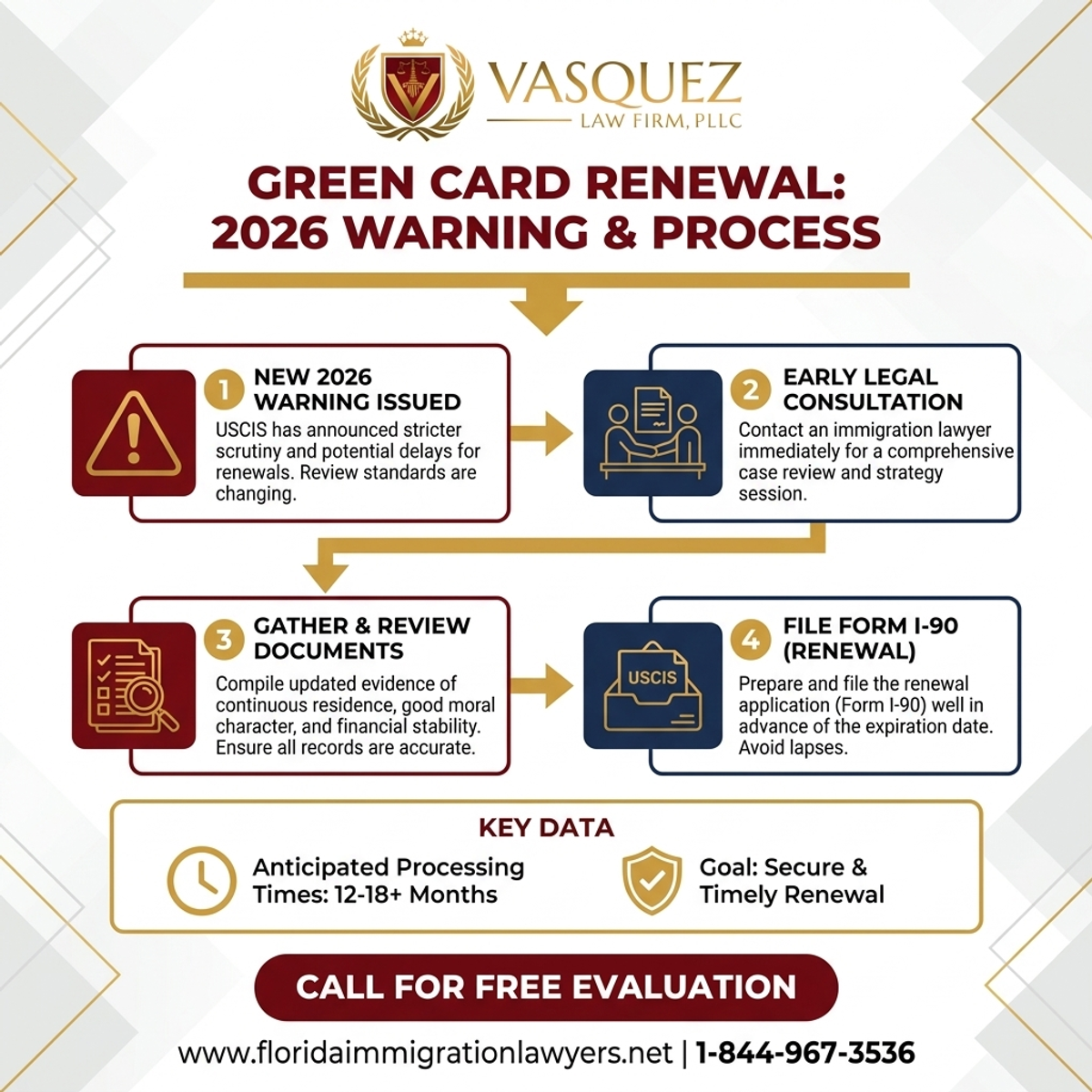
Step-by-Step Process — Green Card Holders Issued New Warning: Renewal Process in 2026
Ensuring that all documents are properly translated into English by a certified translator, if originally in another language, is also essential. Providing clear, legible copies of all supporting documents will prevent requests for evidence (RFEs) and potential delays in your green card renewal process. Always keep original documents safe and only send copies unless USCIS specifically requests an original.
How Long Does Green Card Renewal Take in 2026?
The processing time for green card renewal (Form I-90) can vary significantly depending on several factors, including the specific USCIS service center, the volume of applications, and the completeness of your submission. As of 2026, applicants in Florida can generally expect processing times ranging from 6 to 18 months. It is crucial to file your Form I-90 well in advance of your green card's expiration date to avoid any gaps in your legal documentation.
USCIS provides online tools to check current processing times, which are regularly updated. Factors that can extend processing times include requests for additional evidence (RFEs), errors in the application, or background check delays. While your application is pending, USCIS typically provides an extension of your permanent resident status, often by issuing a temporary I-551 stamp in your passport or an extension sticker on your expiring green card. This allows you to continue working and traveling while awaiting your new card. For Florida residents, especially those who travel frequently internationally, securing this temporary proof of status is vital.
| Stage | Typical Timeframe (As of 2026) | Notes |
|---|---|---|
| Application Submission to Receipt Notice | 1-3 weeks | You will receive Form I-797C, Notice of Action. |
| Receipt Notice to Biometrics Appointment | 3-8 weeks | Appointment at a local Application Support Center (ASC), e.g., Orlando, FL. |
| Biometrics to Application Approval | 6-16 months | Varies greatly; check USCIS online processing times for your service center. |
| Approval to Card Production/Mailing | 1-2 weeks | Your new green card is mailed to the address on file. |
| Total Processing Time | 6-18 months (average) | File early to avoid issues; temporary proof of status may be needed. |
What are the Costs Associated with Green Card Renewal?
The cost of green card renewal primarily includes the USCIS filing fee for Form I-90 and the biometrics services fee. As of 2026, these fees are subject to change, and it is crucial to verify the most current amounts directly on the official USCIS website or by consulting an attorney. These fees are non-refundable, regardless of the outcome of your application, so accurate payment is essential.
Beyond the direct government fees, applicants in Florida might incur other costs. These can include attorney fees if you choose to hire legal representation, which is often advisable for complex cases or if you wish to ensure accuracy. Other potential costs might involve obtaining certified translations for foreign-language documents, postage for mailing applications, or travel expenses to attend your biometrics appointment at a facility like the one in Orlando. Being prepared for these potential expenses can help you budget effectively for your permanent resident card renewal.
| Item | Typical Fee (As of 2026 - Check USCIS for Current) | Notes |
|---|---|---|
| Form I-90 Filing Fee | Approximately $455 | Mandatory fee for processing the application. |
| Biometrics Services Fee | Approximately $85 | Mandatory fee for fingerprinting, photo, and signature. |
| Legal Fees (if applicable) | Varies based on complexity and firm | Recommended for complex cases or peace of mind. |
| Translation Costs (if applicable) | Varies per document/translator | For documents not in English. |
| Postage/Travel Costs | Varies | For mailing documents and attending appointments. |
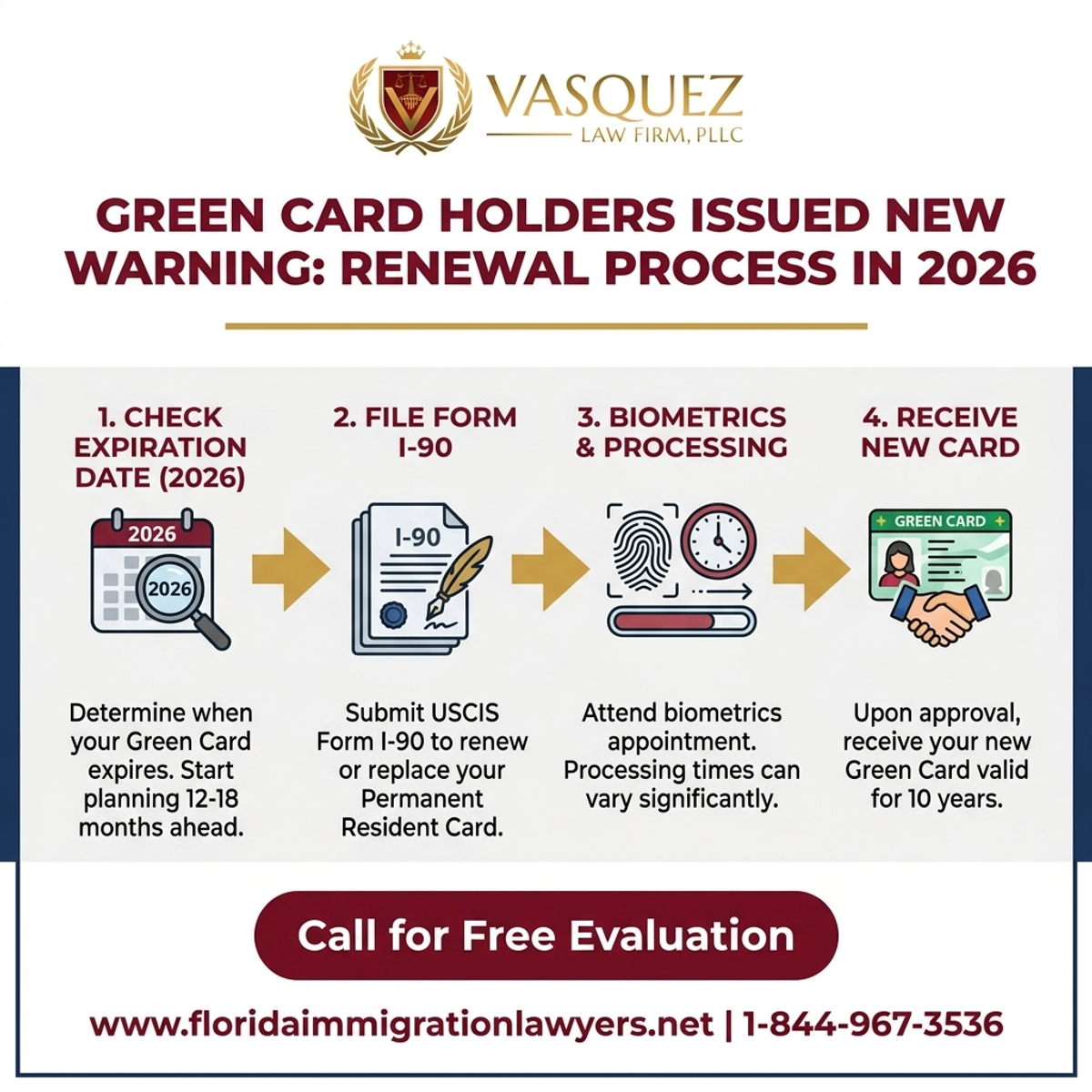
Key Statistics — Green Card Holders Issued New Warning: Renewal Process in 2026
Common Mistakes to Avoid During Green Card Renewal
Renewing your permanent resident card can seem straightforward, but many applicants make common errors that lead to delays or even denial. Avoiding these pitfalls is crucial for a successful green card renewal, especially for residents in Florida.
-
Filing the Wrong Form: Using Form I-90 when you should be filing Form I-751 (Petition to Remove Conditions on Residence) for a conditional green card. This is a common mistake that can lead to significant delays and potential loss of status.
-
Missing the Renewal Deadline: Waiting until your green card has already expired or is very close to expiring. USCIS recommends filing within six months of expiration. An expired card can cause issues with employment, travel, and proving your status (8 CFR Part 264).
-
Incomplete or Inaccurate Information: Failing to fill out every required field on Form I-90 or providing inconsistent information compared to previous immigration records. This often results in Requests for Evidence (RFEs), prolonging the process.
-
Incorrect Fee Payment: Submitting an incorrect filing fee or biometrics fee, or using an outdated fee schedule. USCIS will reject applications with incorrect payments, forcing you to restart the process.
-
Failing to Attend Biometrics: Missing your scheduled biometrics appointment without properly rescheduling. This is a mandatory step, and failure to appear typically leads to application denial.
-
Not Updating Your Address with USCIS: Moving without notifying USCIS of your new address. This can cause you to miss crucial notices, including appointment letters or requests for evidence, leading to delays or denial of your green card renewal application.
-
Lack of Supporting Documentation: Not including all necessary supporting documents, such as a police report for a stolen card or a marriage certificate for a name change. Incomplete submissions will be delayed.
-
Assuming Conditional Status is Permanent: Believing that a 2-year conditional green card renews like a 10-year card. Conditional residents must file a petition to remove conditions (I-751 or I-829), not Form I-90, to obtain permanent status.
-
Ignoring USCIS Notices: Disregarding any notices or requests for evidence from USCIS. Always respond promptly and thoroughly to avoid adverse actions on your case.
-
Traveling with an Expired Green Card: Attempting to re-enter the U.S. with an expired green card without proper temporary documentation (e.g., I-551 stamp in passport). While lawful permanent residents cannot be denied entry, proving status can be extremely difficult without valid proof.
When to Call a Florida Immigration Lawyer for Green Card Renewal
While the green card renewal process for Form I-90 can be straightforward for many, certain situations warrant the expert guidance of a Florida immigration lawyer. For permanent residents in Kissimmee and across Florida, seeking legal counsel can prevent costly mistakes and provide peace of mind.
You should consider contacting Florida Immigration Lawyers if you:
- Have an Expired Green Card and Need to Travel Urgently: An attorney can help you obtain temporary proof of status (I-551 stamp) for emergency travel.
- Have a Criminal Record: Any arrests, charges, or convictions, even minor ones, can complicate your renewal and potentially lead to deportation defense issues.
- Received a Request for Evidence (RFE) from USCIS: An RFE indicates USCIS needs more information, and a lawyer can help you formulate a comprehensive and timely response.
- Believe You May Be Inadmissible: If you have certain health issues, a history of immigration violations, or other grounds of inadmissibility, your renewal could be at risk.
- Are a Conditional Permanent Resident: If you have a 2-year green card, you do not renew with Form I-90; you must file Form I-751 or I-829. An attorney can guide you through this complex process.
- Have Lost or Had Your Green Card Stolen Multiple Times: Repeated incidents can raise red flags with USCIS, requiring a more robust explanation.
- Are Considering Applying for U.S. citizenship Soon: Renewing your green card might still be necessary, but an attorney can advise on the best strategy and timing.
Our firm, Florida Immigration Lawyers, specializes in navigating these complexities. We can assess your unique situation, prepare your Form I-90 application, ensure all documentation is correct, and represent you if any issues arise. Our goal is to protect your permanent resident status and secure your future in Florida.
About Florida Immigration Lawyers
Florida Immigration Lawyers is a leading immigration law firm dedicated to serving individuals and families across the entire state of Florida. With years of specialized experience, our team of compassionate and knowledgeable attorneys is committed to providing exceptional legal representation for a wide range of immigration matters. From green card renewal and family-based petitions to complex deportation defense and asylum cases, we understand the profound impact immigration issues have on our clients' lives.
We pride ourselves on our client-centered approach, offering personalized strategies tailored to each unique situation. Our firm is deeply familiar with the nuances of federal immigration law and how it applies to Florida residents, including those in Kissimmee, Orlando, Miami, and Tampa. We are available 24/7 to answer your questions and offer free, confidential consultations. We speak English and Spanish (Se Habla Español), ensuring effective communication and culturally sensitive service. Let Florida Immigration Lawyers be your trusted partner in achieving your immigration goals and protecting your rights.
Sources and References
- U.S. Citizenship and Immigration Services (USCIS)
- USCIS Form I-90, Application to Replace Permanent Resident Card
- Executive Office for Immigration Review (EOIR)
- U.S. Department of State
- Immigration and Nationality Act (INA) Section 264(e) - 8 U.S.C. § 1304(e)
- 8 Code of Federal Regulations (CFR) Part 264 - Documentary Requirements
- USCIS Policy Manual
Related services: immigration practice areas, experienced immigration attorneys, free immigration consultation.
This article provides general legal information and is not intended as legal advice. Every case is unique, and outcomes depend on specific facts and circumstances. Contact an attorney for advice about your particular situation.
Do not let your permanent resident status lapse or fall into jeopardy. Take proactive steps for your green card renewal. Florida Immigration Lawyers is here to guide you through every step. Call us today for a free consultation at 1-844-967-3536. Se Habla Español - Estamos aqui para ayudarle.
Do Not Navigate This Process Alone
Our experienced immigration attorneys are ready to fight for you. Get a free, confidential consultation today.
Se Habla Español
Or leave your details and we’ll call you:
Free Evaluation in 24 Hours
Or talk to us right now

AI voice assistant — available 24/7
FreeFrequently Asked Questions

William J. Vásquez
Founding Attorney · Vasquez Law Firm
U.S. Air Force veteran and immigration attorney with years of hands-on U.S. immigration experience. J.D., NCCU School of Law. AILA member. Admitted to the 4th, 5th, and 11th Circuit Courts.
Available 24/7 - Free Evaluations
Reviewed for legal accuracy by William J. Vásquez
Licensed in North Carolina; U.S. immigration is federal practice.
Related Legal Services
Our Florida immigration attorneys can help you with experienced immigration attorneys, business immigration and asylum protection. Call today at 1-844-967-3536 for a free consultation.
Related Links
Related Topics
Free Legal Consultation
Discuss your case with our experienced attorneys. We're available 24/7.
Se Habla Español - Estamos aquí para ayudarle.
Related Articles
Military Naturalization Expedited in Florida Bases
Explore military naturalization options for families at Florida bases, including parole in place benefits in Miami. Learn how to expedite your application with expert guidance from Florida Immigration Lawyers.
Immigration Lawyer Orlando Free Consultation 2026
Discover how an immigration lawyer in Orlando can help you through a free consultation. Learn about the services offered, costs, and recent immigration policy updates affecting your case.
Immigration Lawyer Orlando Free Consultation: Protect
Immigration scams pose serious threats to immigrants in Florida. Learn how to protect yourself from notario fraud and find legitimate legal help. Discover steps to verify credentials and avoid common pitfalls. Contact Florida Immigration Lawyers for expert assistance and a free consultation.
Orlando Immigration Criminal Defense Attorney Options
Explore the role of an Orlando immigration criminal defense attorney in navigating the I-601 waiver process. Learn about eligibility, steps, and common mistakes. Contact Florida Immigration Lawyers for expert guidance.