VAWA Immigration Lawyer: Your Guide to Self-Petitioning in
For individuals in Florida facing domestic violence, the VAWA self-petition offers a critical pathway to immigration relief without relying on an abuser. This guide explains the process for abused spouses, children, and parents to file an I-360 petition, detailing eligibility, required documents, and what to expect in terms of timelines and costs in 2026. We cover common mistakes to avoid and highlight when to seek a VAWA immigration lawyer for expert guidance. Florida Immigration Lawyers provides compassionate support for those navigating these sensitive cases, offering free consultations to help secure safety and legal status.

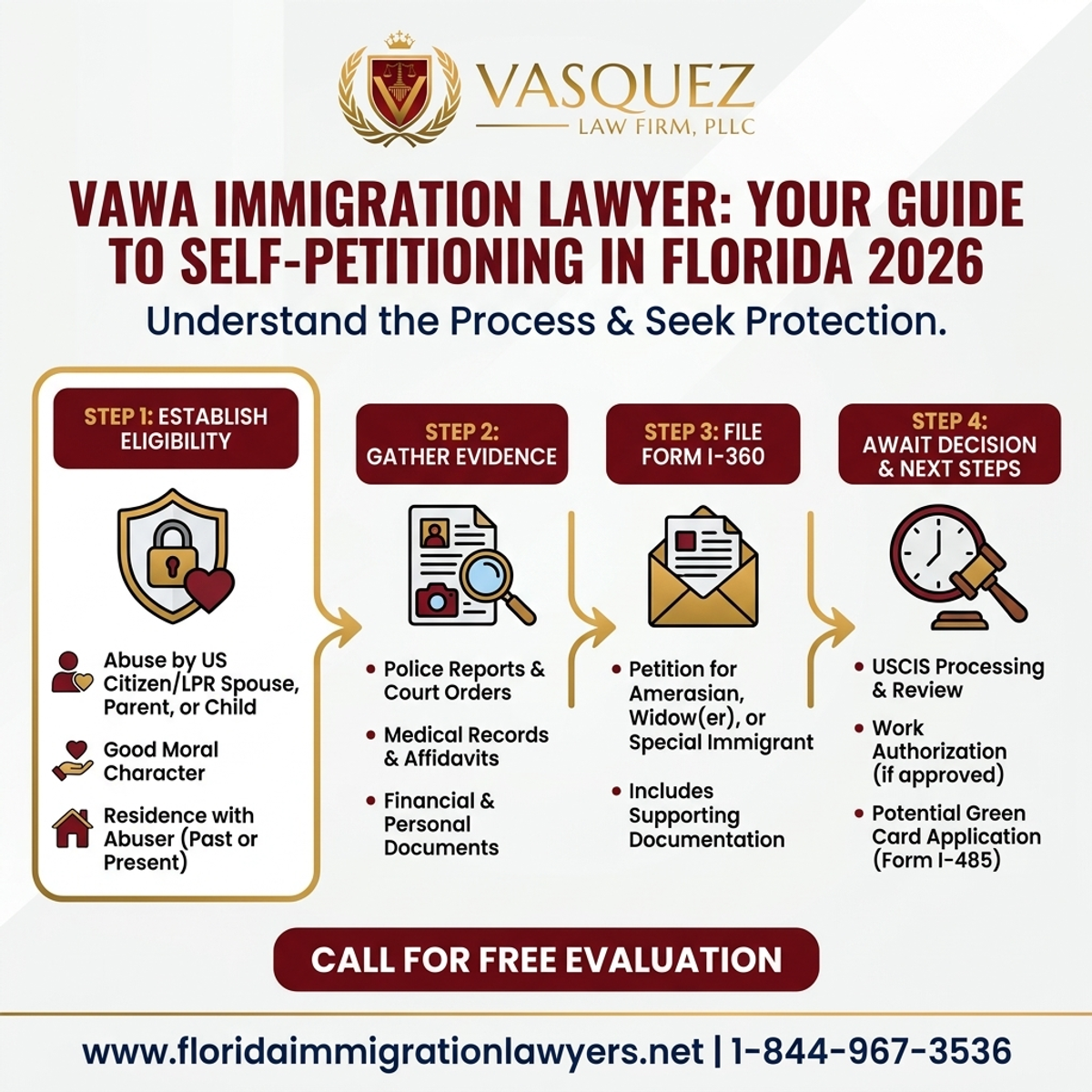
A VAWA self-petition allows certain abused spouses, children, and parents of U.S. citizens or lawful permanent residents to apply for immigration benefits without the knowledge or consent of their abuser. In Florida, this crucial pathway provides protection and a route to legal status for survivors of domestic violence. The process involves filing Form I-360, Petition for Amerasian, Widow(er), or Special Immigrant, with USCIS. Eligibility requires proving a qualifying relationship, abuse, and good moral character. Consulting a VAWA immigration lawyer is vital to navigate the complexities and ensure all requirements are met, particularly given Florida's unique legal landscape and diverse immigrant population.
- VAWA self-petition protects abused immigrants.
- File Form I-360 with USCIS, proving abuse and eligibility.
- Qualifying relatives include spouses, children, and parents.
- Legal assistance is crucial for navigating the complex process.
- Florida residents have specific considerations for filings and support.
VAWA Immigration Lawyer: Your Guide to Self-Petitioning in Florida 2026
Navigating the complex world of immigration law can be incredibly challenging, especially when you are facing the added burden of domestic violence or abuse. For many individuals in Florida, the thought of leaving an abusive relationship is coupled with the fear of losing their immigration status or even facing deportation. Fortunately, the Violence Against Women Act (VAWA) offers a beacon of hope through its self-petitioning provisions. This allows certain abused spouses, children, and parents to seek immigration benefits independently, without the abuser's involvement.
If you are an abused spouse, child, or parent in Florida, understanding your rights and the pathways available under VAWA is essential. This comprehensive guide, prepared with the latest information for 2026, will walk you through the VAWA self-petition process, highlighting critical steps, required documentation, and what to expect. We will also address common pitfalls and explain why securing a knowledgeable VAWA immigration lawyer is not just helpful, but often indispensable, for a successful outcome in Florida.
At Florida Immigration Lawyers, we understand the sensitive nature of these cases and are committed to providing compassionate, effective legal representation. Your safety and legal future are our top priorities. Do not face this journey alone. Call Florida Immigration Lawyers at 1-844-967-3536 for a free consultation to discuss your specific situation and learn how we can help you achieve safety and security.
What is a VAWA Self-Petition and Who is Eligible in Florida?
A VAWA self-petition is an immigration pathway established under the Violence Against Women Act, specifically designed to protect immigrant victims of domestic violence. It allows abused individuals to file an I-360 petition with USCIS on their own behalf, without the need for the abuser's sponsorship or knowledge. This is particularly vital for those whose abusers threaten to withdraw immigration petitions or report them to immigration authorities. As of 2026, the core eligibility requirements remain consistent, focusing on the relationship to the abuser, the nature of the abuse, and the petitioner's good moral character.
Eligibility for a VAWA self-petition extends to three categories of individuals in Florida: abused spouses, abused children, and abused parents. For spouses, you must demonstrate that you are or were married to a U.S. citizen (USC) or a lawful permanent resident (LPR). The marriage must have been entered into in good faith, not solely for immigration purposes. You must also prove that you or your child were subjected to battery or extreme cruelty by your USC or LPR spouse. Furthermore, you must have resided with the abuser and be a person of good moral character. This provision is crucial for survivors seeking independence from their abuser in cities like Tallahassee, Miami, or Orlando, offering a pathway to safety and stability.
Abused children under 21 (or sometimes 25 if the abuse began before 21) can also self-petition if they were abused by a USC or LPR parent. Abused parents can self-petition if they were abused by their adult USC son or daughter. The abuse can be physical, emotional, psychological, sexual, or financial. The key is to provide compelling evidence of this abuse. Consulting a VAWA immigration lawyer in Florida is critical to determine your eligibility and gather the necessary evidence to build a strong case, ensuring compliance with INA § 204(a)(1)(A)(iii) and 8 U.S.C. § 1154(a)(1)(A)(iii) regulations.
How Does the VAWA Self-Petition Process Work?
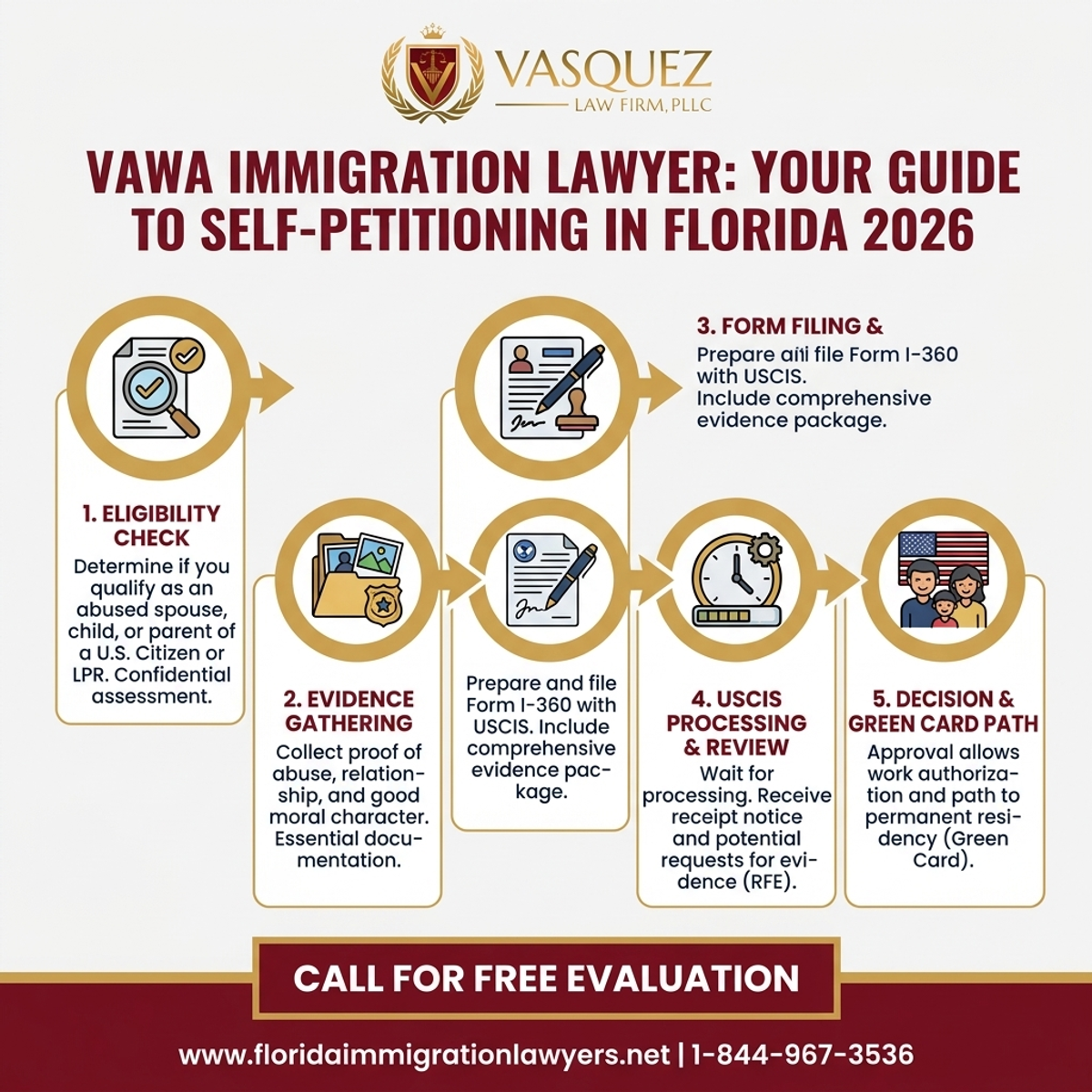
The VAWA self-petition process involves several detailed steps, each requiring careful attention to detail and thorough documentation. Successfully navigating this journey, particularly for those in Florida, often necessitates the guidance of an experienced VAWA immigration lawyer. The process begins with gathering comprehensive evidence and ultimately leads to the potential for lawful permanent residency. Understanding each stage is key to a successful application.
-
Gather Evidence and Documentation: This initial and most crucial step involves collecting all evidence of your relationship to the abuser, the abuse itself, your residence with the abuser, and your good moral character. Evidence of abuse can include police reports, medical records, affidavits from friends, family, or counselors, court orders (such as restraining orders issued in Florida), and personal statements. Proof of relationship might include marriage certificates, birth certificates, and joint financial documents.
-
Prepare and File Form I-360: Once your evidence is compiled, your attorney will help you complete Form I-360, Petition for Amerasian, Widow(er), or Special Immigrant. This form is central to your VAWA self-petition. All supporting documents must be meticulously organized and submitted along with the form to the appropriate USCIS service center. There is typically no filing fee for a VAWA-based I-360 petition, which alleviates some financial burden for petitioners.
-
Receive Prima Facie Determination: After filing, USCIS will review your petition to determine if it establishes a “prima facie” case – meaning, on the face of it, you appear eligible for VAWA benefits. If approved, you will receive a Prima Facie Determination notice, which may entitle you to certain public benefits in Florida. This step confirms that your initial submission meets the basic requirements for further consideration.
-
Biometrics Appointment: USCIS will send you a notice to attend a biometrics appointment at an Application Support Center (ASC) in Florida, such as those located in Orlando, Miami, or Tampa. At this appointment, your fingerprints, photograph, and signature will be collected for background checks. This is a standard procedure for most immigration applications and is essential for security screenings.
-
Decision on I-360 Petition: USCIS will review your entire petition, including the biometrics results, and make a decision. If approved, you will receive an I-360 approval notice. This approval is a critical milestone, confirming your eligibility for VAWA benefits and allowing you to proceed to the next stage of seeking lawful permanent residency. In some complex cases, particularly if USCIS has concerns or requires additional information, they may issue a Request for Evidence (RFE).
-
Apply for Adjustment of Status or Consular Processing: After your I-360 is approved, you can apply for lawful permanent residency (a Green Card). If you are physically present in the United States and eligible, you can file Form I-485, Application to Register Permanent Residence or Adjust Status. If you are outside the U.S. or are not eligible for adjustment of status, you will pursue consular processing through a U.S. embassy or consulate abroad. An experienced immigration lawyer can advise on the best path for your specific circumstances in Florida, whether you are in Tallahassee or elsewhere in the state, and help navigate the requirements of 8 CFR 204.2(c).
What Documents Do I Need for a VAWA I-360 Petition?
A successful VAWA self-petition hinges on providing comprehensive and compelling evidence. Gathering the right documentation is paramount, and an experienced VAWA immigration lawyer in Florida can help you meticulously prepare your submission. The goal is to paint a clear picture of your qualifying relationship, the abuse endured, your good moral character, and your residence with the abuser. Missing or insufficient documentation can significantly delay or jeopardize your petition.
Here is a general checklist of documents typically required for a VAWA I-360 petition:
- Proof of Relationship to Abuser:
- Marriage certificate (if petitioning as a spouse).
- Birth certificates for you and your abuser (if petitioning as a child or parent).
- Divorce decrees or death certificates from previous marriages for both you and the abuser.
- Evidence that the marriage was bona fide (e.g., joint bank accounts, joint leases/mortgages, utility bills, photos, affidavits from friends/family).
- Proof of Abuser's Status:
- Copy of abuser's U.S. birth certificate, naturalization certificate, passport, or Green Card (Form I-551).
- Evidence of Abuse (Battery or Extreme Cruelty):
- Detailed personal sworn statement describing the abuse, including dates, locations, and specific incidents.
- Police reports, arrest records, or court documents related to domestic violence incidents in Florida.
- Medical records, hospital reports, or psychological evaluations detailing injuries or mental health impact from the abuse.
- Affidavits from witnesses (friends, family, teachers, clergy, therapists, social workers) who have knowledge of the abuse.
- Photos of injuries, damaged property, or living conditions.
- Emails, text messages, voicemails, or other communications from the abuser demonstrating control, threats, or abuse.
- Evidence of seeking help from domestic violence shelters, support groups, or counselors in Florida.
- Records of restraining orders or protection orders issued by Florida courts.
Step-by-Step Process — VAWA Immigration Lawyer: Your Guide to Self-Petitioning in Florida 2026
- Proof of Residence with Abuser:
- Joint leases, rental agreements, utility bills, or property deeds showing shared residence in Florida.
- Mail addressed to both you and the abuser at the same address.
- Affidavits from individuals who can attest to your cohabitation.
- Proof of Good Moral Character:
- Criminal background checks from all jurisdictions where you have lived since age 14.
- Affidavits from individuals attesting to your good moral character.
- Any other documents demonstrating your character.
- Proof of Immigration Status (if applicable):
- Copies of all previous immigration documents (e.g., I-94, visa stamps, previous I-797 approval notices).
How Long Does a VAWA Self-Petition Take in 2026?
The processing time for a VAWA self-petition can vary significantly based on several factors, including the complexity of the case, the completeness of the initial submission, and the current workload of USCIS service centers. As of 2026, USCIS provides estimated processing times on its website, which are subject to change. It is crucial for petitioners in Florida to understand that patience is required throughout this multi-stage process. While specific guarantees cannot be made, understanding typical timeframes can help manage expectations.
Generally, the I-360 VAWA petition itself can take anywhere from 12 to 24 months for an initial decision, sometimes longer if a Request for Evidence (RFE) is issued. After I-360 approval, the subsequent application for adjustment of status (Form I-485) or consular processing can add another 6 to 18 months, depending on USCIS field office workloads in Florida (e.g., Miami, Orlando, Tampa) or the specific U.S. embassy/consulate abroad. These are estimates, and individual cases may fall outside these ranges. A qualified VAWA immigration lawyer can provide the most current information and strategies to help expedite your case where possible.
Here is a typical timeline breakdown for a VAWA self-petition in 2026:
| Stage | Typical Timeframe | Notes |
|---|---|---|
| I-360 Petition Filing to Receipt Notice | 2-4 weeks | USCIS acknowledges receipt of your petition. |
| Prima Facie Determination | 3-6 months after filing | Indicates initial eligibility for VAWA benefits, may grant access to certain public benefits. |
| Biometrics Appointment | 3-8 months after filing | Scheduled at a local Application Support Center (ASC) in Florida. |
| I-360 Petition Adjudication | 12-24 months from filing | Time until USCIS makes a decision (approval, denial, or Request for Evidence). |
| I-485 (Adjustment of Status) Filing to Interview | 6-12 months after I-360 approval | If eligible for adjustment of status in the U.S. (e.g., at a Florida field office). |
| I-485 Adjudication to Green Card | 3-6 months after interview | Final decision on lawful permanent residency. |
| Consular Processing (after I-360 approval) | 6-18 months | If applying for a Green Card through a U.S. embassy or consulate abroad. |
What are the Costs Associated with a VAWA Self-Petition in Florida?
Understanding the financial aspects of a VAWA self-petition is important for individuals in Florida seeking this vital immigration relief. One significant benefit of the VAWA program is that, unlike many other immigration petitions, there is generally no USCIS filing fee for the Form I-360 petition itself. This policy is in place to ensure that financial hardship does not prevent victims of abuse from seeking protection. However, while the I-360 fee is waived, other costs can arise throughout the process, particularly related to legal representation and subsequent applications.
Legal fees for a VAWA immigration lawyer will constitute the primary cost for most petitioners. These fees can vary widely depending on the complexity of your case, the attorney's experience, and the scope of services provided. An attorney can help gather evidence, draft compelling personal statements, respond to Requests for Evidence, and represent you through the entire process, including the adjustment of status stage. While this is an investment, the value of professional guidance in such a sensitive and critical matter cannot be overstated. Florida Immigration Lawyers offers free consultations to discuss your case and potential legal fees, ensuring transparency from the outset.
Other potential costs include fees for obtaining supporting documents, such as birth certificates, marriage certificates, police reports, medical records, or psychological evaluations. There may also be translation fees if documents are not in English. If you apply for adjustment of status (Form I-485) after your I-360 is approved, there will be a separate USCIS filing fee for the I-485, as well as a biometrics fee. These fees are subject to change, so always check the USCIS website for the most current information. For those in Florida, navigating these costs with legal counsel can ensure a smoother process.
Key Statistics — VAWA Immigration Lawyer: Your Guide to Self-Petitioning in Florida 2026
Here is a breakdown of typical costs associated with a VAWA self-petition in 2026:
| Item | Typical Fee | Notes |
|---|---|---|
| Form I-360 Filing Fee | $0 | USCIS filing fee is generally waived for VAWA self-petitions. |
| Legal Fees (Attorney) | Varies widely | Covers preparation, filing, evidence gathering, and representation. Discuss during free consultation. |
| Document Procurement | Varies ($10-$100+ per document) | Costs for obtaining birth/marriage certificates, police reports, medical records. |
| Translation Services | Varies ($20-$50+ per page) | If documents are not in English, certified translations are required. |
| Form I-485 Filing Fee (Adjustment of Status) | Check USCIS website (typically $1,225 including biometrics in 2026) | Required after I-360 approval to apply for a Green Card if adjusting status in the U.S. |
| Biometrics Fee (for I-485) | Included in I-485 fee | Separate fee for biometrics is typically waived if filing I-485. |
| Medical Examination Fee | Varies ($200-$500) | Required for Adjustment of Status, conducted by a USCIS-approved civil surgeon in Florida. |
Can a VAWA Self-Petitioner Get Help if They Are in Removal Proceedings in Florida?
Yes, a VAWA self-petition can be a critical form of relief for individuals in removal (deportation) proceedings in Florida. If you are facing deportation and meet the eligibility criteria for VAWA, filing an I-360 petition can potentially halt your removal proceedings or provide a pathway to cancel removal. The Executive Office for Immigration Review (EOIR), which oversees immigration courts, recognizes VAWA as a form of relief from deportation. This is especially relevant for those in Florida who might be appearing before immigration judges in Miami or Orlando.
When an I-360 VAWA petition is filed while an individual is in removal proceedings, an immigration judge may administratively close or continue the case to allow USCIS to adjudicate the I-360. If the I-360 is approved by USCIS, the individual can then apply for adjustment of status with the immigration court or, if the court case is terminated, with USCIS directly. This process offers a crucial lifeline for abused individuals who might otherwise be forced to return to dangerous situations. Seeking assistance from a VAWA immigration lawyer specializing in deportation defense is highly recommended to coordinate with both USCIS and the immigration court.
It is vital to inform the immigration court of your VAWA self-petition filing immediately. Your lawyer can file appropriate motions with the court, such as a motion to continue or administratively close, explaining that a VAWA petition has been submitted. This coordination between USCIS and the EOIR is complex, and errors can lead to adverse outcomes. An attorney can ensure that your rights are protected and that the immigration court is properly informed of your pursuit of VAWA relief, maximizing your chances of a favorable outcome in Florida's immigration courts. This protection is a fundamental aspect of immigration law, providing safety for vulnerable individuals.
Common Mistakes to Avoid in Your VAWA Self-Petition
The VAWA self-petition process is intricate, and even minor errors can lead to significant delays or outright denials. Avoiding common mistakes is crucial for a successful outcome. An experienced VAWA immigration lawyer in Florida can help you sidestep these pitfalls, ensuring your application is as strong as possible.
-
Insufficient Evidence of Abuse: One of the most common reasons for denial is failing to provide enough credible evidence of battery or extreme cruelty. A simple statement is often not enough; you need corroborating documents like police reports, medical records, or affidavits from witnesses. Without robust evidence, USCIS may not find your claim credible, leading to an RFE or denial.
-
Lack of Good Moral Character Documentation: Petitioners must prove good moral character. Failing to disclose past arrests, convictions, or certain immigration violations can lead to denial, even if the underlying VAWA claim is strong. Transparency and proper documentation of character are vital for success.
-
Failure to Prove Bona Fide Marriage (for spouses): For spouse petitioners, USCIS scrutinizes whether the marriage was entered into in good faith, not solely for immigration purposes. Insufficient evidence of a legitimate marital relationship can jeopardize the petition, despite clear evidence of abuse.
-
Inconsistent Information: Any discrepancies between your personal statement, supporting affidavits, and other documents can raise red flags for USCIS. Ensure all information is consistent and accurate across all submitted materials. Inconsistencies can lead to doubts about your credibility.
-
Missing Deadlines or Ignoring RFEs: USCIS provides strict deadlines for responding to Requests for Evidence (RFEs) or other notices. Missing these deadlines or failing to provide all requested information can result in automatic denial of your petition. Prompt and complete responses are critical.
-
Not Proving Co-Residence with Abuser: You must demonstrate that you resided with your abuser in the United States. While temporary separations are sometimes allowed, a lack of strong evidence proving cohabitation can be problematic. This is a fundamental requirement for VAWA eligibility.
-
Attempting the Process Without Legal Counsel: The VAWA process is highly complex and emotionally taxing. Many individuals attempt to self-file, only to make critical errors due to lack of legal knowledge or emotional distress. A lawyer provides objective guidance, expertise, and support, significantly increasing the chances of approval.
When to Call a VAWA Immigration Lawyer in Florida
Deciding when to seek legal counsel is a critical step for anyone considering a VAWA self-petition, especially in Florida. Given the sensitive nature of domestic abuse cases and the complexities of immigration law, having an experienced VAWA immigration lawyer by your side is almost always beneficial. You should consider contacting an attorney as soon as you begin to think about escaping an abusive situation or exploring your immigration options.
Here are specific scenarios and warning signs that indicate it's time to call Florida Immigration Lawyers:
- You are experiencing any form of abuse: If you are currently suffering from physical, emotional, psychological, sexual, or financial abuse by a U.S. citizen or lawful permanent resident spouse, parent, or adult child, an attorney can help you understand your immediate safety options and long-term immigration relief.
- Your abuser is threatening to deport you or withdraw your petition: This is a common tactic used by abusers to maintain control. A VAWA self-petition is designed to circumvent this control, and a lawyer can help you act quickly to protect your status.
- You are unsure if you meet VAWA eligibility criteria: The requirements can be nuanced. An attorney can assess your specific situation, determine if you qualify, and advise on the best strategy for your case, including exploring other forms of relief like asylum.
- You have limited documentation of abuse: If you lack formal police reports or medical records, an attorney can help you gather alternative evidence, such as affidavits, therapist notes, or community support letters, to build a strong case.
- You are in removal (deportation) proceedings: If you have received a Notice to Appear (NTA) and are in immigration court, a VAWA petition can be a powerful defense. A lawyer specializing in deportation defense can coordinate with the court and USCIS.
- You have a criminal record or past immigration violations: Certain past issues can complicate your VAWA petition. An attorney can advise on potential waivers or how to address these issues transparently and effectively.
- You need help with the adjustment of status after I-360 approval: Once your I-360 is approved, the next step is applying for a Green Card. An attorney can guide you through the I-485 application or consular processing, ensuring a seamless transition to permanent residency.
Florida Immigration Lawyers offers comprehensive legal services for all aspects of immigration law, including VAWA self-petitions. Our experienced attorneys are dedicated to serving communities across Florida, from Tallahassee to Miami, providing compassionate and effective representation. Your initial consultation is free, offering a safe space to discuss your case without obligation.
About Florida Immigration Lawyers
Florida Immigration Lawyers is a leading law firm dedicated to providing comprehensive and compassionate immigration legal services across the entire state of Florida. With a deep understanding of both federal immigration law and the specific needs of Florida's diverse immigrant communities, our firm stands ready to assist individuals and families in navigating complex immigration processes. We pride ourselves on offering personalized attention, strategic legal advice, and unwavering support to every client.
Our experienced team specializes in a wide range of immigration matters, including family-based petitions, VAWA self-petitions, deportation defense, asylum claims, citizenship applications, and business immigration. We understand that each case is unique and often carries significant personal stakes. That's why we commit to clear communication, ethical practice, and vigorous advocacy on behalf of our clients. Our goal is to achieve the best possible outcome for your immigration journey, ensuring your rights are protected every step of the way.
We are available 24/7 to answer your questions and provide immediate assistance. We offer free, confidential consultations to help you understand your legal options without any financial commitment. From our offices, we serve clients in Tallahassee, Orlando, Miami, Tampa, Jacksonville, and all surrounding areas of Florida. Trust Florida Immigration Lawyers to be your dedicated advocate in securing your future in the United States. Call us today at 1-844-967-3536 or visit floridaimmigrationlawyers.net to learn more.
Sources and References
- U.S. Citizenship and Immigration Services (USCIS)
- Executive Office for Immigration Review (EOIR)
- U.S. Department of State (Travel.State.Gov)
- 8 U.S.C. Chapter 12 - Immigration and Nationality Act (INA)
- INA § 204(a)(1)(A)(iii) - Self-petitioning spouses of U.S. citizens
- 8 CFR § 204.2(c) - Petitions for spouses, children, and parents of citizens of the United States
- 8 U.S.C. § 1154(a)(1)(A)(iii) - Procedure for granting immigration status
Related services: family petition process, family-based green cards, fiancé visa (K-1), marriage-based immigration.
This article provides general legal information and is not intended as legal advice. Every case is unique, and outcomes depend on specific facts and circumstances. Contact an attorney for advice about your particular situation. Immigration laws are subject to change, and this content is current as of 2026.
If you are an abused spouse, child, or parent in Florida seeking protection and a path to legal status, do not delay in seeking help. The complexities of immigration law combined with the sensitive nature of domestic violence cases require expert legal guidance. Florida Immigration Lawyers is here to provide the compassionate and effective representation you deserve. Take the first step towards a safer, more secure future. Call us for a free, confidential consultation today at 1-844-967-3536. Se Habla Espanol - Estamos aqui para ayudarle.
Do Not Navigate This Process Alone
Our experienced immigration attorneys are ready to fight for you. Get a free, confidential consultation today.
Se Habla Español
Or leave your details and we’ll call you:
Free Evaluation in 24 Hours
Or talk to us right now
AI voice assistant — available 24/7
FreeFrequently Asked Questions

William J. Vásquez
Founding Attorney · Vasquez Law Firm
U.S. Air Force veteran and immigration attorney with years of hands-on U.S. immigration experience. J.D., NCCU School of Law. AILA member. Admitted to the 4th, 5th, and 11th Circuit Courts.
Available 24/7 - Free Evaluations
Reviewed for legal accuracy by William J. Vásquez
Licensed in North Carolina; U.S. immigration is federal practice.
Related Legal Services
Our Florida immigration attorneys can help you with free immigration consultation, experienced immigration attorneys and business immigration. Call today at 1-844-967-3536 for a free consultation.
Related Links
Related Topics
Free Legal Consultation
Discuss your case with our experienced attorneys. We're available 24/7.
Se Habla Español - Estamos aquí para ayudarle.
Related Articles
Military Naturalization Expedited in Florida Bases
Explore military naturalization options for families at Florida bases, including parole in place benefits in Miami. Learn how to expedite your application with expert guidance from Florida Immigration Lawyers.
Immigration Lawyer Orlando Free Consultation 2026
Discover how an immigration lawyer in Orlando can help you through a free consultation. Learn about the services offered, costs, and recent immigration policy updates affecting your case.
Naturalization Ceremony Locations and Schedule 2026 in
Navigating the naturalization process to become a U.S. citizen in Florida requires careful attention to detail, from meeting eligibility criteria to attending the final oath ceremony. This comprehensive guide for 2026 details the step-by-step application process, including preparing Form N-400, understanding document requirements, and navigating interview and civics tests. We also provide crucial information on typical processing timelines and the various costs involved. For residents in Naples, Miami, Orlando, and across Florida, knowing the general locations and schedules for naturalization ceremonies is key. Avoid common mistakes that can delay your application and learn when professional legal assistance is essential. Florida Immigration Lawyers offers expert guidance for a smooth path to citizenship. Contact us for a free consultation at 1-844-967-3536.
How to Get a Work Permit in Florida for 2026
Learn how to obtain a work permit in Florida through the PERM labor certification process. This guide covers everything from job descriptions to filing the necessary forms. Contact Florida Immigration Lawyers for expert advice.