Naturalization Ceremony Locations and Schedule 2026 in
Navigating the naturalization process to become a U.S. citizen in Florida requires careful attention to detail, from meeting eligibility criteria to attending the final oath ceremony. This comprehensive guide for 2026 details the step-by-step application process, including preparing Form N-400, understanding document requirements, and navigating interview and civics tests. We also provide crucial information on typical processing timelines and the various costs involved. For residents in Naples, Miami, Orlando, and across Florida, knowing the general locations and schedules for naturalization ceremonies is key. Avoid common mistakes that can delay your application and learn when professional legal assistance is essential. Florida Immigration Lawyers offers expert guidance for a smooth path to citizenship. Contact us for a free consultation at 1-844-967-3536.

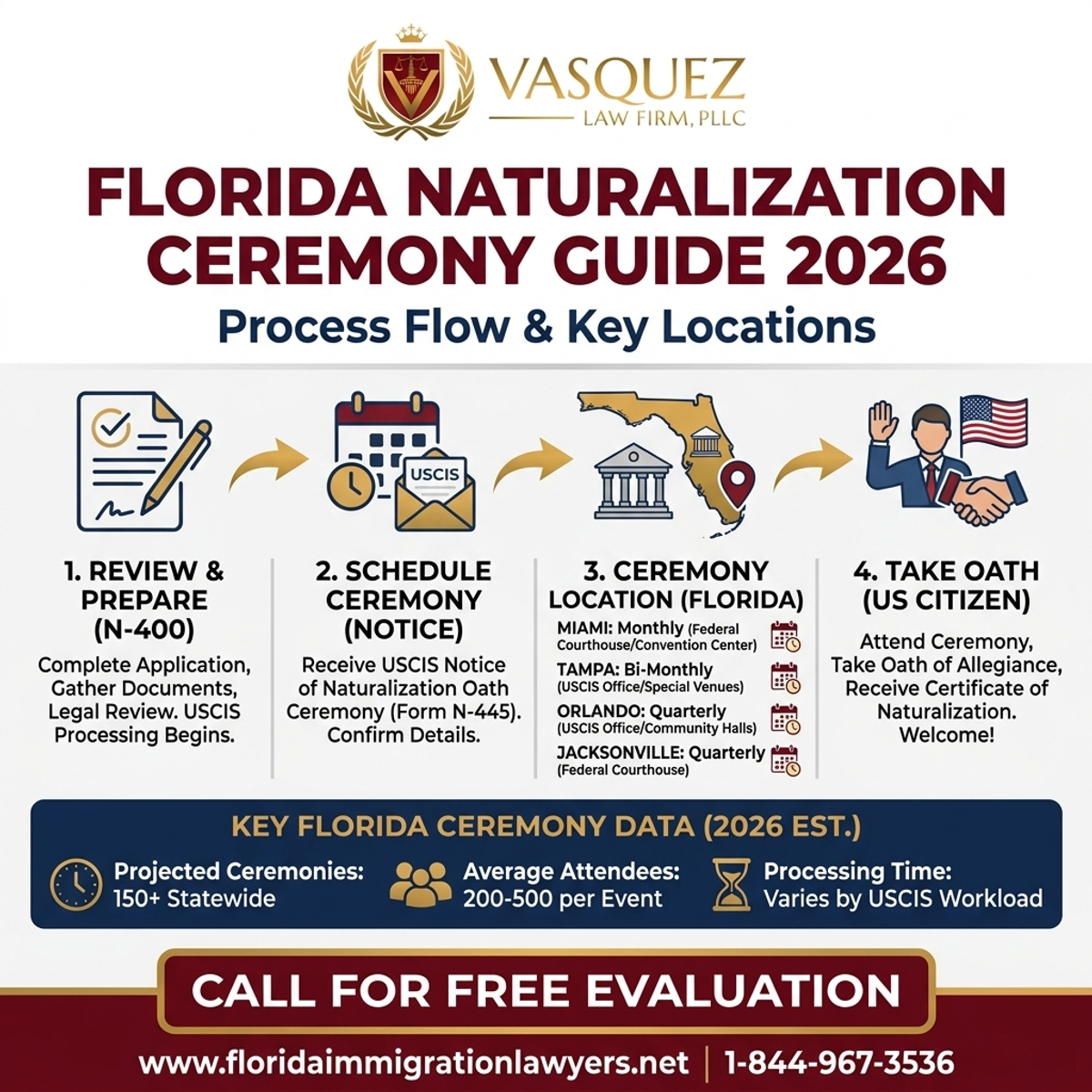
Naturalization ceremony locations and schedules in Florida for 2026 are primarily determined by U.S. Citizenship and Immigration Services (USCIS) field offices across the state, including those serving Naples, Miami, Orlando, Tampa, and Jacksonville. Ceremonies are typically held regularly throughout the year, often at federal courthouses or civic centers, following the approval of Form N-400, Application for Naturalization. Specific dates and venues are communicated directly to applicants via Form N-445, Notice of Naturalization Oath Ceremony, approximately two to four weeks before the event. It is crucial to attend your scheduled ceremony to finalize your path to U.S. citizenship.
- USCIS field offices in Florida (Miami, Orlando, Tampa, Jacksonville) administer naturalization ceremonies.
- Ceremonies are held frequently throughout the year, often at federal courthouses or civic centers.
- Applicants receive Form N-445 with their specific ceremony date, time, and location.
- Attendance is mandatory to become a U.S. citizen.
- Processing times for N-400 applications can vary significantly, impacting ceremony scheduling.
Embarking on the journey to U.S. citizenship is a significant milestone for many residents in Florida, including those in Naples and surrounding communities. The naturalization process, culminating in the oath of allegiance, represents the fulfillment of years of dedication and integration into American society. However, navigating the complexities of immigration law, from eligibility requirements to the final naturalization ceremony, can be daunting. Understanding each step, especially as policies evolve, is crucial for a successful outcome.
This comprehensive guide will walk you through the naturalization process, focusing on key aspects relevant to Florida residents in 2026. We will cover eligibility criteria, the N-400 application, required documentation, expected timelines, and importantly, what to anticipate regarding naturalization ceremony locations and schedules. Our goal is to provide clear, actionable information to help you prepare for this life-changing event. Do not navigate this complex process alone. For personalized guidance and to discuss your unique situation, call Florida Immigration Lawyers at 1-844-967-3536 for a free consultation. Our experienced team is ready to assist you.
What are the Naturalization Ceremony Locations and Schedule in Florida for 2026?
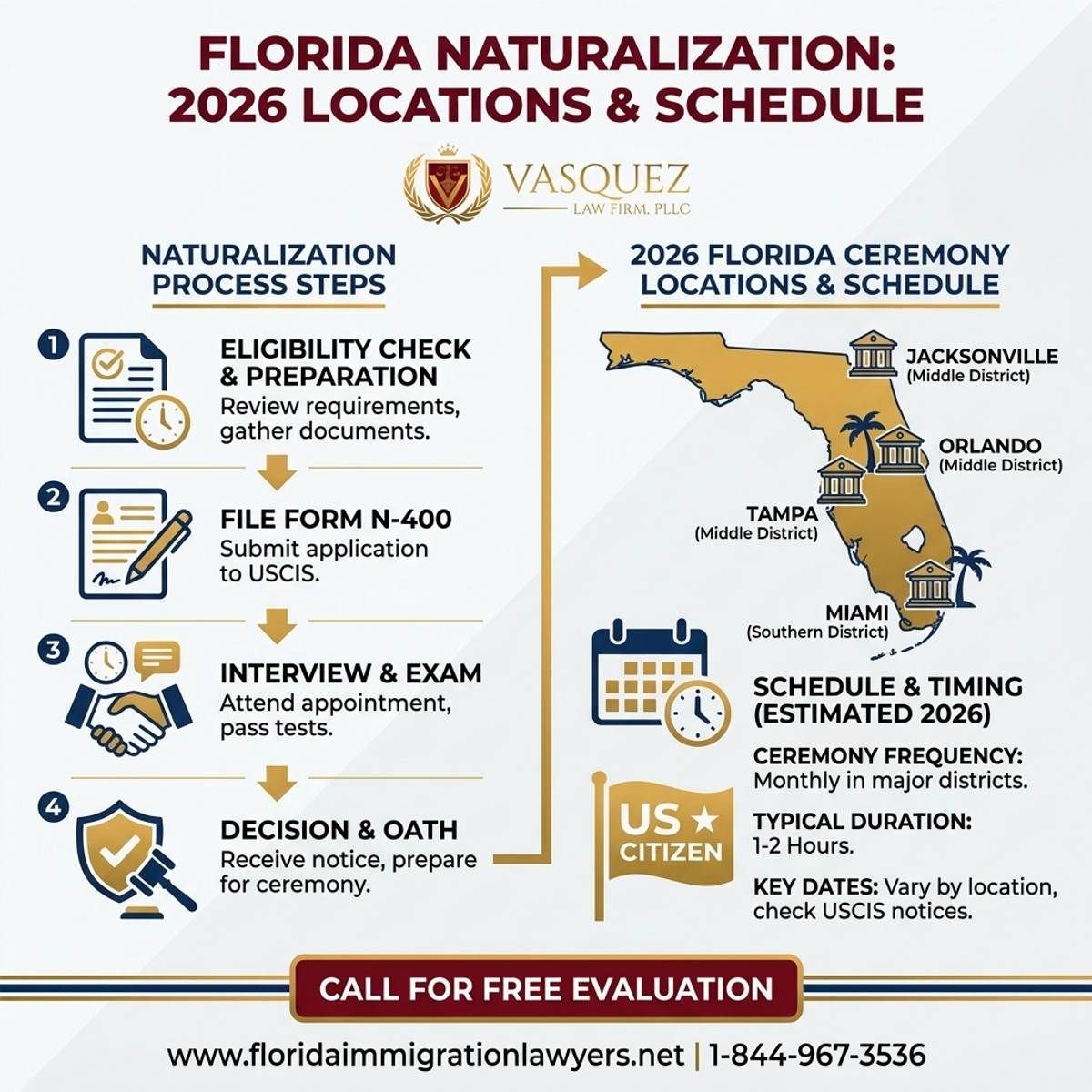
As of 2026, naturalization ceremony locations in Florida are primarily coordinated by the various USCIS field offices serving different regions, including Miami, Orlando, Tampa, and Jacksonville. These offices schedule ceremonies at federal courthouses, convention centers, or other designated civic venues. The schedule is dynamic and depends on the volume of approved applications, but ceremonies are typically held regularly, often multiple times a month, to accommodate new citizens.
For individuals residing in Naples and Southwest Florida, ceremonies are usually administered by the USCIS Miami Field Office, sometimes utilizing satellite locations or federal courthouses in Fort Myers or other nearby larger cities, depending on logistical considerations. While specific dates for 2026 are not pre-published for the general public, applicants who have successfully completed all prior steps, including the interview and civics test, will receive a Form N-445, Notice of Naturalization Oath Ceremony. This form explicitly details the exact date, time, and location of their individual ceremony. It is essential for applicants to carefully review this notice and prepare for their attendance, as it is the final step in becoming a U.S. citizen. Missing this ceremony without valid reason can significantly delay or complicate the naturalization process. USCIS aims to process these final steps efficiently, ensuring new citizens can take their oath in a timely manner, upholding the integrity of the naturalization process as outlined in 8 U.S.C. § 1448.
Understanding the Naturalization Process: Eligibility Requirements in Florida
The path to U.S. citizenship through naturalization is governed by strict eligibility requirements set forth by the Immigration and Nationality Act (INA), specifically INA Section 316 (8 U.S.C. § 1427). For Florida residents, these criteria are no different than for applicants elsewhere in the United States. Generally, you must be at least 18 years old, be a lawful permanent resident (Green Card holder) for at least five years, and demonstrate continuous residence and physical presence in the U.S. The continuous residence requirement means you have maintained your status as a resident, even if you traveled abroad. Physical presence refers to the actual time spent within the U.S. borders.
There are exceptions to the five-year rule, most notably for those married to U.S. citizens, who may be eligible to apply after three years of permanent residency, provided they have been living in marital union with their citizen spouse for that entire period. Additionally, certain military personnel and veterans have expedited naturalization paths. All applicants must demonstrate good moral character for the statutory period, typically the five or three years immediately preceding the application. This involves a review of your criminal record, if any, and adherence to U.S. laws. Furthermore, applicants must be able to read, write, and speak basic English, and possess a knowledge and understanding of U.S. history and government (civics). While the English and civics requirements have some waivers for age and disability, it is critical to prepare for these assessments. The 'public charge' rule, while modified, can still impact those seeking green cards; however, for naturalization, the focus shifts to good moral character and other statutory requirements. Understanding these nuances is vital, and a knowledgeable attorney can help assess your specific eligibility. USCIS provides detailed guidance on these requirements.
How Do I Apply for U.S. Citizenship: A Step-by-Step Guide for Florida Residents?
Applying for U.S. citizenship is a multi-step process that requires careful attention to detail and adherence to USCIS guidelines. For Florida residents, the journey typically begins with ensuring all eligibility criteria are met before submitting the application. Each step is critical, and errors or omissions can lead to delays or even denial. Here is a detailed step-by-step guide to help you navigate the N-400 application process:
- Determine Your Eligibility: Before anything else, confirm you meet all requirements for naturalization, including age, continuous residence, physical presence, good moral character, English language proficiency, and knowledge of U.S. civics. This initial assessment is crucial and can save you time and resources.
- Prepare and File Form N-400: Complete Form N-400, Application for Naturalization, accurately and thoroughly. This form collects extensive personal, residency, and background information. Gather all necessary supporting documents as specified in the N-400 instructions. Ensure all questions are answered truthfully and completely.
- Attend the Biometrics Appointment: After filing your N-400, USCIS will send you an appointment notice for biometrics collection. This involves taking your fingerprints, photograph, and signature, which are used for background and security checks. It is mandatory to attend this appointment at the designated USCIS Application Support Center.
- Complete the Naturalization Interview: You will receive a notice for your naturalization interview at a local USCIS field office, such as those in Miami, Orlando, or Tampa. During the interview, an immigration officer will review your N-400 application, test your English reading, writing, and speaking abilities, and assess your knowledge of U.S. civics. You must bring all original supporting documents to this interview.
- Receive a Decision from USCIS: Following your interview, the officer will issue a decision. This could be an immediate approval, a request for additional documentation (N-14), or a continuance for further review. If approved, you will typically receive Form N-445, Notice of Naturalization Oath Ceremony.
- Attend the Oath of Allegiance Ceremony: This is the final step. You will take the Oath of Allegiance to the United States and receive your Certificate of Naturalization. This ceremony officially confers U.S. citizenship upon you. Remember to return your Permanent Resident Card (Green Card) at this ceremony.
Step-by-Step Process — Naturalization Ceremony Locations and Schedule 2026 in Florida
Throughout this process, it is vital to keep copies of all submitted documents and communications with USCIS. Staying organized will greatly assist in a smoother application journey. Legal counsel can be invaluable in preparing your application, practicing for your interview, and addressing any potential issues that may arise. For those in Naples or other Florida cities, legal representation ensures your application is robust and compliant with all current regulations.
What Documents Do I Need for Naturalization in 2026?
Proper documentation is a cornerstone of a successful naturalization application. As of 2026, USCIS continues to require a comprehensive set of documents to support Form N-400. Providing accurate and complete documentation from the outset can prevent delays and requests for evidence. It is crucial to gather these documents diligently, ensuring they are current and reflect your most accurate information. Missing or incorrect documents are common reasons for application delays or denials.
Here is a general checklist of documents typically required for naturalization:
- Form N-400, Application for Naturalization: The completed and signed application form.
- Photocopies of Permanent Resident Card (Green Card): Front and back.
- Photocopies of State-Issued Identification: Such as a Florida Driver's License or state ID.
- Marriage Certificate (if applicable): If applying based on marriage to a U.S. citizen.
- Divorce Decrees or Death Certificates (if applicable): For all prior marriages of you or your spouse.
- Birth Certificates of Children (if applicable): For all your children, whether biological, adopted, or stepchildren.
- Proof of Name Change (if applicable): Court orders or marriage certificates.
- Tax Transcripts or Returns: For the past five (or three) years, demonstrating financial responsibility and continuous residency.
- Proof of Selective Service Registration (for males 18-26): If applicable.
- Travel Records: Including passport stamps, itineraries, and entry/exit records to demonstrate physical presence and continuous residence.
- Court Dispositions or Police Records (if applicable): For any arrests, citations, or criminal charges, even if expunged or dismissed. This is critical for good moral character assessment.
- Copies of all Court Orders: Related to child support or alimony payments, if applicable.
Always bring original documents to your naturalization interview, even if you only submitted photocopies with your application. USCIS officers will verify the authenticity of your documents. For those in Florida, ensuring that all state-issued documents are current and valid is also important. Consulting with an attorney can help you organize your documents and identify any specific additional evidence required for your unique case, especially if you have complex travel history or legal issues. The guidance provided in 8 CFR Part 316 details the evidentiary requirements.
How Long Does Naturalization Take in Florida: Processing Timelines for N-400?
The naturalization timeline in Florida, as of 2026, can vary significantly depending on the specific USCIS field office processing your application, the complexity of your case, and current agency workloads. While USCIS aims for efficiency, applicants should prepare for a process that can take anywhere from several months to over a year. It is important to monitor the USCIS processing times webpage for the most current estimates specific to your field office, such as Miami, Orlando, or Tampa. Generally, the timeline encompasses several key stages, each with its own typical duration.
Here is a typical breakdown of the naturalization process timeline:
| Stage | Typical Timeframe (As of 2026) | Notes |
|---|---|---|
| Form N-400 Submission to Receipt Notice | 1-3 weeks | You receive Form I-797C, Notice of Action. |
| Receipt Notice to Biometrics Appointment | 3-6 weeks | Appointment at a local Application Support Center. |
| Biometrics to Interview Notice | 4-10 months | This stage often represents the longest wait due to background checks and scheduling. |
| Interview to Decision | Immediately to 1-4 weeks | Often decided on the spot; sometimes requires additional evidence or review. |
| Decision to Oath Ceremony Notice (N-445) | 2-8 weeks | This notice provides the date, time, and location of your ceremony. |
| Oath Ceremony | 1-4 weeks after N-445 | The final step to becoming a U.S. citizen and receiving your Certificate of Naturalization. |
Key Statistics — Naturalization Ceremony Locations and Schedule 2026 in Florida
It is important to remember that these are average timelines. Some cases may be processed faster, while others, particularly those with complex immigration histories, criminal records, or extensive travel, may take longer. For individuals in Naples, the processing times will align with those of the Miami Field Office. Any changes in your contact information, especially your address, must be updated with USCIS promptly to ensure you receive all notices. Delays can also occur if USCIS requests additional evidence (RFE) or if there are issues with background checks. Proactive communication and meticulous preparation of your application can help mitigate potential delays.
What are the Costs Associated with Naturalization in Florida?
The costs associated with naturalization in Florida primarily involve the USCIS filing fees for Form N-400 and the biometrics services fee. As immigration fees are subject to change, USCIS is the definitive source for current fee structures. It is critical to always check the most recent fee schedule on the USCIS website for Form N-400 before filing, as incorrect fees can lead to rejection of your application. While we do not provide specific dollar amounts here due to their fluctuating nature, understanding the categories of costs is essential for financial planning.
| Item | Typical Fee Category (As of 2026) | Notes |
|---|---|---|
| Form N-400 Filing Fee | Base Application Fee | Required for processing your naturalization application. |
| Biometrics Services Fee | Additional Fee | Covers the cost of fingerprinting and background checks. This is often combined with the N-400 fee. |
| Legal Representation Fees | Variable | Costs for hiring an immigration attorney to assist with your application. Highly recommended for complex cases or peace of mind. |
| Document Translation Fees | Variable | If any supporting documents are not in English, certified translations are required. |
| Postage/Shipping Fees | Minor | Costs for mailing your application and any correspondence. Consider certified mail. |
| Travel Expenses | Variable | Costs for traveling to biometrics appointments, interviews, and oath ceremonies, especially for those in Naples traveling to Miami or Fort Myers. |
USCIS offers fee waivers for certain low-income applicants who meet specific federal poverty guidelines or receive means-tested public benefits. It is important to determine if you are eligible for a fee waiver (Form I-912, Request for Fee Waiver) before submitting your application. This can significantly reduce the financial burden of the naturalization process. Legal fees for an immigration attorney, while an additional cost, can be a valuable investment, especially considering the complexity of immigration law and the potential for costly mistakes. An attorney can help identify all applicable fees, explore fee waiver options, and ensure your application is submitted correctly, saving you time and stress in the long run. Florida Immigration Lawyers offers free consultations to help you understand these costs and your options.
Do not navigate this process alone. Contact Florida Immigration Lawyers today at 1-844-967-3536 to ensure your naturalization application is handled with expertise and care. We are here to help you achieve your dream of U.S. citizenship.
Common Mistakes to Avoid During the Naturalization Process
The naturalization process is meticulous, and even minor errors can lead to significant delays or even denial of your application. Being aware of common pitfalls can help you avoid them and ensure a smoother path to U.S. citizenship. Many applicants underestimate the complexity or the strictness of USCIS requirements, leading to easily avoidable mistakes.
- Failing to Meet Continuous Residence or Physical Presence Requirements: Many applicants miscalculate the required time spent in the U.S. or take extended trips abroad that break continuous residence. This can reset the clock on your eligibility.
- Incomplete or Inaccurate Form N-400: Omitting information, providing inconsistent details, or failing to sign the form can lead to immediate rejection or requests for evidence, prolonging the process.
- Not Disclosing All Criminal History: Even minor arrests, citations, or expunged records must be disclosed. Failure to do so can be considered misrepresentation and lead to denial based on lack of good moral character, as per 8 CFR 316.10.
- Submitting Incorrect or Insufficient Supporting Documentation: Not providing certified translations for foreign documents, missing crucial evidence, or submitting photocopies when originals are required can cause significant delays.
- Poor Preparation for the English and Civics Test: Underestimating the difficulty or not studying adequately for the tests can result in failing the interview and requiring a retest, or even denial.
- Failing to Update USCIS of Address Changes: Moving without notifying USCIS via Form AR-11 can lead to missed notices, appointments, and potentially the abandonment of your application.
- Incorrectly Calculating Fees or Forgetting Biometrics Fee: Submitting the wrong payment amount or forgetting the biometrics fee will result in the return of your application. Always check the current fees on the USCIS website.
- Lapses in Good Moral Character: Engaging in activities that demonstrate a lack of good moral character during the statutory period (e.g., severe traffic violations, failure to pay child support, tax evasion) can jeopardize your application.
- Missing Appointments: Failing to attend biometrics appointments or interviews without prior rescheduling or a valid excuse can lead to the denial of your N-400.
- Providing False Information: Any intentional misrepresentation or fraud on your application or during the interview can lead to severe penalties, including denial, deportation, and a ban from future immigration benefits.
- Not Seeking Legal Advice for Complex Cases: If you have a criminal record, extensive travel, prior immigration violations, or other unique circumstances, attempting to navigate the process alone without legal counsel is a significant risk.
When to Call a Lawyer for Your Naturalization Process
While many individuals successfully navigate the naturalization process on their own, there are specific scenarios where the expertise of an immigration attorney, like those at Florida Immigration Lawyers, becomes invaluable. The complexities of immigration law, coupled with the high stakes of U.S. citizenship, often warrant professional guidance. Knowing when to seek legal help can prevent costly mistakes and significantly improve your chances of a positive outcome.
You should consider calling an immigration lawyer if you:
- Have a Criminal Record: Even minor arrests or convictions can impact your good moral character assessment. An attorney can evaluate your record and advise on its potential impact, or help present your case effectively.
- Have an Extensive Travel History: Frequent or long absences from the U.S. can complicate continuous residence and physical presence calculations. A lawyer can help you accurately track and explain your travel.
- Have Had Prior Denials or Immigration Issues: If you've had previous visa denials, deportation proceedings (deportation defense), or other immigration challenges, an attorney can help address these issues in your naturalization application.
- Are Unsure About Your Eligibility: If your situation is not straightforward, such as questions about your green card status, marital history, or specific military service, an attorney can provide a clear assessment.
- Have Difficulty with English or Civics: While waivers exist, an attorney can help determine if you qualify and assist with the necessary documentation or preparation.
- Have Filed for a Fee Waiver: An attorney can ensure your Form I-912 is correctly completed and supported, maximizing your chances of approval.
- Received a Request for Evidence (RFE) or Notice of Intent to Deny (NOID): These indicate USCIS has concerns. An attorney can help you respond effectively and strategically.
- Are Concerned About the Interview Process: An attorney can prepare you for the interview, accompany you, and advocate on your behalf if issues arise.
- Have Changes in Your Life Circumstances: Marriage, divorce, job changes, or new arrests during the application process can affect your case. A lawyer can advise on how to report these changes.
Florida Immigration Lawyers has extensive experience assisting individuals across Florida, from Naples to Miami, with their naturalization applications. We understand the specific nuances of local USCIS offices and can provide the strategic advice you need. Our team also specializes in areas like family immigration and business immigration, offering a holistic approach to your immigration needs.
About Florida Immigration Lawyers
Florida Immigration Lawyers is a leading immigration law firm dedicated to serving individuals and families across the entire state of Florida. With a deep understanding of complex U.S. immigration laws and policies, our experienced attorneys provide compassionate, effective, and results-oriented legal representation. We are committed to helping our clients achieve their American dream, whether it involves obtaining a green card, defending against deportation, or becoming a U.S. citizen through naturalization.
Our firm offers a comprehensive range of immigration services, including general immigration assistance, asylum applications, citizenship and naturalization, family-based petitions, business immigration solutions, and robust deportation defense. We pride ourselves on clear communication, meticulous preparation, and a client-centered approach. We understand the unique challenges faced by immigrants in Florida and strive to provide accessible and high-quality legal services. We are available 24/7 for support and offer free consultations to discuss your case. Choose Florida Immigration Lawyers for dedicated advocacy and peace of mind on your immigration journey. Call us today at 1-844-967-3536 or visit floridaimmigrationlawyers.net.
Sources and References
- U.S. Citizenship and Immigration Services (USCIS)
- Executive Office for Immigration Review (EOIR)
- Immigration and Nationality Act (INA), 8 U.S.C. Chapter 12
- 8 U.S.C. § 1427 - Requirements for naturalization
- 8 U.S.C. § 1448 - Oath of allegiance; certified statement of taking oath
- 8 Code of Federal Regulations (CFR) Part 316 - General requirements for naturalization
- 8 CFR 316.10 - Good moral character
Related services: citizenship test preparation, dual citizenship guidance, citizenship test resources.
This article provides general legal information and is not intended as legal advice. Every case is unique, and outcomes depend on specific facts and circumstances. Contact an attorney for advice about your particular situation.
Your journey to U.S. citizenship is important. Do not leave it to chance. Take the first step towards securing your future by contacting Florida Immigration Lawyers today for a free, confidential consultation. Our dedicated team is ready to provide the expert legal assistance you deserve. Call us now at 1-844-967-3536. Se Habla Espanol - Estamos aqui para ayudarle.
Do Not Navigate This Process Alone
Our experienced immigration attorneys are ready to fight for you. Get a free, confidential consultation today.
Se Habla Español
Or leave your details and we’ll call you:
Free Evaluation in 24 Hours
Or talk to us right now
AI voice assistant — available 24/7
FreeFrequently Asked Questions

William J. Vásquez
Founding Attorney · Vasquez Law Firm
U.S. Air Force veteran and immigration attorney with years of hands-on U.S. immigration experience. J.D., NCCU School of Law. AILA member. Admitted to the 4th, 5th, and 11th Circuit Courts.
Available 24/7 - Free Evaluations
Reviewed for legal accuracy by William J. Vásquez
Licensed in North Carolina; U.S. immigration is federal practice.
Related Legal Services
Our Florida immigration attorneys can help you with business immigration, asylum protection and deportation defense. Call today at 1-844-967-3536 for a free consultation.
Related Links
Related Topics
Free Legal Consultation
Discuss your case with our experienced attorneys. We're available 24/7.
Se Habla Español - Estamos aquí para ayudarle.
Related Articles
Military Naturalization Expedited in Florida Bases
Explore military naturalization options for families at Florida bases, including parole in place benefits in Miami. Learn how to expedite your application with expert guidance from Florida Immigration Lawyers.
Immigration Lawyer Orlando Free Consultation 2026
Explore the cost of an immigration lawyer in Orlando in 2026. Understand attorney fees, what to expect during a consultation, and how to make the best choice for your immigration needs.
Dual Citizenship Lawyer: Navigating Florida Requirements in
Understanding dual citizenship in Florida can be complex, involving both U.S. federal and foreign nationality laws. This guide from Florida Immigration Lawyers explains what dual citizenship means for residents, how to apply for U.S. naturalization while retaining foreign citizenship, and the critical requirements you must meet. We cover essential documents, processing timelines for 2026, and associated costs. Learn about common pitfalls to avoid and when to seek expert legal counsel to navigate this intricate process successfully. Our firm, serving all of Florida including West Palm Beach, offers free consultations to help you achieve your dual nationality goals.
Farmers and H-2A: Essential Guide for Florida Growers
Explore how Florida farmers can benefit from the H-2A visa program to meet their farm labor needs. Learn about the application process, costs, and common pitfalls to avoid. Get expert advice from Florida Immigration Lawyers.