Farmers and H-2A: Essential Guide for Florida Growers
Explore how Florida farmers can benefit from the H-2A visa program to meet their farm labor needs. Learn about the application process, costs, and common pitfalls to avoid. Get expert advice from Florida Immigration Lawyers.
The H-2A visa program allows U.S. farmers to hire temporary foreign agricultural workers when local labor is insufficient. This program helps maintain productivity on farms, particularly in Florida, where agriculture is a crucial industry. Key points include:
- Eligibility criteria for employers
- Application process and timeline
- Benefits for Florida farmers
- Common challenges and solutions
Introduction
In the vibrant agricultural landscape of Florida, the demand for reliable farm labor is constant. For many farmers, the H-2A visa program is a vital tool in maintaining their workforce. This article explores the ins and outs of the H-2A visa process, specifically tailored for Florida growers in areas like Tampa. Whether you're a seasoned farmer or new to the industry, understanding this visa can enhance your operational efficiency. Call Florida Immigration Lawyers at 1-844-967-3536 for a free consultation.
Florida's agricultural sector is a cornerstone of its economy, producing a diverse array of crops from citrus and tomatoes to strawberries and ornamental plants. This intensive farming requires a consistent and skilled labor force, especially during peak planting and harvesting seasons. However, domestic labor shortages often pose significant challenges, threatening crop yields and economic stability for growers across the state.
The H-2A program addresses these critical labor gaps by enabling employers to legally bring in temporary foreign workers. It's a structured system designed to protect both the integrity of the U.S. labor market and the rights of foreign workers, ensuring fair wages, safe housing, and proper working conditions. For Florida farmers, mastering the H-2A process is not just about compliance; it's about securing the future of their operations and contributing to the state's agricultural prosperity.
What is the H-2A Visa and How Does it Work?
The H-2A visa is a non-immigrant visa that allows U.S. employers to bring foreign nationals to fill temporary agricultural jobs. As of 2026, this program continues to be essential for states like Florida, where the agricultural economy thrives.
Employers must demonstrate that there are not enough U.S. workers available and that employing foreign workers will not adversely affect U.S. workers' wages and working conditions. The program ensures that U.S. farmers can meet labor demands during peak seasons.
The "temporary" nature of the H-2A visa is crucial; it is intended for seasonal or peak load needs, not for permanent employment. Jobs must be agricultural in nature, encompassing a wide range of activities from planting, cultivating, and harvesting to packing and processing on the farm. This distinction is vital, as non-agricultural temporary needs fall under the separate H-2B visa program.
A core component of the H-2A program is the requirement for employers to offer the Adverse Effect Wage Rate (AEWR), which is typically higher than the state or federal minimum wage. This wage, along with provisions for free housing, transportation, and workers' compensation insurance, is designed to ensure that the employment of H-2A workers does not negatively impact the wages and working conditions of similarly employed U.S. workers.
- Employers file a temporary labor certification application with the Department of Labor.
- After approval, they submit Form I-129 to the USCIS.
- Workers apply for the visa at a U.S. consulate abroad.
H-2A Visa Application Process: A Step-by-Step Guide
Florida farmers must follow a detailed process to acquire H-2A workers. Here is a step-by-step guide:
- Determine Need: Assess the shortage of local labor for your farm.
- Submit ETA-790: File a job order and an H-2A application with the Department of Labor.
- Recruit U.S. Workers: Actively recruit domestic workers before filing.
- File Form I-129: After labor certification, submit Form I-129 to USCIS.
- Consulate Processing: Foreign workers apply for a visa at a U.S. consulate.
- Arrival in the U.S.: Upon visa approval, workers travel to the U.S. to begin employment.
This initial assessment is critical. Farmers should analyze historical labor data, projected crop yields, and local unemployment rates to accurately forecast their temporary agricultural labor needs. A well-documented determination of need will strengthen subsequent steps in the application process.
This step involves submitting a detailed job offer to the Department of Labor (DOL) and the State Workforce Agency (SWA). The job order must clearly outline job duties, required experience, hours, wages, housing, and transportation provisions. Accuracy here is paramount, as any inconsistencies can lead to delays or denials. It's advisable to submit this application well in advance of your anticipated start date, typically 60-75 days prior.
Before H-2A certification is granted, employers are mandated to conduct a good faith recruitment effort to find qualified U.S. workers. This typically involves placing advertisements in local newspapers, posting job orders with the SWA, and contacting former employees. Maintaining meticulous records of all recruitment activities, including dates, publications, and reasons for not hiring U.S. applicants, is essential for proving compliance.
Once the Department of Labor issues a temporary labor certification, the employer must then file Form I-129, Petition for a Nonimmigrant Worker, with U.S. Citizenship and Immigration Services (USCIS). This petition formally requests permission to bring the foreign workers into the U.S. for the certified positions. The approved labor certification, along with other supporting documents, must accompany this petition.
Upon USCIS approval of Form I-129, the prospective H-2A workers apply for their visas at a U.S. embassy or consulate in their home country. This usually involves an interview, biometric data collection, and a review of their eligibility. Workers must demonstrate their intent to return to their home country after the temporary agricultural work concludes.
After receiving their H-2A visas, workers can travel to the U.S. to commence their employment. Employers are responsible for ensuring transportation from the port of entry to the worksite and providing compliant housing. Proper onboarding, including orientation and safety training, is crucial to integrate the new workforce effectively and maintain a productive and safe environment.
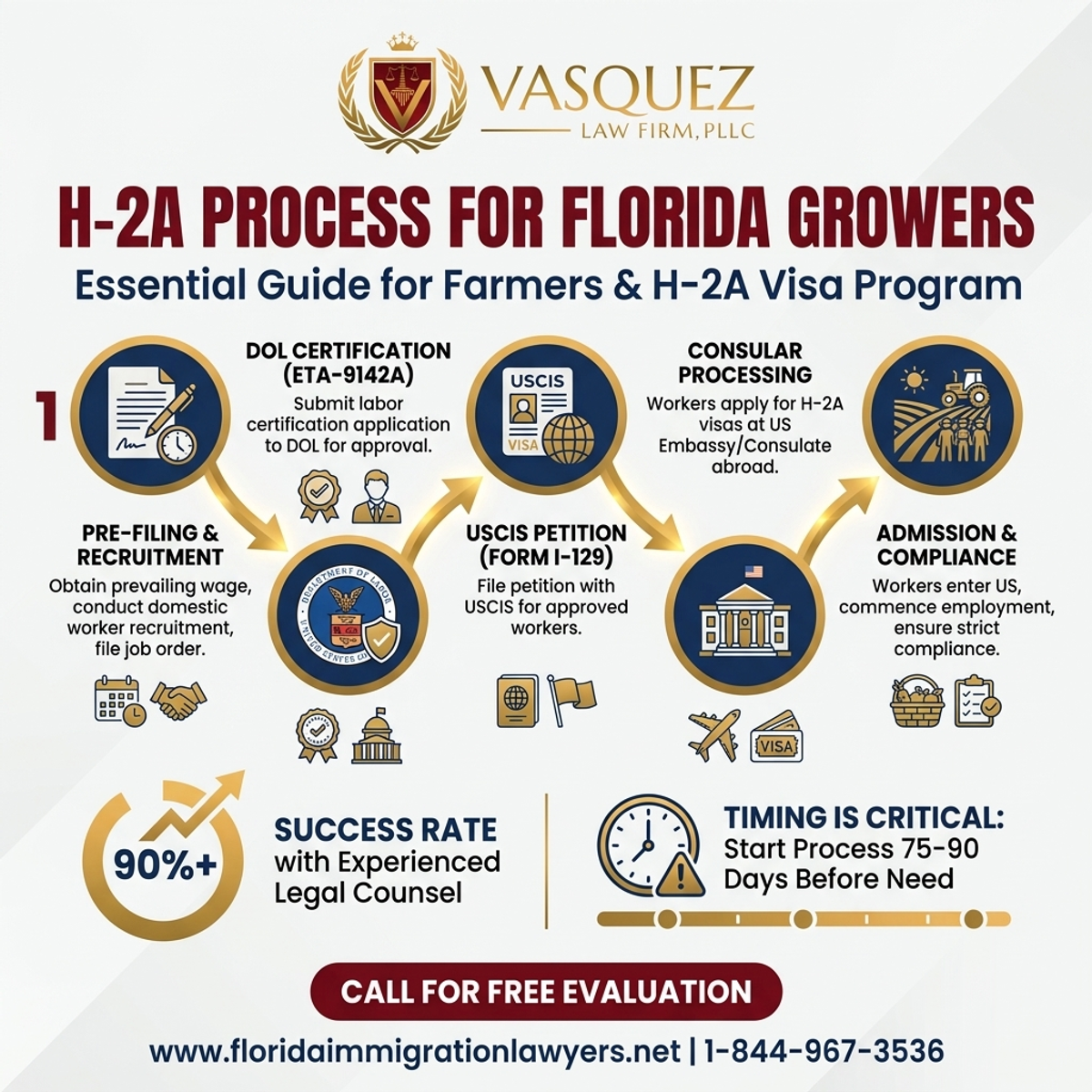
Step-by-Step Process — Farmers and H-2A: Essential Guide for Florida Growers
Document Checklist for H-2A Visa Application
- Completed Form ETA-790/790A
- Proof of recruitment efforts
- Approved temporary labor certification
- Form I-129, Petition for Nonimmigrant Worker
- Evidence of ability to pay wages
- Housing inspection reports
- Transportation plans
- Employer's Federal Employer Identification Number (FEIN)
This is the initial application for temporary employment certification, detailing the job offer, wages, and working conditions. Ensure all sections are accurately completed and match your recruitment efforts.
This includes copies of all advertisements placed (newspapers, trade journals), job orders posted with the State Workforce Agency, and detailed logs of all applicants, interviews conducted, and legitimate, non-discriminatory reasons for not hiring U.S. workers.
This document from the Department of Labor is the cornerstone of your H-2A petition, certifying that no qualified U.S. workers are available and that the employment of foreign workers will not adversely affect U.S. workers.
This USCIS form is filed by the employer to request H-2A workers. It must be accompanied by the approved labor certification and other supporting documents, such as a full explanation of the temporary need and the number of workers requested.
Employers must demonstrate they have the financial capacity to pay the required H-2A wages. This might include bank statements, tax returns, or other financial records. This helps ensure workers receive their promised compensation.
Proof that the employer-provided housing meets all federal and state safety and health standards, typically certified by a local or state authority. This is a critical requirement for worker welfare.
Documentation outlining how workers will be transported from their port of entry to the worksite, as well as daily transportation to and from the fields, and return transportation to their home country at the end of the season.
Your unique identification number with the IRS, which is necessary for all official government filings related to your business and the H-2A program.
Timelines and Processing Expectations
| Stage | Typical Timeframe | Notes |
|---|---|---|
| Labor Certification | 45-60 days | Initial step with the Department of Labor |
| USCIS Petition | 2-3 months | File Form I-129 |
| Consulate Processing | 3-4 weeks | Visa interviews and issuance |
These timelines are general estimates and can fluctuate significantly based on various factors. For instance, peak filing seasons, government holidays, or the need to respond to Requests for Evidence (RFEs) from either the DOL or USCIS can extend processing times considerably. Farmers in Florida should always aim to submit their applications as early as possible to mitigate these potential delays.
Proactive preparation and meticulous attention to detail can
Sources and References
- U.S. Citizenship and Immigration Services (USCIS)
- Executive Office for Immigration Review (EOIR)
- U.S. Department of State - Bureau of Consular Affairs
- Immigration and Nationality Act (INA), 8 U.S.C. Chapter 12
Do Not Navigate This Process Alone
Our experienced immigration attorneys are ready to fight for you. Get a free, confidential consultation today.
Se Habla Español
Or leave your details and we’ll call you:
Free Evaluation in 24 Hours
Or talk to us right now

AI voice assistant — available 24/7
FreeFrequently Asked Questions

William J. Vásquez
Founding Attorney · Vasquez Law Firm
U.S. Air Force veteran and immigration attorney with years of hands-on U.S. immigration experience. J.D., NCCU School of Law. AILA member. Admitted to the 4th, 5th, and 11th Circuit Courts.
Available 24/7 - Free Evaluations
Reviewed for legal accuracy by William J. Vásquez
Licensed in North Carolina; U.S. immigration is federal practice.
Related Legal Services
Our Florida immigration attorneys can help you with citizenship and naturalization, family immigration services and immigration practice areas. Call today at 1-844-967-3536 for a free consultation.
Related Links
Related Topics
Free Legal Consultation
Discuss your case with our experienced attorneys. We're available 24/7.
Se Habla Español - Estamos aquí para ayudarle.
Related Articles
Military Naturalization Expedited in Florida Bases
Explore military naturalization options for families at Florida bases, including parole in place benefits in Miami. Learn how to expedite your application with expert guidance from Florida Immigration Lawyers.
Immigration Lawyer Orlando Free Consultation 2026
Explore the cost of an immigration lawyer in Orlando in 2026. Understand attorney fees, what to expect during a consultation, and how to make the best choice for your immigration needs.
DV-2027 Registration Period: How to Apply in Florida
The DV-2027 registration period offers a chance for eligible individuals to apply for the diversity visa lottery in Florida. Discover how to apply, what to expect, and avoid common mistakes with expert guidance from Florida Immigration Lawyers.
Dual Citizenship Lawyer: Navigating Florida Requirements in
Understanding dual citizenship in Florida can be complex, involving both U.S. federal and foreign nationality laws. This guide from Florida Immigration Lawyers explains what dual citizenship means for residents, how to apply for U.S. naturalization while retaining foreign citizenship, and the critical requirements you must meet. We cover essential documents, processing timelines for 2026, and associated costs. Learn about common pitfalls to avoid and when to seek expert legal counsel to navigate this intricate process successfully. Our firm, serving all of Florida including West Palm Beach, offers free consultations to help you achieve your dual nationality goals.