Dual Citizenship Lawyer: Navigating Florida Requirements in
Understanding dual citizenship in Florida can be complex, involving both U.S. federal and foreign nationality laws. This guide from Florida Immigration Lawyers explains what dual citizenship means for residents, how to apply for U.S. naturalization while retaining foreign citizenship, and the critical requirements you must meet. We cover essential documents, processing timelines for 2026, and associated costs. Learn about common pitfalls to avoid and when to seek expert legal counsel to navigate this intricate process successfully. Our firm, serving all of Florida including West Palm Beach, offers free consultations to help you achieve your dual nationality goals.

Yes, the United States generally permits dual citizenship, meaning you can be a citizen of both the U.S. and another country simultaneously. This is often achieved through birth in one country to parents from another, or by naturalizing in the U.S. while your birth country also recognizes your original citizenship. Florida residents pursuing dual citizenship must adhere to federal immigration laws. It is crucial to understand that while the U.S. allows it, your other country may have different rules regarding retention or acquisition of its nationality.
- The U.S. generally permits dual citizenship; it does not require renunciation of foreign nationality.
- Dual citizenship often arises automatically through birth or naturalization.
- Florida residents follow federal USCIS guidelines for U.S. naturalization.
- Each country has its own laws governing dual nationality; research both.
- Consulting an experienced immigration lawyer is vital for navigating the complexities.
Navigating the intricate landscape of immigration law can feel overwhelming, especially when considering a significant step like obtaining dual citizenship. For many individuals and families in Florida, the idea of holding two passports—one from the United States and another from their country of origin—represents a profound connection to their heritage and future opportunities. Whether you were born a dual citizen or are exploring naturalization in the U.S. while retaining your original nationality, understanding the legal framework is essential. The process is governed by federal law, but its impact is felt directly by residents across Florida, including in vibrant communities like West Palm Beach.
This comprehensive guide from Florida Immigration Lawyers will demystify dual citizenship, covering everything from eligibility requirements and the application process to potential challenges and the benefits of holding two passports. We will explore the specific considerations for those residing in Florida and provide actionable insights into securing your future. Our goal is to empower you with the knowledge needed to make informed decisions, ensuring a smooth and successful journey toward dual nationality. Don't navigate this complex path alone. Call Florida Immigration Lawyers at 1-844-967-3536 for a free consultation and let our experienced team assist you.
Can a U.S. Citizen Have Dual Citizenship in Florida?
Yes, a U.S. citizen can generally have dual citizenship while residing in Florida. The United States does not explicitly prohibit dual nationality, nor does it require a person to choose between their U.S. citizenship and a foreign citizenship. This is a common misconception, as many believe that taking the Oath of Allegiance to the U.S. automatically requires renouncing all other loyalties. However, U.S. law and policy acknowledge that dual nationality can exist and often does, especially for those who acquire citizenship of another country by birth, through parents, or through marriage, without intending to abandon their U.S. citizenship. The key is intent; the U.S. government looks at whether a person intends to renounce their U.S. citizenship, not merely if they acquire another.
For individuals in Florida, the ability to hold dual citizenship means they can enjoy the rights and privileges of both the U.S. and another nation. This might include voting in both countries, holding passports from both, owning property, and benefiting from social services in each. The U.S. Department of State provides guidance on dual nationality, clarifying that while the U.S. government generally disfavors it as a matter of policy, it does not actively seek to terminate U.S. citizenship unless a person performs certain expatriating acts with the specific intent to relinquish U.S. citizenship. This is a high bar and rarely met by simply acquiring another nationality. Therefore, for most residents in West Palm Beach and across Florida, pursuing dual citizenship through another country, or having acquired it automatically, is legally permissible under U.S. law.
Understanding Dual Citizenship Requirements in Florida
The concept of dual citizenship is not primarily about specific state laws in Florida but rather about federal immigration and nationality laws, as well as the laws of the other country involved. When we talk about dual citizenship requirements in Florida, we are typically referring to the federal requirements for U.S. naturalization for those who wish to maintain their existing foreign citizenship, or the rules governing those who are already U.S. citizens and acquire another nationality. The U.S. Immigration and Nationality Act (INA) is the primary legal framework. For individuals seeking to naturalize as U.S. citizens, the core requirements under INA Section 316 (8 U.S.C. 1427) include being at least 18 years old, a lawful permanent resident (Green Card holder) for a specified period (typically five years, or three if married to a U.S. citizen), demonstrating continuous residence and physical presence in the U.S., possessing good moral character, having basic English proficiency, and passing a civics test. Crucially, during the Oath of Allegiance, applicants pledge allegiance to the U.S. but are not explicitly required to renounce all foreign allegiances, unless the other country's laws demand it for its citizenship.
Furthermore, the laws of the other country are equally important. Some nations automatically bestow citizenship based on parentage or birth within their borders, regardless of where the child lives or holds other citizenships. Other countries may require a formal application process, and some may require you to explicitly renounce any other nationalities you hold. For instance, some Latin American countries, like Mexico, have provisions for dual nationality, making it easier for their citizens to also become U.S. citizens. Conversely, countries like India generally do not permit dual citizenship for adults. Therefore, understanding the specific laws of both the U.S. and your country of origin or desired second country is paramount. Consulting with an attorney who understands both U.S. immigration law and the nationality laws of your specific foreign country can provide invaluable guidance, especially for complex cases involving family immigration or business immigration considerations in Florida.
How Do I Apply for Dual Citizenship in Florida? A Step-by-Step Guide
Applying for dual citizenship in Florida isn't a single, unified process, as it involves two distinct legal systems: U.S. immigration law and the nationality laws of another country. Typically, the path to dual citizenship for most non-U.S. citizens residing in Florida involves first becoming a U.S. citizen through naturalization, while simultaneously ensuring that your country of origin permits you to retain your original citizenship. If you are already a U.S. citizen, the process involves acquiring citizenship in another country that allows dual nationality. Here's a general step-by-step guide for non-U.S. citizens seeking to naturalize and potentially hold dual citizenship, as of 2026:
-
Determine Eligibility for U.S. Naturalization: Ensure you meet the core requirements for U.S. citizenship, including age, lawful permanent residency period, continuous residence, physical presence, good moral character, English language ability, and knowledge of U.S. government and history. For residents of West Palm Beach and surrounding areas, this means meeting federal criteria before applying to USCIS.
-
Verify Foreign Country's Dual Citizenship Laws: Before applying for U.S. naturalization, or at any stage, thoroughly research whether your country of origin (or the country whose citizenship you wish to acquire) permits dual nationality. Some countries may require you to renounce your original citizenship upon naturalizing elsewhere, while others have agreements or laws that facilitate dual status. This is a critical step to avoid unintended consequences.
-
Prepare and File Form N-400, Application for Naturalization: Gather all necessary documents, including your Green Card, passport photos, travel history, and supporting evidence for your eligibility. Complete Form N-400 accurately. As of 2026, USCIS provides detailed instructions on their website. Errors can lead to delays or denials, so meticulous preparation is key. You can find forms and instructions on the USCIS website.
-
Attend Biometrics Appointment: After filing, you will receive a notice for a biometrics appointment at a local USCIS Application Support Center, where your fingerprints, photograph, and signature will be collected for background checks.
-
Complete the Interview: A USCIS officer will interview you to verify the information on your N-400, test your English proficiency, and administer the civics test. Be prepared to answer questions about your application, U.S. history, and government. Florida has several USCIS field offices, including Miami and Orlando, where interviews are conducted.
Step-by-Step Process — Dual Citizenship Lawyer: Navigating Florida Requirements in 2026
-
Receive a Decision and Attend the Oath of Allegiance Ceremony: If approved, you will receive a notice for the Oath of Allegiance ceremony. This is the final step where you become a U.S. citizen. During this ceremony, you swear allegiance to the United States. While you are not typically asked to renounce other citizenships, the wording of the oath implies a primary loyalty to the U.S. (see 8 CFR Part 337). After the ceremony, you will receive your Certificate of Naturalization.
-
Apply for Second Country's Citizenship (if applicable): If you are already a U.S. citizen and wish to acquire citizenship in another country that permits dual nationality, you would then follow that country's specific application procedures. This might involve residency, investment, or ancestry requirements.
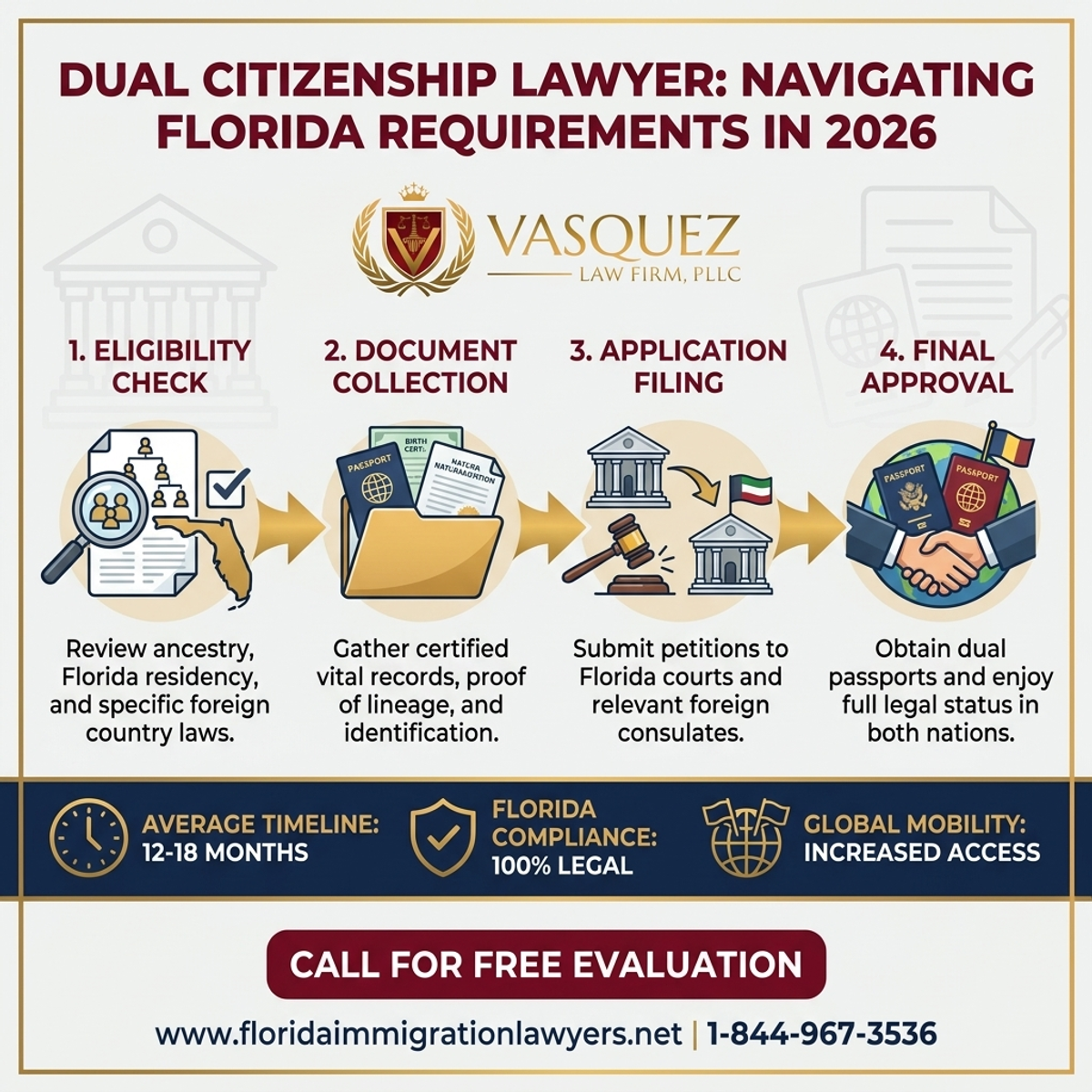
Each step requires careful attention to detail and adherence to strict timelines. Seeking legal counsel from Florida Immigration Lawyers can ensure you meet all requirements and navigate the process successfully.
What Documents Do I Need for Dual Citizenship?
The documents required for dual citizenship depend heavily on whether you are seeking U.S. naturalization while retaining another citizenship, or if you are already a U.S. citizen applying for citizenship in another country. For the U.S. naturalization process, which is the most common path for Florida residents seeking dual citizenship, you will need a comprehensive set of documents. These are critical for proving your eligibility and identity to U.S. Citizenship and Immigration Services (USCIS). Failing to provide complete and accurate documentation can significantly delay your application or even lead to denial. It is always advisable to prepare original documents and provide certified copies where required.
Here is a general checklist of documents you will typically need for your Form N-400, Application for Naturalization:
- Your Permanent Resident Card (Green Card).
- State-issued identification, such as a Florida Driver's License or ID card.
- Your current and any expired passports from your country of origin.
- All travel records for the past five years (or three years if applying based on marriage to a U.S. citizen), including dates of entry and exit from the U.S.
- Certified copies of marriage certificates, divorce decrees, or death certificates if applicable, particularly if your name has changed or if you are applying based on marriage to a U.S. citizen.
- Evidence of good moral character, which can include tax returns for the past five years, proof of child support payments, and police clearances for any arrests, even if charges were dropped or expunged.
- Court disposition documents for any traffic citations or arrests.
- Birth certificates for your children, if applicable, especially if they are U.S. citizens.
- Proof of selective service registration for male applicants aged 18-26.
- Any documents related to military service, if applicable.
- Two passport-style photos meeting USCIS specifications.
- If applying for a disability waiver, Form N-648, Medical Certification for Disability Exceptions, completed by a medical professional.
For individuals acquiring citizenship in another country, the required documents will vary greatly depending on that country's specific laws. This could include birth certificates, marriage certificates, proof of ancestry, financial statements, residency permits, and more. Always consult the official government website or an attorney specializing in the nationality laws of that specific country. Florida Immigration Lawyers can assist with the U.S. naturalization aspect and guide you on where to seek further advice for the foreign citizenship component.
How Long Does it Take to Get Dual Citizenship in 2026?
The timeline for obtaining dual citizenship in 2026 is highly variable and depends primarily on the efficiency of the U.S. naturalization process and the specific laws and procedures of the other country involved. As of 2026, USCIS processing times for Form N-400, Application for Naturalization, can range from 6 months to over 2 years, depending on the specific field office and the complexity of the individual case. For Florida residents, offices like the Miami Field Office or Orlando Field Office may have different backlogs. These estimates are subject to change and can be influenced by application volume, staffing levels, and policy shifts. For example, recent policy adjustments or increased demand, as seen in past years, can impact processing speeds across the board. The total duration for achieving dual citizenship means accounting for both the U.S. naturalization timeline and any processes required by the foreign country, which could add months or even years.
Here is a typical timeline for the U.S. naturalization process as of 2026:
| Stage | Typical Timeframe | Notes |
|---|---|---|
| Form N-400 Filing & Receipt | 1-3 weeks | USCIS sends a receipt notice (Form I-797C, Notice of Action). |
| Biometrics Appointment | 3-5 weeks after filing | Scheduled at a local Application Support Center (ASC) in Florida. |
| Interview Scheduling | 2-10 months after biometrics | Can vary widely by USCIS field office workload (e.g., Miami, Orlando). |
| Naturalization Interview | Typically 20-30 minutes | Assesses eligibility, English, and civics knowledge. |
| Decision & Oath Ceremony | 1 week to 3 months after interview | Approval notice (Form N-652) followed by Oath of Allegiance ceremony notice (Form N-445). |
| Total U.S. Naturalization | 6 months to 2+ years | Highly dependent on field office, case complexity, and current USCIS processing times. |
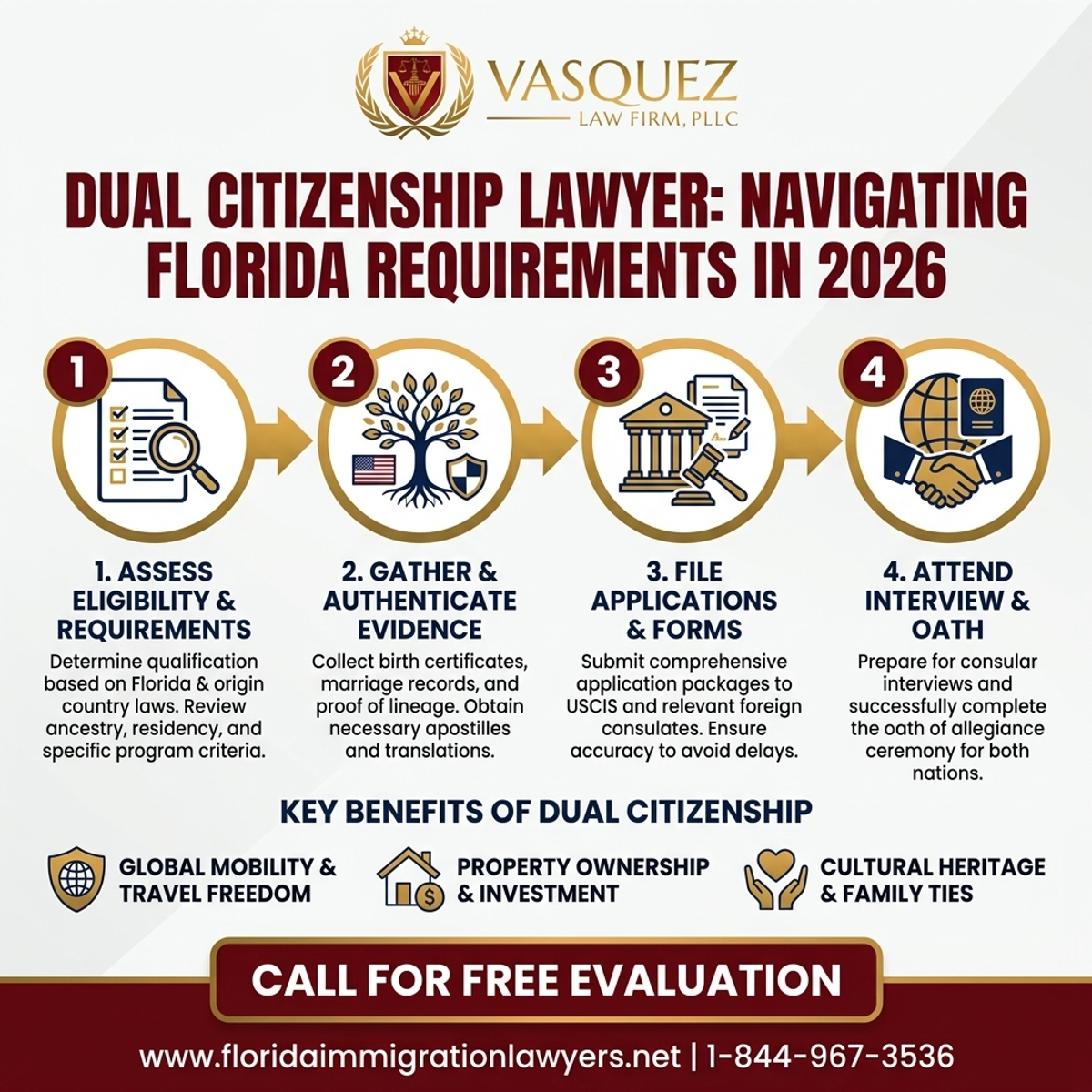
Key Statistics — Dual Citizenship Lawyer: Navigating Florida Requirements in 2026
It is important to remember that these are general estimates. Any issues with your application, such as missing documents, criminal history, or complex travel patterns, can significantly extend these timelines. Furthermore, if you are applying for citizenship in another country after becoming a U.S. citizen, that process will have its own separate timeline, which must be factored into your overall dual citizenship goal. Staying informed about current USCIS processing times and consulting an experienced immigration lawyer in West Palm Beach can help manage expectations and address potential delays.
What Are the Costs Associated with Dual Citizenship Applications?
The costs associated with dual citizenship applications primarily stem from the U.S. naturalization process and any fees required by the foreign country. As of 2026, USCIS fees for Form N-400, Application for Naturalization, are a significant component. These fees are subject to change, so it's critical to check the most current fee schedule directly on the USCIS website before filing. In addition to government filing fees, applicants in Florida should anticipate other potential expenses. These can include legal consultation fees, document translation costs, postage, and travel expenses for interviews or biometrics appointments, especially if traveling to USCIS offices in Miami or Orlando from more remote parts of Florida. Furthermore, if a foreign country has its own citizenship application process, it will undoubtedly involve separate fees, which can range from nominal to substantial, depending on the country and the specific path to citizenship (e.g., ancestry, residency, or investment).
| Item | Typical Fee (as of 2026) | Notes |
|---|---|---|
| USCIS Form N-400 Filing Fee | Check USCIS website for current fee | This fee is for the naturalization application itself. |
| Biometrics Services Fee | Often included in N-400 fee | Covers the cost of fingerprinting and background checks. |
| Immigration Attorney Fees | Varies widely ($2,500 - $7,000+) | Depends on case complexity, lawyer's experience, and services rendered. Essential for complex cases. |
| Document Translation Costs | $20-$50 per page | Required for any non-English documents submitted to USCIS. Must be certified translations. |
| Passport Photos | $10-$20 | Required for Form N-400, specific dimensions. |
| Travel Expenses | Varies | For biometrics and interview appointments at USCIS field offices in Florida. |
| Foreign Citizenship Application Fees | Varies widely by country | Consult the specific country's embassy or consulate for their fee schedule. |
It is crucial to budget for all these potential costs to avoid financial surprises during your dual citizenship journey. While the government fees are non-negotiable (unless eligible for a fee waiver), legal fees can be an investment in ensuring a smooth and successful application, particularly given the complexities of immigration law. Florida Immigration Lawyers offers free consultations to discuss your specific case and provide an estimate of legal costs involved in the U.S. naturalization process, helping you plan your finances effectively. Always verify current fees with official sources as they can change without prior notice.
Common Challenges for Dual Citizenship Applicants in Florida
While dual citizenship offers numerous advantages, the path to obtaining it, particularly for Florida residents, can present several challenges. One primary hurdle is the complexity of navigating two distinct legal systems—U.S. federal immigration law and the nationality laws of another country. Misunderstanding the requirements of either system can lead to significant delays, denials, or even unintended loss of citizenship. For instance, some countries may automatically revoke a person's citizenship if they voluntarily naturalize in another country, even if the U.S. permits dual nationality. This critical detail often catches applicants by surprise, underscoring the need for thorough research and expert legal advice. Furthermore, demonstrating good moral character for U.S. naturalization can be challenging for individuals with even minor past legal infractions, requiring careful legal strategy and documentation.
Another common challenge involves the extensive documentation required for U.S. naturalization. Gathering birth certificates, marriage licenses, divorce decrees, travel records, and tax documents from multiple countries can be time-consuming and difficult, especially if records are old or held in foreign archives. Translation requirements for non-English documents add another layer of complexity and cost. Additionally, maintaining continuous residence and physical presence in the U.S. while traveling frequently can complicate naturalization eligibility, as excessive time spent outside the U.S. can break continuous residency. Florida's large immigrant population and its proximity to many countries mean that many residents have complex travel histories that need careful review. Lastly, the varying processing times at USCIS field offices, such as those serving West Palm Beach, can lead to uncertainty and prolonged waiting periods, requiring patience and persistent follow-up. An experienced dual citizenship lawyer from Florida Immigration Lawyers can help anticipate and mitigate these challenges, ensuring a more straightforward process.
Do not navigate this process alone. Contact Florida Immigration Lawyers today for a free consultation at 1-844-967-3536 and let us simplify your path to dual citizenship. Our dedicated team is ready to assist you.
Common Mistakes to Avoid in Your Dual Citizenship Journey
The journey to dual citizenship is fraught with potential pitfalls that can jeopardize your application or lead to unintended consequences. Avoiding these common mistakes is crucial for a smooth and successful process:
-
Failing to Research Foreign Country's Laws: Many applicants focus solely on U.S. naturalization rules and overlook the critical fact that their country of origin might not permit dual citizenship or may require explicit renunciation. This can lead to automatic loss of their original nationality upon becoming a U.S. citizen.
-
Misrepresenting Information on Form N-400: Providing false or misleading information, even unintentionally, can result in denial of naturalization, accusations of fraud, and even deportation proceedings. Accuracy and honesty are paramount.
-
Ignoring Good Moral Character Requirements: Minor criminal infractions, failure to pay taxes or child support, or even certain traffic violations can impact your good moral character assessment for naturalization. All past legal issues must be disclosed and properly addressed.
-
Insufficient Documentation: Submitting an application with missing documents, uncertified translations, or incomplete evidence of eligibility will cause significant delays or lead to a Request for Evidence (RFE) or denial.
-
Excessive Time Outside the U.S.: Spending too much time outside the United States during your permanent residency period can break your continuous residence requirement for naturalization, resetting your eligibility clock.
-
Missing Deadlines or Appointments: Failing to respond to USCIS requests for additional evidence, missing biometrics appointments, or not attending your naturalization interview can lead to your application being denied or closed.
-
Taking the Oath of Allegiance Lightly: While the U.S. permits dual nationality, the Oath of Allegiance signifies a primary loyalty to the U.S. Understanding its implications is important, especially concerning potential obligations like military service or taxation in both countries.
-
Not Seeking Legal Advice: Attempting to navigate the complexities of dual citizenship without the guidance of an experienced immigration lawyer can lead to critical errors, missed opportunities, and unnecessary stress. An attorney can identify potential issues and strategize solutions.
When to Call a Dual Citizenship Lawyer in Florida
While some aspects of immigration may seem straightforward, the path to dual citizenship often presents unique complexities that benefit immensely from professional legal guidance. You should consider contacting a dual citizenship lawyer at Florida Immigration Lawyers if you encounter any of the following scenarios:
- You are unsure whether your country of origin permits dual nationality or what the implications are for your existing citizenship.
- You have a complex immigration history, such as previous visa denials, deportations, or periods of unauthorized stay.
- You have a criminal record, even for minor offenses, as this can affect your good moral character determination for naturalization.
- You have spent significant time outside the U.S. during your permanent residency and are concerned about meeting the continuous residence requirements.
- You are struggling to gather necessary documents, especially from foreign countries, or require certified translations.
- USCIS has issued a Request for Evidence (RFE) or a Notice of Intent to Deny (NOID) for your naturalization application.
- You have concerns about the Oath of Allegiance and its implications for your loyalty to another country.
- You are a U.S. citizen seeking citizenship in another country and need advice on potential U.S. tax implications or other legal considerations.
- You simply want to ensure your application is perfectly prepared and submitted, minimizing the risk of delays or denial.
Our attorneys at Florida Immigration Lawyers specialize in these nuanced cases, offering personalized advice and robust representation. We serve clients across Florida, including West Palm Beach, helping them navigate the intricacies of dual citizenship with confidence. Don't leave your future to chance.
About Florida Immigration Lawyers
Florida Immigration Lawyers is a premier immigration law firm dedicated to serving individuals and families across the entire state of Florida. With a deep understanding of the complexities of U.S. immigration law, our experienced attorneys provide compassionate, effective, and results-driven legal representation. We specialize in a wide range of immigration matters, including naturalization, family immigration, business immigration, asylum, and deportation defense. Our commitment is to guide our clients through every step of their immigration journey, offering clarity, support, and strategic advice tailored to their unique circumstances. We pride ourselves on our meticulous approach and our unwavering dedication to protecting our clients' rights and achieving their immigration goals.
We understand that immigration challenges can be stressful and life-altering, which is why we offer free consultations and are available 24/7 to address your concerns. Our bilingual team is proficient in English and Spanish, ensuring that language is never a barrier to accessing high-quality legal services. Whether you are in West Palm Beach, Miami, Orlando, or any other part of Florida, Florida Immigration Lawyers is here to be your trusted advocate. Visit our website at floridaimmigrationlawyers.net or call us today at 1-844-967-3536 to schedule your free consultation and take the first step towards a brighter future.
Sources and References
- U.S. Citizenship and Immigration Services (USCIS)
- U.S. Department of State - Dual Nationality
- USCIS Policy Manual - Volume 12, Part H, Chapter 4 (Oath of Allegiance)
- Executive Office for Immigration Review (EOIR)
- 8 U.S.C. § 1427 - Immigration and Nationality Act (INA) Section 316 (Requirements for Naturalization)
- 8 U.S.C. § 1481 - Immigration and Nationality Act (INA) Section 349 (Loss of Nationality)
- 8 CFR Part 337 - Oath of Allegiance
Related services: citizenship test preparation, dual citizenship guidance, family-based immigration.
This article provides general legal information and is not intended as legal advice. Every case is unique, and outcomes depend on specific facts and circumstances. Contact an attorney for advice about your particular situation. Immigration laws are subject to change, and it is crucial to consult with an attorney for the most current information.
Ready to explore your options for dual citizenship in Florida? Don't wait. Contact Florida Immigration Lawyers today for your free consultation at 1-844-967-3536. Se Habla Español - Estamos aquí para ayudarle.
If you need legal assistance, learn more about speak with a citizenship lawyer, or call us at 1-844-967-3536 for a free consultation.
Do Not Navigate This Process Alone
Our experienced immigration attorneys are ready to fight for you. Get a free, confidential consultation today.
Se Habla Español
Or leave your details and we’ll call you:
Free Evaluation in 24 Hours
Or talk to us right now
AI voice assistant — available 24/7
FreeFrequently Asked Questions

William J. Vásquez
Founding Attorney · Vasquez Law Firm
U.S. Air Force veteran and immigration attorney with years of hands-on U.S. immigration experience. J.D., NCCU School of Law. AILA member. Admitted to the 4th, 5th, and 11th Circuit Courts.
Available 24/7 - Free Evaluations
Reviewed for legal accuracy by William J. Vásquez
Licensed in North Carolina; U.S. immigration is federal practice.
Related Legal Services
Our Florida immigration attorneys can help you with immigration practice areas, free immigration consultation and experienced immigration attorneys. Call today at 1-844-967-3536 for a free consultation.
Related Links
Related Topics
Free Legal Consultation
Discuss your case with our experienced attorneys. We're available 24/7.
Se Habla Español - Estamos aquí para ayudarle.
Related Articles
Military Naturalization Expedited in Florida Bases
Explore military naturalization options for families at Florida bases, including parole in place benefits in Miami. Learn how to expedite your application with expert guidance from Florida Immigration Lawyers.
Immigration Lawyer Orlando Free Consultation 2026
Explore the cost of an immigration lawyer in Orlando in 2026. Understand attorney fees, what to expect during a consultation, and how to make the best choice for your immigration needs.
DV-2027 Registration Period: How to Apply in Florida
The DV-2027 registration period offers a chance for eligible individuals to apply for the diversity visa lottery in Florida. Discover how to apply, what to expect, and avoid common mistakes with expert guidance from Florida Immigration Lawyers.
Farmers and H-2A: Essential Guide for Florida Growers
Explore how Florida farmers can benefit from the H-2A visa program to meet their farm labor needs. Learn about the application process, costs, and common pitfalls to avoid. Get expert advice from Florida Immigration Lawyers.