Orlando Immigration Fraud Attorney: I-601 Waivers
Facing allegations of immigration fraud or misrepresentation in Florida can be a frightening experience, potentially leading to inadmissibility and separation from loved ones. The I-601 Waiver of Grounds of Inadmissibility offers a critical pathway to overcome these challenges by demonstrating extreme hardship to a qualifying U.S. citizen or lawful permanent resident relative. This comprehensive guide details the eligibility criteria, the intricate step-by-step application process, essential documentation, and realistic processing timelines for I-601 waivers as of 2026, with a special focus on the Orlando and wider Florida context. We highlight common mistakes to avoid and emphasize the invaluable role of an experienced Orlando immigration fraud attorney. Florida Immigration Lawyers stands ready to provide legal counsel, ensuring your application is meticulously prepared and persuasively presented, guiding you through every complex stage.
An Orlando immigration fraud attorney specializes in helping individuals overcome inadmissibility due to fraud or material misrepresentation by filing an I-601 Waiver of Grounds of Inadmissibility. As of 2026, this complex process requires demonstrating extreme hardship to a qualifying U.S. citizen or lawful permanent resident relative. Navigating these cases in Florida demands a deep understanding of U.S. immigration law, including specific USCIS policies and local court procedures. Legal representation is crucial to present compelling evidence and arguments for a successful outcome, especially in the Orlando area where many cases are processed.
- An I-601 waiver addresses inadmissibility due to fraud or material misrepresentation.
- Applicants must prove extreme hardship to a qualifying U.S. relative.
- The process is highly complex and requires strong legal expertise.
- Florida-specific legal guidance is essential for successful waiver applications.
- Consulting an immigration attorney is vital for preparing a robust case.
Introduction: Navigating Immigration Fraud Waivers in Florida
Are you or a loved one in Florida facing the daunting challenge of inadmissibility to the United States due to allegations of fraud or material misrepresentation? This situation can feel overwhelming, threatening your future in the U.S. and separation from your family. In the complex landscape of immigration law, understanding your options, particularly the I-601 Waiver of Grounds of Inadmissibility, is paramount. This waiver offers a pathway for individuals who are otherwise inadmissible to seek forgiveness and continue their immigration journey.
For those in Orlando and across Florida, the stakes are incredibly high. Allegations of immigration fraud, even if unintentional, can lead to severe consequences, including denial of visas, adjustment of status, and even deportation. This comprehensive guide will illuminate the intricacies of the fraud waiver process, outlining eligibility, required documentation, timelines, and potential pitfalls. We will focus on the specific context of Florida, addressing how local USCIS offices and immigration courts might handle these cases as of 2026.
At Florida Immigration Lawyers, we understand the profound impact these legal challenges have on individuals and families. Our dedicated team of immigration attorneys is here to provide compassionate and guidance through every step. Do not face these complex legal battles alone. Call Florida Immigration Lawyers at 1-844-YO-PELEO for a free case review and let us help you explore your options.
What is an I-601 Waiver for Fraud or Misrepresentation?
An I-601 Waiver of Grounds of Inadmissibility is a crucial immigration benefit designed to forgive certain grounds of inadmissibility, including those related to fraud or willful misrepresentation of a material fact. Under Section 212(a)(6)(C)(i) of the Immigration and Nationality Act (INA), individuals who have sought to obtain an immigration benefit by fraud or by willfully misrepresenting a material fact are generally deemed inadmissible to the United States. This can include falsifying documents, providing untruthful information in interviews, or making false claims to gain entry or status. The I-601 waiver provides a potential remedy for such inadmissibility.
To be eligible for an I-601 waiver for fraud or misrepresentation, applicants typically must demonstrate that their denial of admission would result in extreme hardship to a qualifying U.S. citizen or lawful permanent resident spouse or parent. As of 2026, the definition of "extreme hardship" is rigorously interpreted by USCIS. It requires more than the usual level of difficulty or inconvenience that would naturally arise from family separation. Instead, applicants must present compelling evidence of unusual and severe hardship, such as significant health issues, financial devastation, or psychological impact, that would befall their qualifying relative if the waiver is not granted. This process is complex and highly fact-dependent, making experienced legal counsel invaluable for residents of Orlando and throughout Florida.
Who is Eligible for an I-601 Fraud Waiver in Florida?
Eligibility for an I-601 fraud waiver in Florida hinges on several critical factors, primarily the ability to demonstrate extreme hardship to a qualifying U.S. citizen (USC) or lawful permanent resident (LPR) spouse or parent. The law, specifically 8 U.S.C. § 1182(a)(6)(C)(i), details the inadmissibility for fraud or willful misrepresentation. To qualify for the waiver, the applicant must have committed the act of fraud or misrepresentation that makes them inadmissible. Furthermore, they must have a qualifying relative who would suffer extreme hardship if the applicant were not allowed to enter or remain in the United States. This does not include U.S. citizen children, which is a common misconception.
Demonstrating extreme hardship is often the most challenging aspect of the I-601 waiver application. USCIS reviews each case individually, considering factors such as the qualifying relative's health (physical and mental), financial situation, educational opportunities, personal ties in the U.S., and family responsibilities. For Florida residents, this might involve detailing specific medical needs requiring specialized care available only in the U.S., significant financial burdens tied to property or businesses in Florida, or the unique psychological impact of separation within the local community. The evidence must be substantial and thoroughly documented, often requiring expert opinions from doctors, therapists, or financial advisors. An experienced family immigration attorney can help you gather and present this evidence effectively to meet USCIS standards.
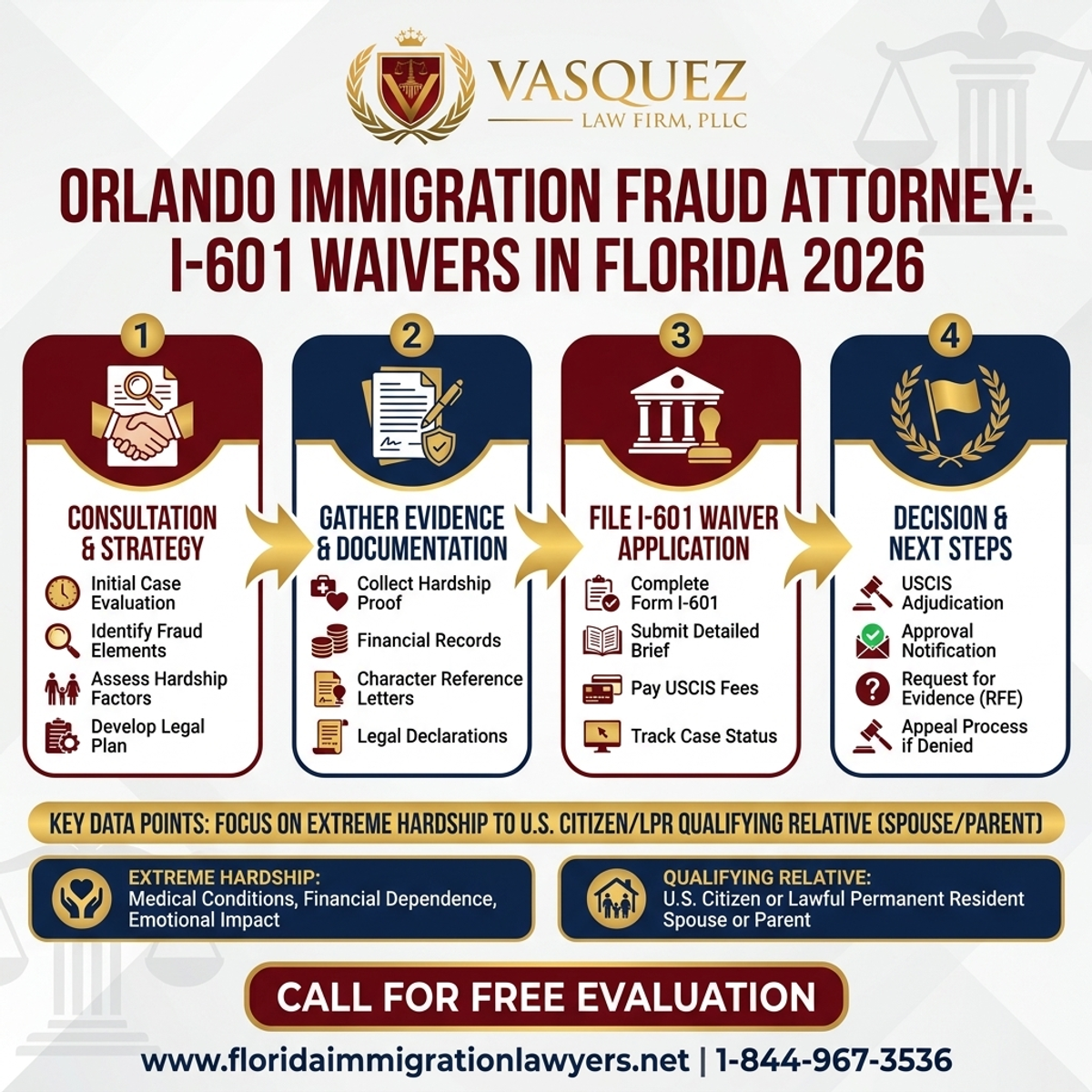
Step-by-Step Process — Orlando Immigration Fraud Attorney: I-601 Waivers in Florida 2026
What is the Step-by-Step Process for Filing an I-601 Waiver?
Filing an I-601 waiver for fraud or misrepresentation is a detailed and often lengthy process. As of 2026, successful navigation requires meticulous preparation and adherence to USCIS guidelines. For individuals in Florida, understanding each stage is crucial to avoid delays or denials. Here's a general step-by-step guide:
-
Determine Inadmissibility: First, it must be established that the applicant is indeed inadmissible under INA Section 212(a)(6)(C)(i) due to fraud or willful misrepresentation. This usually occurs during a visa interview at a U.S. Consulate abroad or during an adjustment of status interview at a USCIS office in Florida. The officer will typically issue a finding of inadmissibility.
-
Identify a Qualifying Relative: The applicant must have a U.S. citizen or lawful permanent resident spouse or parent who would suffer extreme hardship if the waiver is not granted. Gathering proof of this relationship is essential.
-
Gather Evidence of Extreme Hardship: This is the most critical step. Collect comprehensive documentation demonstrating the extreme hardship your qualifying relative would face. This includes medical records, psychological evaluations, financial statements, property deeds, tax returns, letters from employers, and affidavits from family members and community leaders in Florida. The evidence must clearly illustrate hardship beyond typical separation.
-
Complete Form I-601, Application for Waiver of Grounds of Inadmissibility: Fill out the form accurately and completely. Any errors or omissions can lead to requests for evidence (RFEs) or denial. Attach all supporting documentation to this form.
-
Prepare a Legal Brief: A detailed legal brief prepared by an immigration attorney is highly recommended. This brief will summarize the facts of the case, present legal arguments for why the waiver should be granted, and explain how the submitted evidence meets the "extreme hardship" standard as interpreted by relevant case law and USCIS policy.
-
File the Waiver Application: The filing location depends on whether the applicant is seeking an immigrant visa abroad or adjusting status in the U.S. For those abroad, the I-601 is typically filed with USCIS Lockbox facilities or with the Department of State's National Visa Center (NVC) after an inadmissibility finding by a consular officer. For adjustment of status cases in Florida, it's generally filed with the appropriate USCIS service center. Always verify the current filing instructions on the USCIS website.
-
Attend Biometrics Appointment: After filing, USCIS will send a notice for a biometrics appointment to collect fingerprints and photographs. This is a mandatory step in the process.
-
Respond to Requests for Evidence (RFEs): It is common for USCIS to issue an RFE if they need more information or clarification. Timely and thorough responses are crucial. An RFE can indicate that the initial submission was not strong enough to establish eligibility, especially concerning extreme hardship.
-
Receive Decision: USCIS will issue a decision approving or denying the waiver. If approved, the immigration process can continue. If denied, there may be options for appeal or refiling, depending on the specific reasons for denial.
Essential Documents for an I-601 Fraud Waiver Application
A robust I-601 waiver application relies heavily on comprehensive and compelling documentation. For Florida residents, gathering these documents meticulously is key to demonstrating eligibility and extreme hardship. As of 2026, USCIS expects a well-organized submission that leaves no doubt about the applicant's case. Here is a checklist of essential documents:
- Form I-601, Application for Waiver of Grounds of Inadmissibility: The completed and signed form.
- Filing Fee: Check the current fee on the USCIS website.
- Passport-style Photos: Two identical photos of the applicant.
- Proof of Relationship to Qualifying Relative: Marriage certificates, birth certificates, adoption decrees, and any other evidence establishing the relationship (e.g., joint bank accounts, property deeds, photos).
- Proof of U.S. Citizenship or LPR Status of Qualifying Relative: Copy of passport, birth certificate, naturalization certificate, or Green Card.
- Detailed Affidavit from Qualifying Relative: A sworn statement from the USC/LPR spouse or parent describing in detail the extreme hardship they would suffer if the waiver is not granted. This should be personal, specific, and compelling, covering all aspects of hardship.
- Applicant's Affidavit: A sworn statement from the applicant explaining the circumstances of the fraud or misrepresentation, expressing remorse, and detailing their positive contributions and ties to the U.S. or their home country.
- Medical Records: For qualifying relatives with health issues, provide comprehensive medical records, diagnoses, treatment plans, and letters from doctors explaining the severity of conditions and the need for U.S.-based care.
- Psychological Evaluations: Reports from licensed psychologists or psychiatrists detailing the emotional or mental health impact on the qualifying relative due to potential separation.
- Financial Documentation: Bank statements, tax returns (Form 1040), proof of employment, mortgage statements, rental agreements, utility bills, and any evidence of financial obligations or assets in the U.S. that would be severely impacted.
- Employment Records: Letters from employers, pay stubs, and evidence of job stability for both the applicant and qualifying relative.
- Educational Records: Transcripts, enrollment verification, and letters from schools if education would be disrupted.
- Community Ties Documentation: Letters from community leaders, religious figures, teachers, and friends attesting to the qualifying relative's involvement and reliance on local support networks in Florida.
- Country Conditions Information: If applicable, evidence of adverse conditions in the applicant's home country that would exacerbate hardship for the qualifying relative if they were forced to relocate.
- Legal Brief: A comprehensive legal argument prepared by your attorney, citing relevant laws and precedents, and summarizing the evidence.
- Police Clearances: If required, from all countries where the applicant has resided.
Organizing these documents thoroughly is critical. Missing or insufficient evidence is a leading cause of delays and denials. Your Orlando immigration attorney will help ensure your submission is complete and persuasive.
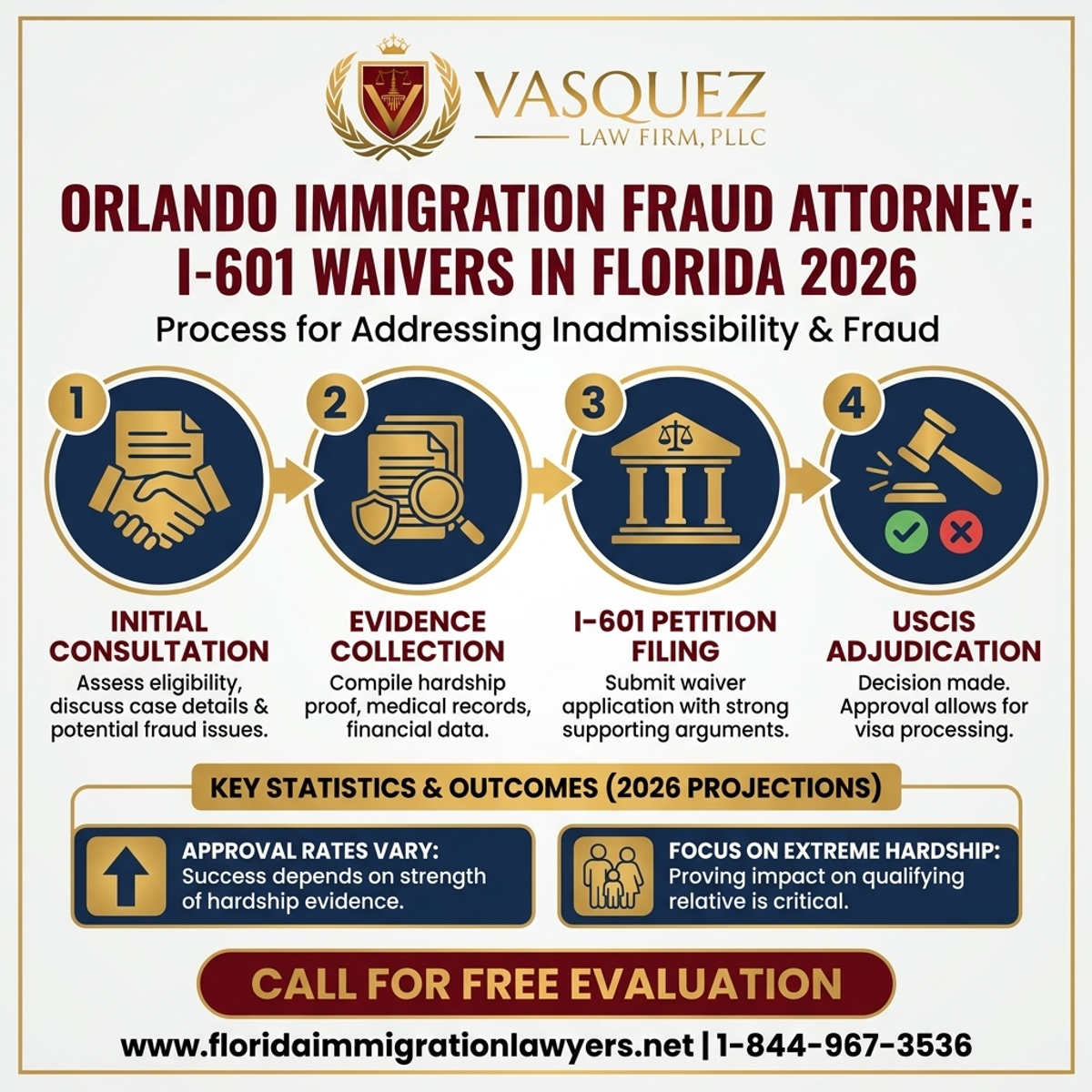
Key Statistics — Orlando Immigration Fraud Attorney: I-601 Waivers in Florida 2026
Do not navigate this process alone. Contact Florida Immigration Lawyers today at 1-844-YO-PELEO for assistance with your I-601 waiver application.
How Long Does an I-601 Waiver Take to Process in Florida in 2026?
The processing time for an I-601 waiver can vary significantly based on several factors, including the specific USCIS service center or consular post handling the case, the complexity of the application, and the volume of submissions. As of 2026, applicants in Florida should anticipate a waiting period that can range from several months to over a year. While there are no guaranteed timelines, understanding the typical stages can help manage expectations. USCIS publishes estimated processing times on its website, which are regularly updated.
Factors that can influence processing times include the completeness of your application, whether an RFE is issued, and the current workload of the adjudicating officer. For those applying through a U.S. consulate after an immigrant visa interview, the waiver decision often impacts the final visa issuance. For adjustment of status cases within Florida, the I-601 decision is crucial for the green card approval. An experienced immigration lawyer can help monitor your case and respond promptly to any USCIS inquiries, potentially expediting the process where possible.
| Stage | Typical Timeframe (as of 2026) | Notes |
|---|---|---|
| Application Preparation | 1-3 months | Gathering documents, drafting affidavits, legal brief. Highly variable based on complexity. |
| USCIS Receipt Notice | 1-3 weeks | Confirmation that USCIS has received your I-601 application. |
| Biometrics Appointment | 3-6 weeks after receipt | Mandatory appointment for fingerprints and photos. |
| Initial Review & RFE (if applicable) | 3-9 months | Officer reviews the case. If more evidence is needed, an RFE is issued, pausing the clock. |
| Decision | 6-18 months (after filing or RFE response) | Final approval or denial. Times vary widely by service center. |
| Post-Approval Processing | 1-3 months | If approved, visa issuance or adjustment of status finalization. |
What are the Costs Associated with an I-601 Fraud Waiver?
The costs associated with an I-601 fraud waiver application in Florida involve more than just the government filing fee. As of 2026, applicants should budget for various expenses to ensure a comprehensive and strong submission. The primary cost is the USCIS filing fee for Form I-601, which is subject to change. It is crucial to always verify the most current fee directly on the USCIS website or by consulting with your attorney, as incorrect fees can lead to rejection of your application.
Beyond the government fee, significant costs can arise from gathering compelling evidence. This includes fees for medical exams, psychological evaluations, translation services for foreign documents, and expert witness consultations. Additionally, legal representation is a substantial, yet invaluable, investment. Attorney fees for I-601 waivers reflect the complexity of these cases, the extensive evidence gathering required, and the detailed legal arguments that need to be crafted. While specific legal fees vary based on the complexity of your case and the firm, hiring an experienced immigration lawyer in Orlando can significantly increase your chances of success and prevent costly mistakes.
| Item | Typical Fee (as of 2026) | Notes |
|---|---|---|
| USCIS Form I-601 Filing Fee | Varies (Check USCIS website) | Mandatory government fee. Subject to change. |
| Attorney Legal Fees | Varies widely by case complexity and firm | Covers legal counsel, document preparation, brief writing, communication with USCIS. |
| Medical Examinations | Varies by provider | If required for qualifying relative's health hardship claims. |
| Psychological Evaluations | Varies by provider | Essential for demonstrating emotional/mental hardship to qualifying relative. |
| Document Translation Services | Varies by volume and language | For any foreign documents not in English. Must be certified translations. |
| Postage/Courier Fees | Minor costs | For sending applications and supporting documents securely. |
| Travel Expenses | Varies | For biometrics appointments or interviews, if applicable. |
Common Mistakes to Avoid in I-601 Fraud Waiver Applications
Navigating an I-601 fraud waiver application in Florida can be fraught with potential missteps that could jeopardize your case. Avoiding these common mistakes is crucial for a successful outcome:
-
Underestimating "Extreme Hardship": Many applicants fail to provide sufficient evidence demonstrating extreme hardship beyond normal separation. USCIS requires compelling proof of unusual and severe suffering, not just inconvenience. Without strong evidence, the waiver will likely be denied.
-
Failing to Disclose All Inadmissibility Grounds: If there are multiple grounds of inadmissibility, failing to waive all of them will result in a denial, even if the fraud waiver is approved. A thorough legal review can identify all potential issues.
-
Incomplete or Inconsistent Documentation: Submitting an application with missing documents, uncertified translations, or conflicting information can lead to RFEs, significant delays, or outright denials. Organization and accuracy are paramount.
-
Not Filing a Legal Brief: While not strictly required, a well-crafted legal brief from an attorney synthesizes the facts and legal arguments, making it easier for the adjudicator to understand the merits of your case. Omitting this can weaken your application.
-
Incorrectly Identifying the Qualifying Relative: Only a U.S. citizen or LPR spouse or parent can be a qualifying relative for extreme hardship in fraud waivers. Children do not qualify, which is a frequent error. This mistake will lead to an immediate denial.
-
Lack of Remorse or Responsibility: While not a legal requirement, expressing genuine remorse for the misrepresentation and taking responsibility for actions can positively influence the adjudicator's perception of your character and rehabilitation efforts.
-
Missing Deadlines or Ignoring RFEs: Failing to respond to an RFE by the deadline or providing an inadequate response will almost certainly lead to a denial. Timely and complete responses are critical.
-
Not Seeking Legal Counsel: The I-601 waiver is one of the most complex immigration applications. Attempting to navigate it without an experienced immigration attorney significantly increases the risk of errors and denial, especially with the evolving policies in 2026.
-
Submitting Boilerplate Letters: Generic letters of support or hardship statements that lack specific details and personal impact are often ineffective. Each piece of evidence must be tailored to your unique case.
-
Ignoring Florida-Specific Nuances: While federal law governs the waiver, local USCIS offices and judicial circuits in Florida may have subtle differences in how they interpret certain evidence or prioritize cases. An attorney familiar with Florida's immigration landscape can offer crucial insights.
When to Call an Orlando Immigration Fraud Attorney
The moment you suspect you might be inadmissible due to fraud or misrepresentation, or if you have already received an inadmissibility finding, is precisely when you should contact an experienced Orlando immigration fraud attorney. These cases are among the most challenging in immigration law, with high stakes that can impact your ability to live and work in the United States permanently. Attempting to navigate the I-601 waiver process without legal guidance can lead to critical errors, delays, and ultimately, denial.
You should call Florida Immigration Lawyers if you:
- Have been accused of immigration fraud or misrepresentation.
- Are facing an inadmissibility finding at a U.S. Consulate or USCIS office in Florida.
- Are unsure if you have a qualifying relative for an I-601 waiver.
- Need help identifying and proving "extreme hardship" to a qualifying relative.
- Require assistance gathering and organizing the extensive documentation.
- Want to ensure your application is comprehensive, legally sound, and persuasive.
- Are responding to a Request for Evidence (RFE) from USCIS.
- Need representation in immigration court proceedings related to inadmissibility.
Our attorneys at Florida Immigration Lawyers possess a deep understanding of INA provisions, USCIS regulations, and BIA (Board of Immigration Appeals) decisions relevant to fraud waivers. We can assess your unique situation, develop a tailored strategy, and meticulously prepare your application to maximize your chances of success. Do not jeopardize your future by facing this complex legal challenge alone.
About Florida Immigration Lawyers
Florida Immigration Lawyers is an immigration law firm dedicated to serving individuals and families across the entire state of Florida, including Orlando. With a profound commitment to justice and client success, our firm focuses on a wide range of immigration services, including complex cases such as I-601 fraud waivers, asylum applications, deportation defense, citizenship, and business immigration. Our experienced attorneys bring a wealth of knowledge and a compassionate approach to every case, understanding the unique challenges faced by immigrants in Florida.
We pride ourselves on providing personalized legal strategies, meticulous attention to detail, and unwavering advocacy for our clients. Our team is available 24/7 to provide assistance, offering free case reviews to help you understand your options without financial obligation. Choosing Florida Immigration Lawyers means partnering with a firm that prioritizes your future and fights tirelessly to achieve the strongest possible outcome. Contact us today at 1-844-YO-PELEO or visit www.floridaimmigrationlawyers.net to schedule your free consultation.
Sources and References
- U.S. Citizenship and Immigration Services (USCIS)
- Executive Office for Immigration Review (EOIR)
- U.S. Department of State
- 8 U.S.C. § 1182(a)(6)(C)(i) - Immigration and Nationality Act (INA) Section 212(a)(6)(C)(i)
- 8 CFR Part 212 - Documentary Requirements: Nonimmigrants; Waivers; Admission of Certain Inadmissible Aliens; Parole
- USCIS Policy Manual, Volume 9, Part A, Chapter 2 - Waivers for Inadmissibility
- Matter of H-N-, 22 I&N Dec. 1039 (BIA 1999) - A key BIA decision relating to extreme hardship.
Related services: immigration practice areas.
This article provides general legal information and is not intended as legal advice. Every case is unique, and outcomes depend on specific facts and circumstances. Contact an attorney for advice about your particular situation.
Contact an Orlando Immigration Fraud Attorney Today
If you are navigating the complexities of an I-601 fraud waiver or facing any other immigration challenge in Florida, legal representation is not just beneficial, it is essential. The pathway to a successful outcome requires a deep understanding of intricate immigration laws, meticulous preparation, and compelling advocacy. Do not leave your future to chance.
Florida Immigration Lawyers is here to provide the dedicated and experienced legal support you need. We are committed to protecting your rights and helping you achieve your immigration goals. Contact our Orlando immigration fraud attorneys today for a free, confidential case review. Call us at 1-844-YO-PELEO. Se Habla Espanol - Estamos aqui para ayudarle.
Do Not Navigate This Process Alone
Our experienced immigration attorneys are ready to fight for you. Get a free, confidential case review today.
Se Habla Español
Or leave your details and we’ll call you:
Free Evaluation in 24 Hours
Or talk to us right now

AI voice assistant — available 24/7
FreeFrequently Asked Questions

William J. Vásquez
Founding Attorney · Vasquez Law Firm
U.S. Air Force veteran and immigration attorney with years of hands-on U.S. immigration experience. J.D., NCCU School of Law. AILA member. Admitted to the 4th, 5th, and 11th Circuit Courts.
Available 24/7 - Free Evaluations
Reviewed for legal accuracy by William J. Vásquez
Licensed in North Carolina; U.S. immigration is federal practice.
Related Legal Services
Our Florida immigration attorneys can help you with free immigration consultation, business immigration and deportation defense. Call today at 1-844-YO-PELEO for a free case review.
Related Links
Related Topics
Free Legal Case Review
Discuss your case with our experienced attorneys. We're available 24/7.
Se Habla Español - Estamos aquí para ayudarle.
Related Articles
DUI Immigration Consequences in Florida 2026
A DUI conviction in Florida can have severe immigration consequences, potentially leading to inadmissibility, deportation, or denial of immigration benefits. For non-citizens, a DUI is not just a traffic offense but a serious criminal matter that federal immigration law scrutinizes closely. Factors like multiple offenses, injury, or property damage can escalate a simple DUI to a Crime Involving Moral Turpitude (CIMT) or even an aggravated felony, triggering mandatory detention and removal proceedings. Understanding the specific nature of your Florida conviction and its interpretation under the Immigration and Nationality Act (INA) is crucial. This article outlines how DUIs impact immigration status, the grounds for inadmissibility and deportation, a step-by-step guide to navigating the process, essential documentation, and expected timelines for 2026. We also highlight common mistakes to avoid and when to seek legal counsel from an experienced immigration attorney. Florida Immigration Lawyers offers comprehensive support for individuals facing these challenging situations, providing expert guidance through complex legal landscapes.
Dual Citizenship Lawyer in Florida: What You Need to Know
For Florida residents, the concept of dual citizenship, or holding two passports, offers a compelling blend of opportunities and challenges. While the U.S. generally permits dual nationality, the path to achieving this status requires a meticulous understanding of both U.S. immigration laws and the citizenship policies of your country of origin. This guide explores the definition of dual citizenship, the detailed step-by-step process for U.S. naturalization, and the significant benefits and potential pitfalls involved. We cover essential documentation, typical timelines, and cost considerations for 2026, providing crucial insights for anyone in Orlando, Miami, or across Florida considering this important legal step. Learn about common mistakes to avoid and understand when to seek professional legal counsel to navigate this complex process successfully. Florida Immigration Lawyers is here to provide expert, bilingual support for your dual citizenship journey.
EAD Advance Parole Combo Card in Florida: What You Need
An EAD advance parole combo card allows individuals with pending adjustment applications to both work and travel abroad without jeopardizing their green card application. Learn how to apply in Florida, what documents you need, and common mistakes to avoid.
EAD Advance Parole Combo Card in Florida 2026
For individuals with a pending Form I-485, Application to Register Permanent Residence or Adjust Status, the EAD Advance Parole Combo Card is an essential document. This single card combines the authorization to work legally in the U.S. (Employment Authorization Document - EAD) with permission to travel internationally and re-enter without abandoning your green card application (Advance Parole). This guide from Florida Immigration Lawyers provides a comprehensive overview for applicants in Florida in 2026, covering eligibility, the step-by-step application process, required documents, expected processing times, and associated costs. We also highlight common mistakes to avoid and when to seek legal counsel to ensure a smooth and successful immigration journey. Understanding this vital card is key to maintaining stability while awaiting your permanent residency approval.