Why is Form N-600 Taking So Long in Florida?
Form N-600 delays in Florida can be caused by incomplete applications, background checks, and USCIS backlogs. Learn how to address these issues and when to seek legal help.
Form N-600 delays can be frustrating, especially when trying to secure your child's citizenship status. Understanding the causes can help. Common reasons for delays include:
- Incomplete or incorrect application submissions
- Background checks taking longer than expected
- Processing backlogs at USCIS offices
- Additional documentation requests
Introduction
For many families in Florida, particularly in vibrant communities like Orlando, securing a Certificate of Citizenship for their children is not just a bureaucratic step; it's a profound milestone that solidifies their child's place in the nation. This certificate serves as official proof of U.S. citizenship, crucial for everything from school enrollment and passport applications to future employment and voting rights. However, when delays occur in the Form N-600 application process, the excitement can quickly turn into stress, anxiety, and confusion for parents eager to finalize their child's legal status.
Understanding the intricacies of the U.S. Citizenship and Immigration Services (USCIS) process is challenging, and unexpected holdups can leave families feeling helpless. This comprehensive article aims to demystify why Form N-600 applications might be taking longer than anticipated, offering clarity and practical guidance. We will delve into the most common reasons behind these delays, outline proactive steps you can take to minimize the wait, and crucially, identify situations where seeking professional legal assistance becomes not just helpful, but essential. Navigating immigration law can be complex, but you don't have to do it alone. For personalized advice and support, we encourage you to call Florida Immigration Lawyers at 1-844-YO-PELEO for a free, no-obligation consultation. Our team is dedicated to helping families across Florida achieve their immigration goals.
Why is Form N-600 Taking So Long?
Delays in processing Form N-600, the Application for Certificate of Citizenship, can stem from a multitude of factors, creating uncertainty for families awaiting this vital document. While USCIS strives for efficiency, various systemic and individual case-specific issues contribute to extended wait times. As of 2026, we've observed that some of the most common causes include significantly increased scrutiny during background checks, a direct consequence of evolving national security protocols, and a persistent backlog in processing applications across various service centers.
The U.S. Citizenship and Immigration Services (USCIS) has indeed been experiencing unprecedented processing delays, largely attributable to a sustained surge in application volumes across nearly all immigration categories. This high demand, coupled with resource constraints and staffing challenges, creates bottlenecks that impact even seemingly straightforward applications like the N-600. For families in Florida, this can mean longer waits for interviews at local field offices or extended periods for document review. Furthermore, the administrative burden of handling millions of applications annually means that even minor discrepancies or missing information in an N-600 submission can cause significant slowdowns, as USCIS must then issue requests for evidence (RFEs), adding weeks or even months to the overall timeline.
It is paramount for applicants to approach the N-600 process with meticulous attention to detail. Every piece of information provided must be accurate, and every required document must be included from the outset. A single overlooked signature, an outdated address, or an unattached supporting document can trigger an RFE, sending your application back into a queue and prolonging the wait. Understanding these potential pitfalls is the first step in preparing a robust application designed to minimize unnecessary delays. When in doubt, consulting with a knowledgeable legal professional, such as the team at Florida Immigration Lawyers, can provide peace of mind and help ensure your application is as complete and accurate as possible.
What Can Cause Delays in N-600 Processing?
Beyond the general issues of increased scrutiny and high application volumes, several specific issues can significantly contribute to N-600 processing delays, turning what should be a relatively straightforward process into a prolonged ordeal. Understanding these potential roadblocks is critical for applicants and their families to prepare thoroughly and proactively address any foreseeable challenges.
- Incomplete Applications: Missing information or documents can lead to requests for evidence, delaying the process. This is perhaps the most common and easily avoidable cause of delay. USCIS requires precise documentation to verify eligibility. If a birth certificate is missing, a parent's naturalization certificate is not properly submitted, or even if a signature is absent, USCIS will issue a Request for Evidence (RFE). Responding to an RFE takes time, and your application effectively pauses until the requested information is received and reviewed. A real-world example might involve a parent who recently naturalized but forgot to include their original naturalization certificate number, leading to an RFE and a several-month delay.
- Background Checks: Enhanced security measures mean background checks can take longer. USCIS conducts thorough background checks on all applicants and, in some cases, their parents, to ensure national security and public safety. These checks involve multiple government agencies and can sometimes flag common names or past minor infractions, leading to extended review periods. While most checks are routine, any discrepancies or hits, however minor, can necessitate deeper investigation, which can add significant time to the processing timeline.
- Processing Backlog: High volumes of applications at USCIS offices, particularly in busy states like Florida, can create backlogs. Florida, with its large immigrant population, often sees higher volumes of applications across all categories. This means local USCIS field offices in cities like Miami, Orlando, and Tampa can experience heavier workloads, leading to longer queues for interviews and document processing. These backlogs are often compounded by staffing shortages or temporary office closures, further exacerbating wait times for N-600 applicants.
- Policy Changes: Changes in immigration policy can temporarily slow processing as staff adapt. The immigration landscape is dynamic, and policy shifts, whether through new executive orders, regulatory changes, or revised interpretations of existing laws, can have a ripple effect on processing times. USCIS staff need time to implement and adapt to these changes, which can lead to temporary slowdowns as new guidelines are understood and applied to incoming applications. For instance, new requirements for specific types of evidence or altered interview protocols can cause a temporary dip in processing efficiency.
Each of these factors, individually or in combination, can extend the wait for your child's Certificate of Citizenship. Proactive preparation, meticulous attention to detail, and a clear understanding of the process are your best defenses against these potential delays. If you find yourself facing an unexpected delay or a complex RFE, don't hesitate to reach out to Florida Immigration Lawyers at 1-844-YO-PELEO for expert guidance.
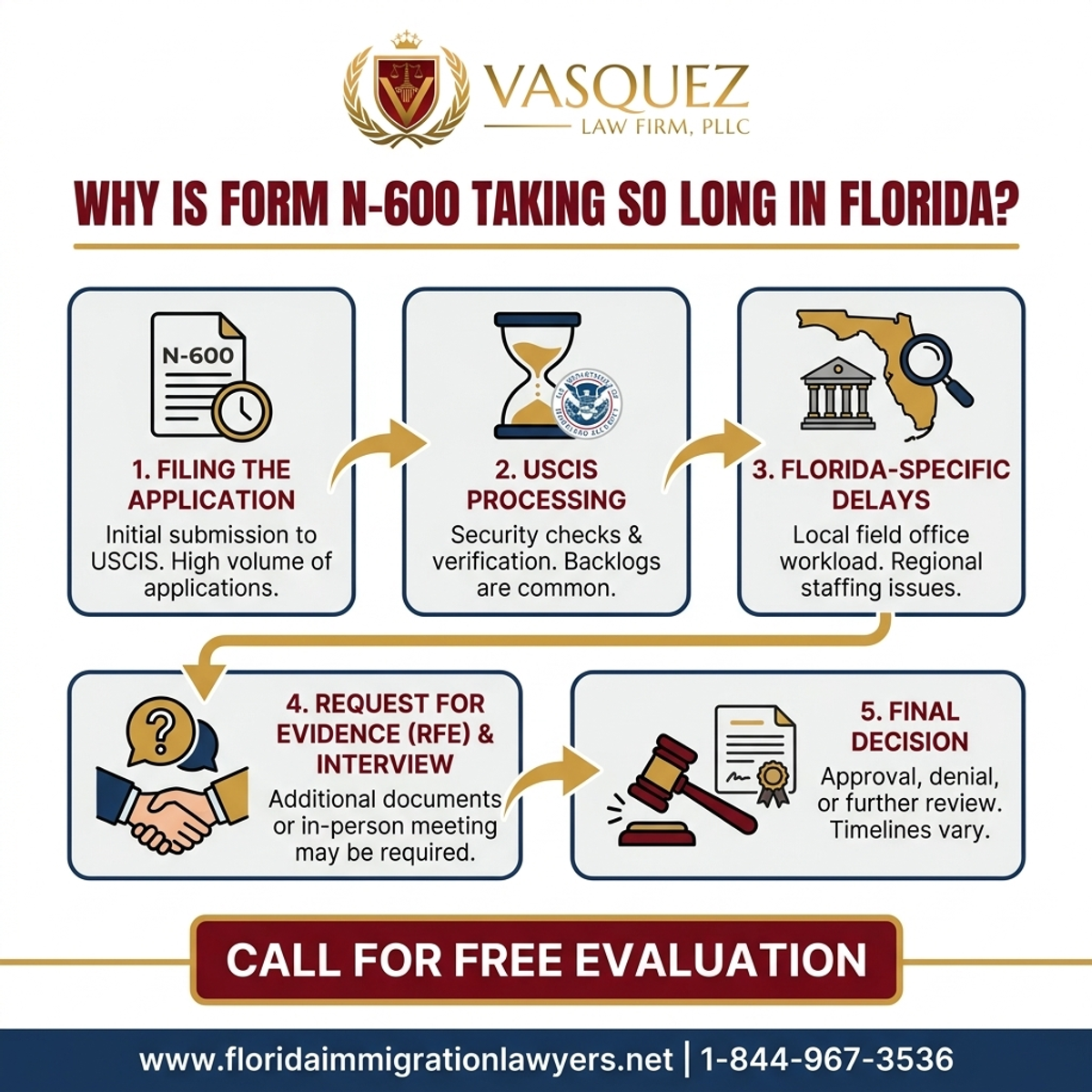
Step-by-Step Process — Why is Form N-600 Taking So Long in Florida?
How to Expedite Your N-600 Application
While some delays are unavoidable due to systemic issues, there are proactive steps you can take to significantly expedite your N-600 application and minimize potential roadblocks. A well-prepared and thoroughly managed application is your best tool for a smoother, faster process.
- Double-check your application: Ensure all information is correct and all required documents are included. Before submitting, meticulously review every section of Form N-600. Verify names, dates, addresses, and citizenship information for both the child and parents. Cross-reference the official USCIS instructions to ensure every single required supporting document, from birth certificates and marriage licenses to naturalization certificates and permanent resident cards, is attached and clearly labeled. Even a minor typo or missing copy can trigger an RFE, adding months to your wait. Consider having a second pair of eyes, perhaps a trusted family member or an immigration attorney, review your complete package.
- Respond promptly to requests: If USCIS asks for additional information, respond as quickly as possible. USCIS will issue a Request for Evidence (RFE) if they need more information or clarification. These requests come with strict deadlines, typically 30 to 87 days. Failing to respond by the deadline can lead to a denial of your application. Gather the requested documents immediately, ensure they are properly formatted and include the RFE cover sheet, and mail them back with proof of delivery. A delay in your response directly translates to a delay in your application's processing.
- Consider premium processing: Although not available for all forms, check if this option is available for your situation. While premium processing is generally not available for Form N-600 itself, it's crucial to understand that if your child's eligibility hinges on a parent's pending Form I-130 or I-485 that does qualify for premium processing, expediting that underlying petition could indirectly speed up the N-600 process. Always check the latest USCIS guidelines or consult with Florida Immigration Lawyers to see if any related petitions can be expedited.
- Contact a lawyer: An immigration attorney can help ensure your application is complete and advocate on your behalf if issues arise. An experienced immigration attorney, like those at Florida Immigration Lawyers, brings invaluable expertise to the N-600 process. They can thoroughly review your application and supporting documents for accuracy and completeness, identify potential issues before submission, and help you gather complex evidence. If delays occur, an attorney can communicate with USCIS on your behalf, inquire about case status, respond to RFEs effectively, and even intervene in cases of administrative error or unusual processing times. Their advocacy can often cut through bureaucratic red tape and significantly streamline the process.
By taking these proactive measures, you not only increase the likelihood of a swift and successful N-600 application but also gain peace of mind throughout the process. Remember, preparation is key, and expert guidance is always within reach. Call Florida Immigration Lawyers at 1-844-YO-PELEO for a free consultation to discuss your specific N-600 needs.
Document Checklist for N-600 Application
A crucial component of a successful N-600 application is the submission of a complete and accurate set of supporting documents. These documents serve as evidence to prove your child's eligibility for U.S. citizenship, either through birth to a U.S. citizen parent or through derivation/acquisition after birth. Failing to provide any required document, or submitting an unreadable or incomplete copy, is a primary reason for delays and Requests for Evidence (RFEs).
- Completed Form N-600: This is the primary application form itself. Ensure every section is filled out accurately, completely, and legibly. Do not leave any fields blank; if a question does not apply, write "N/A." Remember to sign and date the form in all required places.
- Child's birth certificate: This document establishes the child's identity and date/place of birth. If born outside the U.S., ensure it's an official, certified copy, often accompanied by a certified English translation if the original is in another language.
- Proof of parent's U.S. citizenship: This is critical for proving the child's eligibility. Acceptable forms include a U.S. birth certificate, a Certificate of Naturalization, a Certificate of Citizenship, a Consular Report of Birth Abroad (CRBA), or a valid unexpired U.S. passport. Provide a clear, legible copy.
- Parent's marriage certificate (if applicable): If the child's citizenship is derived through a married parent, or if the parents were married at the time of the child's birth, this document proves the legal relationship between the parents. Again, provide a certified copy with translation if necessary.
- Child's permanent resident card (if applicable): If the child acquired citizenship automatically upon becoming a lawful permanent resident (LPR), their Green Card (Form I-551) is essential proof of their LPR status. This demonstrates they met the residency requirement for automatic acquisition of citizenship.
- Other supporting documents: Depending on the specific circumstances, additional documents may be required. This could include divorce decrees or death certificates if parents are no longer married, adoption decrees if the child was adopted, or evidence of legal and physical custody. Always refer to the latest USCIS instructions for a comprehensive list tailored to your unique situation.
Organizing these documents systematically, perhaps with cover sheets or tabs, can also aid USCIS in processing your application more efficiently. Make sure to send copies, not originals, unless specifically requested by USCIS. Keeping a personal copy of your entire submission package is also a wise practice for your records. If you're unsure about any document, Florida Immigration Lawyers can provide clarity and ensure your submission is flawless. Call us at 1-844-YO-PELEO for expert assistance.
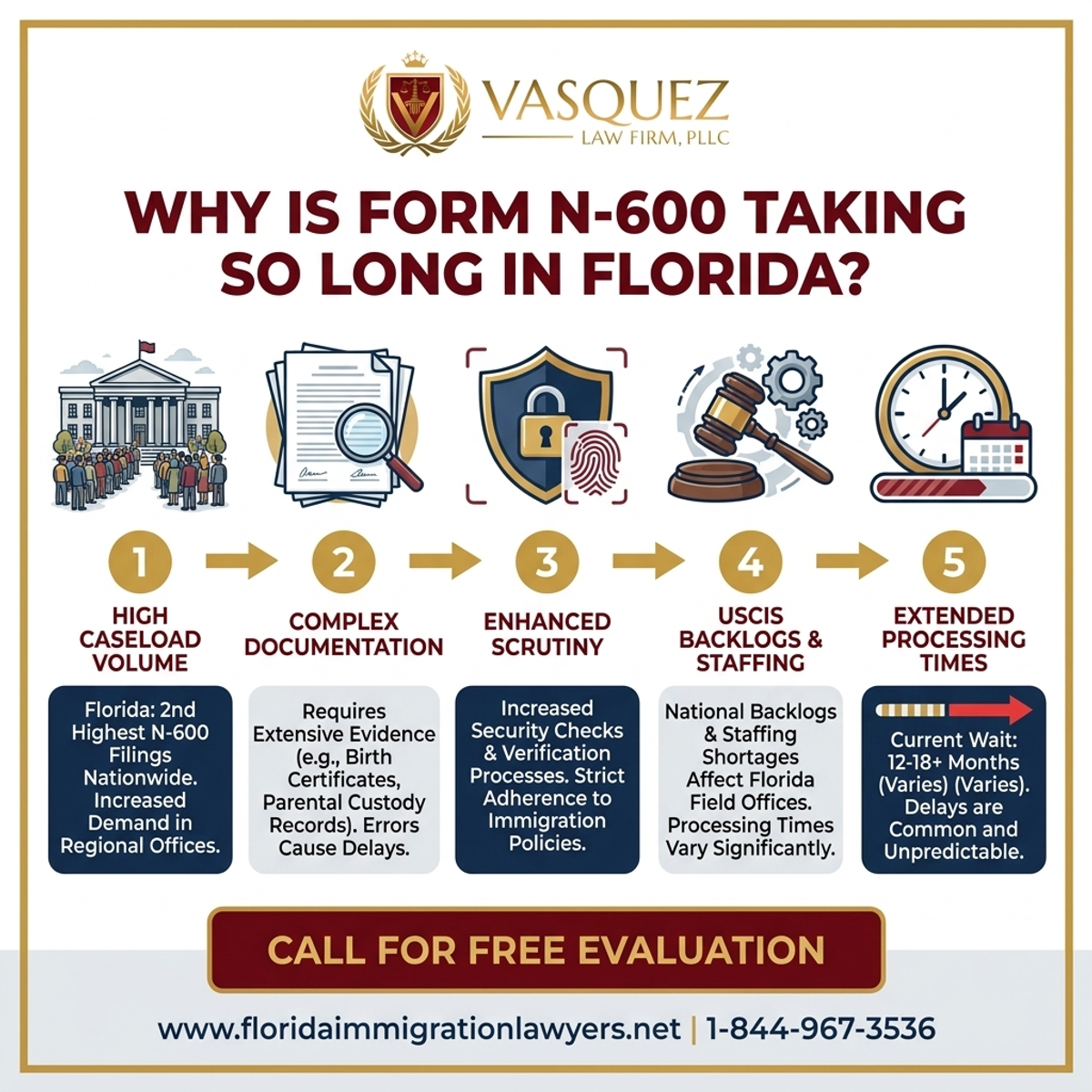
Sources and References
- U.S. Citizenship and Immigration Services (USCIS)
- Executive Office for Immigration Review (EOIR)
- U.S. Department of State - Bureau of Consular Affairs
- Immigration and Nationality Act (INA), 8 U.S.C. Chapter 12
Do Not Navigate This Process Alone
Our experienced immigration attorneys are ready to fight for you. Get a free, confidential case review today.
Se Habla Español
Or leave your details and we’ll call you:
Free Evaluation in 24 Hours
Or talk to us right now

AI voice assistant — available 24/7
FreeFrequently Asked Questions

William J. Vásquez
Founding Attorney · Vasquez Law Firm
U.S. Air Force veteran and immigration attorney with years of hands-on U.S. immigration experience. J.D., NCCU School of Law. AILA member. Admitted to the 4th, 5th, and 11th Circuit Courts.
Available 24/7 - Free Evaluations
Reviewed for legal accuracy by William J. Vásquez
Licensed in North Carolina; U.S. immigration is federal practice.
Related Legal Services
Our Florida immigration attorneys can help you with immigration lawyer cost in Florida, experienced immigration attorneys and asylum protection. Call today at 1-844-YO-PELEO for a free case review.
Related Links
Related Topics
Free Legal Case Review
Discuss your case with our experienced attorneys. We're available 24/7.
Se Habla Español - Estamos aquí para ayudarle.
Related Articles
EAD Advance Parole Combo Card in Florida 2026
For individuals with a pending Form I-485, Application to Register Permanent Residence or Adjust Status, the EAD Advance Parole Combo Card is an essential document. This single card combines the authorization to work legally in the U.S. (Employment Authorization Document - EAD) with permission to travel internationally and re-enter without abandoning your green card application (Advance Parole). This guide from Florida Immigration Lawyers provides a comprehensive overview for applicants in Florida in 2026, covering eligibility, the step-by-step application process, required documents, expected processing times, and associated costs. We also highlight common mistakes to avoid and when to seek legal counsel to ensure a smooth and successful immigration journey. Understanding this vital card is key to maintaining stability while awaiting your permanent residency approval.
Immigration Lawyer Orlando Free Consultation in Florida
For individuals and families in Orlando, Florida, navigating the complexities of U.S. immigration law requires expert guidance. An immigration lawyer in Orlando offers crucial support for everything from visa applications and green card processes to naturalization and deportation defense. This comprehensive guide details what a free consultation covers, providing a step-by-step overview of immigration pathways, essential document checklists, and expected timelines in 2026. We also highlight common mistakes to avoid, discuss the critical role of legal counsel in deportation and asylum cases, and explain why choosing a local Orlando immigration attorney is beneficial. Florida Immigration Lawyers is dedicated to serving the diverse community of Orlando with compassionate, effective legal solutions, ensuring you receive personalized advice and robust representation for a successful immigration journey.
USCIS Oath Ceremony Schedule 2026: Your Guide to Citizenship
Achieving U.S. citizenship culminates in the naturalization oath ceremony, a pivotal moment for immigrants in Florida. This comprehensive guide from Florida Immigration Lawyers details the USCIS oath ceremony schedule for 2026, outlining what to expect from your Form N-445 notice to the final pledge of allegiance. We cover the entire naturalization process, including eligibility requirements, the step-by-step application (Form N-400), necessary documents, typical timelines for Florida field offices like Orlando, Miami, and Tampa, and associated costs. Learn how to prepare for your ceremony, avoid common mistakes that could delay your path, and understand when legal counsel becomes indispensable. Our firm is dedicated to providing expert guidance, ensuring a smooth and successful journey to becoming a U.S. citizen. Get a free case review from our bilingual team today.
Annual Asylum Fee: Preparation for Florida Interviews
As of 2026, there is no annual asylum fee in the U.S. Preparing for your asylum interview in Florida is crucial for success. Learn more about the process, necessary documentation, and common mistakes to avoid. Florida Immigration Lawyers are here to help.