Motion to Reopen Deportation in Florida 2026
A motion to reopen a deportation case in South Florida offers a critical opportunity for individuals to challenge a final removal order. This complex legal process allows immigrants to present new evidence or arguments not available during their initial hearings, potentially leading to a reconsideration of their case by an Immigration Judge or the Board of Immigration Appeals. Strict deadlines, typically 90 days from the final order, apply, but exceptions exist for scenarios like changed country conditions or joint motions with DHS. Navigating the requirements, preparing compelling documentation, and adhering to precise procedural rules are essential for success. Florida Immigration Lawyers provides expert guidance for those seeking to reopen their deportation cases, ensuring every possible avenue for relief is explored. Understanding these intricate legal pathways is vital for protecting your future in the U.S.
A motion to reopen a deportation case in South Florida allows an individual facing removal to ask the immigration court or the Board of Immigration Appeals (BIA) to reconsider its decision. This legal mechanism is typically used when new evidence becomes available, circumstances have significantly changed, or a legal error occurred that was not previously considered. As of 2026, strict deadlines usually apply, often within 90 days of the final order, but exceptions exist for asylum claims, changed country conditions, or joint motions with the Department of Homeland Security (DHS). Successfully filing requires meticulous preparation and adherence to complex procedural rules.
- Motions to reopen address new facts or legal errors in deportation cases.
- Strict deadlines, typically 90 days, apply from the final order date.
- Exceptions exist for asylum, changed conditions, or joint motions.
- Filing can be with an Immigration Judge (IJ) or the Board of Immigration Appeals (BIA).
- Legal assistance is crucial due to the complexity and high stakes involved.
Facing deportation can be one of the most stressful and uncertain experiences for individuals and families in Florida. The finality of a removal order can feel overwhelming, leaving many to believe there are no further options. However, for some, a legal pathway exists to challenge such decisions: the motion to reopen an immigration case.
This comprehensive guide from Florida Immigration Lawyers will delve into the intricacies of filing a motion to reopen deportation south florida, covering everything from eligibility requirements and filing procedures to common pitfalls and critical deadlines. We understand the unique challenges faced by immigrants in Central Florida and across the state, and our goal is to provide clear, actionable information. Understanding this complex process is the first step toward potentially changing your immigration outcome.
Do not navigate this challenging legal landscape alone. If you believe you may have grounds to reopen your case, it is imperative to seek professional legal guidance. Call Florida Immigration Lawyers at 1-844-YO-PELEO for a free case review and let our experienced team help you understand your options.
What is a Motion to Reopen a Deportation Case in South Florida?
A motion to reopen is a formal request submitted to an Immigration Judge (IJ) or the Board of Immigration Appeals (BIA) asking them to re-examine a previous decision in a deportation or removal case. This motion is not an appeal of the previous decision on its merits, but rather a request to present new evidence or arguments that were not available or could not have been presented at the prior hearing. It essentially asks the court to allow the case to be heard again, often because new facts have emerged or there has been a significant change in law or circumstances.
For individuals in South Florida, particularly those whose cases were heard at the Miami Immigration Court, understanding this mechanism is critical. The legal authority for motions to reopen is primarily found in 8 CFR § 1003.23 for motions before an Immigration Judge and 8 CFR § 1003.2 for motions before the BIA. These regulations outline the strict requirements and deadlines that must be met. The goal of a motion to reopen is to allow the immigrant to present new evidence or argue for a form of relief from removal that was previously unavailable or not fully considered.
It is important to distinguish a motion to reopen from an appeal. An appeal challenges the legal and factual correctness of the original decision based on the evidence already presented. A motion to reopen, conversely, introduces new material. For instance, if an individual was ordered deported and subsequently married a U.S. citizen, this new marital relationship could be grounds for a motion to reopen to pursue adjustment of status, provided all other eligibility criteria are met. This process is highly technical and demands a thorough understanding of immigration law and procedure.
How Do I File a Motion to Reopen an Immigration Case in Florida?
Filing a motion to reopen an immigration case in Florida involves a precise, multi-step legal procedure that must be followed without error. The process begins by determining which court has jurisdiction over your case – either the Immigration Judge (IJ) who issued the last order or the Board of Immigration Appeals (BIA) if your case was appealed. Accuracy at each stage is paramount, as even minor mistakes can lead to rejection.
As of 2026, the specific forms and filing locations depend on whether the motion is directed to the IJ or the BIA. For motions before an IJ, you will typically file Form EOIR-42A, Motion to Reopen. For motions before the BIA, you will file Form EOIR-42B, Motion to Reopen. These forms must be accompanied by supporting documentation and a detailed legal brief explaining the basis for reopening the case.
-
Determine Jurisdiction: Identify whether the final order in your case was issued by an Immigration Judge or the Board of Immigration Appeals. This dictates where you will file your motion.
-
Identify Grounds for Reopening: You must demonstrate new facts, new evidence that was not available at the prior hearing, or a change in law that would affect the outcome of your case. Simply disagreeing with the prior decision is not enough. Examples include a newly approved visa petition, a change in country conditions, or evidence of ineffective assistance of counsel.
-
Gather Supporting Documentation: Collect all relevant documents, affidavits, and evidence that supports your claim for reopening. This could include marriage certificates, birth certificates, medical records, police reports, expert opinions, or any other proof of new circumstances.
-
Prepare the Motion: Complete the appropriate form (EOIR-42A for IJ; EOIR-42B for BIA). Draft a comprehensive legal brief or statement explaining the new facts or legal arguments, why they were not presented previously, and how they would likely change the outcome. Cite relevant legal authorities, such as the Executive Office for Immigration Review (EOIR) regulations and case law.
-
File with the Court: Submit the completed motion, all supporting documents, and the required filing fee to the correct immigration court or the BIA. Ensure you follow their specific filing instructions, which may include electronic filing or mailing to a specific address.
-
Serve Opposing Counsel: You must serve a copy of your motion and all supporting documents on the Department of Homeland Security (DHS) Office of Chief Counsel. Proof of service must be filed with the court.
-
Await Decision: The Immigration Judge or BIA will review your motion. They may issue a decision based on the written submissions or schedule a hearing. This process can take several months.
Document Checklist for a Motion to Reopen:
- Completed Form EOIR-42A (for IJ) or EOIR-42B (for BIA)
- Filing fee or fee waiver request (Form EOIR-26A)
- Detailed legal brief or supporting statement
- Affidavits from yourself and supporting witnesses
- New evidence (e.g., marriage certificates, birth certificates, medical records, approved I-130 petition)
- Proof of service on DHS Office of Chief Counsel
- Any relevant court orders or decisions from your previous case
- Translations of any non-English documents, certified by a translator
What Are the Deadlines for Filing a Motion to Reopen a Deportation Case?
Deadlines are critically important when filing a motion to reopen a deportation case, and missing them almost always results in the denial of the motion. Generally, a motion to reopen must be filed within 90 days of the date of the Immigration Judge's (IJ) or the Board of Immigration Appeals' (BIA) final order of removal. This 90-day rule is strictly enforced by the courts and is codified in 8 CFR § 1003.23(b)(1) for IJs and 8 CFR § 1003.2(c)(2) for the BIA.
However, there are crucial exceptions to this 90-day deadline that can provide relief in specific circumstances. These exceptions are vital for many immigrants in Florida who may discover new grounds for relief long after their initial case concluded. Understanding these exceptions can mean the difference between remaining in the U.S. and facing deportation. As of 2026, some of the most common exceptions include motions based on changed country conditions, joint motions with DHS, and certain asylum claims.
For instance, a motion to reopen based on changed country conditions may be filed at any time if the evidence of change is material and was not available and could not have been discovered or presented at the previous hearing. Similarly, a joint motion to reopen, filed by both the immigrant and DHS, has no time limit. This often occurs when DHS agrees that reopening the case is in the interest of justice or when new evidence makes a form of relief possible. Additionally, motions to reopen to apply for asylum or withholding of removal based on changed country conditions can also be filed without a time limit, provided the conditions in the applicant's country of origin have materially changed and that evidence is new. These exceptions are complex and require compelling evidence and legal arguments.
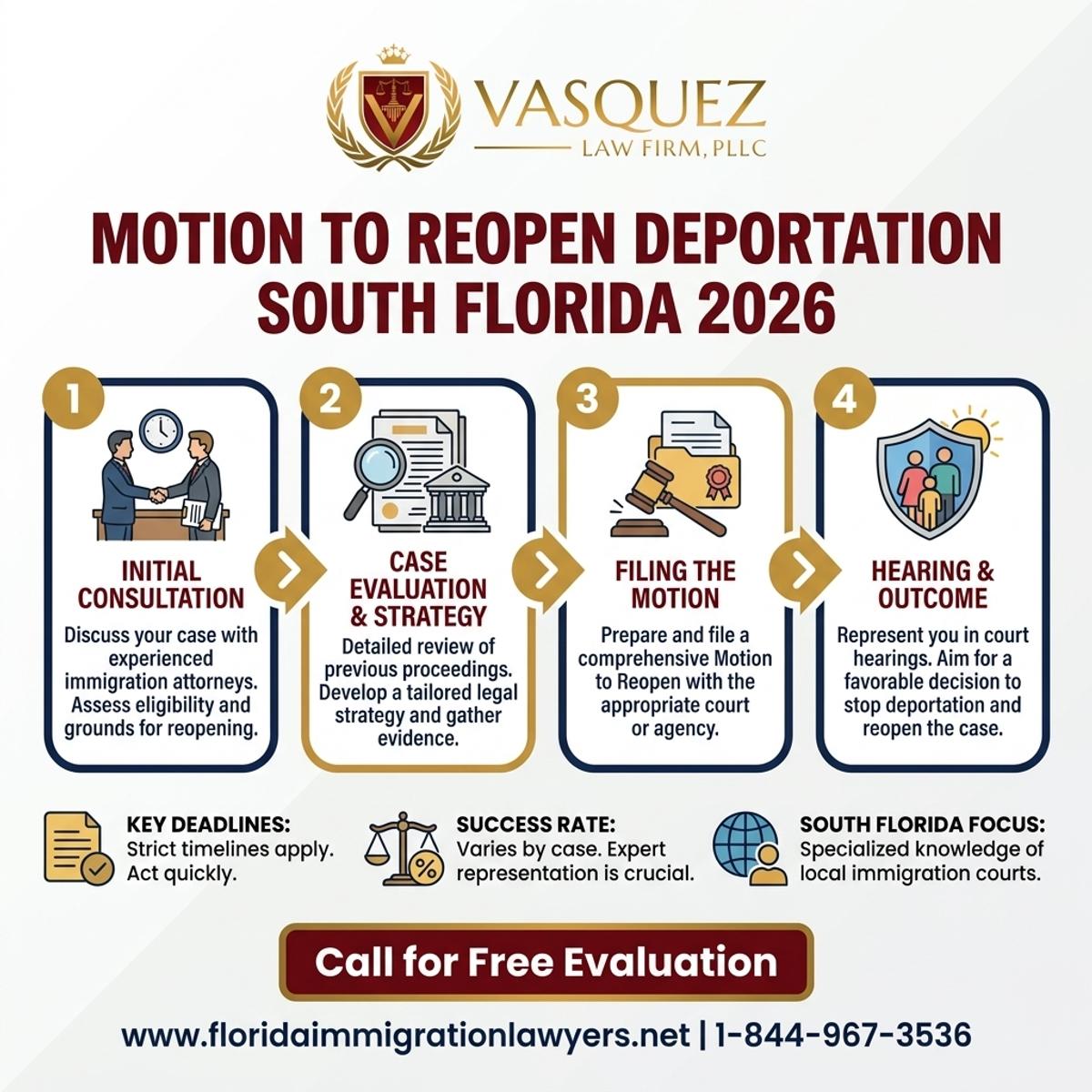
Step-by-Step Process — Motion to Reopen Deportation South Florida 2026
Typical Timeline for Motions to Reopen (As of 2026):
| Stage | Typical Timeframe | Notes |
|---|---|---|
| Initial Filing Deadline (IJ/BIA) | 90 days from final order | Strictly enforced; few exceptions. |
| Response from DHS | 30 days after service | DHS may oppose or join the motion. |
| Court Review (IJ) | 3-12 months | Varies greatly by court backlog (e.g., Miami Immigration Court). |
| Court Review (BIA) | 6-18 months | Often longer due to higher caseloads. |
| Decision Issued | Upon review completion | Can be granted, denied, or remanded for further proceedings. |
| Motion based on Changed Country Conditions | No time limit | Requires compelling evidence of material change. |
| Joint Motion with DHS | No time limit | Requires agreement from DHS; often strategic. |
What Factors Influence the Cost of a Motion to Reopen in Florida?
The cost of filing a motion to reopen an immigration case in Florida can vary significantly, depending on several factors including the complexity of the case, the specific court involved, and whether you retain legal counsel. As of 2026, there are generally two main categories of costs: government filing fees and attorney fees. Understanding these expenses upfront is crucial for planning and making informed decisions about your legal strategy.
Government filing fees are standardized and are paid directly to the Executive Office for Immigration Review (EOIR). However, the most substantial portion of the cost typically comes from attorney fees. Given the intricate legal requirements, strict deadlines, and high stakes involved in deportation cases, most individuals choose to hire an immigration attorney. An attorney's expertise is invaluable in identifying valid grounds for reopening, preparing compelling legal arguments, and navigating the procedural nuances. The overall cost will reflect the amount of work required to thoroughly prepare and file a strong motion to reopen.
Additional costs might also arise, such as fees for obtaining necessary documents, certified translations of foreign-language records, or expert witness testimonies if particular circumstances require specialized input. For example, if you are filing a motion based on changed country conditions, you might need an expert report on human rights in your home country. These additional expenses, while not always present, can add to the total financial commitment. It is always best to discuss all potential costs with your attorney during your initial consultation.
Typical Fee Breakdown for a Motion to Reopen (As of 2026):
| Item | Typical Fee | Notes |
|---|---|---|
| EOIR-42A/B Filing Fee | $110 (subject to change) | Paid to the Executive Office for Immigration Review. Fee waivers may be available for eligible individuals. |
| Attorney Fees (Hourly) | $250 - $500+ per hour | Varies based on attorney experience, firm location, and case complexity. A motion can take 10-30+ hours. |
| Attorney Fees (Flat Fee) | $3,000 - $8,000+ | Many attorneys offer flat fees for motions to reopen, covering all aspects of preparation and filing. |
| Document Translation Fees | $20 - $50+ per page | Required for any non-English documents. Must be certified translations. |
| Expert Witness Fees | Highly variable | Only if specific expertise (e.g., country conditions expert, medical expert) is needed to support the motion. |
| Postage/Courier Fees | Variable | Costs associated with mailing documents to the court and DHS. |
What Happens After My Motion to Reopen is Granted?
If your motion to reopen is granted, it is a significant victory, but it is not the end of your immigration journey. Instead, it means that the previous decision in your deportation case has been vacated, and your case is returned to the Immigration Judge (IJ) for further proceedings. This effectively gives you another opportunity to present your case, introduce new evidence, or apply for a form of relief from removal that was previously unavailable or not fully considered. The granting of a motion to reopen signifies that the court believes there are sufficient new facts or legal arguments to warrant a fresh look at your situation.
Upon reopening, the case is typically calendared for a new hearing before the IJ. This hearing will focus on the new evidence or legal arguments that formed the basis of your motion. For example, if your motion was based on a newly approved family petition, the IJ will then consider your eligibility for adjustment of status. If it was based on changed country conditions, you would then have the opportunity to apply for asylum or withholding of removal. This new hearing provides a crucial chance to present a full and fair case, which was the original intent of the motion.
For individuals in Florida, this could mean returning to the Miami Immigration Court or another relevant court in the state. The outcome of these subsequent hearings can vary widely. The IJ might grant the relief you sought, such as adjustment of status, asylum, or cancellation of removal. Alternatively, the IJ might deny the relief, leading to a new order of removal, which you may then choose to appeal to the BIA. The process after reopening is essentially a continuation of the original removal proceedings, but with the benefit of presenting previously unavailable information. This is why having strong legal representation from Florida Immigration Lawyers during this phase is just as critical as during the initial filing of the motion.
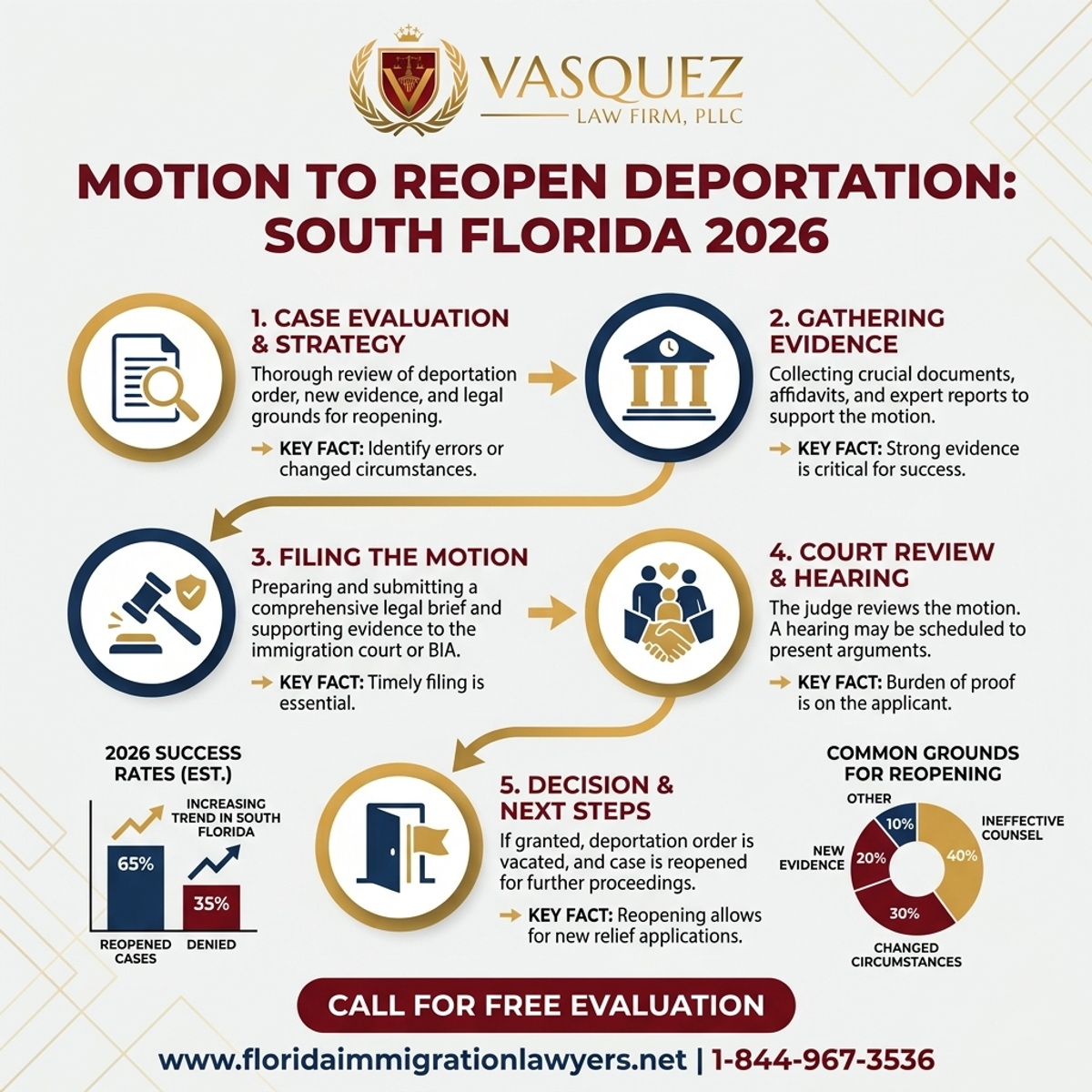
Key Statistics — Motion to Reopen Deportation South Florida 2026
Do not navigate this process alone. The complexities of a motion to reopen, especially in deportation cases, demand the expertise of seasoned legal professionals. Contact Florida Immigration Lawyers today at 1-844-YO-PELEO for a free case review. Our team is ready to assist immigrants across Florida, including those in Orlando and the Central Florida region, in understanding their options and fighting for their rights.
Common Mistakes to Avoid When Filing a Motion to Reopen
-
Missing the Filing Deadline: The most common and often fatal mistake is filing after the 90-day deadline (or other applicable deadlines for exceptions). Courts are very strict about these time limits, and late filings are almost always denied without review.
-
Failing to Present New, Material Evidence: A motion to reopen requires new facts or evidence that were not available or discoverable at the time of the previous hearing. Simply re-arguing old points or presenting evidence that could have been submitted before is insufficient and will lead to denial.
-
Improper Service on DHS: You must properly serve a copy of your motion and all supporting documents on the Department of Homeland Security (DHS) Office of Chief Counsel and provide proof of service to the court. Failure to do so is a procedural error that can result in denial.
-
Incomplete or Incorrect Forms: Submitting forms with missing information, incorrect dates, or without proper signatures can lead to rejection or delays. Every detail on the form must be accurate and complete.
-
Lack of Supporting Documentation: A motion to reopen must be well-supported by evidence. Filing a motion without sufficient documentation to prove your new claims or changed circumstances will weaken your case significantly.
-
Not Addressing the "Good Cause" Requirement (for some motions): For certain types of motions, especially those related to ineffective assistance of counsel, you must demonstrate "good cause" for why the issue was not raised earlier. Failing to explain this can be detrimental.
-
Failing to Cite Legal Authority: Your motion should clearly state the legal basis for reopening, citing relevant sections of the Immigration and Nationality Act (INA), Code of Federal Regulations (CFR), and binding case law. A lack of legal foundation can result in denial.
-
Submitting Uncertified Translations: Any document not in English must be accompanied by a certified English translation. Uncertified translations are often not accepted by the court.
-
Not Filing the Correct Fee or Fee Waiver: Failing to include the required filing fee or an approved fee waiver request (Form EOIR-26A) will prevent your motion from being processed.
-
Attempting to Reopen an Unreopenable Case: Some orders are not eligible for reopening, such as certain stipulated orders or cases where the individual has already departed the U.S. without proper authorization. It's crucial to understand your case's specific limitations.
-
Failing to Address Statutory Bars: Even with new evidence, if you are subject to statutory bars to relief (e.g., certain criminal convictions), the motion may still be denied. Your motion should address how you overcome any such bars.
When to Call a Lawyer for a Motion to Reopen
Navigating the complexities of a motion to reopen an immigration case, especially one involving a deportation order, is incredibly challenging. The legal landscape is fraught with strict deadlines, intricate procedural rules, and demanding evidentiary standards. This is not a process to undertake without expert legal guidance. You should call an experienced immigration lawyer, like those at Florida Immigration Lawyers, as soon as you consider filing a motion to reopen.
Specific scenarios that signal an immediate need for legal counsel include:
- You have recently discovered new evidence that was unavailable during your previous removal proceedings, such as a newly approved family petition from USCIS, a change in your marital status, or a new medical diagnosis.
- There has been a significant change in immigration law or policy that directly impacts your eligibility for relief.
- You believe your previous attorney provided ineffective assistance, leading to an unfair outcome in your case.
- You are facing a fast-approaching 90-day deadline from your final order of removal, and you need urgent assistance to prepare and file your motion correctly.
- Your case involves complex issues such as criminal convictions, national security concerns, or a history of prior immigration violations.
- You are unsure whether your specific circumstances qualify for an exception to the 90-day filing deadline, such as changed country conditions or a joint motion with DHS.
Florida Immigration Lawyers specialize in deportation defense and motions to reopen. Our attorneys have a deep understanding of the procedures at the Miami and Orlando Immigration Courts and the Board of Immigration Appeals. We can assess the merits of your potential motion, help gather the necessary evidence, draft compelling legal arguments, and ensure all procedural requirements are met. Do not risk your future by attempting to handle such a critical legal matter alone. Schedule a free consultation with us today.
About Florida Immigration Lawyers
Florida Immigration Lawyers is a leading immigration law firm dedicated to serving individuals and families throughout all of Florida, including our home base in Orlando and the wider Central Florida region. With a profound understanding of U.S. immigration laws and a steadfast commitment to our clients, we provide compassionate yet aggressive legal representation across a broad spectrum of immigration matters. Our attorneys are passionate advocates for immigrant rights, offering personalized strategies tailored to each unique case.
Our comprehensive services include deportation defense, asylum claims, family-based immigration, business immigration, naturalization, and, crucially, complex litigation such as motions to reopen and appeals. We pride ourselves on being accessible, available 24/7 to address urgent concerns, and offering free case reviews to help you understand your legal standing without financial commitment. Our bilingual team, fluent in English and Spanish, ensures that language is never a barrier to quality legal assistance. When your future in America is at stake, choose a firm that fights tirelessly for you. Call 1-844-YO-PELEO for dedicated and experienced legal support.
Sources and References
- U.S. Citizenship and Immigration Services (USCIS)
- Executive Office for Immigration Review (EOIR)
- U.S. Department of State
- 8 U.S.C. Chapter 12 - Immigration and Nationality Act (INA)
- 8 U.S.C. § 1229a - Removal proceedings; cancellation of removal and adjustment of status for certain nonpermanent residents
- 8 CFR § 1003.2 - Motions to reopen or reconsider before the Board of Immigration Appeals
- 8 CFR § 1003.23 - Motions to reopen or reconsider before the Immigration Judge
Related services: asylum and refugee protection, immigration waivers, humanitarian protection programs, DACA renewal and applications.
This article provides general legal information and is not intended as legal advice. Every case is unique, and outcomes depend on specific facts and circumstances. Contact an attorney for advice about your particular situation.
Don't let a deportation order be the final word on your immigration future. A motion to reopen could be your pathway to a second chance. Contact Florida Immigration Lawyers today for a free, confidential case review. Our dedicated team is ready to provide the aggressive and compassionate representation you deserve. Call us now at 1-844-YO-PELEO. Se Habla Español - Estamos aquí para ayudarle.
If you need legal assistance, learn more about our deportation defense services, or call us at 1-844-967-3536 for a free case review.
Do Not Navigate This Process Alone
Our experienced immigration attorneys are ready to fight for you. Get a free, confidential case review today.
Se Habla Español
Or leave your details and we’ll call you:
Free Evaluation in 24 Hours
Or talk to us right now

AI voice assistant — available 24/7
FreeFrequently Asked Questions

William J. Vásquez
Founding Attorney · Vasquez Law Firm
U.S. Air Force veteran and immigration attorney with years of hands-on U.S. immigration experience. J.D., NCCU School of Law. AILA member. Admitted to the 4th, 5th, and 11th Circuit Courts.
Available 24/7 - Free Evaluations
Reviewed for legal accuracy by William J. Vásquez
Licensed in North Carolina; U.S. immigration is federal practice.
Related Legal Services
Our Florida immigration attorneys can help you with citizenship and naturalization, immigration practice areas and free immigration consultation. Call today at 1-844-YO-PELEO for a free case review.
Related Links
Related Topics
Free Legal Case Review
Discuss your case with our experienced attorneys. We're available 24/7.
Se Habla Español - Estamos aquí para ayudarle.
Related Articles
DUI Immigration Consequences in Florida 2026
A DUI conviction in Florida can have severe immigration consequences, potentially leading to inadmissibility, deportation, or denial of immigration benefits. For non-citizens, a DUI is not just a traffic offense but a serious criminal matter that federal immigration law scrutinizes closely. Factors like multiple offenses, injury, or property damage can escalate a simple DUI to a Crime Involving Moral Turpitude (CIMT) or even an aggravated felony, triggering mandatory detention and removal proceedings. Understanding the specific nature of your Florida conviction and its interpretation under the Immigration and Nationality Act (INA) is crucial. This article outlines how DUIs impact immigration status, the grounds for inadmissibility and deportation, a step-by-step guide to navigating the process, essential documentation, and expected timelines for 2026. We also highlight common mistakes to avoid and when to seek legal counsel from an experienced immigration attorney. Florida Immigration Lawyers offers comprehensive support for individuals facing these challenging situations, providing expert guidance through complex legal landscapes.
Dual Citizenship Lawyer in Florida: What You Need to Know
For Florida residents, the concept of dual citizenship, or holding two passports, offers a compelling blend of opportunities and challenges. While the U.S. generally permits dual nationality, the path to achieving this status requires a meticulous understanding of both U.S. immigration laws and the citizenship policies of your country of origin. This guide explores the definition of dual citizenship, the detailed step-by-step process for U.S. naturalization, and the significant benefits and potential pitfalls involved. We cover essential documentation, typical timelines, and cost considerations for 2026, providing crucial insights for anyone in Orlando, Miami, or across Florida considering this important legal step. Learn about common mistakes to avoid and understand when to seek professional legal counsel to navigate this complex process successfully. Florida Immigration Lawyers is here to provide expert, bilingual support for your dual citizenship journey.
EAD Advance Parole Combo Card in Florida 2026
For individuals with a pending Form I-485, Application to Register Permanent Residence or Adjust Status, the EAD Advance Parole Combo Card is an essential document. This single card combines the authorization to work legally in the U.S. (Employment Authorization Document - EAD) with permission to travel internationally and re-enter without abandoning your green card application (Advance Parole). This guide from Florida Immigration Lawyers provides a comprehensive overview for applicants in Florida in 2026, covering eligibility, the step-by-step application process, required documents, expected processing times, and associated costs. We also highlight common mistakes to avoid and when to seek legal counsel to ensure a smooth and successful immigration journey. Understanding this vital card is key to maintaining stability while awaiting your permanent residency approval.
EAD Advance Parole Combo Card in Florida: What You Need
An EAD advance parole combo card allows individuals with pending adjustment applications to both work and travel abroad without jeopardizing their green card application. Learn how to apply in Florida, what documents you need, and common mistakes to avoid.