L-1 Visa Intracompany Transfers in Florida | VLF Florida
Discover how an L-1 visa can facilitate your intracompany transfer to Gainesville, Florida. Learn about the process, required documentation, and common pitfalls. Schedule a free consultation with Florida Immigration Lawyers today.

The L-1 visa is a non-immigrant visa category that allows U.S. employers to transfer an executive, manager, or a professional with specialized knowledge from one of its affiliated foreign offices to one of its offices in the United States. This visa is particularly vital for multinational companies looking to expand their operations or transfer key personnel to their U.S. branches, subsidiaries, or affiliates. For businesses eyeing the vibrant economic landscape of Florida, understanding the intricacies of the L-1 visa is crucial for a smooth and successful transition.
Understanding the L-1 Visa Categories: L-1A vs. L-1B
The L-1 visa is divided into two primary categories, each designed for different types of employees and their roles within a multinational organization:
L-1A Visa: Executives and Managers
The L-1A visa is designated for executives and managers. An executive generally directs the management of an organization or a major component or function, establishes goals and policies, exercises wide latitude in discretionary decision-making, and receives only general supervision or direction from higher-level executives. A manager, on the other hand, supervises other supervisory, professional, or managerial employees, or manages an essential function within the organization, department, or subdivision. The L-1A visa is initially granted for up to three years, with extensions possible for a maximum total stay of seven years. A significant advantage of the L-1A visa is its potential pathway to permanent residency through the EB-1C multinational executive or manager green card category, offering a streamlined route for eligible individuals.
L-1B Visa: Specialized Knowledge
The L-1B visa is for professionals with "specialized knowledge." This refers to knowledge possessed by an individual of the petitioning organization's product, service, research, equipment, techniques, management, or other interests and its application in international markets, or an advanced level of knowledge in the organization's processes and procedures. This category is ideal for highly skilled technical staff, engineers, or other professionals whose unique expertise is critical to the U.S. operations. The initial validity for an L-1B visa is typically up to three years, with extensions allowing for a maximum total stay of five years. While it doesn't offer as direct a path to a green card as the L-1A, L-1B holders may still pursue other employment-based green card options.
Key Requirements for L-1 Visa Eligibility
To qualify for an L-1 visa, both the petitioning organization and the employee must meet specific criteria set forth by U.S. Citizenship and Immigration Services (USCIS). Navigating these requirements can be complex, and seeking expert immigration law assistance is highly recommended.
Qualifying Organization
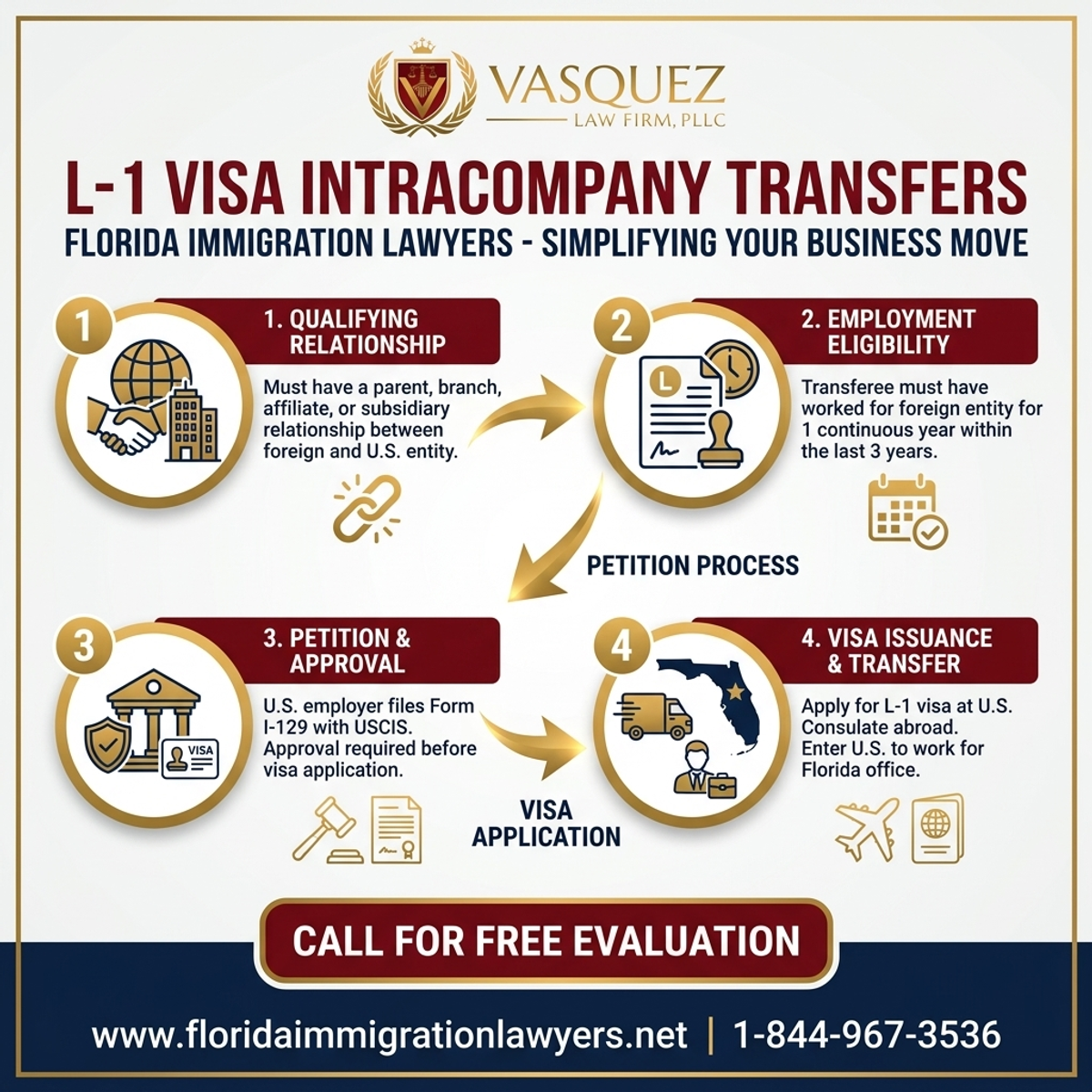
The U.S. employer must be a parent, subsidiary, affiliate, or branch of the foreign employer. This means there must be a qualifying relationship between the U.S. and foreign entities. This relationship can be established through common ownership and control, typically demonstrated by a majority ownership stake or effective control through other means. Both entities must be actively doing business, which means regularly, systematically, and continuously providing goods and/or services.
Employee Requirements
The employee must have been employed abroad by the qualifying organization for at least one continuous year within the three years immediately preceding their application for admission to the U.S. This employment must have been in a managerial, executive, or specialized knowledge capacity. The employee must also be coming to the U.S. to work in one of these capacities for the U.S. entity. The nature of the U.S. employment must be clearly defined and align with the L-1 visa category sought.
New Office Petitions
For companies establishing a new office in the U.S., specific rules apply. The petition must demonstrate that the U.S. office has secured sufficient physical premises, that the beneficiary has been employed for one continuous year abroad in an executive or managerial capacity, and that the new office will be able to support an executive or managerial position within one year of approval. These petitions are initially approved for one year, requiring a subsequent extension petition to prove the office is fully operational and the executive/managerial role is sustained.
The Application Process: Steps to Securing Your L-1 Visa
The L-1 visa application process involves several critical steps, from preparing the initial petition to attending a consular interview. Each stage demands meticulous attention to detail and thorough documentation.
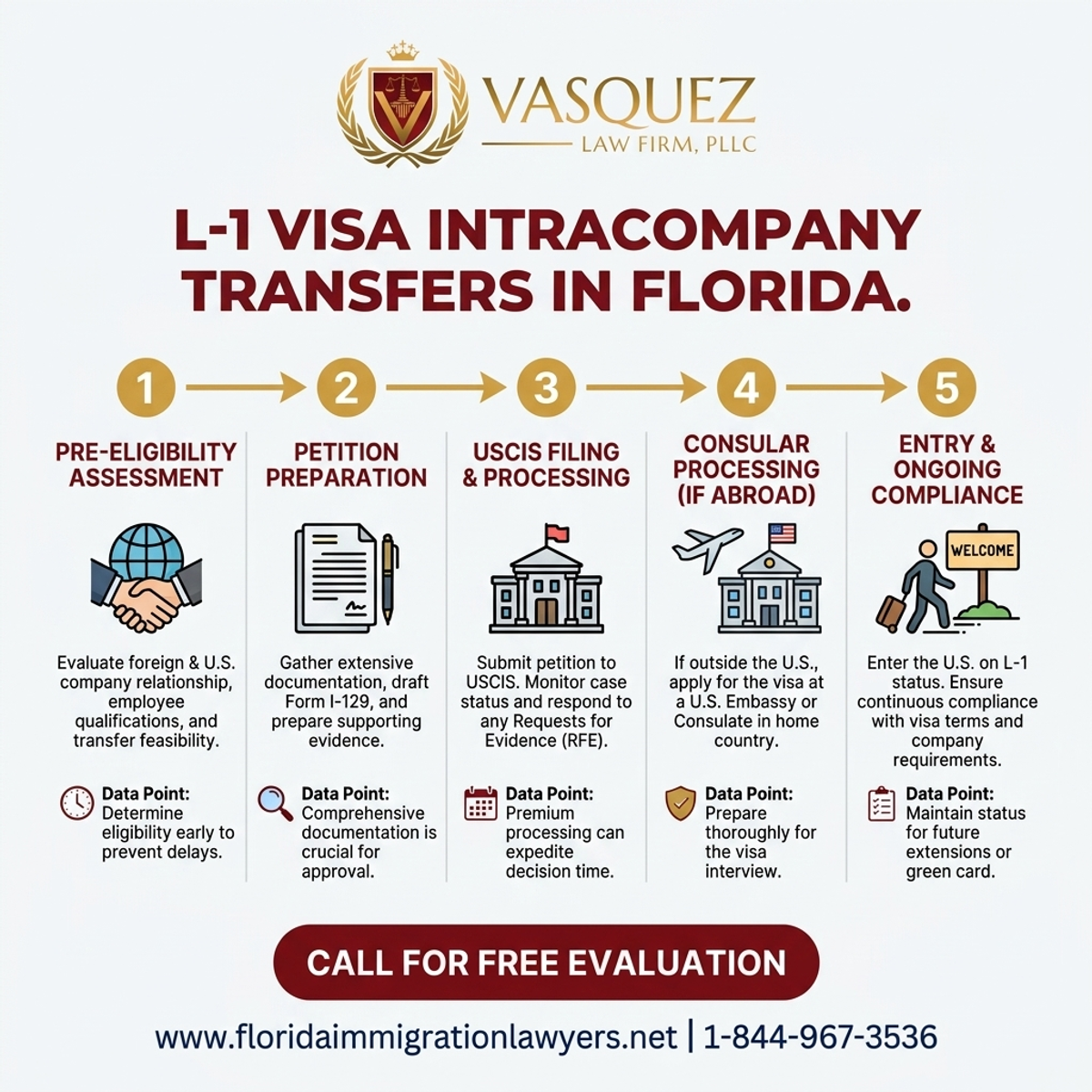
Step 1: Filing Form I-129, Petition for a Nonimmigrant Worker
The U.S. employer files Form I-129, Petition for a Nonimmigrant Worker, with USCIS on behalf of the foreign employee. This petition must include extensive supporting documentation proving the qualifying relationship between the entities, the employee's eligibility, and the nature of the U.S. employment. This includes corporate documents, financial statements, organizational charts, and detailed job descriptions for both the foreign and U.S. positions. A well-prepared petition is essential to avoid delays or requests for evidence (RFEs).
Step 2: Premium Processing Option
For employers seeking an expedited decision, USCIS offers a Premium Processing Service. For an additional fee, USCIS guarantees a response (approval, denial, or RFE) within 15 calendar days. This option can be invaluable for businesses with urgent transfer needs, allowing for quicker strategic planning and personnel deployment.
Step-by-Step Process — L-1 Visa Intracompany Transfers in Florida | VLF Florida
Step 3: Consular Processing or Adjustment of Status
Once the I-129 petition is approved, the next step depends on whether the employee is already in the U.S. or abroad. If the employee is outside the U.S., they will undergo consular processing at a U.S. embassy or consulate in their home country. This involves submitting a DS-160 form, attending an interview, and providing biometric data. If the employee is already in the U.S. on a different nonimmigrant visa and is eligible, they may apply for an adjustment of status to L-1 status without leaving the country. However, this option has specific eligibility requirements and should be discussed with an experienced attorney.
Special Considerations for L-1 Visas in Florida
Florida presents a unique and highly attractive environment for multinational companies looking to leverage the L-1 visa program. Its strategic geographical location, robust economy, and diverse population make it an ideal hub for international business operations. The state's pro-business policies and strong infrastructure further enhance its appeal, creating a fertile ground for companies utilizing intracompany transfers.
Florida boasts a thriving economy driven by key sectors such as tourism, international trade, aerospace, technology, and agriculture. Companies in these industries often rely on global talent and specialized expertise, making the L-1 visa an indispensable tool for their growth. For instance, a tech company with a strong presence in Europe or Asia might transfer key developers or project managers with specialized knowledge of their proprietary systems to its new Florida-based R&D center. Similarly, a multinational logistics firm could transfer executives to manage its operations near Florida's major ports, such as Miami or Jacksonville, which serve as critical gateways for trade with Latin America and beyond.
The state's extensive network of international airports, including Orlando International and Miami International, facilitates easy travel for executives and employees, connecting Florida businesses to global markets. Furthermore, Florida's cultural diversity and strong ties to Latin America provide a significant advantage for companies looking to expand their reach into those markets. An L-1 visa holder from a Latin American subsidiary, for example, could bring invaluable cultural insights and business relationships to a Florida-based headquarters, enhancing its regional competitiveness.
Navigating the local business landscape and ensuring compliance with all U.S. immigration laws requires expert guidance. While the L-1 visa is a federal program, understanding how it integrates with state-level business practices and opportunities is crucial. Our firm is well-versed in assisting businesses and individuals with their L-1 visa needs, ensuring that all aspects of the transfer are handled efficiently and effectively, allowing you to focus on your business growth in the Sunshine State. We can also provide support for broader immigration matters that may arise during your stay.
Dependent Visas: L-2 for Spouses and Children
The L-1 visa program extends benefits to the immediate family members of the principal L-1 visa holder. Spouses and unmarried children under the age of 21 are eligible for L-2 dependent visas. This allows families to stay together during the L-1 visa holder's assignment in the U.S., providing stability and support.
Work Authorization for L-2 Spouses
A significant advantage of the L-2 visa for spouses is the ability to apply for work authorization. Once in the U.S., L-2 spouses can file Form I-765, Application for Employment Authorization, with USCIS. Upon approval, they receive an Employment Authorization Document (EAD), which allows them to work for any employer in the U.S. without restriction. This flexibility can be a major factor for families considering an international transfer, as it allows spouses to maintain their careers and contribute to the household income.
Key Statistics — L-1 Visa Intracompany Transfers in Florida | VLF Florida
Education for L-2 Children
L-2 dependent children are permitted to attend school in the U.S., from primary education through university, without needing a separate student visa. This ensures that the educational development of children is not interrupted by the family's relocation, making the L-1 visa a family-friendly option for multinational transfers.
Navigating Challenges and Potential Pitfalls
While the L-1 visa offers significant opportunities, applicants and employers must be aware of potential challenges and pitfalls that can arise during the application process or during the period of stay. Proactive legal counsel can help mitigate these risks.
Common Reasons for Denial
L-1 visa petitions can be denied for various reasons, including insufficient evidence of a qualifying relationship between the entities, failure to demonstrate the employee's managerial, executive, or specialized knowledge capacity, or inadequate proof that the U.S. entity is actively doing business. For new office petitions, failure to prove the viability of the new office or its ability to support an executive/managerial role within one year is a common issue. In such cases, understanding the grounds for denial and exploring options like motions to reconsider or new petitions is crucial. Our experienced attorneys can help assess your situation.
Maintaining L-1 Status and Compliance
Once an L-1 visa is approved, it's vital for both the employer and employee to maintain compliance with immigration regulations. This includes ensuring the employee continues to work in the approved capacity, adhering to the visa's validity period, and filing for extensions in a timely manner. Any significant changes to the employment terms or company structure may require an amended petition. Failure to maintain status can lead to serious consequences, including potential deportation proceedings. It's also important to be aware of broader U.S. immigration policies, which can sometimes lead to unexpected challenges, such as those faced by individuals seeking asylum in different contexts, though distinct from L-1, highlights the complexity of immigration law.
Path to Green Card: EB-1C
For L-1A visa holders, the EB-1C (Employment-Based First Preference Category) immigrant visa offers a direct path to a green card. This category is specifically designed for multinational executives and managers. The requirements for EB-1C are similar to those for L-1A, making the transition relatively smooth for eligible individuals. The primary benefit of the EB-1C is that it typically does not require a PERM labor certification, which can significantly shorten the green card process. L-1B holders, while not directly eligible for EB-1C, may explore other employment-based green card categories if they meet the criteria.
Why Choose VLF Florida for Your L-1 Visa Needs?
Navigating the complexities of U.S. immigration law, particularly for business-related visas like the L-1, requires specialized knowledge and experience. At VLF Florida, our dedicated team of immigration lawyers understands the nuances of intracompany transfers and is committed to providing comprehensive legal support to both companies and individuals.
We offer personalized guidance through every stage of the L-1 visa process, from initial eligibility assessment and petition preparation to responding to RFEs and preparing for consular interviews. Our goal is to streamline the process, minimize potential delays, and maximize the chances of a successful outcome for your L-1 visa application in Florida. Our expertise extends beyond just the L-1, encompassing a wide range of immigration services to ensure all your needs are met.
Conclusion
The L-1 visa is an invaluable tool for multinational companies seeking to transfer key personnel to the United States, particularly within the dynamic business environment of Florida. Whether you are an executive, manager, or a professional with specialized knowledge, the L-1 visa facilitates crucial international talent mobility, contributing to global business growth and innovation. Understanding the distinct categories, stringent requirements, and detailed application process is paramount for a successful transfer.
Given the complexities involved, partnering with experienced immigration attorneys is not just beneficial but often essential. At VLF Florida, we are committed to guiding you through every step, ensuring compliance, and addressing any challenges that may arise. We empower businesses to capitalize on Florida's strategic advantages and individuals to pursue their professional aspirations in the U.S. Don't let the intricacies of immigration law hinder your global ambitions. Contact us today for a consultation to discuss your L-1 visa needs and embark on your journey to Florida with confidence.
Sources and References
- U.S. Citizenship and Immigration Services (USCIS)
- Executive Office for Immigration Review (EOIR)
- U.S. Department of State - Bureau of Consular Affairs
- Immigration and Nationality Act (INA), 8 U.S.C. Chapter 12
Do Not Navigate This Process Alone
Our experienced immigration attorneys are ready to fight for you. Get a free, confidential consultation today.
Se Habla Español
Frequently Asked Questions
Florida Immigration Lawyers
Immigration Attorney | Founder, Vasquez Law Firm
U.S. Air Force veteran and immigration attorney with thousands of cases resolved. J.D., NCCU School of Law. AILA member. Admitted to the 4th, 5th, and 11th Circuit Courts.
Available 24/7 - Free Evaluations
Related Legal Services
Our Florida immigration attorneys can help you with free immigration consultation, experienced immigration attorneys and business immigration. Call today at 1-844-967-3536 for a free consultation.
Related Links
Related Topics
Free Legal Consultation
Discuss your case with our experienced attorneys. We're available 24/7.
Se Habla Español - Estamos aquí para ayudarle.
Related Articles
U Visa for Crime Victims in Florida: What You Need to Know
Discover how the U visa can offer immigration relief to crime victims in Florida. Learn about eligibility, the application process, and how to avoid common mistakes. Contact Florida Immigration Lawyers for guidance.
Cancellation of Removal Guide for Florida | VLF Florida
Explore cancellation of removal in Florida with our comprehensive guide. Learn eligibility criteria, step-by-step application process, and common mistakes to avoid. Contact Florida Immigration Lawyers for expert assistance.
ICE Check-In Attorney Representation in Florida | VLF Florida
Facing an ICE check-in in Jacksonville? Learn how legal representation can make a difference. Discover key steps and common mistakes to avoid. Call Florida Immigration Lawyers for a free consultation.
Refugee Resettlement in Florida: A Guide | VLF Florida
Explore the refugee resettlement process in Florida, focusing on key steps for those seeking safety and stability. Understand how to navigate this complex journey with guidance from Florida Immigration Lawyers. Contact us for a free consultation.