K-3 Spouse Visa Timeline in Orlando Florida
Explore the timeline for obtaining a K-3 spouse visa in Orlando, Florida. Understand the steps involved, potential hurdles, and how to navigate the process efficiently. Contact Florida Immigration Lawyers for assistance.
- Filing the I-129F Petition for Alien Fiancé(e).
- Processing times vary and can be influenced by USCIS workload.
- Available to spouses of U.S. citizens residing outside the U.S.
- Helps reunite families faster than waiting for an immigrant visa alone.
Introduction
For many, the prospect of reuniting with a spouse in the United States is a critical goal. If you're in Orlando, Florida, and seeking to bring your spouse to the U.S. through a K-3 visa, understanding the timeline is essential. This article provides a detailed overview of the K-3 spouse visa process, including the necessary steps and potential hurdles. Don't navigate this process alone—call Florida Immigration Lawyers at 1-844-YO-PELEO for a free case review.
The journey to family reunification can often feel overwhelming, fraught with complex legal requirements and lengthy waiting periods. The K-3 visa, specifically designed for spouses of U.S. citizens, offers a beacon of hope by allowing them to enter the U.S. and be with their loved ones sooner, rather than enduring the entire immigrant visa process from abroad.
This comprehensive guide aims to demystify the K-3 visa timeline, offering clarity on what to expect at each stage. From initial petition filing to the final visa interview, we'll cover critical details, potential challenges, and practical advice to help you navigate this important immigration pathway successfully. Our team at Florida Immigration Lawyers understands the urgency and emotional investment involved, and we are here to provide expert guidance every step of the way.
What is the K-3 Visa?
The K-3 visa is a nonimmigrant visa designed for spouses of U.S. citizens to enter the U.S. while their immigrant visa petitions are pending. This visa facilitates quicker reunification for families separated by international borders.
The K-3 visa process begins with the U.S. citizen spouse filing the I-129F, Petition for Alien Fiancé(e), with the United States Citizenship and Immigration Services (USCIS). Once approved, it allows the foreign spouse to enter the U.S. under nonimmigrant status.
Initially created by Congress in 2000 through the Legal Immigration Family Equity (LIFE) Act, the K-3 visa was intended to mitigate the emotional and financial strain caused by prolonged separation during the processing of immigrant visa petitions (Form I-130). While the immigrant visa process can take many months or even years, the K-3 visa offers a temporary solution, allowing the foreign spouse to live and work in the U.S. during this waiting period.
It's crucial to understand that the K-3 is a nonimmigrant visa, meaning it's a temporary status. Its ultimate purpose is to serve as a bridge to permanent residency. Once the K-3 spouse is in the U.S., they typically proceed with filing Form I-485, Application to Register Permanent Residence or Adjust Status, to become a lawful permanent resident (Green Card holder). This dual process ensures that families can be together while the more extensive immigrant visa application is finalized.
How Long Does the K-3 Visa Process Take in 2026?
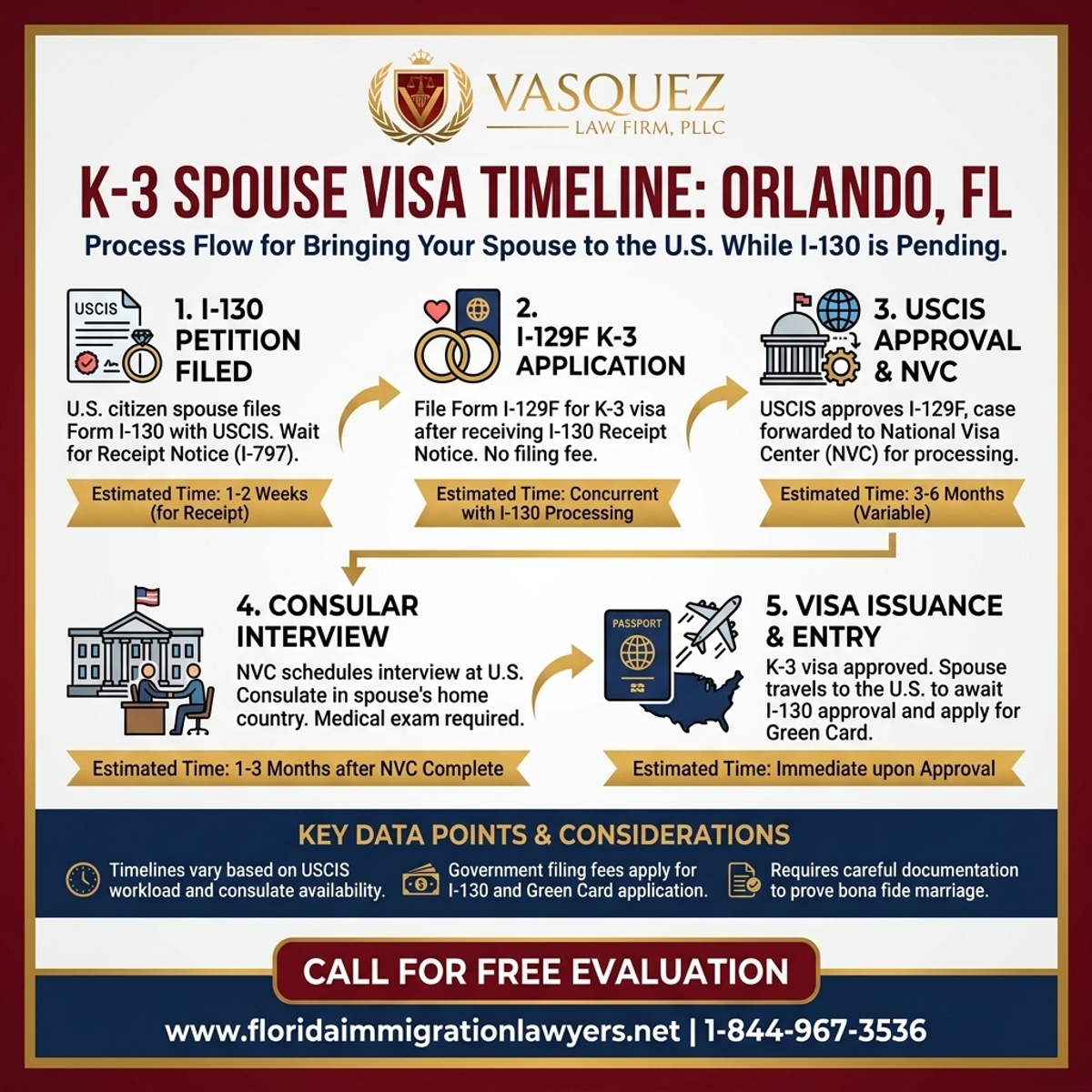
As of 2026, the timeline for K-3 visa processing varies based on several factors, including USCIS workload and specific case details. Generally, the process involves multiple stages, each with its own timeframe.
Initial Filing: The I-129F petition typically takes several months for processing.
Step-by-Step Process — K-3 Spouse Visa Timeline in Orlando Florida
Consular Processing: Following USCIS approval, the case is transferred to the National Visa Center (NVC) and then to the appropriate U.S. consulate or embassy for visa issuance.
While the K-3 visa was designed to expedite reunification, actual processing times can fluctuate significantly. Factors such as the volume of applications received by USCIS, the specific service center handling your petition, and the efficiency of the U.S. embassy or consulate abroad all play a role. For instance, an embassy in a country with high demand for U.S. visas might have longer wait times for interviews compared to one with lower volume.
It's also important to consider potential delays that can arise from Requests for Evidence (RFEs) from USCIS or issues during consular processing, such as missing documents or administrative processing after an interview. Being meticulous with your application and responsive to all official communications can help mitigate these delays. Consulting with Florida Immigration Lawyers can provide you with the most current processing estimates and help prepare you for potential challenges, ensuring your application is as strong as possible.
Steps to Apply for a K-3 Visa
- File Form I-129F: The U.S. citizen spouse submits Form I-129F to USCIS. This initial petition establishes the bona fide nature of your marriage and your intent to bring your spouse to the U.S. It's crucial to include all required supporting documentation, such as proof of your U.S. citizenship and a copy of your marriage certificate, to avoid delays.
- Wait for USCIS Approval: Processing times can vary widely. During this stage, USCIS reviews your I-129F petition. You can monitor your case status online using the receipt number provided by USCIS. Be prepared to respond promptly to any Requests for Evidence (RFEs) if USCIS requires additional information or clarification regarding your marriage or eligibility.
- Consular Processing: After approval, the case is sent to the NVC. The National Visa Center (NVC) acts as a liaison between USCIS and the U.S. embassy or consulate abroad. Here, you will pay applicable fees, submit civil documents, and complete necessary forms like the DS-160 (Online Nonimmigrant Visa Application) for your spouse. The NVC ensures your case is complete before forwarding it to the embassy.
- Visa Interview: The foreign spouse attends an interview at the designated U.S. embassy or consulate. This is a critical step where a consular officer will review your application, verify your documents, and ask questions to confirm the authenticity of your marriage and your eligibility for the K-3 visa. Thorough preparation, often with the help of an attorney like those at Florida Immigration Lawyers, is key to a successful interview.
- Receive Visa: If approved, the K-3 visa is issued, allowing entry into the U.S. Upon approval, your spouse will receive a visa stamp in their passport. They can then travel to the United States. It's important to remember that the K-3 visa is typically valid for a limited period, and the next step upon entry will be to apply for adjustment of status to become a lawful permanent resident.
Document Checklist for K-3 Visa Application
- Completed Form I-129F: This is the foundational petition filed by the U.S. citizen spouse. Ensure all sections are accurately filled out, and that it is signed and dated. Any missing information can lead to significant delays or even rejection.
- Proof of U.S. citizenship of the petitioner: Acceptable documents include a copy of the U.S. citizen's birth certificate, naturalization certificate, or U.S. passport. This establishes the petitioner's eligibility to sponsor their foreign spouse.
- Marriage certificate: A certified copy of your legal marriage certificate is essential. This document proves the legal validity of your marital relationship, which is central to the K-3 visa application.
- Passport-style photos of both spouses: Both the U.S. citizen petitioner and the foreign spouse must provide recent passport-style photographs that meet specific USCIS and Department of State requirements regarding size, background, and facial expression.
- Proof of ongoing relationship: This is critical for demonstrating a bona fide marriage. Examples include joint bank statements, utility bills addressed to both spouses, shared property deeds, photographs together over time, communication records (emails, chat logs), and affidavits from friends and family.
- Affidavit of Support (Form I-864): While not part of the initial I-129F, an Affidavit of Support will be required later during the immigrant visa or adjustment of status process. It ensures the foreign spouse will not become a public charge in the U.S.
- Police Certificates and Medical Examination Results: These are required for the foreign spouse during consular processing. Police certificates from countries where the spouse resided for certain periods are necessary, and a medical examination must be performed by an authorized panel physician.
Key Statistics — K-3 Spouse Visa Timeline in Orlando Florida
Processing Timeline and Expectations
| Stage | Typical Timeframe | Notes |
|---|---|---|
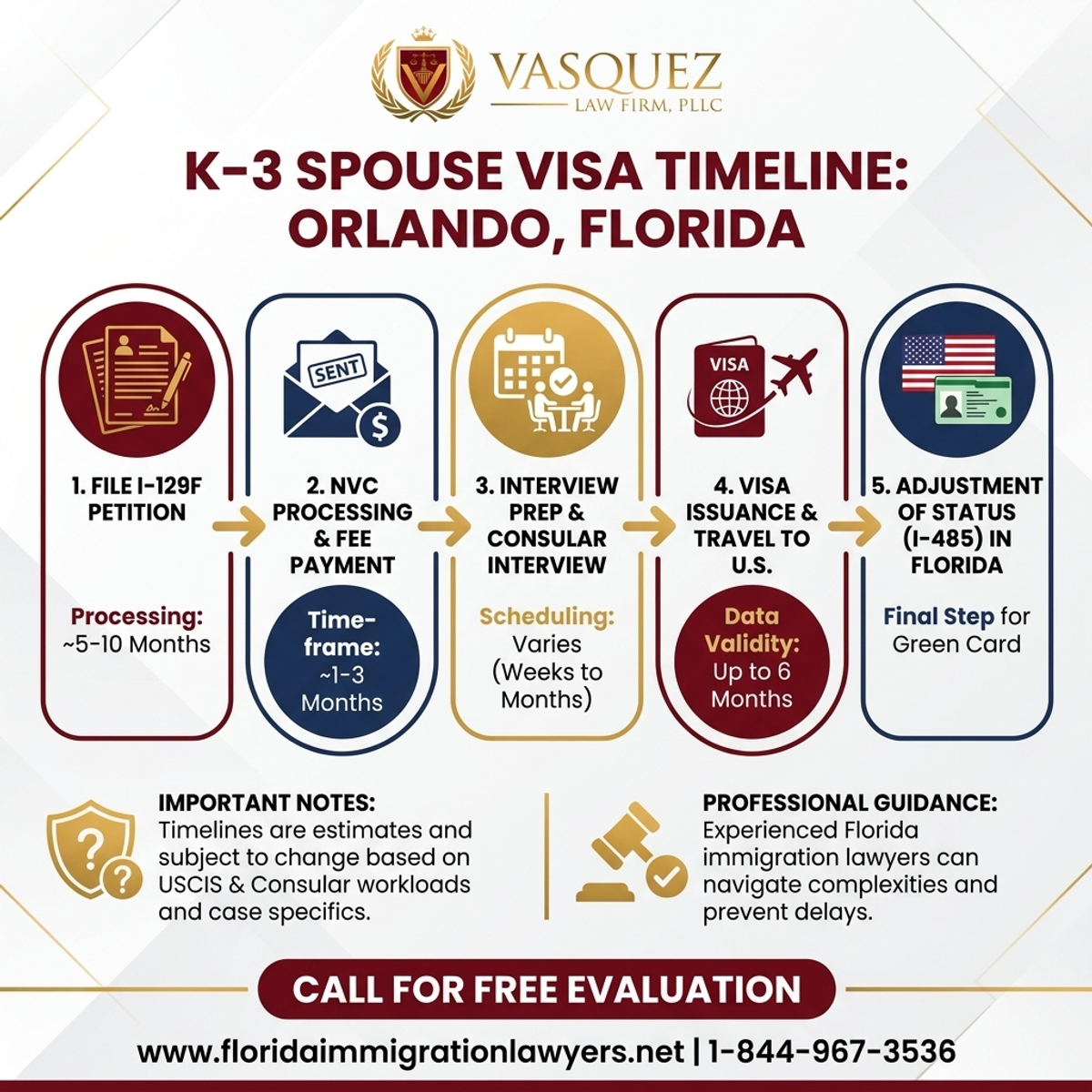
| I-129F Processing | 4-6 months | Varies by USCIS workload |
| NVC Processing | 1-3 months | Case preparation for consular interview |
| Consular Interview | 1-2 months | Depends on consulate's schedule |
Understanding the typical timeframes for each stage can help manage expectations, but it's crucial to remember these are estimates. The I-129F petition processing by USCIS is the first hurdle, and its duration can be influenced by the specific service center's backlog and the completeness of your initial submission. A well-prepared petition, often reviewed by an expert from Florida Immigration Lawyers, can significantly reduce the risk of delays.
Once your I-129F is approved, your case transitions to the National Visa Center (NVC). This phase involves document collection and fee payments, which can move quickly if you are organized and responsive. Any delays in submitting required civil documents or the Affidavit of Support can prolong this stage. Finally, the consular interview schedule depends heavily on the specific U.S. embassy or consulate's availability and local processing procedures.
Applicants should also account for potential administrative processing after the interview, which can add weeks or even months in some cases, particularly if security checks are required. While these timelines provide a general guide, preparing for contingencies and maintaining open communication with your legal team at Florida Immigration Lawyers can help you navigate the process more smoothly and efficiently.
Cost Factors and Fee Breakdown
| Item | Typical Fee | Notes |
|---|---|---|
| Form I-129F | Varies | Subject to change, confirm current fee |
| Medical Exam | Varies | Required for visa issuance |
| Visa Application Fee | Varies | Consular processing fee |
Beyond the listed fees, applicants should budget for several other potential costs associated with the K-3 visa process. These can include attorney fees for legal guidance and representation, which can be invaluable in ensuring a smooth application. Other expenses might involve document translation services if any required documents are not in English, postage and courier fees for sending applications and supporting evidence, and travel costs for the foreign spouse to attend the medical examination and visa interview at the U.S. embassy or consulate.
It's important to note that all government fees are subject to change, so always verify the most current amounts on the official USCIS and Department of State websites. While the I-129F fee is paid to USCIS, the medical exam and visa application fees are typically paid directly to the authorized panel physician and the U.S. embassy/consulate, respectively. Having a clear understanding of all potential costs upfront can help you plan financially for this significant immigration journey.
Do not navigate this process alone. Contact Florida Immigration Lawyers today. For more detailed guidance on avoiding common pitfalls, please refer to our comprehensive FAQ section below.
When to Call a Lawyer
Consider contacting an immigration lawyer if you face complexities in your K-3 visa application, such as previous visa denials or legal issues. An attorney can guide you through the intricate process and increase your chances of success.
For personalized assistance, reach out to Florida Immigration Lawyers. We offer expertise in family immigration and can help you navigate the K-3 visa process efficiently. Call us at 1-844-YO-PELEO for support.
The K-3 visa process, while designed to be straightforward, can present significant challenges, especially for those unfamiliar with U.S. immigration law. You should definitely consider legal counsel if you have a criminal record, previous immigration violations, or if your marriage has any unusual circumstances such as a large age difference, a short duration, or if either spouse has been previously married multiple times. These factors can raise red flags for immigration officials and necessitate expert legal intervention.
An immigration attorney from Florida Immigration Lawyers can provide invaluable assistance by reviewing your entire application package, ensuring all forms are correctly filled out and all necessary evidence is included. They can help prepare you for the consular interview, anticipating potential questions and coaching you on how to respond truthfully and effectively. In cases where a Request for Evidence (RFE) is issued, an attorney can help formulate a robust and timely response, significantly improving your chances of approval. Don't hesitate to call 1-844-YO-PELEO for a free consultation.
About Florida Immigration Lawyers
Florida Immigration Lawyers is dedicated to serving the immigration needs of families across Florida. Our team specializes in various immigration services including family immigration, asylum, and deportation defense. Located in Orlando, we provide bilingual support and are available 24/7. For a free case review, schedule a consultation with us today.
With a deep understanding of the intricacies of U.S. immigration law, our firm prides itself on a client-centered approach. We recognize that each family's situation is unique and requires personalized attention. Our experienced attorneys are committed to guiding you through every step of the K-3 visa process, from the initial petition filing to preparing for the consular interview and ultimately, the adjustment of status. We strive to make the journey as smooth and stress-free as possible for families in Orlando and throughout Florida.
Our commitment extends beyond just legal advice; we offer compassionate support, clear communication, and a relentless dedication to achieving positive outcomes for our clients. Whether you are at the beginning of your K-3 visa journey or facing unexpected challenges, Florida Immigration Lawyers is your trusted partner. Our bilingual team ensures that language is never a barrier to receiving top-tier legal representation. Call us today at 1-844-YO-PELEO to begin your path to reunification.
Sources and References
- U.S. Citizenship and Immigration Services (USCIS)
- Executive Office for Immigration Review (EOIR)
- 8 U.S.C. Chapter 12 - Immigration and Nationality Act
- U.S. Department of State
Related services: family petition process, family-based green cards, fiancé visa (K-1), marriage-based immigration.
This article provides general legal information and is not intended as legal advice. Every case is unique, and outcomes depend on specific facts and circumstances. Contact an attorney for advice about your particular situation.
Final CTA: For expert guidance on the K-3 visa, contact Florida Immigration Lawyers at 1-844-YO-PELEO. Se Habla Español - Estamos aquí para ayudarle.
Do Not Navigate This Process Alone
Our experienced immigration attorneys are ready to fight for you. Get a free, confidential case review today.
Se Habla Español
Or leave your details and we’ll call you:
Free Evaluation in 24 Hours
Or talk to us right now

AI voice assistant — available 24/7
FreeFrequently Asked Questions

William J. Vásquez
Founding Attorney · Vasquez Law Firm
U.S. Air Force veteran and immigration attorney with years of hands-on U.S. immigration experience. J.D., NCCU School of Law. AILA member. Admitted to the 4th, 5th, and 11th Circuit Courts.
Available 24/7 - Free Evaluations
Reviewed for legal accuracy by William J. Vásquez
Licensed in North Carolina; U.S. immigration is federal practice.
Related Legal Services
Our Florida immigration attorneys can help you with immigration practice areas, free immigration consultation and business immigration. Call today at 1-844-YO-PELEO for a free case review.
Related Links
Related Topics
Free Legal Case Review
Discuss your case with our experienced attorneys. We're available 24/7.
Se Habla Español - Estamos aquí para ayudarle.
Related Articles
DUI Immigration Consequences in Florida 2026
A DUI conviction in Florida can have severe immigration consequences, potentially leading to inadmissibility, deportation, or denial of immigration benefits. For non-citizens, a DUI is not just a traffic offense but a serious criminal matter that federal immigration law scrutinizes closely. Factors like multiple offenses, injury, or property damage can escalate a simple DUI to a Crime Involving Moral Turpitude (CIMT) or even an aggravated felony, triggering mandatory detention and removal proceedings. Understanding the specific nature of your Florida conviction and its interpretation under the Immigration and Nationality Act (INA) is crucial. This article outlines how DUIs impact immigration status, the grounds for inadmissibility and deportation, a step-by-step guide to navigating the process, essential documentation, and expected timelines for 2026. We also highlight common mistakes to avoid and when to seek legal counsel from an experienced immigration attorney. Florida Immigration Lawyers offers comprehensive support for individuals facing these challenging situations, providing expert guidance through complex legal landscapes.
Dual Citizenship Lawyer in Florida: What You Need to Know
For Florida residents, the concept of dual citizenship, or holding two passports, offers a compelling blend of opportunities and challenges. While the U.S. generally permits dual nationality, the path to achieving this status requires a meticulous understanding of both U.S. immigration laws and the citizenship policies of your country of origin. This guide explores the definition of dual citizenship, the detailed step-by-step process for U.S. naturalization, and the significant benefits and potential pitfalls involved. We cover essential documentation, typical timelines, and cost considerations for 2026, providing crucial insights for anyone in Orlando, Miami, or across Florida considering this important legal step. Learn about common mistakes to avoid and understand when to seek professional legal counsel to navigate this complex process successfully. Florida Immigration Lawyers is here to provide expert, bilingual support for your dual citizenship journey.
EAD Advance Parole Combo Card in Florida 2026
For individuals with a pending Form I-485, Application to Register Permanent Residence or Adjust Status, the EAD Advance Parole Combo Card is an essential document. This single card combines the authorization to work legally in the U.S. (Employment Authorization Document - EAD) with permission to travel internationally and re-enter without abandoning your green card application (Advance Parole). This guide from Florida Immigration Lawyers provides a comprehensive overview for applicants in Florida in 2026, covering eligibility, the step-by-step application process, required documents, expected processing times, and associated costs. We also highlight common mistakes to avoid and when to seek legal counsel to ensure a smooth and successful immigration journey. Understanding this vital card is key to maintaining stability while awaiting your permanent residency approval.
EAD Advance Parole Combo Card in Florida: What You Need
An EAD advance parole combo card allows individuals with pending adjustment applications to both work and travel abroad without jeopardizing their green card application. Learn how to apply in Florida, what documents you need, and common mistakes to avoid.