J-1 Visa Cost in 2026: Physician Waivers in Florida
For foreign physicians on a J-1 visa, understanding the costs and the path to a J-1 waiver is essential for continuing their medical careers in the U.S. This guide details the J-1 visa costs in 2026, including SEVIS and application fees, and elaborates on the J-1 waiver process, particularly for those seeking placement in Florida's underserved areas through the Conrad 30 program. We provide a step-by-step overview, document checklist, and crucial timelines. Learn about common mistakes to avoid and when to seek legal counsel to navigate this complex immigration journey successfully. Florida Immigration Lawyers offers expert assistance to physicians across Florida.
The J-1 visa cost for applicants in 2026 typically includes several fees, such as the SEVIS I-901 fee, visa application (DS-160) fee, and potential reciprocity fees. While the J-1 waiver itself does not have a direct USCIS filing fee, physicians seeking a J-1 waiver through programs like Conrad 30 in Florida will incur significant legal fees for attorney representation and possibly state application fees. These costs vary widely based on individual circumstances and the complexity of the case, making legal counsel essential for accurate cost assessment.
- J-1 visa costs include SEVIS, DS-160, and reciprocity fees.
- J-1 waiver applications do not have a direct USCIS filing fee.
- Physicians pursuing a Conrad 30 waiver in Florida will face legal fees.
- Total expenses depend on case complexity and attorney rates.
- Consulting an immigration lawyer provides a clear breakdown of costs.
Navigating the complex world of U.S. immigration can be a daunting experience, especially for medical professionals seeking to contribute their skills in the United States. If you are a foreign physician on a J-1 visa, you may be subject to a two-year home residency requirement, meaning you must return to your home country for two years after your program. However, for many, the opportunity to continue practicing medicine in the U.S., particularly in underserved communities, is a compelling path. This often involves applying for a J-1 waiver, a critical step for physicians hoping to remain in the U.S. and continue their medical careers.
This comprehensive guide will break down the various aspects of the J-1 visa, its associated costs, and the intricate process of obtaining a J-1 waiver, specifically focusing on the Conrad 30 program for physicians in Florida. We will cover everything from eligibility requirements and required documentation to processing timelines and potential pitfalls. Our goal is to provide you with a clear roadmap, helping you understand what to expect and how to successfully navigate this journey. Understanding the J-1 visa cost and waiver process is crucial for your future in medicine.
Do not attempt to navigate these complex immigration procedures alone. For personalized guidance and expert representation, call Florida Immigration Lawyers at 1-844-YO-PELEO for a free consultation. Our experienced attorneys are ready to assist you every step of the way.
What is the J-1 Visa and How Much Does it Cost in 2026?
The J-1 nonimmigrant visa is designed for individuals approved to participate in exchange visitor programs in the U.S., including foreign medical graduates coming for medical training. As of 2026, the direct governmental fees associated with the J-1 visa itself are relatively fixed, but the overall J-1 visa cost can vary significantly based on individual circumstances, such as country of origin and specific program requirements. These costs are distinct from the J-1 waiver application process, which may involve additional fees, primarily for legal services.
Typically, the main components of the J-1 visa cost include the SEVIS I-901 fee, the DS-160 nonimmigrant visa application fee, and potential visa reciprocity fees, which depend on your home country. The SEVIS fee supports the Student and Exchange Visitor Information System, which tracks exchange visitors. The DS-160 fee covers the processing of your visa application at a U.S. embassy or consulate abroad. It is important to note that these fees are subject to change by the U.S. government, so always check the latest rates on official websites like travel.state.gov before applying. Beyond these government fees, applicants should budget for travel expenses, medical examinations, and potential costs for preparing required documentation, such as translation services.
Typical J-1 Visa Related Fees (Estimated for 2026)
| Item | Typical Fee | Notes |
|---|---|---|
| SEVIS I-901 Fee | $220 - $350 | Mandatory for most J-1 applicants. |
| DS-160 Visa Application Fee | $185 - $205 | Paid to the U.S. Department of State. |
| Visa Reciprocity Fee | Varies ($0 - $300+) | Depends on nationality and U.S. agreements. |
| Medical Examination | $100 - $500+ | Required by designated physician. |
| Travel Expenses | Varies greatly | Flights, accommodation for interview. |
Understanding the J-1 Waiver for Physicians in Florida
The J-1 visa program requires many participants, particularly foreign medical graduates, to return to their home country for two years after their program concludes before they can apply for certain other visas or green cards. This is known as the two-year home residency requirement under Immigration and Nationality Act (INA) Section 212(e). However, for physicians, there are specific waiver options available that allow them to bypass this requirement if they agree to work in a medically underserved area in the U.S. for a specified period.
One of the most common and critical pathways for J-1 physicians seeking a waiver is through the Conrad 30 program. This program allows each U.S. state's Department of Health to recommend up to 30 J-1 physicians for a waiver each year. Florida, with its diverse population and significant healthcare needs, actively participates in the Conrad 30 program. Securing a J-1 waiver is a complex process that involves obtaining a recommendation from a state's Department of Health (like the Florida Department of Health), followed by a favorable recommendation from the U.S. Department of State, and finally, approval from USCIS.
For physicians in Florida, understanding the nuances of the Conrad 30 program is paramount. It requires a commitment to provide full-time clinical medical practice in a Health Professional Shortage Area (HPSA) or Medically Underserved Area (MUA) for a minimum of three years. This commitment directly addresses critical healthcare shortages in communities across Florida, from urban centers like Miami-Dade County to rural regions in the Panhandle. Successfully obtaining this waiver opens doors for physicians to pursue H-1B visas and eventually, permanent residency.
How Does the Conrad 30 Program Work for Physicians in Florida?
The Conrad 30 program is a vital lifeline for J-1 physicians who wish to continue practicing medicine in the U.S. after completing their training. In Florida, the program is managed by the Florida Department of Health, which sets specific application guidelines and priorities each year. The process is highly competitive, given the limited number of waivers available per state. Physicians must secure a full-time employment contract with a healthcare facility located in a designated HPSA or MUA within Florida. This facility must demonstrate a genuine need for the physician's services and commit to employing them for the three-year service obligation.
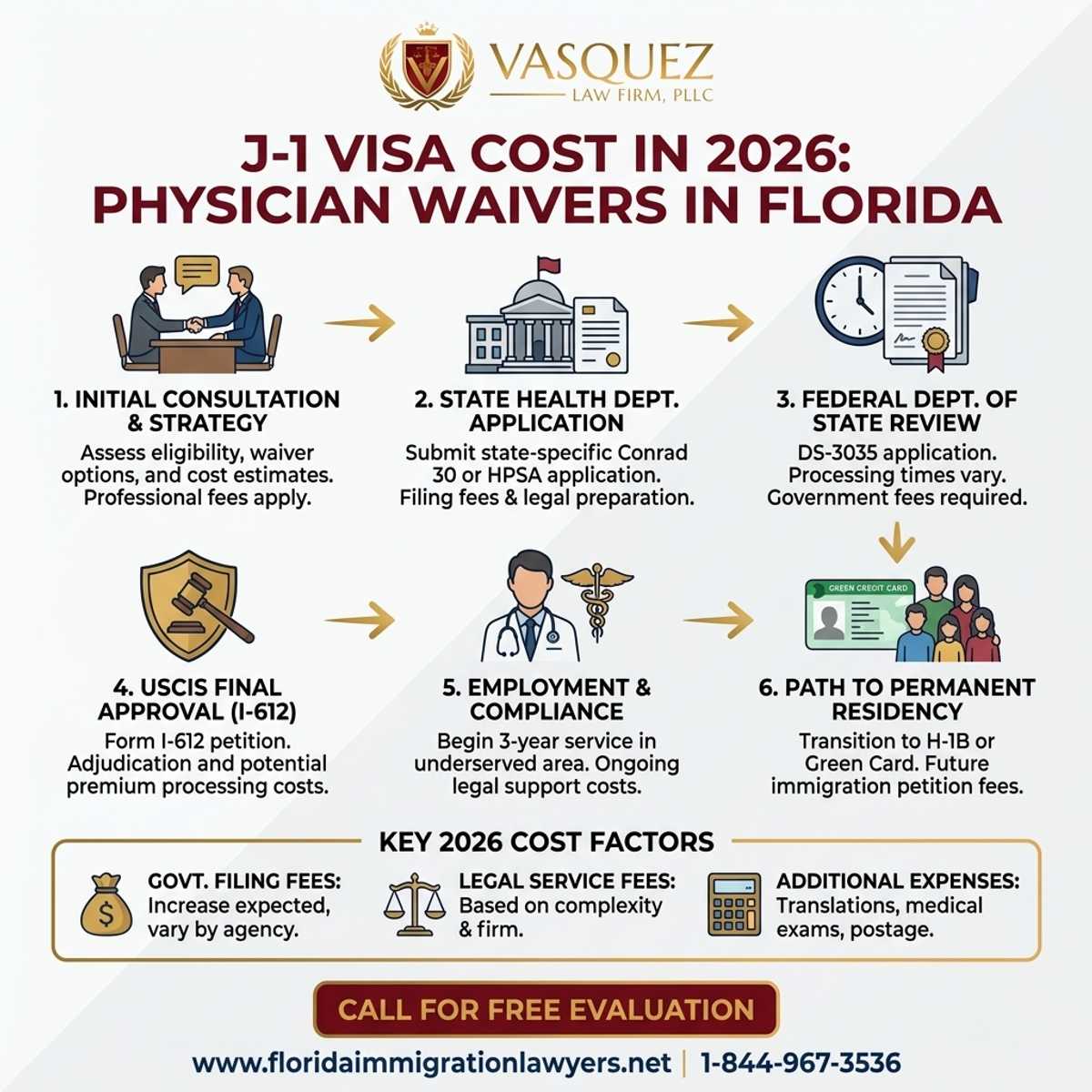
The application to the Florida Department of Health typically involves submitting a comprehensive package that includes the employment contract, evidence of the facility's location in an underserved area, letters of support, and detailed personal and professional documentation from the physician. Once the state issues a favorable recommendation, the application is forwarded to the U.S. Department of State's Waiver Review Division. The State Department then reviews the application and makes its own recommendation to USCIS. Finally, USCIS adjudicates the I-612, Application for Waiver of the Foreign Residence Requirement, making the final decision. This multi-layered process requires meticulous attention to detail and adherence to strict deadlines.
Step-by-Step Process — J-1 Visa Cost in 2026: Physician Waivers in Florida
Step-by-Step Guide to the Conrad 30 Waiver in Florida:
- Secure an Employment Offer: Obtain a bona fide, full-time employment contract from a healthcare facility in a designated HPSA or MUA in Florida for at least three years.
- Gather Required Documents: Compile all necessary personal, professional, and employer-related documents, including letters of support and proof of the facility's underserved status.
- Apply to Florida Department of Health: Submit a complete application package to the Florida Department of Health during their specified application window.
- State Recommendation: If approved, the Florida Department of Health will send a favorable recommendation to the U.S. Department of State.
- Department of State Review: The State Department's Waiver Review Division will review the application and issue its own recommendation.
- USCIS Filing (Form I-612): File Form I-612, Application for Waiver of the Foreign Residence Requirement, with USCIS, along with all supporting documentation and the State Department's recommendation.
- USCIS Adjudication: USCIS will review the entire package and make the final decision on the J-1 waiver.
What Documents Are Needed for a J-1 Physician Waiver Application?
A successful J-1 physician waiver application, especially through the Conrad 30 program in Florida, hinges on the submission of a meticulously prepared and complete set of documents. Any missing or incorrect information can lead to significant delays or even denial. The specific requirements can vary slightly between the Florida Department of Health and the U.S. Department of State, but there is a core set of documents that are universally required. It is crucial to gather these documents well in advance of any application deadlines, ensuring they are current and accurately reflect your situation.
Key documents include personal identification, proof of your J-1 visa status and program participation, and comprehensive details about your medical qualifications. For the employer, the employment contract is paramount, along with evidence that the facility is located in a designated underserved area. Letters of support from the employer and other relevant parties are also critical to demonstrate the need for your services. All foreign-language documents must be accompanied by certified English translations. Consulting with an immigration attorney can help ensure that your documentation package is robust and meets all regulatory requirements under 8 CFR Part 212.
Essential Document Checklist for J-1 Physician Waiver:
- Copy of your J-1 Visa, DS-2019 forms (all previous and current), and I-94 arrival/departure record.
- Current CV/Resume detailing your education, training, and professional experience.
- Personal statement explaining your desire for the waiver and commitment to the underserved area.
- Employment contract with a healthcare facility in a Florida HPSA or MUA, specifying a three-year full-time commitment.
- Letter of support from the employing facility, detailing the need for your services and the facility's location.
- Proof of the facility's designation as a HPSA or MUA (e.g., official designation letter or screenshot from HRSA website).
- Copies of all medical licenses (e.g., Florida medical license or eligibility for one).
- No Objection Statement from your home country's government (if applicable and chosen waiver category).
- Copies of your passport, birth certificate, and marriage certificate (if applicable).
- Official transcripts and diplomas from medical school and residency/fellowship programs.
- Any other documents requested by the Florida Department of Health or the U.S. Department of State.
What is the Timeline for a J-1 Waiver and Physician Placement in Florida?
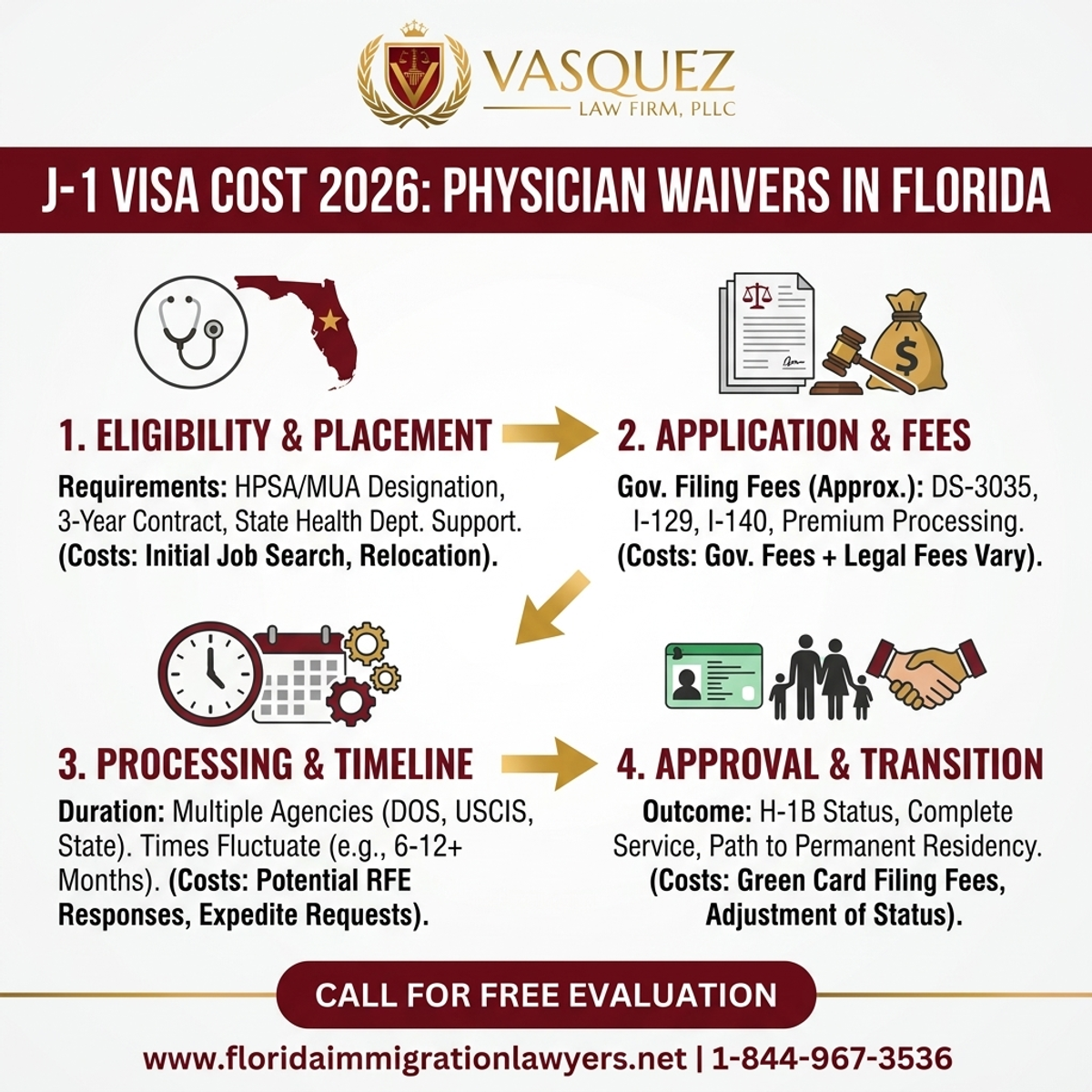
The timeline for obtaining a J-1 waiver and securing physician placement in Florida can be lengthy and unpredictable, often spanning several months to over a year. It is crucial for physicians to plan meticulously and apply well in advance of their J-1 visa expiration. The process involves multiple stages, each with its own processing times, which can be affected by factors such as the volume of applications, the responsiveness of various government agencies, and the completeness of your submitted documentation. As of 2026, applicants should anticipate a significant waiting period.
The Florida Department of Health's Conrad 30 application window typically opens once a year, and decisions are usually made within a few months. After a state recommendation, the U.S. Department of State's Waiver Review Division can take several months to process its recommendation. Finally, the USCIS adjudication of Form I-612 can also take many months. Delays are common, especially if requests for evidence (RFEs) are issued. Therefore, maintaining communication with your legal counsel and staying informed about your application status is vital. Early preparation and a well-organized application can help mitigate potential delays.
Key Statistics — J-1 Visa Cost in 2026: Physician Waivers in Florida
Typical J-1 Waiver and Placement Timeline (Estimated for 2026)
| Stage | Typical Timeframe | Notes |
|---|---|---|
| Job Search & Contract Negotiation | 2-6 months | Finding a suitable HPSA/MUA position in Florida. |
| Florida DOH Application Submission | Specific window (e.g., July-Sept) | Must adhere to state deadlines. |
| Florida DOH Review & Recommendation | 3-6 months | State agency processing time. |
| U.S. Department of State Review | 4-8 months | Waiver Review Division processing. |
| USCIS Form I-612 Adjudication | 6-12 months | Final approval from USCIS. |
| H-1B Filing & Approval (Post-Waiver) | 3-9 months | Often filed concurrently or immediately after waiver approval. |
Navigating Underserved Areas for J-1 Waiver Placements in Florida
For J-1 physicians seeking a waiver, the requirement to serve in a medically underserved area is central to the Conrad 30 program. Florida, a large and diverse state, has numerous designated Health Professional Shortage Areas (HPSAs) and Medically Underserved Areas (MUAs) that desperately need qualified medical professionals. These areas can range from rural counties with limited access to healthcare to specific urban neighborhoods within major cities like Miami, Orlando, or Tampa, where certain populations face significant barriers to medical care.
Identifying and securing a position in a designated underserved area in Florida is a critical first step. The U.S. Department of Health and Human Services, through the Health Resources and Services Administration (HRSA), maintains a list of these areas. Physicians should actively research available positions in these locations and ensure that any potential employer's facility is indeed within a current HPSA or MUA. This is not only a legal requirement but also an opportunity to make a profound impact on communities that truly need your expertise. Working in these areas often provides a unique and rewarding professional experience, allowing physicians to serve populations that might otherwise go without adequate medical attention.
The Florida Department of Health's website often provides guidance and resources for identifying eligible practice sites within the state. It is essential to confirm the designation of the specific practice site, as designations can change. An experienced immigration attorney can also assist in verifying the eligibility of a potential placement site, ensuring compliance with all state and federal requirements for your J-1 waiver application. This meticulous verification prevents future complications and strengthens your application.
The Role of a Florida Immigration Lawyer in Your J-1 Waiver Case
The J-1 waiver process, especially for physicians through the Conrad 30 program in Florida, is highly intricate and filled with legal complexities. Attempting to navigate it without professional legal assistance can lead to critical errors, delays, or even denial of your application. An experienced Florida immigration lawyer provides invaluable guidance from the initial assessment of your eligibility to the final approval of your waiver. They understand the specific requirements of the Florida Department of Health, the U.S. Department of State, and USCIS, ensuring that your application is robust and compliant.
A skilled attorney will help you identify suitable employment opportunities in designated underserved areas, meticulously prepare all required documentation, and draft compelling letters of support. They can also represent you in communications with government agencies, respond to Requests for Evidence (RFEs), and address any unforeseen challenges that may arise during the lengthy process. Their expertise minimizes the risk of common mistakes and significantly improves your chances of a successful outcome. This professional support is particularly crucial when dealing with the competitive nature of the Conrad 30 program and the strict deadlines involved.
Beyond the J-1 waiver itself, your immigration lawyer can assist you with subsequent steps, such as transitioning to an H-1B visa and eventually pursuing permanent residency. They can provide strategic advice tailored to your unique circumstances, helping you plan your long-term career path in the U.S. Having a dedicated legal advocate on your side allows you to focus on your medical practice while your immigration matters are handled with precision and care. They are your trusted partner in achieving your professional goals in Florida.
Common Mistakes to Avoid in Your J-1 Waiver Application
The J-1 waiver application process is fraught with potential pitfalls that can jeopardize a physician's chances of approval. Avoiding these common mistakes is crucial for a smooth and successful outcome.
- Failing to Secure a Bona Fide Job Offer: Many physicians make the mistake of applying for a waiver without a firm, legitimate employment contract in a designated HPSA or MUA. The job offer must be concrete and meet all regulatory requirements for the Conrad 30 program. Without a valid offer, the application will be rejected.
- Incomplete or Inaccurate Documentation: Submitting an application with missing documents, outdated information, or errors is a common reason for delays and denials. Every form and supporting document must be meticulously completed and verified. This includes ensuring all foreign documents have certified English translations.
- Missing Application Deadlines: The Florida Department of Health, like other state agencies, has strict application windows for the Conrad 30 program. Missing these deadlines means waiting another year, significantly impacting your career timeline.
- Not Verifying HPSA/MUA Designation: Relying on outdated or incorrect information about a facility's location in an underserved area can be a critical error. Always verify the current HPSA or MUA designation of your intended practice site through official HRSA resources.
- Lack of Strong Letters of Support: Generic or weak letters of support from the employing facility or community leaders can undermine the demonstration of need for your services. Letters should be specific, detailed, and compelling.
- Failure to Address the Two-Year Home Residency Requirement: Some physicians incorrectly assume they are not subject to the two-year requirement. It is vital to accurately determine your status and understand why you are subject to it before applying for a waiver.
- Neglecting to Plan for Subsequent Visa Status: A J-1 waiver allows you to change status, typically to an H-1B visa. Failing to plan for this next step and its associated requirements can create future immigration challenges.
- Not Seeking Legal Counsel: The most significant mistake is attempting to navigate this complex process without an experienced immigration attorney. Legal professionals can identify potential issues, ensure compliance, and maximize your chances of success.
When to Call a Florida Immigration Lawyer for Your J-1 Waiver
While some immigration processes can be managed independently, the J-1 waiver for physicians, particularly through the Conrad 30 program in Florida, is not one of them. The stakes are incredibly high, as your ability to continue your medical career in the U.S. depends on a successful outcome. You should strongly consider contacting a Florida immigration lawyer at the very beginning of your journey, ideally even before you start looking for a job or gathering documents.
Specific scenarios that signal an immediate need for legal assistance include: if you are unsure whether you are subject to the two-year home residency requirement; if you have received a job offer but are unsure if the facility qualifies as an HPSA or MUA; if your J-1 visa is nearing expiration; or if you have previously had an immigration application denied. Additionally, if you have any criminal history, even minor infractions, or complex family situations that might impact your application, an attorney's guidance is indispensable. Florida Immigration Lawyers can assess your unique situation, explain your options, and develop a strategic plan to navigate the entire process, including the application to the Florida Department of Health and subsequent filings with the U.S. Department of State and USCIS. Our team is well-versed in the specifics of Florida's Conrad 30 program and can provide the expert representation you need to achieve your professional goals.
About Florida Immigration Lawyers
Florida Immigration Lawyers is a leading law firm dedicated to providing exceptional immigration services across the entire state of Florida. With a deep understanding of U.S. immigration law and a commitment to our clients, we offer comprehensive legal solutions for individuals, families, and businesses. Our team of experienced attorneys specializes in a wide range of immigration matters, including J-1 waivers, family-based petitions, business immigration, asylum claims, and deportation defense. We pride ourselves on our empathetic approach, ensuring that every client receives personalized attention and strategic advocacy.
We understand the profound impact immigration decisions have on people's lives and futures. That is why we are available 24/7 to answer your questions and provide support. We offer free consultations, allowing you to discuss your case without financial obligation and understand your legal options. Our bilingual staff ensures that language is never a barrier to receiving quality legal representation. Whether you are a physician seeking a J-1 waiver in Miami, a family reuniting in Orlando, or an individual facing deportation in Tampa, Florida Immigration Lawyers is here to fight for your rights and help you achieve your American dream. Call us today at 1-844-YO-PELEO or visit floridaimmigrationlawyers.net to learn more about how we can assist you.
Frequently Asked Questions About J-1 Waivers
What is the two-year home residency requirement?
The two-year home residency requirement (INA 212(e)) mandates that certain J-1 exchange visitors return to their home country for two years after their program ends before they can apply for an H-1B visa, L-1 visa, or permanent residency. This requirement applies if your program was government-funded, involved specialized knowledge, or if your home country has a skill shortage in your field. Understanding if you are subject to this is the first step in considering a waiver.
Can I work anywhere in Florida with a J-1 waiver?
No, a J-1 physician waiver through the Conrad 30 program specifically requires you to work in a designated Health Professional Shortage Area (HPSA) or Medically Underserved Area (MUA) in Florida for a minimum of three years. These areas are identified by the federal government and are typically rural or urban locations with critical healthcare provider shortages. You must commit to serving in one of these specific areas.
How long does the J-1 waiver process take in Florida?
The entire J-1 waiver process, from initial application to final USCIS approval, can take anywhere from 12 to 24 months, or even longer. This includes state-level processing by the Florida Department of Health, review by the U.S. Department of State, and final adjudication by USCIS. Timelines are estimates and can vary based on caseloads and individual case complexities. Early application and meticulous preparation are key.
What happens after my J-1 waiver is approved?
Once your J-1 waiver is approved by USCIS, you are no longer subject to the two-year home residency requirement. This allows you to pursue other immigration options, most commonly applying for an H-1B nonimmigrant visa to continue your employment as a physician in the U.S. After fulfilling your three-year service obligation, you may then be eligible to apply for permanent residency. Your immigration lawyer can guide you through these subsequent steps.
Are there other types of J-1 waivers besides Conrad 30?
Yes, besides the Conrad 30 program, other J-1 waiver categories include the No Objection Statement (if your home country agrees to waive the requirement), Interested Government Agency (IGA) waivers (where a U.S. federal agency requests the waiver), and exceptional hardship or persecution waivers. Each category has distinct eligibility criteria and application processes. For physicians, Conrad 30 and IGA waivers are most common.
Can my family also get a J-1 waiver?
Yes, if you, as the primary J-1 visa holder, receive a waiver of the two-year home residency requirement, your J-2 dependents (spouse and unmarried children under 21) are generally also relieved of the requirement. Their status is tied to yours. It's important to ensure their immigration status is properly managed alongside your own waiver application to avoid future complications. Consult an attorney for specific advice on family members.
What is an HPSA or MUA?
HPSA stands for Health Professional Shortage Area, and MUA stands for Medically Underserved Area. These are designations by the federal government (HRSA) for geographic areas, populations, or facilities with a lack of primary care, dental, or mental health providers. Physicians seeking J-1 waivers through the Conrad 30 program must commit to working in one of these designated underserved areas to address critical healthcare needs.
Can I change employers after receiving a J-1 waiver?
Generally, no. A J-1 waiver through the Conrad 30 program is tied to your commitment to work for a specific employer in a specific HPSA/MUA for three years. Changing employers or locations before fulfilling this service obligation can jeopardize your waiver and future immigration status. Any proposed changes would require new applications and approvals, which are rarely granted. Always consult your attorney before considering any changes to your employment.
Sources and References
- U.S. Citizenship and Immigration Services (USCIS)
- U.S. Department of State (J-1 Visa Information)
- U.S. Department of State (J-1 Waiver Review Division)
- Immigration and Nationality Act (INA) Section 212(e) - 8 U.S.C. § 1182(e)
- 8 Code of Federal Regulations (CFR) Part 212 - Documentary Requirements: Nonimmigrants; Waivers; Admission of Certain Inadmissible Aliens; Parole
- 22 Code of Federal Regulations (CFR) Part 41 - Visas: Documentation of Nonimmigrants Under the Immigration and Nationality Act, as Amended
- USCIS Policy Manual, Volume 9, Part A, Chapter 5 - Waivers of the J-1 Two-Year Foreign Residence Requirement
- Florida Department of Health (Conrad 30 Program Information)
- U.S. Department of Health and Human Services (HRSA) - Health Professional Shortage Areas (HPSAs) and Medically Underserved Areas (MUAs)
Related services: immigration practice areas.
This article provides general legal information and is not intended as legal advice. Every case is unique, and outcomes depend on specific facts and circumstances. Contact an attorney for advice about your particular situation.
Your journey as a physician in the United States is a significant one, and navigating the J-1 waiver process is a crucial step. Do not leave your future to chance. Florida Immigration Lawyers are here to provide the expert legal guidance and support you need to successfully achieve your professional goals. We are available 24/7 for a free consultation.
Call us today at 1-844-YO-PELEO. Se Habla Espanol - Estamos aqui para ayudarle.
If you need legal assistance, learn more about experienced immigration attorneys in Orlando, or call us at 1-844-YO-PELEO for a free consultation.
Do Not Navigate This Process Alone
Our experienced immigration attorneys are ready to fight for you. Get a free, confidential case review today.
Se Habla Español
Or leave your details and we’ll call you:
Free Evaluation in 24 Hours
Or talk to us right now
AI voice assistant — available 24/7
FreeFrequently Asked Questions

William J. Vásquez
Founding Attorney · Vasquez Law Firm
U.S. Air Force veteran and immigration attorney with years of hands-on U.S. immigration experience. J.D., NCCU School of Law. AILA member. Admitted to the 4th, 5th, and 11th Circuit Courts.
Available 24/7 - Free Evaluations
Reviewed for legal accuracy by William J. Vásquez
Licensed in North Carolina; U.S. immigration is federal practice.
Related Legal Services
Our Florida immigration attorneys can help you with immigration practice areas, free immigration consultation and business immigration. Call today at 1-844-YO-PELEO for a free case review.
Related Links
Related Topics
Free Legal Case Review
Discuss your case with our experienced attorneys. We're available 24/7.
Se Habla Español - Estamos aquí para ayudarle.
Related Articles
Immigration Lawyer Orlando Free Consultation in Florida
For individuals and families in Orlando, Florida, navigating the complexities of U.S. immigration law requires expert guidance. An immigration lawyer in Orlando offers crucial support for everything from visa applications and green card processes to naturalization and deportation defense. This comprehensive guide details what a free consultation covers, providing a step-by-step overview of immigration pathways, essential document checklists, and expected timelines in 2026. We also highlight common mistakes to avoid, discuss the critical role of legal counsel in deportation and asylum cases, and explain why choosing a local Orlando immigration attorney is beneficial. Florida Immigration Lawyers is dedicated to serving the diverse community of Orlando with compassionate, effective legal solutions, ensuring you receive personalized advice and robust representation for a successful immigration journey.
EAD Advance Parole Combo Card in Florida 2026
For individuals with a pending Form I-485, Application to Register Permanent Residence or Adjust Status, the EAD Advance Parole Combo Card is an essential document. This single card combines the authorization to work legally in the U.S. (Employment Authorization Document - EAD) with permission to travel internationally and re-enter without abandoning your green card application (Advance Parole). This guide from Florida Immigration Lawyers provides a comprehensive overview for applicants in Florida in 2026, covering eligibility, the step-by-step application process, required documents, expected processing times, and associated costs. We also highlight common mistakes to avoid and when to seek legal counsel to ensure a smooth and successful immigration journey. Understanding this vital card is key to maintaining stability while awaiting your permanent residency approval.
I-601 Waiver Lawyer Florida: Your Guide
Facing inadmissibility issues in Florida? Learn how an I-601 waiver can help you overcome these challenges with the guidance of an experienced lawyer. This guide provides a detailed overview of the process, eligibility requirements, and common pitfalls to avoid. Call Florida Immigration Lawyers at 1-844-YO-PELEO for expert assistance today.
O-1 Visa Extraordinary Ability in Florida: What You Need
Explore the O-1 visa for extraordinary ability in Florida. Learn about eligibility, application process, and common mistakes to avoid. Contact Florida Immigration Lawyers for expert assistance.