Investor Visa Immigration Services Florida in 2026
Florida is a prime destination for foreign investors seeking U.S. immigration opportunities. This guide from Florida Immigration Lawyers explores the two primary investor visa categories: the EB-5 Immigrant Investor Program and the E-2 Treaty Investor Visa. The EB-5 offers a path to a Green Card through substantial investment and job creation in Florida's diverse economy, with options for reduced investment in Targeted Employment Areas. The E-2 visa provides a renewable non-immigrant status for entrepreneurs from treaty countries looking to operate a business in the state. We detail the rigorous eligibility requirements, the multi-stage application processes, the extensive documentation needed, and the typical timelines and costs involved for both visa types. Crucially, we highlight common mistakes to avoid, such as issues with source of funds or inadequate business plans, and emphasize when professional legal counsel is indispensable. Florida Immigration Lawyers provides guidance for investor visa immigration services in Florida, ensuring compliance and maximizing your chances of success. Contact us for a free case review.

Investor visa immigration services in Florida assist foreign nationals in obtaining U.S. residency or long-term visas through significant investments. The primary options include the EB-5 Immigrant Investor Program, leading to a Green Card for those investing $800,000 to $1,050,000 and creating ten full-time jobs, and the E-2 Treaty Investor Visa, a non-immigrant option for nationals of treaty countries making a substantial investment. These services guide applicants through complex eligibility, documentation, and compliance requirements to ensure a smooth application process in Florida's dynamic economic landscape.
- EB-5 and E-2 are the main investor visa categories.
- EB-5 leads to a Green Card with significant investment and job creation.
- E-2 is a non-immigrant visa for treaty country nationals making substantial investments.
- Florida offers diverse investment opportunities for entrepreneurs.
- Legal counsel is crucial for navigating complex requirements and avoiding common pitfalls.
Florida, a vibrant hub of commerce and culture, attracts entrepreneurs and investors from around the globe seeking new opportunities. For those looking to establish a business or invest significantly in the U.S. economy, investor visa immigration services Florida provides a clear pathway to achieving their American dream. Navigating the intricacies of U.S. immigration law, particularly for investment-based visas, can be a daunting task. Understanding the specific requirements for visas like the EB-5 Immigrant Investor Program or the E-2 Treaty Investor Visa is paramount for a successful application.
This comprehensive guide from Florida Immigration Lawyers will demystify the process, outlining the various investor visa options, their eligibility criteria, application steps, and the critical role legal experience plays. We'll delve into Florida-specific considerations, ensuring you have the knowledge to make informed decisions about your investment and immigration journey. Whether you're considering a direct investment in a new Florida enterprise or joining a regional center project, our goal is to illuminate the path forward. Do not let the complexity of immigration law deter your aspirations. Call Florida Immigration Lawyers at 1-844-YO-PELEO for a free case review and begin your journey with confidence.
What Are the Primary Investor Visas Available in Florida?
The primary investor visas available to foreign nationals seeking to invest and immigrate to Florida are the EB-5 Immigrant Investor Visa and the E-2 Treaty Investor Visa. The EB-5 visa offers a path to permanent residency (Green Card) through a substantial investment and job creation, while the E-2 visa provides a renewable non-immigrant status for individuals from specific treaty countries who make a significant investment in a U.S. business.
Florida's robust economy, diverse industries, and strategic location make it an attractive destination for foreign investors. The state boasts strong sectors in tourism, real estate, technology, healthcare, and international trade, offering a wide array of opportunities for investment. The choice between an EB-5 and an E-2 visa largely depends on your long-term immigration goals, nationality, and the scale of your investment. Both visas are designed to stimulate the U.S. economy and create jobs, but they differ significantly in their requirements and benefits. For instance, the EB-5 program, governed by USCIS, is specifically for those seeking permanent residency, whereas the E-2 visa, administered by the U.S. Department of State, is for temporary, albeit renewable, stays. Understanding these distinctions is crucial for selecting the appropriate visa pathway for your specific situation in Florida, a state that actively welcomes foreign capital and entrepreneurial spirit.
The EB-5 Immigrant Investor Program: Your Path to a Green Card
The EB-5 program, codified under 8 U.S.C. § 1153(b)(5), allows foreign investors to obtain a Green Card by investing in a commercial enterprise within the United States. As of 2026, the standard minimum investment amount is $1,050,000. However, this amount is reduced to $800,000 if the investment is made in a Targeted Employment Area (TEA), which includes rural areas or areas with high unemployment. Florida has several designated TEAs, particularly in economically developing regions outside of major metropolitan centers like Orlando, presenting attractive options for reduced investment. The investment must lead to the creation or preservation of at least ten full-time jobs for qualifying U.S. workers within two years of the investor's admission as a conditional permanent resident. Investors typically choose between making a direct investment in their own commercial enterprise or investing through a USCIS-approved Regional Center. Regional Centers manage projects designed to meet EB-5 requirements, offering a more passive investment approach. Florida's vibrant economy, especially in Central Florida around Orlando, provides ample opportunities for both direct and regional center investments, ranging from new hotel developments to agricultural ventures and tech startups.
The E-2 Treaty Investor Visa: For Non-Immigrant Business Owners
The E-2 visa is a non-immigrant visa available to nationals of countries that maintain treaties of commerce and navigation with the United States. This visa allows individuals to enter the U.S. solely to develop and direct the operations of an enterprise in which they have invested a substantial amount of capital. Unlike the EB-5, the E-2 visa does not directly lead to a Green Card, but it can be renewed indefinitely as long as the underlying investment and business operations meet the requirements outlined in 22 CFR Part 41.51. The investment must be substantial in relation to the total cost of the enterprise and sufficient to ensure the successful operation of the business. It cannot be marginal, meaning it must generate significantly more than enough income to provide a minimal living for the investor and their family. Florida's diverse business environment, from boutique shops on the coast to burgeoning tech companies in Orlando, offers numerous avenues for E-2 investments. This visa is particularly popular among investors from countries like Canada, Mexico, the UK, France, and Japan, who wish to operate their businesses in the lucrative Florida market without committing to permanent residency.
How Can I Qualify for an EB-5 Immigrant Investor Visa in Florida?
To qualify for an EB-5 Immigrant Investor Visa in Florida, you must invest the required capital in a new commercial enterprise or a troubled business, and this investment must create or preserve at least ten full-time jobs for U.S. workers. Additionally, you must prove the lawful source of your invested funds and demonstrate that you will be engaged in the management of the enterprise, either through active management or policy-making.
The EB-5 program is highly structured and requires meticulous attention to detail. As of 2026, the capital requirement is $1,050,000, or $800,000 if the investment is within a Targeted Employment Area (TEA). Florida has numerous TEAs, which are often rural areas or areas with high unemployment rates, making the reduced investment option accessible across the state. Your investment must be "at risk," meaning it must be subject to potential loss and cannot be guaranteed. This is a critical component of the program, ensuring genuine economic engagement. Furthermore, you must provide clear and verifiable evidence of the lawful source of your funds, which can come from various sources such as personal assets, gifts, loans, or business profits. This often involves providing extensive financial documentation, including tax returns, bank statements, and business records from your home country. The job creation requirement is also stringent: you must show that your investment will create at least ten full-time positions for qualified U.S. workers (U.S. citizens, Green Card holders, or other authorized immigrants, excluding the investor and their immediate family). For direct investments, these jobs must be directly created by the commercial enterprise. For Regional Center investments, both direct and indirect/induced jobs can be counted, which is a key advantage for many investors. An experienced business immigration lawyer can help you identify suitable investment opportunities in Florida that meet these rigorous criteria.
- Step-by-Step Guide to the EB-5 Application Process
The EB-5 application process is multi-stage and typically spans several years:
- File Form I-526E, Immigrant Petition by Regional Center Investor: This is the initial petition filed with USCIS. It requires detailed documentation proving the investment has been made or is in the process of being made, the lawful source of funds, and that the enterprise will create the required jobs. For direct investors, Form I-526 is used.
- USCIS Review and Approval: USCIS will review your petition. Processing times can vary significantly, but as of 2026, they generally range from 24 to 48 months, depending on the volume of applications and the specific USCIS office.
- Adjustment of Status (Form I-485) or Consular Processing: Once your I-526E is approved, if you are already in the U.S. on a non-immigrant visa, you may file Form I-485 to adjust your status to a conditional permanent resident. If you are outside the U.S., your case will be sent to the National Visa Center (NVC) for consular processing at a U.S. embassy or consulate in your home country. This stage involves interviews and medical examinations.
- Conditional Permanent Residency: Upon approval, you will receive a two-year conditional Green Card. During this period, you must maintain your investment and ensure the job creation requirements are met.
- File Form I-829, Petition by Investor to Remove Conditions: Within the 90-day period before your conditional Green Card expires, you must file Form I-829 to prove that you have met all the EB-5 requirements, including sustaining the investment and creating the ten full-time jobs.
- Permanent Green Card: Upon approval of your I-829, the conditions on your Green Card are removed, and you become a lawful permanent resident of the United States.
What is the Process for Obtaining an E-2 Treaty Investor Visa in Florida?
The process for obtaining an E-2 Treaty Investor Visa in Florida involves demonstrating your nationality from a treaty country, proving a substantial and at-risk investment in a bona fide enterprise, and showing that the business is not marginal and that you intend to depart the U.S. once your E-2 status concludes. This can be done either through a petition with USCIS or directly at a U.S. consulate abroad.
To qualify for an E-2 visa, you must first be a national of a country with which the U.S. maintains a treaty of commerce and navigation. A current list of such countries can be found on the Department of State's website. Your investment must be substantial, meaning it must be sufficient to ensure the successful operation of the enterprise. While there's no fixed dollar amount, it typically needs to be a significant portion of the total value of the business. The funds must be irrevocably committed and at risk, and the enterprise must be an active commercial undertaking, not a passive investment. The business cannot be marginal, meaning it must have the present or future capacity to generate significantly more income than just a living for the investor and their family. You must also prove your intent to depart the U.S. upon the termination of your E-2 status, even though the visa is renewable. This is a crucial distinction from immigrant visas like the EB-5. Many E-2 investors choose to establish businesses in Florida's thriving service, hospitality, and technology sectors, particularly in areas like Orlando, Tampa, and Miami, where there's a strong market for new ventures. This visa is an excellent option for those looking to actively manage their investment in the U.S. for an extended period.
- Step-by-Step Guide to the E-2 Application Process
The E-2 application can be pursued through two main avenues:
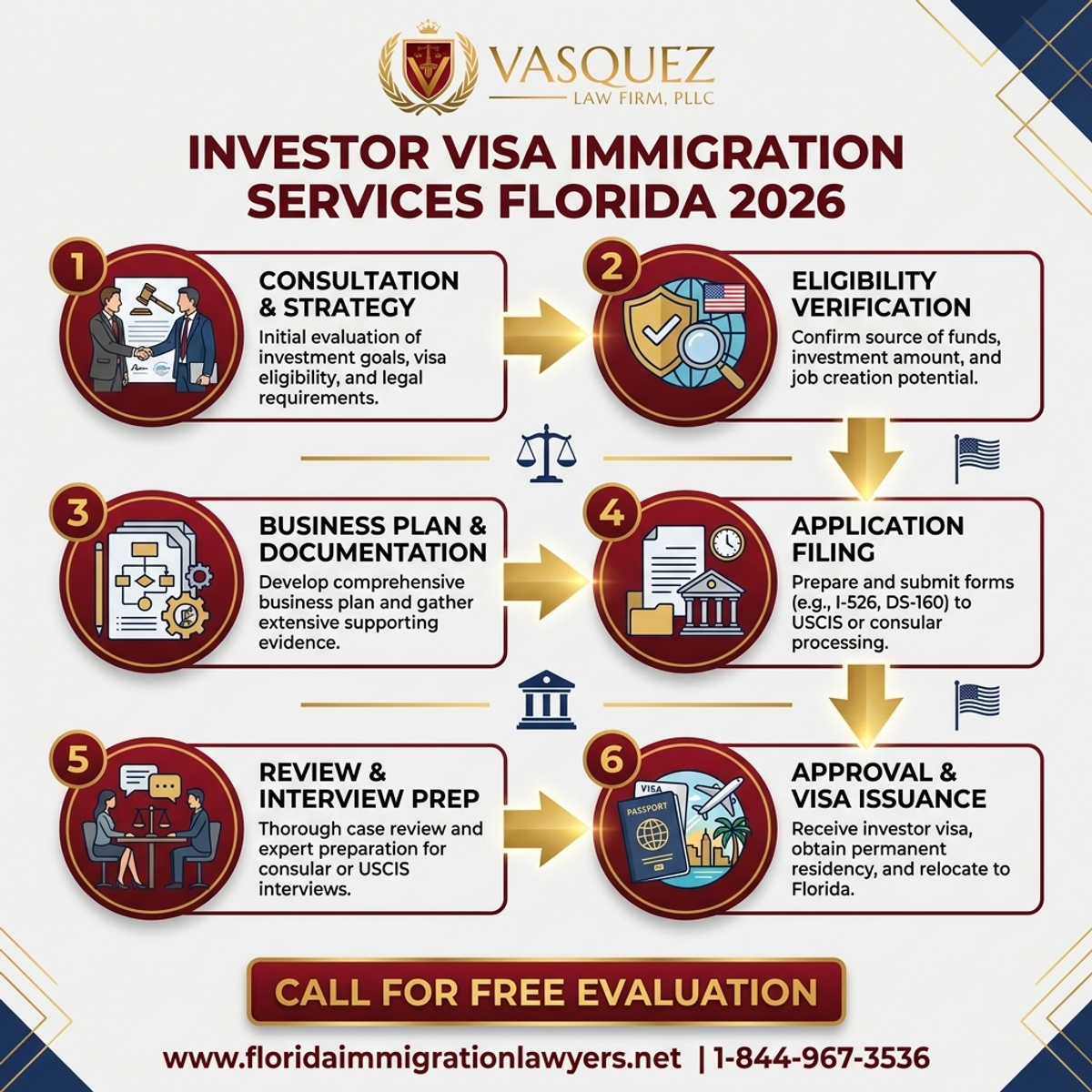
Step-by-Step Process — Investor Visa Immigration Services Florida in 2026
- Consular Processing (Outside the U.S.):
- Prepare Documentation: Gather all necessary documents, including proof of nationality, evidence of substantial investment, a comprehensive business plan, and financial projections.
- Complete Form DS-160: Fill out the Online Nonimmigrant Visa Application.
- Schedule Interview: Schedule an E-2 visa interview at a U.S. embassy or consulate in your home country.
- Attend Interview: Present your case and documents to a consular officer. If approved, the visa stamp will be placed in your passport.
- Change of Status (Within the U.S.):
- File Form I-129, Petition for a Nonimmigrant Worker: If you are already in the U.S. on a different non-immigrant status (e.g., B-1/B-2, F-1), you can file Form I-129 with USCIS to change your status to E-2.
- USCIS Review and Approval: USCIS will review your petition. If approved, you will be granted E-2 status for a specific period, typically up to two years.
- Travel Considerations: If you leave the U.S. after changing status via I-129, you will need to apply for an E-2 visa stamp at a U.S. consulate abroad to re-enter.
What Documents Are Required for Investor Visa Applications?
Investor visa applications, whether for EB-5 or E-2, require extensive documentation to prove eligibility, the lawful source of funds, and the viability of the investment and business. Key documents include personal identification, detailed financial statements, comprehensive business plans, and evidence of the investment itself, all meticulously organized and often supported by expert reports.
The specific documents needed will vary slightly between the EB-5 and E-2 visas, but there is significant overlap. Preparing a thorough and accurate document package is one of the most critical steps in the entire application process. Any missing or inconsistent information can lead to Requests for Evidence (RFEs) or even denial, significantly prolonging the process. For this reason, working with experienced immigration services in Florida is highly recommended. They can help you compile, review, and translate all necessary documents, ensuring compliance with USCIS and Department of State regulations. This documentation serves to establish the legitimacy of the investor, the source of their capital, and the viability and impact of their U.S. business venture. In Florida, where many international investors operate, ensuring that all foreign documents are properly authenticated and translated is a common but crucial step.
- Comprehensive Document Checklist for Investor Visas
- Personal Identification Documents: Valid passport, birth certificates, marriage certificates (if applicable), police clearance certificates, and detailed resumes or CVs for the investor and any derivative family members.
- Proof of Nationality (E-2 only): Evidence of citizenship in a treaty country.
- Financial Documents (Source of Funds): Personal and business tax returns (typically for the last 5-7 years), bank statements, investment account statements, property deeds, gift deeds, loan agreements, evidence of sale of assets, and business registration documents from your home country. This is crucial for EB-5, demonstrating the legal origin of all invested capital.
- Investment Evidence: Escrow agreements, wire transfer confirmations, purchase agreements for assets, stock certificates, loan documents, and evidence of capital contribution to the U.S. enterprise.
- Business Plan: A detailed, comprehensive business plan outlining the enterprise's structure, products/services, market analysis, management team, financial projections (P&L, cash flow), and, critically for EB-5, a robust job creation model. For E-2, it must demonstrate the business's non-marginal nature.
- Business Registration and Licenses: Articles of incorporation, operating agreements, federal and state tax IDs (EIN), and any necessary business licenses required to operate in Florida.
- Job Creation Evidence (EB-5 only): Economic impact reports from qualified economists, detailed job descriptions, payroll records, and W-2 forms for existing employees.
- Proof of Funds Transfer: Bank statements showing the transfer of funds from your foreign account to the U.S. enterprise account.
- Immigration Forms: Properly completed USCIS forms (I-526E/I-526, I-485, I-829 for EB-5; I-129 for E-2 status change; DS-160 for E-2 consular processing).
- Legal and Due Diligence Reports: Any reports from attorneys or financial advisors related to the investment, if applicable.
What Are the Typical Timelines and Costs for Florida Investor Visas?
The typical timelines for investor visas in Florida can range from several months for an E-2 visa to several years for the EB-5 program, largely depending on USCIS processing backlogs and the specific visa category. Costs involve USCIS filing fees, legal fees, business setup expenses, and the substantial investment capital itself.
As of 2026, both the processing times and associated costs for investor visas are significant and require careful financial planning. USCIS continually updates its processing times, which can be checked on their official website. Factors such as the volume of applications, the efficiency of the reviewing office (e.g., the USCIS Service Centers handling I-526E petitions), and the completeness of your application can all impact the timeline. For EB-5, delays can arise from backlogs, especially for applicants from countries with high demand. The E-2 process, particularly through consular processing, tends to be faster, often completed within a few months, though this can vary by consulate. Beyond government fees, legal fees for experienced immigration counsel are a substantial, yet invaluable, part of the investment. These fees cover guidance, document preparation, business plan review, and representation throughout the complex process. Additionally, investors must factor in business setup costs, due diligence expenses, and potential regional center administrative fees. These costs underscore the importance of securing a reliable immigration lawyer Orlando to guide you through the financial and procedural maze.
| Stage | Typical Timeframe | Notes |
|---|---|---|
| EB-5: I-526E/I-526 Petition Review | 24-48 months | Varies by country of chargeability and USCIS workload. |
| EB-5: NVC Processing / Consular Interview | 6-12 months (after I-526E approval) | Subject to visa availability and embassy scheduling. |
| EB-5: I-485 Adjustment of Status | 12-24 months (after I-526E approval) | If filed concurrently or after I-526E approval in the U.S. |
| EB-5: Conditional Green Card Period | 2 years | Period to maintain investment and create jobs. |
| EB-5: I-829 Petition to Remove Conditions | 24-48 months | Filed within 90 days before conditional Green Card expires. |
| E-2: Consular Processing | 2-6 months | Varies significantly by consulate and appointment availability. |
| E-2: I-129 Change of Status | 6-12 months | If applying from within the U.S. (premium processing available for additional fee). |
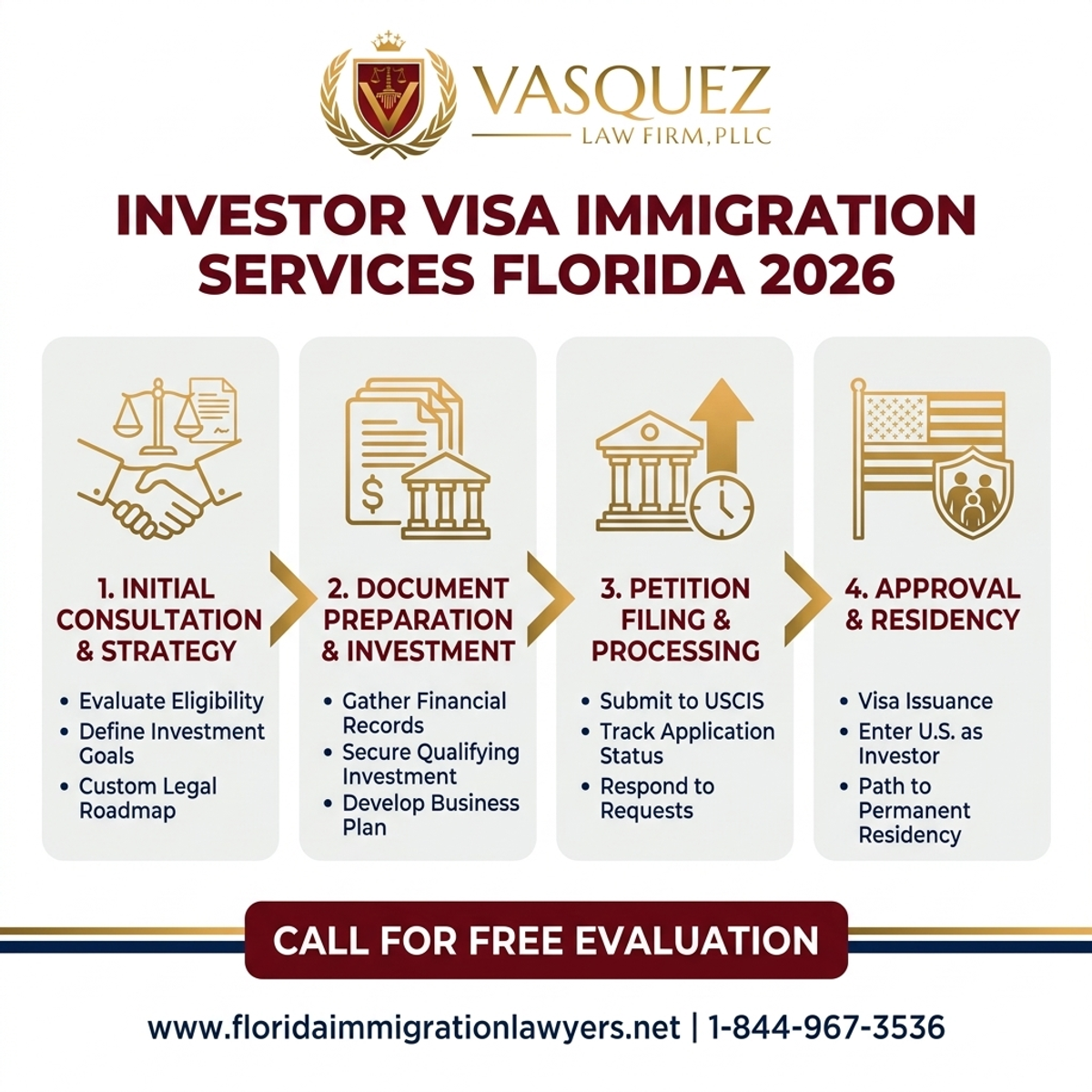
Key Statistics — Investor Visa Immigration Services Florida in 2026
| Item | Typical Fee | Notes |
|---|---|---|
| EB-5 Investment Capital (TEA) | $800,000 | Required minimum for Targeted Employment Areas. |
| EB-5 Investment Capital (Non-TEA) | $1,050,000 | Required minimum for non-Targeted Employment Areas. |
| E-2 Investment Capital | Varies (typically $100,000 - $500,000+) | Must be "substantial" in relation to the business. |
| USCIS I-526E/I-526 Filing Fee | $3,675 | For EB-5 immigrant investor petition. |
| USCIS I-485 Filing Fee | $1,440 | For adjustment of status (includes biometric services). |
| USCIS I-829 Filing Fee | $3,950 | For petition to remove conditions on Green Card. |
| USCIS I-129 Filing Fee | $460 | For E-2 change of status (Standard). Premium Processing extra. |
| Consular Processing Fees | ~$345 per applicant | National Visa Center processing and visa application fee. |
| Immigration Attorney Fees | Varies ($25,000 - $75,000+) | Covers comprehensive legal services for complex cases. |
| Business Plan/Economic Impact Report | Varies ($5,000 - $25,000) | Often required by qualified experts. |
| Regional Center Administrative Fee (EB-5) | $50,000 - $80,000 | If investing through a Regional Center. |
| Due Diligence & Source of Funds Report | Varies ($5,000 - $20,000+) | For verifying the legality of investment funds. |
Do not navigate this process alone. Contact Florida Immigration Lawyers today.
Common Mistakes to Avoid in Investor Visa Applications
Navigating the complex landscape of investor visas requires precision and a deep understanding of U.S. immigration law. Even minor errors can lead to significant delays, requests for evidence (RFEs), or outright denials. Avoiding these common pitfalls is essential for a successful application, especially when dealing with substantial investments and the creation of jobs in Florida. Here are some of the most frequent mistakes applicants make:
- Insufficient or Unverifiable Source of Funds: Failing to clearly demonstrate that all invested capital was obtained through lawful means is a primary reason for EB-5 denials. USCIS requires a clear, traceable path for all funds, often stretching back several years. Lack of documentation or inconsistent financial records can be fatal to an application.
- Inadequate Business Plan: A weak or generic business plan that doesn't clearly outline job creation, market analysis, financial projections, or the management structure can jeopardize both EB-5 and E-2 applications. The plan must be comprehensive, credible, and demonstrate the business's viability and compliance with visa requirements.
- Marginal Investment (E-2): For E-2 visas, failing to prove that the investment will generate significantly more than a minimal living for the investor and family is a common pitfall. The business must contribute meaningfully to the U.S. economy.
- Investment Not "At Risk": Both EB-5 and E-2 require the investment to be genuinely at risk, with no guaranteed return or redemption. Any arrangements that protect the investor from loss typically lead to denial.
- Failure to Create or Sustain Required Jobs (EB-5): Not meeting the ten full-time job creation requirement for U.S. workers within the specified timeframe, or failing to properly document these jobs, is a critical error for EB-5 investors, particularly when filing Form I-829.
- Incorrect Visa Category Selection: Choosing between EB-5 and E-2 (or other business visas) requires a thorough assessment of long-term goals, nationality, and investment capacity. Misidentifying the most suitable visa can lead to wasted time and resources.
- Ignoring Florida-Specific Regulations: While federal law governs immigration, businesses in Florida must comply with state and local regulations, licensing, and taxation. Failing to account for these can impact the legitimacy and operation of the enterprise.
- Incomplete or Inconsistent Documentation: Submitting an application with missing forms, outdated information, or discrepancies across various documents almost guarantees an RFE or denial. Precision is key.
- Late Filing of I-829 (EB-5): Missing the 90-day window before the conditional Green Card expires to file Form I-829 can result in the termination of conditional permanent residency.
- Misunderstanding Treaty Country Requirements (E-2): Applying for an E-2 visa without being a national of a qualifying treaty country will result in an immediate denial.
When to Call a Lawyer for Investor Visa Immigration Services Florida
The complexities of U.S. immigration law, particularly for investment visas, make legal counsel not just beneficial but often essential. You should consider calling an experienced immigration lawyer in Florida at the earliest stages of your investor visa journey, ideally before making any significant financial commitments. Specific scenarios that strongly warrant legal intervention include:
- Complex Source of Funds: If your investment capital comes from multiple sources, international transfers, or involves gifts, loans, or complex business transactions, a lawyer can help document and present this information clearly to USCIS.
- Business Plan Development: Crafting a robust business plan that meets all USCIS requirements for job creation and business viability is a specialized skill. An attorney can work with business consultants to ensure your plan is compliant and persuasive.
- Responding to Requests for Evidence (RFEs): If USCIS issues an RFE, it indicates a deficiency in your application. A lawyer can strategically address these concerns, providing the necessary documentation and legal arguments to overcome the RFE.
- Prior Immigration Issues: If you have any past immigration violations, visa denials, or other legal issues, these can complicate your investor visa application. An attorney can assess the impact and advise on the best course of action.
- Navigating Changing Regulations: Immigration laws and policies, including those for investor visas, are subject to change. An attorney stays abreast of these updates and ensures your application remains compliant with the most current rules.
- Choosing the Right Visa: Deciding between an EB-5, E-2, or other business visa options requires expert analysis of your personal circumstances and business goals. A lawyer can help you select the most appropriate pathway.
- Establishing a Business in Florida: Beyond immigration, setting up a business in Florida involves state-specific legal and regulatory compliance. While not immigration law, your immigration attorney can refer you to specialists for this.
Florida Immigration Lawyers offers comprehensive business immigration services, guiding investors through every step of the EB-5 and E-2 processes. Our team understands the nuances of Florida's economic landscape and immigration requirements. Do not hesitate to seek professional guidance when your future in the U.S. depends on a successful investment visa application.
About Florida Immigration Lawyers
Florida Immigration Lawyers is an immigration law firm dedicated to serving individuals and businesses across the entire state of Florida. With a deep understanding of complex U.S. immigration laws, our experienced attorneys provide compassionate and strategic legal representation to clients seeking to navigate various immigration pathways, including investor visas, family-based petitions, employment visas, and deportation defense. Our commitment is to offer personalized service, ensuring each client receives tailored advice and robust advocacy.
Based in Central Florida, our firm is strategically positioned to assist clients in Orlando and surrounding areas, as well as throughout the state. We pride ourselves on our client-focused approach, offering free case reviews and being available 24/7 to address urgent needs. Whether you are an entrepreneur seeking to invest in Florida's thriving economy, a family member pursuing reunification, or someone facing immigration challenges, our team is here to help. We offer bilingual services, ensuring that language is never a barrier to accessing quality legal assistance. Schedule a free consultation with Florida Immigration Lawyers today at 1-844-YO-PELEO to discuss your immigration goals.
Sources and References
- U.S. Citizenship and Immigration Services (USCIS)
- Executive Office for Immigration Review (EOIR)
- U.S. Department of State
- 8 U.S.C. § 1153(b)(5) - Immigration and Nationality Act (INA) - Employment-Based Immigrants: Fifth Preference (EB-5)
- 8 CFR Part 204.6 - Petitions for Employment-Based Immigrants: Fifth Preference (EB-5)
- 22 CFR Part 41.51 - E Visas: Treaty Traders and Treaty Investors
- USCIS Policy Manual, Volume 6, Part G - Investors
Related services: deportation defense services, asylum and refugee protection, immigration waivers, humanitarian protection programs.
This article provides general legal information and is not intended as legal advice. Every case is unique, and outcomes depend on specific facts and circumstances. Contact an attorney for advice about your particular situation.
Your investment in Florida's future is a significant step, and your immigration journey deserves guidance. Florida Immigration Lawyers is here to provide the dedicated and knowledgeable representation you need to achieve your investor visa goals. Do not leave your future to chance. Call us today at 1-844-YO-PELEO for a free case review. Se Habla Espanol - Estamos aqui para ayudarle.
Do Not Navigate This Process Alone
Our experienced immigration attorneys are ready to fight for you. Get a free, confidential case review today.
Se Habla Español
Or leave your details and we’ll call you:
Free Evaluation in 24 Hours
Or talk to us right now

AI voice assistant — available 24/7
FreeFrequently Asked Questions

William J. Vásquez
Founding Attorney · Vasquez Law Firm
U.S. Air Force veteran and immigration attorney with years of hands-on U.S. immigration experience. J.D., NCCU School of Law. AILA member. Admitted to the 4th, 5th, and 11th Circuit Courts.
Available 24/7 - Free Evaluations
Reviewed for legal accuracy by William J. Vásquez
Licensed in North Carolina; U.S. immigration is federal practice.
Related Legal Services
Our Florida immigration attorneys can help you with asylum protection, citizenship and naturalization and immigration practice areas. Call today at 1-844-YO-PELEO for a free case review.
Related Links
Related Topics
Free Legal Case Review
Discuss your case with our experienced attorneys. We're available 24/7.
Se Habla Español - Estamos aquí para ayudarle.
Related Articles
DUI Immigration Consequences in Florida 2026
A DUI conviction in Florida can have severe immigration consequences, potentially leading to inadmissibility, deportation, or denial of immigration benefits. For non-citizens, a DUI is not just a traffic offense but a serious criminal matter that federal immigration law scrutinizes closely. Factors like multiple offenses, injury, or property damage can escalate a simple DUI to a Crime Involving Moral Turpitude (CIMT) or even an aggravated felony, triggering mandatory detention and removal proceedings. Understanding the specific nature of your Florida conviction and its interpretation under the Immigration and Nationality Act (INA) is crucial. This article outlines how DUIs impact immigration status, the grounds for inadmissibility and deportation, a step-by-step guide to navigating the process, essential documentation, and expected timelines for 2026. We also highlight common mistakes to avoid and when to seek legal counsel from an experienced immigration attorney. Florida Immigration Lawyers offers comprehensive support for individuals facing these challenging situations, providing expert guidance through complex legal landscapes.
Immigration Lawyer Orlando Free Consultation in Florida
For individuals and families in Orlando, Florida, navigating the complexities of U.S. immigration law requires expert guidance. An immigration lawyer in Orlando offers crucial support for everything from visa applications and green card processes to naturalization and deportation defense. This comprehensive guide details what a free consultation covers, providing a step-by-step overview of immigration pathways, essential document checklists, and expected timelines in 2026. We also highlight common mistakes to avoid, discuss the critical role of legal counsel in deportation and asylum cases, and explain why choosing a local Orlando immigration attorney is beneficial. Florida Immigration Lawyers is dedicated to serving the diverse community of Orlando with compassionate, effective legal solutions, ensuring you receive personalized advice and robust representation for a successful immigration journey.
EAD Advance Parole Combo Card in Florida: What You Need
An EAD advance parole combo card allows individuals with pending adjustment applications to both work and travel abroad without jeopardizing their green card application. Learn how to apply in Florida, what documents you need, and common mistakes to avoid.
Dual Citizenship Lawyer in Florida: What You Need to Know
For Florida residents, the concept of dual citizenship, or holding two passports, offers a compelling blend of opportunities and challenges. While the U.S. generally permits dual nationality, the path to achieving this status requires a meticulous understanding of both U.S. immigration laws and the citizenship policies of your country of origin. This guide explores the definition of dual citizenship, the detailed step-by-step process for U.S. naturalization, and the significant benefits and potential pitfalls involved. We cover essential documentation, typical timelines, and cost considerations for 2026, providing crucial insights for anyone in Orlando, Miami, or across Florida considering this important legal step. Learn about common mistakes to avoid and understand when to seek professional legal counsel to navigate this complex process successfully. Florida Immigration Lawyers is here to provide expert, bilingual support for your dual citizenship journey.