Immigration Documents Checklist Florida 2026 Guide
Navigating the intricate world of immigration in Florida requires a precise understanding of essential documents and USCIS forms. This 2026 guide provides a comprehensive checklist for your immigration paperwork, helping you avoid common pitfalls and ensure your application is complete and accurate. From identity and financial records to medical exams and specific USCIS forms like I-130 or N-400, we cover what you need to know. Learn about processing timelines, cost factors, and Florida-specific considerations, including local USCIS offices in Tampa, Orlando, and Miami. Don't risk delays or denials due to missing paperwork. Contact Florida Immigration Lawyers for expert guidance and a free consultation to confidently pursue your immigration goals in the Sunshine State.

Preparing **immigration documents** in **Florida** for **USCIS forms** and applications requires meticulous attention to detail. This essential **checklist** ensures you gather all necessary **paperwork**, from identity proofs to financial records, to support your visa, green card, or citizenship petition. Proper organization and accuracy are crucial to avoid delays and potential denials. Understanding the specific requirements for your case and presenting a complete application package is key to a successful outcome. Always consult official **USCIS** guidelines and consider legal advice.
- Accurate and complete documentation is vital for all **Florida** immigration applications.
- Common **USCIS forms** require extensive supporting **paperwork**, including identity, financial, and civil records.
- Organize documents thoroughly and ensure all foreign-language papers are certified translated.
- Processing times can vary; prepare early and monitor your application status.
- Seeking legal guidance from experienced **Florida Immigration Lawyers** can prevent costly mistakes.
Embarking on an immigration journey in the United States, especially in a bustling state like **Florida**, can feel overwhelming. The sheer volume of **immigration documents** and complex **USCIS forms** required often leaves applicants feeling confused and anxious. Whether you are applying for a family-based green card, a work visa, or naturalization, understanding and meticulously preparing your **paperwork** is the cornerstone of a successful application.
This comprehensive guide provides an essential **immigration documents checklist** specifically tailored for individuals navigating the process in **Florida** in 2026. We will walk you through the critical documentation, common pitfalls to avoid, and how to ensure your application is as strong as possible. Our goal is to demystify the process and empower you with the knowledge needed to proceed confidently. Don't navigate this intricate path alone; for personalized assistance, call Florida Immigration Lawyers at 1-844-967-3536 for a free consultation.
Understanding Essential Immigration Documents in Florida
The foundation of any successful immigration application lies in providing accurate and complete documentation. In **Florida**, like the rest of the country, immigration processes demand a wide array of **immigration documents** to verify identity, eligibility, and the bona fides of your petition. These documents are not just formalities; they are the evidence that tells your story to **USCIS** officers and immigration judges. Failing to provide the correct **paperwork** can lead to Request for Evidence (RFE), delays, or even denial of your application, impacting your future in the United States.
Common categories of documents include identity and civil records such as birth certificates, marriage certificates, and passports. Financial documents, like tax returns and employment letters, demonstrate your ability to support yourself or that a sponsor can support you. Medical examinations are often required to ensure public health safety. For complex cases involving past legal issues or waivers, additional records may be necessary. The specific requirements vary significantly depending on the type of visa, green card, or other immigration benefit you are seeking. For instance, a family-based petition will require extensive proof of relationship, while an employment-based petition will focus on qualifications and job offers. The Immigration and Nationality Act (INA), specifically 8 U.S.C. Chapter 12, outlines many of these requirements. Understanding the specific legal basis for your application is crucial for gathering the correct evidence.
Florida is home to a diverse immigrant population and several key **USCIS** field offices, including those in Tampa, Orlando, and Miami, which process various applications and conduct interviews. Each office operates under federal guidelines, but local nuances or caseloads can sometimes affect processing. Therefore, being thoroughly prepared with your **immigration documents** is paramount, regardless of which **Florida** office handles your case. Engaging with an attorney who understands both federal immigration law and local **Florida** procedures can provide a significant advantage, helping you navigate the system more effectively and ensuring your **USCIS forms** are perfectly aligned with current regulations.
Your Step-by-Step Immigration Documents Checklist for Florida Applications
Navigating the complex world of immigration can be daunting, but a systematic approach to gathering your **immigration documents** can make the process smoother. This step-by-step **checklist** is designed to help **Florida** residents prepare their **paperwork** efficiently for various **USCIS forms** and applications. Remember, organization is key, and every document plays a vital role in supporting your case.
-
Initial Assessment and Legal Counsel
Before gathering any documents, understand the specific immigration benefit you are seeking. Are you applying for a green card through a family member, a work visa, or naturalization? Each path has unique requirements. A free consultation with **Florida Immigration Lawyers** can help you determine the correct application path and identify the precise **USCIS forms** and **immigration documents** you will need. This initial assessment will save you time and prevent unnecessary complications down the line. We can help you understand the legal framework under 8 CFR Part 103, which governs the adjudication of applications.
-
Gathering Personal and Identity Documents
These are the most fundamental **immigration documents**. Ensure you have original birth certificates for yourself and any family members included in the application. Collect valid passports from your home country, and any U.S. visas or entry stamps. Other crucial items include government-issued photo IDs, such as a driver's license or state ID from **Florida**. You will also need recent passport-style photographs that meet **USCIS** specifications. Make sure all names match across all documents; inconsistencies can cause delays.
-
Financial and Sponsorship Evidence
If you are applying for a green card through a sponsor, or if you need to demonstrate self-sufficiency, financial **paperwork** is critical. This includes federal income tax returns for the past three years (Form W-2, Form 1099, tax transcripts), employment verification letters, pay stubs, and bank statements. For sponsors, proof of domicile in the U.S. and sufficient income to meet poverty guidelines (Form I-864 Affidavit of Support) is essential. These documents prove you or your sponsor will not become a public charge.
-
Civil and Relationship Documentation
For family-based petitions, provide original marriage certificates, divorce decrees (if applicable), and birth certificates of all children. If you are applying based on marriage, gather extensive evidence of a bona fide marital relationship, such as joint bank accounts, joint leases or mortgages, utility bills in both names, insurance policies, and photographs together. Affidavits from friends and family can also strengthen your case, attesting to the legitimacy of your relationship.
-
Medical and Background Checks
Most green card and some visa applicants must undergo a medical examination by a **USCIS**-approved civil surgeon. The results are submitted on Form I-693. Additionally, you will be required to submit to fingerprinting and background checks (biometrics) as part of the application process. For certain applications, police clearance certificates from countries where you have lived for more than six months may also be required. Be honest about all aspects of your background, as misrepresentation can lead to severe consequences.
-
Organizing and Submitting Your Application
Once all **immigration documents** are collected, make copies of everything for your records. Organize your application package according to **USCIS** filing instructions for each specific form (e.g., Form I-130, Form I-485, Form N-400). Use cover letters, tabs, and fasteners as recommended. Ensure all foreign language documents are accompanied by certified English translations. Mail your application to the correct **USCIS** lockbox facility or service center. Accuracy and completeness at this stage are crucial for a smooth process.
Key USCIS Forms and Supporting Paperwork for Florida Residents
Successfully navigating the immigration process in **Florida** hinges on correctly completing and supporting various **USCIS forms**. Each form serves a specific purpose, and understanding the required **paperwork** for each is vital. This **checklist** highlights common forms and their typical supporting documents, offering a detailed guide for **Florida** residents.
- Form I-130, Petition for Alien Relative: Filed by a U.S. citizen or green card holder to establish a relationship with an eligible foreign relative.
- Supporting Documents: Petitioner's birth certificate or passport, beneficiary's birth certificate, marriage certificate (if applicable), divorce decrees (if applicable), evidence of bona fide marriage (for spouses), photos, joint documents.
- Form I-485, Application to Register Permanent Residence or Adjust Status: Used by individuals already in the U.S. to apply for a green card.
- Supporting Documents: Birth certificate, passport photos, G-325A (if applicable), I-94 arrival/departure record, medical exam (Form I-693), I-864 Affidavit of Support (if applicable), employment authorization documents (EAD), advance parole documents, police clearances, criminal records (if any).
- Form I-765, Application for Employment Authorization: Allows eligible non-citizens to request employment authorization (work permit).
- Supporting Documents: I-94 record, previous EAD card (if applicable), passport photos, proof of eligibility category (e.g., I-485 receipt notice, asylum application receipt).
- Form I-131, Application for Travel Document: Used to apply for a re-entry permit, refugee travel document, or advance parole.
- Supporting Documents: I-94 record, green card (if applicable), passport photos, explanation for travel, proof of pending I-485 (for Advance Parole).
- Form N-400, Application for Naturalization: For eligible green card holders to apply for U.S. citizenship.
- Supporting Documents: Green card copy, marriage certificate (if applicable), divorce decrees (if applicable), tax returns for the last five years (or three years if married to a U.S. citizen), selective service registration, child support orders, criminal history records (if any).
- Form I-693, Report of Medical Examination and Vaccination Record: Completed by a **USCIS**-approved civil surgeon.
- Supporting Documents: Government-issued photo ID, vaccination records.
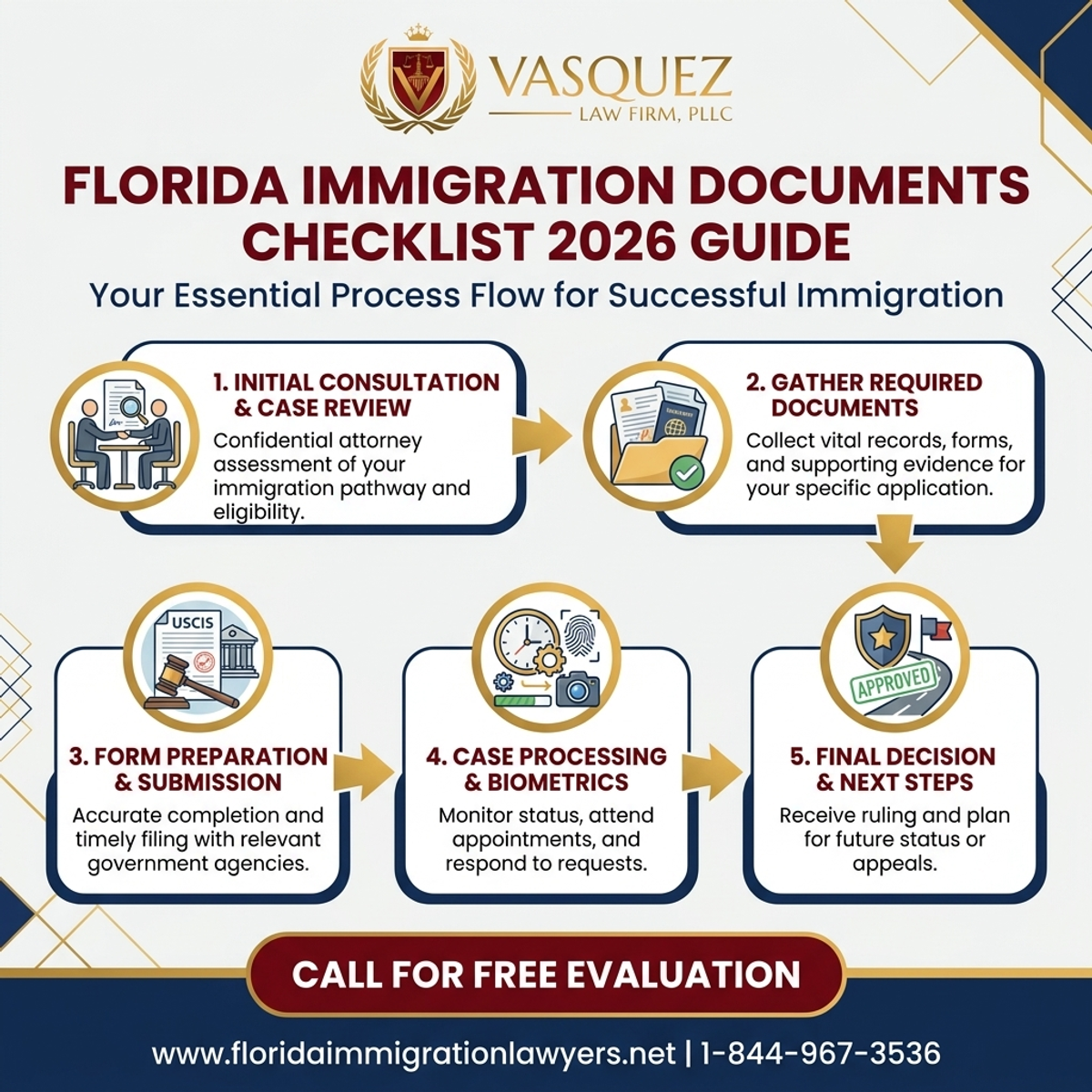
Step-by-Step Process — Immigration Documents Checklist Florida 2026 Guide
Always refer to the official USCIS website for the most current versions of forms and detailed instructions. The instructions often contain specific **immigration documents** requirements and filing tips that are crucial for a successful submission. Remember to make copies of all submitted **paperwork** for your personal records.
Navigating Immigration Timelines and Processing Expectations in Florida
Understanding the timelines and processing expectations for your **immigration documents** and **USCIS forms** is a significant concern for many **Florida** applicants. The duration of the immigration process is rarely fixed and can vary widely based on several factors, including the type of application, the specific **USCIS** service center or field office handling your case (such as those in Tampa, Orlando, or Miami), and the prevailing caseloads. It is crucial to manage your expectations and prepare for potential delays.
For common applications, family-based green cards can take anywhere from 1 to 3 years, or even longer for certain preference categories, due to visa bulletin backlogs. Employment-based green cards also have varying timelines, often depending on the applicant's country of origin and specific visa category. Naturalization applications (Form N-400) typically range from 6 to 18 months, though this can fluctuate. You can check current processing times on the USCIS website, which provides estimates for different forms and field offices. These times are estimates only and are subject to change without notice.
Several factors can influence how long your application takes. The completeness and accuracy of your initial **immigration documents** are paramount; any missing **paperwork** or errors will likely result in a Request for Evidence (RFE), significantly extending your timeline. Response times to RFEs or other **USCIS** inquiries also play a role. Furthermore, the scheduling of biometrics appointments and interviews at **Florida** field offices depends on their capacity. For instance, the Tampa Field Office, serving a large area, may have different interview schedules than a smaller office. Political changes and new immigration policies can also impact processing times across the board. While the wait can be frustrating, continuous monitoring of your case status online and ensuring all communications with **USCIS** are prompt and accurate can help keep your application moving forward. Always keep your contact information updated with **USCIS** to receive important notices.
Understanding Immigration Application Costs and Fee Breakdown
Beyond the meticulous gathering of **immigration documents** and completion of **USCIS forms**, applicants in **Florida** must also consider the financial aspects of the immigration process. The costs involved can be substantial and typically fall into several categories: **USCIS** filing fees, biometrics fees, medical examination costs, and legal fees. It is important to understand that these fees are subject to change by the government, and specific amounts should always be verified on the official **USCIS** website or by consulting an attorney.
USCIS filing fees are mandatory for almost every application and petition. These fees cover the administrative costs of processing your **paperwork**. For example, filing an I-485 application for adjustment of status involves a significant fee, which often includes the biometrics fee. Some applicants may be eligible for a fee waiver (Form I-912) if they meet certain income guidelines or are receiving public benefits. This option can provide much-needed relief for individuals facing financial hardship, ensuring that economic status does not completely bar access to immigration benefits. However, not all forms are eligible for fee waivers, and the application for a waiver itself requires specific **paperwork** to prove eligibility.
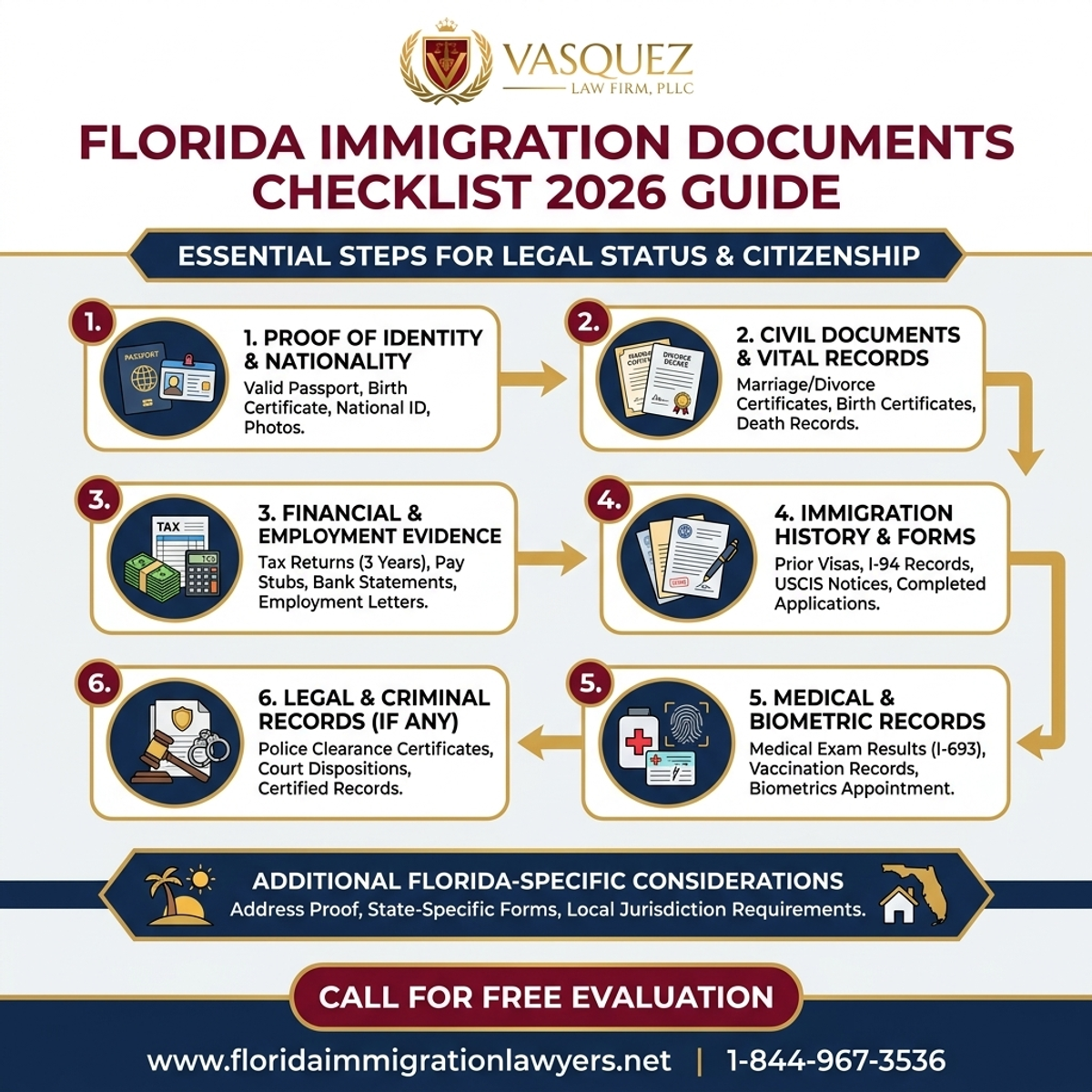
Key Statistics — Immigration Documents Checklist Florida 2026 Guide
In addition to government fees, other costs include the medical examination (Form I-693) conducted by a **USCIS**-approved civil surgeon, which can range from a few hundred dollars to more, depending on the provider and required vaccinations. Travel expenses to **USCIS** field offices in **Florida** for interviews or biometrics appointments should also be factored in. While legal fees are an additional expense, the value of expert legal representation, especially for complex cases or when preparing a comprehensive **immigration documents checklist**, often outweighs the cost. An experienced attorney can prevent costly mistakes, ensure all **paperwork** is correctly submitted, and advocate on your behalf, potentially saving you time and money in the long run. Florida Immigration Lawyers offers free consultations to discuss your case and provide a clear understanding of potential legal costs.
Florida-Specific Considerations for Your Immigration Journey
While federal law governs immigration, local conditions and resources in **Florida** can significantly impact your journey. For individuals in areas like **Tampa**, Orlando, or Miami, understanding these local nuances is essential for a smoother process. **Florida**'s diverse population means there are numerous community organizations and support networks available to assist immigrants. These organizations often provide language services, cultural integration programs, and sometimes even help with basic **immigration documents** questions, complementing the legal support offered by firms like Florida Immigration Lawyers.
One key aspect for **Florida** residents is knowing the location and jurisdiction of various **USCIS** field offices and Executive Office for Immigration Review (EOIR) immigration courts. For example, the **USCIS** Tampa Field Office serves a wide area, handling interviews for green cards and naturalization, while the Miami Immigration Court handles deportation and asylum cases for South **Florida**. Understanding which office or court has jurisdiction over your case can influence where you need to attend appointments and how your case progresses. The EOIR website provides a list of all immigration court locations, including those in Florida.
Furthermore, **Florida**'s state laws, while not directly controlling federal immigration policy, can intersect with an immigrant's daily life. For instance, state laws regarding driver's licenses for non-citizens, access to certain public benefits, or even local law enforcement's interaction with federal immigration authorities can be relevant. Staying informed about these state-level considerations is crucial. For those seeking to establish themselves in **Florida**, understanding these local intricacies, combined with a thorough preparation of all **immigration documents** and **USCIS forms**, will provide a stronger foundation for a successful and settled future in the Sunshine State.
Do not navigate this complex process alone. The stakes are too high to risk errors or omissions in your **immigration documents** and **USCIS forms**. Contact Florida Immigration Lawyers today for expert guidance on your application. We are here to help you secure your future in **Florida**.
Common Mistakes to Avoid When Preparing Immigration Documents
Preparing **immigration documents** for **USCIS forms** in **Florida** is a detailed process where even small errors can lead to significant delays or denials. Being aware of common mistakes can help you avoid them and ensure a smoother application journey.
- Incomplete or Inaccurate Forms: Failing to answer all questions or providing incorrect information on **USCIS forms** (e.g., Form I-485, Form N-400) is a frequent issue. Even a blank space can be interpreted as an incomplete response, leading to an RFE or rejection. Always double-check every field.
- Missing Supporting Documents: Applicants often overlook specific supporting **paperwork** required for their case. Forgetting a birth certificate, marriage certificate, or an essential financial document can halt the process. Refer to the official **USCIS** instructions for each form's comprehensive **checklist**.
- Incorrect Filing Fees: Submitting an incorrect fee amount, whether too much or too little, or using an outdated payment method, will result in your application being rejected and returned. Fees change; always verify the current amounts on the **USCIS** website before mailing.
- Failure to Provide Certified Translations: Any **immigration document** not in English must be accompanied by a complete and certified English translation. A simple translation is not enough; it must include a statement from the translator attesting to their competency and the accuracy of the translation.
- Ignoring Deadlines: Missing deadlines for responding to RFEs, Notices of Intent to Deny (NOID), or attending scheduled appointments can lead to the denial of your application without further review. Always prioritize and respond promptly to all **USCIS** communications.
- Not Updating USCIS with Address Changes: If you move, you are legally required to notify **USCIS** within 10 days using Form AR-11. Failure to do so can result in missed appointments or critical notices, which can lead to application denial or even deportation proceedings.
- Misrepresenting Facts: Providing false information or concealing relevant facts on your **USCIS forms** or during interviews is considered fraud. This can lead to a permanent bar from receiving immigration benefits and even criminal charges. Honesty is always the best policy.
- Failing to Keep Copies of Everything: Always make a complete copy of your entire application package, including all **immigration documents**, **USCIS forms**, and correspondence, before mailing it. This record is invaluable if originals are lost or if you need to reference information during an interview.
- Submitting Expired Documents: Ensure all identity documents, like passports or visas, are valid and not expired. Submitting an expired document will cause delays.
- Poor Organization of Documents: Sending a disorganized stack of **paperwork** can frustrate **USCIS** officers and make it difficult for them to process your application efficiently. Follow **USCIS** guidelines for organizing your submission, using tabs and fasteners where appropriate.
When to Call a Lawyer for Your Immigration Documents in Florida
While this **immigration documents checklist** provides a strong foundation, there are many situations where the expertise of a qualified immigration attorney is not just helpful but essential. The immigration landscape in **Florida** and across the U.S. is constantly evolving, making legal guidance invaluable for complex or challenging cases. Knowing when to call a lawyer can make the difference between success and significant setbacks.
You should consider contacting **Florida Immigration Lawyers** if your case involves any complexities such as a prior deportation order, criminal history, previous visa denials, or if you have overstayed a visa. These issues can significantly complicate your application and often require waivers or specialized legal arguments that are difficult to manage without professional help. Furthermore, if you are seeking asylum, facing **deportation defense** proceedings, or have a particularly intricate family-based petition, an attorney can provide critical support. For instance, proving a bona fide marriage can be challenging, and an attorney can help you gather and present compelling evidence. Business immigration cases, which involve specific corporate and labor laws, also greatly benefit from legal expertise.
Even for seemingly straightforward applications like naturalization or a green card, an attorney can offer peace of mind by thoroughly reviewing your **immigration documents** and **USCIS forms** before submission. They can identify potential issues you might overlook, ensure compliance with the latest regulations, and prepare you for interviews. If you receive a Request for Evidence (RFE) or a Notice of Intent to Deny (NOID), immediate legal counsel is paramount. These notices indicate **USCIS** has concerns about your application, and a swift, well-reasoned legal response is necessary to prevent denial. Don't wait until problems arise; proactive legal engagement with **Florida Immigration Lawyers** can safeguard your immigration journey and help you confidently navigate the requirements.
About Florida Immigration Lawyers
Florida Immigration Lawyers is a leading law firm dedicated to providing comprehensive and compassionate immigration legal services across the entire state of **Florida**. With a deep understanding of U.S. immigration law and its unique implications for **Florida** residents, our experienced attorneys are committed to helping individuals, families, and businesses achieve their immigration goals. We believe in providing personalized attention to every client, understanding that each case is unique and requires a tailored strategy.
Our firm handles a wide range of immigration matters, including but not limited to family-based visas, employment-based visas, green card applications, naturalization and citizenship, asylum, and robust **deportation defense**. We are proficient in preparing all necessary **immigration documents** and **USCIS forms**, ensuring accuracy and completeness. Our team is known for its zealous advocacy, meticulous preparation, and unwavering support for our clients throughout every stage of the process. We pride ourselves on being accessible and responsive, offering transparent communication and clear explanations of complex legal concepts.
Choosing Florida Immigration Lawyers means partnering with a team that genuinely cares about your future. We offer free consultations to discuss your specific needs and outline a strategic path forward. Our services are available 24/7, ensuring that you have access to legal support when you need it most. We serve clients in **Tampa**, Orlando, Miami, and all other cities and counties throughout **Florida**. Let us put our expertise to work for you. Contact us today at 1-844-967-3536 or visit floridaimmigrationlawyers.net to learn more about how we can assist you with your immigration needs.
Sources and References
- U.S. Citizenship and Immigration Services (USCIS)
- USCIS Processing Times
- Executive Office for Immigration Review (EOIR)
- EOIR Immigration Court Locations
- U.S. Department of State
- 8 U.S.C. Chapter 12 - Immigration and Nationality Act (INA)
- 8 CFR Part 103 - Adjudication of Applications
Related services: immigration practice areas, family immigration services.
This article provides general legal information and is not intended as legal advice. Every case is unique, and outcomes depend on specific facts and circumstances. Contact an attorney for advice about your particular situation.
Don't let the complexity of **immigration documents** overwhelm you. For personalized legal assistance in **Florida**, call Florida Immigration Lawyers at 1-844-967-3536 for a free consultation. Se Habla Espanol - Estamos aqui para ayudarle.
If you need legal assistance, learn more about speak with an immigration lawyer, or call us at 1-844-967-3536 for a free consultation.
Do Not Navigate This Process Alone
Our experienced immigration attorneys are ready to fight for you. Get a free, confidential consultation today.
Se Habla Español
Frequently Asked Questions
Florida Immigration Lawyers
Immigration Attorney | Founder, Vasquez Law Firm
U.S. Air Force veteran and immigration attorney with thousands of cases resolved. J.D., NCCU School of Law. AILA member. Admitted to the 4th, 5th, and 11th Circuit Courts.
Available 24/7 - Free Evaluations
Related Legal Services
Our Florida immigration attorneys can help you with experienced immigration attorneys, business immigration and asylum protection. Call today at 1-844-967-3536 for a free consultation.
Related Links
Related Topics
Free Legal Consultation
Discuss your case with our experienced attorneys. We're available 24/7.
Se Habla Español - Estamos aquí para ayudarle.
Related Articles
BIA Remand in Florida: What Happens After Your Immigration
A BIA remand in Florida sends your immigration case back to the Immigration Court for further review, often due to a legal error or the need for more evidence. This crucial stage requires careful attention to the Board of Immigration Appeals' instructions and a strategic approach to new hearings before an Immigration Judge. For individuals in Kissimmee, Orlando, and across Florida, understanding this process is vital. Florida Immigration Lawyers offers expert guidance to navigate the complexities of BIA remands, helping you prepare documentation, present compelling arguments, and avoid common mistakes. Don't face this critical second chance alone; learn how to effectively manage your remand case and protect your future in the U.S.
Immigration Services in Port St Lucie and Treasure Coast
Explore immigration services in Port St Lucie and the Treasure Coast. Learn about local options for visas, asylum, and citizenship. Contact Florida Immigration Lawyers for expert guidance at 1-844-967-3536.
Immigration Interview Preparation Tips for Florida
Preparing for your USCIS immigration interview in Florida is crucial for success. Understanding the process and knowing what to expect can make a significant difference. This guide provides tips on documents, common questions, and what to do on the day of the interview. Call Florida Immigration Lawyers at 1-844-967-3536 for a free consultation.
Stokes Interview & Marriage Fraud: Florida Guide | VLF Florida
A Stokes interview is a rigorous examination conducted by USCIS when there are suspicions of marriage fraud in a marriage-based green card petition. This separate interview process involves extensive questioning of each spouse to verify the authenticity of their relationship. For couples in Florida, understanding the implications of a Stokes interview, preparing thoroughly, and gathering comprehensive evidence of a bona fide marriage are critical. Marriage fraud carries severe penalties, including permanent bars to immigration benefits and potential criminal charges. Seeking expert legal guidance from Florida Immigration Lawyers is essential to navigate this challenging process successfully, protect your rights, and present a strong case to USCIS.