BIA Remand in Florida: What Happens After Your Immigration
A BIA remand in Florida sends your immigration case back to the Immigration Court for further review, often due to a legal error or the need for more evidence. This crucial stage requires careful attention to the Board of Immigration Appeals' instructions and a strategic approach to new hearings before an Immigration Judge. For individuals in Kissimmee, Orlando, and across Florida, understanding this process is vital. Florida Immigration Lawyers offers expert guidance to navigate the complexities of BIA remands, helping you prepare documentation, present compelling arguments, and avoid common mistakes. Don't face this critical second chance alone; learn how to effectively manage your remand case and protect your future in the U.S.

A BIA remand occurs when the Board of Immigration Appeals (BIA) sends an immigration case back to the Immigration Court for further proceedings. This usually happens because the BIA found a legal error, a need for more fact-finding, or new evidence to be considered. For individuals in Florida, a remand means your case is not fully resolved; it returns to an immigration judge in cities like Miami or Orlando. Understanding the specific instructions from the BIA is crucial for the next steps. It offers a renewed opportunity to present your case or address previous deficiencies, often requiring a skilled immigration attorney.
- A BIA remand sends your case back to the Immigration Court.
- It often indicates a legal error or need for more evidence.
- You will have new hearings before an Immigration Judge.
- Legal representation is highly recommended to navigate the complexities.
- A remand is not a final decision but a chance to strengthen your case.
Navigating the U.S. immigration system can feel like moving through a labyrinth, especially when your future hangs in the balance. Perhaps you've faced a challenging decision from an Immigration Judge, and after appealing to the Board of Immigration Appeals (BIA), your case has been remanded. For many individuals and families in Florida, particularly those in areas like Kissimmee, Orlando, and Miami, receiving a BIA remand order can bring a mix of relief and renewed uncertainty. What does it truly mean for your immigration journey, and what happens next?
This comprehensive guide from Florida Immigration Lawyers will demystify the BIA remand process. We will walk you through the intricacies of immigration appeals, explain what a remand entails, and outline the crucial steps you need to take when your case returns to the Immigration Court. Our goal is to empower you with the knowledge necessary to face this critical phase with confidence. We understand the unique challenges faced by Florida residents and are here to provide the expert guidance you need. Call Florida Immigration Lawyers at 1-844-967-3536 for a free consultation today to discuss your BIA remand case.
Understanding the Board of Immigration Appeals (BIA) Process and Remands
The Board of Immigration Appeals (BIA) is the highest administrative body for interpreting and applying immigration laws. It falls under the Executive Office for Immigration Review (EOIR) within the U.S. Department of Justice. When an Immigration Judge issues a decision in an immigration court, either the government or the noncitizen can appeal that decision to the BIA. This appellate process is a critical safeguard, ensuring that immigration laws are applied fairly and correctly.
A BIA remand is one of several possible outcomes of an appeal. Instead of affirming (upholding) or reversing (overturning) the Immigration Judge's decision, the BIA sends the case back to the Immigration Court for further action. This action is usually prompted by specific instructions from the BIA. For instance, the BIA might determine that the Immigration Judge made a legal error, failed to consider crucial evidence, or needs to develop the factual record further. A remand is not a victory or a loss; it is an opportunity for a second look at your case.
Common reasons for a BIA remand include situations where the Immigration Judge did not adequately explain their findings, misapplied a legal standard, or new evidence became available after the initial hearing. The BIA may also remand a case to allow the Immigration Judge to consider a new form of relief that was not previously available or to make a credibility finding that was overlooked. Understanding the precise reasons for the remand, as detailed in the BIA's decision, is paramount. This decision will dictate the scope of the new proceedings before the Immigration Judge in Florida.
Legal Citation: The BIA's authority and procedures are primarily governed by 8 CFR § 1003.1. This regulation outlines the composition, jurisdiction, and powers of the Board, including its ability to affirm, modify, reverse, or remand decisions from Immigration Judges. The EOIR, which oversees the BIA and Immigration Courts, aims to provide fair and efficient immigration adjudication. You can learn more about EOIR's mission and structure on the Executive Office for Immigration Review (EOIR) website.
The Journey of an Immigration Appeal: From Immigration Court to BIA
The path to a BIA remand begins in the Immigration Court. If an Immigration Judge issues an unfavorable decision, such as an order of removal or a denial of an application for relief, you generally have 30 days to file a Notice of Appeal (Form EOIR-26) with the BIA. This crucial step initiates the appellate process. Missing this deadline is a common and often fatal mistake, as it can lead to the finality of the Immigration Judge's decision and potentially an order of deportation. In Florida, Immigration Courts are located in cities like Miami and Orlando, serving immigrants across the state, including Kissimmee and surrounding Central Florida communities.
Once the Notice of Appeal is filed, a briefing schedule is established. Both you (the appellant) and the government (the appellee) typically have the opportunity to submit written briefs arguing why the Immigration Judge's decision should be overturned or upheld. These briefs are critical legal documents, meticulously outlining legal arguments, citing relevant case law, and referencing the factual record. After the briefs are submitted, the BIA reviews the case, usually without oral arguments. The BIA panel, typically consisting of three Board Members, examines the record of proceedings, the Immigration Judge's decision, and the submitted briefs.
The BIA can reach several conclusions: it can affirm the Immigration Judge's decision, meaning it agrees with the outcome; it can reverse the decision, ruling in your favor; or it can dismiss the appeal, often due to procedural defects. However, a significant outcome, especially in cases with complex legal or factual issues, is a remand. A remand means the BIA is not issuing a final decision on the merits of your case but rather sending it back to the Immigration Court for further consideration. This is a critical juncture, as it reopens your case before an Immigration Judge, giving you another chance to present evidence or arguments consistent with the BIA's instructions.
Legal Citation: The process for appeals to the BIA is detailed in 8 CFR § 1003.38, which covers the filing of the Notice of Appeal, the payment of fees, and the submission of briefs. Understanding these procedural requirements is vital for anyone considering an appeal. The BIA's decisions are binding on all Immigration Judges unless overturned by a federal circuit court of appeals or the U.S. Attorney General.
Navigating a BIA Remand: Next Steps and Strategic Considerations
Receiving a BIA remand order can feel like a fresh start for your immigration case. However, it is essential to understand that a remand is not an automatic approval of your immigration benefit. Instead, it directs the Immigration Judge to revisit specific aspects of your case. The BIA's remand order will contain detailed instructions, outlining what the Immigration Judge needs to do. This could involve taking additional testimony, admitting new evidence, applying a different legal standard, or making clearer findings of fact. Your success on remand heavily depends on precisely understanding and addressing these instructions.
Upon remand, your case will be calendared for new hearings before an Immigration Judge. These hearings are your opportunity to present the information or arguments requested by the BIA. For example, if the BIA remanded for further fact-finding regarding a persecution claim, you might need to provide additional affidavits, expert testimony on country conditions, or medical records to substantiate your claims. If the remand was due to a legal error, your attorney would then argue how the law should be correctly applied to your specific facts. The Immigration Judge, now bound by the BIA's instructions, will conduct these proceedings and issue a new decision.
Types of BIA Remands and Their Implications
BIA remands can vary significantly in their scope. Some remands are broad, instructing the Immigration Judge to conduct an entirely new hearing on the merits, while others are narrow, requiring only a specific finding or the consideration of a particular piece of evidence. Understanding the type of remand is crucial for developing an effective strategy. A broad remand might allow for the introduction of substantial new evidence or the pursuit of alternative forms of relief. A narrow remand, however, will limit the scope of the new proceedings, focusing only on the issues identified by the BIA. Your attorney will analyze the BIA's decision carefully to determine the best path forward.

Step-by-Step Process — BIA Remand in Florida: What Happens After Your Immigration Appeal?
Preparing for the Remand Hearing in Florida
Preparation for a remand hearing is similar to preparing for an initial immigration court hearing, but with the added layer of addressing the BIA's specific directives. This involves gathering new evidence, lining up witnesses, and meticulously preparing your legal arguments. For individuals in Florida, these hearings will take place at the local Immigration Courts. It is important to remember that the Immigration Judge, while bound by the BIA's instructions, still has the authority to make factual findings and apply the law within those parameters. Therefore, presenting a clear, compelling, and well-supported case remains paramount. This is where the expertise of an experienced Florida immigration lawyer becomes invaluable.
Key Documents and Evidence for Your Remand Case
A successful BIA remand case hinges on presenting comprehensive and relevant documentation. The specific documents required will depend heavily on the BIA's instructions and the nature of your original case. However, certain categories of documents are almost always critical. Preparing these thoroughly can significantly strengthen your position before the Immigration Judge in Florida. Remember, the goal is to address the deficiencies or new considerations identified by the BIA.
- BIA Remand Order: This is the most critical document. It explicitly states the reasons for the remand and the instructions for the Immigration Judge. Your entire strategy will be built around addressing this order.
- Original Application and Supporting Documents: Any forms you initially filed (e.g., I-589 for asylum, I-485 for adjustment of status) and their original supporting evidence remain relevant. You may need to update or supplement these.
- Transcripts of Previous Hearings: The transcripts from your initial Immigration Court proceedings provide a detailed record of testimony and arguments. These are crucial for identifying specific factual findings or legal conclusions that the BIA may have questioned.
- New or Updated Evidence: This is often the primary reason for a remand. Examples include:
- Affidavits/Declarations: Sworn statements from you, family members, friends, or expert witnesses providing new information or clarifying previous testimony.
- Country Conditions Reports: If your case involves asylum or withholding of removal, updated reports from reputable sources (e.g., U.S. State Department, Amnesty International, Human Rights Watch) on conditions in your home country.
- Medical or Psychological Evaluations: If your claim involves past persecution, trauma, or health issues relevant to your eligibility for relief, updated evaluations can be vital.
- Financial Documents: If your eligibility for relief depends on income or assets, provide current tax returns, pay stubs, or bank statements.
- Police Reports/Court Records: Any criminal history or law enforcement interactions, both in the U.S. and abroad, that need clarification or new evidence of rehabilitation.
- Correspondence with USCIS or Other Agencies: Any new communications regarding your immigration status.
- Legal Briefs and Memoranda: Your attorney will prepare new legal arguments tailored to the BIA's remand instructions, referencing relevant statutes, regulations, and case law.
- Witness Lists: If you plan to call witnesses, a detailed list with contact information and a summary of their expected testimony.
Organizing these documents meticulously is paramount. Each piece of evidence should directly address an issue raised by the BIA or strengthen your overall case in line with the remand instructions. Working with an experienced immigration attorney ensures that your documentation is complete, properly formatted, and strategically presented to the Immigration Judge.
Timelines, Processing Expectations, and Potential Delays in Florida Remand Cases
Understanding the potential timelines for a BIA remand case is crucial for managing expectations and planning your future. While the BIA aims for efficient processing, immigration cases are inherently complex, and timelines can vary significantly. The time it takes for the BIA to issue a remand decision after an appeal is filed can range from several months to over a year, depending on the complexity of the case, the BIA's current caseload, and whether any motions (e.g., motions to reopen) are also pending. Once the BIA issues a remand order, your case is sent back to the appropriate Immigration Court in Florida, such as the ones in Miami or Orlando.
Upon return to the Immigration Court, your case will be re-calendared for a new hearing before an Immigration Judge. The speed at which this happens can be influenced by the court's backlog, the availability of judges, and the specific instructions from the BIA. For instance, a remand requiring extensive new fact-finding may be scheduled further out than one requiring only a brief legal argument. In 2026, Immigration Courts across the U.S., including those in Florida, continue to grapple with significant backlogs, which can unfortunately lead to delays in scheduling remand hearings. Wait times can sometimes extend for many months, or even over a year, before your next court date is set.
Several factors can contribute to potential delays in your BIA remand case:
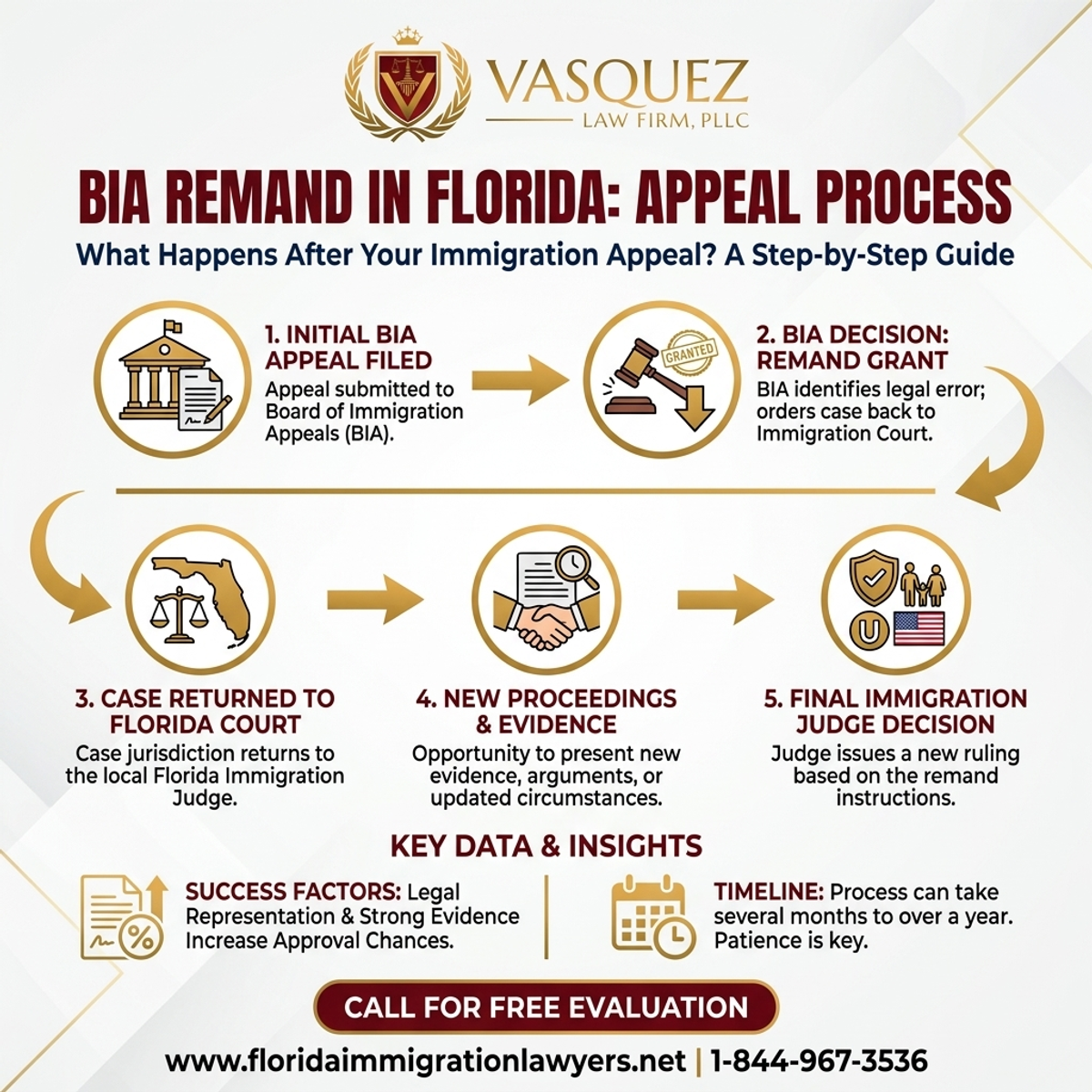
Key Statistics — BIA Remand in Florida: What Happens After Your Immigration Appeal?
- Court Backlogs: The sheer volume of cases pending before Immigration Courts is a primary cause of delays.
- Complexity of the Case: Cases involving multiple forms of relief, complex legal questions, or extensive evidence often require more court time.
- Availability of Witnesses: If your case requires testimony from multiple witnesses, coordinating their schedules can cause delays.
- Requests for Continuances: Either party (you or the government) may request a continuance for various reasons, such as needing more time to gather evidence or prepare.
- Changes in Law or Policy: New immigration laws or policy directives from agencies like USCIS or EOIR can impact how cases are processed, sometimes causing temporary slowdowns as courts adapt.
While these delays can be frustrating, they also provide additional time to strengthen your case, gather more evidence, and thoroughly prepare with your attorney. Proactive communication with your legal team and the court, where appropriate, can help manage expectations. It is crucial to remain patient but persistent, ensuring all deadlines are met and all required documentation is submitted promptly. Your attorney at Florida Immigration Lawyers will keep you informed about your case's status and any expected timelines.
Understanding the Costs: Attorney Fees and Filing Fees for BIA Remands
Pursuing an immigration appeal and navigating a BIA remand involves various costs, which can be a significant concern for many individuals and families in Florida. These costs typically fall into two main categories: government filing fees and attorney fees. Understanding these financial aspects upfront is crucial for planning and ensuring you have the necessary resources throughout the process.
Government Filing Fees
When you initially file an appeal with the Board of Immigration Appeals, there is a filing fee for Form EOIR-26, the Notice of Appeal. This fee is set by the Department of Justice and is subject to change. While the BIA remand itself does not typically incur a new filing fee, subsequent actions in Immigration Court might. For example, if the remand allows you to file a new application for relief (e.g., a new asylum application, a waiver application), each of these applications will have its own associated filing fee with USCIS. It is important to remember that these fees are non-refundable, regardless of the outcome of your case. Fee waiver options may be available for certain forms and for individuals who can demonstrate an inability to pay, but eligibility criteria are strict.
Attorney Fees
Attorney fees constitute the other significant cost. Representing yourself in a BIA remand case is highly discouraged due to the complex legal issues, procedural rules, and high stakes involved. An experienced immigration attorney can provide invaluable guidance, prepare legal briefs, gather evidence, represent you in court, and navigate the nuances of immigration law. Attorney fees for BIA remand cases can vary based on several factors:
- Complexity of the Case: A straightforward remand with clear instructions will generally cost less than a highly complex case requiring extensive legal research, expert witnesses, or multiple court appearances.
- Attorney's Experience: Highly experienced attorneys, especially those with a strong track record in appellate and remand cases, may charge higher fees.
- Geographic Location: While Florida Immigration Lawyers serves all of Florida, legal fees can sometimes vary slightly by region, though our firm strives for consistent, fair pricing.
- Fee Structure: Attorneys may charge an hourly rate or a flat fee for specific stages of the remand process. A flat fee provides predictability, while an hourly rate reflects the actual time spent on your case. During your free consultation, our firm will discuss the fee structure that best suits your situation.
When you contact Florida Immigration Lawyers, we will provide a clear and transparent breakdown of our fees and discuss payment options. Investing in qualified legal representation is an investment in your future and can significantly increase your chances of a favorable outcome. We offer free consultations to help you understand your options without financial commitment upfront.
Common Mistakes to Avoid in a BIA Remand Case
A BIA remand offers a second chance, but it also presents opportunities for critical errors that can jeopardize your case. Avoiding these common mistakes is paramount for a successful outcome:
- Ignoring the BIA's Specific Instructions: The remand order is your roadmap. Failing to directly address the BIA's directives or introducing arguments outside its scope can lead to another denial. Each remand instruction must be carefully analyzed and directly responded to.
- Missing Deadlines: Immigration proceedings are unforgiving regarding deadlines. Missing a deadline for filing documents, submitting briefs, or appearing in court can result in your case being dismissed or an order of removal being reinstated.
- Failing to Gather Sufficient New Evidence: If the remand was for further fact-finding, simply resubmitting old evidence is often insufficient. You must actively seek out and present new, compelling evidence that directly supports your claims or addresses the BIA's concerns.
- Not Updating Your Personal Information: Changes in address, phone number, or other contact details must be promptly updated with EOIR. Failure to do so can lead to missed notices, court dates, and potentially an in absentia order of removal.
- Attempting to Self-Represent: Immigration law is incredibly complex and constantly evolving. Representing yourself in a remand case, especially after the BIA has identified specific legal or factual issues, is a high-risk strategy that often leads to unfavorable outcomes.
- Failing to Prepare for Court Appearances: Even if the remand is for a legal issue, be prepared for questioning by the Immigration Judge. Your testimony must be consistent and credible.
- Not Addressing Credibility Issues: If the BIA remanded for a credibility determination, you must proactively address any past inconsistencies or concerns raised about your testimony. This often requires careful explanation and supporting evidence.
- Filing Redundant Motions: Filing motions that are not directly related to the BIA's remand order or have already been addressed can waste valuable time and resources and may be viewed unfavorably by the court.
- Assuming a Remand Means Approval: A remand is not an approval. It is a directive for further proceedings. Your case is still ongoing, and you must actively work to achieve a positive outcome.
- Not Consulting with an Experienced Attorney: The most significant mistake is trying to navigate this intricate process without the guidance of a qualified immigration lawyer. An attorney understands the nuances, can interpret the BIA's order, and build a strong strategy.
When to Call a Lawyer for Your BIA Remand Case
A BIA remand is a critical juncture in your immigration journey, offering a second chance that should not be taken lightly. While the process can be complex and daunting, having experienced legal counsel can make a profound difference. You should absolutely call an immigration lawyer if you receive a BIA remand order, especially if you are in Florida. Here are specific scenarios where legal assistance from Florida Immigration Lawyers is not just helpful, but essential:
- You Received a BIA Remand Order: The moment you receive the BIA's decision, particularly if it's a remand, contact an attorney. They can immediately analyze the order, explain its implications, and help you understand the next steps.
- Complex Legal Issues Are Involved: If the BIA remanded your case due to a complex legal error or a need to apply a nuanced area of immigration law, an attorney's expertise is indispensable. They can research relevant case law and craft compelling legal arguments.
- New Evidence Needs to Be Presented: If the remand requires the submission of new or updated evidence, an attorney can guide you on what type of evidence is needed, how to obtain it, and how to present it effectively to the Immigration Judge.
- You Have Language Barriers: If English is not your first language, navigating legal proceedings can be incredibly challenging. An attorney can ensure clear communication and that your voice is heard accurately.
- Your Case Involves Credibility Issues: If the BIA remanded for a credibility determination, this is a serious matter. An attorney can help you prepare to address these concerns and present your testimony in a consistent and believable manner.
- You Are Facing Deportation: Any case involving potential deportation or removal proceedings carries extremely high stakes. A BIA remand in this context means your freedom to remain in the U.S. is still on the line, making legal representation crucial.
- You Are Considering Further Appeals (e.g., to a Circuit Court): If the outcome of the remand hearing is still unfavorable, your attorney can advise you on the possibility and strategy for appealing to a U.S. Court of Appeals for the Eleventh Circuit, which covers Florida.
Florida Immigration Lawyers has extensive experience with BIA remands and complex immigration litigation. We serve clients throughout Florida, including Kissimmee, Orlando, Miami, and beyond. Our team is dedicated to protecting your rights and fighting for your future. Don't face this critical stage alone. Contact us for a free consultation.
About Florida Immigration Lawyers
Florida Immigration Lawyers is a leading immigration law firm dedicated to serving individuals and families across the entire state of Florida. With a deep understanding of the complexities of U.S. immigration law, our experienced attorneys provide compassionate, strategic, and effective legal representation. We are committed to helping our clients navigate the often-challenging immigration system, from initial applications to complex appeals and deportation defense.
Our firm specializes in a broad range of immigration services, including family-based immigration, employment visas, asylum claims, naturalization and citizenship, and, critically, appeals and deportation defense. We understand that every case is unique and that behind every file is a person with hopes, dreams, and fears. That's why we offer personalized attention and tailor our strategies to meet your specific needs and goals.
Choosing Florida Immigration Lawyers means choosing a team that is available 24/7 to address your concerns. We pride ourselves on clear communication, aggressive advocacy, and a commitment to achieving the best possible outcomes for our clients. Our bilingual staff ensures that language is never a barrier to receiving top-tier legal advice. We offer free consultations to help you understand your options and how we can assist you with your immigration journey, including complex BIA remand cases. Your future is our priority.
Sources and References
- U.S. Citizenship and Immigration Services (USCIS)
- Executive Office for Immigration Review (EOIR)
- 8 U.S.C. Chapter 12 - Immigration and Nationality Act (INA)
- 8 U.S.C. § 1229a - Removal Proceedings
- 8 CFR § 1003.1 - Board of Immigration Appeals: Organization and Jurisdiction
- 8 CFR § 1003.38 - Appeals to the Board
- USCIS Policy Manual
Related services: deportation defense services, asylum and refugee protection, immigration waivers, humanitarian protection programs.
This article provides general legal information and is not intended as legal advice. Every case is unique, and outcomes depend on specific facts and circumstances. Contact an attorney for advice about your particular situation. Immigration laws are subject to frequent changes.
A BIA remand is a pivotal moment that can redefine the trajectory of your immigration case. With the right legal support, you can transform this challenge into an opportunity to secure your future in the United States. Don't leave your fate to chance. Let the experienced attorneys at Florida Immigration Lawyers guide you through every step of your remand proceedings. We are here to provide the dedicated and knowledgeable representation you deserve. Contact us today for a free consultation at 1-844-967-3536. Se Habla Espanol - Estamos aqui para ayudarle.
If you need legal assistance, learn more about learn about our immigration practice, or call us at 1-844-967-3536 for a free consultation.
Do Not Navigate This Process Alone
Our experienced immigration attorneys are ready to fight for you. Get a free, confidential consultation today.
Se Habla Español
Or leave your details and we’ll call you:
Free Evaluation in 24 Hours
Or talk to us right now

AI voice assistant — available 24/7
FreeFrequently Asked Questions

William J. Vásquez
Founding Attorney · Vasquez Law Firm
U.S. Air Force veteran and immigration attorney with years of hands-on U.S. immigration experience. J.D., NCCU School of Law. AILA member. Admitted to the 4th, 5th, and 11th Circuit Courts.
Available 24/7 - Free Evaluations
Reviewed for legal accuracy by William J. Vásquez
Licensed in North Carolina; U.S. immigration is federal practice.
Related Legal Services
Our Florida immigration attorneys can help you with family immigration services, immigration practice areas and free immigration consultation. Call today at 1-844-967-3536 for a free consultation.
Related Links
Related Topics
Free Legal Consultation
Discuss your case with our experienced attorneys. We're available 24/7.
Se Habla Español - Estamos aquí para ayudarle.
Related Articles
Immigration Lawyer Orlando Free Consultation 2026
Discover how to find an immigration lawyer in Orlando offering a free consultation. Understand the services available and why choosing Florida Immigration Lawyers can make a difference in your case.
Military Naturalization Expedited in Florida Bases
Explore military naturalization options for families at Florida bases, including parole in place benefits in Miami. Learn how to expedite your application with expert guidance from Florida Immigration Lawyers.
K-3 Visa Timeline in Florida: What to Expect
Learn the K-3 visa timeline process in Florida, including steps, costs, and documentation. Understand your options in 2026 with guidance from Florida Immigration Lawyers.
ead advance parole combo card: What to Expect in 2026
For individuals in Florida with a pending I-485 application, an ead advance parole combo card is essential. This single document allows you to work legally in the U.S. and travel internationally without abandoning your green card application. Understanding eligibility, the application process, required documents, and current processing times in 2026 is critical. This comprehensive guide from Florida Immigration Lawyers provides detailed insights into securing your combo card, covering everything from filing Forms I-765 and I-131 to avoiding common mistakes. Learn how to maintain your stability and mobility while you await your permanent residency decision in St. Petersburg and across Florida. We offer expert legal guidance to navigate this crucial immigration benefit.