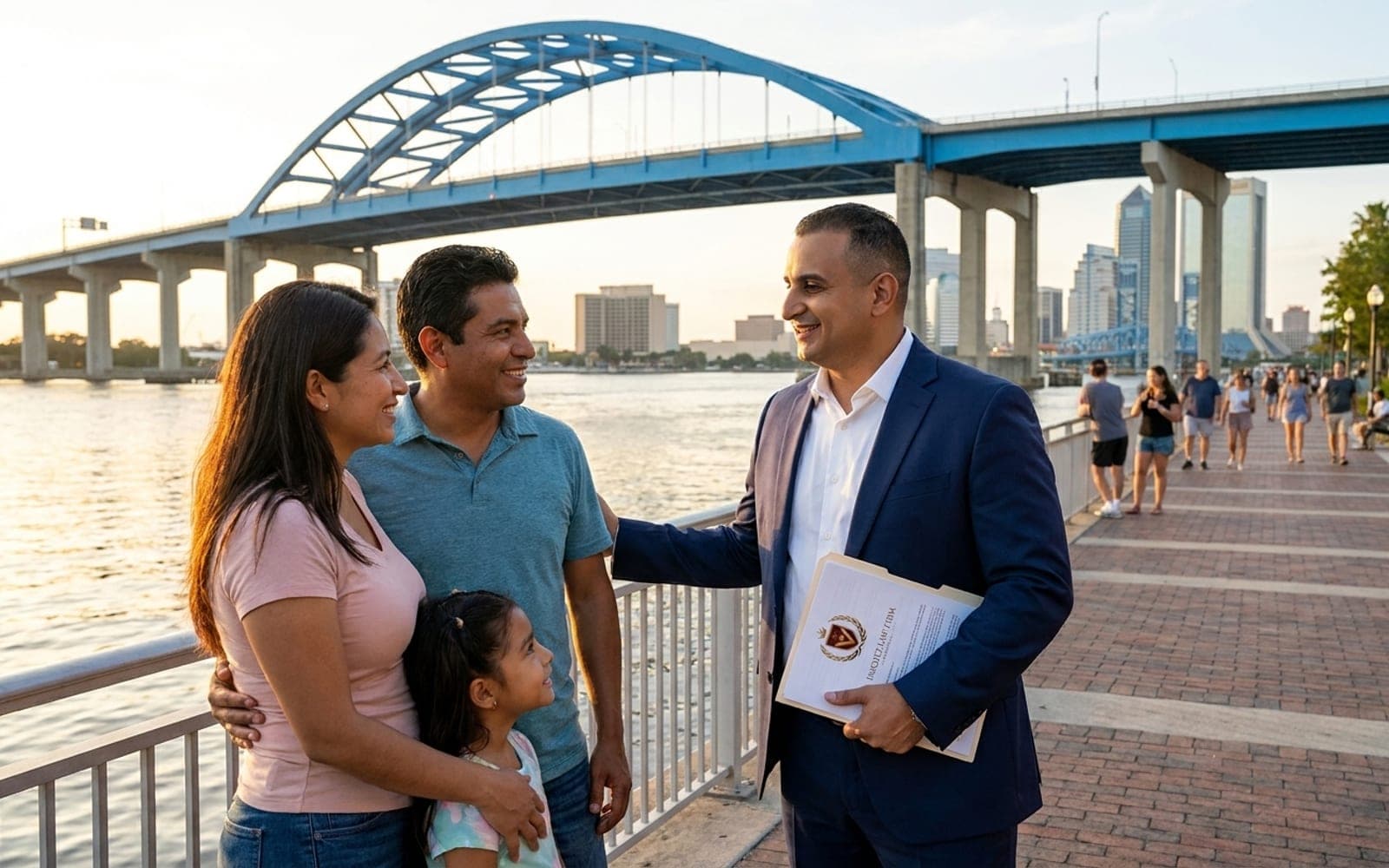
If you live in Jacksonville, Orange Park, Fernandina Beach or St. Augustine, comparing immigration lawyers means looking past a long list of search results. A lawyer outside your city can often handle your case, but it depends on what the case involves. Common questions in Northeast Florida include family petitions, work visas and green cards, naturalization including military families, removal defense after a Notice to Appear, and humanitarian protection. Our immigration-only firm has one office in Orlando and serves the region by video, phone and appointment.
- A lawyer outside your city can often handle your case, depending on what it involves.
- Common matters include family petitions, work visas, naturalization and removal defense.
- Service members and military families may have special naturalization rules.
- Ask a licensed lawyer to review your documents before filing, whichever lawyer you choose.
Introduction
If you live in Jacksonville, Orange Park, Fernandina Beach or St. Augustine and need an immigration lawyer, you will find a long list of search results and very little to separate them. This page gives you a practical way to compare options, explains the matters that come up most often in Northeast Florida, and describes how Vasquez Law Firm, an immigration-only firm with its single office in Orlando, serves the region by video, phone and appointment; call 1-844-YO-PELEO or contact us to begin.
It is written for people who have received a letter they do not understand, who want to petition for a family member, or who are trying to decide whether a lawyer outside the city can handle their case. The short answer to the last question is often yes, but it depends on what the case involves.
The information here is general and is not legal advice. Every case depends on its own facts, and rules change, so ask a licensed lawyer to review your documents before you file.
Immigration Help for Jacksonville-Area Residents
Northeast Florida has a port, logistics and shipping employers, hospitals, banks and insurers, military installations, tourism and hospitality, and many long-established immigrant communities. The immigration questions follow the same pattern:
- Family petitions: a citizen or permanent resident filing for a spouse, parent or child.
- Work visas and green cards: professionals, seasonal workers and employers who need to understand sponsorship rules.
- Naturalization: permanent residents ready to apply for citizenship, including service members and military families who may have special rules.
- Removal defense: people who received a Notice to Appear or were detained.
- Humanitarian protection: asylum, TPS and other options for people who cannot safely return home.
Each category has its own forms, evidence and deadlines. Our immigration practice page gives an overview, and the sections below show how to choose a lawyer for any of them.
How to Compare Immigration Attorneys in Jacksonville
When you search for immigration attorneys in Jacksonville, you will probably see advertising from many firms, including some that are based elsewhere. Use the same checklist for each one:
- Does the firm practice only or mainly immigration law, so the lawyer is familiar with USCIS, consular and court procedure?
- Who will actually prepare and review your case, and who will you speak with?
- Will the lawyer explain risks in plain language before you sign an agreement?
- Is the scope of work and the fee arrangement written down?
- Can you communicate in English or Spanish, whichever you are more comfortable with?
- Where does the lawyer actually practice? A firm that claims offices it does not have should be a warning sign.
Many people phrase the search with a superlative. Those searches are understandable, but there is no official ranking, and the Florida Bar does not allow a lawyer to advertise as better than other lawyers. Do not rely on a firm that does so; look at the checklist above instead.
How We Work With Jacksonville and Northeast Florida Clients
People looking for a Florida immigration law firm that serves Jacksonville often wonder whether they can hire a lawyer who is not in town. Many can. Our one office is at 1111 E Amelia Street in Orlando. We meet Northeast Florida clients by phone or secure video, collect documents electronically, and meet in person in Orlando when that helps. We do not have a Jacksonville office, and we say so up front.
Those comparing a local firm with a firm that serves Jacksonville remotely should ask how in-person events are handled. USCIS interviews and immigration court hearings take place at the location named in your notice. Your lawyer should prepare you in advance, explain who will attend, and arrange for appearances where the rules allow. In our practice, preparation sessions for interviews and hearings happen by video before the day arrives. The usual steps are:
- Contact the firm and share your city, deadline and language preference.
- Upload your documents securely and meet by video or phone.
- Review the options and risks and decide whether to proceed.
- Sign a written agreement and approve the prepared filing.
- Prepare by video for biometrics, interviews or hearings.
- Receive updates and plan next steps after the decision.
Word of mouth is useful, but also ask the lawyer to explain what the first steps would be in your case and what could go wrong.
St. Augustine and St. Johns County
St. Augustine's economy relies on tourism, hospitality, education and construction. People in St. Augustine usually need help in one of three areas: employer-sponsored work status, family petitions for a spouse or relative, or a pending case that has stalled. A person who asks whether a lawyer outside the city can handle a case is usually asking whether distance matters. For most applications, the answer is that it does not, because filings are made through USCIS online or by mail and interviews are assigned to the office that serves your address.
Our work visa page and family immigration page describe those matters.
Document Checklist for a First Consultation
- Passports, visas, green cards, I-94 records and work permits.
- Every notice you have from USCIS, ICE or an immigration court.
- Marriage, birth and divorce records relevant to the case.
- A list of arrests or charges, including those that were dismissed.
- A short timeline of when you entered the United States and any trips abroad.
- For employer-sponsored cases: job offer letters, pay records and employer contact details.
- For military families: service records and any documents showing a service member's status.
Bring originals to the consultation if you can, and send clear copies through our secure upload afterward. If something is missing, tell us rather than guessing; there are often ways to obtain replacements or substitute evidence, and we can talk through which options fit your situation.
Timeline and Processing Expectations
How long a case takes depends on the category, the office handling it and whether the government asks for more evidence. USCIS, the State Department and the immigration courts publish current processing information and hearing calendars, and we recommend checking those official sources before planning around any date.
A lawyer can describe the order of events and the parts you control. A complete filing at the start, quick answers to requests and a current address on file are the simplest ways to avoid delay.
| Stage | What happens | Who acts |
|---|
| Consultation | Facts and documents are reviewed and options are explained | You and the lawyer |
| Filing | Forms and evidence prepared, reviewed and submitted | Lawyer prepares; you sign |
| Receipt and biometrics | Agency issues a receipt and may schedule fingerprints | USCIS |
| Interview or hearing | Questions at the field office, or a hearing before a judge | Officer or judge; you attend |
| Request for Evidence, if any | More proof is requested by a deadline | You and the lawyer respond |
| Decision | Approval, denial or a further step | USCIS or the court |
What to Do After a Notice Arrives
Often the call comes after a letter arrives. People searching for a lawyer in Jacksonville have usually received one of the following:
- A Request for Evidence, which has a response deadline that cannot be extended without good cause.
- An interview notice from USCIS.
- A Notice to Appear in immigration court.
- A denial that explains why the application was refused.
Keep the envelope and the notice, and do not ignore the dates. If a family member is detained, say so right away; our bond page explains what bond requests involve. Detained cases usually move faster than other cases, so early contact makes a real difference. For a Request for Evidence, note exactly which items are listed as missing, gather them before the call and bring the original notice. For an interview notice, confirm the date, time and address, and ask whether anything must be brought in addition to the usual identity and civil documents.
Family Petitions and Humanitarian Protection
Family-based cases are among the most common we discuss with Northeast Florida residents. A citizen or permanent resident may petition for certain relatives, and the path depends on the relationship, the relative's age and marital status and whether the relative is inside or outside the United States. A relative abroad usually goes through the National Visa Center and a consulate, while a relative inside the country may be able to adjust status if the entry was lawful. Waiting periods differ by category and country, and the government publishes current information, so a lawyer should check it before giving any estimate.
People who fear returning to their home country may have asylum or related protection available, but these cases have strict deadline rules and require a careful, consistent account of what happened. Temporary Protected Status is a separate program with its own registration periods and is tied to the person's country and entry date. In both cases we review the facts and the documents first, explain what the law currently provides, and describe the risks, including what could happen if an application is denied.
Families that include both citizens and people without status deserve special planning, because one filing can affect another. Ask a lawyer to look at the whole household before any form is sent.
Finally, remember that a first consultation is a chance to test fit. You can ask how the lawyer would approach your case, what documents would be needed, who would sign each form and how often you would hear from the office. A clear, unhurried answer to those questions says a great deal about how the representation will go.
Naturalization, Military Families and Work Cases in Northeast Florida
Jacksonville is home to several military installations, and service members and their families sometimes have special rules for citizenship, such as different residence requirements or the ability to complete steps abroad. These rules are specific and change, so a family should ask a lawyer to confirm which apply before filing. Employers in logistics, health care, finance and hospitality may sponsor workers, and each category has its own rules about who files, which documents are needed and how long a worker may stay.
For permanent residents who are not in the military, naturalization still turns on time as a resident, continuous residence, physical presence, good moral character and the English and civics tests. A review of travel, taxes and any arrests before filing is wise. Families who want to understand how the whole process fits together can read our immigration overview and then schedule a consultation.
Cost Factors and Fee Breakdown
The table below lists the kinds of costs that usually come up, without quoting figures that change over time.
| Item | Amount | Notes |
|---|
| USCIS filing fees | Check USCIS for the current fee | Depends on the form; fee rules can change |
| Immigration court fees | Check the court or agency for current fees | Varies by application |
| Employer petition costs | Varies by case | Depend on the visa category and who pays |
| Attorney fees | Varies by case | Defined in a written agreement |
| Translations and records | Varies by case | Foreign-language documents need English translations |
Government filing fees are set by the agency and change from time to time, so check the current fee schedule on the agency's website before you file. Legal fees are separate and vary with the complexity of the case, the number of people included and the amount of work involved. Ask for the scope of work and the fee arrangement in writing before you sign anything.
Other costs may include medical exams, translations, travel to appointments and the cost of obtaining records from other countries or from courts. A lawyer can help you plan for these in advance so there are fewer surprises. Be cautious about any lawyer who guarantees an outcome, and about anyone who quotes a price without first reviewing your documents.
Common Mistakes to Avoid
- Assuming a firm has a Jacksonville office because it advertises there.
- Ignoring a Request for Evidence or hearing notice because it looks routine.
- Signing an agreement that does not describe the scope of work.
- Choosing a lawyer from a ranking or a promise of results.
- Filing for citizenship without reviewing travel history, taxes and arrests.
- Using a notario or consultant who is not a licensed lawyer.
When to Call a Lawyer
Call a lawyer before you file anything, and call right away when you receive a Request for Evidence, an interview notice, a Notice to Appear or a denial, or when a relative is detained. To schedule, contact the firm at 1-844-YO-PELEO or through the contact page. Consultations are available in English and Spanish.
About Vasquez Law Firm
Vasquez Law Firm practices immigration law only. Our one and only office is at 1111 E Amelia Street in Orlando, and we serve clients throughout Florida by phone and secure video, with in-person meetings at the Orlando office whenever a client prefers. We do not have an office in Jacksonville, Orange Park, Fernandina Beach, St. Augustine or elsewhere in Northeast Florida; we serve the area by phone and secure video, with in-person meetings in Orlando. William J. Vásquez is the founding attorney of the firm. Consultations are held in English and Spanish. To talk about your situation, call 1-844-YO-PELEO or contact us.
Sources and References
Related services: immigration practice overview, immigration lawyers in Florida
Other ways people search for this
People look for this help under different names. Related searches include immigration attorneys in jacksonville florida; immigration lawyer in jacksonville fl; immigration lawyers jacksonville; jacksonville fl immigration attorney; jacksonville florida immigration lawyers; best immigration attorney jacksonville; best immigration lawyer jacksonville; immigration adoption attorney jacksonville; immigration attorney in jacksonville fl; immigration attorney in jacksonville florida; immigration attorneys in jacksonville fl; immigration lawyer st augustine; best immigration lawyer in jacksonville fl; best immigration lawyers in jacksonville fl; immigration attorney jacksonville beach; immigration lawyer jacksonville florida; immigration lawyers in jacksonville florida; best immigration lawyer jacksonville fl; immigration attorneys jacksonville fl; immigration attorney st augustine; immigration attorney st augustine fl; st augustine immigration lawyer; best immigration attorney in jacksonville florida; best immigration lawyer in jacksonville florida; florida immigration law firm jacksonville; immigration law firm jacksonville; immigration law firms jacksonville fl; immigration lawyer jax fl; immigration lawyer st augustine fl; immigration lawyers jacksonville florida; jacksonville fl immigration lawyers; jacksonville immigration attorney.
This article is general information, not legal advice. Every case is different; speak with an immigration lawyer about your situation.