Immediate Relative Petition in Florida: Key Insights
Filing an immediate relative petition in Florida can bring your family closer by securing a green card for your loved ones. Learn the steps, requirements, and common pitfalls to avoid. Contact Florida Immigration Lawyers for expert guidance and a free consultation.

Filing an immediate relative petition in Florida involves submitting Form I-130 to the USCIS to help your family member obtain a green card. It is crucial to understand eligibility criteria and required documents to ensure a successful application. Here are key takeaways:
- Immediate relatives include spouses, unmarried children under 21, and parents of U.S. citizens.
- Form I-130 establishes the relationship between the petitioner and the beneficiary.
- It's important to provide accurate documentation to avoid delays.
Introduction
Imagine living in Hollywood, Florida, and wanting to bring your loved ones closer. Filing an immediate relative petition can make this dream a reality by helping your family member obtain a green card. This article covers the steps involved in filing an immediate relative petition, eligibility requirements, and common mistakes to avoid. Call Florida Immigration Lawyers at 1-844-967-3536 for a free consultation.
The journey to reuniting with family through immigration can seem daunting, but for U.S. citizens, the immediate relative petition offers a streamlined path. This unique category prioritizes family unity, reflecting a core principle of U.S. immigration law. Understanding the nuances of this process, especially as it applies to residents of Florida, is key to a successful outcome.
Throughout this comprehensive guide, we will delve into the intricacies of Form I-130, the essential documentation required, and what to expect regarding processing times and costs. We’ll also equip you with practical tips and highlight critical errors to steer clear of, ensuring your application moves forward as smoothly as possible. Our goal is to empower you with the knowledge needed to confidently navigate this significant step towards bringing your family to the Sunshine State.
What is an Immediate Relative Petition?
An immediate relative petition is a process that allows U.S. citizens to sponsor their close family members for immigration. As of 2026, immediate relatives include spouses, unmarried children under 21, and parents. Unlike other family-based categories, there are no annual limits on visas for immediate relatives, making this process relatively faster.
To begin, the U.S. citizen must file Form I-130 with the USCIS. This form establishes the familial relationship. Once approved, the immediate relative can apply for a green card either through adjustment of status if they're in the U.S., or through consular processing if they're abroad.
The absence of annual visa caps for immediate relatives is a significant advantage. This means that once the U.S. citizen petitioner successfully proves the qualifying relationship, a visa number is immediately available for their family member. This contrasts sharply with other family preference categories, which often involve lengthy waiting periods due to numerical limitations, sometimes spanning several years or even decades. For families in Florida eager to reunite, this accelerated timeline provides immense relief and predictability.
For instance, consider a U.S. citizen residing in Miami who wishes to sponsor their spouse. Once Form I-130 is approved, the spouse can proceed directly to the next stage of green card application without waiting for a visa to become available. This expedited process underscores the U.S. government's commitment to immediate family reunification, recognizing the foundational role of close family ties in society.
Eligibility Criteria
Eligibility requires the petitioner to be a U.S. citizen. The relationship must be immediate, such as a spouse or child under 21. It is crucial to provide valid documentation like birth or marriage certificates to prove the relationship.
Beyond basic documentation, USCIS scrutinizes the authenticity of the relationship. For spouses, this involves providing evidence that the marriage is bona fide and not entered into solely for immigration purposes. This could include joint bank accounts, shared leases, photos together, and affidavits from friends and family. For children, the birth certificate establishing parentage is usually sufficient, but in some cases, additional proof may be requested, especially if there are complexities such as adoption or previous marriages.
Benefits of Immediate Relative Petitions
Immediate relative petitions offer quicker processing times and no visa caps. This means your family member can join you in the U.S. sooner compared to other immigration categories.
Beyond speed, the immediate relative category provides a more direct path to permanent residency. Beneficiaries are not subject to the same level of backlogs that plague other family-based categories. This certainty allows families to plan their lives and futures together with greater confidence, whether it's finding a home in Orlando, enrolling children in school, or pursuing career opportunities without the prolonged uncertainty often associated with other immigration avenues.
How to File Form I-130 for an Immediate Relative?
Filing Form I-130 involves several steps. As of 2026, these steps are crucial to ensure your application is processed smoothly:
- Gather Required Documents: Collect documents proving the relationship, such as marriage or birth certificates.
- Complete Form I-130: Fill out the form accurately and comprehensively.
- Submit the Form: Mail the completed form along with supporting documents to the correct USCIS address.
- Receive Receipt Notice: After submission, you will receive a receipt notice from USCIS indicating your application is being processed.
- Await Approval: Once approved, your relative can apply for a green card.
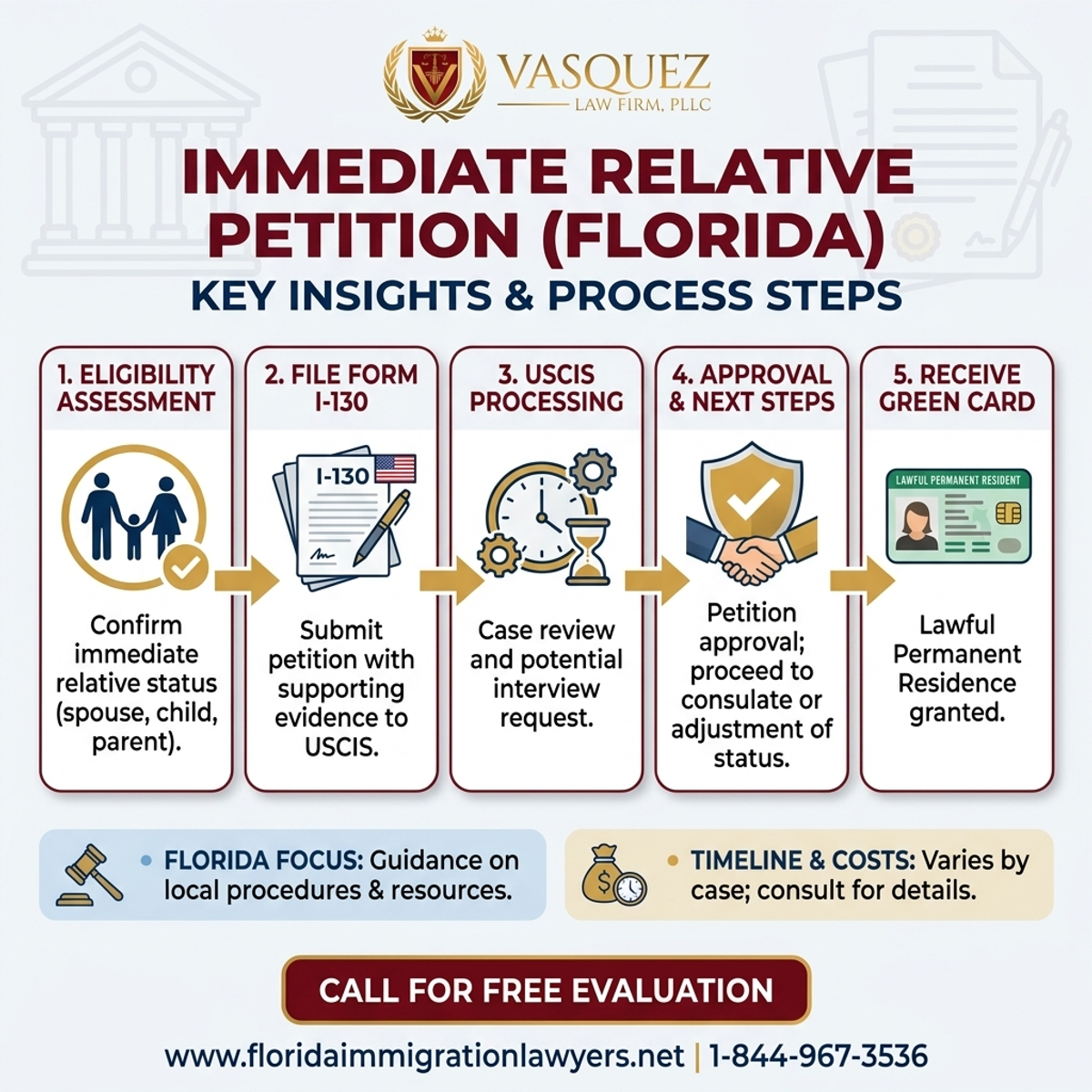
Step-by-Step Process — Immediate Relative Petition in Florida: Key Insights
Each step is crucial. Errors or missing documents can delay processing, so attention to detail is vital.
When gathering documents, it's not just about having them, but ensuring they are current, accurate, and properly translated if not in English. For example, if you're sponsoring a parent, you'll need your birth certificate showing your parent's name, and your parent's birth certificate. If names have changed due to marriage or other legal processes, include documentation proving those changes. Organize everything meticulously, perhaps in binders, to make it easy for USCIS officers to review.
Completing Form I-130 requires careful attention to every field. Any discrepancies or omissions can trigger a Request for Evidence (RFE) or even a denial. It's advisable to review the form multiple times, perhaps with a trusted friend or legal professional, to catch any potential errors. Remember, this form is the foundational piece of your petition, establishing the core relationship that qualifies your relative for immigration.
After submission, keep a copy of everything you sent. The receipt notice (Form I-797C) will contain a case number, which is essential for tracking your application's progress online. This notice confirms that USCIS has received your petition and has begun processing it. If you don't receive a receipt notice within a few weeks, contact USCIS to inquire. This proactive approach can prevent significant delays down the line.
Document Checklist for Immediate Relative Petitions
Ensure you have the following documents ready when filing:
- Proof of U.S. citizenship (passport, birth certificate)
- Marriage certificate (for spouses)
- Birth certificates (for children or parents)
- Evidence of relationship (photos, correspondence)
- Affidavit of support (if necessary)
Proof of U.S. Citizenship
To prove your U.S. citizenship, you can submit a copy of your U.S. birth certificate, a U.S. passport (current or expired), a Consular Report of Birth Abroad (FS-240, DS-1350, or FS-545), a Certificate of Naturalization (Form N-550 or N-570), or a Certificate of Citizenship (Form N-560 or N-561). Ensure the copies are clear and legible. Never send original documents unless specifically requested by USCIS.
Relationship Documentation
For spouses, a certified copy of your marriage certificate is paramount. If either spouse was previously married, you must also provide proof of termination of all prior marriages (e.g., divorce decrees, annulment records, or death certificates). For children, a certified copy of the child's birth certificate listing you as the parent is required. For parents, your birth certificate listing the parent you are petitioning for is necessary. All foreign documents must be accompanied by a certified English translation.
Supporting Evidence
Supporting evidence strengthens your application. Include photos, correspondence, and joint financial documents to prove the relationship's authenticity.
For marriage-based petitions, this can include joint bank statements, joint utility bills, joint leases or property deeds, insurance policies listing each other as beneficiaries, and photos from different stages of your relationship (dating, engagement, wedding, family events). Affidavits from friends, family, and employers who can attest to the bona fide nature of your relationship are also valuable. For other immediate relatives, such as parents or children, evidence of ongoing communication and support can also be beneficial, though the primary focus remains on official civil documents.
Affidavit of Support (Form I-864)
The Affidavit of Support, Form I-864, is a legally binding contract where the petitioner agrees to financially support the immigrant beneficiary. This is crucial to ensure the immigrant will not become a public charge. The petitioner must demonstrate income at or above 125% of the federal poverty guidelines for their household size. If the petitioner's income is insufficient, a joint sponsor may be required. This form is typically submitted later in the process, either with the adjustment of status application or during consular processing.
Understanding Processing Times and Expectations
Processing times can vary. As of 2026, here’s an expected timeline:
| Stage | Typical Timeframe | Notes |
|---|---|---|
| Form I-130 Processing | 6-12 months | Varies based on caseload and completeness of application |
| Consular Processing | 3-6 months | For relatives outside the U.S. |
| Adjustment of Status | 8-14 months | For relatives already in the U.S. |
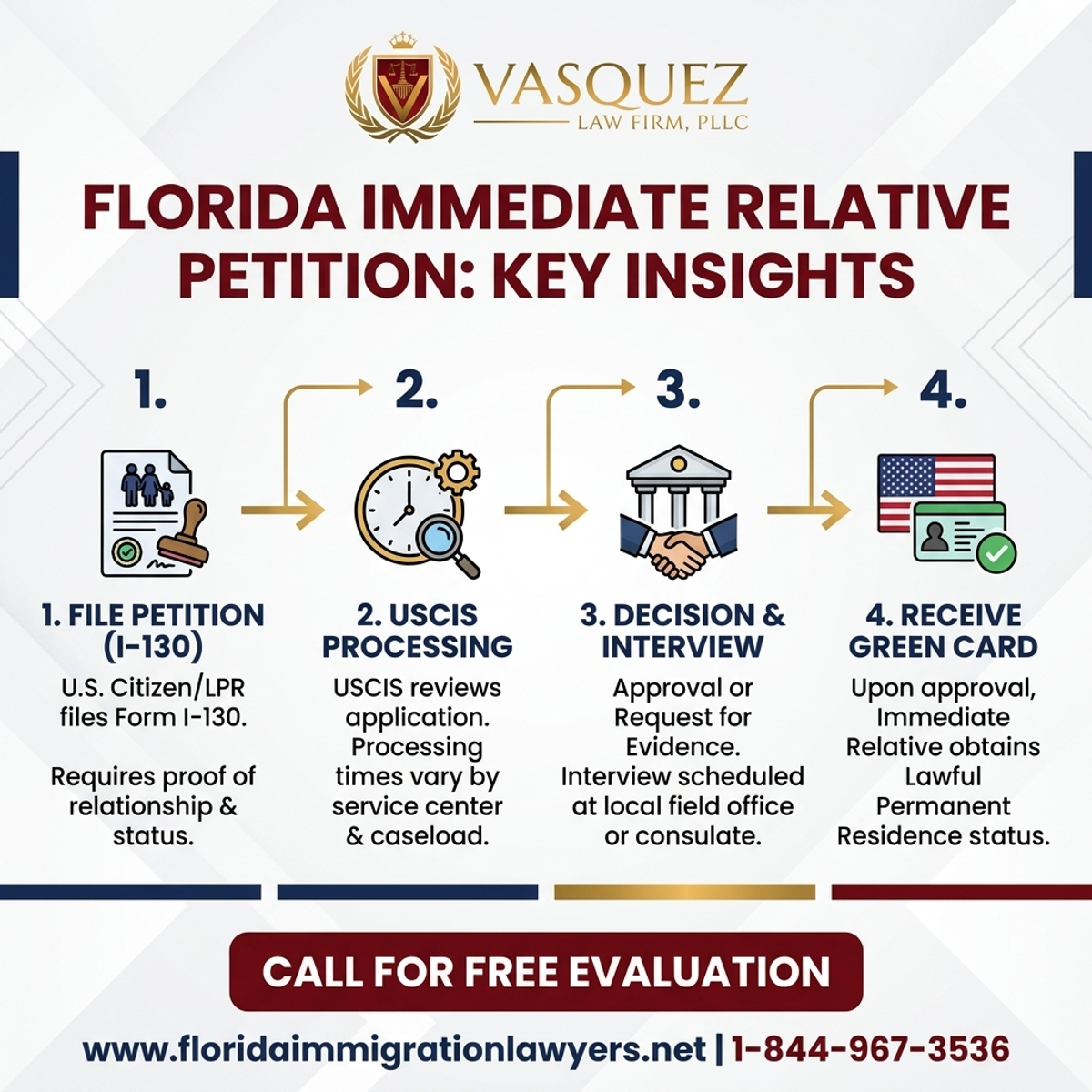
Key Statistics — Immediate Relative Petition in Florida: Key Insights
These timelines are estimates and can change based on USCIS workload and individual circumstances.
Several factors can influence these processing times. The specific USCIS service center handling your case, the volume of applications they receive, and the completeness of your submission all play a role. For instance, a Request for Evidence (RFE) can significantly extend processing times, as it requires you to gather and submit additional documents, and USCIS then needs to review them. Being proactive and submitting a thorough, well-organized application from the outset can help mitigate potential delays.
You can monitor the status of your petition online using the case number provided on your Form I-797C receipt notice. USCIS also provides estimated processing times on their website for each service center, which can give you a more current idea of what to expect. While the process requires patience, staying informed and responding promptly to any USCIS requests are crucial steps to keep your application moving forward efficiently.
Cost Factors and Fee Breakdown
Understanding cost factors is crucial when filing an immediate relative petition. Here is a general breakdown:
| Item | Typical Fee | Notes |
|---|---|---|
| Form I-130 Filing Fee | Varies | Check the USCIS website for current fees |
| Medical Examination | Varies | Required for adjustment of status |
| Attorney Fees | Varies | Optional, but recommended for complex cases |
Fees are subject to change. Always verify with official sources for the most current information.
In addition to the Form I-130 filing fee, there are other potential costs depending on whether the beneficiary is adjusting status within the U.S. or undergoing consular processing abroad. For adjustment of status, the primary additional fee is for Form I-485, Application to Register Permanent Residence or Adjust Status, which also includes biometric services. If the beneficiary is outside the U.S., they will pay a visa application processing fee to the Department of State and an immigrant visa issuance fee to USCIS.
Medical examinations are mandatory for all green card applicants and must be performed by a USCIS-approved civil surgeon. The cost for this varies significantly by provider and location, typically ranging from $200 to $500. While attorney fees are optional, the value of expert guidance from Florida Immigration Lawyers cannot be overstated, especially for complex cases, as they can help avoid costly mistakes and delays. It's wise to budget for all these potential expenses to ensure a smooth financial aspect of your immigration journey.
Common Mistakes to Avoid
- Incomplete Forms: Missing information can delay processing.
- Incorrect Filing Fees: Using outdated fees can result in rejections.
- Inadequate Documentation: Failing to prove the relationship can lead to denials.
- Outdated Contact Information: USCIS cannot reach you if your contact details are incorrect.
- Not Responding to RFE: Ignoring requests for additional evidence can halt the process.
- Missing Deadlines: Late submissions can invalidate your application.
- Ignoring Legal Advice: Complex cases benefit from professional guidance.
One of the most frequent errors is submitting forms with blank fields or failing to sign where required. USCIS is very strict about this; even a single missing signature or unanswered question can lead to the rejection of your entire package. Always double-check every page of every form before mailing. Furthermore, ensure you are using the most current version of the forms available on the USCIS website, as older versions are often rejected.
A critical mistake is underestimating the importance of robust evidence, particularly for marriage-based petitions. USCIS officers are trained to detect fraudulent marriages, and a lack of compelling evidence of a shared life can raise red flags. Don't just include a few photos; provide a narrative of your relationship through joint documents, travel itineraries, and communications. If you receive an RFE, take it seriously and provide all requested information comprehensively and promptly. Failure to do so is a common reason for denials.
Consider the case of a couple in Tampa, John and Maria. John, a U.S. citizen, petitioned for Maria, his spouse. They submitted their Form I-130 with a marriage certificate and a few photos. USCIS issued an RFE requesting more evidence of a bona fide marriage. John, busy with work, delayed gathering documents and missed the deadline. Their petition was denied, forcing them to refile and incur significant delays and additional costs. This scenario highlights why meticulous preparation and timely responses are not just recommendations but necessities.
When to Call a Lawyer
Legal assistance is crucial in complex cases or when facing difficulties with your application. If you encounter issues such as previous immigration violations or criminal records, consulting with a lawyer is advisable. Florida Immigration Lawyers can provide expert guidance and representation to navigate these challenges. Call us at 1-844-967-3536.
You should consider contacting a lawyer if your case involves any complexities beyond a straightforward petition. This includes situations where the beneficiary has a history of overstaying a visa, has entered the U.S. without inspection, or has any criminal record, no matter how minor. These issues can trigger inadmissibility grounds that require waivers, a process best handled by experienced legal counsel.
Additionally, if you've previously had an immigration petition denied, or if your relationship has unusual circumstances (e.g., a significant age difference, cultural differences that might be misunderstood by USCIS, or a short marriage), a lawyer can help present your case effectively. Florida Immigration Lawyers are adept at anticipating potential issues and crafting strong arguments, ensuring your application has the best chance of approval. Don't hesitate to reach out for a free consultation at 1-844-967-3536 if you're unsure about any aspect of your case.
About Florida Immigration Lawyers
Florida Immigration Lawyers is a leading firm dedicated to helping clients with their immigration needs. We specialize in all areas of immigration law, including family immigration, asylum, and deportation defense. Our team is available 24/7, offering free consultations. Contact us at 1-844-967-3536 or visit our website at www.floridaimmigrationlawyers.net.
Our commitment extends beyond just filing forms; we provide comprehensive support, from initial consultation to the final interview. With a deep understanding of both federal immigration laws and the unique circumstances of Florida residents, we offer personalized strategies tailored to each client's specific situation. Our multilingual staff is ready to assist you, ensuring clear communication and peace of mind throughout your immigration journey.
Sources and References
- U.S. Citizenship and Immigration Services (USCIS)
- Executive Office for Immigration Review (EOIR)
- 8 U.S.C. Chapter 12 - Immigration and Nationality Act
Frequently Asked Questions (FAQs) About Immediate Relative Petitions in Florida
Q1: Can I file an immediate relative petition if I am a Legal Permanent Resident (Green Card holder)?
No, only U.S. citizens can file immediate relative petitions for their spouses, unmarried children under 21, and parents. Legal Permanent Residents (LPRs) can file Form I-130 for their spouses and unmarried children of any age, but these categories fall under the family preference system, which involves annual visa limits and often longer waiting times. You must be a U.S. citizen to benefit from the immediate relative category's expedited processing.
Q2: What if my relative entered the U.S. illegally? Can I still petition for them as an immediate relative?
This is a complex situation. While a U.S. citizen can file Form I-130 for an immediate relative who entered illegally, the beneficiary typically cannot adjust status within the U.S. without having been inspected and admitted or paroled. They would usually need to leave the U.S. for consular processing, which could trigger a 3-year or 10-year bar to re-entry. It is crucial to consult with Florida Immigration Lawyers at 1-844-967-3536 to assess eligibility for waivers or other relief.
Q3: Do I need a lawyer to file an immediate relative petition?
While not legally required, hiring an immigration lawyer is highly recommended, especially for complex cases. An attorney can help ensure all forms are correctly filled out, all necessary evidence is submitted, and potential issues are identified and addressed proactively. This can prevent costly delays, RFEs, or even denials due to technical errors or misunderstandings of immigration law. Florida Immigration Lawyers provide expert guidance to navigate the process smoothly.
Q4: What happens if my Form I-130 is denied?
If your Form I-130 is denied, USCIS will send you a written notice explaining the reasons. You may have the option to appeal the decision to the Board of Immigration Appeals (BIA) or to file a new petition. The best course of action depends on the specific reasons for denial. It is crucial to consult with an immigration attorney promptly to understand your options and strategize the next steps, as an appeal has strict deadlines.
Q5: Can my immediate relative work while their green card application is pending?
If your immediate relative is adjusting status within the U.S., they can apply for an Employment Authorization Document (EAD) by filing Form I-765 concurrently with or after their Form I-485. Once the EAD is approved, they can legally work in the U.S. while their green card application is pending. However, if they are undergoing consular processing abroad, they cannot work in the U.S. until they receive their immigrant visa and enter as a lawful permanent resident.
Q6: What is the difference between adjustment of status and consular processing?
Adjustment of status is for beneficiaries who are already physically present in the U.S. and meet eligibility requirements to apply for a green card without leaving the country. Consular processing is for beneficiaries who are outside the U.S. or ineligible for adjustment of status; they complete their green card application through a U.S. embassy or consulate in their home country. The choice depends on the beneficiary's current location and immigration history.
Related services: family petition process, family-based green cards, fiancé visa (K-1), marriage-based immigration.
This article provides general legal information and is not intended as legal advice. Every case is unique, and outcomes depend on specific facts and circumstances. Contact an attorney for advice about your particular situation.
For personalized assistance, call Florida Immigration Lawyers at 1-844-967-3536. Se Habla Español - Estamos aquí para ayudarle.
If you need legal assistance, learn more about family immigration consultation, or call us at 1-844-967-3536 for a free consultation.
Do Not Navigate This Process Alone
Our experienced immigration attorneys are ready to fight for you. Get a free, confidential consultation today.
Se Habla Español
Frequently Asked Questions
Harold Estrada-Rodriguez
Florida Immigration Attorney · FL Bar No. 1041171
Florida Bar attorney handling Florida-jurisdiction immigration matters. Bilingual representation, free consultations.
Available 24/7 - Free Evaluations
Related Legal Services
Our Florida immigration attorneys can help you with immigration practice areas, free immigration consultation and experienced immigration attorneys. Call today at 1-844-967-3536 for a free consultation.
Related Links
Related Topics
Free Legal Consultation
Discuss your case with our experienced attorneys. We're available 24/7.
Se Habla Español - Estamos aquí para ayudarle.
Related Articles
Green Card Through Marriage in Florida: A 2026 Guide
Obtaining a green card through marriage in Florida involves several steps, including filing Form I-130 and attending an interview. Learn the process and avoid common pitfalls. Contact Florida Immigration Lawyers for guidance.
Diversity Visa: Green Card Lottery in Florida | VLF Florida
Explore the Diversity Visa Lottery process in Florida, including eligibility, application steps, and common pitfalls. Gain insights and expert advice from Florida Immigration Lawyers to maximize your chances of success.
DACA Work Permit Florida: Renewals & New Applications 2026
Navigating the DACA work permit Florida process in 2026 requires a deep understanding of current eligibility criteria, application steps, and potential legal challenges. This comprehensive guide from Florida Immigration Lawyers provides essential information for DACA recipients seeking to renew their employment authorization (EAD). Learn about the necessary documents, estimated costs, and crucial timelines to ensure a successful application. We cover common mistakes to avoid and highlight when to seek expert legal counsel, especially given the evolving legal landscape surrounding DACA. Our firm is dedicated to helping individuals in Gainesville and across Florida protect their DACA status and secure their ability to work legally.
Understanding 2026 Immigration Policy Changes in Florida
Explore how 2026 immigration policy changes affect Florida, particularly Tampa. Understand new rules, timelines, and costs. Call Florida Immigration Lawyers for expert guidance today.