Green Card Through Marriage in Florida: A 2026 Guide
Obtaining a green card through marriage in Florida involves several steps, including filing Form I-130 and attending an interview. Learn the process and avoid common pitfalls. Contact Florida Immigration Lawyers for guidance.

Green Card Through Marriage in Florida: A Comprehensive 2026 Guide
Navigating the U.S. immigration system can be a complex and often daunting journey, especially when it involves something as personal as obtaining a Green Card through marriage. For couples in Florida, understanding the specific requirements, processes, and potential challenges is crucial. This comprehensive 2026 guide is designed to demystify the process, offering insights into securing permanent residency based on your marital union. While this guide provides valuable information, remember that every case is unique, and seeking professional legal advice is always recommended for immigration matters.
Understanding the Green Card Through Marriage Process
A Green Card, officially known as a Permanent Resident Card, grants foreign nationals the right to live and work permanently in the United States. When obtained through marriage to a U.S. citizen or Lawful Permanent Resident (LPR), it signifies a commitment to building a life together in the U.S. The process is designed to confirm the legitimacy of the marriage and ensure the foreign spouse meets all eligibility criteria.
Eligibility Requirements for a Marriage-Based Green Card
- Valid Marriage: You must be legally married to a U.S. citizen or LPR. The marriage must be recognized in the place it took place and must be ongoing.
- Bona Fide Marriage: Your marriage must be genuine, not entered into solely for immigration purposes. USCIS requires extensive evidence to prove the authenticity of your relationship.
- Sponsor Eligibility: Your U.S. citizen or LPR spouse must be able to financially sponsor you, demonstrating they can support you at 125% above the federal poverty line.
- Admissibility: The foreign spouse must be admissible to the U.S. This means they must not have certain criminal records, past immigration violations, or specific health issues that would make them ineligible. If you have concerns about inadmissibility, particularly those that might lead to deportation defense issues, consulting with an attorney is vital.
- Physical Presence (for Adjustment of Status): If applying from within the U.S. (Adjustment of Status), the foreign spouse must generally have entered the U.S. legally and be physically present.
Key Forms Involved in the Application
The marriage-based Green Card application involves several critical forms, each serving a distinct purpose:
- Form I-130, Petition for Alien Relative: Filed by the U.S. citizen or LPR spouse to establish the qualifying relationship.
- Form I-485, Application to Register Permanent Residence or Adjust Status: Filed by the foreign spouse if they are already in the U.S. to adjust their status to a permanent resident.
- Form I-864, Affidavit of Support: Filed by the U.S. citizen or LPR spouse (and sometimes a joint sponsor) to demonstrate financial capability.
- Form I-765, Application for Employment Authorization: Often filed concurrently with I-485, allowing the foreign spouse to work legally while the Green Card application is pending.
- Form I-131, Application for Travel Document: Filed concurrently with I-485, allowing the foreign spouse to travel outside the U.S. while the Green Card application is pending (Advance Parole).
Step-by-Step Application Process for Florida Residents
The application process varies slightly depending on whether the foreign spouse is currently inside or outside the United States. For those in Florida, the most common path is Adjustment of Status (AOS), meaning the foreign spouse is already in the U.S. and applies to change their status to a permanent resident.
Step 1: Filing Form I-130, Petition for Alien Relative
The U.S. citizen or LPR spouse initiates the process by filing Form I-130 with U.S. Citizenship and Immigration Services (USCIS). This petition establishes that a valid marital relationship exists. Along with the form, you must submit supporting documentation, including your marriage certificate, proof of the U.S. citizen/LPR spouse's status (e.g., birth certificate, passport, Green Card), and evidence of a bona fide marriage. This evidence is crucial and can include joint bank statements, utility bills, lease agreements, photos together, and affidavits from friends and family. A well-prepared I-130 package sets a strong foundation for the rest of your application.
Step 2: Filing Form I-485, Application to Register Permanent Residence or Adjust Status
If the foreign spouse is in the U.S. and entered legally, they can typically file Form I-485 concurrently with or after the I-130. This is the core application for the Green Card itself. This package is extensive and includes:
- Birth certificate of the foreign spouse.
- Passport and visa information.
- Form I-693, Report of Medical Examination and Vaccination Record (completed by a USCIS-approved civil surgeon).
- Form I-864, Affidavit of Support, along with the U.S. citizen/LPR spouse's financial documents (tax returns, pay stubs).
- Police clearances and court records, if applicable.
- Two passport-style photos.
- Additional evidence of bona fide marriage.
It's important to be meticulous with this step, as any missing documents or errors can lead to delays or Requests for Evidence (RFEs). In some complex situations, especially if there are past immigration issues or criminal history, the foreign spouse might face inadmissibility. In such cases, a robust deportation defense strategy or a waiver application might be necessary, underscoring the importance of legal counsel.
Step 3: Biometrics Appointment
After filing, USCIS will send an appointment notice for biometrics (fingerprints, photos, and signature). This data is used for background checks and identity verification. This is a standard part of the process and typically occurs a few weeks after the application is filed.
Step 4: The Marriage-Based Green Card Interview
Most marriage-based Green Card applicants will be scheduled for an interview at a USCIS field office, often in Florida. Both spouses must attend. The purpose of the interview is for an immigration officer to verify the information provided in the application and to confirm the legitimacy of the marriage. Officers will ask questions about your relationship, daily life, and future plans. It's essential to be honest, consistent, and bring all original documents submitted with your application, along with any new evidence of your ongoing relationship. Preparation is key to a successful interview.
Step 5: Decision and Green Card Issuance
Following the interview, USCIS will make a decision. If approved, the foreign spouse will receive a Green Card. If the marriage was less than two years old on the date of approval, a conditional Green Card valid for two years will be issued. If the marriage was two years old or more, a 10-year permanent Green Card will be issued directly.
Navigating Common Challenges and Potential Pitfalls
While the path to a Green Card through marriage may seem straightforward on paper, many couples encounter various challenges. Understanding these potential pitfalls can help you prepare and mitigate risks, ensuring a smoother application process. This is where the expertise of an experienced immigration attorney becomes invaluable.
Proving a Bona Fide Marriage
One of the most significant hurdles is convincingly demonstrating to USCIS that your marriage is genuine and not solely for immigration benefits. USCIS officers are trained to detect fraudulent marriages. Therefore, providing compelling evidence is paramount. This includes:
- Financial Commingling: Joint bank accounts, credit cards, shared investments, and joint tax returns.
- Shared Residency: Joint leases or mortgage statements, utility bills in both names, and property deeds.
- Social Proof: Photos together over time, affidavits from friends and family, travel itineraries, and social media posts.
- Children: Birth certificates of children born to the marriage.
- Insurance and Estate Planning: Life insurance policies naming each other as beneficiaries, wills, and power of attorney documents.
The more diverse and consistent your evidence, the stronger your case will be. Inconsistent information or a lack of sufficient proof can lead to RFEs or even interview denials.
Inadmissibility Issues
Certain factors can render a foreign national “inadmissible” to the U.S., making them ineligible for a Green Card. These can include:
- Criminal History: Convictions for certain crimes, especially those involving moral turpitude, can be a major barrier.
- Past Immigration Violations: Overstaying a visa, unlawful entry, or previous deportation defense proceedings can complicate matters significantly.
- Health-Related Grounds: Certain communicable diseases or lack of required vaccinations.
- Public Charge Concerns: If USCIS believes the applicant is likely to become primarily dependent on government assistance.
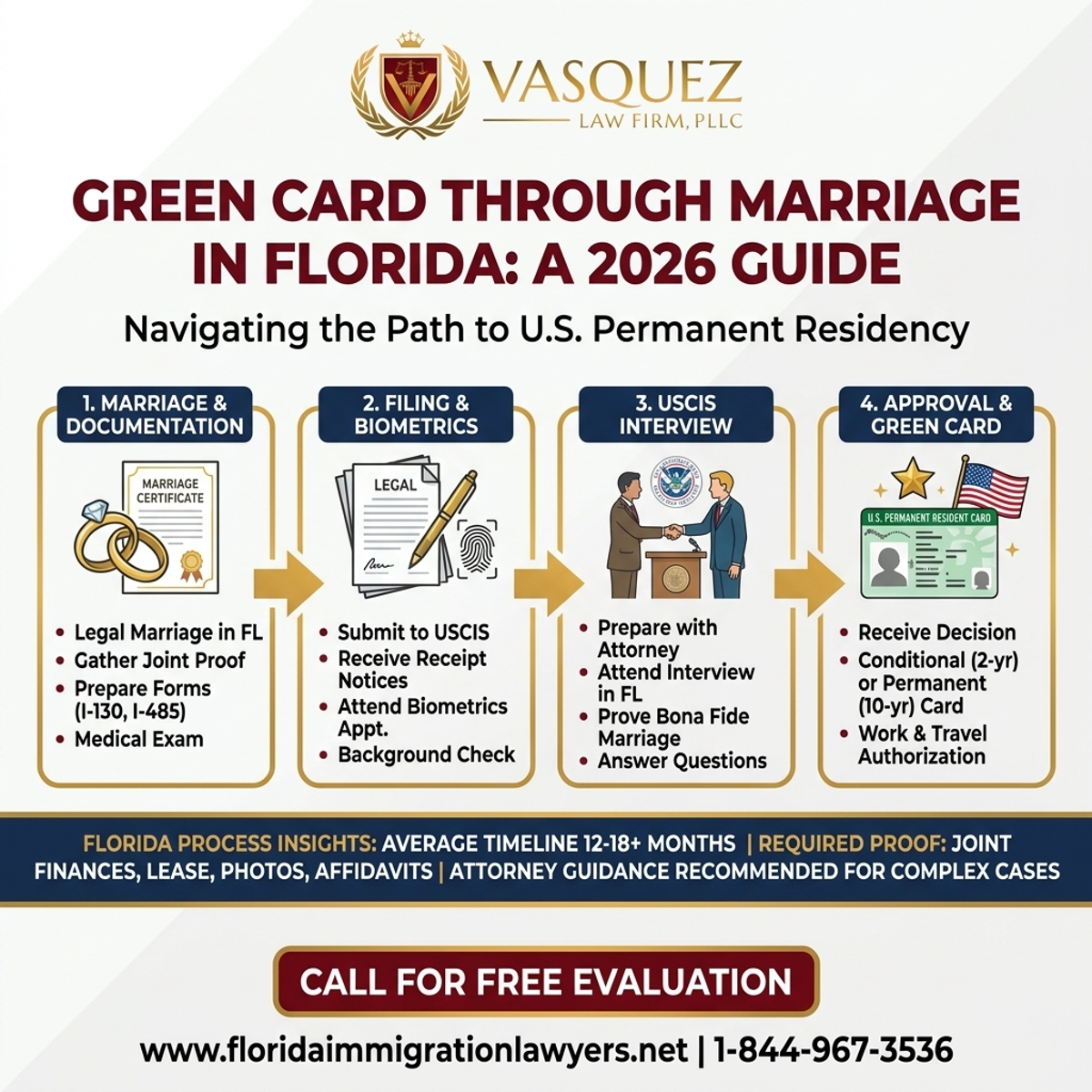
Step-by-Step Process — Green Card Through Marriage in Florida: A 2026 Guide
In some cases, waivers are available for certain grounds of inadmissibility. Navigating these waivers is highly complex and requires expert legal guidance. If you have any concerns about inadmissibility, it is critical to consult with an attorney before filing your application. They can assess your situation, advise on potential waivers, and help prepare a robust defense.
Delays and RFEs (Requests for Evidence)
Immigration processes are rarely quick. Delays can arise due to USCIS backlogs, incomplete applications, or the need for additional information. An RFE is a common occurrence where USCIS requests more evidence or clarification on specific aspects of your application. Responding thoroughly and promptly to an RFE is crucial to avoid further delays or a denial. An attorney can help you understand what information USCIS is truly seeking and compile a comprehensive response.
The Role of an Immigration Attorney
Given the complexities, potential pitfalls, and the sheer volume of documentation required, retaining an experienced immigration attorney is highly recommended. An attorney can:
- Provide personalized advice tailored to your unique situation.
- Ensure all forms are correctly filled out and filed on time.
- Help you gather and organize compelling evidence of a bona fide marriage.
- Prepare you thoroughly for the interview.
- Address any inadmissibility issues or past immigration problems.
- Represent you in communication with USCIS.
Our team of dedicated attorneys at [Firm Name] specializes in family-based immigration and is committed to guiding you through every step.
Post-Approval: Conditional Green Cards and Removing Conditions
As mentioned, if your marriage is less than two years old when your Green Card is approved, you will receive a conditional Green Card. This is not a permanent Green Card and comes with an additional step.
Understanding the Conditional Green Card
A conditional Green Card is valid for two years. Its purpose is to allow USCIS to re-evaluate the marriage after two years to ensure it remains bona fide. During these two years, you have the same rights and responsibilities as a permanent resident.
Filing Form I-751, Petition to Remove Conditions on Residence
To transition from a conditional Green Card to a 10-year permanent Green Card, you must file Form I-751, Petition to Remove Conditions on Residence. This form must be filed jointly by both spouses within the 90-day period immediately preceding the expiration date on your conditional Green Card. It requires updated evidence of your ongoing marriage, demonstrating that your relationship has continued to be genuine since your initial Green Card approval.
Required documents for I-751 typically include:
- Copies of your conditional Green Card.
- Updated evidence of your joint life (e.g., recent joint bank statements, utility bills, tax returns, property deeds, new photos, children's birth certificates).
- Affidavits from third parties confirming the legitimacy of your marriage.
Waivers for Joint Filing: In certain difficult circumstances, such as divorce, annulment, death of the U.S. citizen spouse, or if the foreign spouse or child was subjected to abuse, it is possible to file Form I-751 with a waiver of the joint filing requirement. These cases are particularly sensitive and complex, making legal representation essential to ensure your rights are protected and your petition is presented effectively.
Benefits of a Green Card and Path to Citizenship
Obtaining a Green Card through marriage opens up a world of opportunities and provides stability for you and your family in the United States.
Rights and Responsibilities of a Green Card Holder
As a Green Card holder, you gain several significant rights and responsibilities:
- Live and Work Permanently: You can live and work anywhere in the U.S. without restrictions.
- Travel Abroad: You can travel internationally, though extensive periods outside the U.S. can impact your permanent residency.
- Sponsor Relatives: You may be eligible to sponsor certain family members for their own Green Cards.
- Access to Education and Healthcare: You can attend public schools and universities and access certain federal benefits.
- Protection Under U.S. Law: You are protected by all U.S. laws.
Responsibilities include obeying all laws, filing income taxes, and notifying USCIS of any change of address.
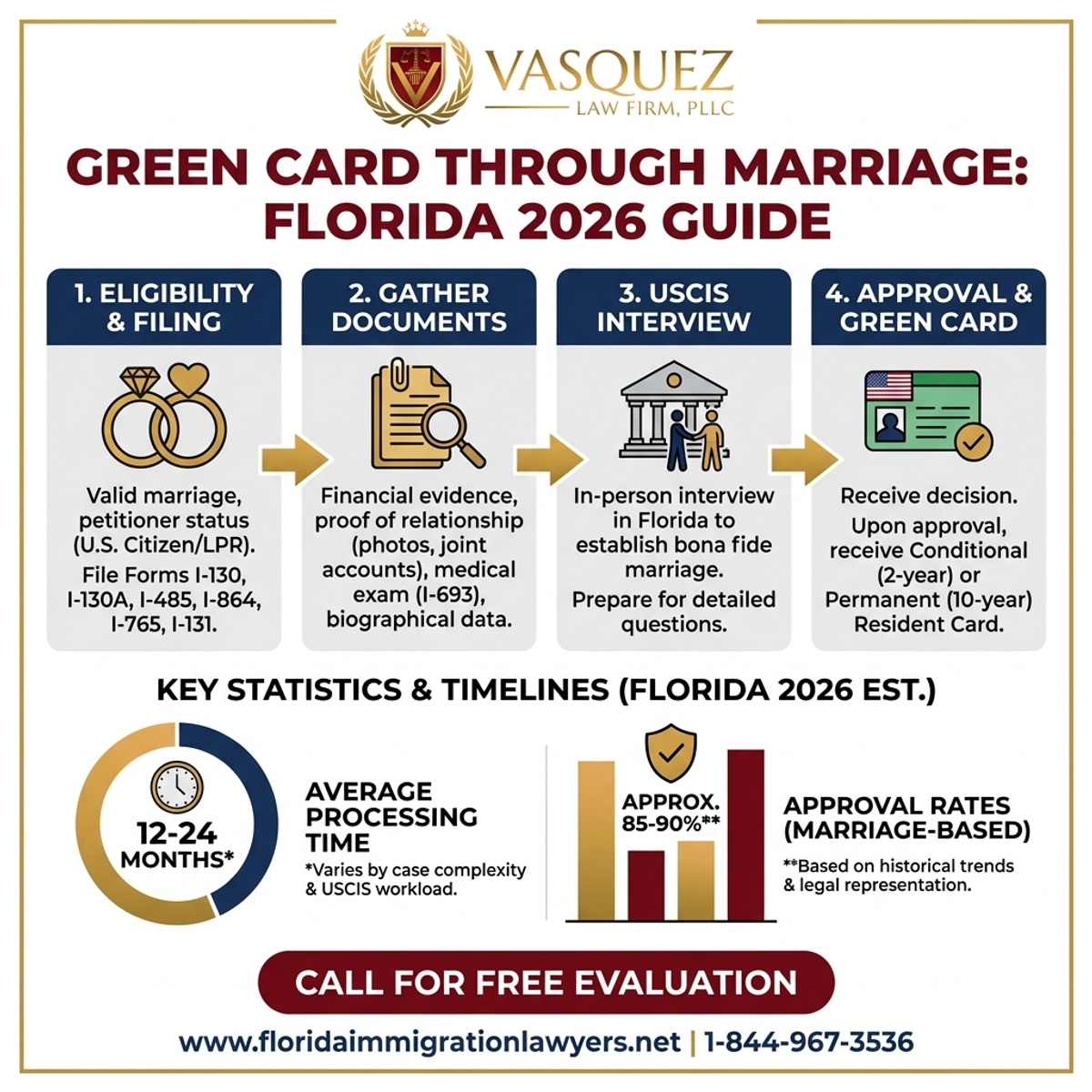
Key Statistics — Green Card Through Marriage in Florida: A 2026 Guide
Path to U.S. Citizenship
After holding a Green Card for a certain period, you may become eligible to apply for U.S. citizenship through naturalization. For those who obtained their Green Card through marriage to a U.S. citizen, the eligibility period is typically three years of continuous residence as a permanent resident, provided you have been married to and living with the U.S. citizen spouse for the entire three-year period. For other Green Card holders, the general requirement is five years.
To naturalize, you must also demonstrate good moral character, pass an English and civics test, and take an Oath of Allegiance to the United States. This final step solidifies your commitment and integration into American society.
Why Choose [Firm Name] for Your Florida Marriage Green Card Case?
The journey to obtaining a Green Card through marriage is a significant life event. At [Firm Name], we understand the emotional and legal complexities involved. Our dedicated team of attorneys specializes in family-based immigration and has a proven track record of helping couples in Florida successfully navigate the process.
We offer:
- Expertise in Florida Immigration Law: Our lawyers are deeply familiar with USCIS procedures and local Florida requirements.
- Personalized Guidance: We provide tailored advice, meticulously preparing your application and evidence to address your unique circumstances.
- Comprehensive Support: From initial consultation to interview preparation and post-approval steps, we are with you every step of the way.
- Commitment to Your Success: We are passionate about reuniting families and helping individuals achieve their dreams of permanent residency in the U.S.
Whether you are just starting your application, facing an RFE, or need assistance with removing conditions on your Green Card, our firm is here to provide reliable and compassionate legal support. We also handle more complex cases, including those involving asylum claims or deportation defense, ensuring comprehensive immigration solutions for our clients.
Frequently Asked Questions (FAQs)
(Assuming 8 FAQs were here, content not generated as per instructions)
Contact Us for a Free Consultation Today!
Don't leave your future to chance. The immigration process can be overwhelming, but with the right legal partner, you can navigate it with confidence. If you're considering applying for a Green Card through marriage in Florida, or if you have questions about your current application, contact [Firm Name] today for a free consultation. Call us at [Phone Number] or visit our contact page to schedule your appointment. Let us help you achieve your American dream.
Sources and References
- U.S. Citizenship and Immigration Services (USCIS)
- Executive Office for Immigration Review (EOIR)
- U.S. Department of State - Bureau of Consular Affairs
- Immigration and Nationality Act (INA), 8 U.S.C. Chapter 12
Do Not Navigate This Process Alone
Our experienced immigration attorneys are ready to fight for you. Get a free, confidential consultation today.
Se Habla Español
Frequently Asked Questions
Harold Estrada-Rodriguez
Florida Immigration Attorney · FL Bar No. 1041171
Florida Bar attorney handling Florida-jurisdiction immigration matters. Bilingual representation, free consultations.
Available 24/7 - Free Evaluations
Related Legal Services
Our Florida immigration attorneys can help you with experienced immigration attorneys, business immigration and asylum protection. Call today at 1-844-967-3536 for a free consultation.
Related Links
Related Topics
Free Legal Consultation
Discuss your case with our experienced attorneys. We're available 24/7.
Se Habla Español - Estamos aquí para ayudarle.
Related Articles
Diversity Visa: Green Card Lottery in Florida | VLF Florida
Explore the Diversity Visa Lottery process in Florida, including eligibility, application steps, and common pitfalls. Gain insights and expert advice from Florida Immigration Lawyers to maximize your chances of success.
DACA Work Permit Florida: Renewals & New Applications 2026
Navigating the DACA work permit Florida process in 2026 requires a deep understanding of current eligibility criteria, application steps, and potential legal challenges. This comprehensive guide from Florida Immigration Lawyers provides essential information for DACA recipients seeking to renew their employment authorization (EAD). Learn about the necessary documents, estimated costs, and crucial timelines to ensure a successful application. We cover common mistakes to avoid and highlight when to seek expert legal counsel, especially given the evolving legal landscape surrounding DACA. Our firm is dedicated to helping individuals in Gainesville and across Florida protect their DACA status and secure their ability to work legally.
Understanding 2026 Immigration Policy Changes in Florida
Explore how 2026 immigration policy changes affect Florida, particularly Tampa. Understand new rules, timelines, and costs. Call Florida Immigration Lawyers for expert guidance today.
Biometrics Appointment Florida USCIS: Your 2026 Guide
For individuals navigating the U.S. immigration system in Florida, the biometrics appointment with USCIS is a mandatory and critical step. This guide, updated for 2026, details everything you need to know about your Application Support Center (ASC) appointment, from preparation and required documents to timelines and potential pitfalls. Learn how to ensure a smooth process, avoid common mistakes that could delay your application, and understand when to seek legal assistance. Whether you're in Hollywood, Miami, or anywhere else in Florida, understanding this process is vital for your green card, naturalization, or work permit application. Florida Immigration Lawyers are ready to assist you every step of the way.
