I-601 Waiver Florida Guide: Overcoming Inadmissibility...
Discover how the I-601 waiver can help you overcome inadmissibility and achieve your immigration goals in Florida. This comprehensive guide details the application process, required documents, and critical factors for success, with a focus on residents in Jacksonville and surrounding areas. Learn about common mistakes to avoid and when professional legal assistance is essential. Florida Immigration Lawyers provides expert guidance for complex waiver cases, ensuring a robust application. Secure your future in the U.S. by understanding this vital immigration tool and how to navigate its challenges effectively. Contact us for a free consultation to discuss your specific situation.

The I-601 waiver, officially the Application for Waiver of Grounds of Inadmissibility, allows certain individuals in Florida and nationwide to overcome specific immigration bars. If you have been deemed inadmissible to the U.S. due to past actions or circumstances, this waiver may provide a path forward for you. It is crucial for family reunification and permanent residency for many.
- An I-601 waiver addresses specific grounds of inadmissibility.
- It requires demonstrating extreme hardship to a qualifying U.S. citizen or LPR relative.
- The process involves detailed documentation and careful legal strategy.
- Processing times can vary significantly, often taking months or even years.
- Expert legal guidance is highly recommended for a successful application.
I-601 Waiver Florida Guide: Overcoming Inadmissibility in 2026
Imagine your dream of living permanently in the United States, perhaps with your family in sunny Jacksonville, Florida, suddenly halted. You've discovered that a past mistake or circumstance has made you "inadmissible" to the U.S. immigration system. This can be a deeply distressing revelation, creating uncertainty and fear for your future.
Many individuals in Florida face this exact challenge. The good news is that for certain grounds of inadmissibility, a solution exists: the I-601 waiver, also known as the Application for Waiver of Grounds of Inadmissibility. This crucial immigration tool can open the door to lawful status, allowing you to reunite with loved ones and build a stable life.
At Florida Immigration Lawyers, we understand the complexities and emotional toll of the immigration process. Our dedicated team is here to guide you through every step, ensuring your application is strong and compelling. Do not let inadmissibility define your future. Call Florida Immigration Lawyers at 1-844-967-3536 for a free consultation and explore your options today.
Understanding the I-601 Waiver for Florida Residents
The I-601 waiver is a vital mechanism for individuals seeking to overcome certain legal barriers to entering or remaining in the United States. It allows applicants to request an exemption from specific grounds of inadmissibility that might otherwise prevent them from obtaining a visa or adjusting their status. This waiver is often critical for family-based immigration cases.
For those living in or seeking to immigrate to Florida, understanding the I-601 waiver is paramount. Whether you are in Miami, Orlando, Tampa, or Jacksonville, the principles remain the same. Our firm, serving all of Florida, can help you navigate these complex requirements.
What is Inadmissibility?
Inadmissibility refers to specific legal reasons that prevent an individual from entering the United States or from being granted a green card. These grounds are outlined in the Immigration and Nationality Act (INA) Section 212(a) and cover a broad range of issues. Understanding these grounds is the first step in determining if an I-601 waiver is appropriate for your situation.
Common grounds for inadmissibility include certain criminal convictions, misrepresentations or fraud committed to obtain immigration benefits, past immigration violations like unlawful presence, and specific health-related issues. Each ground has unique criteria and specific waivers that may apply. It is important to accurately identify your specific ground of inadmissibility.
Who Qualifies for an I-601 Waiver?
Eligibility for an I-601 waiver hinges on several factors. Generally, you must be the spouse, son, or daughter of a U.S. citizen or Lawful Permanent Resident (LPR), or in some cases, a K visa applicant. The most critical requirement is demonstrating "extreme hardship" to your qualifying U.S. citizen or LPR relative if you are denied admission to the United States.
The concept of extreme hardship is not easily defined and is evaluated on a case-by-case basis. It involves showing that your qualifying relative would suffer more than the usual hardship expected from family separation or relocation. This could include significant medical, financial, psychological, or educational burdens. Our attorneys can help you gather compelling evidence to meet this high standard.
Certain grounds of inadmissibility, such as those related to terrorism or persecution, are generally not waivable. However, many common issues, including some criminal offenses (under INA 212(h)) and fraud or misrepresentation (under INA 212(i)), can be waived through the I-601 process. We will assess your specific circumstances to determine the best path forward.
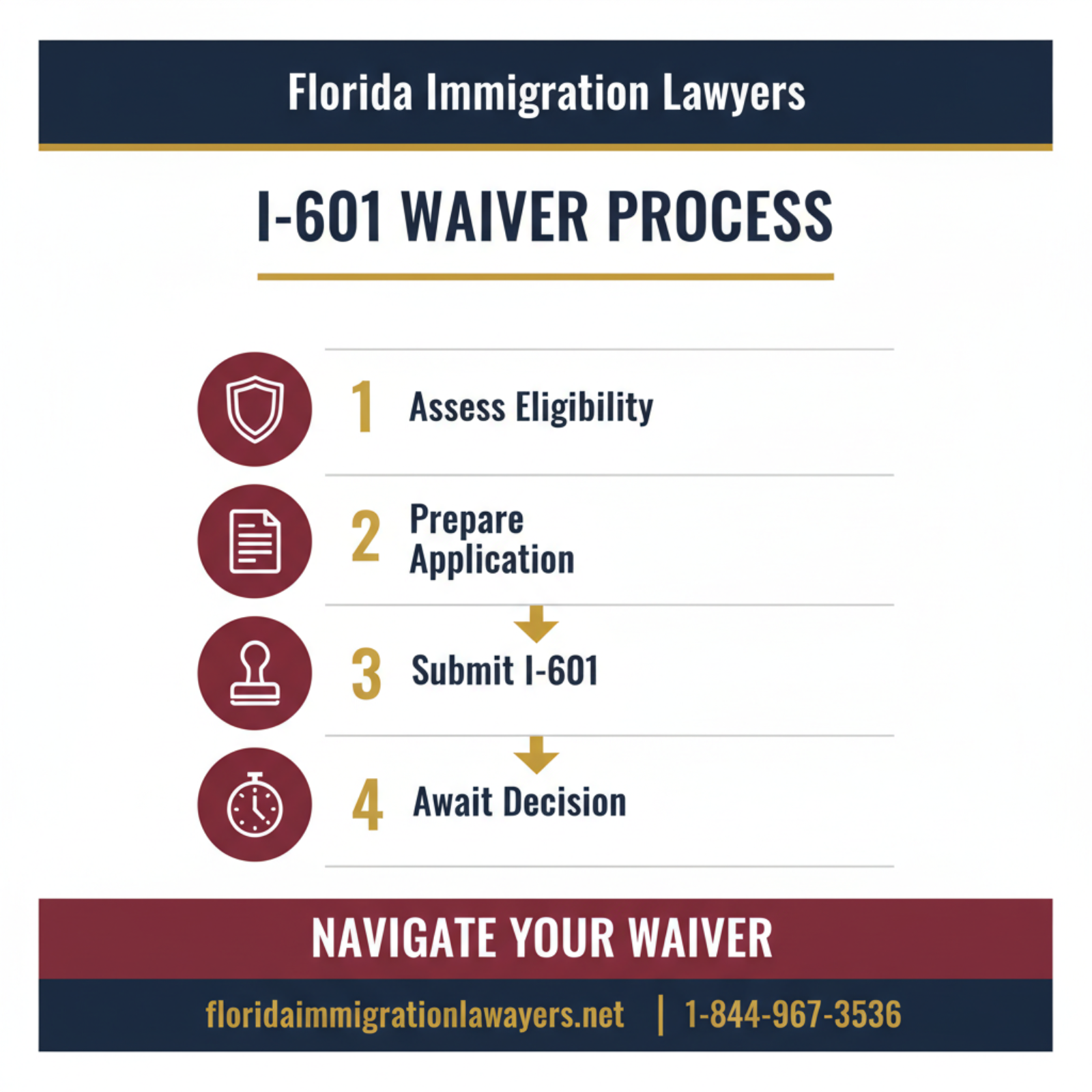
Step-by-Step Guide to Filing Your I-601 Waiver Application
Filing an I-601 waiver application is a detailed process that requires precision and thoroughness. Missing any step or failing to provide sufficient evidence can lead to significant delays or even denial. Here is a general step-by-step guide to help you understand what to expect:
-
Determine Eligibility and Ground of Inadmissibility: Your first step is to definitively identify the specific ground(s) of inadmissibility that apply to your case. This may require reviewing your immigration history, any prior denials, or consulting with an experienced immigration attorney. Understanding the exact nature of your inadmissibility is crucial for selecting the correct waiver.
We will help you understand if the I-601 waiver is the appropriate form for your specific situation. Sometimes, other waivers, like the I-601A provisional waiver for unlawful presence, might be more suitable. This initial assessment is vital for a successful outcome.
-
Identify Your Qualifying Relative: You must have a qualifying U.S. citizen or Lawful Permanent Resident (LPR) spouse, parent, or in some cases, child, who would suffer extreme hardship if you were denied admission. This qualifying relative is central to your waiver application. Their relationship to you forms the basis of the extreme hardship claim.
For certain criminal grounds, a waiver may be available if you are the victim of domestic violence, or if you have a U.S. citizen or LPR spouse, parent, son, or daughter. It's important to confirm this relationship and their status early in the process.
-
Gather Evidence of Extreme Hardship: This is arguably the most critical and challenging part of the I-601 waiver application. You must collect comprehensive and compelling evidence demonstrating that your qualifying relative would experience extreme hardship if you were not allowed to immigrate to the U.S. This evidence must go beyond typical separation difficulties.
Evidence can include medical records, psychological evaluations, financial statements, educational records, country condition reports, and affidavits from family members, employers, and community leaders. Our team helps you identify and organize the strongest evidence for your case, often focusing on unique factors specific to Florida living or the relative's needs.
-
Complete Form I-601, Application for Waiver of Grounds of Inadmissibility: Accurately fill out Form I-601. This form requires detailed personal information, a clear statement of the grounds of inadmissibility you are seeking to waive, and information about your qualifying relative. Any errors or omissions can lead to delays or requests for additional evidence.
Ensure all sections are completed truthfully and accurately. This includes providing your Alien Registration Number (A-Number), if applicable, and signing the form. An incomplete form will likely be rejected by USCIS.
-
Prepare Supporting Documents and Legal Brief: Beyond the form itself, you will compile a robust package of supporting documents. This includes all the evidence of extreme hardship, proof of your qualifying relationship, and any other documentation relevant to your specific inadmissibility ground. A well-structured legal brief from your attorney will summarize your case, explain how you meet the waiver requirements, and cite relevant legal precedents.
This brief is an opportunity to present your story in a persuasive legal argument. It connects your evidence to the legal standard of extreme hardship, making a clear case for approval. This is where the expertise of our attorneys at Florida Immigration Lawyers truly shines.
-
File the Application with USCIS or Department of State: The filing location for Form I-601 depends on your specific immigration process. If you are applying for adjustment of status within the U.S., you will generally file with USCIS. If you are applying for an immigrant visa at a U.S. embassy or consulate abroad, you will typically file the I-601 with the Department of State or USCIS lockbox facility, often after an interview.
Always verify the current filing instructions and fees on the USCIS website. Incorrect filing can result in your application being rejected. We stay updated on all filing procedures to ensure your application is submitted correctly.
-
Attend Interviews (If Required): In some cases, USCIS or a consular officer may request an interview to discuss your I-601 waiver application. This is an opportunity to clarify information and answer questions about your case and the hardship claimed. Preparation for this interview is crucial.
Our lawyers will help you prepare for any potential interviews, ensuring you understand the types of questions you might be asked and how to answer them effectively and truthfully. Having legal representation can provide peace of mind during this critical stage.
-
Await Decision: After your application is filed and any interviews are completed, you will enter a period of waiting for a decision. USCIS processing times can vary significantly. You can check the status of your case online using the receipt number provided by USCIS.
While waiting, it is important to avoid any actions that could negatively impact your case. If there are any changes to your circumstances, such as a change of address, you must inform USCIS promptly.
Essential Document Checklist for Your I-601 Waiver
A well-organized and comprehensive set of documents is vital for a successful I-601 waiver application. This checklist outlines the types of documents you will typically need to prepare. Remember, every case is unique, and additional documents may be required based on your specific grounds of inadmissibility and extreme hardship claim.
- Form I-601, Application for Waiver of Grounds of Inadmissibility: The properly completed and signed form.
- Proof of Filing Fee Payment: Check or money order for the correct fee. (Note: Do not include specific fee amounts as they change).
- Copy of Passport: Biographical page and visa stamps.
- Copy of Birth Certificate: For both the applicant and qualifying relative.
- Copy of Marriage Certificate: If applicable, proving the relationship to a U.S. citizen or LPR spouse.
- Proof of Qualifying Relative's U.S. Citizenship or LPR Status: Copy of birth certificate, passport, naturalization certificate, or green card.
- Detailed Personal Statement from Applicant: Explaining the circumstances leading to inadmissibility and why the waiver should be granted.
- Detailed Personal Statement from Qualifying Relative: Describing the extreme hardship they would face if the waiver is denied.
- Evidence of Financial Hardship: Tax returns, bank statements, mortgage/rent statements, utility bills, debt statements, proof of employment/income for the qualifying relative, evidence of special financial needs.
- Evidence of Medical Hardship: Medical records, doctor's letters, prognosis, treatment plans, prescription lists for the qualifying relative (and sometimes the applicant if it impacts the relative).
- Evidence of Psychological Hardship: Psychological evaluations or reports from licensed mental health professionals detailing the impact of separation or relocation on the qualifying relative.
- Evidence of Educational Hardship: School records, enrollment information, proof of special educational needs, impact on children's schooling if relocated.
- Evidence of Country Conditions: Reports or articles demonstrating adverse conditions in the applicant's home country if the qualifying relative were forced to relocate (e.g., lack of medical care, safety concerns, political instability).
- Affidavits: Statements from friends, family, employers, or community members attesting to the qualifying relationship and the hardship faced by the relative.
- Police Clearances and Court Records: For any arrests or convictions, both in the U.S. and abroad, if applicable to the ground of inadmissibility.
- Previous Immigration Applications/Decisions: Copies of any prior visa applications, denials, or immigration court orders.
- Expert Opinions: If relevant, from economists, social workers, or country condition experts.
I-601 Waiver Processing Times and Expectations in 2026
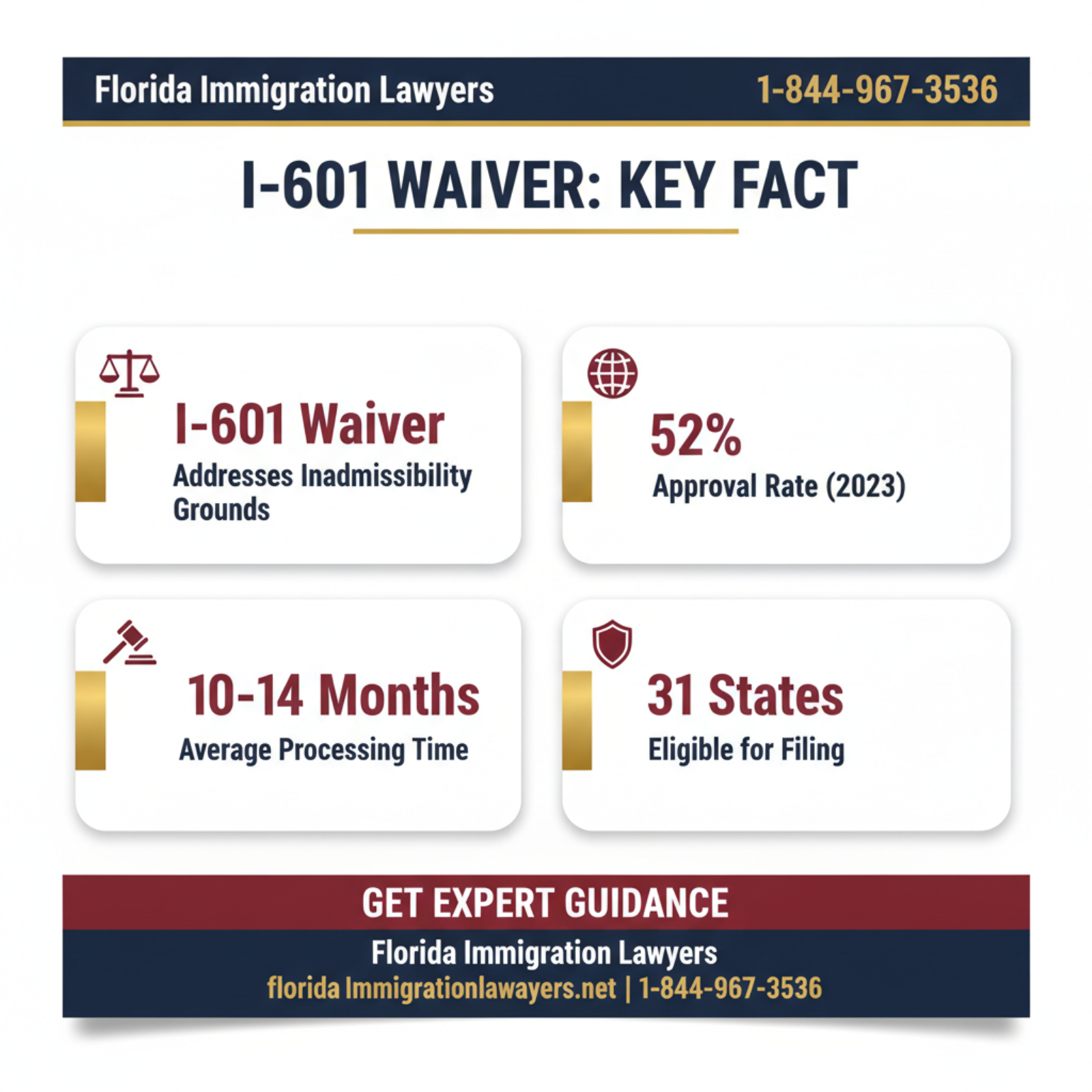
One of the most common questions we receive in Florida regarding the I-601 waiver is, "How long does it take for an I-601 waiver to be approved in 2026?" The answer, unfortunately, is that processing times can vary significantly and are subject to change. There is no single, fixed timeline for all I-601 applications.
USCIS processing times depend on various factors, including the service center handling your case, the complexity of your application, the volume of applications received, and the specific grounds of inadmissibility being waived. Historically, I-601 waivers can take anywhere from several months to over two years to process. For those applying from abroad, consular processing can add further variables.
You can monitor current processing times for Form I-601 on the USCIS website by selecting the form number and the relevant service center. It is important to remember that these are estimates and not guarantees. Our firm continuously monitors these updates to provide you with the most current information available.
While waiting, it is crucial to remain patient and avoid making inquiries too frequently, as this can sometimes slow down the process. Ensure your contact information with USCIS is always up-to-date. If there are significant changes to your case, consult with your attorney.
Cost Factors and Legal Fees for Your I-601 Waiver in Florida
Understanding the costs associated with an I-601 waiver is an important part of planning your immigration journey. There are generally two main categories of costs: government filing fees and legal fees for attorney representation. It is important to budget for both.
The government filing fee for Form I-601 is set by USCIS and is subject to change. We advise clients to always check the official USCIS website for the most current fee schedule. This fee must be paid directly to USCIS at the time of filing your application.
Legal fees for an I-601 waiver can vary widely based on the complexity of your case, the amount of evidence required, and the experience of your attorney. An I-601 waiver is one of the most challenging applications in immigration law, often requiring extensive legal research, document preparation, and persuasive writing. Therefore, legal fees reflect the significant effort and expertise involved.
While we cannot provide specific fee amounts here, our firm, Florida Immigration Lawyers, offers transparent fee structures and will discuss all costs upfront during your free consultation. Investing in experienced legal counsel for your I-601 waiver can significantly increase your chances of approval and save you from costly mistakes in the long run. Remember, a denial can lead to further complications and expenses.
Do not navigate this process alone. The stakes are too high for your future in Florida. Contact Florida Immigration Lawyers today to schedule your consultation and let our experienced team advocate for you. We are ready to help you overcome inadmissibility.
Common Mistakes to Avoid with Your I-601 Waiver
The I-601 waiver process is fraught with potential pitfalls. Avoiding these common mistakes can significantly improve your chances of approval and prevent costly delays or denials. Our experience serving clients across Florida, including Jacksonville, has highlighted these key errors:
-
Insufficient Evidence of Extreme Hardship: This is the most frequent reason for I-601 waiver denials. Applicants often submit general statements or evidence that does not meet the high legal standard of "extreme hardship." You must demonstrate unique and severe suffering beyond normal separation. Consequences: Denial, requiring a new application and prolonging separation.
-
Failing to Identify All Grounds of Inadmissibility: If you only waive one ground but another still applies, your application will be denied. It is critical to accurately identify and address every single ground of inadmissibility. Consequences: Denial, wasted time and money, continued inadmissibility.
-
Incomplete or Inaccurate Form I-601: Minor errors, missing signatures, or unanswered questions on Form I-601 can lead to rejection or a request for evidence, causing significant delays. Consequences: Application rejection, delays, potential re-filing fees.
-
Not Providing a Comprehensive Legal Brief: While not strictly required by USCIS, a well-written legal brief from an attorney is crucial. It ties your evidence to legal precedents and clearly articulates why your waiver should be granted. Consequences: USCIS may overlook key arguments, leading to an unfavorable decision.
-
Missing Deadlines or Filing in the Wrong Place: Strict deadlines apply to various immigration processes, and filing the I-601 in the wrong USCIS service center or consular post can lead to rejection. Consequences: Rejection, loss of filing fee, missed opportunities.
-
Lack of Organization in Supporting Documents: A disorganized application package makes it difficult for USCIS officers to review your case, potentially leading to a superficial review or a request for evidence. Consequences: Delays, requests for evidence, potential denial.
-
Misrepresenting Facts or Providing False Information: Any attempt to deceive USCIS can lead to permanent bars to immigration and severe legal consequences. Always be truthful in your application. Consequences: Permanent inadmissibility, criminal charges in severe cases.
-
Not Consulting with an Experienced Immigration Attorney: The I-601 waiver is complex. Attempting to navigate it without legal expertise often results in critical errors. Consequences: Increased risk of denial, missed legal arguments, prolonged uncertainty.
-
Failing to Update USCIS on Changes: If your address, phone number, or other critical information changes during processing, you must notify USCIS promptly. Failure to do so can result in missed notices or decisions. Consequences: Missed communication, potential case abandonment.
-
Not Preparing for a Potential Interview: If an interview is required, being unprepared can undermine your entire application. Know your case, your evidence, and be ready to articulate your extreme hardship claim. Consequences: Inability to clarify issues, potential negative impression on the adjudicator.
When to Call a Lawyer for Your I-601 Waiver in Florida
Given the intricate nature of the I-601 waiver, knowing when to seek legal counsel is paramount. While some individuals might consider filing on their own, the risks associated with an I-601 waiver denial are too significant to take lightly. An experienced immigration attorney can be your most valuable asset throughout this challenging process.
You should strongly consider contacting Florida Immigration Lawyers if any of the following scenarios apply to your case:
- Complex Grounds of Inadmissibility: If your inadmissibility involves criminal convictions, multiple immigration violations, or misrepresentation, your case will be highly complex. These situations demand a nuanced understanding of immigration law and waiver eligibility.
- Difficulty Proving Extreme Hardship: Demonstrating "extreme hardship" is subjective and requires a persuasive, well-documented argument. If you are struggling to gather compelling evidence or articulate your case effectively, an attorney can provide strategic guidance.
- Previous Denial of an I-601 Waiver: If your prior waiver application was denied, it is crucial to understand why. An attorney can review the denial, identify weaknesses in your previous application, and help you strategize for a stronger re-filing or appeal.
- Uncertainty About Eligibility: If you are unsure whether you even qualify for an I-601 waiver or which specific grounds of inadmissibility apply to you, a lawyer can provide a thorough assessment of your case.
- Language Barriers or Difficulty with Legal Jargon: The immigration process involves extensive legal terminology and complex forms. If English is not your first language or you find legal documents overwhelming, an attorney can ensure accurate communication and proper documentation.
- Tight Deadlines: If you are facing imminent deadlines for your immigration application or removal proceedings, an attorney can act swiftly to prepare and file your waiver application. Our deportation defense team can often work in tandem with waiver applications.
- Concerns About Fraud or Misrepresentation: If your inadmissibility is due to alleged fraud or misrepresentation, an I-601 waiver under INA 212(i) is highly specialized. You need an attorney experienced in arguing these sensitive cases.
At Florida Immigration Lawyers, we have a proven track record of helping individuals throughout Florida, including in Jacksonville and surrounding areas, successfully navigate complex waiver applications. Our family immigration and general immigration practice areas are deeply intertwined with waiver applications. We offer comprehensive services, from initial assessment to evidence gathering, application preparation, and representation. Let us be your trusted advocates.
About Florida Immigration Lawyers
Florida Immigration Lawyers is a leading immigration law firm dedicated to serving individuals and families across the entire state of Florida. With offices strategically located to assist clients from Jacksonville to Miami, and everywhere in between, we pride ourselves on delivering compassionate, effective, and results-driven legal representation.
Our firm specializes in a wide array of immigration matters, including family-based immigration, business immigration, asylum, deportation defense, citizenship, and complex waiver applications like the I-601. We understand that each client's situation is unique and deserves personalized attention and a tailored legal strategy.
Why choose Florida Immigration Lawyers? Our team of experienced attorneys is committed to upholding the highest standards of legal excellence and client service. We are available 24/7 to address your urgent concerns and offer free, confidential consultations to help you understand your options without financial commitment. We are passionate about helping our clients achieve their American dream and secure their future in Florida. Your success is our mission.
Contact us today: 1-844-967-3536 or visit our website at https://www.floridaimmigrationlawyers.net. Se Habla Español.
Sources and References
- U.S. Citizenship and Immigration Services (USCIS) - Form I-601
- USCIS Policy Manual
- Executive Office for Immigration Review (EOIR)
- Immigration and Nationality Act (INA) Section 212(a) - Grounds of Inadmissibility
- Immigration and Nationality Act (INA) Section 212(h) - Waiver of certain criminal grounds of inadmissibility
- Immigration and Nationality Act (INA) Section 212(i) - Waiver of fraud or misrepresentation
- 8 U.S.C. § 1182 - Admission and Exclusion; Waivers
- 8 CFR Part 212 - Documentary Requirements: Nonimmigrants; Waivers; Admission of Certain Inadmissible Aliens; Parole
This article provides general legal information and is not intended as legal advice. Every case is unique, and outcomes depend on specific facts and circumstances. Contact an attorney for advice about your particular situation.
Navigating the complex landscape of immigration law, especially when facing inadmissibility, requires expert guidance. The I-601 waiver can be your bridge to a new life in Florida, but it demands meticulous preparation and a deep understanding of legal requirements. Do not risk your future by attempting this process alone.
Florida Immigration Lawyers is here to provide the dedicated support and seasoned legal representation you need. We serve clients across all of Florida, offering personalized strategies for your unique circumstances. Take the first crucial step towards overcoming inadmissibility.
Call Florida Immigration Lawyers today at 1-844-967-3536 for a free, confidential consultation. Se Habla Español - Estamos aquí para ayudarle.
Do Not Navigate This Process Alone
Our experienced immigration attorneys are ready to fight for you. Get a free, confidential consultation today.
Se Habla Español
Frequently Asked Questions
Florida Immigration Lawyers
Immigration Attorney | Founder, Vasquez Law Firm
U.S. Air Force veteran and immigration attorney with thousands of cases resolved. J.D., NCCU School of Law. AILA member. Admitted to the 4th, 5th, and 11th Circuit Courts.
Available 24/7 - Free Evaluations
Related Legal Services
Our Florida immigration attorneys can help you with asylum protection, deportation defense and citizenship and naturalization. Call today at 1-844-967-3536 for a free consultation.
Related Links
Related Topics
Free Legal Consultation
Discuss your case with our experienced attorneys. We're available 24/7.
Se Habla Español - Estamos aquí para ayudarle.
Related Articles
Stokes Interview: Navigating Marriage Fraud in Florida
A Stokes interview is a specialized, separate interview conducted by USCIS when there are suspicions of marriage fraud in a green card application. This rigorous process involves individual questioning of spouses, focusing on inconsistencies in their testimonies to determine the authenticity of their marital bond. For couples in Florida, navigating this high-stakes interview requires meticulous preparation, extensive documentation, and often the strategic guidance of an experienced immigration lawyer. Understanding the process, preparing for detailed questions, and presenting a strong case are crucial for overcoming marriage fraud allegations and securing your immigration future. Florida Immigration Lawyers stands ready to assist you.
Immigration Attorney Gainesville: North Florida Legal Help
For those in Gainesville, Alachua County, and throughout North Florida, navigating U.S. immigration law requires expert guidance. An experienced immigration attorney can simplify complex processes, from family-based petitions and employment visas to critical asylum claims and deportation defense. This comprehensive guide outlines the essential services provided by an immigration attorney, details necessary documentation, clarifies processing timelines, and discusses associated costs. We also highlight common mistakes to avoid and crucial scenarios where legal counsel is indispensable. Florida Immigration Lawyers serves all of Florida, including Gainesville and St. Petersburg, providing dedicated legal support to help you achieve your immigration goals. Contact us for a free consultation to discuss your specific needs.
Military Naturalization Expedited at Florida Bases
Explore expedited military naturalization processes for service members at Florida bases like MacDill. Learn about eligibility, steps, and common mistakes. Contact Florida Immigration Lawyers for a free consultation.
Protect Yourself from Immigration Scams in Florida
Learn how to protect against immigration scams in Florida, focusing on St. Petersburg. This guide covers identifying scams, verifying credentials, and getting legal help. Call Florida Immigration Lawyers at 1-844-967-3536 for assistance.