What are the I-864 Affidavit of Support Requirements
The I-864 Affidavit of Support is a cornerstone of U.S. immigration for family-based visas and some employment-based categories, ensuring financial backing for intending immigrants. This legally binding document requires a sponsor, typically the petitioner, to demonstrate an income at least 125% of the Federal Poverty Guidelines for their household size. As of 2026, understanding these requirements is vital for anyone in Florida sponsoring a loved one. Our comprehensive guide details who must file the I-864, the precise financial thresholds, required documentation, and expected processing timelines. We also address common pitfalls, such as miscalculating household size or failing to properly document income and assets. For complex cases or if you need to utilize a joint sponsor, expert legal counsel from Florida Immigration Lawyers can make a significant difference. We provide crucial insights into avoiding delays and denials, helping families navigate the intricate process to secure their future in the United States. Contact us for a free case review.

Quick Answer: I-864 Affidavit of Support Requirements
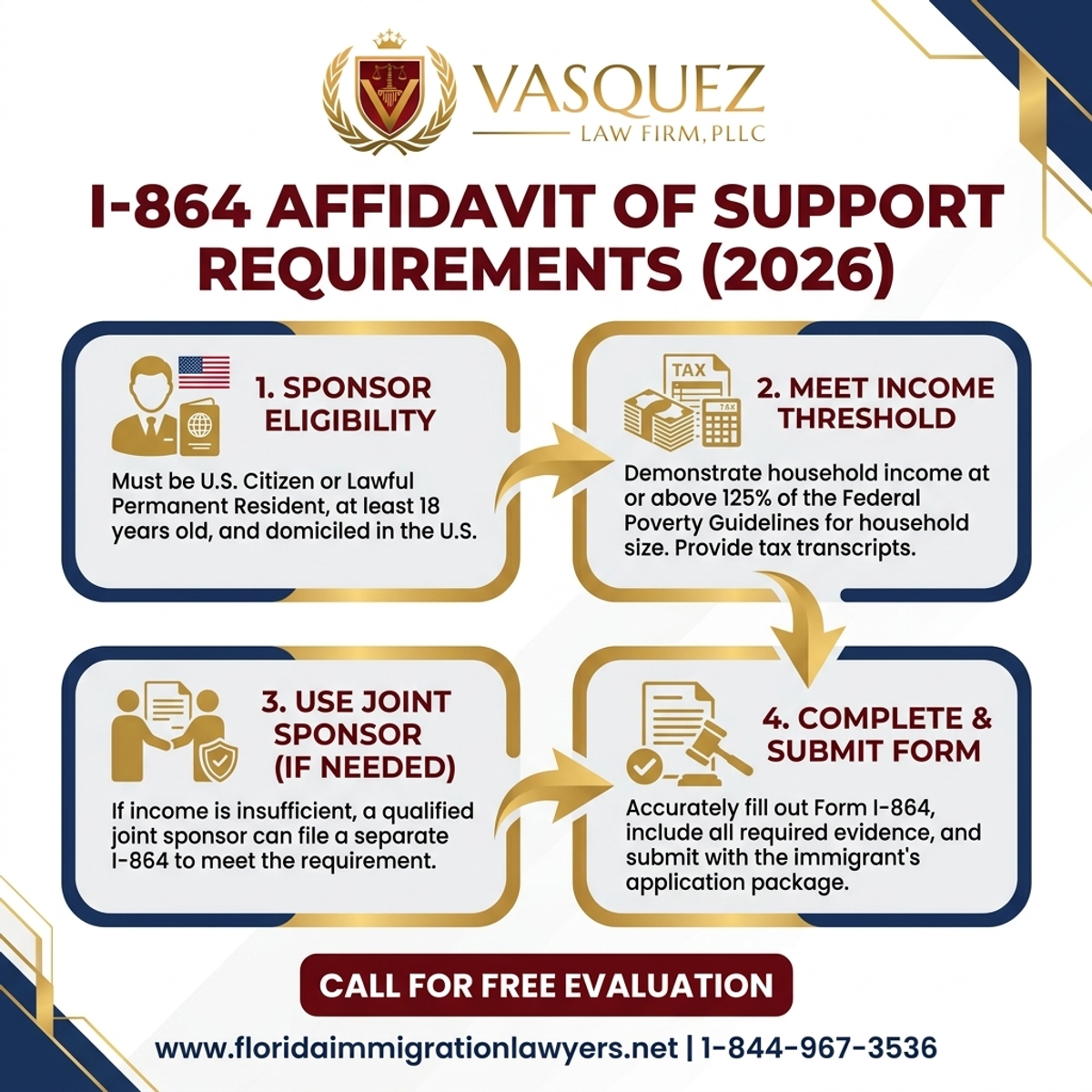
The I-864 Affidavit of Support is a legally binding contract an immigration sponsor signs, promising to financially support the intending immigrant. As of 2026, key requirements include the sponsor being a U.S. citizen or permanent resident, at least 18 years old, and domiciled in the U.S. They must also demonstrate an income at or above 125% of the Federal Poverty Guidelines for their household size. This form is essential for most family-based immigrants and certain employment-based immigrants to prevent them from becoming a public charge in the United States.
- Sponsor must be a U.S. citizen or LPR, 18+, and domiciled in the U.S.
- Income must meet or exceed 125% of Federal Poverty Guidelines.
- Required for most family-based and some employment-based green card applications.
- Provides financial assurance, preventing the immigrant from becoming a public charge.
- Failure to meet requirements can lead to visa denial or green card refusal.
Navigating the complex world of U.S. immigration can feel overwhelming, especially when the future of your loved ones hangs in the balance. For many individuals seeking to immigrate to Florida, one of the most critical documents in this journey is the Form I-864, Affidavit of Support. This legally binding contract ensures that an intending immigrant will have financial support and won't become a public charge in the United States.
Whether you're sponsoring a spouse, parent, or child, understanding the intricate requirements of the I-864 affidavit of support is paramount. Errors or omissions on this form can lead to significant delays, requests for evidence, or even denial of the immigration application. For families in Orlando and across Central Florida, securing a green card often hinges on successfully fulfilling these obligations.
This comprehensive guide will break down the essential requirements for the I-864, clarify who needs to file it, explain the financial thresholds, and provide insights into common pitfalls. Our goal is to equip you with the knowledge to approach this process with confidence. Don't leave your family's future to chance; call Florida Immigration Lawyers at 1-844-YO-PELEO for a free case review and expert guidance today.
Who is required to file Form I-864 and why?
Form I-864, Affidavit of Support, is a mandatory document for most family-based immigrants and some employment-based immigrants. Its purpose is to demonstrate that the intending immigrant has adequate means of financial support and will not become a public charge, meaning they will not primarily rely on government assistance after entering the United States. This requirement is rooted in U.S. immigration law to protect public resources and ensure immigrants can sustain themselves.
Generally, the petitioner who filed the immigrant visa petition (Form I-130, Form I-140, etc.) must complete and file Form I-864. This applies to all family-based immigrants, including spouses, children, parents, and siblings of U.S. citizens or lawful permanent residents (LPRs). For employment-based immigrants, an I-864 is required only if a relative filed the visa petition or if the relative has a significant ownership interest (5% or more) in the entity that filed the petition. There are very limited exceptions, such as for those who have earned 40 quarters of coverage under the Social Security Act or for self-petitioning widows/widowers or battered spouses/children. Understanding these distinctions is critical for anyone in Florida seeking to sponsor a family member for a green card. Incorrectly determining who is responsible for the I-864 can cause substantial delays in the process.
What are the I-864 financial requirements for sponsors in Florida?
To be an eligible sponsor for the I-864 Affidavit of Support, you must demonstrate an income that is at least 125% of the Federal Poverty Guidelines (FPG) for your household size. For active duty U.S. military personnel petitioning for a spouse or child, the income requirement is 100% of the FPG. These guidelines are updated annually by the Department of Health and Human Services, and sponsors must meet the guidelines in effect at the time of filing.
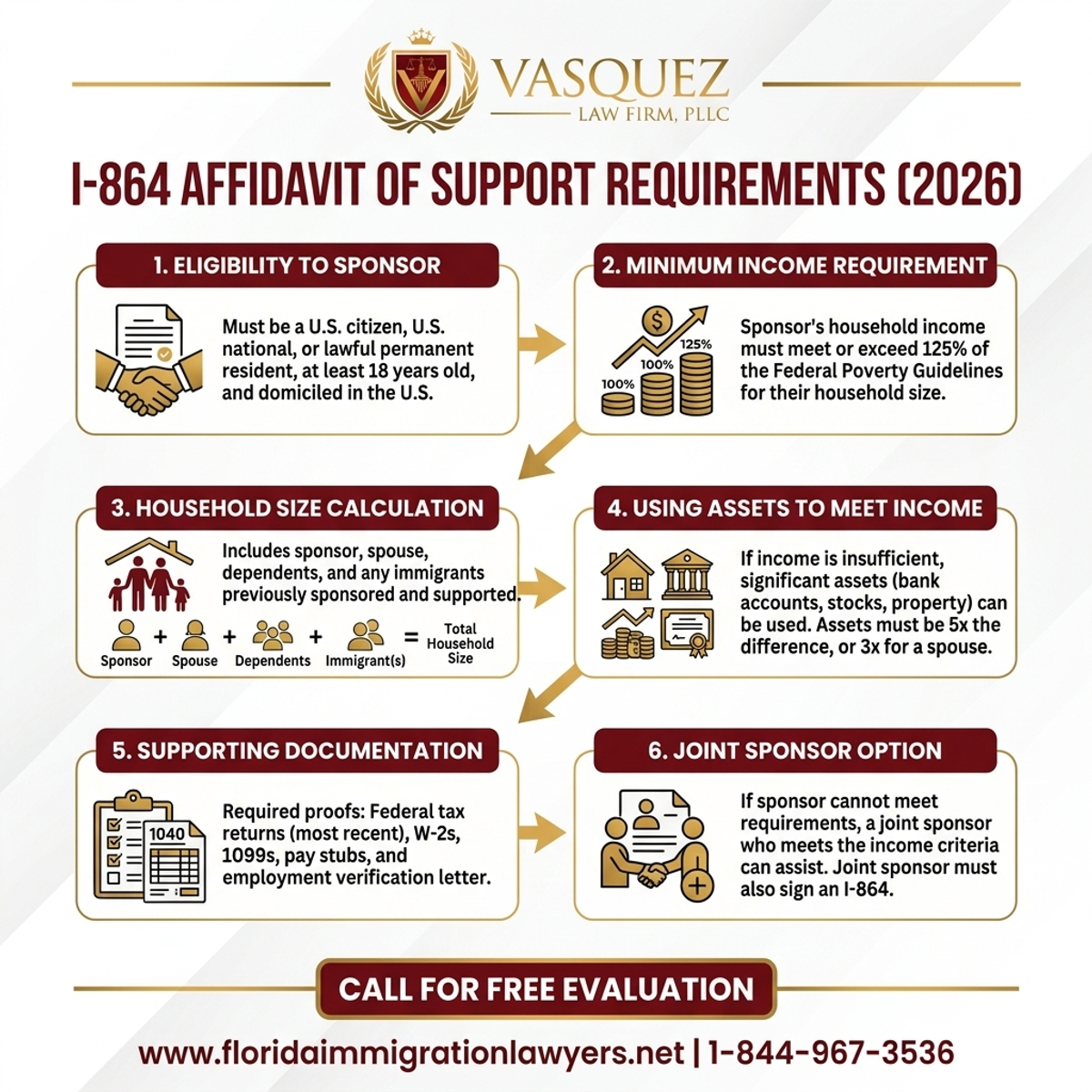
As of 2026, the specific income thresholds vary based on the number of people in your household, which includes yourself, your dependents, any relatives you have sponsored previously who are still under obligation, and the intending immigrant(s). For example, a sponsor in Orlando with a household of three (sponsor, spouse, one child) would need to earn 125% of the FPG for a household of three. If your income alone is insufficient, you may use the value of your assets (such as real estate, bank accounts, stocks) or obtain a joint sponsor. Assets must typically be five times the difference between your income and the poverty guideline, or three times the difference for spouses and children of U.S. citizens. Properly calculating household size and income is a frequent challenge, and miscalculations can lead to a Request for Evidence (RFE) from USCIS.
Cost Factors and Fee Breakdown
While USCIS does not charge a separate fee for filing Form I-864, there are other costs associated with the overall immigration process that sponsors and applicants in Florida should be aware of. These fees are subject to change, so it is always important to consult the latest USCIS fee schedule.
Step-by-Step Process — What are the I-864 Affidavit of Support Requirements in 2026?
| Item | Typical Fee | Notes |
|---|---|---|
| USCIS Immigrant Petition (e.g., Form I-130) | Varies | Required to initiate family-based immigration. |
| USCIS Adjustment of Status (Form I-485) | Varies | If adjusting status within the U.S. |
| Department of State Immigrant Visa Application | Varies | If consular processing outside the U.S. |
| Biometrics Fee | Varies | For fingerprinting and background checks. |
| Medical Examination Fee | Varies | Paid to an authorized civil surgeon. |
| Attorney Fees | Varies | For legal representation and guidance. |
What documents are needed for an I-864 Affidavit of Support?
Submitting a complete and accurate set of supporting documents is crucial for a successful I-864 application. Without the proper evidence, USCIS or the U.S. Department of State may issue a Request for Evidence (RFE) or even deny the application, causing significant delays for families hoping to reunite in Florida. Gathering these documents systematically can simplify the process and reduce stress.
The sponsor must provide evidence of their income and assets, as well as proof of their U.S. citizenship or lawful permanent resident status. They also need to demonstrate their domicile in the United States. It's important to include clear, legible copies of all required documents. For those going through consular processing, these documents will be submitted to the National Visa Center (NVC) and then presented at the visa interview at the U.S. embassy or consulate abroad. If you are adjusting status within the U.S., the documents are filed directly with your Form I-485 application to USCIS, typically at a service center.
I-864 Document Checklist
- Completed and signed Form I-864.
- Proof of U.S. citizenship or LPR status (e.g., birth certificate, U.S. passport, Form I-551 green card).
- Proof of domicile in the U.S. (e.g., state ID, utility bills, lease agreement showing a U.S. address).
- Federal income tax returns (IRS Form 1040) for the most recent tax year, or the last three years if requested.
- All supporting tax documents (W-2s, 1099s, schedules).
- Proof of current income (e.g., recent pay stubs, employment letter, business license if self-employed).
- Bank statements or other evidence of assets (if relying on assets to meet income requirements).
- Proof of relationship to the intending immigrant (e.g., marriage certificate, birth certificate).
- Copies of any previous Affidavits of Support filed for other immigrants.
How long does the I-864 Affidavit of Support process take?
The processing time for the I-864 Affidavit of Support is not a standalone process but is intertwined with the overall immigrant visa or adjustment of status application. The timeline can vary significantly based on whether the application is processed through consular processing at a U.S. embassy or consulate abroad, or through adjustment of status within the United States. Factors like the specific USCIS service center, the National Visa Center (NVC) workload, and the completeness of the submitted documentation all play a role. As of 2026, applicants should be prepared for potential fluctuations in processing times.
For consular processing, after the I-130 petition is approved by USCIS, the case moves to the NVC. The NVC collects all required documents, including the I-864 and its supporting evidence. Once all documents are accepted, the NVC schedules an interview at the appropriate U.S. embassy or consulate. This stage alone can take several months. For adjustment of status cases filed with USCIS within Florida, the I-864 is submitted concurrently with Form I-485. The processing time for I-485 applications can range from several months to over a year, depending on the applicant's category and the specific field office, such as the USCIS Orlando Field Office. Delays often occur if additional evidence is requested, underscoring the importance of meticulous preparation.
Key Statistics — What are the I-864 Affidavit of Support Requirements in 2026?
| Stage | Typical Timeframe | Notes |
|---|---|---|
| I-130 Petition Approval | 6-24 months | Varies by relationship and USCIS workload. |
| National Visa Center (NVC) Processing | 2-6 months | Time to gather and submit all documents, including I-864. |
| Consular Interview Scheduling | 1-3 months (after NVC completion) | Depends on embassy/consulate availability. |
| Adjustment of Status (I-485) Processing | 8-24+ months | If filing within the U.S., includes I-864 review. |
| Request for Evidence (RFE) Response | Adds 2-6 months | If USCIS or NVC needs more information. |
Can a joint sponsor be used for the I-864 in Florida?
Yes, a joint sponsor can absolutely be used for the I-864 Affidavit of Support if the primary petitioner's income and assets are insufficient to meet the Federal Poverty Guidelines. A joint sponsor is an individual who agrees to accept joint legal responsibility for financially supporting the intending immigrant alongside the primary sponsor. This is a common solution for many families in Florida who might otherwise struggle to meet the strict financial requirements on their own.
The joint sponsor must meet all the same eligibility requirements as the primary sponsor: they must be a U.S. citizen or LPR, at least 18 years old, domiciled in the U.S., and meet the 125% FPG income requirement for their own household size (including the intending immigrant they are sponsoring). Each joint sponsor must file a separate Form I-864, along with all their supporting financial documentation. It is important to note that a joint sponsor does not need to be related to the petitioner or the intending immigrant. This flexibility allows more individuals to successfully navigate the immigration process. The legal obligations of a joint sponsor are identical to those of the primary sponsor, lasting until the immigrant becomes a U.S. citizen, works 40 quarters, departs permanently, or passes away. For complex cases involving multiple joint sponsors or unusual income situations, consulting with an experienced immigration attorney in Central Florida is highly advisable.
Do not navigate this process alone. The complexities of the I-864 Affidavit of Support can be daunting, with strict financial requirements and extensive documentation. A single mistake could jeopardize your immigration application. Contact Florida Immigration Lawyers today to ensure your application is accurate, complete, and filed correctly, protecting your future in Florida.
Common I-864 Mistakes to Avoid
The I-864 Affidavit of Support is a critical document, and errors can lead to significant delays or even denial of an immigration application. Be vigilant to avoid these common pitfalls:
- Incorrect Household Size Calculation: Many sponsors miscalculate their household size, leading to an incorrect poverty guideline threshold. This can result in insufficient income claims and an RFE. Always include yourself, your dependents, the intending immigrant(s), and any other individuals you have sponsored previously.
- Insufficient Income Documentation: Failing to provide all necessary tax documents (Form 1040, W-2s, 1099s, schedules) or current income evidence (pay stubs, employment letter) is a frequent issue. USCIS requires clear proof of your financial ability.
- Not Meeting Poverty Guidelines: Submitting an I-864 when your income is below 125% of the Federal Poverty Guidelines without sufficient assets or a joint sponsor will lead to rejection. Know your numbers before filing.
- Failure to Establish Domicile: The sponsor must be domiciled in the U.S. Providing insufficient proof of a U.S. residence can be a problem, especially for sponsors who live abroad temporarily.
- Incomplete or Unsigned Forms: A simple oversight like failing to sign the I-864 form or leaving sections blank can result in rejection. Double-check every field for completeness and signature.
- Ignoring Joint Sponsor Requirements: If using a joint sponsor, ensure they meet all eligibility criteria, including income, citizenship/LPR status, and domicile. Their I-864 must be just as complete as the primary sponsor's.
- Incorrectly Using Assets: Relying on assets without properly valuing them or providing sufficient evidence of ownership and liquidity (e.g., recent bank statements, property appraisals) can lead to issues.
- Not Updating Information: If your income or household size changes significantly between filing the petition and the immigrant's interview, failing to update the I-864 or provide new evidence can cause problems.
- Failure to Understand Legal Obligations: Sponsors sometimes underestimate the long-term, legally binding nature of the I-864. This is a serious commitment, lasting until specific termination events occur.
- Missing Required Translations: Any documents not in English must be accompanied by a certified English translation. Failing to provide this can lead to RFEs and delays.
When to Call a Lawyer for Your I-864 Affidavit of Support
While the I-864 Affidavit of Support form seems straightforward, its implications and requirements can be incredibly complex. Knowing when to seek professional legal help can save you from costly delays, denials, and prolonged separation from your loved ones. Florida Immigration Lawyers specializes in helping individuals and families across Central Florida navigate these critical immigration processes with confidence and clarity.
You should consider contacting an experienced immigration attorney if you encounter any of the following scenarios: your income is close to or below the poverty guidelines and you need to rely on assets or a joint sponsor; you have a complex financial situation (e.g., self-employment, foreign income, multiple sources of income); you have previously sponsored other immigrants; you or the intending immigrant have a history of receiving public benefits; or if you've received a Request for Evidence (RFE) from USCIS or the Department of State regarding your I-864. Our team can help you understand your obligations under 8 U.S.C. § 1182(a)(4) and 8 CFR Part 213a, ensuring compliance with all legal requirements. We can also assist if you are facing challenges with an immigration court case, perhaps involving a previous I-864 issue being reviewed by the Executive Office for Immigration Review (EOIR). Don't risk your family's future on a technicality. Our dedicated attorneys are here to provide comprehensive support and strategic advice for your family immigration needs.
About Florida Immigration Lawyers
Florida Immigration Lawyers is a leading law firm dedicated to providing compassionate and effective legal representation for immigrants across all of Florida. With an office conveniently located in Orlando, we proudly serve clients throughout Central Florida and beyond, helping individuals and families achieve their American dreams. Our team of experienced immigration attorneys understands the profound impact immigration matters have on people's lives and approaches each case with diligence, empathy, and a deep knowledge of U.S. immigration law.
We offer a comprehensive range of immigration services, including family-based petitions, adjustment of status, consular processing, deportation defense, asylum claims, citizenship applications, and business immigration solutions. Our commitment to our clients is unwavering, and we strive to make complex legal processes understandable and manageable. We are available 24/7 to address your urgent concerns and offer free case reviews to help you understand your options without financial commitment. When you choose Florida Immigration Lawyers, you gain a powerful advocate dedicated to fighting for your rights and your future. Schedule a free consultation with us today – Se Habla Español.
Sources and References
- U.S. Citizenship and Immigration Services (USCIS)
- U.S. Department of State
- Executive Office for Immigration Review (EOIR)
- 8 U.S.C. § 1182(a)(4) - Inadmissible aliens: Public charge
- 8 CFR Part 213a - Affidavits of Support on Behalf of Immigrants
- U.S. Department of Health and Human Services - Federal Poverty Guidelines
- Immigration and Nationality Act (INA)
Related services: immigration practice areas, immigration lawyer cost in Florida.
This article provides general legal information and is not intended as legal advice. Every case is unique, and outcomes depend on specific facts and circumstances. Contact an attorney for advice about your particular situation.
Navigating the I-864 Affidavit of Support is a critical step in many immigration journeys. Ensure your application is handled with the utmost care and expertise. For personalized legal guidance tailored to your unique situation, reach out to Florida Immigration Lawyers. We offer free case reviews and are available 24/7 to assist you. Call us today at 1-844-YO-PELEO. Se Habla Español - Estamos aqui para ayudarle.
If you need legal assistance, learn more about our immigration legal services, or call us at 1-844-967-3536 for a free case review.
Do Not Navigate This Process Alone
Our experienced immigration attorneys are ready to fight for you. Get a free, confidential case review today.
Se Habla Español
Or leave your details and we’ll call you:
Free Evaluation in 24 Hours
Or talk to us right now
AI voice assistant — available 24/7
FreeFrequently Asked Questions

William J. Vásquez
Founding Attorney · Vasquez Law Firm
U.S. Air Force veteran and immigration attorney with years of hands-on U.S. immigration experience. J.D., NCCU School of Law. AILA member. Admitted to the 4th, 5th, and 11th Circuit Courts.
Available 24/7 - Free Evaluations
Reviewed for legal accuracy by William J. Vásquez
Licensed in North Carolina; U.S. immigration is federal practice.
Related Legal Services
Our Florida immigration attorneys can help you with asylum protection, citizenship and naturalization and immigration practice areas. Call today at 1-844-YO-PELEO for a free case review.
Related Links
Related Topics
Free Legal Case Review
Discuss your case with our experienced attorneys. We're available 24/7.
Se Habla Español - Estamos aquí para ayudarle.
Related Articles
DUI Immigration Consequences in Florida 2026
A DUI conviction in Florida can have severe immigration consequences, potentially leading to inadmissibility, deportation, or denial of immigration benefits. For non-citizens, a DUI is not just a traffic offense but a serious criminal matter that federal immigration law scrutinizes closely. Factors like multiple offenses, injury, or property damage can escalate a simple DUI to a Crime Involving Moral Turpitude (CIMT) or even an aggravated felony, triggering mandatory detention and removal proceedings. Understanding the specific nature of your Florida conviction and its interpretation under the Immigration and Nationality Act (INA) is crucial. This article outlines how DUIs impact immigration status, the grounds for inadmissibility and deportation, a step-by-step guide to navigating the process, essential documentation, and expected timelines for 2026. We also highlight common mistakes to avoid and when to seek legal counsel from an experienced immigration attorney. Florida Immigration Lawyers offers comprehensive support for individuals facing these challenging situations, providing expert guidance through complex legal landscapes.
Immigration Lawyer Orlando Free Consultation in Florida
For individuals and families in Orlando, Florida, navigating the complexities of U.S. immigration law requires expert guidance. An immigration lawyer in Orlando offers crucial support for everything from visa applications and green card processes to naturalization and deportation defense. This comprehensive guide details what a free consultation covers, providing a step-by-step overview of immigration pathways, essential document checklists, and expected timelines in 2026. We also highlight common mistakes to avoid, discuss the critical role of legal counsel in deportation and asylum cases, and explain why choosing a local Orlando immigration attorney is beneficial. Florida Immigration Lawyers is dedicated to serving the diverse community of Orlando with compassionate, effective legal solutions, ensuring you receive personalized advice and robust representation for a successful immigration journey.
EAD Advance Parole Combo Card in Florida 2026
For individuals with a pending Form I-485, Application to Register Permanent Residence or Adjust Status, the EAD Advance Parole Combo Card is an essential document. This single card combines the authorization to work legally in the U.S. (Employment Authorization Document - EAD) with permission to travel internationally and re-enter without abandoning your green card application (Advance Parole). This guide from Florida Immigration Lawyers provides a comprehensive overview for applicants in Florida in 2026, covering eligibility, the step-by-step application process, required documents, expected processing times, and associated costs. We also highlight common mistakes to avoid and when to seek legal counsel to ensure a smooth and successful immigration journey. Understanding this vital card is key to maintaining stability while awaiting your permanent residency approval.
EAD Advance Parole Combo Card in Florida: What You Need
An EAD advance parole combo card allows individuals with pending adjustment applications to both work and travel abroad without jeopardizing their green card application. Learn how to apply in Florida, what documents you need, and common mistakes to avoid.