I-601A Provisional Waiver in Florida: What You Need to Know
By William J. Vásquez, immigration attorney
The I-601A provisional waiver allows immigrants in the U.S. to apply for a waiver of unlawful presence while remaining with family. Learn about eligibility, how to prove extreme hardship, and why Florida residents should consider this waiver. Call Florida Immigration Lawyers for a free consultation.

Introduction
Living in Florida and dealing with immigration issues can be challenging, especially when facing the possibility of separation from loved ones. The I-601A provisional waiver is a critical option for many immigrants residing unlawfully in the U.S., allowing them to remain with their families while their waiver is processed. This article explores the I-601A waiver process, eligibility criteria, and how to demonstrate extreme hardship, with a focus on Florida residents.
For countless families in Florida, the threat of separation due to immigration status creates immense stress and uncertainty. The I-601A provisional waiver offers a glimmer of hope, providing a pathway for individuals who have accrued unlawful presence to adjust their status without enduring prolonged periods apart from their U.S. citizen or lawful permanent resident family members. Understanding this complex process is the first step towards achieving stability and peace of mind.
Navigating the intricacies of immigration law requires expert guidance. This guide aims to demystify the I-601A process, offering practical insights and emphasizing the importance of legal counsel. Whether you are just beginning to explore your options or are deep into the application process, knowing the requirements, potential pitfalls, and how to build a strong case for extreme hardship is paramount to success. Florida Immigration Lawyers are here to support you.
Call Florida Immigration Lawyers at 1-844-YO-PELEO for a free case review to determine if the I-601A waiver is right for you.
What is the I-601A Provisional Waiver?
The I-601A provisional waiver permits certain immigrants who are in the United States unlawfully to apply for a waiver of the unlawful presence ground of inadmissibility. It is intended for those who would experience extreme hardship if separated from a U.S. citizen or lawful permanent resident family member.
As of 2026, applicants must demonstrate that their removal would cause extreme hardship to a qualifying relative. This waiver is processed stateside, allowing applicants to remain in the U.S. while their case is reviewed.
The term "provisional" is key to understanding this waiver. It means the waiver is adjudicated by USCIS while the applicant is still in the United States. If approved, the applicant then departs the U.S. for their immigrant visa interview at a U.S. consulate or embassy abroad, typically in their home country. This pre-approval significantly reduces the time and uncertainty of separation, as applicants know their unlawful presence waiver is approved before they leave.
Before the I-601A waiver was introduced, individuals who had accrued unlawful presence had to leave the U.S. and apply for a waiver from abroad, often facing lengthy separations from their families with no guarantee of approval. The I-601A was designed to mitigate this hardship, allowing families to stay together during most of the process. It specifically addresses the 3-year and 10-year bars to re-entry that result from accumulating more than 180 days or one year, respectively, of unlawful presence in the U.S.
Eligibility Criteria for the I-601A Waiver
To qualify for an I-601A waiver, applicants must meet specific criteria, including:
- Being physically present in the U.S. at the time of application.
- Having an approved immigrant visa petition.
- Demonstrating extreme hardship to a qualifying U.S. citizen or lawful permanent resident relative.
- Having no other grounds of inadmissibility aside from unlawful presence.
Each of these criteria is crucial and must be met precisely. For instance, "physically present in the U.S." means you must be residing within the United States when you file your Form I-601A. If you have departed the U.S. after accruing unlawful presence, you may not be eligible for this specific waiver and should consult an attorney immediately.
The requirement of an "approved immigrant visa petition" typically refers to a Form I-130, Petition for Alien Relative, filed by a U.S. citizen spouse, parent, or in some cases, an adult child, or a lawful permanent resident spouse or parent. Without an approved petition establishing the familial relationship and a path to an immigrant visa, the I-601A cannot proceed. Furthermore, it's vital to ensure you have no other grounds of inadmissibility, such as certain criminal convictions, fraud, misrepresentation, or previous deportation orders, as these would disqualify you from the I-601A waiver and require different, often more complex, waivers or solutions. A comprehensive review of your immigration history by Florida Immigration Lawyers is essential to identify any potential issues.
How to Demonstrate Extreme Hardship
Proving extreme hardship is a critical component of the I-601A waiver process. It requires showing that a qualifying relative would suffer significantly if the applicant were removed from the U.S.
Factors considered include financial burdens, medical conditions, educational disruptions, and emotional or psychological impacts. Providing comprehensive documentation and evidence is essential to substantiate claims of hardship.
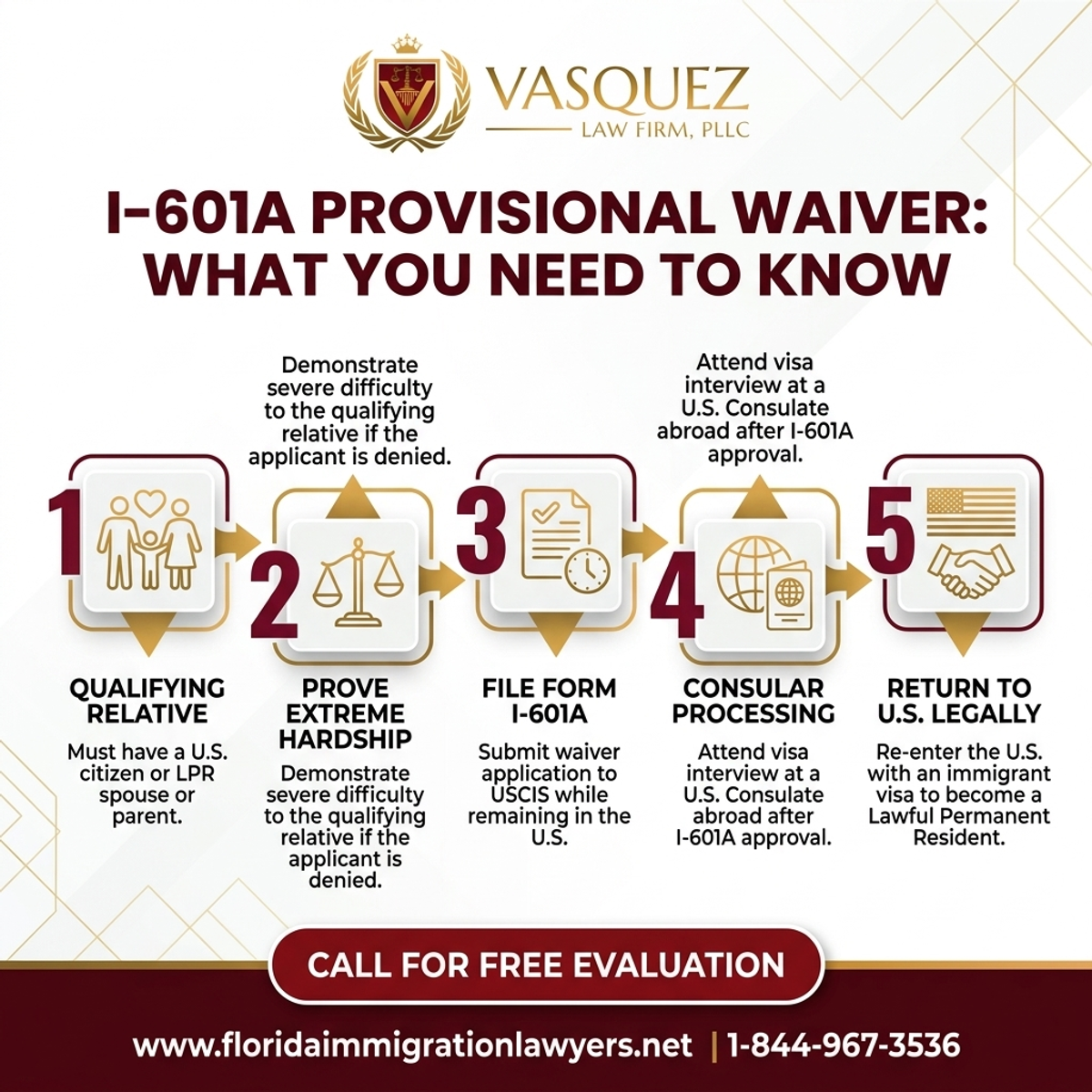
Step-by-Step Process — I-601A Provisional Waiver in Florida: What You Need to Know
Demonstrating extreme hardship goes beyond mere inconvenience. USCIS considers the "totality of the circumstances" when evaluating a case. This means they look at all aspects of the qualifying relative's life that would be negatively impacted by your absence. For example, financial hardship could include the loss of the applicant's income, leading to inability to pay rent/mortgage, medical bills, or support children. Medical hardship might involve a qualifying relative suffering from a chronic illness requiring the applicant's constant care, or a child with special needs who relies on the applicant for daily support and access to specific U.S. medical facilities.
Emotional and psychological hardship is often the most compelling, especially when it affects children or spouses. This can manifest as severe depression, anxiety, or trauma resulting from the potential separation. For children, it could mean educational disruption, difficulty adapting to a new country and language, or the loss of a primary caregiver, significantly impacting their development and well-being. A strong hardship argument weaves together these various factors into a coherent and deeply personal narrative, supported by robust evidence. Our team at Florida Immigration Lawyers excels at helping clients articulate and document these profound impacts.
Document Checklist for Proving Extreme Hardship
- Medical records and physician statements.
- Financial documents such as income statements and bills.
- Affidavits from family members and community leaders.
- Educational records for children affected by the removal.
To build a compelling case, your documentation should be exhaustive. In addition to the items above, consider including letters from therapists or counselors detailing the psychological impact on your qualifying relative, school records demonstrating a child's academic progress or special needs, and utility bills or mortgage statements to prove financial dependency. Photos and personal letters can also add a human element to your application, illustrating the depth of your family's bond and reliance on each other.
It's not just about collecting documents; it's about presenting them in an organized manner that tells a clear story of extreme hardship. Each piece of evidence should directly support a specific claim made in your hardship letter. Florida Immigration Lawyers can assist in compiling this crucial evidence, ensuring nothing is overlooked and your case is presented as strongly as possible.
Step-by-Step Guide to Applying for the I-601A Waiver
- Consult with an immigration attorney to assess eligibility.
- Gather necessary documentation and evidence of extreme hardship.
- Complete Form I-601A and pay the required fee.
- Submit the application to USCIS and wait for processing.
- Attend biometric services appointment if required.
- Receive a decision from USCIS and prepare for consular processing if approved.
The first step, consulting with an immigration attorney, is arguably the most critical. An experienced lawyer from Florida Immigration Lawyers can thoroughly review your immigration history, identify any potential inadmissibility grounds beyond unlawful presence, and advise on the strength of your extreme hardship claim. This initial assessment can save you significant time, money, and emotional distress by preventing you from pursuing a path for which you are ineligible.
Once eligibility is confirmed, the meticulous process of gathering documentation begins. This phase requires organization and attention to detail, as the strength of your case hinges on the quality and comprehensiveness of your evidence. Completing Form I-601A accurately is also paramount; even minor errors can lead to delays or denials. After submission, USCIS will send a receipt notice, and you will likely receive an appointment notice for biometrics, which involves fingerprinting and a photograph for background checks. If your waiver is approved, your attorney will guide you through the final steps of consular processing, including scheduling your interview and undergoing a medical examination abroad.
Timeline and Processing Expectations
| Stage | Typical Timeframe | Notes |
|---|---|---|
| Initial Consultation | 1-2 weeks | Consult a qualified attorney |
| Application Preparation | 2-3 months | Gather all required documents |
| USCIS Processing | 6-12 months | Dependent on case specifics |
It is important to remember that these timeframes are estimates and can fluctuate significantly based on USCIS workload, policy changes, and the complexity of individual cases. Factors such as requests for evidence (RFEs) can extend processing times, so it's crucial to respond promptly and thoroughly to any additional information USCIS requests. While waiting can be stressful, maintaining open communication with your attorney at Florida Immigration Lawyers can help manage expectations and ensure you are prepared for each stage.
Patience is a virtue in the immigration process. USCIS processing times can vary, and it's not uncommon for cases to take longer than initially anticipated. Your attorney can provide you with the most up-to-date information on current processing times and help you understand what to expect during the waiting period. Planning ahead for the consular interview abroad, including potential travel and accommodation, is also a key consideration once your waiver is approved.
Cost Factors and Fee Breakdown
Applying for an I-601A waiver involves various costs, which may include filing fees, attorney fees, and other related expenses. While the exact amounts can vary, understanding these costs can help applicants budget accordingly.
| Item | Typical Fee | Notes |
|---|---|---|
| Filing Fee | Varies | Check the latest USCIS fee schedule |
| Attorney Fees | Varies | Based on complexity and services |
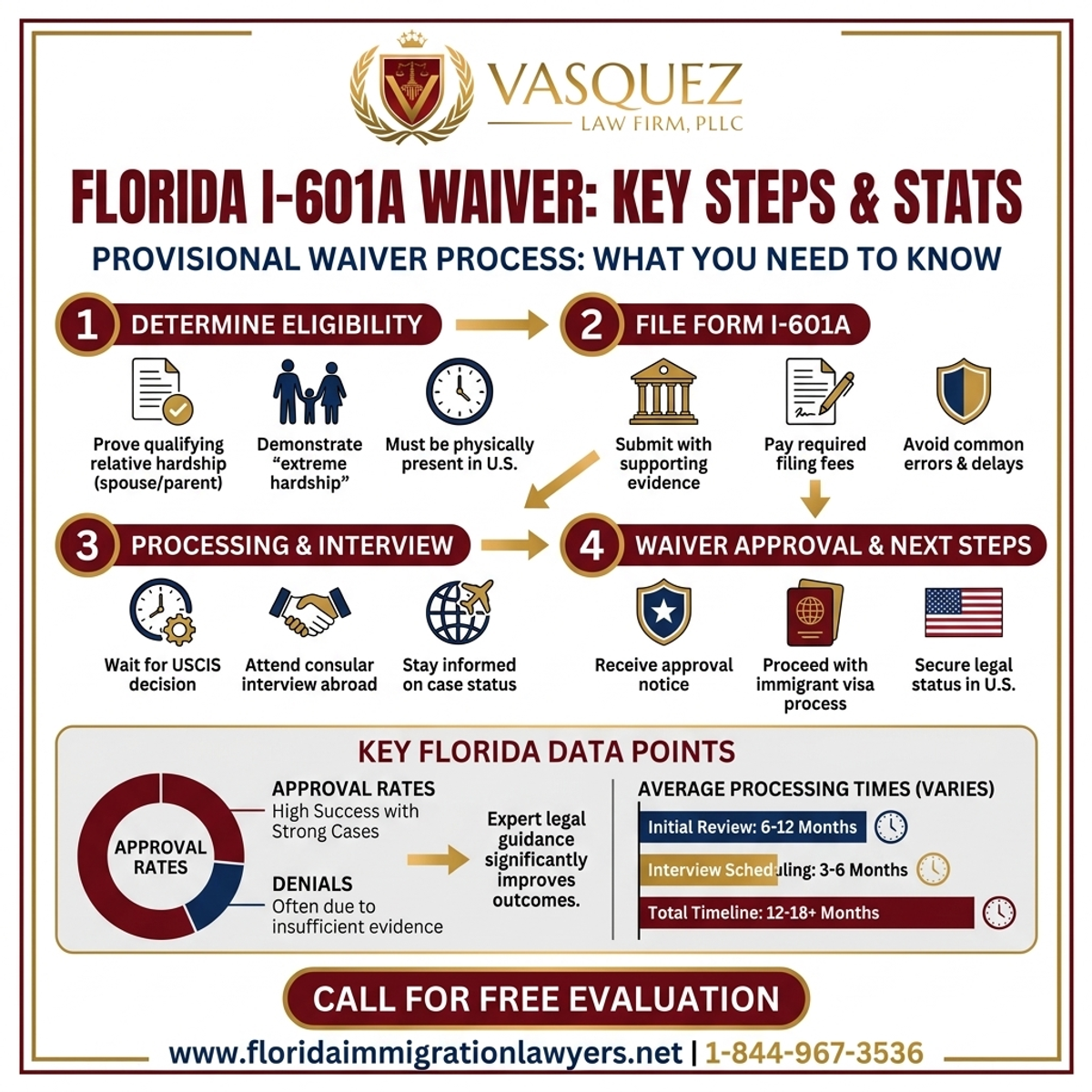
Key Statistics — I-601A Provisional Waiver in Florida: What You Need to Know
Beyond the USCIS filing fee, which is subject to change, attorney fees constitute a significant portion of the total cost. These fees can vary widely depending on the lawyer's experience, the complexity of your case, and the scope of services provided. Some firms offer flat fees for I-601A waivers, while others may charge hourly. It's important to have a clear understanding of what is included in the attorney's fee agreement from the outset.
Additional expenses can include translation services for foreign-language documents, postage, fees for obtaining medical records or expert evaluations, and travel costs associated with the consular interview abroad, including the required medical examination fee at the embassy-approved panel physician. While these costs can seem daunting, investing in proper legal representation and thorough preparation can significantly increase your chances of approval, ultimately saving you from more costly mistakes or denials in the long run. Florida Immigration Lawyers offers transparent fee structures and can discuss payment options during your consultation.
Frequently Asked Questions (FAQs) About the I-601A Waiver
1. Who is considered a "qualifying relative" for the I-601A waiver?
A qualifying relative for the I-601A waiver must be a U.S. citizen or lawful permanent resident (LPR) spouse or parent. Importantly, children, even if U.S. citizens, are generally not considered qualifying relatives for the purpose of demonstrating extreme hardship for an I-601A waiver. This distinction is crucial, as many applicants mistakenly believe hardship to their U.S. citizen children is sufficient. Always verify your qualifying relative's status with an attorney.
2. Can I apply for the I-601A if I have a criminal record?
Generally, no. The I-601A waiver is specifically for inadmissibility due to unlawful presence. If you have a criminal record, you likely have other grounds of inadmissibility that the I-601A does not waive. You would need to explore different waiver options, such as the I-601 (Application for Waiver of Grounds of Inadmissibility), which is a broader waiver but typically requires you to depart the U.S. before applying. Consult Florida Immigration Lawyers to assess your specific situation.
3. What happens if my I-601A waiver is denied?
If your I-601A waiver is denied, you do not have an appeal process. However, you may be able to file a new I-601A application, provided you still meet all eligibility requirements and can address the reasons for the previous denial. This often involves submitting stronger evidence of extreme hardship or correcting previous errors. Before refiling, it is imperative to seek legal advice to understand why your application was denied and how to strengthen a new submission.
4. How long does the I-601A process typically take from start to finish?
The entire I-601A process, from initial consultation to receiving an immigrant visa, can take anywhere from 12 to 24 months, or even longer. USCIS processing times for the I-601A waiver itself typically range from 6 to 12 months. This does not include the time required to prepare the application, obtain an approved immigrant visa petition, or complete the consular processing abroad. These timelines are estimates and can fluctuate.
5. Can I travel outside the U.S. while my I-601A is pending?
No, it is highly advisable not to travel outside the U.S. while your I-601A waiver is pending. The provisional waiver is designed for individuals who are physically present in the U.S. and awaiting their consular interview. Departing the U.S. without proper authorization or before your waiver is approved and your interview scheduled can trigger the unlawful presence bar, potentially leading to a denial of your waiver and preventing your re-entry.
6. Is the I-601A waiver the same as the I-601 waiver?
While both are waivers of inadmissibility, they are distinct. The I-601A is a *provisional* waiver specifically for unlawful presence, filed while the applicant is in the U.S. and approved before they depart for their consular interview. The I-601 is a broader waiver for various grounds of inadmissibility (including unlawful presence, certain crimes, fraud) and is typically filed *after* the applicant has departed the U.S. and been found inadmissible at a consular interview. The I-601A minimizes family separation.
Common Mistakes to Avoid
- Failing to prove extreme hardship, leading to denial.
- Submitting incomplete or incorrect forms.
- Not consulting an attorney for legal guidance.
- Missing deadlines for submitting additional documentation.
- Ignoring updates to immigration laws and policies.
- Assuming eligibility without verifying specific criteria.
- Providing insufficient or outdated evidence.
- Failing to attend required appointments, such as biometrics.
- Not preparing for the consular interview adequately.
- Underestimating the importance of legal representation.
Avoiding these common pitfalls is crucial for a successful I-601A application. Each mistake, from an incomplete form to a weak hardship argument, can lead to significant delays, a Request for Evidence (RFE), or even outright denial, forcing you to start over or pursue more complex alternatives. The consequences can be severe, potentially impacting your ability to remain in the U.S. with your family.
Many of these errors can be easily prevented with the guidance of an experienced immigration attorney. A lawyer can meticulously review your application, ensure all documentation is complete and compelling, and prepare you for every stage of the process, including the consular interview. Don't let a preventable mistake jeopardize your family's future; seek professional legal assistance.
When to Call a Lawyer
Legal assistance is crucial when dealing with complex immigration matters like the I-601A waiver. Consider contacting a lawyer if you face any of the following issues:
- Uncertainty about eligibility criteria.
- Difficulty in gathering necessary documentation.
- Concerns about proving extreme hardship.
- Complex family or immigration history.
- Any previous immigration violations.
Beyond simply assessing your eligibility, a qualified immigration attorney can provide invaluable strategic advice. They can help you identify and gather the most persuasive evidence of extreme hardship, craft a compelling narrative for your application, and ensure all forms are completed accurately and submitted on time. This comprehensive approach significantly strengthens your case and increases your chances of approval, providing peace of mind during a stressful process.
A lawyer also acts as your advocate, communicating directly with USCIS on your behalf and responding to any Requests for Evidence (RFEs) with well-reasoned arguments and additional documentation. Given the high stakes involved in an I-601A waiver, professional legal representation is not just a recommendation but often a necessity to navigate the complex legal landscape successfully. Our experienced team at Florida Immigration Lawyers is ready to assist you with every step of the process. We understand the intricacies of immigration law and are here to help you achieve a favorable outcome.
About Florida Immigration Lawyers
At Florida Immigration Lawyers, we offer comprehensive legal services to immigrants across Florida from our office in Orlando. Our dedicated team specializes in various immigration matters, including family immigration, asylum, deportation defense, and business immigration. We pride ourselves on providing empathetic, personalized service to each client, ensuring you feel supported throughout your immigration journey.
Our commitment extends beyond just legal advice; we strive to be a trusted partner for every family navigating the U.S. immigration system. We understand the unique challenges faced by Florida's diverse immigrant communities and tailor our strategies to meet the specific needs of each client. With a deep understanding of federal immigration laws and a focus on client success, Florida Immigration Lawyers is dedicated to helping you achieve your American dream.
From the initial consultation to the final resolution of your case, our team is with you every step of the way. We are passionate about protecting the rights of immigrants and reuniting families. Don't face the complexities of the I-601A waiver alone. Let our expertise and dedication work for you. We are available 24/7 and offer services in both English and Spanish.
Contact us today for a free consultation by visiting our contact page or exploring our immigration practice areas. We are available 24/7 and offer services in both English and Spanish.
Sources and References
- U.S. Citizenship and Immigration Services (USCIS)
- Executive Office for Immigration Review (EOIR)
- 8 U.S.C. Chapter 12 - Immigration and Nationality Act
Related services: family immigration services, citizenship and naturalization.
This article provides general legal information and is not intended as legal advice. Every case is unique, and outcomes depend on specific facts and circumstances. Contact an attorney for advice about your particular situation.
For personalized assistance, call Florida Immigration Lawyers at 1-844-YO-PELEO. Se Habla Español - Estamos aquí para ayudarle.
If you need legal assistance, learn more about how our immigration attorneys can help, or call us at 1-844-967-3536 for a free case review.
Do Not Navigate This Process Alone
Our experienced immigration attorneys are ready to fight for you. Get a free, confidential case review today.
Se Habla Español
Or leave your details and we’ll call you:
We will call you back within 24 hours
Free evaluation · Private and confidential · Se habla español
Helping Florida immigrant families since 2011
Or talk to us right now
AI voice assistant — available 24/7
FreeFrequently Asked Questions

William J. Vásquez
Founding Attorney · Vasquez Law Firm
U.S. Air Force veteran and immigration attorney with years of hands-on U.S. immigration experience. J.D., NCCU School of Law. AILA member. Admitted to the 4th, 5th, and 11th Circuit Courts.
Available 24/7 - Free Evaluations
Reviewed for legal accuracy by William J. Vásquez
Licensed in North Carolina; U.S. immigration is federal practice.
Related Legal Services
Our Florida immigration attorneys can help you with asylum protection, citizenship and naturalization and immigration practice areas. Call today at 1-844-YO-PELEO for a free case review.
Related Links
Related Topics
Free Legal Case Review
Discuss your case with our experienced attorneys. We're available 24/7.
Se Habla Español - Estamos aquí para ayudarle.
Related Articles
What to Expect at Your First Immigration Consultation in Orlando
What happens at a first immigration consultation in Orlando, which documents to bring, and how to prepare for questions about visas, green cards, citizenship and court cases.
EAD Advance Parole Combo Card in Florida 2026
For individuals with a pending Form I-485, Application to Register Permanent Residence or Adjust Status, the EAD Advance Parole Combo Card is an essential document. This single card combines the authorization to work legally in the U.S. (Employment Authorization Document - EAD) with permission to travel internationally and re-enter without abandoning your green card application (Advance Parole). This guide from Florida Immigration Lawyers provides a comprehensive overview for applicants in Florida in 2026, covering eligibility, the step-by-step application process, required documents, expected processing times, and associated costs. We also highlight common mistakes to avoid and when to seek legal counsel to ensure a smooth and successful immigration journey. Understanding this vital card is key to maintaining stability while awaiting your permanent residency approval.
Certificate of Eligibility for Expungement in Florida: 2026
Discover how obtaining a certificate of eligibility for expungement in Florida can impact your immigration status. Learn the step-by-step process, understand the timeline, and avoid common mistakes. Contact Florida Immigration Lawyers for assistance.
H-2A Visa for Agricultural Workers in Florida 2026
Explore the H-2A visa process for agricultural workers in Florida. Learn about eligibility, application steps, and common mistakes to avoid. Florida Immigration Lawyers provide expert guidance to navigate these complexities.