The I-601A provisional unlawful presence waiver offers a crucial pathway to legal residency for many immigrants in Florida. This waiver allows individuals to apply for forgiveness of unlawful presence from within the U.S. before their immigrant visa interview abroad, minimizing family separation. This comprehensive guide for 2026 details eligibility requirements, the complex 'extreme hardship' criteria, a step-by-step application process, and essential documentation. We also cover typical timelines, cost factors, and common mistakes to avoid, emphasizing the importance of expert legal assistance. For families in Plantation, Kissimmee, and across Florida, understanding this waiver is key to reuniting and building a secure future. Florida Immigration Lawyers provides dedicated support for these critical applications.
William J. VásquezPublished on July 25, 2026
0 views
The I-601A provisional unlawful presence waiver, often sought by individuals in Plantation and across Florida, allows eligible applicants to seek a waiver for certain periods of unlawful presence in the United States before departing for their immigrant visa interview abroad. This process helps minimize the time separated from family, as the waiver decision is made stateside. Eligibility primarily requires the applicant to be an immediate relative of a U.S. citizen or lawful permanent resident, demonstrate extreme hardship to a qualifying relative, and meet specific filing criteria. As of 2026, understanding the precise requirements and potential pitfalls is crucial for a successful application.
The I-601A waiver allows certain immigrants to apply for a waiver of unlawful presence from within the U.S.
It significantly reduces the time separated from family during the consular processing phase.
Applicants must prove 'extreme hardship' to a U.S. citizen or lawful permanent resident spouse or parent.
The process requires careful documentation and adherence to USCIS guidelines.
Consulting an experienced immigration attorney in Florida is highly recommended for I-601A applications.
Navigating the complex landscape of U.S. immigration law can feel overwhelming, especially when your future and family's unity are at stake. For many individuals in Florida, particularly those in diverse communities like Kissimmee, the I-601A provisional unlawful presence waiver offers a beacon of hope. This waiver allows certain immigrants who are otherwise inadmissible due to unlawful presence to apply for a waiver while still in the United States, greatly streamlining the path to a green card. It's a critical tool for those who entered the U.S. without inspection or overstayed their visas, and whose only path to legal residency is through consular processing abroad.
The I-601A provisional waiver stateside process is designed to prevent lengthy separations from qualifying U.S. citizen or lawful permanent resident family members. Instead of waiting abroad for a waiver decision, applicants can remain with their families in Florida while USCIS reviews their petition. This article will meticulously break down the I-601A provisional waiver process for individuals in Florida for 2026, covering eligibility, the application steps, required documentation, and the crucial concept of 'extreme hardship.' We will also discuss common mistakes to avoid and highlight when expert legal guidance is indispensable. Your journey to lawful permanent residency is important, and understanding every step is key to success.
Do not attempt to navigate this intricate process alone. For personalized guidance and to understand your options, call Florida Immigration Lawyers at 1-844-967-3536 for a free consultation. Our experienced attorneys are here to help families across Florida, including Plantation and Kissimmee, achieve their immigration goals.
What is an I-601A Provisional Waiver and Who is Eligible in Florida?
The I-601A provisional unlawful presence waiver allows certain individuals who are inadmissible to the United States solely due to unlawful presence to apply for a waiver of that inadmissibility before they depart the U.S. for their immigrant visa interview. This process, also known as stateside waiver processing, significantly reduces the time U.S. citizens and lawful permanent residents are separated from their immediate relatives during the immigrant visa process.
As of 2026, an individual in Florida is generally eligible for an I-601A provisional waiver if they are at least 17 years old, are physically present in the United States at the time of filing, and are the beneficiary of an approved immediate relative petition (Form I-130, I-140, or I-360) filed by a U.S. citizen spouse, parent, or child, or a lawful permanent resident spouse or parent. They must also establish that refusal of their admission to the U.S. would cause 'extreme hardship' to a qualifying U.S. citizen or lawful permanent resident spouse or parent. Furthermore, the applicant must meet all other immigrant visa eligibility requirements, except for the unlawful presence ground of inadmissibility, and be scheduled for an immigrant visa interview at a U.S. embassy or consulate abroad.
This waiver is specifically designed for those who have accrued more than 180 days of unlawful presence in the U.S., which would trigger a 3-year or 10-year bar upon departure. The I-601A allows them to seek a waiver for this bar before leaving. It is crucial to note that this waiver does not forgive other grounds of inadmissibility, such as criminal convictions, misrepresentation, or previous deportation orders. For residents of Florida, whether in Plantation, Kissimmee, or other communities, understanding these specific eligibility criteria is the first vital step. The Orlando USCIS Field Office, while not directly processing I-601A forms, is a key local presence for other immigration matters, emphasizing the importance of local legal expertise.
What Constitutes 'Extreme Hardship' for an I-601A Waiver in Florida?
Proving 'extreme hardship' is the cornerstone of a successful I-601A provisional waiver application. Extreme hardship refers to the exceptional and uncommon suffering that a qualifying U.S. citizen or lawful permanent resident spouse or parent would endure if the applicant were not allowed to return to the United States. This goes beyond the normal emotional and financial difficulties associated with family separation.
To establish extreme hardship for an I-601A provisional waiver in Florida, applicants must submit compelling evidence that demonstrates the profound impact their absence would have on their qualifying relative. USCIS considers a wide range of factors, including the health of the qualifying relative (e.g., serious medical conditions requiring the applicant's care), financial hardship (e.g., loss of income, inability to pay bills, reliance on the applicant's earnings), educational disruption for children, psychological impact (e.g., severe emotional distress, need for therapy), and ties to the community in Florida (e.g., loss of support networks, inability to sell property). For families in areas like Kissimmee, where community ties are strong, demonstrating the disruption to established social and support systems can be particularly relevant.
The evidence must be specific, detailed, and directly linked to the qualifying relative. General claims of hardship are often insufficient. Examples of strong evidence include medical records, psychological evaluations, financial statements, tax returns, letters from employers, school records, property deeds, and affidavits from family members and community leaders. It is not enough to show that the qualifying relative would miss the applicant; rather, it must be proven that the qualifying relative would suffer in a way that is significantly greater than what is typically experienced by families separated by immigration processes. An experienced Florida immigration attorney can help you gather and present the most persuasive evidence to meet this high legal standard, which is critical for the I-601A provisional waiver. The burden of proof for extreme hardship rests entirely on the applicant.
How Do I Apply for an I-601A Provisional Waiver in 2026? A Step-by-Step Guide
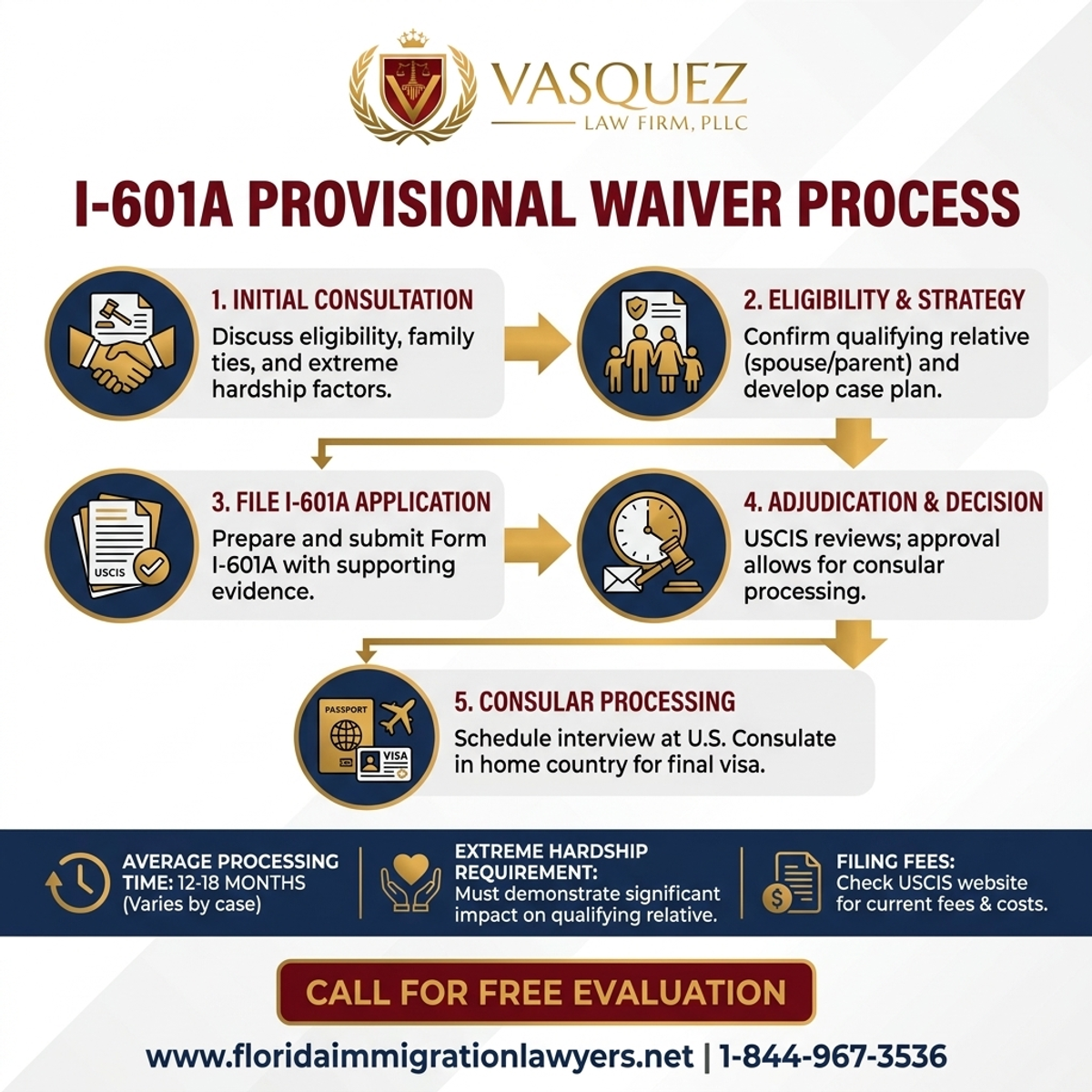
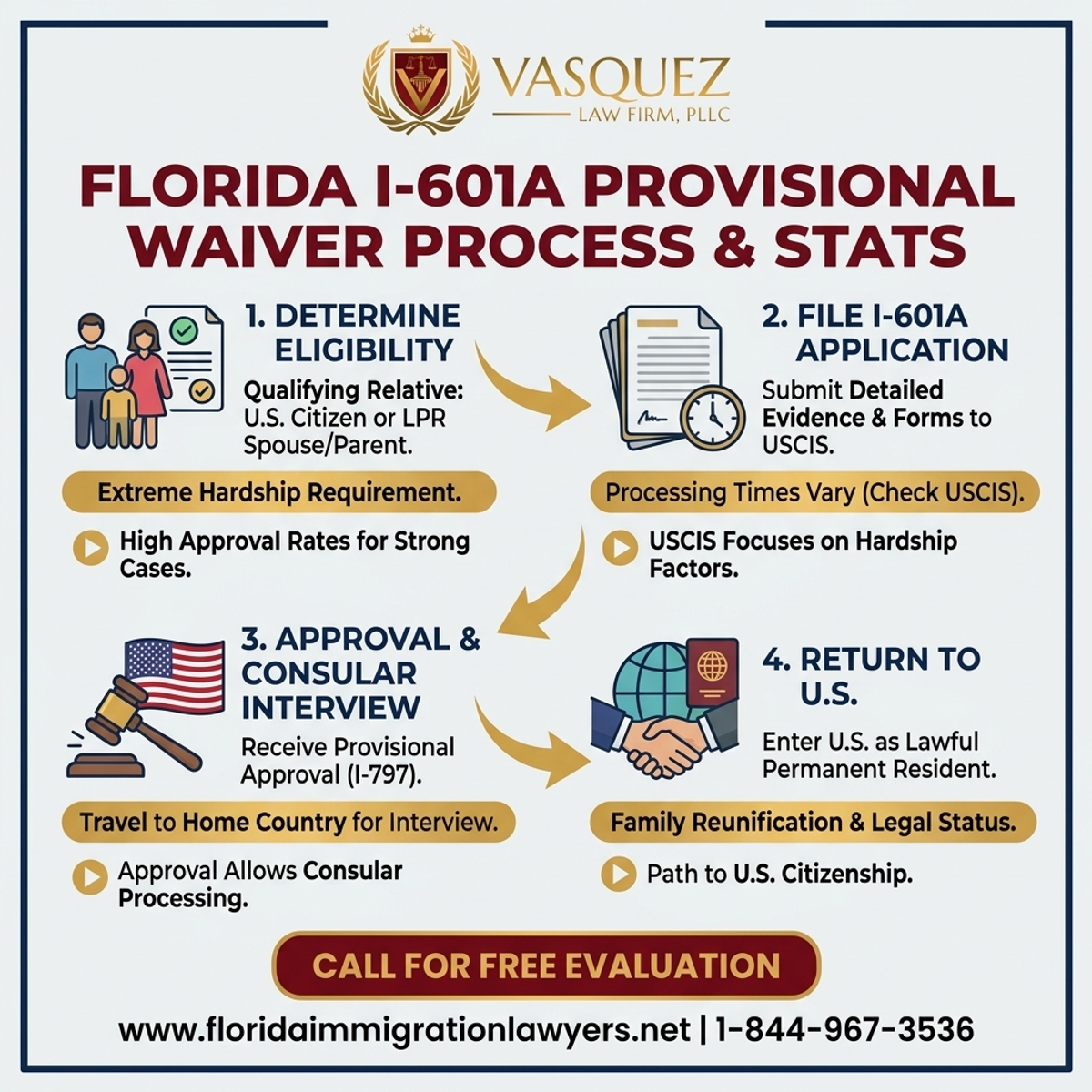
Applying for an I-601A provisional waiver in Florida in 2026 involves a series of precise steps. Missing any detail can lead to delays or denial. Here is a general outline of the process:
Immigrant Visa Petition Approval: First, a U.S. citizen or lawful permanent resident must file an immigrant visa petition (Form I-130, Petition for Alien Relative) on behalf of the applicant, and it must be approved by USCIS. This establishes the familial relationship and the basis for the immigrant visa.
DS-260 Filing and Fee Payment: Once the I-130 is approved, the National Visa Center (NVC) will process the case. The applicant must complete and submit the Immigrant Visa Electronic Application (Form DS-260) and pay the immigrant visa processing fees. This signals intent to pursue consular processing.
I-601A Waiver Application Filing: After the DS-260 is submitted and the NVC confirms the immigrant visa case is documentarily complete, but before the scheduled immigrant visa interview, the applicant files Form I-601A, Application for Provisional Unlawful Presence Waiver, with USCIS. This form must be accompanied by the required filing fee.
Gathering Supporting Documentation: This is a critical step. Applicants must meticulously gather all documents proving their eligibility and, most importantly, demonstrating 'extreme hardship' to their qualifying U.S. citizen or lawful permanent resident spouse or parent. This includes personal identification, proof of relationship, and extensive hardship evidence.
USCIS Decision: USCIS will review the I-601A application and supporting evidence. They may issue a Request for Evidence (RFE) if more information is needed. If approved, USCIS sends an approval notice. If denied, the applicant will receive a denial notice.
Consular Interview Abroad: If the I-601A is approved, the applicant will attend their immigrant visa interview at a U.S. embassy or consulate abroad. This is typically in their home country. Because the unlawful presence waiver was provisionally approved stateside, the consular officer can issue the immigrant visa if no other grounds of inadmissibility are found.
Admission to the U.S.: Upon successful interview and visa issuance, the applicant can return to the United States as a lawful permanent resident.
Step-by-Step Process — I-601A Provisional Waiver Plantation: Florida Guide 2026
This process requires precision and an understanding of both USCIS and Department of State procedures. For residents of Plantation and Kissimmee, Florida, working with a local immigration attorney can significantly enhance the likelihood of a successful application.
Essential Documents for Your I-601A Provisional Waiver Application
A comprehensive collection of documents is vital for a strong I-601A provisional waiver application. Submitting an incomplete or poorly organized package can lead to delays or even denial. Here is a general checklist of the types of documents you will need:
Proof of Approved Immigrant Petition: Copy of Form I-797, Approval Notice, for the underlying Form I-130, I-140, or I-360 petition.
Proof of U.S. Citizenship or LPR Status of Qualifying Relative: Copy of U.S. birth certificate, U.S. passport, Certificate of Naturalization, or green card (Form I-551) for the qualifying U.S. citizen or lawful permanent resident spouse or parent.
Proof of Relationship: Marriage certificate (if applicable), birth certificates of children, and any other documents establishing the relationship between the applicant and the qualifying relative.
Identity Documents: Copy of applicant's passport biographic page, birth certificate, and any previous visas or entry stamps.
Proof of Unlawful Presence: While not strictly required to prove unlawful presence (USCIS often presumes it), any documents showing entry and length of stay can be helpful.
Extreme Hardship Documentation: This is the most extensive section and typically includes:
Medical Records: For the qualifying relative, detailing any serious health conditions, diagnoses, treatment plans, and the need for the applicant's care.
Psychological Evaluations: Reports from licensed therapists or psychologists detailing emotional and mental health impact on the qualifying relative due to separation.
Financial Records: Bank statements, tax returns (Forms W-2, 1099, 1040), pay stubs, mortgage statements, utility bills, and any documents showing financial dependency on the applicant or financial strain.
Educational Records: For dependent children, showing disruption to schooling or special needs.
Affidavits/Letters of Support: Detailed letters from the qualifying relative, family members, friends, employers, and community leaders describing the hardship.
Property Documents: Deeds, lease agreements, and other evidence of property ownership or rental agreements in Florida.
Community Ties: Evidence of the qualifying relative's involvement in the community, church, or other organizations in Florida, showing disruption.
Fee Payment: Check or money order for the I-601A filing fee (as of 2026, check USCIS website for current fees).
Passport-style Photos: Two identical passport-style photographs of the applicant.
Organizing these documents clearly and providing translations for any non-English documents are crucial. USCIS provides detailed instructions on their website (USCIS). An attorney from Florida Immigration Lawyers can help you compile a robust application package tailored to your specific situation.
Do not navigate this process alone. The complexities of immigration law, especially concerning waivers, require expert attention. Contact Florida Immigration Lawyers today at 1-844-967-3536 for a free consultation to discuss your I-601A provisional waiver case and ensure your application is as strong as possible.
I-601A Provisional Waiver Timelines and Cost Factors in 2026
Understanding the typical timelines and potential costs associated with the I-601A provisional waiver can help applicants in Florida plan effectively. Please note that processing times are estimates and can vary significantly based on USCIS workload, case complexity, and policy changes. Filing fees are also subject to change by USCIS.
Typical Timeline for I-601A Processing (As of 2026):
Stage
Typical Timeframe
Notes
I-130 Petition Processing
6-18 months
This initial petition must be approved before filing I-601A.
NVC Processing (DS-260, fees)
3-6 months
After I-130 approval, NVC collects documents and fees.
I-601A Waiver Processing
12-24 months
This is the time USCIS takes to adjudicate the provisional waiver application. Check USCIS processing times for current estimates.
Consular Interview & Visa Issuance
1-3 weeks (after I-601A approval)
Once I-601A is approved, the applicant departs for the interview.
Cost Factors and Fee Breakdown:
Item
Typical Fee (as of 2026)
Notes
Form I-130 Filing Fee
Varies by petition type
Paid by the U.S. citizen/LPR petitioner. Check USCIS for current fee.
Immigrant Visa Application Fee (DS-260)
Varies
Paid to the Department of State. Check Travel.State.Gov for current fee.
Form I-601A Filing Fee
Varies
Paid to USCIS. This is for the provisional waiver itself.
Biometrics Fee
Varies
Paid to USCIS for fingerprinting and background checks.
Medical Examination Fee
Varies (paid to panel physician)
Required for the immigrant visa process.
Attorney Fees
Varies widely
Highly recommended for complex cases like I-601A. An investment in expertise.
Document Translation & Preparation
Varies
Costs for certified translations and gathering extensive evidence.
It is important to budget for all these costs. Remember, USCIS and Department of State fees are subject to change without notice. Always refer to the official government websites for the most current fee schedules. While these costs may seem significant, the potential for achieving lawful permanent residency and family unity makes the investment worthwhile for many families in Florida. For specific financial planning advice related to your I-601A provisional waiver, consult with Florida Immigration Lawyers.
Common Mistakes to Avoid in Your I-601A Provisional Waiver Application
The I-601A provisional waiver process is fraught with potential pitfalls that can lead to delays or outright denial. Avoiding these common mistakes is critical for a successful outcome:
Failing to Prove Extreme Hardship: This is the most common reason for denial. Applicants often submit insufficient evidence or fail to demonstrate hardship beyond normal separation. Generic letters or vague claims are not enough.
Not Meeting Eligibility Requirements: Applying for the I-601A without an approved I-130, not having a qualifying relative, or having other grounds of inadmissibility (like criminal records) will result in denial.
Departing the U.S. Before Approval: The I-601A waiver must be approved before you leave the United States for your consular interview. Leaving prematurely will void the application and trigger the unlawful presence bar.
Incomplete or Incorrect Forms: Small errors, missing signatures, or unanswered questions on Form I-601A or supporting documents can lead to Requests for Evidence (RFEs) or denial.
Failing to Disclose All Information: Omitting relevant information, even if seemingly minor, can be considered misrepresentation and lead to severe penalties, including a permanent bar.
Not Providing Certified Translations: Any document not in English must be accompanied by a complete and certified English translation.
Submitting Disorganized Evidence: USCIS officers review thousands of applications. A poorly organized submission can make it difficult for them to find key information, potentially leading to an unfavorable decision.
Ignoring Other Grounds of Inadmissibility: The I-601A only waives unlawful presence. If you have other inadmissibility issues (e.g., criminal history, fraud, prior deportations), this waiver will not help, and you may need other waivers or be ineligible.
Missing Deadlines: Failing to respond to RFEs or other USCIS notices within the specified timeframe can result in the abandonment or denial of your application.
Not Consulting an Attorney: The complexity of the I-601A waiver makes it one of the most challenging immigration applications. Attempting it without legal counsel significantly increases the risk of errors and denial.
When to Call a Florida Immigration Lawyer for Your I-601A Waiver
While the information provided here offers a comprehensive overview, the I-601A provisional waiver process is highly individualized and legally intricate. There are many scenarios where the guidance of an experienced Florida immigration lawyer becomes not just helpful, but essential. You should strongly consider contacting Florida Immigration Lawyers if any of the following situations apply to you:
You are unsure if you meet the eligibility criteria for the I-601A waiver.
Your case involves any criminal history, even minor offenses, as this can trigger other grounds of inadmissibility.
You have previously been deported or have a prior order of removal.
You have a complex immigration history, such as multiple entries, visa overstays, or previous immigration applications.
You are struggling to gather compelling evidence to prove 'extreme hardship' to your qualifying relative.
You have received a Request for Evidence (RFE) from USCIS and need assistance responding effectively.
Your qualifying relative has medical or psychological conditions that require expert documentation for the hardship claim.
You are concerned about potential misrepresentation issues or other inadmissibility grounds.
You simply want to ensure your application is meticulously prepared and presented, minimizing risks of denial.
Florida Immigration Lawyers has extensive experience with I-601A provisional waivers for clients throughout Florida, including Plantation, Kissimmee, and the greater Orlando area. Our team understands the nuances of proving extreme hardship and navigating USCIS procedures. We are dedicated to protecting your rights and helping you achieve your immigration goals.
About Florida Immigration Lawyers
Florida Immigration Lawyers is a leading immigration law firm dedicated to serving individuals and families across the entire state of Florida. With a deep understanding of U.S. immigration laws and a commitment to our clients, we provide compassionate yet aggressive legal representation. Our experienced attorneys specialize in a wide range of immigration matters, including family-based immigration, asylum, deportation defense, citizenship applications, and complex waiver cases like the I-601A provisional waiver.
We pride ourselves on our client-focused approach, offering personalized strategies tailored to each unique situation. Our firm is available 24/7 to address your urgent immigration needs, and we offer free consultations to help you understand your options without financial obligation. Choosing Florida Immigration Lawyers means partnering with a team that genuinely cares about your future and is equipped to handle the complexities of the immigration system. We serve all of Florida, from Miami to Jacksonville, and are here to be your trusted legal advocate.
This article provides general legal information and is not intended as legal advice. Every case is unique, and outcomes depend on specific facts and circumstances. Contact an attorney for advice about your particular situation.
Do not let the complexities of the I-601A provisional waiver process deter you from seeking the legal status you deserve. Our dedicated team at Florida Immigration Lawyers is ready to assist you every step of the way. Contact us today for a free, confidential consultation. Call 1-844-967-3536 now to speak with an attorney. Se Habla Español - Estamos aquí para ayudarle.
The I-601A provisional waiver's main purpose is to allow certain individuals who are inadmissible due to unlawful presence to apply for a waiver while still in the United States. This prevents them from having to leave the U.S. and wait abroad for a waiver decision, which significantly reduces family separation during the immigrant visa process.
For the I-601A provisional waiver, a 'qualifying relative' is a U.S. citizen or lawful permanent resident (LPR) spouse or parent. The applicant must demonstrate that refusal of their admission to the U.S. would cause 'extreme hardship' to this specific qualifying relative. Hardship to a U.S. citizen child is generally not considered for this waiver.
The I-601A waiver only addresses inadmissibility due to unlawful presence. If you have a criminal record, even a minor one, it may trigger other grounds of inadmissibility that the I-601A does not waive. In such cases, you might be ineligible or require a different type of waiver, making legal consultation essential.
As of 2026, I-601A provisional waiver processing times can vary, but generally range from 12 to 24 months. These times are estimates and depend on various factors, including USCIS workload and the complexity of your case. It is crucial to check the official USCIS website for the most current processing times.
If your I-601A waiver is denied, USCIS will notify you of the decision. You generally cannot appeal the denial of an I-601A. You may have options to refile the application if the reasons for denial can be addressed, or pursue other immigration pathways, but this requires immediate legal advice.
Yes, even with an approved I-601A provisional waiver, you must still depart the United States to attend your immigrant visa interview at a U.S. embassy or consulate abroad. The waiver is 'provisional' because the final immigrant visa decision is made by a consular officer at your interview.
No, the I-601A provisional waiver specifically addresses inadmissibility due to unlawful presence. It does not waive other grounds of inadmissibility, such as those related to criminal convictions, fraud or misrepresentation, health-related issues, or prior deportation orders. Other waivers may be necessary for these issues.
Proving 'extreme hardship' is challenging because it requires demonstrating suffering to a qualifying relative that is significantly beyond the normal emotional and financial difficulties of family separation. USCIS looks for compelling, well-documented evidence of severe impact, making a strong, detailed legal argument crucial for success.
William J. Vásquez
Founding Attorney · Vasquez Law Firm
U.S. Air Force veteran and immigration attorney with years of hands-on U.S. immigration experience. J.D., NCCU School of Law. AILA member. Admitted to the 4th, 5th, and 11th Circuit Courts.
Available 24/7 - Free Evaluations
Reviewed for legal accuracy by William J. Vásquez
Licensed in North Carolina; U.S. immigration is federal practice.