2026 I-539 H-4 Change of Status Processing in Florida
Understanding the I-539 H-4 change of status processing times in Florida for 2026 is vital for anyone looking to transition between nonimmigrant statuses, particularly to an F-1 student visa. While processing can take 6-18 months, accurate filing and adherence to regulations are key. This guide covers eligibility, detailed processing timelines, required documents, and associated costs, including the I-539 filing fee and SEVIS I-901 fee. Learn how to avoid common mistakes and when to seek legal counsel for complex cases. Florida Immigration Lawyers offers comprehensive assistance across Florida, providing expert guidance for your change of status application, ensuring you navigate the legal landscape with confidence.
Navigating an I-539 H-4 change of status in Florida for 2026 involves understanding complex processing times, which can vary significantly. While there's no single definitive timeframe, applicants typically see processing ranging from 6 to 18 months, sometimes longer, depending on the USCIS service center, current workload, and the completeness of the application. It is crucial to file Form I-539, Application to Extend/Change Nonimmigrant Status, accurately and promptly, especially if seeking to change to an F-1 student visa or another nonimmigrant category while in the U.S.
- I-539 H-4 processing times in 2026 generally range from 6 to 18 months.
- Factors like USCIS workload and application accuracy impact timelines.
- Changing status to an F-1 student visa requires specific additional documentation.
- Maintaining current nonimmigrant status throughout the process is critical.
- Consulting an immigration lawyer is highly recommended for complex cases.
Navigating the intricate landscape of U.S. immigration law can feel overwhelming, especially when you are seeking to change your nonimmigrant status. Whether you are currently in H-4 status and considering a move to an F-1 student visa, or exploring other nonimmigrant categories, understanding the process, timelines, and requirements is paramount. The Form I-539, Application to Extend/Change Nonimmigrant Status, is a critical document in this journey, and its processing can be lengthy and complex. For those residing in Florida, including Orlando and surrounding Central Florida communities, specific considerations apply, from local USCIS field offices to the diverse educational opportunities available.
This comprehensive guide from Florida Immigration Lawyers aims to demystify the change of status process, with a particular focus on I-539 H-4 applications and the pathway to an F-1 student visa. We will delve into eligibility, required documentation, estimated processing times for 2026, and common pitfalls to avoid. Our goal is to equip you with the knowledge needed to make informed decisions about your immigration future. If you find yourself facing questions or complexities, do not hesitate to reach out. Call Florida Immigration Lawyers at 1-844-YO-PELEO for a free case review and professional guidance on your change of status application.
What is a Change of Status and Who is Eligible?
A change of status allows a nonimmigrant lawfully present in the United States to change from one nonimmigrant classification to another. This means you do not have to leave the U.S. to apply for a new visa at a U.S. embassy or consulate abroad. Instead, you can apply from within the country, provided you meet specific eligibility criteria. For instance, an individual holding an H-4 visa, granted to dependents of H-1B visa holders, might wish to change to an F-1 student visa to pursue higher education, or to a B-2 visitor visa for an extended stay for tourism or medical treatment. The legal framework for changing nonimmigrant status is primarily outlined in Section 248 of the Immigration and Nationality Act (INA), 8 U.S.C. § 1258.
To be eligible for a change of status, you must generally meet several conditions. You must have been lawfully admitted into the U.S. in a nonimmigrant status, and your current nonimmigrant status must still be valid at the time of filing your I-539 application. Furthermore, you must not have violated the terms of your previous nonimmigrant status, such as by working without authorization or overstaying your permitted period of stay. You also cannot be in removal proceedings. Certain nonimmigrant categories are ineligible for a change of status, such as those admitted under the Visa Waiver Program (VWP). It is essential to demonstrate that you are eligible for the new nonimmigrant classification you are requesting. For example, changing to an F-1 student visa requires acceptance into a Student and Exchange Visitor Program (SEVP) approved school and sufficient financial resources. Understanding these foundational requirements is the first step in a successful change of status application, especially for those in Florida considering their options.
How Long Does an I-539 H-4 Change of Status Take in 2026?
As of 2026, the processing time for an I-539 H-4 change of status application can range significantly, typically from 6 to 18 months. However, some cases may take longer, extending up to two years or more, depending on various factors.
Several critical factors influence the processing duration for Form I-539. These include the specific USCIS service center handling your application, the current volume of applications received by that center, and the completeness and accuracy of your submission. Applications with missing documents or errors will inevitably face delays as USCIS issues Requests for Evidence (RFEs), which can add months to the process. Additionally, background checks and security clearances are standard procedures that can extend timelines. While USCIS provides online tools to check current processing times, these are estimates and can fluctuate. It is always wise to apply well in advance of your current status expiration date to avoid potential gaps in legal status, especially for those in Florida planning their future.
Understanding the typical stages and their associated timeframes can help manage expectations:
| Stage | Typical Timeframe | Notes |
|---|---|---|
| Application Submission & Receipt Notice | 1-4 weeks | USCIS issues Form I-797C, Notice of Action. |
| Biometrics Appointment | 2-8 weeks after Receipt Notice | Required for most I-539 applicants, scheduled at an Application Support Center (ASC) like the one in Orlando, Florida. |
| Initial Review & RFE (if applicable) | 3-12 months | USCIS reviews the application; RFEs can add significant delays. |
| Decision | 6-18 months (total) | Approval or denial notice is mailed; premium processing is not available for I-539. |
Understanding the F-1 Student Visa and Change of Status to F-1 in Florida
The F-1 visa is a nonimmigrant visa for individuals who wish to pursue academic studies or language training programs in the United States. Changing your status to an F-1 visa from another nonimmigrant category, such as H-4, allows you to enroll in a Student and Exchange Visitor Program (SEVP) approved school without leaving the U.S.
To qualify for an F-1 visa, you must be accepted by an SEVP-approved school in Florida or elsewhere, demonstrate proficiency in English or be enrolled in courses to become proficient, and prove you have sufficient funds to cover your tuition, living expenses, and other costs for the duration of your study. You must also intend to depart the U.S. upon completion of your studies and not abandon your foreign residence. Many students in Central Florida choose to pursue higher education at institutions like the University of Central Florida, Valencia College, or Rollins College, all of which are SEVP-certified. The process involves meticulous planning and adherence to specific regulations outlined in 8 CFR 214.2(f).
Here is a step-by-step guide for changing your status to an F-1 student visa:
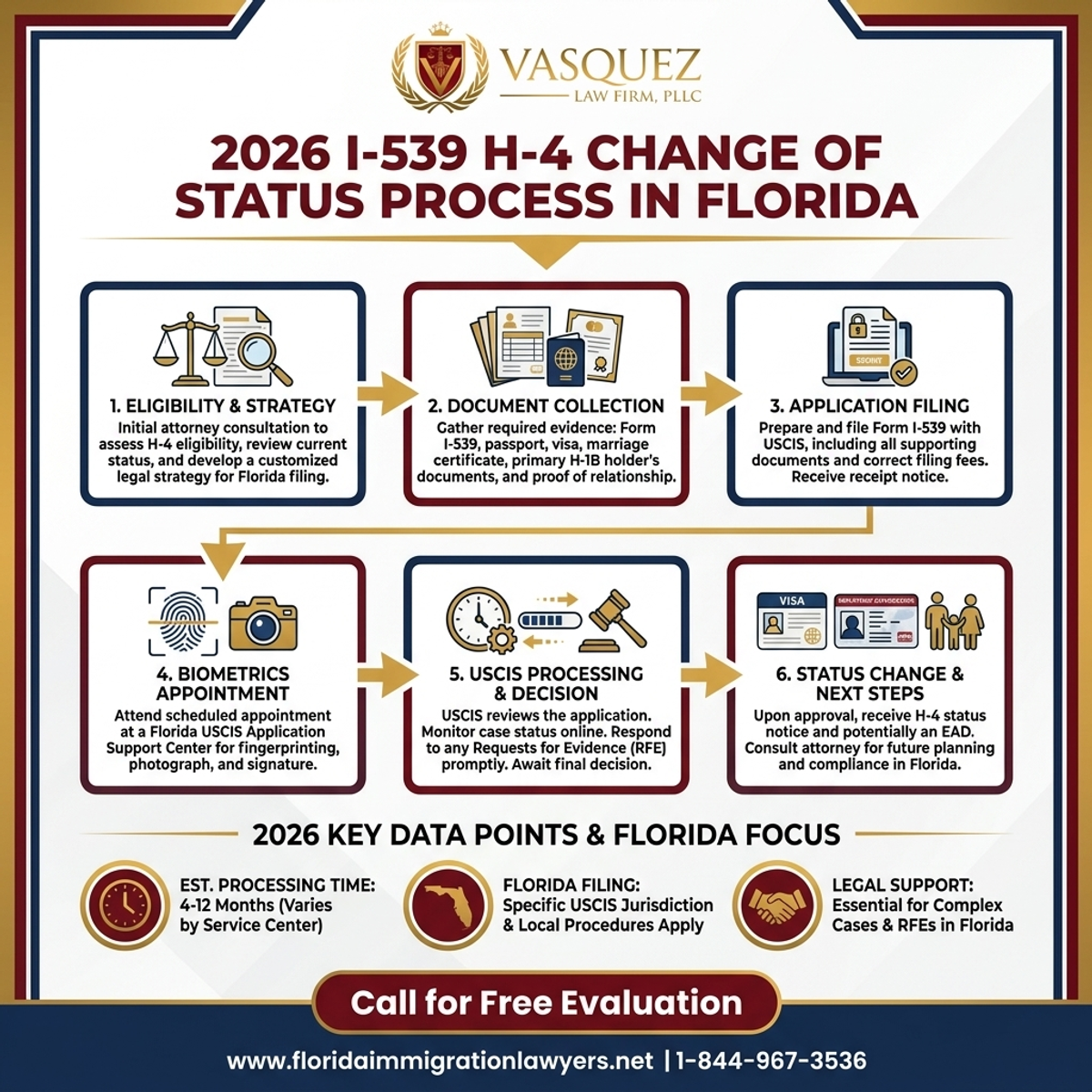
Step-by-Step Process — 2026 I-539 H-4 Change of Status Processing in Florida
- Gain Acceptance from an SEVP-Approved School: You must apply to and be accepted by a school approved by the Student and Exchange Visitor Program (SEVP). Once accepted, the school will issue you a Form I-20, Certificate of Eligibility for Nonimmigrant Student Status.
- Pay the SEVIS I-901 Fee: Before filing your I-539, you must pay the SEVIS I-901 fee. You will need the SEVIS ID from your Form I-20 to complete this payment.
- Complete Form I-539: Fill out Form I-539 accurately and completely, indicating your request to change to F-1 student status. Ensure all sections are correctly answered, and provide your SEVIS ID.
- Gather Supporting Documents: Collect all necessary documentation, including your I-20, proof of financial resources, academic transcripts, passport copies, and evidence of your intent to return to your home country after studies.
- Mail Your Application: Send your complete I-539 application package, along with all supporting documents and the USCIS filing fee, to the appropriate USCIS service center. The correct filing address depends on your current nonimmigrant status and the state you reside in (e.g., Florida).
- Attend Biometrics Appointment: If required, you will receive a notice for a biometrics appointment at an Application Support Center (ASC), such as the one serving Orlando applicants.
- Maintain Status While Awaiting Decision: It is crucial to maintain your current nonimmigrant status (e.g., H-4) while your I-539 is pending. This means adhering to all conditions of your current visa until a decision is made.
- Receive Decision: USCIS will mail you a decision. If approved, your new F-1 status will be effective from the date indicated on the approval notice.
What Documents Do I Need for an I-539 Change of Status Application?
A complete I-539 change of status application requires a comprehensive set of documents to prove eligibility and support your request. Preparing these documents meticulously can prevent delays and RFEs.
The specific documents needed for an I-539 application can vary slightly depending on your current status and the status you are requesting. However, a general checklist includes personal identification, proof of current legal status, and evidence supporting your eligibility for the new status. For those changing to an F-1 student visa, the Form I-20 and financial documentation are particularly important. It is vital that all documents are current, accurate, and, if not in English, accompanied by certified translations. Failure to provide all necessary evidence can lead to significant processing delays or even a denial of your application, impacting your ability to remain lawfully in Florida.
Here is a detailed document checklist for an I-539 change of status application, with a focus on changing to F-1 status:
- Form I-539, Application to Extend/Change Nonimmigrant Status: Completed and signed by the applicant.
- Form I-539A, Supplemental Information for Co-Applicants (if applicable): If applying with dependents.
- Copy of Form I-94, Arrival/Departure Record: Most recent I-94 record for all applicants, available online from CBP.
- Copy of Passport: Biographical page and visa stamp page for all applicants.
- Copy of Current U.S. Visa: If applicable.
- Copy of previous I-797 Approval Notices: For previous extensions or changes of status.
- Proof of Financial Support: Bank statements, affidavits of support, scholarship letters, or other evidence showing sufficient funds to cover tuition and living expenses (especially critical for F-1).
- Form I-20, Certificate of Eligibility for Nonimmigrant Student Status: Issued by the SEVP-approved school (mandatory for F-1 applicants).
- SEVIS I-901 Fee Payment Receipt: Proof of payment for the Student and Exchange Visitor Information System fee.
- Academic Transcripts and Diplomas: For F-1 applicants, showing previous educational background.
- Letter of Intent: Explaining reasons for change of status and educational goals (highly recommended for F-1).
- Marriage Certificate (if applicable): For H-4 dependents, proving relationship to primary H-1B holder.
- Birth Certificates (if applicable): For dependents.
- Filing Fee: Check or money order payable to the U.S. Department of Homeland Security.
What are the Costs Associated with a Change of Status Application?
The costs associated with a change of status application, particularly for Form I-539, include government filing fees and potentially legal fees. These fees are subject to change, so it's always important to verify the most current amounts on the official USCIS website before filing your application. As of 2026, the primary costs include the USCIS filing fee for Form I-539 and, in many cases, a biometrics services fee. For those applying for an F-1 student visa, the SEVIS I-901 fee is an additional, mandatory expense.
Beyond the government fees, engaging an experienced immigration attorney, such as those at Florida Immigration Lawyers, will incur legal fees. While these are an additional expense, the value of expert guidance in navigating complex immigration laws, ensuring accuracy, and addressing potential challenges cannot be overstated. An attorney can help prepare a robust application, respond to RFEs, and represent your interests, significantly increasing the likelihood of a successful outcome. This is particularly beneficial for individuals in Central Florida who may not be familiar with the nuances of U.S. immigration procedures. It is important to budget for all these costs when planning your change of status.
| Item | Typical Fee (2026 Estimate) | Notes |
|---|---|---|
| Form I-539 Filing Fee | $470 - $495 | This fee is for the primary applicant; check USCIS website for current amount. |
| Biometrics Services Fee | $30 - $85 | Required for most I-539 applicants; may be waived for certain categories. |
| SEVIS I-901 Fee (for F-1) | $350 | Mandatory for F-1 student visa applicants. |
| Legal Fees (Immigration Attorney) | Varies ($1,500 - $5,000+) | Dependent on case complexity, firm's experience, and services provided. |
| Document Translation Fees | Varies | If any supporting documents are not in English. |
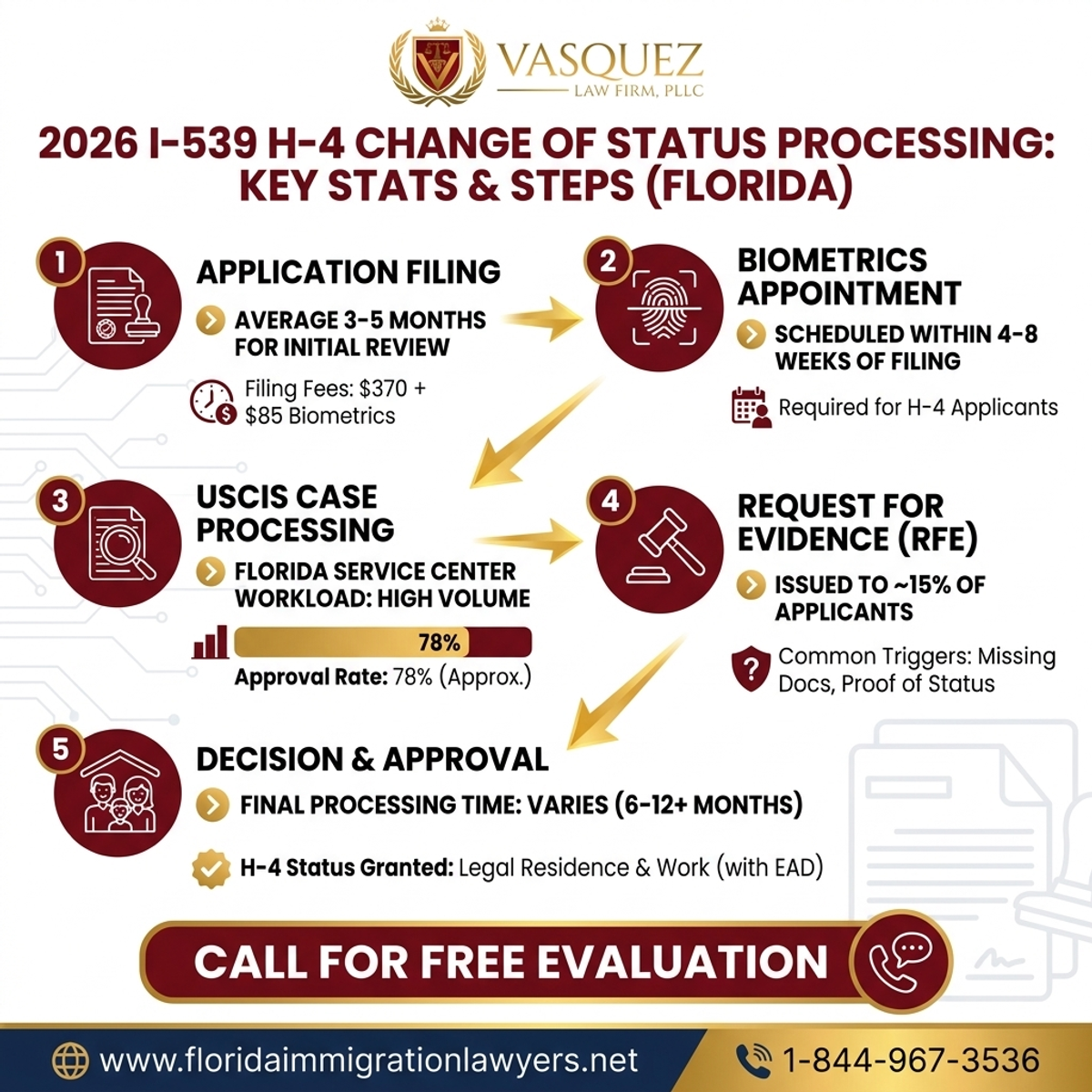
Key Statistics — 2026 I-539 H-4 Change of Status Processing in Florida
Do not navigate this process alone. The complexities of immigration law require experienced guidance to ensure a smooth and successful change of status. Contact Florida Immigration Lawyers today to schedule your free case review and let our dedicated team assist you.
Common Mistakes to Avoid in Your Change of Status Application
Applying for a change of status can be fraught with potential errors that could jeopardize your application. Avoiding these common mistakes is crucial for a successful outcome, especially for those in Florida navigating the I-539 H-4 process or seeking an F-1 student visa.
- Overstaying Your Current Status: Filing Form I-539 after your current authorized period of stay has expired. This can lead to denial and may trigger unlawful presence.
- Failing to Maintain Status While Application is Pending: Even if you've filed, you must continue to abide by the terms of your current nonimmigrant status until a decision is made.
- Incomplete or Inaccurate Forms: Missing information, incorrect dates, or unsigned forms are common reasons for RFEs or outright denials.
- Insufficient Evidence of Financial Support: Especially critical for F-1 applicants, failing to demonstrate adequate funds for tuition and living expenses.
- Not Paying the Correct Fees: USCIS fees change. Submitting an incorrect fee amount will result in your application being rejected.
- Lack of Certified Translations: Any document not in English must be accompanied by a complete and certified English translation.
- Failing to Attend Biometrics Appointment: Missing this mandatory appointment without rescheduling can lead to your application being considered abandoned.
- Not Responding to Requests for Evidence (RFEs) Promptly: Ignoring an RFE or responding late will almost certainly lead to a denial.
- Applying for a Change of Status from an Ineligible Category: Certain nonimmigrant statuses, like the Visa Waiver Program (VWP), are not eligible for a change of status.
- Not Demonstrating Nonimmigrant Intent: For F-1 visas, failing to convince USCIS that you intend to return to your home country after completing your studies.
- Misrepresenting Facts: Providing false information or omitting material facts can lead to severe immigration consequences, including findings of misrepresentation.
- Not Consulting with an Attorney: Attempting to navigate complex cases or past immigration issues without legal counsel can lead to critical errors.
When to Call a Lawyer for Your Change of Status in Florida
While some change of status applications may seem straightforward, the intricacies of immigration law often warrant professional legal assistance. For individuals in Florida, whether you are in Orlando, Miami, or Tampa, understanding when to seek an attorney's help is crucial for a smooth process and a successful outcome. Florida Immigration Lawyers are here to provide the expertise you need.
You should consider calling an immigration lawyer if you:
- Have a complex immigration history, including previous visa denials or overstays.
- Are applying for a change of status from a less common nonimmigrant category.
- Have received a Request for Evidence (RFE) from USCIS, requiring a detailed and timely response.
- Are concerned about maintaining your legal status while your I-539 application is pending.
- Have any criminal record, no matter how minor, which could impact your eligibility.
- Are unsure about which supporting documents are required or how to properly prepare them.
- Are facing tight deadlines or potential gaps in your legal status.
- Are changing from H-4 to F-1 and have questions about maintaining F-1 status or OPT eligibility.
- Need help appealing a denied change of status application.
- Simply want peace of mind knowing your application is prepared correctly and professionally.
Our experienced attorneys at Florida Immigration Lawyers understand the nuances of change of status applications, including I-539 H-4 and F-1 student visas. We can help you navigate the process, prepare a strong application, and respond to any challenges that may arise. Do not risk your immigration future by attempting to go it alone. We serve clients throughout Florida, from Central Florida to the Panhandle, providing dedicated legal support.
About Florida Immigration Lawyers
Florida Immigration Lawyers is a leading immigration law firm dedicated to serving individuals and families across the entire state of Florida. With a deep understanding of U.S. immigration laws and a commitment to our clients, we provide comprehensive legal services tailored to your unique needs. Our team of compassionate and knowledgeable attorneys is passionate about helping immigrants achieve their American dreams.
We specialize in a wide range of immigration matters, including family-based petitions, employment visas, asylum, deportation defense, citizenship, and, of course, change of status applications like the I-539 H-4 and F-1 student visas. Our office in Orlando serves as a hub for clients throughout Central Florida, but our reach extends to every corner of the state. We pride ourselves on offering personalized attention, clear communication, and strategic legal advice, ensuring you are supported every step of the way. We offer free case reviews and are available 24/7 to address your urgent questions and concerns. Choose Florida Immigration Lawyers for dedicated advocacy and expert guidance.
Sources and References
- U.S. Citizenship and Immigration Services (USCIS)
- U.S. Department of State
- Executive Office for Immigration Review (EOIR)
- Immigration and Nationality Act (INA) Section 248 - 8 U.S.C. § 1258, Change of Nonimmigrant Classification
- 8 Code of Federal Regulations (CFR) 214.2(f) - Academic Students
- 8 CFR 248.1 - Eligibility for Change of Nonimmigrant Status
- Customs and Border Protection (CBP) I-94 Website: https://i94.cbp.dhs.gov/I94/#/home
Related services: immigration practice areas, family immigration services, business immigration, free immigration consultation.
This article provides general legal information and is not intended as legal advice. Every case is unique, and outcomes depend on specific facts and circumstances. Contact an attorney for advice about your particular situation.
Do not let the complexities of immigration law deter you from pursuing your goals. Whether you are seeking an I-539 H-4 change of status, an F-1 student visa, or any other immigration solution in Florida, Florida Immigration Lawyers is here to help. Our dedicated team is ready to provide the compassionate and effective legal representation you deserve. Call us today for a free case review: 1-844-YO-PELEO. Se Habla Espanol - Estamos aqui para ayudarle.
Do Not Navigate This Process Alone
Our experienced immigration attorneys are ready to fight for you. Get a free, confidential case review today.
Se Habla Español
Or leave your details and we’ll call you:
Free Evaluation in 24 Hours
Or talk to us right now

AI voice assistant — available 24/7
FreeFrequently Asked Questions

William J. Vásquez
Founding Attorney · Vasquez Law Firm
U.S. Air Force veteran and immigration attorney with years of hands-on U.S. immigration experience. J.D., NCCU School of Law. AILA member. Admitted to the 4th, 5th, and 11th Circuit Courts.
Available 24/7 - Free Evaluations
Reviewed for legal accuracy by William J. Vásquez
Licensed in North Carolina; U.S. immigration is federal practice.
Related Legal Services
Our Florida immigration attorneys can help you with immigration lawyer cost in Florida, experienced immigration attorneys and asylum protection. Call today at 1-844-YO-PELEO for a free case review.
Related Links
Related Topics
Free Legal Case Review
Discuss your case with our experienced attorneys. We're available 24/7.
Se Habla Español - Estamos aquí para ayudarle.
Related Articles
DUI Immigration Consequences in Florida 2026
A DUI conviction in Florida can have severe immigration consequences, potentially leading to inadmissibility, deportation, or denial of immigration benefits. For non-citizens, a DUI is not just a traffic offense but a serious criminal matter that federal immigration law scrutinizes closely. Factors like multiple offenses, injury, or property damage can escalate a simple DUI to a Crime Involving Moral Turpitude (CIMT) or even an aggravated felony, triggering mandatory detention and removal proceedings. Understanding the specific nature of your Florida conviction and its interpretation under the Immigration and Nationality Act (INA) is crucial. This article outlines how DUIs impact immigration status, the grounds for inadmissibility and deportation, a step-by-step guide to navigating the process, essential documentation, and expected timelines for 2026. We also highlight common mistakes to avoid and when to seek legal counsel from an experienced immigration attorney. Florida Immigration Lawyers offers comprehensive support for individuals facing these challenging situations, providing expert guidance through complex legal landscapes.
PERM Labor Certification in Florida: A 2026 Guide
Learn all about the PERM labor certification process in Florida, essential for employers sponsoring green card applicants. Understand the steps, document requirements, and common mistakes to avoid in this 2026 guide.
Immigration Lawyer Orlando Free Consultation in Florida
For individuals and families in Orlando, Florida, navigating the complexities of U.S. immigration law requires expert guidance. An immigration lawyer in Orlando offers crucial support for everything from visa applications and green card processes to naturalization and deportation defense. This comprehensive guide details what a free consultation covers, providing a step-by-step overview of immigration pathways, essential document checklists, and expected timelines in 2026. We also highlight common mistakes to avoid, discuss the critical role of legal counsel in deportation and asylum cases, and explain why choosing a local Orlando immigration attorney is beneficial. Florida Immigration Lawyers is dedicated to serving the diverse community of Orlando with compassionate, effective legal solutions, ensuring you receive personalized advice and robust representation for a successful immigration journey.
EAD Advance Parole Combo Card in Florida: What You Need
An EAD advance parole combo card allows individuals with pending adjustment applications to both work and travel abroad without jeopardizing their green card application. Learn how to apply in Florida, what documents you need, and common mistakes to avoid.