H-2A Visa for Florida Growers: Essential Farm Labor Guide
The H-2A visa program is crucial for Florida's agricultural sector, enabling growers to address temporary labor shortages by bringing in foreign agricultural workers. This guide delves into the step-by-step application process, essential documentation, expected timelines, and associated costs for Florida employers. We highlight the stringent requirements set by the Department of Labor (DOL) and U.S. Citizenship and Immigration Services (USCIS) regarding worker wages, housing, and transportation. Furthermore, we outline common pitfalls to avoid and emphasize when legal counsel from Florida Immigration Lawyers becomes indispensable. Understanding these intricacies is vital for ensuring compliance and the successful operation of your farm in Florida. Contact us today for a free consultation.

The H-2A visa program is a crucial lifeline for Florida's agricultural industry, allowing U.S. employers to bring foreign nationals to the United States to fill temporary or seasonal agricultural jobs. This program addresses critical labor shortages that Florida growers often face, ensuring that essential crops are planted, cultivated, and harvested. It is an employer-sponsored visa, meaning the employer must meet specific requirements regarding housing, transportation, and wages to protect workers' rights and ensure fair labor practices. Navigating the H-2A process involves multiple government agencies, including the Department of Labor (DOL) and U.S. Citizenship and Immigration Services (USCIS), making legal guidance invaluable.
- The H-2A visa is for temporary or seasonal agricultural work.
- Employers must demonstrate a shortage of U.S. workers.
- Strict requirements apply for wages, housing, and transportation.
- The process involves both the DOL and USCIS.
- Legal expertise is highly recommended for successful petitions.
Florida's vibrant agricultural sector is a cornerstone of its economy, producing everything from citrus and berries to vegetables and ornamental plants. However, securing a consistent and reliable workforce for temporary and seasonal needs remains a significant challenge for many Florida growers. This is where the H-2A visa program becomes indispensable. Designed to help U.S. agricultural employers fill temporary labor gaps, the H-2A visa allows foreign nationals to come to the United States for specific farm labor tasks. From the sprawling fields near Tallahassee to the citrus groves in Central Florida, the demand for skilled agricultural workers is constant, especially during planting and harvesting seasons. Understanding and correctly navigating the H-2A process is not just a regulatory hurdle; it is essential for the economic viability of many Florida farms. This comprehensive guide will walk you through the intricacies of the H-2A program, its requirements, and how Florida Immigration Lawyers can assist you. Do not navigate this complex process alone. Call Florida Immigration Lawyers at 1-844-967-3536 for a free consultation.
Understanding the H-2A Visa Program for Florida Agriculture
The H-2A visa program is authorized under Section 101(a)(15)(H)(ii)(a) of the Immigration and Nationality Act (INA), codified at 8 U.S.C. § 1101(a)(15)(H)(ii)(a). It permits U.S. employers to bring foreign nationals to the United States to perform temporary or seasonal agricultural labor. This program is particularly vital for Florida, a state with diverse agricultural needs that fluctuate throughout the year. For instance, citrus harvesting requires a large workforce during winter, while berry picking peaks in spring. Without access to a reliable temporary workforce, many Florida growers would struggle to bring their crops to market, impacting both local economies and national food supply chains.
To qualify for the H-2A program, an employer must demonstrate two key points: first, that there are not enough U.S. workers who are able, willing, qualified, and available to perform the temporary agricultural work; and second, that employing foreign workers will not adversely affect the wages and working conditions of similarly employed U.S. workers. This dual requirement ensures that the program serves its intended purpose of supplementing, not supplanting, the domestic labor force. The term 'temporary or seasonal' generally means work that is tied to a certain time of year by an event or pattern, such as a growing season, or for a period of up to one year.
For Florida growers, this means carefully planning their labor needs well in advance of their peak seasons. The program covers a wide range of agricultural activities, from planting and cultivating to harvesting and packing. It also includes duties like operating farm machinery, irrigating fields, and maintaining farm structures. The Department of Labor (DOL) plays a critical role in certifying the employer's need for foreign workers and ensuring compliance with labor protections, including the payment of the Adverse Effect Wage Rate (AEWR) and providing adequate housing and transportation. USCIS then reviews the petition for eligibility. This multi-agency oversight underscores the program's complexity and the importance of adhering to all regulations to avoid delays or denials.
Step-by-Step Guide to Obtaining an H-2A Visa for Your Farm
Obtaining an H-2A visa for your agricultural workers involves a multi-stage process that requires meticulous planning and strict adherence to regulatory deadlines. For Florida growers, understanding each step is critical to securing the necessary workforce in time for your planting and harvesting schedules. This process typically begins several months before the anticipated start date of work.
-
Test the U.S. Labor Market (DOL Requirement): Before filing, employers must demonstrate that they have attempted to recruit U.S. workers. This involves actively advertising the job opportunity in various media, including local newspapers, state workforce agencies, and other relevant channels, for a specific period (typically 30 days). The job offer must clearly state the terms and conditions of employment, including the wage rate, housing, and transportation provisions. The goal is to prove that no qualified U.S. workers are available to fill the positions. This step, governed by 20 CFR Part 655, Subpart B, is crucial and often a point of scrutiny.
-
File a Temporary Labor Certification Application (DOL): Once market testing is complete, the employer files Form ETA-9142A, Application for Temporary Employment Certification, with the U.S. Department of Labor's Employment and Training Administration (ETA). This application outlines the job offer, wage, working conditions, and recruitment efforts. The DOL reviews this application to ensure compliance with all H-2A regulations, including the Adverse Effect Wage Rate (AEWR) for Florida, and may issue a Notice of Deficiency (NOD) if more information is needed. This stage typically takes 60-75 days.
-
File the H-2A Petition with USCIS: After receiving a certified ETA-9142A from the DOL, the employer then files Form I-129, Petition for a Nonimmigrant Worker, with U.S. Citizenship and Immigration Services (USCIS). This petition requests H-2A classification for the foreign workers. It must include the certified ETA-9142A and all supporting documentation. USCIS reviews the employer's eligibility and the workers' qualifications. Processing times vary but can range from 2 to 6 months, though premium processing is available for an additional fee to expedite this stage to 15 calendar days.
-
Visa Interview at a U.S. Consulate (for workers abroad): If the petition is approved, foreign workers located outside the U.S. must apply for an H-2A visa at a U.S. embassy or consulate in their home country. This involves completing the DS-160 online nonimmigrant visa application, paying the visa fee, and attending an interview. During the interview, consular officers verify the worker's eligibility and intent to return home after their temporary employment. Workers should bring their passport, visa appointment confirmation, and a copy of the approved I-129 petition.
-
Entry to the U.S. and Employment: Upon successful interview, the worker receives the H-2A visa stamp in their passport. They can then travel to the U.S. at the specified start date. At the port of entry, Customs and Border Protection (CBP) officers will review their documents and issue an I-94 Arrival/Departure Record, which indicates their authorized period of stay. Upon arrival in Florida, employers must ensure compliance with all H-2A regulations, including providing the promised housing, wages, and working conditions for the duration of the employment period.
Essential Document Checklist for H-2A Petitions
Preparing a thorough and accurate set of documents is paramount for a successful H-2A visa petition. Any missing or incorrect information can lead to delays, Requests for Evidence (RFEs), or even denial of your application, which can be detrimental to Florida growers relying on this critical workforce. Both the employer and the prospective H-2A workers have specific documentation requirements.
For the Employer (Petitioner):
- Form ETA-9142A: Certified Application for Temporary Employment Certification from the Department of Labor. This is the cornerstone of your petition, confirming your need for foreign workers.
- Form I-129: Petition for a Nonimmigrant Worker, properly filled out and signed.
- H-2A Supplement to Form I-129: Specific details related to the H-2A program.
- Employer's Business Documentation: Proof of legal business existence, such as articles of incorporation, business licenses, and Federal Employer Identification Number (FEIN).
- Job Offer Details: A detailed description of the job duties, required qualifications, specific work location (e.g., farm addresses in Tallahassee or other Florida regions), wage rate (AEWR), and anticipated start and end dates.
- Proof of Recruitment Efforts: Copies of all advertisements, recruitment reports, and contacts with U.S. workers, demonstrating a good faith effort to recruit domestically. This includes newspaper clippings, website postings, and records from state workforce agencies.
- Housing Compliance Documentation: Evidence that the provided housing meets all federal and state safety and health standards, including local Florida housing codes. This may include inspection reports and photographs.
- Transportation Plans: Details on how workers will be transported from their home country to the job site in Florida, and daily transportation to/from housing and fields.
- Wage Records: Documentation of how the AEWR was determined and how wages will be paid.
- Workers' Compensation Insurance: Proof of coverage as required by Florida law.
For the H-2A Agricultural Worker (Beneficiary):
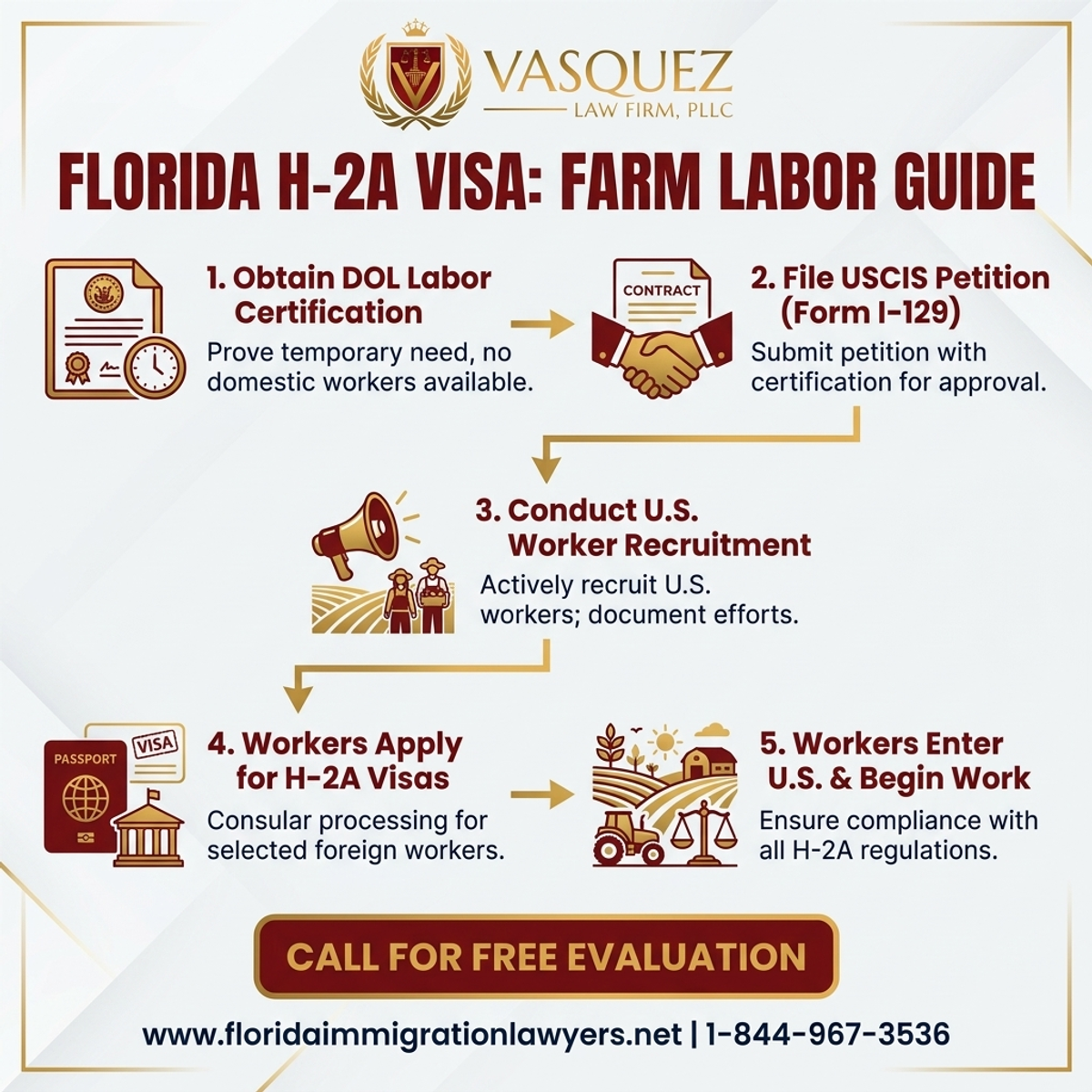
Step-by-Step Process — H-2A Visa for Florida Growers: Essential Farm Labor Guide
- Valid Passport: Must be valid for at least six months beyond the intended period of stay.
- Nonimmigrant Visa Application, Form DS-160: Confirmation page.
- Visa Interview Appointment Confirmation.
- Photographs: Meeting U.S. visa photo requirements.
- Copy of the Approved Form I-129 Petition: A copy of the Notice of Action (Form I-797) from USCIS.
- Proof of Intent to Return Home: Documents demonstrating ties to their home country, such as property deeds, family obligations, or employment contracts.
- Previous Visa History (if applicable): Any prior U.S. visas or entry records.
- Birth Certificate and National ID: As required by the specific consulate.
Organizing these documents systematically and ensuring their accuracy is crucial. A single oversight can lead to significant delays, potentially jeopardizing your agricultural operations for the season. Working with an experienced immigration attorney can help Florida growers compile a complete and compliant petition packet.
H-2A Visa Processing Timelines and Expectations for Florida Growers
Understanding the processing timelines for the H-2A visa program is critical for Florida growers, as agricultural operations are highly time-sensitive. Delays can lead to missed planting windows or unharvested crops, resulting in significant financial losses. While specific timelines can vary based on agency workload, time of year, and the completeness of your application, there are general expectations for each stage of the process.
The entire H-2A process, from initial recruitment efforts to the worker's arrival in Florida, can take anywhere from 3 to 6 months, or even longer if issues arise. Employers should ideally begin planning and initiating the process at least 150 days (approximately five months) before the date of need. This proactive approach helps mitigate risks associated with potential delays or Requests for Evidence (RFEs) from either the DOL or USCIS.
-
Department of Labor (DOL) Processing: The initial stages with the DOL, including the labor market test and the processing of Form ETA-9142A, typically take about 60-75 days. This period includes the mandatory 30-day recruitment window and the DOL's review and certification process. During peak agricultural seasons, the DOL may experience higher volumes, potentially extending these times. For Florida growers, applying outside of peak national H-2A demand (e.g., not simultaneously with major harvest seasons in other large agricultural states) might offer a slight advantage in processing speed.
-
USCIS Petition Processing: Once the DOL certification is received, the Form I-129 petition is filed with USCIS. Standard processing for H-2A petitions can range from 2 to 6 months. However, USCIS offers a premium processing service for an additional fee, guaranteeing a decision within 15 calendar days. This option is often a worthwhile investment for Florida growers facing urgent labor needs, especially for seasonal crops with narrow harvest windows. USCIS processing times can be checked on the USCIS website by form type and service center.
-
Consular Processing (Visa Interview): After USCIS approves the petition, workers abroad must attend a visa interview at a U.S. embassy or consulate. Appointment availability can vary significantly by country and season. While the interview itself is usually quick, securing an appointment can take weeks. This stage is outside the direct control of the employer but can be streamlined by ensuring workers have all necessary documents ready.
What to Expect: Expect potential delays. RFEs from either the DOL or USCIS are common, requiring employers to submit additional evidence or clarification. Responding promptly and thoroughly to an RFE is crucial to avoid further delays or denial. Furthermore, unforeseen circumstances, such as changes in immigration policy or natural disasters affecting Florida's agriculture, can impact timelines. The H-2A visa is generally issued for up to one year, corresponding to the certified period of need, and can be extended for up to a total of three years, with a mandatory break in physical presence outside the U.S. after three years.
Cost Factors and Fee Breakdown for H-2A Visas
The H-2A visa program represents a significant investment for Florida growers, encompassing various fees, wages, and ancillary costs. Understanding this financial commitment upfront is crucial for budgeting and planning your agricultural operations. It's important to note that many of these costs are legally mandated responsibilities of the employer.
-
Department of Labor (DOL) Fees: Currently, there is no filing fee for the Form ETA-9142A, Application for Temporary Employment Certification, with the DOL. However, employers incur costs related to the labor market test, such as advertising expenses for recruitment efforts in newspapers and online job boards. These can vary widely depending on the chosen publications and duration of advertisements.
-
USCIS Filing Fees: The primary fee for the H-2A petition is for Form I-129, Petition for a Nonimmigrant Worker. As of 2026, this fee is subject to change but typically ranges from a few hundred dollars. Additionally, there is an optional premium processing fee for Form I-129, which significantly expedites USCIS's decision to 15 calendar days. This fee is substantial but often justified for time-sensitive agricultural needs.
-
Visa Application Fees (for Workers): Each foreign worker must pay a non-refundable Machine Readable Visa (MRV) fee for the DS-160, Nonimmigrant Visa Application. This fee is paid directly to the U.S. embassy or consulate where the worker applies for their visa. The employer is generally responsible for reimbursing the worker for this fee, as per H-2A regulations.
-
Transportation Costs: H-2A regulations require employers to pay for the worker's transportation from their home country to the place of employment in Florida, or reimburse them for these costs. This also includes daily transportation from employer-provided housing to the worksite. At the completion of the contract, the employer is also responsible for providing or paying for return transportation. These costs can be substantial, especially for workers traveling from distant countries.
-
Housing Costs: Employers must provide free, safe, and sanitary housing to all H-2A workers and any U.S. workers who are not reasonably able to return to their permanent residence daily. This involves initial setup costs, ongoing maintenance, utilities, and ensuring compliance with federal and Florida state housing standards. Housing inspections are mandatory and must be passed.
Key Statistics — H-2A Visa for Florida Growers: Essential Farm Labor Guide
-
Wages and Payroll: Employers must pay H-2A workers at least the Adverse Effect Wage Rate (AEWR), the prevailing wage, the federal minimum wage, or the state minimum wage, whichever is highest. For Florida, the AEWR is determined annually by the DOL and is specific to agricultural occupations. Employers must also cover workers' compensation insurance.
-
Attorney Fees: Navigating the complex H-2A process often necessitates the expertise of an immigration attorney. Legal fees can vary based on the complexity of the case, the number of workers, and the services provided. While an additional cost, legal guidance can prevent costly mistakes and ensure a smooth, compliant process, potentially saving more in the long run.
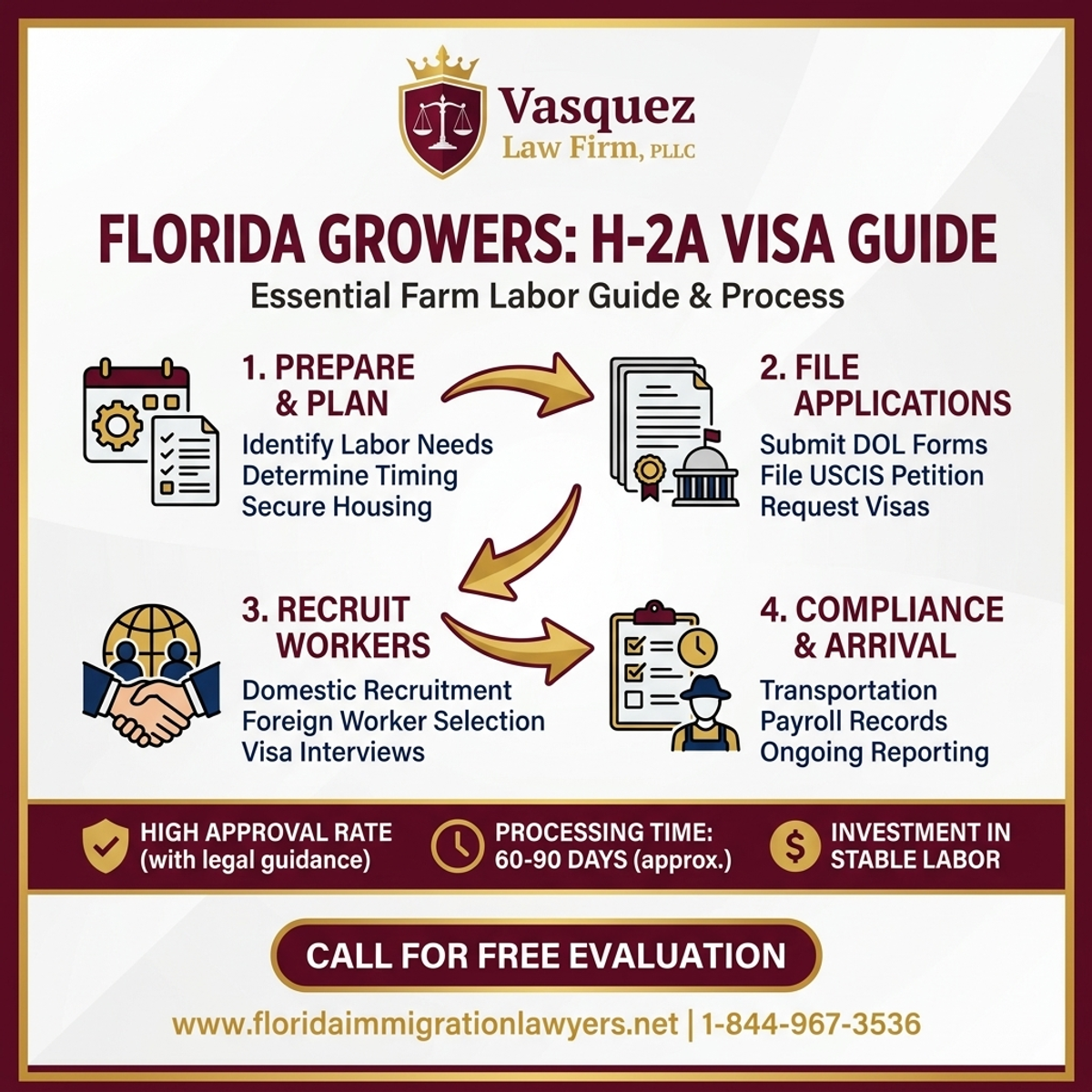
Do not navigate this complex process alone. The success of your agricultural season in Florida often hinges on your ability to secure a compliant and timely H-2A workforce. Contact Florida Immigration Lawyers today for expert guidance and support.
Common Mistakes to Avoid in the H-2A Process
The H-2A visa program is fraught with complexities, and even minor errors can lead to significant delays, denials, or severe penalties. Florida growers must be acutely aware of these pitfalls to ensure a smooth and compliant process. Avoiding these common mistakes is crucial for the success of your agricultural operations.
-
Inadequate Labor Market Test: Failing to conduct a thorough and compliant U.S. worker recruitment effort is a frequent misstep. Employers must genuinely attempt to find domestic workers, advertise correctly, and document all responses. Insufficient recruitment can lead to DOL denial of the labor certification, halting the entire H-2A process.
-
Incorrect Wage Determination: Not paying the Adverse Effect Wage Rate (AEWR) or the highest applicable wage is a serious violation. The AEWR is set annually by the DOL and varies by state and occupation. Underpaying workers can result in substantial back wage liabilities, fines, and future disqualification from the program.
-
Substandard Housing: Providing housing that does not meet federal, state, and local Florida health and safety standards is a critical error. Housing must be inspected and certified. Non-compliant housing can lead to immediate program termination, fines, and reputational damage.
-
Late Filing: Missing critical deadlines for filing with the DOL and USCIS can result in your workers not arriving in time for the planting or harvest season. The H-2A process is lengthy; starting too late is a common mistake that can devastate a season's yield.
-
Incomplete or Inaccurate Documentation: Submitting petitions with missing forms, incorrect information, or insufficient supporting evidence is a leading cause of RFEs and denials. Each form and piece of evidence must be meticulously prepared and cross-referenced to avoid scrutiny.
-
Misrepresenting Job Duties or Conditions: Any discrepancy between the job description provided to the DOL and the actual work performed, or deviations from promised wages and working conditions, can lead to serious compliance issues. This can trigger investigations, penalties, and even criminal charges.
-
Failure to Comply with Post-Certification Requirements: The employer's responsibilities do not end once the visa is approved. Ongoing compliance includes maintaining accurate payroll records, providing agreed-upon transportation, ensuring safe working conditions, and adhering to all terms of the certified job offer. Neglecting these can lead to audits, penalties, and debarment from the program.
-
Ignoring Florida-Specific Regulations: While federal laws govern the H-2A program, Florida also has specific labor and housing regulations that employers must follow. Overlooking these local requirements can lead to state-level penalties in addition to federal issues.
When to Call a Florida H-2A Visa Lawyer
Navigating the H-2A visa program can be exceptionally complex, with strict regulations and tight deadlines that can overwhelm even experienced Florida growers. While the information provided here offers a comprehensive overview, specific situations often demand the specialized knowledge of an immigration attorney. Knowing when to seek legal counsel can save you time, money, and significant stress, ultimately protecting your agricultural operations.
You should consider contacting Florida Immigration Lawyers if any of the following scenarios apply to your situation:
-
First-Time H-2A Petitioner: If you are new to the H-2A program, the learning curve can be steep. An attorney can guide you through each step, ensuring all requirements are met from the outset and establishing a strong foundation for future petitions.
-
Received a Request for Evidence (RFE) or Notice of Deficiency (NOD): If the DOL or USCIS has requested additional information or clarified your application, it's a clear sign that your petition needs expert review. An attorney can help you understand the specific issues and formulate a comprehensive, timely response to prevent denial.
-
Previous H-2A Petition Denials or Compliance Issues: If your farm has faced past denials or has a history of compliance problems, an attorney can help identify the root causes, address them, and strengthen your current or future petitions. They can assist in developing strategies to regain eligibility.
-
Complex Agricultural Operations: Farms with multiple locations across Florida, diverse crop types, varying seasonal needs, or a large number of H-2A workers often have more intricate compliance requirements. An attorney can help manage these complexities efficiently.
-
Audits or Investigations: If your farm is subject to a DOL or USCIS audit, or if you are facing an investigation related to H-2A compliance, immediate legal representation is crucial. An attorney can protect your rights, represent you, and help you navigate the investigative process.
-
Changes in Immigration Law or Policy: Immigration laws are subject to frequent changes. An attorney stays current with these developments and can advise you on how they impact your H-2A petitions, ensuring ongoing compliance.
-
Need for Strategic Planning: Beyond mere compliance, an attorney can help you develop a long-term H-2A strategy, optimize your recruitment process, and ensure your labor needs are consistently met year after year. This is especially valuable for growers in Tallahassee and other key agricultural regions of Florida.
Florida Immigration Lawyers has extensive experience assisting Florida growers with their H-2A visa needs. We understand the unique challenges of agricultural labor and are dedicated to providing clear, effective legal solutions. Our team is ready to help you navigate the complexities and secure the workforce you need.
About Florida Immigration Lawyers
Florida Immigration Lawyers is a leading immigration law firm dedicated to serving individuals, families, and businesses across the entire state of Florida. With a deep understanding of both federal immigration law and the unique needs of Florida's diverse communities, our firm provides comprehensive and compassionate legal representation. We pride ourselves on offering personalized attention, strategic advice, and unwavering advocacy for our clients.
Our experienced team specializes in a wide range of immigration matters, including H-2A visas for agricultural workers, family-based petitions, employment-based visas, asylum claims, deportation defense, and naturalization. We understand that immigration challenges can be daunting, which is why we are committed to simplifying the process for our clients, providing clear communication, and working tirelessly to achieve favorable outcomes. Whether you are a Florida grower seeking to secure your workforce or an individual pursuing a new life in the U.S., we are here to help.
We offer free consultations to discuss your specific situation and provide an honest assessment of your legal options. Our firm is available 24/7, ensuring that you have access to legal support when you need it most. We serve all of Florida, from Tallahassee to Miami, and our bilingual staff ensures that language is never a barrier to quality legal representation. Contact Florida Immigration Lawyers today at 1-844-967-3536 or visit our website at https://www.floridaimmigrationlawyers.net to learn how we can assist you.
Sources and References
- U.S. Citizenship and Immigration Services (USCIS) - H-2A Temporary Agricultural Workers
- U.S. Department of Labor (DOL) - H-2A Program
- Executive Office for Immigration Review (EOIR)
- 8 U.S.C. Chapter 12 - Immigration and Nationality Act (INA), specifically § 1101(a)(15)(H)(ii)(a)
- 20 CFR Part 655, Subpart B - Labor Certification Process for Temporary Agricultural Employment of H-2A Aliens in the United States
- U.S. Department of State - Visa Categories
Related services: immigration practice areas, family immigration services, citizenship and naturalization.
This article provides general legal information and is not intended as legal advice. Every case is unique, and outcomes depend on specific facts and circumstances. Contact an attorney for advice about your particular situation.
Securing the right workforce is paramount for Florida's agricultural success. Do not let the complexities of the H-2A visa process hinder your operations. For expert legal guidance and a free consultation, contact Florida Immigration Lawyers today at 1-844-967-3536. Se Habla Español - Estamos aquí para ayudarle.
If you need legal assistance, learn more about our immigration legal services, or call us at 1-844-967-3536 for a free consultation.
Do Not Navigate This Process Alone
Our experienced immigration attorneys are ready to fight for you. Get a free, confidential consultation today.
Se Habla Español
Or leave your details and we’ll call you:
Free Evaluation in 24 Hours
Or talk to us right now

AI voice assistant — available 24/7
FreeFrequently Asked Questions

William J. Vásquez
Founding Attorney · Vasquez Law Firm
U.S. Air Force veteran and immigration attorney with years of hands-on U.S. immigration experience. J.D., NCCU School of Law. AILA member. Admitted to the 4th, 5th, and 11th Circuit Courts.
Available 24/7 - Free Evaluations
Reviewed for legal accuracy by William J. Vásquez
Licensed in North Carolina; U.S. immigration is federal practice.
Related Legal Services
Our Florida immigration attorneys can help you with free immigration consultation, experienced immigration attorneys and business immigration. Call today at 1-844-967-3536 for a free consultation.
Related Links
Related Topics
Free Legal Consultation
Discuss your case with our experienced attorneys. We're available 24/7.
Se Habla Español - Estamos aquí para ayudarle.
Related Articles
Immigration Lawyer Orlando Free Consultation 2026
Discover how to find an immigration lawyer in Orlando offering a free consultation. Understand the services available and why choosing Florida Immigration Lawyers can make a difference in your case.
Military Naturalization Expedited in Florida Bases
Explore military naturalization options for families at Florida bases, including parole in place benefits in Miami. Learn how to expedite your application with expert guidance from Florida Immigration Lawyers.
Immediate Relative Petition Tampa: Your 2026 Florida Guide
Securing a green card for an immediate relative in Florida involves a detailed process, starting with Form I-130. This guide, updated for 2026, explains who qualifies as an immediate relative-spouses, unmarried children under 21, and parents of U.S. citizens-and outlines the step-by-step journey from petition filing to green card issuance. We cover essential documents, expected timelines, and associated costs, emphasizing the critical difference of no visa backlogs for this category. Learn how to navigate USCIS procedures, whether through adjustment of status in cities like Tampa and Hialeah or consular processing abroad. We also detail common mistakes to avoid and highlight scenarios where legal counsel from Florida Immigration Lawyers is indispensable to ensure a smooth and successful family reunification.
Immigration Lawyer Orlando Free Consultation in 2026
Discover how to find an immigration lawyer in Orlando offering a free consultation in 2026. This guide from Florida Immigration Lawyers covers essential services, the Green Card application process, typical timelines, and cost factors in Central Florida. Learn about critical documents, common mistakes to avoid, and when expert legal counsel is indispensable for your immigration case. We serve clients across Florida, including Lakeland, Polk County, and Coral Springs, providing compassionate and effective representation for family visas, deportation defense, and naturalization. Get started with a free consultation today.