H-1B Visa Florida Employer Guide 2026: Sponsoring
Florida employers looking to sponsor foreign professionals for an H-1B visa in 2026 face a complex process. This comprehensive guide from Florida Immigration Lawyers details the H-1B visa requirements, the annual lottery, and crucial steps for successful sponsorship. Learn about specialty occupations, document checklists, and cost factors. Avoid common mistakes and understand when to seek legal counsel to navigate the intricate regulations. Our experienced attorneys provide tailored advice for businesses across Florida, including Orlando, Miami, and Tampa, ensuring compliance and maximizing your chances of securing essential work visas. Contact us for a free consultation.
Sponsoring an H-1B visa in Florida allows employers to hire foreign professionals in specialty occupations. This process involves proving a qualifying job, the beneficiary's credentials, and navigating the annual H-1B cap and lottery, especially crucial for the 2026 filing season. Employers must comply with strict Department of Labor and USCIS regulations to ensure a successful petition.
- H-1B visas are for specialty occupations requiring a bachelor's degree or equivalent.
- The annual H-1B cap and lottery significantly impact petition timing and strategy.
- Employers must meet specific wage and working condition requirements.
- The process involves multiple steps, including LCA certification and I-129 petition filing.
- Legal counsel is highly recommended to navigate complex H1B visa requirements.
As a dynamic and growing state, Florida's businesses constantly seek top talent to remain competitive. Many employers, especially in tech, healthcare, and finance across cities like Orlando, recognize the value of international professionals. Sponsoring an H-1B visa can be a crucial strategy for securing these skilled workers.
However, navigating the intricate H-1B visa process can be challenging, particularly with evolving regulations and the highly competitive annual lottery. Understanding the requirements, timelines, and potential pitfalls is essential for any Florida employer looking to hire foreign talent in 2026.
This comprehensive guide provides Florida employers with essential information on the H-1B visa program. We will walk you through the sponsorship process, highlight key considerations, and help you prepare for a successful petition. Do not face this complex journey alone. Call Florida Immigration Lawyers at 1-844-YO-PELEO for a free consultation and let our experienced team assist your business.
Understanding the H-1B Visa for Florida Employers in 2026
The H-1B visa program allows U.S. employers to temporarily employ foreign workers in specialty occupations. These occupations generally require a bachelor's degree or higher in a specific field. For Florida businesses, the H-1B program offers a pathway to fill critical skill gaps and enhance their workforce diversity.
The H-1B classification is defined under the Immigration and Nationality Act (INA) Section 101(a)(15)(H)(i)(b). It is a nonimmigrant visa, meaning it is for temporary stay, but it is also a "dual intent" visa. This allows H-1B holders to seek lawful permanent residency while maintaining their H-1B status.
Employers seeking to sponsor an H-1B visa must demonstrate that the position qualifies as a specialty occupation. They also need to show that the foreign worker meets the minimum requirements for that occupation. Compliance with Department of Labor (DOL) and U.S. Citizenship and Immigration Services (USCIS) regulations is paramount throughout the process.
What is a Specialty Occupation?
A specialty occupation is one that requires the theoretical and practical application of a body of highly specialized knowledge. It typically demands at least a bachelor's degree or its equivalent as a minimum for entry into the occupation. Examples include IT professionals, engineers, architects, professors, and certain medical specialists.
USCIS looks at several criteria to determine if a position qualifies. This includes whether a bachelor's or higher degree is normally required for the position. They also consider whether the degree requirement is common to the industry, or if the employer normally requires such a degree for the job.
For a Florida employer, clearly defining the role and its educational requirements is a critical first step. This ensures that the position meets the strict definitions set forth by immigration authorities. Our team can help you assess if your job opening qualifies.
The H-1B Cap and Lottery Explained
A significant aspect of the H-1B program is the annual cap. Congress sets a limit on the number of H-1B visas issued each fiscal year. Currently, this cap is 65,000 for the regular quota and an additional 20,000 for those with a U.S. master's degree or higher (the "master's cap").
Due to high demand, the number of petitions typically far exceeds the available visas. USCIS therefore conducts an electronic registration process and a lottery to select eligible petitions. The registration period usually occurs in March for the fiscal year beginning October 1st.
For the 2026 fiscal year, Florida employers must be prepared for the H1B visa lottery. This competitive process means that even if a position and candidate are highly qualified, selection is not guaranteed. Strategic planning and timely action are crucial for increasing your chances.
Step-by-Step Guide to Sponsoring an H-1B Visa in Florida
Sponsoring an H-1B visa involves several distinct stages, each with its own requirements and complexities. Understanding this sequence is vital for Florida employers. Our firm, Florida Immigration Lawyers, is here to guide you through each step.
-
Determine Eligibility and Job Requirements: First, ensure the position qualifies as a specialty occupation and the foreign national meets the educational and experience requirements. This initial assessment is critical for the entire process. Consider the specific needs of your Orlando-based company or other Florida location.
Review the job duties, required qualifications, and prevailing wage for the occupation in your specific geographic area. This research helps lay a strong foundation for the petition.
-
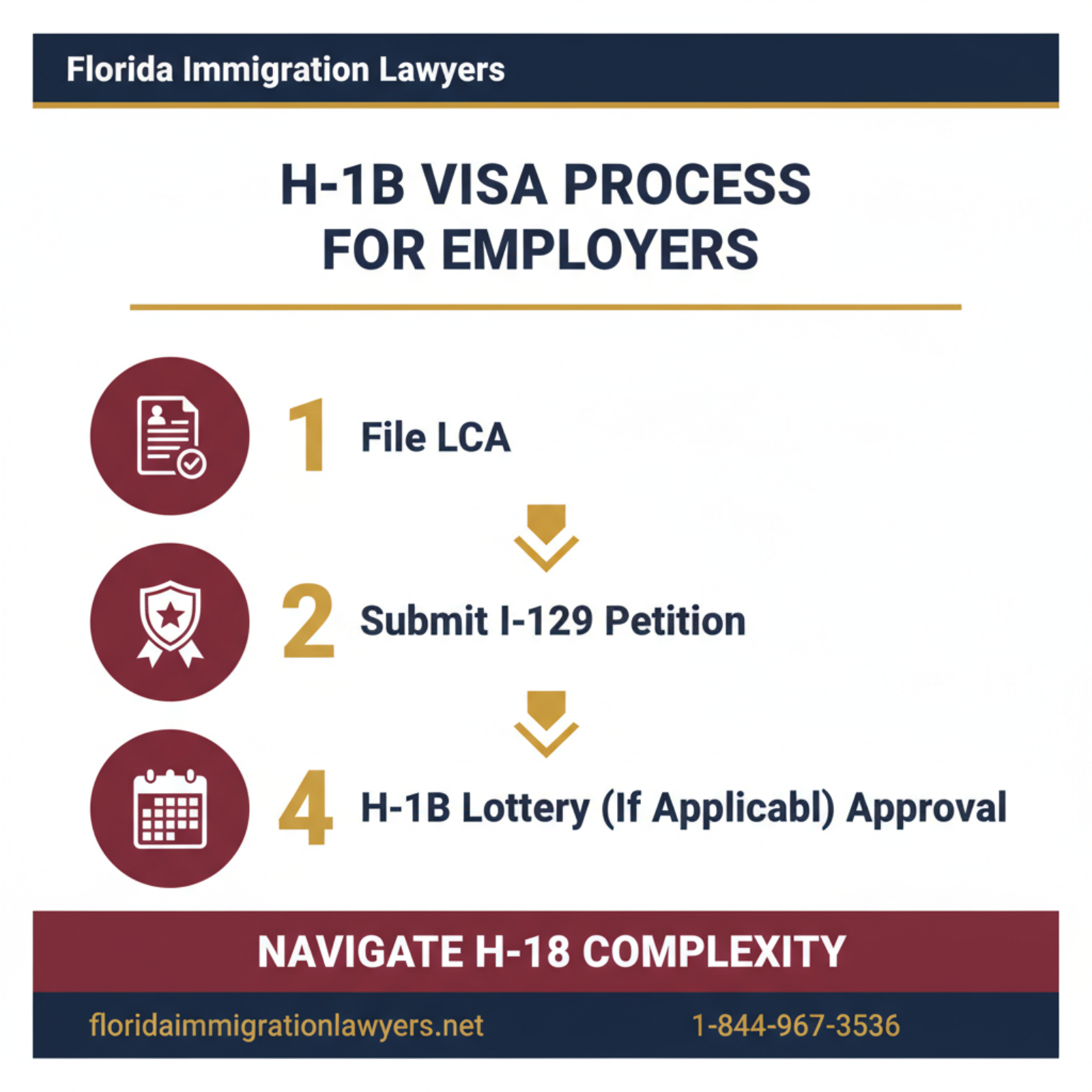
Obtain a Certified Labor Condition Application (LCA): Before filing the H-1B petition, employers must file a Form ETA-9035, Labor Condition Application (LCA), with the U.S. Department of Labor (DOL). The LCA attests that the employer will pay the H-1B worker at least the prevailing wage or the actual wage paid to similarly employed workers, whichever is higher. It also ensures proper working conditions and notice to U.S. workers.
The DOL typically processes LCAs within 7-10 business days. A certified LCA is a prerequisite for the H-1B petition.
-
H-1B Cap Registration (If Applicable): If the H-1B cap applies, the employer must register the prospective H-1B employee electronically with USCIS during the designated registration period. This is typically in March for the fiscal year starting October 1st. Each registration requires a small fee.
If selected in the H1B visa lottery, USCIS will notify the employer and provide a filing window for the I-129 petition. Selection in the lottery is not an approval, but rather an invitation to file.
-
File Form I-129, Petition for a Nonimmigrant Worker: Once the LCA is certified and, if applicable, the H-1B registration is selected, the employer files Form I-129, Petition for a Nonimmigrant Worker, with USCIS. This petition includes extensive supporting documentation about the employer, the beneficiary, and the specialty occupation.
The petition package must clearly demonstrate that all H1B visa requirements are met. This is where meticulous preparation and legal expertise become invaluable.
-
Respond to Requests for Evidence (RFEs): USCIS may issue a Request for Evidence (RFE) if they require additional information or clarification. Responding to an RFE accurately and promptly is crucial for the success of the petition. Failure to provide adequate responses can lead to denial.
RFEs are common, especially for complex cases or those with potential discrepancies. Our attorneys are skilled at crafting comprehensive RFE responses.
-
Visa Interview (for those abroad) and Entry: If the I-129 petition is approved, the foreign national, if outside the U.S., applies for an H-1B visa stamp at a U.S. embassy or consulate. This typically involves an interview. Once the visa is issued, they can enter the U.S. and begin employment with the sponsoring employer.
For individuals already in the U.S. on a different nonimmigrant status, the approved I-129 petition may include a change of status. This allows them to begin H-1B employment without leaving the country.
Essential Document Checklist for H-1B Petitions
Submitting a complete and accurate set of documents is critical for any H-1B visa petition. Missing or incorrect documentation can lead to delays, Requests for Evidence (RFEs), or even denial. Florida Immigration Lawyers helps our clients compile every necessary item.
- Certified Labor Condition Application (LCA) Form ETA-9035.
- Form I-129, Petition for a Nonimmigrant Worker, and H-1B Data Collection and Filing Fee Exemption Supplement.
- Employer's Federal Employer Identification Number (FEIN).
- Company financial statements, tax returns, and business licenses to demonstrate ability to pay the proffered wage and legitimacy of the business.
- Detailed job description, including duties, responsibilities, and minimum educational requirements.
- Organizational chart showing where the H-1B beneficiary fits within the company structure.
- Beneficiary's educational documents: diplomas, transcripts, degree evaluations (if foreign degrees).
- Beneficiary's professional licenses (if applicable) and certifications.
- Beneficiary's resume and letters of experience from previous employers.
- Beneficiary's passport, visa, I-94 arrival/departure record, and previous I-797 approval notices (if applicable).
- Employer letter of support explaining the job, the need for the H-1B worker, and the beneficiary's qualifications.
- Any contracts between the employer and the H-1B beneficiary.
H-1B Visa Timeline and Processing Expectations
The timeline for an H-1B visa petition can vary significantly depending on several factors, especially the annual cap and whether premium processing is utilized. For the 2026 fiscal year, employers in Florida should anticipate the following general timeline:
March 2026: The electronic H-1B cap registration period typically opens in early March and closes mid-March. This is a crucial window for all cap-subject petitions.
Late March 2026: USCIS announces the results of the H1B visa lottery. Only those selected can proceed to file Form I-129. If your registration is not selected, you must wait until the next fiscal year.
April 1, 2026 onwards: For selected registrations, the earliest date to file the Form I-129 petition is April 1st. USCIS provides a specific filing window, usually 90 days. During this time, the certified LCA must also be obtained.
October 1, 2026: This is the earliest date an approved H-1B petition can become effective for the new fiscal year. H-1B workers can begin employment on this date, assuming their petition is approved and they have the appropriate status.
Processing Times: Regular processing for an H-1B petition can take anywhere from 3 to 6 months, or sometimes even longer, depending on the USCIS service center workload. Premium processing, if available, guarantees a 15-calendar-day processing time for an additional fee. However, premium processing is not always available during the initial cap-subject filing period.
Planning ahead and submitting all required documentation accurately is key to avoiding delays. Florida Immigration Lawyers can help you manage these timelines effectively.
Cost Factors and Fee Breakdown for H-1B Sponsorship
Sponsoring an H-1B visa involves various fees that employers must consider. These costs can add up, and it's important for Florida businesses to budget appropriately. Please note that USCIS fees are subject to change, and specific amounts are not listed here to avoid providing outdated information. Always refer to the official USCIS website for current fees.
- USCIS Filing Fee: This is the base fee for Form I-129.
- American Competitiveness and Workforce Improvement Act (ACWIA) Fee: This fee varies based on the employer's size (number of full-time equivalent employees). It supports U.S. worker training and education programs.
- Fraud Prevention and Detection Fee: A mandatory fee for initial H-1B petitions and petitions for new employment.
- Public Law 114-113 Fee: An additional fee for employers with 50 or more employees, where more than 50% of their U.S. workforce are on H-1B or L-1 nonimmigrant status. This is often referred to as the "50/50 rule" fee.
- Premium Processing Fee (Optional): If you choose to expedite processing, an additional fee is required for the 15-calendar-day guarantee.
- Attorney Fees: Legal fees for preparing and filing the H-1B petition. These fees vary based on the complexity of the case and the firm's experience. Florida Immigration Lawyers offers competitive rates for our services.
- LCA Posting and Compliance Costs: While there's no direct DOL fee for LCA filing, there are costs associated with ensuring compliance, such as posting notices at the worksite.
- Educational Credential Evaluation Fees: If the foreign national's degree is from outside the U.S., an independent evaluation may be required, incurring an additional cost.
Most of these fees are typically paid by the employer. It is generally not permissible for the H-1B beneficiary to pay for certain mandatory fees, such as the ACWIA fee or fraud prevention fee. Consulting with an immigration attorney can help you understand which fees are permissible for the employer to pay and which, if any, the employee can contribute towards.
The H-1B visa process is filled with intricate legal requirements and deadlines. Making a mistake can lead to significant delays or even denial of a crucial work visa for your business. Do not navigate this process alone. Contact Florida Immigration Lawyers today for guidance and support. We serve employers across Florida, including Orlando.
Common Mistakes Florida Employers Make with H-1B Visas
Successfully sponsoring an H-1B visa requires precision and a thorough understanding of immigration law. Many Florida employers, despite their best intentions, can make errors that jeopardize their petitions. Avoid these common pitfalls:
-
Failing to Meet the Specialty Occupation Requirement: Not clearly demonstrating that the job requires a bachelor's degree or higher in a specific field. This often leads to Requests for Evidence (RFEs) or denials, as the position may appear too general or not complex enough.
Consequence: Delay, RFE, or denial of the H-1B petition.
-
Incorrect Prevailing Wage Determination: Failing to research and pay the correct prevailing wage for the occupation in the specific geographic area. The DOL has strict guidelines for wage levels.
Consequence: LCA denial, H-1B petition denial, or even penalties for wage violations.
-
Missing H-1B Cap Registration Deadlines: Forgetting or being unaware of the short registration window in March for cap-subject petitions. This means missing an entire year for new H-1B filings.
Consequence: Inability to file a new cap-subject H-1B petition for the fiscal year.
-
Insufficient Documentation or Evidence: Submitting an incomplete petition package or failing to provide compelling evidence for every claim. USCIS requires substantial proof for all aspects of the petition.
Consequence: Lengthy delays, RFEs, or outright denial of the petition.
-
Lack of Employer-Employee Relationship Proof: For third-party placements or consulting firms, not adequately demonstrating that the petitioner has direct control over the H-1B worker. This is a common area for RFEs.
Consequence: Significant scrutiny, RFE, or denial, especially for off-site placements.
-
Failure to Amend Petition for Material Changes: Not filing an amended H-1B petition when there are significant changes to the terms or conditions of employment (e.g., job location, duties, salary). This is required by law.
Consequence: H-1B status invalidation, potential for unauthorized employment, or even deportation proceedings.
-
Improper Public Access File Maintenance: Not maintaining a compliant Public Access File (PAF) as required by the DOL for all certified LCAs. This file must be available for public inspection.
Consequence: DOL investigations, fines, and potential debarment from sponsoring future H-1B workers.
-
Not Understanding Dual Intent: Misinterpreting the "dual intent" nature of the H-1B visa, which allows beneficiaries to pursue permanent residency. Employers should understand that this is a recognized pathway.
Consequence: May lead to confusion or incorrect advice for employees regarding their long-term immigration goals.
-
Failure to Notify USCIS of Termination: Not withdrawing the H-1B petition with USCIS when an H-1B employee's employment is terminated. This is an employer's responsibility.
Consequence: Potential ongoing liability for the employer for the H-1B worker's wages or other issues.
-
Relying Solely on Online Information: Using outdated or general online information instead of consulting with an experienced immigration attorney. Immigration law is dynamic and complex.
Consequence: Critical errors due to misinformation, leading to costly delays or denials.
When to Call a Lawyer
The complexities of the H-1B visa program make professional legal assistance invaluable for Florida employers. While this guide provides a comprehensive overview, specific situations always benefit from tailored advice. You should contact an experienced immigration attorney from Florida Immigration Lawyers in the following scenarios:
- Your company is new to H-1B sponsorship and needs end-to-end guidance.
- You are unsure if a position qualifies as a specialty occupation or if a candidate meets H1B visa requirements.
- Your H-1B registration was selected, and you need to prepare a robust I-129 petition.
- USCIS has issued a Request for Evidence (RFE) or a Notice of Intent to Deny (NOID).
- You are considering premium processing and want to understand its implications.
- There are significant changes to the H-1B employee's job duties, salary, or work location.
- Your company has been audited by the Department of Labor regarding H-1B compliance.
- You are an employer with a workforce primarily consisting of H-1B or L-1 employees and need to understand the "50/50 rule" fee.
- You wish to transition an H-1B employee to permanent residency. Our business immigration attorneys can advise on the best path forward.
- You have questions about maintaining public access files or other compliance obligations.
Do not wait for a problem to arise. Proactive legal counsel can save your business time, money, and stress. Our firm handles a wide range of immigration cases, including complex deportation defense and citizenship matters, demonstrating our comprehensive experience.
About Florida Immigration Lawyers
Florida Immigration Lawyers is a leading law firm dedicated to providing exceptional immigration services throughout Florida. Our team of experienced attorneys understands the complexities of U.S. immigration law and is committed to achieving the strongest possible outcomes for our clients. Whether you are an individual seeking a family immigration visa or a business requiring business immigration solutions, we are here to help.
We pride ourselves on our client-focused approach, offering personalized attention and strategic legal advice. Our services include H-1B visa petitions, asylum claims, green card applications, citizenship, and deportation defense. With offices strategically located, we serve clients in Orlando and all surrounding areas.
Choose Florida Immigration Lawyers for our unwavering dedication, proven track record, and deep understanding of Florida's diverse communities. We are available 24/7 to answer your urgent questions and offer free consultations to discuss your immigration needs. Let us be your trusted partner in navigating the U.S. immigration system.
Phone: 1-844-YO-PELEO
Website: Vasquez Law Firm
Sources and References
- U.S. Citizenship and Immigration Services (USCIS) - H-1B Specialty Occupations
- U.S. Department of Labor (DOL) - H-1B Program
- Executive Office for Immigration Review (EOIR)
- Immigration and Nationality Act (INA) § 101(a)(15)(H)(i)(b)
- Immigration and Nationality Act (INA) § 214(g) - Numerical Limitations
- 8 U.S. Code § 1101 - Definitions
- 8 Code of Federal Regulations (CFR) § 214.2(h) - Petitions for Nonimmigrant Workers
This article provides general legal information and is not intended as legal advice. Every case is unique, and outcomes depend on specific facts and circumstances. Contact an attorney for advice about your particular situation.
Securing an H-1B visa for your skilled workers is a critical investment in your Florida business's future. Do not leave this complex process to chance. Trust the experienced immigration attorneys at Florida Immigration Lawyers to provide the guidance and representation you need. We are here to help you navigate every step, from initial assessment to final approval.
Contact us today for a free consultation: 1-844-YO-PELEO. Se Habla Español - Estamos aquí para ayudarle.
Do Not Navigate This Process Alone
Our experienced immigration attorneys are ready to fight for you. Get a free, confidential case review today.
Se Habla Español
Or leave your details and we’ll call you:
Free Evaluation in 24 Hours
Or talk to us right now
AI voice assistant — available 24/7
FreeFrequently Asked Questions

William J. Vásquez
Founding Attorney · Vasquez Law Firm
U.S. Air Force veteran and immigration attorney with years of hands-on U.S. immigration experience. J.D., NCCU School of Law. AILA member. Admitted to the 4th, 5th, and 11th Circuit Courts.
Available 24/7 - Free Evaluations
Reviewed for legal accuracy by William J. Vásquez
Licensed in North Carolina; U.S. immigration is federal practice.
Related Legal Services
Our Florida immigration attorneys can help you with immigration practice areas, free immigration consultation and business immigration. Call today at 1-844-YO-PELEO for a free case review.
Related Links
Related Topics
Free Legal Case Review
Discuss your case with our experienced attorneys. We're available 24/7.
Se Habla Español - Estamos aquí para ayudarle.
Related Articles
Immigration Lawyer Orlando Free Consultation in Florida
For individuals and families in Orlando, Florida, navigating the complexities of U.S. immigration law requires expert guidance. An immigration lawyer in Orlando offers crucial support for everything from visa applications and green card processes to naturalization and deportation defense. This comprehensive guide details what a free consultation covers, providing a step-by-step overview of immigration pathways, essential document checklists, and expected timelines in 2026. We also highlight common mistakes to avoid, discuss the critical role of legal counsel in deportation and asylum cases, and explain why choosing a local Orlando immigration attorney is beneficial. Florida Immigration Lawyers is dedicated to serving the diverse community of Orlando with compassionate, effective legal solutions, ensuring you receive personalized advice and robust representation for a successful immigration journey.
Fiance Visa in Miami: 2026 Process Guide for Florida
For U.S. citizens in Florida, bringing a foreign fiancé(e) to the U.S. requires navigating the K-1 Fiance Visa process. This guide details the 2026 requirements, step-by-step application, essential documents, and expected timelines. Learn about filing Form I-129F with USCIS, consular interviews, and the crucial Adjustment of Status after marriage. We cover typical fees, common mistakes to avoid, and when to seek legal assistance. Florida Immigration Lawyers offers expert guidance for couples in Miami, Orlando, and across Florida, ensuring a smooth path to uniting with your loved one. Get a free case review today.
Immigration Lawyer Services in Orlando, Florida
Explore immigration consultation services in Orlando, Florida, with a qualified immigration lawyer. Learn what to expect and understand your options for family and business immigration needs.
Fraud Prevention and Detection Fee: What to Know in Florida
Explore the fraud prevention and detection fee essential for immigration processes in Florida. Discover how it impacts applications like the I-601 waiver and learn key steps to navigate this requirement effectively.