Green Card Through Marriage in Florida: Your 2026 Guide
For foreign nationals married to U.S. citizens or lawful permanent residents in Florida, obtaining a green card is a key step towards permanent residency. This comprehensive guide from Florida Immigration Lawyers details the entire process, from understanding eligibility and required documents to navigating interviews and timelines. We cover adjustment of status, consular processing, and the crucial steps to avoid common mistakes that can delay your application. Learn about conditional green cards, financial requirements, and when to seek legal counsel for complex cases. Our firm provides expert assistance to couples across Florida, ensuring a smooth and successful immigration journey. Contact us for a free consultation.

Obtaining a green card through marriage in Florida involves a multi-step process for foreign nationals married to U.S. citizens or lawful permanent residents. This typically includes filing petitions, undergoing interviews, and providing extensive evidence of a bona fide marriage. The timeline varies, but careful preparation is crucial for a successful outcome.
- Eligibility hinges on a valid marriage to a U.S. citizen or LPR.
- The process generally involves filing Form I-130 and Form I-485 (or DS-260).
- Applicants must attend an interview and demonstrate a genuine marital relationship.
- Most initial marriage-based green cards are conditional for two years.
- Seeking legal guidance from a Florida immigration lawyer is highly recommended.
Green Card Through Marriage in Florida: Your 2026 Guide
Are you a foreign national married to a U.S. citizen or lawful permanent resident and dreaming of building your life together in the vibrant state of Florida? The path to obtaining a green card through marriage in Florida can seem complex, filled with forms, interviews, and specific requirements. It is a journey many couples undertake, seeking stability and a future in the United States.
This comprehensive guide from Florida Immigration Lawyers is designed to demystify the process for you. We will walk you through every critical step, from understanding eligibility to preparing for your interview. Our goal is to provide clear, actionable information to help you navigate this important immigration pathway successfully.
As you embark on this significant journey, remember that expert legal assistance can make all the difference. For personalized guidance and to ensure your application is strong, call Florida Immigration Lawyers at 1-844-967-3536 for a free consultation today. We are here to help you achieve your immigration goals.
Understanding the Green Card Through Marriage Process in Florida
Securing a green card based on your marriage allows you to live and work permanently in the United States. For couples residing in Florida, including communities like Pembroke Pines, understanding the specific legal framework is essential. This process is broadly governed by federal immigration law, but local USCIS field offices play a direct role in processing applications.
Who is Eligible for a Marriage-Based Green Card?
Eligibility for a green card through marriage in Florida primarily depends on your spouse's immigration status. You must be legally married to either a U.S. citizen or a lawful permanent resident (LPR). The marriage must be bona fide, meaning it was entered into in good faith, not solely to obtain an immigration benefit.
U.S. citizens can petition for their spouses as "immediate relatives," which generally offers a faster processing timeline as there are no annual visa limits. Lawful permanent residents can also petition for their spouses, but these cases fall under the "family-sponsored preference categories," which may involve longer waiting periods due to visa availability. (See U.S. Department of State Visa Bulletin for current wait times).
Adjustment of Status vs. Consular Processing
Your physical location at the time of application determines whether you will pursue adjustment of status or consular processing. If you are already present in the United States after a lawful entry, you may be eligible to "adjust your status" to a lawful permanent resident without leaving the country. This typically involves filing Form I-485.
If you are residing outside the United States, or are in the U.S. but ineligible for adjustment of status (e.g., entered without inspection), you will generally go through "consular processing." This means your application will be processed by a U.S. embassy or consulate in your home country, and you will attend an interview there. Both pathways lead to the same goal: a green card.
Step-by-Step Guide to Applying for Your Marriage-Based Green Card
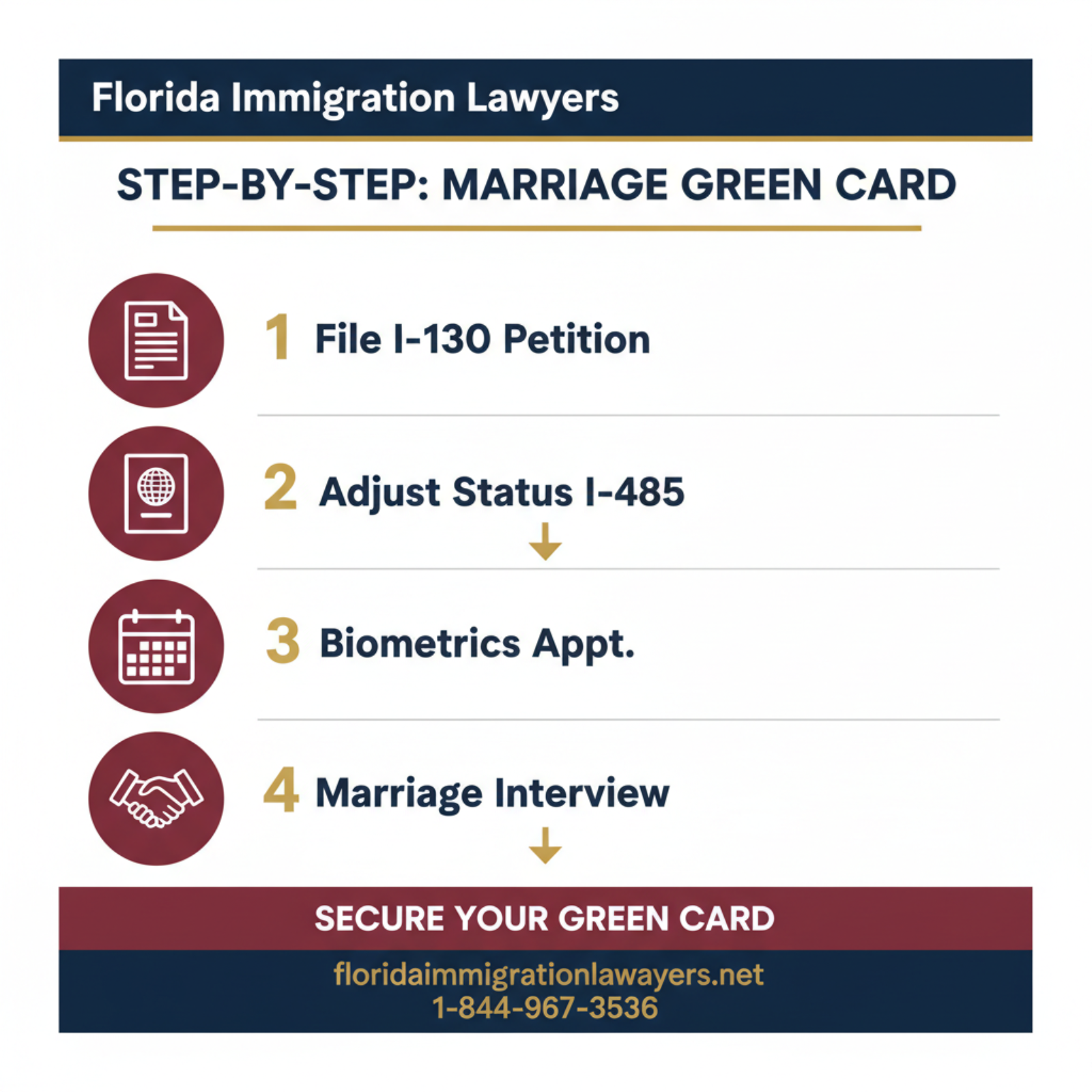
The journey to obtaining your marriage green card in Florida follows a structured path. While each case has unique aspects, the general steps remain consistent. Here is a detailed guide to help you understand what to expect:
-
File Form I-130, Petition for Alien Relative: The U.S. citizen or LPR spouse (the petitioner) initiates the process by filing Form I-130 with U.S. Citizenship and Immigration Services (USCIS). This form establishes the qualifying relationship between you and your spouse. You will need to provide evidence of your spouse's U.S. citizenship or LPR status, as well as your marriage certificate.
USCIS reviews this petition to confirm the validity of the marriage and the petitioner's status. Approval of Form I-130 is a foundational step for the rest of your application. This form is governed by 8 CFR Part 204.
-
File Form I-485, Application to Register Permanent Residence or Adjust Status (or DS-260):
- If you are in the U.S. (Adjustment of Status): If a visa is immediately available (always for immediate relatives of U.S. citizens), you can generally file Form I-485 concurrently with, or after, Form I-130. This application is your request to become a lawful permanent resident.
- If you are outside the U.S. (Consular Processing): Once Form I-130 is approved, USCIS forwards the case to the National Visa Center (NVC). The NVC will then instruct you to complete Form DS-260, Immigrant Visa Application, and submit civil documents and financial forms.
-
Attend Biometrics Appointment: For adjustment of status applicants, after filing Form I-485, you will receive an appointment notice for biometrics. This involves fingerprinting, photographs, and a signature collection. This data is used for background and security checks.
-
Complete Medical Examination: All green card applicants must undergo a medical examination by a USCIS-approved civil surgeon. The surgeon will complete Form I-693, Report of Medical Examination and Vaccination Record, which you will submit to USCIS or bring to your interview. This ensures you meet health-related admissibility standards.
-
Attend the Interview: Both spouses are typically required to attend an interview with a USCIS officer (for adjustment of status) or a consular officer (for consular processing). The purpose of the interview is to verify the information in your applications and to confirm that your marriage is genuine and not entered into solely for immigration purposes. You should bring all original documents and additional evidence of your relationship.
-
Receive Decision: After the interview, the officer will make a decision. If approved, you will either receive your green card in the mail (for adjustment of status) or be issued an immigrant visa stamp in your passport (for consular processing), which allows you to enter the U.S. as a permanent resident and receive your green card later. Many initial marriage-based green cards are conditional for two years under INA Section 216 (8 U.S.C. § 1186a).
Essential Documents for Your Florida Marriage Green Card Application
A well-prepared application package with all necessary documents is crucial for a smooth process. Missing or incorrect documents can lead to significant delays or even denial. Gather these essential items carefully:
- Proof of U.S. Citizenship or LPR Status: Petitioner's U.S. passport, birth certificate, naturalization certificate, or green card (Form I-551).
- Marriage Certificate: An official, certified copy of your marriage certificate from the state where you were married (e.g., Florida).
- Birth Certificates: Certified copies of both spouses' birth certificates.
- Passport Photos: Recent, passport-style photographs for both applicant and petitioner.
- Form I-864, Affidavit of Support: The U.S. citizen or LPR spouse must demonstrate the financial ability to support the immigrant spouse. This form includes tax returns, employment letters, and bank statements.
- Evidence of Bona Fide Marriage: This is perhaps the most critical category. You need to prove your marriage is real. Examples include:
- Joint bank accounts, credit cards, or utility bills.
- Leases or mortgages showing joint residency.
- Birth certificates of children born to the marriage.
- Life insurance policies or wills naming each other as beneficiaries.
- Photos of the couple together over time, with family, and at significant events.
- Affidavits from friends and family attesting to the bona fide nature of the marriage.
- Joint tax returns.
- Divorce Decrees or Death Certificates: If either spouse was previously married, you must provide proof that all prior marriages were legally terminated.
- Medical Examination Report: Form I-693 completed by a USCIS-approved civil surgeon.
- Police Clearances/Criminal Records: If applicable, from any country you have lived in for certain durations.
- Travel Records: Copies of all pages of your passport with visas, entry stamps, and I-94 arrival/departure records.
Green Card Through Marriage Timeline and Processing Expectations in 2026
The time it takes to obtain a marriage green card in Florida can vary significantly. Several factors influence the processing timeline, including the specific USCIS field office (e.g., Miami or Orlando offices that serve Pembroke Pines residents), the volume of applications, and the completeness of your submitted documentation.
Typical Processing Stages and Durations
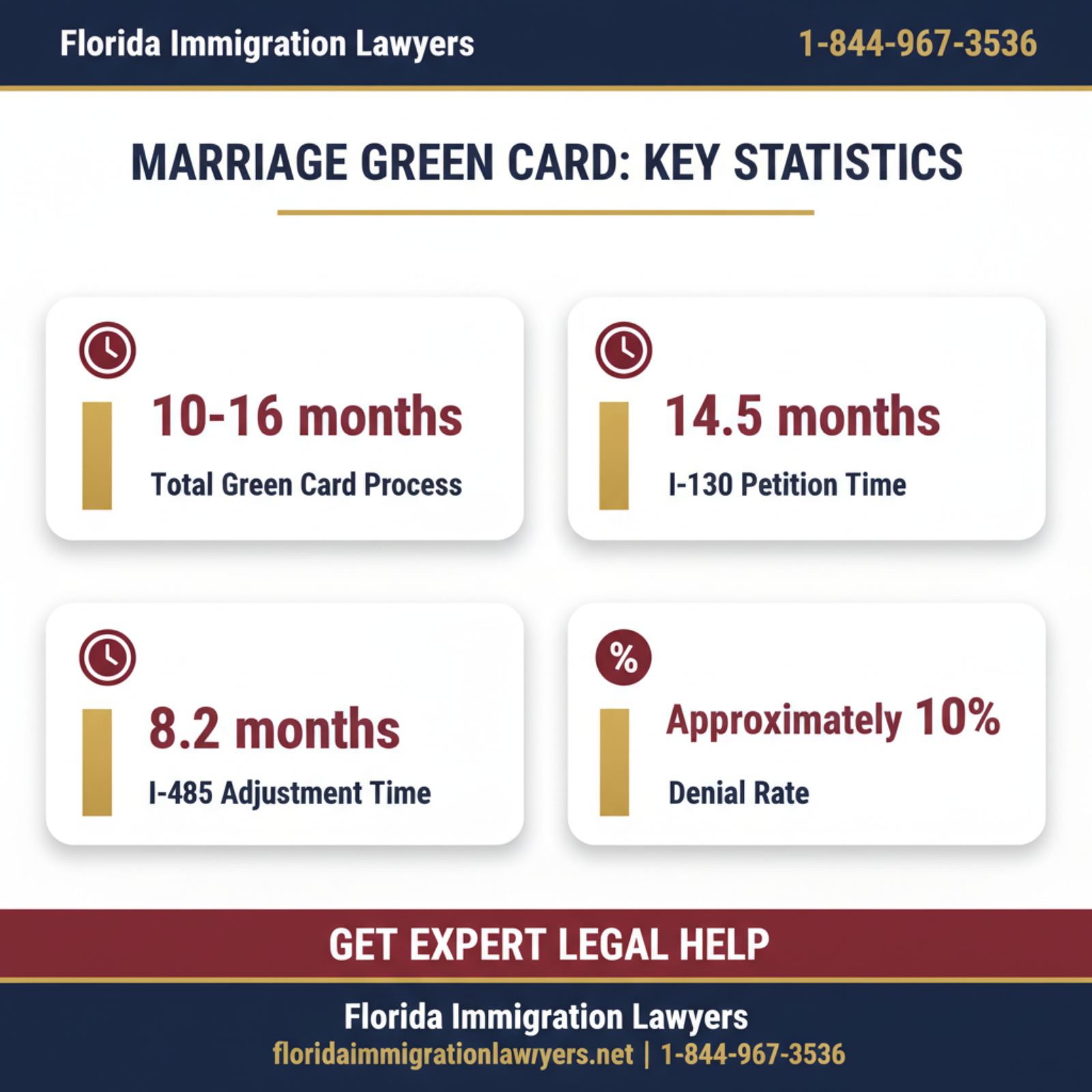
For spouses of U.S. citizens filing for adjustment of status in the U.S., the entire process from filing Form I-130 to receiving the green card typically ranges from 10 to 18 months. This includes:
- I-130 Petition Processing: 7-12 months (if filed separately).
- I-485 Application Processing: 8-14 months (this often overlaps with I-130 if filed concurrently).
- Biometrics Appointment: 3-5 weeks after filing.
- Work Authorization (EAD) & Travel Permit (Advance Parole): Often received within 5-9 months after filing Form I-765 and Form I-131 concurrently with I-485.
- Interview Scheduling: Varies by field office backlog.
For spouses of Lawful Permanent Residents (LPRs), the process is generally longer due to visa bulletin waiting times. After I-130 approval, you may wait several years for a visa to become available before you can file Form I-485 or proceed with consular processing. You can check current processing times on the USCIS website.
Conditional Green Card and Removing Conditions
If your marriage is less than two years old on the day your green card is approved, USCIS will issue a conditional green card valid for two years. This is a measure to deter marriage fraud. To remove these conditions and receive a 10-year permanent green card, you must file Form I-751, Petition to Remove Conditions on Residence, within the 90-day period before your conditional green card expires.
Both spouses typically file Form I-751 jointly, providing updated evidence of their ongoing bona fide marriage. If the marriage has ended due to divorce or the U.S. citizen spouse has passed away, waivers are available, but these cases are more complex and benefit greatly from legal counsel.
Cost Factors and Fee Breakdown for Marriage Green Card Filings
Understanding the financial aspects of applying for a green card through marriage in Florida is crucial for proper planning. While specific fee amounts are subject to change by USCIS, we can outline the general categories of costs you should anticipate. Always refer to the official USCIS website for the most current fee schedule.
Mandatory Government Filing Fees
The primary costs come from USCIS filing fees for the required forms:
- Form I-130, Petition for Alien Relative: This fee is paid by the U.S. citizen or LPR petitioner.
- Form I-485, Application to Register Permanent Residence or Adjust Status: This fee covers the adjustment of status application itself, including biometrics services. It is paid by the immigrant applicant.
- Form DS-260, Immigrant Visa Application Processing Fee: For consular processing cases, this fee is paid to the Department of State.
- Form I-751, Petition to Remove Conditions on Residence: If you receive a conditional green card, you will need to pay this fee later to apply for your permanent green card.
It is important to note that the fee for Form I-485 often includes the fees for Form I-765 (Application for Employment Authorization) and Form I-131 (Application for Travel Document - Advance Parole) if filed concurrently. This allows the applicant to work and travel while their green card application is pending.
Additional Potential Costs
- Medical Examination Fees: The cost of the required medical exam (Form I-693) is paid directly to the civil surgeon's office. This fee varies by provider and is separate from USCIS fees.
- Document Translation Fees: If any of your supporting documents are not in English, you will need certified translations, which incur additional costs.
- Postage and Expedited Shipping: Costs associated with mailing your application and any requests for expedited processing.
- Attorney Fees: While not mandatory, retaining an experienced immigration attorney like Florida Immigration Lawyers can be an invaluable investment. Our fees cover expert guidance, document preparation, and representation throughout the process.
Do not navigate this complex process alone. The stakes are high, and even minor errors can lead to significant delays or denials. Contact Florida Immigration Lawyers today for dedicated support and to discuss your options. We offer free consultations to help you understand your unique situation.
Common Mistakes to Avoid During Your Marriage Green Card Application
Applying for a green card through marriage in Florida requires meticulous attention to detail. Many applicants encounter setbacks due to preventable errors. Being aware of these common mistakes can help you avoid them:
-
Incomplete or Inaccurate Forms: Submitting forms with missing information, unchecked boxes, or incorrect details is a frequent cause of delays. USCIS may issue a Request for Evidence (RFE) or even deny your application. Always double-check every entry and ensure all required signatures are present.
-
Insufficient Evidence of Bona Fide Marriage: This is arguably the most common reason for denials. Couples fail to provide enough compelling evidence that their marriage is real and not just for immigration purposes. USCIS needs to see a shared life, not just a marriage certificate.
-
Failure to Disclose All Information: Omitting past immigration history, criminal records, or previous marriages, even if seemingly minor, can be considered misrepresentation. This can lead to serious legal consequences, including a permanent bar from the U.S. Transparency is paramount.
-
Missing Deadlines: Forgetting to file Form I-751 to remove conditions on time, or responding late to an RFE, can result in the termination of your conditional resident status. This can lead to deportation proceedings.
-
Poor Interview Preparation: Appearing unprepared for the marriage interview can raise red flags. Both spouses should be familiar with the application details and be able to answer questions consistently about their relationship. Practice discussing your shared life and significant dates.
-
Not Meeting Financial Requirements: The petitioner must meet the income requirements for the Affidavit of Support (Form I-864). If their income is insufficient, they may need a joint sponsor. Failing to meet these requirements can lead to application denial.
-
Entering the U.S. with "Immigrant Intent" on a Non-Immigrant Visa: If you enter the U.S. on a tourist visa (B-2) or through the Visa Waiver Program with the pre-conceived intent to marry a U.S. citizen and adjust status, this can be considered visa fraud. While the "90-day rule" is a guideline, proving genuine non-immigrant intent upon entry is critical.
-
Not Updating Address Changes: Failing to inform USCIS of a change of address using Form AR-11 can result in missed notices, interview appointments, or RFEs. This can lead to delays or even denial if you do not receive critical communications.
-
Ignoring Legal Inadmissibility Issues: Certain factors like past criminal convictions, previous immigration violations, or specific health conditions can make an applicant "inadmissible." These issues often require waivers, which are complex to obtain without legal assistance. It is crucial to address these upfront.
-
Submitting Uncertified Translations: Any document not in English must be accompanied by a complete and accurate English translation, certified by the translator. Uncertified translations will not be accepted by USCIS.
When to Call a Florida Immigration Lawyer for Your Spouse Visa
While some straightforward green card through marriage in Florida cases might be attempted independently, many situations warrant the expertise of an experienced immigration attorney. Florida Immigration Lawyers is here to provide the guidance you need, especially in these scenarios:
- Complex Immigration History: If the foreign national has prior visa overstays, unlawful entries, previous deportations, or other immigration violations, legal counsel is essential. These issues can lead to inadmissibility and require waivers.
- Criminal Record: Any arrests, charges, or convictions for either spouse can significantly complicate the application. An attorney can assess the impact and advise on potential waivers or defense strategies.
- Prior Denials: If a previous green card application was denied, understanding the reasons for denial and addressing them properly for a new application is crucial.
- Short Marriage History: If your marriage is relatively new or you have limited joint documentation, an attorney can help you gather persuasive evidence and prepare for the interview.
- Language Barriers: If either spouse struggles with English, a lawyer can ensure clear communication and accurate representation of your case.
- Divorce During Conditional Period: If your marriage ends before you can remove the conditions on your green card, you will need a waiver. This is a complex process best handled with legal assistance to avoid deportation.
- Requests for Evidence (RFEs) or Notices of Intent to Deny (NOIDs): Receiving these from USCIS indicates a problem with your application. An attorney can help you respond effectively and timely to prevent denial.
- Fear of Interview: If you are anxious about the interview process, a lawyer can prepare you thoroughly, conduct mock interviews, and sometimes even attend the interview with you (for adjustment of status cases).
Florida Immigration Lawyers has extensive experience assisting individuals and families throughout Florida, including Pembroke Pines, with their marriage-based green card applications. We understand the nuances of immigration law and are committed to protecting your rights and interests.
Frequently Asked Questions About Marriage Green Cards in Florida
Here are answers to some common questions we receive regarding the green card through marriage Florida process:
How long does it take to get a marriage-based Green Card in Florida?
The processing time for a marriage-based green card in Florida typically ranges from 10 to 18 months for spouses of U.S. citizens who are adjusting status. However, this can vary based on the specific USCIS field office, current caseloads, and the completeness of your application. Spouses of Lawful Permanent Residents often face longer waits due to visa bulletin backlogs.
Do you automatically get a Green Card through marriage?
No, you do not automatically get a green card through marriage. Marriage to a U.S. citizen or lawful permanent resident makes you eligible to apply, but you must go through a formal application process. This involves filing petitions, submitting extensive documentation, attending interviews, and proving the legitimacy of your marriage to USCIS.
How long does it take to get citizenship after Green Card through marriage?
Generally, a lawful permanent resident must wait five years before applying for naturalization to become a U.S. citizen. However, if you obtained your green card through marriage to a U.S. citizen and remain married, you may be eligible to apply for citizenship after only three years of permanent residency. This is a significant benefit for marriage-based green card holders.
Do I lose my Green Card if I get divorced?
If you have a 10-year permanent green card, divorce generally does not automatically cause you to lose it. However, if you received a conditional green card (valid for two years) and divorce before filing Form I-751 to remove conditions, the situation is more complex. You would need to file Form I-751 with a waiver, demonstrating that your marriage was bona fide at its inception and that the divorce was not your fault or for other specific reasons. Failing to remove conditions can lead to loss of status.
About Florida Immigration Lawyers
Florida Immigration Lawyers is a leading immigration law firm dedicated to serving individuals and families across the entire state of Florida. With a deep understanding of U.S. immigration laws and a compassionate approach, we are committed to helping our clients achieve their American dreams.
Our team of experienced attorneys specializes in a wide range of immigration services, including family-based immigration, green cards through marriage, deportation defense, asylum applications, citizenship and naturalization, and business immigration. We pride ourselves on providing personalized, effective legal strategies tailored to your unique situation.
Choosing Florida Immigration Lawyers means choosing a firm that prioritizes your future. We offer comprehensive support, transparent communication, and relentless advocacy. Our goal is to simplify complex legal processes and provide peace of mind for you and your family.
Contact us today to learn how we can assist you. We are available 24/7 for free consultations. Call 1-844-967-3536 or visit our website at https://www.floridaimmigrationlawyers.net to schedule your appointment. Let us be your trusted partner on your immigration journey.
Sources and References
- U.S. Citizenship and Immigration Services (USCIS)
- U.S. Department of State Visa Bulletin
- USCIS Processing Times
- USCIS Fee Schedule
- 8 U.S.C. Chapter 12 - Immigration and Nationality Act (INA)
- INA Section 201(b) - Immediate Relatives
- INA Section 203(a) - Family-Sponsored Preference Immigrants
- INA Section 216 (8 U.S.C. § 1186a) - Conditional Permanent Resident Status
- 8 CFR Part 204 - Immigrant Petitions
This article provides general legal information and is not intended as legal advice. Every case is unique, and outcomes depend on specific facts and circumstances. Contact an attorney for advice about your particular situation.
Navigating the path to a green card through marriage in Florida is a significant undertaking, but with the right legal support, your chances of success are greatly enhanced. Florida Immigration Lawyers is dedicated to providing the expert guidance and compassionate representation you deserve.
Do not leave your future to chance. Take the first step towards securing your permanent residency in the U.S. by reaching out to our experienced team. We are here to answer your questions and help you build a strong case.
Call Florida Immigration Lawyers today at 1-844-967-3536 for a free consultation. Se Habla Español - Estamos aquí para ayudarle.
Do Not Navigate This Process Alone
Our experienced immigration attorneys are ready to fight for you. Get a free, confidential consultation today.
Se Habla Español
Frequently Asked Questions
Florida Immigration Lawyers
Immigration Attorney | Founder, Vasquez Law Firm
U.S. Air Force veteran and immigration attorney with thousands of cases resolved. J.D., NCCU School of Law. AILA member. Admitted to the 4th, 5th, and 11th Circuit Courts.
Available 24/7 - Free Evaluations
Related Legal Services
Our Florida immigration attorneys can help you with citizenship and naturalization, family immigration services and immigration practice areas. Call today at 1-844-967-3536 for a free consultation.
Related Links
Related Topics
Free Legal Consultation
Discuss your case with our experienced attorneys. We're available 24/7.
Se Habla Español - Estamos aquí para ayudarle.
Related Articles
Stokes Interview: Navigating Marriage Fraud in Florida
A Stokes interview is a specialized, separate interview conducted by USCIS when there are suspicions of marriage fraud in a green card application. This rigorous process involves individual questioning of spouses, focusing on inconsistencies in their testimonies to determine the authenticity of their marital bond. For couples in Florida, navigating this high-stakes interview requires meticulous preparation, extensive documentation, and often the strategic guidance of an experienced immigration lawyer. Understanding the process, preparing for detailed questions, and presenting a strong case are crucial for overcoming marriage fraud allegations and securing your immigration future. Florida Immigration Lawyers stands ready to assist you.
Immigration Attorney Gainesville: North Florida Legal Help
For those in Gainesville, Alachua County, and throughout North Florida, navigating U.S. immigration law requires expert guidance. An experienced immigration attorney can simplify complex processes, from family-based petitions and employment visas to critical asylum claims and deportation defense. This comprehensive guide outlines the essential services provided by an immigration attorney, details necessary documentation, clarifies processing timelines, and discusses associated costs. We also highlight common mistakes to avoid and crucial scenarios where legal counsel is indispensable. Florida Immigration Lawyers serves all of Florida, including Gainesville and St. Petersburg, providing dedicated legal support to help you achieve your immigration goals. Contact us for a free consultation to discuss your specific needs.
Military Naturalization Expedited at Florida Bases
Explore expedited military naturalization processes for service members at Florida bases like MacDill. Learn about eligibility, steps, and common mistakes. Contact Florida Immigration Lawyers for a free consultation.
Protect Yourself from Immigration Scams in Florida
Learn how to protect against immigration scams in Florida, focusing on St. Petersburg. This guide covers identifying scams, verifying credentials, and getting legal help. Call Florida Immigration Lawyers at 1-844-967-3536 for assistance.