Florida Wrongful Death Survivor Damages: Know Your Rights
When a loved one dies due to negligence in Florida, their surviving family members may be entitled to wrongful death survivor damages. The Florida Wrongful Death Act (§768.16-.26) defines who can seek compensation, including spouses, children, and dependent relatives, and outlines the types of damages available. These can range from economic losses like lost financial support and medical expenses to non-economic losses such as pain and suffering and loss of companionship. The process involves appointing a personal representative, filing a lawsuit within the strict statute of limitations, and potentially engaging in discovery and negotiations. Understanding these complex laws is vital for families in West Palm Beach, Orlando, and Kissimmee seeking justice. Florida Immigration Lawyers offers compassionate legal guidance for personal injury matters, including wrongful death claims, with Harold Estrada-Rodriguez (Florida Bar No. 1041171) leading these cases. Contact us for a free consultation.

In Florida, wrongful death survivor damages allow specific family members to seek compensation when a loved one dies due to another's negligence or wrongful act. Governed by the Florida Wrongful Death Act (§768.16-.26), survivors may claim economic losses like lost support and medical expenses, and non-economic damages such as pain and suffering or loss of companionship. A personal representative files the claim on behalf of the estate and beneficiaries, with strict deadlines. Understanding who qualifies as a survivor and what damages are recoverable is crucial for securing justice. Seek legal guidance to navigate this complex process effectively.
- Florida law defines specific 'survivors' eligible for damages.
- Damages include economic (lost support, medical bills) and non-economic (pain, companionship loss) losses.
- A personal representative files the claim on behalf of all survivors.
- Strict statute of limitations applies, typically two years from the date of death.
- Legal counsel is essential to maximize compensation and navigate complexities.
Losing a loved one is an incredibly painful experience, a tragedy that no family should endure, especially when it results from someone else's negligence or wrongful actions. The emotional toll is immense, but often, families are also left grappling with significant financial burdens, from medical bills to funeral costs and the sudden loss of income. In West Palm Beach, Orlando, Kissimmee, and across Florida, families facing such devastating circumstances have legal rights under the Florida Wrongful Death Act.
Understanding these rights, particularly concerning wrongful death survivor damages, is crucial for securing the justice and financial stability your family deserves. This comprehensive guide will walk you through Florida's specific laws, who qualifies as a survivor, the types of damages available, and the steps involved in pursuing a claim. We will reference key Florida Statutes, including §768.16 and §768.21, to provide a clear picture of the legal landscape in 2026.
At Florida Immigration Lawyers, we understand the profound impact of such losses. While our name highlights our immigration services, we are also a dedicated Florida personal injury practice, serving families throughout the state. If your family has suffered the tragic loss of a loved one due to negligence, do not hesitate to seek professional legal guidance. Call Florida Immigration Lawyers at 1-844-967-3536 for a free consultation to discuss your specific situation and understand your legal options.
Understanding Florida Wrongful Death Law: An Overview
Florida's legal framework for wrongful death claims is designed to provide a pathway for families to recover damages when a death is caused by the negligent, reckless, or intentional act of another party. The foundation of these claims is the Florida Wrongful Death Act, primarily codified in Florida Statutes §768.16 through §768.26. This Act establishes who can bring a claim, what damages are recoverable, and the procedures for doing so.
A wrongful death claim is distinct from a personal injury claim because it is brought by the survivors and the estate of the deceased, rather than the injured person themselves. The purpose is not to punish the wrongdoer, but to compensate the survivors for their losses. These losses can be both economic and non-economic, reflecting the full spectrum of the impact a death has on a family.
Under Florida law, specifically §768.18, a 'survivor' is defined broadly to include the decedent's spouse, children, parents, and any blood relatives or adoptive brothers and sisters who are partly or wholly dependent on the decedent for support or services. This definition is critical because only those who meet these criteria can recover damages. The law recognizes that the loss of a loved one extends beyond immediate family, encompassing those who relied on the deceased.
The claim itself is typically brought by a 'personal representative' of the decedent's estate. This individual, often a close family member, is appointed by a Florida probate court to act on behalf of the estate and all eligible survivors. Their role is to gather evidence, file the lawsuit, and ultimately distribute any recovered damages according to the law and the court's direction. This structure ensures a unified legal approach for all parties affected by the wrongful death, streamlining the process in complex situations. Understanding these foundational elements is the first step in navigating a wrongful death claim in Florida.
Who Qualifies as a "Survivor" Under Florida Law?
The question of who can claim wrongful death survivor damages in Florida is strictly defined by statute, specifically §768.18 of the Florida Wrongful Death Act. It's not simply anyone who feels a loss; rather, the law specifies distinct categories of individuals considered 'survivors' who are eligible to seek compensation. This clarity helps ensure that claims are brought by those most directly and legally impacted by the death.
The primary categories of eligible survivors include:
- Spouse: The surviving spouse of the deceased.
- Children: All children of the deceased, regardless of age. This includes adopted children.
- Parents: The parents of the deceased, particularly if the deceased was a minor child.
- Dependent Relatives: Any blood relatives of the deceased, or adopted brothers and sisters, who were partially or wholly dependent on the deceased for support or services. This can include grandparents, siblings, or other relatives who relied on the decedent for financial or practical assistance.
It is important to note that the personal representative of the estate, appointed by a Florida probate court, is the only party with the legal standing to file a wrongful death lawsuit. This personal representative acts on behalf of all statutory survivors and the estate itself. The personal representative's duties include identifying all potential beneficiaries, gathering necessary documentation, and pursuing the claim through negotiations or litigation. For instance, in a case handled in the 9th Judicial Circuit Court, serving Orange and Osceola counties, the personal representative would be responsible for presenting the unified claim.
The specific relationship and dependency criteria are crucial. For example, an adult child who was financially independent might claim different types of damages than a minor child who lost a parent's financial support and guidance. Similarly, parents of a deceased adult child may have limited claims unless they were dependent or the child had no other survivors. These distinctions underscore the complexity of identifying eligible parties and calculating appropriate damages, making legal counsel invaluable for families in West Palm Beach and across Florida.
Types of Damages Available to Florida Wrongful Death Survivors
The Florida Wrongful Death Act, particularly §768.21, outlines the specific types of damages that eligible survivors and the decedent's estate can recover. These damages are categorized to address both the tangible financial losses and the intangible emotional suffering that result from the untimely death of a loved one. Understanding these categories is vital for anyone pursuing a claim for wrongful death survivor damages.
Economic Damages (Compensatory)
These damages aim to compensate for measurable financial losses. They include:
- Loss of Support and Services: This is often the largest component of economic damages. It includes the value of the financial contributions the deceased would have provided to their family members (e.g., salary, benefits) and the value of services they would have performed (e.g., childcare, household chores, home maintenance). The calculation considers the decedent's probable life expectancy, earning capacity, and the age and relationship of the survivors.
- Medical and Funeral Expenses: Any medical or funeral expenses incurred by the survivor or the estate due to the fatal injury can be recovered. This includes ambulance services, hospital stays, doctor visits, and burial or cremation costs.
- Lost Accumulations: If the decedent's death prevents them from accumulating an estate (e.g., savings, investments) that would have passed to their heirs, this loss can be recovered by the estate. This is often relevant for younger individuals with high earning potential.
Non-Economic Damages (Non-Compensatory)
These damages address the emotional and psychological impact of the loss, which are harder to quantify but no less real:
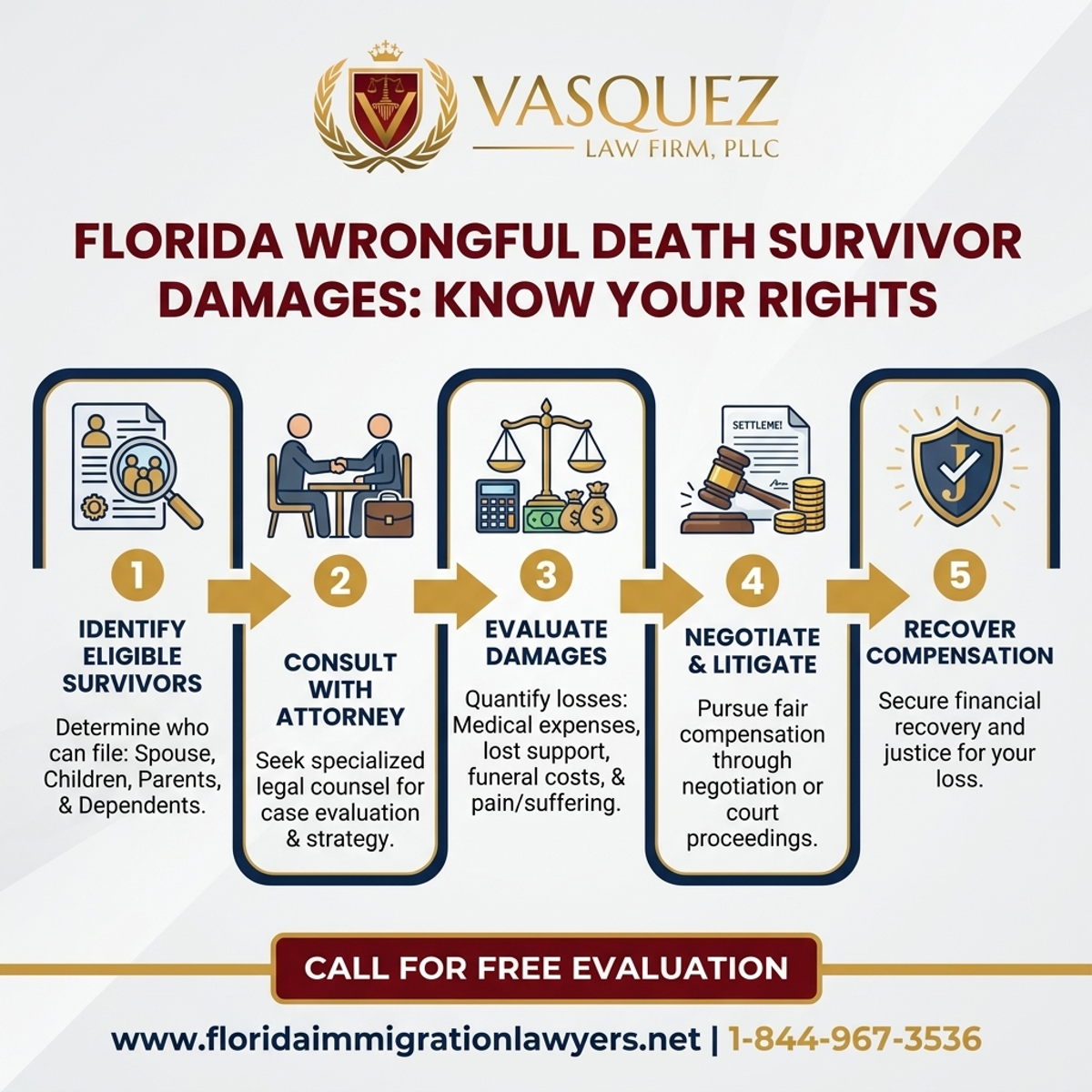
Step-by-Step Process — Florida Wrongful Death Survivor Damages: Know Your Rights
- Loss of Companionship, Instruction, and Guidance: A surviving spouse can claim for the loss of companionship and protection. Minor children (under 25) can claim for the loss of parental companionship, instruction, and guidance. This acknowledges the irreplaceable role the deceased played in the survivors' lives.
- Mental Pain and Suffering: A surviving spouse can recover for mental pain and suffering from the date of injury. Minor children (under 25) can also recover for mental pain and suffering from the date of injury. In cases where there is no surviving spouse or minor children, parents of a deceased minor child may recover for mental pain and suffering. Parents of an adult child may also recover if there are no other survivors.
The specific damages recoverable depend heavily on the relationship between the survivor and the deceased, as well as the unique circumstances of the case. For example, under §768.21(1), a surviving spouse can recover for loss of the decedent's companionship and protection and for mental pain and suffering. A child of the decedent, under 25 years of age, can recover for lost parental companionship, instruction, and guidance, and for mental pain and suffering. The careful calculation and presentation of these damages require an experienced legal team.
The Process of Filing a Wrongful Death Claim in West Palm Beach and Beyond
Navigating a wrongful death claim in Florida, whether in West Palm Beach, Orlando, or Kissimmee, involves a series of critical steps. The process is complex and requires careful adherence to legal procedures and deadlines. Understanding this journey can help families prepare for what lies ahead and make informed decisions.
- Initial Consultation and Investigation: The first step is to consult with an experienced Florida personal injury attorney. During this initial meeting, you will discuss the circumstances of your loved one's death. Your attorney will then conduct a thorough investigation, gathering evidence such as police reports, medical records, witness statements, accident reconstruction reports, and any other documentation that proves negligence. This stage is crucial for building a strong case.
- Appointment of a Personal Representative: As discussed, a wrongful death claim must be filed by a personal representative appointed by a Florida probate court. This individual, often a close family member, will manage the legal proceedings on behalf of the estate and all eligible survivors. Your attorney will guide you through the probate process to get a personal representative officially appointed.
- Filing the Lawsuit: Once sufficient evidence is gathered and a personal representative is appointed, your attorney will draft and file a wrongful death lawsuit in the appropriate Florida court. This document, known as a complaint, formally initiates the legal action and outlines the basis of the claim, the parties involved, and the damages sought. It's imperative to file within the statute of limitations, which for most personal injury claims, including wrongful death, is two years from the date of death, as per Florida Statute §95.11(4)(a). Missing this deadline almost always bars your claim permanently.
- Discovery Phase: After the lawsuit is filed, both sides engage in discovery. This involves exchanging information, including documents, interrogatories (written questions), requests for admission, and depositions (out-of-court sworn testimony). This phase allows both parties to understand the strengths and weaknesses of each other's cases, often revealing critical details.
- Mediation and Settlement Negotiations: Many wrongful death cases are resolved outside of court through negotiation or mediation. Mediation involves a neutral third-party mediator who helps facilitate discussions between the parties to reach a mutually agreeable settlement. A settlement can avoid the uncertainties and stresses of a trial. Your attorney will negotiate fiercely on your behalf to secure fair compensation for wrongful death survivor damages.
- Trial (If No Settlement is Reached): If a settlement cannot be reached, the case proceeds to trial. A judge or jury will hear evidence from both sides, determine fault, and decide on the amount of damages to be awarded. Trials can be lengthy and emotionally taxing, but an experienced attorney will be prepared to advocate for your family's rights in court.
- Judgment and Appeals: If the trial results in a favorable verdict, the court will issue a judgment. The at-fault party may have the right to appeal this decision. Your attorney will continue to represent your interests through any post-trial motions or appeals to ensure the judgment is upheld and enforced.
Throughout this process, continuous communication with your attorney is vital. They will keep you informed, explain complex legal terms, and guide you every step of the way, ensuring your family's rights are protected.
Do not navigate this process alone. The complexities of Florida wrongful death law, coupled with the emotional burden of loss, make legal representation indispensable. Contact Florida Immigration Lawyers today at 1-844-967-3536 for a free, confidential consultation. We are here to help your family in West Palm Beach, Orlando, Kissimmee, and throughout Florida.
Key Factors Affecting Your Wrongful Death Claim's Value
The value of wrongful death survivor damages in Florida is not a fixed amount; it depends on numerous factors unique to each case. Understanding these elements is essential for setting realistic expectations and for your legal team to build the strongest possible claim for maximum compensation. In West Palm Beach and across Florida, courts consider a range of details when evaluating such profound losses.
1. Proving Negligence or Wrongdoing
The cornerstone of any wrongful death claim is proving that the defendant's negligence, recklessness, or intentional act directly caused your loved one's death. Without clear evidence of fault, a claim cannot succeed. This involves demonstrating:
- Duty of Care: The defendant owed a legal duty to the deceased (e.g., a driver's duty to operate safely, a property owner's duty to maintain safe premises).
- Breach of Duty: The defendant violated that duty (e.g., speeding, failing to fix a hazard).
- Causation: The breach of duty directly led to the death.
- Damages: The death resulted in actual losses to the survivors and the estate.
The strength of the evidence supporting these elements significantly impacts the claim's value. For example, in a premises liability case, proving that a property owner knew or should have known about a dangerous condition is crucial, as outlined in Florida Statute §768.0755.
2. The Decedent's Characteristics
The deceased individual's life circumstances play a major role in calculating economic damages:
- Age and Life Expectancy: A younger decedent with a longer life expectancy generally leads to higher claims for lost future earnings and services.
- Earning Capacity: The decedent's past, present, and projected future income and benefits are critical for calculating lost support and services. High earners may result in higher economic damage awards.
- Contributions to Household: The value of non-financial contributions, such as childcare, home maintenance, and companionship, is also considered. Expert witnesses may be called to quantify these 'replacement services.'
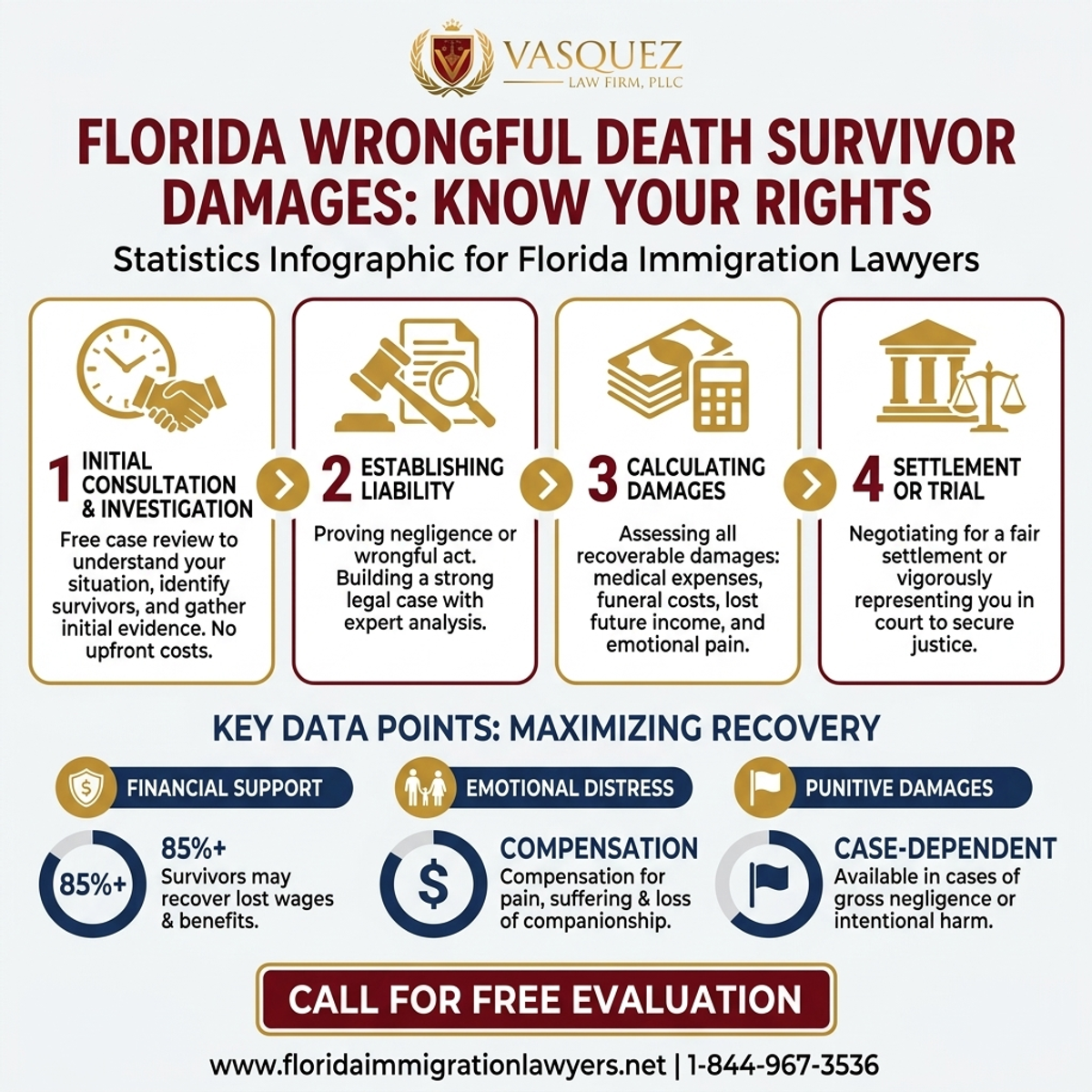
Key Statistics — Florida Wrongful Death Survivor Damages: Know Your Rights
3. Survivor's Relationship and Dependency
As outlined in §768.21, the type and amount of damages recoverable by each survivor depend on their relationship to the deceased and their dependency:
- Spouses and minor children often have the broadest range of recoverable damages, including significant non-economic losses like pain and suffering and loss of companionship.
- Parents of a deceased minor child also have strong claims for pain and suffering.
- Adult children or other dependent relatives may have more limited claims, primarily focused on lost support and services.
4. Insurance Coverage and Defendant's Assets
Ultimately, the ability to collect damages can be limited by the available insurance coverage of the at-fault party and their personal assets. While a large verdict may be awarded, if the defendant has insufficient insurance or assets, collecting the full amount can be challenging. An experienced attorney will investigate all potential sources of recovery, including uninsured/underinsured motorist (UM/UIM) coverage if applicable, to maximize your family's compensation.
5. Comparative Negligence
Florida operates under a modified comparative negligence system, as updated by HB 837 in 2023, codified in §768.81. If the deceased is found to be partially at fault for their own death, the total damages awarded to the survivors will be reduced by their percentage of fault. However, if the deceased is found to be 50% or more at fault, no damages can be recovered. This factor makes proving sole or primary fault of the defendant critical for a successful claim.
Each of these factors requires meticulous investigation, expert testimony, and skilled legal argumentation. A Florida wrongful death attorney understands how to gather and present this information effectively to pursue the full compensation your family deserves.
Document Checklist for a Florida Wrongful Death Claim
Gathering the right documents is a critical step in building a strong wrongful death claim in Florida. A comprehensive collection of evidence helps establish negligence, prove the extent of damages, and streamline the legal process. While your attorney will assist you, having these documents readily available can significantly expedite your case. This checklist serves as a starting point for families in West Palm Beach and across Florida seeking wrongful death survivor damages.
- Death Certificate: Official document confirming the death, its cause, and date.
- Police Report/Incident Report: If applicable, any reports from law enforcement or other agencies detailing the incident that led to the death.
- Medical Records of the Deceased:
- Records related to the fatal injury and treatment leading up to death.
- Past medical records to establish general health and life expectancy.
- Autopsy Report (if performed): Provides detailed information on the cause and manner of death.
- Funeral and Burial/Cremation Expense Receipts: Documentation of all costs incurred for final arrangements.
- Proof of Income and Employment of the Deceased:
- Pay stubs, W-2 forms, tax returns for several years prior to death.
- Employment contracts, letters of promotion, or other documents demonstrating earning capacity.
- Benefit statements (e.g., pension, 401k, health insurance).
- Proof of Services Provided by the Deceased:
- Testimony or statements from family members regarding childcare, household chores, home maintenance, etc.
- Any records of paid services that the deceased previously performed for the family (e.g., if they managed family finances or property).
- Marriage Certificate (if applicable): For a surviving spouse to prove legal relationship.
- Birth Certificates of Children: To establish legal relationship for minor children and other dependents.
- Proof of Dependency (for other relatives): Financial records, utility bills, or other documents showing reliance on the deceased for support or services.
- Witness Information: Names, contact details, and statements from anyone who witnessed the incident.
- Photographs and Videos: Any visual evidence of the accident scene, injuries, or property damage.
- Insurance Policies: Details of the deceased's life insurance, health insurance, and any applicable auto or homeowner's insurance policies. Also, details of the at-fault party's liability insurance.
- Letters of Administration/Probate Documents: Official court documents appointing the personal representative of the estate.
Organizing these documents can feel overwhelming during a time of grief. Your attorney will help you identify what is needed and assist in obtaining records from various sources. This meticulous approach ensures that all potential damages are accounted for and properly presented in your wrongful death survivor damages claim.
Common Mistakes to Avoid in a Florida Wrongful Death Claim
Navigating a wrongful death claim in Florida is fraught with legal complexities, and even small missteps can significantly jeopardize your ability to recover fair compensation. Being aware of common mistakes can help families in West Palm Beach, Orlando, and Kissimmee protect their rights when pursuing wrongful death survivor damages.
- Delaying Legal Action: Florida has a strict statute of limitations for wrongful death claims, typically two years from the date of death, as outlined in §95.11(4)(a). Waiting too long can result in your claim being permanently barred, regardless of its merits. Immediate action allows for timely investigation and preservation of evidence.
- Not Appointing a Personal Representative: Only a personal representative of the decedent's estate can file a wrongful death lawsuit in Florida. Failing to go through the probate process to appoint this individual means the lawsuit cannot legally proceed. This is a common oversight that can cause significant delays.
- Communicating Directly with Insurance Companies: Insurance adjusters represent the interests of the at-fault party, not yours. They may try to minimize payouts or obtain statements that can be used against your claim. It's crucial to direct all communication through your attorney.
- Failing to Gather and Preserve Evidence: Critical evidence, such as accident scenes, vehicle damage, witness recollections, and even electronic data, can disappear or degrade quickly. Not documenting and preserving this evidence promptly can weaken your ability to prove negligence.
- Accepting a Quick Settlement Offer: Insurance companies often offer low settlements early on, hoping to resolve the case before you fully understand the extent of your losses. Accepting such an offer without legal counsel means you forfeit your right to seek further compensation, potentially leaving significant damages unaddressed.
- Not Identifying All Eligible Survivors: The Florida Wrongful Death Act specifies who can claim damages. Overlooking an eligible survivor or failing to properly account for their losses can lead to an incomplete claim and leave deserving family members without compensation.
- Underestimating the Value of the Claim: Calculating the full scope of both economic and non-economic damages is complex. Families often underestimate future lost income, the value of lost services, and the profound impact of pain and suffering. An experienced attorney uses experts (e.g., economists, vocational specialists) to accurately assess these long-term losses.
- Discussing the Case on Social Media: Anything you post online, even in private settings, can be used as evidence against you in court. Avoid discussing the details of the accident, your grief, or your financial situation on social media.
- Failing to Seek Legal Counsel: The intricacies of Florida wrongful death law, from identifying liable parties to calculating damages and negotiating with insurance companies, are best handled by a qualified attorney. Attempting to manage the claim alone often leads to lower settlements or outright denials.
When to Call a Lawyer for Wrongful Death Survivor Damages
The decision to contact a lawyer after a wrongful death is a significant one, often made during a time of immense grief and confusion. However, due to the complexities of Florida law and strict deadlines, prompt legal consultation is essential. You should call an attorney at Florida Immigration Lawyers immediately if your loved one's death occurred under any of the following circumstances in West Palm Beach, Orlando, Kissimmee, or anywhere in Florida:
- Death Caused by Negligence: If you believe another party's careless, reckless, or intentional actions led to your loved one's death, whether it was a car accident, medical malpractice, slip and fall, or any other incident.
- Uncertainty About Your Rights: If you are unsure who qualifies as a 'survivor' or what types of damages you may be entitled to under Florida Statute §768.21.
- Facing Insurance Companies: If an insurance company for the at-fault party has contacted you, offering a settlement or requesting information. It is critical to have legal representation before engaging in any discussions.
- Complex Investigations: If the circumstances of the death are unclear, require extensive investigation, or involve multiple parties.
- Concerns About Statute of Limitations: If you are approaching the two-year deadline (or a shorter period in some cases) for filing a wrongful death claim in Florida.
- Disputes Among Survivors: If there are disagreements among family members about who should be the personal representative or how potential damages should be allocated.
- Need for Expert Testimony: If your case requires expert witnesses (e.g., accident reconstructionists, economists, medical professionals) to prove negligence or quantify damages.
An attorney from Florida Immigration Lawyers can provide invaluable assistance by investigating the incident, identifying all liable parties, calculating the full scope of your wrongful death survivor damages, and negotiating with insurance companies. We work on a contingency fee basis, meaning no recovery, no fee. This allows you to focus on healing without the added financial stress of upfront legal costs.
Reviewed By
This article was reviewed for Florida legal accuracy by Harold Estrada-Rodriguez, Florida Bar No. 1041171, the attorney responsible for personal injury matters at Florida Immigration Lawyers. Personal injury representation in Florida only. No recovery, no fee.
About Florida Immigration Lawyers
Florida Immigration Lawyers is a distinguished legal practice serving communities across Florida, including Orlando, Kissimmee, and West Palm Beach. While our name reflects our deep expertise in immigration law, we also proudly offer comprehensive legal representation in personal injury matters. Our firm is dedicated to providing compassionate and effective legal services, always putting our clients' needs first.
All personal injury cases are handled by our experienced attorney, Harold Estrada-Rodriguez, Florida Bar No. 1041171. He is committed to fighting for the rights of accident victims and families who have suffered due to the negligence of others, ensuring they receive the justice and compensation they deserve.
We understand that legal challenges can arise unexpectedly, which is why we offer free consultations and are available 24/7 to answer your questions and provide immediate assistance. Our team is fluent in both English and Spanish, ensuring clear and culturally sensitive communication for all our clients. When you choose Florida Immigration Lawyers, you choose a dedicated advocate ready to stand by your side.
Contact us today for a free consultation: 1-844-967-3536 or visit www.floridaimmigrationlawyers.net.
Sources and References
Related services: fatal car accident claims, fatal truck collisions.
This article provides general legal information and is not intended as legal advice. Every case is unique, and outcomes depend on specific facts and circumstances. Contact an attorney for advice about your particular situation.
If you have lost a loved one due to another's negligence, the path to justice and compensation for wrongful death survivor damages can be overwhelming. Let the compassionate and experienced team at Florida Immigration Lawyers guide you. We are dedicated to protecting your rights and securing the maximum compensation your family deserves in West Palm Beach, Orlando, Kissimmee, and throughout Florida.
Call us today for a free consultation: 1-844-967-3536.
Se Habla Espanol - Estamos aqui para ayudarle.
If you need legal assistance, learn more about Florida personal injury attorney services, or call us at 1-844-967-3536 for a free consultation.
Do Not Navigate This Process Alone
Our experienced immigration attorneys are ready to fight for you. Get a free, confidential consultation today.
Se Habla Español
Frequently Asked Questions
Florida Immigration Lawyers
Immigration Attorney | Founder, Vasquez Law Firm
U.S. Air Force veteran and immigration attorney with thousands of cases resolved. J.D., NCCU School of Law. AILA member. Admitted to the 4th, 5th, and 11th Circuit Courts.
Available 24/7 - Free Evaluations
Related Legal Services
Our Florida immigration attorneys can help you with Florida personal injury attorney Harold Estrada-Rodriguez, free personal injury consultation and Florida personal injury representation. Call today at 1-844-967-3536 for a free consultation.
Related Links
Related Topics
Free Legal Consultation
Discuss your case with our experienced attorneys. We're available 24/7.
Se Habla Español - Estamos aquí para ayudarle.
Related Articles
Understanding Florida Rideshare Insurance: Uber and Lyft
Learn about the multi-layer insurance requirements for Uber and Lyft drivers in Florida. Understand your rights and protections in case of an accident. Contact us for guidance.
Florida's 2-Year Statute of Limitations for PI Claims
Learn about Florida's 2-year statute of limitations for personal injury claims under 95.11, crucial for Jacksonville residents. Contact us for guidance.
Florida Wrongful Death Survivor Damages Explained | VLF Florida
Explore Florida's wrongful death statutes and how they support survivors seeking damages. Learn who qualifies, what compensation is available, and why legal guidance is crucial. Call Florida Immigration Lawyers at 1-844-967-3536 for a free consultation.
Florida Rideshare Accident: Uber/Lyft Insurance | VLF Florida
Involved in a Florida Uber or Lyft rideshare accident? Navigating the multi-layer insurance policies of Transportation Network Companies (TNCs) can be incredibly complex. From understanding Florida Statute §627.748 to dealing with personal injury protection (PIP) and various liability coverages, securing fair compensation requires expert legal guidance. This guide details immediate actions, the claims process, essential evidence, and common mistakes to avoid. Learn how Florida Immigration Lawyers, with attorney Harold Estrada-Rodriguez, can help you fight for your rights and maximize your recovery after a rideshare crash in Hollywood, Orlando, or Kissimmee.