Immigration Court Proceedings Florida: Your Guide to...
Understanding immigration court proceedings in Florida is vital for anyone facing removal. This guide covers the step-by-step process, essential documents, timelines, and costs associated with your case. Learn about Master Calendar and Individual Hearings, applying for relief, and common mistakes to avoid. Florida Immigration Lawyers provides expert guidance for non-citizens in Tampa and across Florida. We help you navigate the complexities of EOIR courts, ensuring your rights are protected. Contact us for a free consultation to discuss your specific situation and defend your future in the U.S.

Immigration court proceedings in Florida involve the Executive Office for Immigration Review (EOIR) determining if a non-citizen should be removed from the U.S. These complex legal processes, often called removal proceedings, require understanding your rights and legal options. Representation by an experienced immigration attorney is crucial to effectively defend your case.
- Immigration court cases begin with a Notice to Appear (NTA).
- Hearings involve an Immigration Judge, DHS counsel, and the respondent.
- Florida has high-volume courts, primarily in Miami, Orlando, and Pompano Beach.
- You can apply for various forms of relief from removal.
- Legal representation significantly improves your chances of a favorable outcome.
Facing immigration court proceedings in Florida can be an incredibly daunting experience. The thought of defending your right to remain in the United States against the government can feel overwhelming. Many individuals in Tampa and across Florida find themselves unsure of where to turn or what steps to take when they receive a Notice to Appear (NTA).
This comprehensive guide from Florida Immigration Lawyers aims to demystify the immigration court process. We will walk you through the procedures, explain key terminology, and highlight what you can expect. Our goal is to empower you with knowledge as you navigate this challenging journey.
Do not face the complexities of the immigration court system alone. Your future in Florida depends on informed decisions and skilled advocacy. Call Florida Immigration Lawyers at 1-844-967-3536 for a free consultation and let our experienced team provide the guidance you need.
Understanding Immigration Court Proceedings in Florida
The immigration court system in the United States operates under the Executive Office for Immigration Review (EOIR), a component of the Department of Justice. Unlike federal criminal or civil courts, EOIR courts are administrative tribunals. Their primary function is to determine whether non-citizens should be allowed to remain in the U.S. or be ordered removed (deported).
In Florida, our immigration courts are among the busiest in the nation. This high volume can lead to longer wait times and complex dockets. Residents of Tampa and surrounding areas typically have their cases heard at the Miami, Orlando, or Pompano Beach Immigration Courts, depending on their jurisdiction and the location of their apprehension or residence.
When you are placed into removal proceedings, the Department of Homeland Security (DHS) alleges that you are deportable under U.S. immigration law. It is then up to the Immigration Judge to hear evidence and arguments from both DHS counsel and your legal team. The judge will ultimately decide your case based on the law and the facts presented.
Understanding these foundational aspects is the first step in building a strong defense. The legal intricacies involved are substantial, making professional legal assistance invaluable. An attorney specializing in deportation defense can analyze your specific situation and identify potential avenues for relief.
Key Players in the Immigration Court
Several key individuals are involved in every immigration court case. Knowing their roles can help you understand the process better. The Immigration Judge (IJ) presides over the hearings and makes decisions. They are neutral arbiters of the law.
The Department of Homeland Security (DHS) attorney represents the U.S. government. Their role is to argue for your removal. You, as the non-citizen, are referred to as the respondent. Your attorney represents your interests, presenting evidence and legal arguments on your behalf.
The Step-by-Step Immigration Court Process in Florida
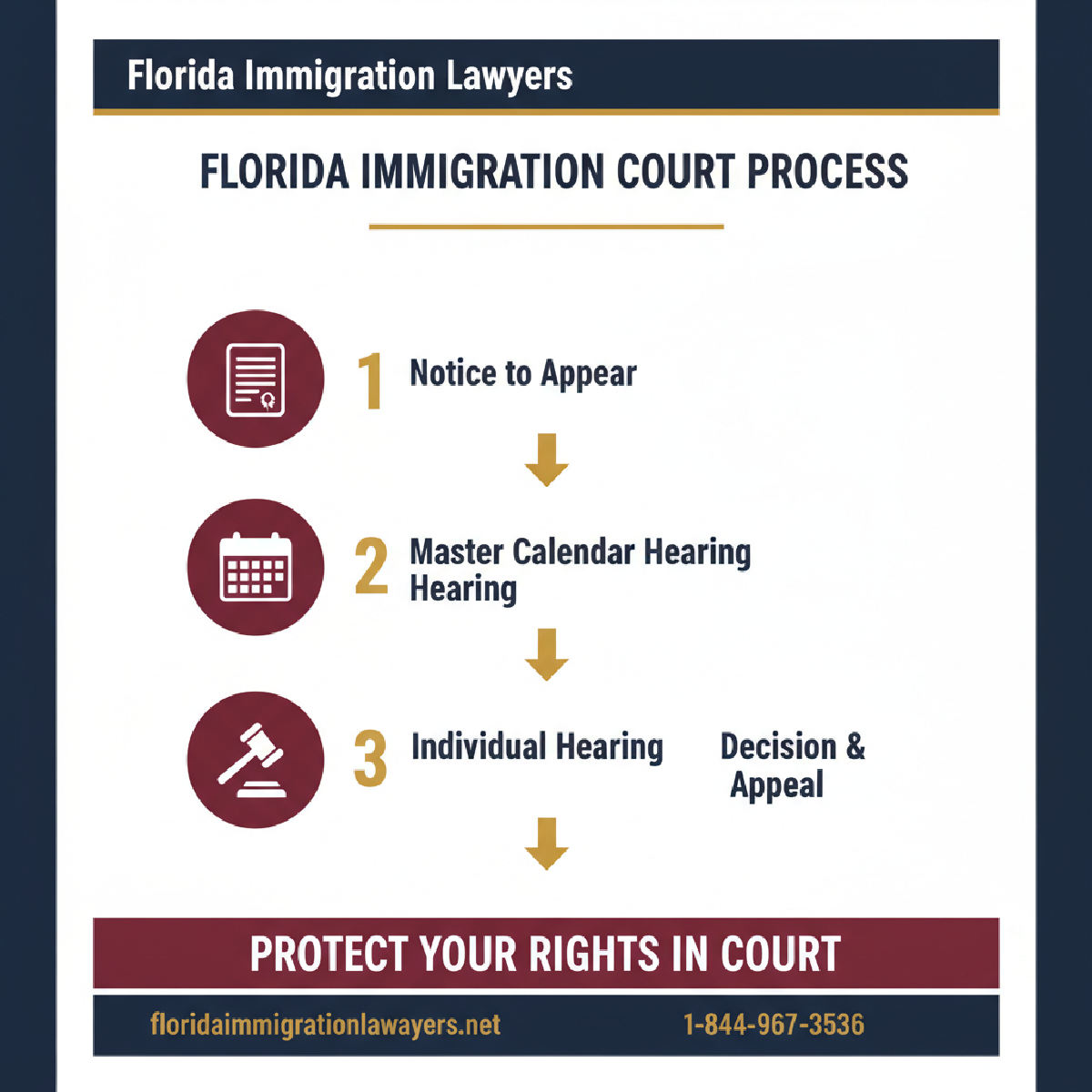
Navigating the immigration court system involves a series of structured steps. Each stage is critical and requires careful attention to detail and deadlines. Here is a typical overview of what you can expect in immigration court proceedings Florida.
-
Issuance of a Notice to Appear (NTA): Your journey in immigration court begins when DHS issues a Form I-862, Notice to Appear (NTA). This document formally charges you with being removable from the United States. It specifies the legal grounds for your alleged deportability and lists the time and location of your first hearing.
It is crucial to review your NTA carefully for accuracy. Any errors or missing information should be brought to your attorney's attention immediately. This document is the foundation of your entire removal case.
-
Master Calendar Hearing (MCH): The MCH is your initial appearance before an Immigration Judge. This hearing is typically brief and focuses on procedural matters. During the MCH, you will be asked to acknowledge receipt of the NTA and admit or deny the factual allegations and legal charges within it.
You or your attorney will also inform the judge whether you intend to seek any forms of relief from removal. The judge will then set deadlines for filing applications and schedule your next hearing, which is usually an Individual Hearing.
-
Filing Applications for Relief: If you are eligible for relief from removal, you must file the appropriate application(s) with the EOIR court. Common forms of relief include asylum, withholding of removal, protection under the Convention Against Torture (CAT), adjustment of status, cancellation of removal, and waivers of inadmissibility.
Each application has specific eligibility criteria and requires extensive documentation. Missing filing deadlines can severely impact your case. An experienced attorney can help determine your eligibility and prepare these vital documents.
-
Individual Hearing (Merits Hearing): This is the substantive hearing where your case is decided. During an Individual Hearing, you and your witnesses will testify under oath before the Immigration Judge. Your attorney will present evidence and legal arguments supporting your application for relief.
DHS counsel will have the opportunity to cross-examine you and your witnesses. They will also present their own evidence to argue against your requested relief. This hearing can be lengthy and requires thorough preparation.
-
Decision by the Immigration Judge: After all evidence and arguments have been presented, the Immigration Judge will issue a decision. This decision may be delivered orally at the end of the Individual Hearing or in writing at a later date. The judge will either grant your application for relief, terminate your removal proceedings, or order you removed from the U.S.
If the judge orders you removed, they will also inform you of your right to appeal the decision. Understanding the judge's decision and your options post-decision is vital.
-
Appeals to the Board of Immigration Appeals (BIA): If either you or DHS counsel disagrees with the Immigration Judge's decision, you have the right to appeal to the Board of Immigration Appeals (BIA). The BIA is the highest administrative body for interpreting and applying immigration laws.
Appeals must be filed within 30 days of the IJ's decision. The BIA reviews the judge's decision for legal or factual errors. Further appeals can be made to a U.S. Circuit Court of Appeals, though this is a more complex and rare step.
Essential Documents for Your Immigration Court Case
Thorough documentation is paramount for success in immigration court proceedings Florida. The specific documents you need will vary based on your case and the type of relief you are seeking. However, a general checklist can help you prepare.
Organizing these documents meticulously is crucial. Any missing or improperly submitted paperwork can delay your case or even lead to denial. Your attorney at Florida Immigration Lawyers will provide a tailored list of required documents.
- Notice to Appear (NTA): The original document initiating your removal proceedings.
- Identity Documents: Passport, birth certificate, national identity card, driver's license, or state ID from Florida.
- Proof of Relationship: Marriage certificates, birth certificates of children, divorce decrees, adoption papers (for family-based relief).
- Financial Documents: Tax returns, employment letters, pay stubs, bank statements, affidavits of support (Form I-864).
- Affidavits from Witnesses: Statements from individuals who can attest to your character, hardships, or claims.
- Proof of Residence: Utility bills, lease agreements, property deeds, school records in Florida.
- Medical Records: Especially relevant for humanitarian or asylum cases, or for demonstrating severe medical conditions.
- Police Clearance and Criminal Records: Any arrest records, court dispositions, or evidence of rehabilitation.
- Applications for Relief: Completed forms such as Form I-589 (Application for Asylum), Form I-485 (Application to Register Permanent Residence), or Form EOIR-42B (Application for Cancellation of Removal).
- Supporting Evidence for Claims: Articles, reports, expert opinions, photos, or other evidence corroborating your claims for asylum or other relief.
- Proof of Good Moral Character: Letters of recommendation, community involvement, volunteer work.
- Previous Immigration Filings: Copies of any prior applications or petitions filed with USCIS.
Timelines and Expectations in Florida Immigration Courts
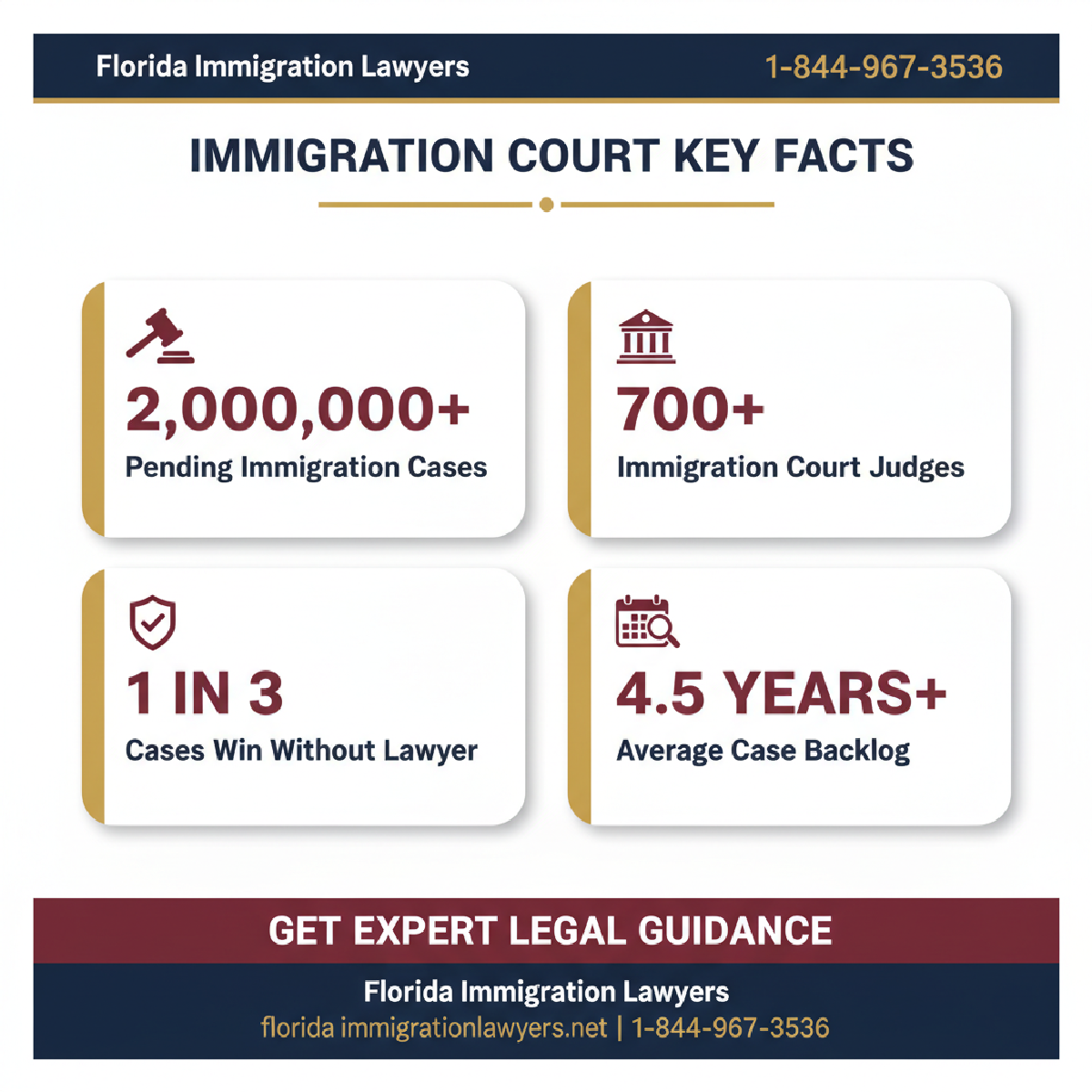
One of the most common questions individuals have about immigration court proceedings Florida concerns the timeline. The reality is that immigration cases can take a significant amount of time, often years, to resolve. This is particularly true in Florida, where courts face substantial backlogs.
Several factors influence the length of your immigration court case. The court's docket congestion, the complexity of your case, the availability of an Immigration Judge, and the type of relief you seek all play a role. For example, asylum cases or those involving extensive evidence tend to take longer.
It is vital to manage your expectations and remain patient throughout the process. Your attorney will keep you informed of any developments and deadlines. Missing a deadline can have severe consequences, including the denial of your application or an order of removal. Always ensure your address is up-to-date with the EOIR court.
You can check the status of your immigration court case online through the Executive Office for Immigration Review (EOIR) automated case information system. This system provides updates on scheduled hearings and decisions. While it is a helpful tool, it should not replace direct communication with your attorney.
Understanding Costs Associated with Immigration Court
When preparing for immigration court proceedings, it is natural to consider the financial aspects. Unlike some civil court cases, there are generally no direct filing fees for appearing before an Immigration Judge. However, costs arise from other crucial parts of the process.
The main costs are typically associated with filing applications for relief from removal with USCIS or EOIR. For instance, an application for adjustment of status (Form I-485) or a waiver may carry a significant filing fee. It is important to remember that these fees are subject to change, so specific amounts are not listed here. You can find current fee information on the USCIS website.
Legal fees for an experienced immigration attorney represent another significant investment. These fees vary depending on the complexity of your case, the attorney's experience, and the services required. Some attorneys charge hourly rates, while others offer flat fees for specific stages or the entire case.
While legal fees are a consideration, the value of skilled representation in removal proceedings cannot be overstated. An attorney can help you navigate complex laws, prepare compelling arguments, and avoid critical mistakes. This investment can be crucial for securing your future in the U.S.
Additional costs may include fees for document translations, expert witness testimony, or travel expenses for hearings. Your attorney will provide a clear understanding of potential costs involved in your specific situation. We offer free consultations to discuss your case and our fee structure.
Do not navigate the intricate world of immigration court proceedings Florida alone. The stakes are too high to take chances with your future. Contact Florida Immigration Lawyers today at 1-844-967-3536 to ensure you have powerful legal representation by your side.
Common Mistakes to Avoid in Immigration Court
Making mistakes in immigration court can have severe and lasting consequences, potentially leading to an order of removal. Being aware of these pitfalls can help you avoid them. Our team at Florida Immigration Lawyers can help you prevent these common errors.
-
Missing Court Dates: Failing to appear for any scheduled hearing, whether a Master Calendar or Individual Hearing, can result in an automatic order of removal (in absentia). It is one of the most critical errors you can make.
Always confirm your hearing dates and times. If you cannot attend due to an emergency, immediately notify the court and your attorney.
-
Failing to Disclose Criminal History: Attempting to hide or misrepresent past criminal convictions, no matter how minor, will severely damage your credibility. The DHS attorney will likely discover this information, and it can be used against you.
Always be truthful and provide all relevant information to your attorney so they can properly assess your case and prepare a defense.
-
Not Filing Applications for Relief on Time: Immigration Judges set strict deadlines for filing applications for relief. Missing these deadlines, even by a day, can lead to the denial of your application without review of its merits.
Work closely with your attorney to ensure all required forms and supporting documents are submitted well before the deadline.
-
Providing Inconsistent Information: Any discrepancies in your testimony, applications, or past statements can be used to question your credibility. This includes inconsistencies between what you tell different immigration officials.
Consistency and truthfulness are paramount throughout your removal proceedings. Review all documents and be prepared for your testimony.
-
Attempting to Represent Yourself Without Legal Knowledge: The complexities of immigration law are vast. Representing yourself against a trained DHS attorney and before an Immigration Judge is extremely challenging and often leads to unfavorable outcomes.
An attorney understands the nuances of the law, court procedures, and how to present your case effectively. Consult with a qualified legal professional.
-
Ignoring Correspondence from EOIR or DHS: Letters, notices, or requests for evidence from the EOIR court or DHS are time-sensitive and legally binding. Ignoring them can lead to missed deadlines or adverse decisions.
Open and review all mail related to your case immediately. Inform your attorney of any new correspondence.
-
Not Preparing Adequately for Hearings: Hearings, especially Individual Hearings, require extensive preparation. This includes practicing your testimony, reviewing evidence, and understanding potential questions from the judge and DHS attorney.
Your attorney will help you prepare, but your active participation is essential for a strong presentation.
-
Failing to Gather All Necessary Evidence: The burden of proof often lies with the respondent to demonstrate eligibility for relief. Insufficient or weak evidence can result in denial.
Work diligently with your attorney to collect every piece of supporting documentation needed for your case.
-
Arriving Late to Court: Punctuality is a sign of respect for the court and the judge. Arriving late can cause delays, irritate the judge, and in some cases, lead to an in absentia order.
Always plan to arrive early for your hearings, especially in busy Florida courthouses like Miami or Orlando.
-
Disrespecting the Immigration Judge or Court Staff: Maintaining a respectful demeanor is crucial. Any disrespectful conduct can negatively impact the judge's perception of you and your case.
Always address the judge respectfully and follow court protocols. Your attorney will guide you on proper courtroom etiquette.
-
Not Updating Your Address with the Court: If you move, you are legally required to update your address with the EOIR court within five days using Form EOIR-33. Failure to do so means you might not receive important notices.
Missing notices can lead to missed hearings and an order of removal without your knowledge.
-
Making False Statements: Providing false information, whether orally or in writing, is a serious offense. It can lead to criminal charges, a finding of permanent inadmissibility, and a denial of all immigration benefits.
Always be truthful in all your interactions with the immigration court and DHS.
When to Call Florida Immigration Lawyers for Your Immigration Court Case
The moment you receive a Notice to Appear (NTA) is the moment you should seek legal counsel. Immigration court proceedings are highly complex, and the consequences of an unfavorable outcome can be life-altering. Having an experienced attorney from Florida Immigration Lawyers by your side can make all the difference.
We are here to help you understand your rights and options. Our team can assess your eligibility for various forms of relief, prepare compelling arguments, and represent you effectively before the Immigration Judge. We serve clients in Tampa, Miami, Orlando, and throughout Florida.
Consider calling us if any of these scenarios apply to you:
- You have received a Notice to Appear (NTA) for removal proceedings.
- You have a prior deportation order or criminal history that may affect your case.
- You believe you are eligible for asylum or other forms of humanitarian relief.
- You are unsure about your eligibility for any form of relief from removal.
- You need assistance gathering and organizing complex documentation.
- You have an upcoming immigration court hearing and feel unprepared.
- You wish to appeal an Immigration Judge's decision.
- You simply want peace of mind knowing your case is handled by professionals.
Do not wait until it is too late. Early legal intervention is often key to a successful outcome. Contact Florida Immigration Lawyers for a free consultation to discuss your specific situation and how we can assist you in your immigration court proceedings Florida.
About Florida Immigration Lawyers
Florida Immigration Lawyers is a leading immigration law firm dedicated to serving individuals and families across the entire state of Florida. Our team of highly skilled and compassionate attorneys understands the complexities and emotional toll that immigration challenges can bring. We are committed to providing exceptional legal representation and personalized service to each client.
We specialize in a broad range of immigration matters, including deportation defense, asylum, family-based immigration, business immigration, and citizenship. Our deep knowledge of U.S. immigration law, coupled with our commitment to our clients, sets us apart. We pride ourselves on offering strategic, effective, and ethical legal solutions.
When you choose Florida Immigration Lawyers, you gain a dedicated advocate who will fight tirelessly for your rights and your future. We offer free consultations, are available 24/7, and are ready to assist you. Your journey through the immigration system is our priority.
Call us today at 1-844-967-3536 or visit our website at https://www.floridaimmigrationlawyers.net to learn how we can help you.
Sources and References
- Executive Office for Immigration Review (EOIR)
- U.S. Citizenship and Immigration Services (USCIS)
- 8 U.S.C. Chapter 12 - Immigration and Nationality Act (INA)
- 8 CFR - Code of Federal Regulations, Title 8 (Aliens and Nationality)
- INA Section 240 - Removal Proceedings
- INA Section 208 - Asylum
This article provides general legal information and is not intended as legal advice. Every case is unique, and outcomes depend on specific facts and circumstances. Contact an attorney for advice about your particular situation.
Navigating immigration court proceedings Florida requires expert legal guidance. Do not leave your future to chance. Our dedicated team at Florida Immigration Lawyers is ready to provide the compassionate and effective representation you deserve. We are here to answer your questions and protect your rights.
Call Florida Immigration Lawyers today for a free consultation at 1-844-967-3536. Se Habla Español - Estamos aquí para ayudarle.
Do Not Navigate This Process Alone
Our experienced immigration attorneys are ready to fight for you. Get a free, confidential consultation today.
Se Habla Español
Frequently Asked Questions
Florida Immigration Lawyers
Immigration Attorney | Founder, Vasquez Law Firm
U.S. Air Force veteran and immigration attorney with thousands of cases resolved. J.D., NCCU School of Law. AILA member. Admitted to the 4th, 5th, and 11th Circuit Courts.
Available 24/7 - Free Evaluations
Related Legal Services
Our Florida immigration attorneys can help you with experienced immigration attorneys, business immigration and asylum protection. Call today at 1-844-967-3536 for a free consultation.
Related Links
Related Topics
Free Legal Consultation
Discuss your case with our experienced attorneys. We're available 24/7.
Se Habla Español - Estamos aquí para ayudarle.
Related Articles
Stokes Interview: Navigating Marriage Fraud in Florida
A Stokes interview is a specialized, separate interview conducted by USCIS when there are suspicions of marriage fraud in a green card application. This rigorous process involves individual questioning of spouses, focusing on inconsistencies in their testimonies to determine the authenticity of their marital bond. For couples in Florida, navigating this high-stakes interview requires meticulous preparation, extensive documentation, and often the strategic guidance of an experienced immigration lawyer. Understanding the process, preparing for detailed questions, and presenting a strong case are crucial for overcoming marriage fraud allegations and securing your immigration future. Florida Immigration Lawyers stands ready to assist you.
Immigration Attorney Gainesville: North Florida Legal Help
For those in Gainesville, Alachua County, and throughout North Florida, navigating U.S. immigration law requires expert guidance. An experienced immigration attorney can simplify complex processes, from family-based petitions and employment visas to critical asylum claims and deportation defense. This comprehensive guide outlines the essential services provided by an immigration attorney, details necessary documentation, clarifies processing timelines, and discusses associated costs. We also highlight common mistakes to avoid and crucial scenarios where legal counsel is indispensable. Florida Immigration Lawyers serves all of Florida, including Gainesville and St. Petersburg, providing dedicated legal support to help you achieve your immigration goals. Contact us for a free consultation to discuss your specific needs.
Military Naturalization Expedited at Florida Bases
Explore expedited military naturalization processes for service members at Florida bases like MacDill. Learn about eligibility, steps, and common mistakes. Contact Florida Immigration Lawyers for a free consultation.
Protect Yourself from Immigration Scams in Florida
Learn how to protect against immigration scams in Florida, focusing on St. Petersburg. This guide covers identifying scams, verifying credentials, and getting legal help. Call Florida Immigration Lawyers at 1-844-967-3536 for assistance.
