Florida Drunk Driver Punitive Damages: DUI Accident Guide
Being injured by a drunk driver in Florida can leave you with severe physical, emotional, and financial burdens. Beyond seeking compensation for medical bills and lost wages, victims in Gainesville and across Florida may be eligible for punitive damages. These damages are designed to punish the at-fault drunk driver for their reckless actions and deter similar behavior in the future. Florida law sets specific requirements for proving punitive damages, often necessitating clear and convincing evidence of gross negligence or intentional misconduct. Understanding the interplay between criminal DUI proceedings and your civil personal injury claim is crucial. Florida Immigration Lawyers, led by Harold Estrada-Rodriguez, Florida Bar No. 1041171, specializes in helping victims navigate these complex legal waters, ensuring aggressive representation to pursue maximum compensation, including punitive damages. Contact us for a free consultation to protect your rights.

If you are injured by a drunk driver in Florida, you may be eligible to seek punitive damages in addition to compensatory damages. Punitive damages are not meant to compensate for losses but to punish the at-fault driver for their egregious conduct and deter similar behavior. Florida law, specifically Statute §768.72, sets strict requirements for proving punitive damages, often requiring clear and convincing evidence of intentional misconduct or gross negligence. Coordinating with the criminal DUI case is crucial, but your civil personal injury claim proceeds independently to secure justice and compensation for your injuries.
- Punitive damages punish drunk drivers and deter future misconduct.
- Florida law requires clear and convincing evidence for punitive damages.
- Your civil claim is separate from the criminal DUI prosecution.
- A personal injury attorney can help gather evidence and navigate the process.
- Gainesville victims of DUI accidents have specific legal rights.
Understanding Punitive Damages in Florida DUI Accidents
Being involved in a car accident is distressing, but when a drunk driver causes it, the emotional and physical toll can be even greater. Victims in Gainesville and across Florida often wonder about their legal options beyond just covering medical bills and lost wages. This is where punitive damages come into play. Unlike compensatory damages, which aim to make the injured party whole again by covering specific losses, punitive damages serve a different purpose.
Punitive damages are designed to punish the defendant for their reckless or malicious behavior and to deter others from engaging in similar conduct. In the context of a DUI car accident Florida, driving under the influence is often considered sufficiently egregious to warrant such penalties. Florida Statute §768.72 outlines the specific conditions under which punitive damages may be awarded. It requires a showing of intentional misconduct or gross negligence by clear and convincing evidence. This high legal standard means you need compelling proof that the drunk driver acted with a conscious disregard for safety.
For victims of a drunk driver Florida punitive damages claim, understanding these distinctions is vital. It's not just about proving fault for the accident; it's about demonstrating the severity of the driver's actions. These damages can significantly increase the total compensation awarded, reflecting society's condemnation of impaired driving. Our firm, Florida Immigration Lawyers, understands the profound impact these accidents have and is dedicated to helping you pursue every avenue for justice, including punitive damages, in your personal injury claim.
The severity of the drunk driver's intoxication, prior DUI offenses, and other aggravating factors can all influence a court's decision to award punitive damages. For instance, if the driver had an extremely high blood alcohol content (BAC) or was driving at excessive speeds, this could strengthen your claim. It's important to collect all available evidence from the scene, including police reports, witness statements, and toxicology results, to build a strong case for punitive damages.
The Role of Criminal DUI Proceedings in Your Civil Claim
When a drunk driver causes an accident, two separate legal processes typically begin: a criminal case and a civil personal injury case. While distinct, the criminal DUI proceedings can significantly influence your civil claim for drunk driver Florida punitive damages. In the criminal case, the state prosecutes the driver for violating laws against driving under the influence. The goal is to impose penalties such as fines, license suspension, and jail time.
Your civil personal injury claim, on the other hand, is filed by you, the injured victim, against the drunk driver. Its purpose is to recover financial compensation for your injuries and losses, including medical expenses, lost wages, pain and suffering, and potentially punitive damages. Although the outcomes are separate, evidence gathered during the criminal investigation, such as police reports, toxicology results, and witness testimonies, can be highly valuable in your civil case. A conviction in the criminal case, while not automatically guaranteeing a civil win, can serve as strong evidence of the driver's negligence or gross negligence in your civil suit.
It's crucial to understand that the burden of proof differs between the two cases. In a criminal case, the prosecution must prove guilt beyond a reasonable doubt, a very high standard. In a civil case, you, as the plaintiff, must prove your claims by a preponderance of the evidence, a lower standard. This means that even if the drunk driver is acquitted in criminal court, you might still succeed in your civil claim. However, a criminal conviction can make it easier to establish liability and argue for punitive damages in your personal injury case.
Coordinating between these two legal tracks requires a skilled attorney. Your legal team at Florida Immigration Lawyers will monitor the criminal proceedings, gather relevant evidence, and use it to bolster your civil claim. This strategic approach helps ensure that the drunk driver is held accountable on all fronts. For residents of Gainesville and surrounding areas, our firm is ready to guide you through this complex legal landscape.
Furthermore, it is important not to interfere with the criminal investigation. Allow law enforcement to conduct their duties thoroughly. Your attorney will know how to obtain the necessary documents and information without jeopardizing either case. This careful handling ensures that no crucial evidence is overlooked and that your rights as a victim are protected throughout the entire process.
Proving Punitive Damages Against a Drunk Driver in Florida
Securing punitive damages in a DUI car accident Florida case is a challenging but achievable goal. Florida Statute §768.72 sets a high bar, requiring plaintiffs to present clear and convincing evidence that the defendant acted with intentional misconduct or gross negligence. This standard is significantly higher than the preponderance of the evidence typically required for compensatory damages, meaning the evidence must be highly probable and free from serious doubt.
Defining Intentional Misconduct and Gross Negligence
- Intentional Misconduct: This means the defendant had actual knowledge of the wrongfulness of the conduct and the high probability that injury or damage would result, and, despite that knowledge, intentionally pursued the course of conduct. Driving under the influence, especially with a very high BAC or after multiple warnings, can sometimes fall into this category.
- Gross Negligence: This refers to conduct so reckless or wanting in care that it constituted a conscious disregard or indifference to the life, safety, or rights of persons exposed to such conduct. A drunk driver getting behind the wheel knowing they are impaired is a prime example of gross negligence.
To meet this burden, your attorney will meticulously gather and present evidence. This includes the police report detailing the accident and the driver's impairment, field sobriety test results, chemical test results (BAC levels), witness statements about the driver's behavior before and during the accident, and any prior DUI convictions. The higher the driver's BAC and the more reckless their driving, the stronger the argument for punitive damages. For those in Gainesville, working with a local attorney familiar with Florida's specific legal nuances is invaluable.
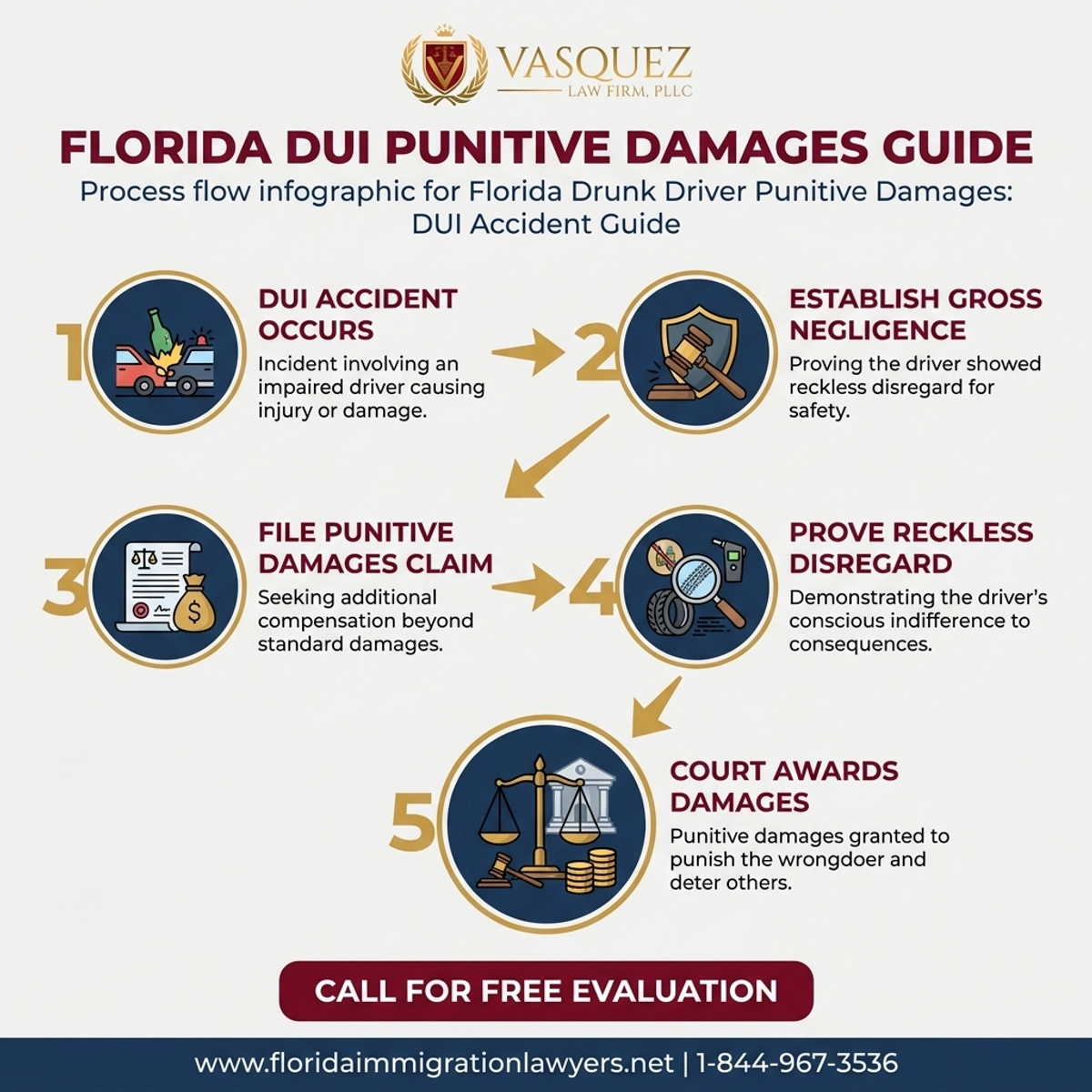
Step-by-Step Process — Florida Drunk Driver Punitive Damages: DUI Accident Guide
Expert testimony may also be crucial. Accident reconstructionists can illustrate the impact of the drunk driver's actions, and medical experts can detail the extent of your injuries caused by such reckless behavior. Your legal team at Florida Immigration Lawyers will build a comprehensive case, connecting the driver's impaired state directly to the severity of your injuries and the need for punitive action. We understand the specific rules that apply to punitive damage claims, ensuring all procedural requirements are met to maximize your chances of recovery.
It is important to remember that the court must first allow the claim for punitive damages to proceed. This often involves a preliminary hearing where the judge determines if there is a reasonable basis to seek such damages. Only after this initial hurdle is cleared can the jury consider awarding punitive damages at trial. This two-step process highlights the complexity and the need for experienced legal counsel.
Navigating the Civil Lawsuit Process After a DUI Accident
After a DUI car accident Florida, navigating the civil lawsuit process can seem overwhelming, especially when recovering from injuries. However, understanding the typical steps can help you feel more prepared. This is a general overview; each case is unique, and your attorney at Florida Immigration Lawyers will provide personalized guidance specific to your situation in Gainesville or elsewhere in Florida.
- Immediate Actions & Medical Treatment: Your health is the priority. Seek immediate medical attention, even for seemingly minor injuries. Document everything, including medical records, bills, and any out-of-pocket expenses. This forms the foundation of your claim.
- Contact an Attorney: As soon as possible, contact a personal injury attorney experienced in drunk driver Florida punitive damages cases. We offer a free consultation to discuss your case and explain your rights.
- Investigation and Evidence Gathering: Your attorney will launch an independent investigation. This includes obtaining police reports, toxicology results, witness statements, accident scene photos, surveillance footage, and the at-fault driver's insurance information. They will also collect all your medical records and bills.
- Demand Letter & Negotiations: Once your medical treatment is complete, your attorney will compile all damages and send a demand letter to the at-fault driver's insurance company. This letter outlines your losses and demands compensation, including any potential punitive damages. Negotiations will then begin.
- Filing a Lawsuit: If negotiations fail to yield a fair settlement, your attorney will file a personal injury lawsuit in Florida Circuit Court. This formally initiates the litigation process. Remember the statute of limitations for personal injury claims in Florida is generally two years from the date of the accident, as per §95.11(3)(a), making timely action crucial.
- Discovery Phase: Both sides exchange information through interrogatories (written questions), requests for production (documents), and depositions (out-of-court sworn testimony). This phase is critical for uncovering facts and assessing the strengths and weaknesses of each party's case.
- Mediation or Arbitration: Many civil cases in Florida resolve through alternative dispute resolution methods like mediation (a neutral third party facilitates settlement discussions) or arbitration (a neutral third party makes a decision). This can save time and costs associated with a trial.
- Trial: If no settlement is reached, the case proceeds to trial. A judge or jury will hear evidence, including arguments for and against punitive damages, and render a verdict. This is where your attorney will present your case, including evidence of the drunk driver's gross negligence or intentional misconduct.
- Judgment and Appeals: If you win at trial, the court enters a judgment. The at-fault party may appeal the decision. Your attorney will guide you through the collection of damages and any potential appeals process.
Factors Influencing Your Punitive Damages Claim
When pursuing drunk driver Florida punitive damages, several key factors can significantly influence the strength and potential value of your claim. These elements help the court and jury understand the severity of the drunk driver's actions and the appropriate level of punishment. Understanding these factors is crucial for building a compelling case.
Key Influencing Factors:
- Driver's Blood Alcohol Content (BAC): A significantly high BAC level, far exceeding the legal limit of 0.08%, often indicates a greater disregard for safety and can strengthen a punitive damages claim.
- Prior DUI History: If the at-fault driver has previous DUI convictions, it demonstrates a pattern of reckless behavior and a failure to learn from past mistakes, making a stronger case for punitive damages.
- Aggravating Circumstances: Factors such as excessive speeding, reckless driving, fleeing the scene, or driving without a valid license while intoxicated can all serve to heighten the culpability of the drunk driver and increase the likelihood of punitive damages.
- Severity of Injuries: While punitive damages are not tied to the extent of your injuries, severe injuries resulting from the drunk driver's gross negligence can underscore the devastating impact of their actions, making a jury more inclined to award a higher amount.
- Financial Condition of the Drunk Driver: Courts consider the defendant's financial resources when determining punitive damages. The goal is to punish, and a higher award may be necessary to have a punitive effect on a wealthier defendant. However, there are caps on punitive damages in Florida, generally three times the amount of compensatory damages or $500,000, whichever is greater, as per §768.73.
- Evidence of Gross Negligence or Intentional Misconduct: The quality and clarity of evidence demonstrating the driver's extreme recklessness or deliberate disregard for safety are paramount. This is the core legal requirement under Florida Statute §768.72.
Your attorney from Florida Immigration Lawyers will meticulously analyze each of these factors to build the strongest possible case for punitive damages in Gainesville and across Florida. We understand how to present this evidence persuasively to a judge and jury, ensuring the drunk driver is held fully accountable for their actions.
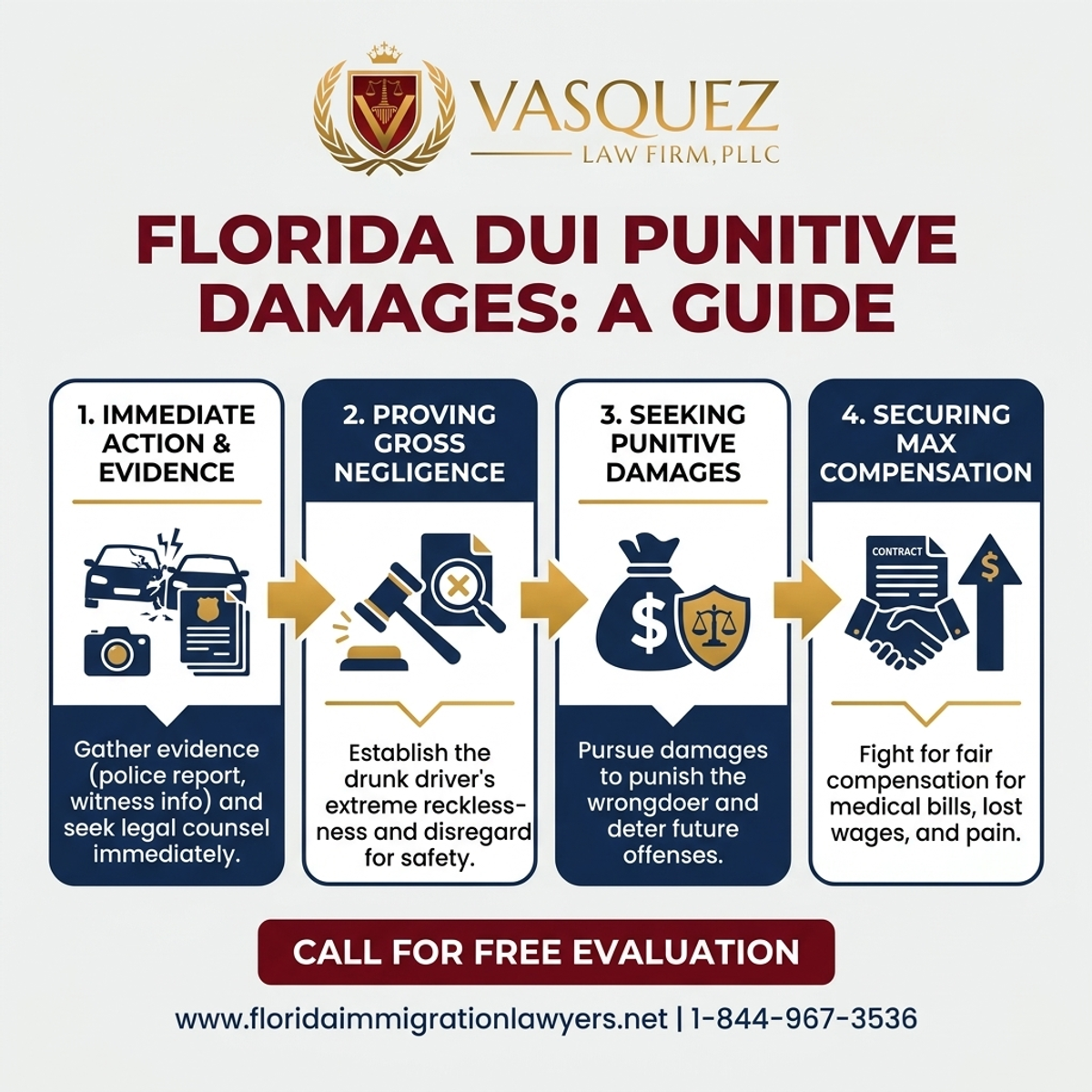
Key Statistics — Florida Drunk Driver Punitive Damages: DUI Accident Guide
It's also important to note that insurance policies typically do not cover punitive damages. This means that if awarded, these damages would likely need to be paid directly by the at-fault driver. This aspect can add complexity to the collection process, making skilled legal representation even more critical.
Common Challenges in DUI Accident Cases
Dealing with the aftermath of a DUI car accident Florida presents unique challenges that can complicate your personal injury claim. Victims in Gainesville and throughout Florida often face specific hurdles when seeking compensation, especially when pursuing drunk driver Florida punitive damages. Being aware of these challenges can help you prepare and work effectively with your legal team.
Potential Hurdles You Might Encounter:
- Insurance Company Tactics: Insurance adjusters for the at-fault driver may try to minimize your injuries, shift blame, or offer a quick, lowball settlement before you fully understand the extent of your damages, including the potential for punitive damages. They are not on your side.
- Proving Gross Negligence for Punitive Damages: As discussed, the clear and convincing evidence standard for punitive damages is high. Gathering sufficient proof of the driver's extreme recklessness requires a thorough investigation and expert legal strategy.
- Defendant's Financial Limitations: Even if punitive damages are awarded, collecting them can be difficult if the drunk driver has limited assets and their insurance policy does not cover such damages. Your attorney will explore all available avenues for recovery.
- Coordination with Criminal Case: While the criminal case can provide useful evidence, delays or an unfavorable outcome in criminal court can sometimes be used by the defense to argue against your civil claim, even though the standards of proof are different.
- Comparative Negligence Claims: The defense may attempt to argue that you were partially at fault for the accident, even if the other driver was intoxicated. Under Florida Statute §768.81, if you are found to be more than 50% at fault, you may be barred from recovering damages. This makes strong evidence of the drunk driver's sole fault critical.
- Witness Credibility Issues: If witnesses were also impaired or their statements are inconsistent, it can present challenges in court. Your attorney will work to verify and corroborate all witness accounts.
- Delayed Symptoms: Some serious injuries, like concussions or soft tissue damage, may not manifest immediately after the accident. Delaying medical treatment can make it harder to link these injuries directly to the accident. Always seek prompt medical evaluation.
Overcoming these challenges requires an experienced personal injury attorney. Florida Immigration Lawyers has the knowledge and resources to anticipate these issues and develop effective strategies to protect your rights and pursue the maximum compensation you deserve. We are committed to standing by you every step of the way.
It is also important to maintain clear and consistent communication with your legal team. Providing all requested documents, attending all medical appointments, and following your doctor's advice are critical steps that strengthen your case and help overcome potential defense arguments.
Common Mistakes to Avoid in Florida DUI Accident Cases
Navigating a personal injury claim after a DUI accident is complex. Avoiding common pitfalls can significantly impact the success of your drunk driver Florida punitive damages claim. Here are critical mistakes victims often make:
- Not Seeking Immediate Medical Attention: Delaying medical evaluation can not only jeopardize your health but also weaken your claim by allowing the defense to argue your injuries were not directly caused by the accident. Always prioritize your health first.
- Failing to Report the Accident to Police: A police report is crucial documentation. It provides an official record of the accident, including details about the drunk driver's impairment, and is vital evidence for your case.
- Giving a Recorded Statement to the At-Fault Driver's Insurance: Insurance companies are not looking out for your best interests. Providing a recorded statement without legal counsel can lead to inadvertently saying something that harms your claim. Direct all communication through your attorney.
- Admitting Any Fault: Never admit fault at the scene of the accident, even if you think you might have contributed. Investigations are needed to determine fault accurately. Your words can be used against you.
- Not Gathering Evidence at the Scene: If possible and safe, take photos and videos of the accident scene, vehicle damage, visible injuries, and any contributing factors. Collect contact information from witnesses.
- Posting About the Accident on Social Media: Anything you post online, even seemingly innocent updates, can be misinterpreted and used by the defense to undermine your claim, including your injuries or emotional distress. Refrain from discussing your case online.
- Failing to Follow Medical Advice: Gaps in treatment or not following your doctor's recommendations can be used by the defense to argue that your injuries are not as severe as claimed or that you contributed to your own prolonged recovery.
- Accepting a Quick Settlement Offer: Insurance companies often offer low settlements early on, before the full extent of your injuries and damages, including potential punitive damages, is known. Do not accept any offer without consulting an attorney.
- Not Hiring an Experienced Attorney: DUI accident cases, especially those involving punitive damages, are highly complex. An experienced personal injury attorney understands Florida law, the specific requirements for punitive damages, and how to negotiate with insurance companies effectively.
- Missing Deadlines (Statute of Limitations): Florida has strict deadlines, like the two-year statute of limitations (§95.11(3)(a)), for filing personal injury lawsuits. Missing this deadline can permanently bar you from seeking compensation.
When to Call a Lawyer for Your DUI Accident Claim
After being involved in a DUI car accident Florida, the stress and confusion can be immense. Knowing when to seek legal counsel is crucial for protecting your rights and ensuring you receive the compensation you deserve, especially when considering drunk driver Florida punitive damages. It is almost always advisable to contact a personal injury attorney immediately after a DUI accident.
You should call Florida Immigration Lawyers if:
- You have suffered any injuries: Even seemingly minor injuries can develop into serious long-term conditions. An attorney can help document your injuries and secure proper medical care.
- The at-fault driver was under the influence: This significantly complicates the case and opens the door for punitive damages, which require specialized legal knowledge to pursue effectively.
- The insurance company is contacting you: Insurers often try to settle quickly for less than your case is worth. Let your attorney handle all communications to protect your interests.
- There are disputes over fault: Even with a drunk driver, the other side may try to shift blame. An attorney will investigate and gather evidence to prove the drunk driver's sole fault.
- You have significant medical bills or lost wages: An attorney can help you recover comprehensive compensation for all economic and non-economic damages.
- You are unsure of your legal rights: The legal system can be confusing. A lawyer will explain your options, guide you through the process, and advocate on your behalf.
Our firm, Florida Immigration Lawyers, is well-versed in Florida personal injury law and the nuances of DUI accident claims, including the pursuit of punitive damages in Gainesville and other Florida communities. We offer a free consultation to assess your case and provide clear guidance. Don't delay; the sooner you contact us, the sooner we can begin building a strong case for your recovery.
About Florida Immigration Lawyers
Florida Immigration Lawyers is a dedicated Florida personal injury practice serving clients in Orlando, Kissimmee, Gainesville, and throughout the state. While our firm's name reflects our broader legal services, our personal injury division is committed to advocating for victims of negligence, particularly those affected by serious incidents like DUI car accident Florida cases. We understand the physical, emotional, and financial burdens these accidents impose.
All personal injury matters at our firm are handled by Harold Estrada-Rodriguez, Florida Bar No. 1041171, an experienced attorney dedicated to achieving justice for his clients. We operate on a contingency fee basis, meaning there is no recovery, no fee. You pay nothing unless we win your case. Our goal is to alleviate your stress so you can focus on recovery while we tirelessly pursue the maximum compensation you deserve, including potential drunk driver Florida punitive damages.
We pride ourselves on providing compassionate yet aggressive legal representation, ensuring that our clients' voices are heard and their rights are protected. Our firm is available 24/7 for free consultations, making legal assistance accessible when you need it most. Whether you are in Orlando, Kissimmee, Gainesville, or any other Florida community, we are here to help you navigate the complexities of your personal injury claim with expertise and dedication. Learn more about our team and services at our attorney profiles.
Reviewed By
This article was reviewed for Florida legal accuracy by Harold Estrada-Rodriguez, Florida Bar No. 1041171, the attorney responsible for personal injury matters at Florida Immigration Lawyers. Personal injury representation in Florida only. No recovery, no fee.
Sources and References
- Florida Statutes Chapter 768 - Negligence
- Florida Statutes Chapter 95 - Limitations of Actions
- U.S. Citizenship and Immigration Services (USCIS)
- Executive Office for Immigration Review (EOIR)
- U.S. Department of State
- Florida Statute §768.72 - Punitive damages; when allowed
- Florida Statute §768.81 - Comparative fault
- Florida Statute §95.11(3)(a) - Limitations; actions other than for recovery of real property
Related services: Florida car accident attorney, commercial truck accident claims, motorcycle accident representation.
This article provides general legal information and is not intended as legal advice. Every case is unique, and outcomes depend on specific facts and circumstances. Contact an attorney for advice about your particular situation.
If you or a loved one has been injured by a drunk driver in Florida, do not hesitate to seek experienced legal help. Florida Immigration Lawyers is here to provide the dedicated representation you need. Call us today at 1-844-967-3536 for a free, no-obligation consultation. Se Habla Espanol - Estamos aqui para ayudarle.
If you need legal assistance, learn more about Florida personal injury case review, or call us at 1-844-967-3536 for a free consultation.
Do Not Navigate This Process Alone
Our experienced immigration attorneys are ready to fight for you. Get a free, confidential consultation today.
Se Habla Español
Frequently Asked Questions
Florida Immigration Lawyers
Immigration Attorney | Founder, Vasquez Law Firm
U.S. Air Force veteran and immigration attorney with thousands of cases resolved. J.D., NCCU School of Law. AILA member. Admitted to the 4th, 5th, and 11th Circuit Courts.
Available 24/7 - Free Evaluations
Related Legal Services
Our Florida immigration attorneys can help you with Florida wrongful death claims, Florida personal injury attorney Harold Estrada-Rodriguez and free personal injury consultation. Call today at 1-844-967-3536 for a free consultation.
Related Links
Related Topics
Free Legal Consultation
Discuss your case with our experienced attorneys. We're available 24/7.
Se Habla Español - Estamos aquí para ayudarle.
Related Articles
Florida Truck Driver Fatigue and HOS Violations | VLF Florida
Explore truck driver fatigue and Hours of Service violations in Florida. Learn how these regulations impact safety and compliance. Call Florida Immigration Lawyers for a free consultation.
Florida Wrongful Death Claims: Survivor Damages Explained
Explore how Florida's wrongful death statutes, §§768.16-768.21, provide a pathway for survivors to seek damages. Understand who can file a claim, the types of damages available, and the common pitfalls to avoid. Contact Florida Immigration Lawyers for guidance in Miami and throughout Florida.
Bicycle Accident Liability in Orlando: Key Florida Laws
In Orlando, understanding bicycle accident liability and helmet laws is crucial. Learn about driver responsibility, legal steps, and when to consult a lawyer. For a free consultation, contact Florida Immigration Lawyers.
Florida Pedestrian Accident Crosswalk Rights Explained
Understanding your rights after a pedestrian crosswalk accident in Florida is crucial. Learn what to do, common mistakes to avoid, and how Florida Immigration Lawyers can help you claim the compensation you deserve.
