Family Petition Immigration Lawyer Miami
Need help with a family petition in Miami? Our experienced immigration lawyers guide you through the I-130 process, ensuring your family can join you in the U.S. promptly. Call Florida Immigration Lawyers at 1-844-967-3536 for a free consultation.

Need help with a family petition in Miami? Our experienced immigration lawyers guide you through the I-130 process, ensuring your family can join you in the U.S. promptly.
- Expert legal assistance in family petitions
- Navigate the I-130 process smoothly
- Free consultations available
- Serving Miami and all of Florida
Introduction
Imagine being separated from your loved ones and eager to reunite them with you in Miami. The family petition process, especially the I-130 form, can be complex, but with the right guidance, it becomes manageable. This article covers everything you need to know about filing a family petition, the steps involved, and why having an immigration lawyer in Miami is crucial. Call Florida Immigration Lawyers at 1-844-967-3536 for a free consultation.
The journey to family reunification is often filled with hope, but it can also be daunting due to the intricate legal requirements set forth by U.S. Citizenship and Immigration Services (USCIS). Understanding each phase of the I-130 petition is paramount to a successful outcome. From establishing eligibility to gathering exhaustive documentation, every detail matters.
In a vibrant city like Miami, where families from all corners of the world seek new beginnings, the demand for clear, concise, and compassionate legal assistance is higher than ever. This guide aims to demystify the process, offering practical advice and highlighting the indispensable role of expert legal counsel. Let Florida Immigration Lawyers be your trusted partner in navigating this significant step towards bringing your family together.
Understanding Family Petitions
Family petitions are essential for reuniting families in the U.S. The I-130 form, Petition for Alien Relative, is the first step to helping your family members join you. An experienced immigration lawyer can simplify this process.
Miami, with its diverse communities, is a hub for immigrants seeking to bring family members to the U.S. Navigating the intricacies of immigration laws, especially with recent policy changes, requires expert advice.
The I-130 petition serves as a formal request to USCIS to establish a qualifying relationship between a U.S. citizen or lawful permanent resident (petitioner) and an eligible foreign national relative (beneficiary). This crucial step sets the foundation for the beneficiary to eventually apply for a green card, either through adjustment of status within the U.S. or through consular processing abroad. The type of relationship — whether it's an immediate relative (spouse, unmarried child under 21, or parent of a U.S. citizen) or a family preference category relative (unmarried adult children, married children, siblings) — significantly impacts the processing timeline and visa availability.
Reuniting families isn't just a legal process; it's a deeply personal one. For many, it represents the culmination of years of separation and longing. The U.S. immigration system, while designed to facilitate family unity, is notoriously complex. Even a minor oversight can lead to significant delays or even denial. This is why having a knowledgeable guide, such as the team at Florida Immigration Lawyers, can make all the difference, ensuring your petition is prepared accurately and comprehensively from the outset.
Why Miami Needs Immigration Lawyers
With its large immigrant population, Miami frequently sees changes in immigration policies. Having a lawyer who understands local and federal laws is invaluable.
Miami's unique position as a major port of entry and a melting pot of cultures means its immigrant communities are particularly susceptible to the nuances and shifts in immigration policy. From evolving interpretations of existing laws to new executive actions, the legal landscape can change rapidly. An immigration lawyer in Miami not only stays abreast of these federal changes but also understands how they impact local residents and their specific family situations. They can provide tailored advice that accounts for the diverse backgrounds and challenges faced by Miami's immigrant population.
Consider a scenario where a family is petitioning for a relative from a country facing political instability, which might lead to special humanitarian considerations or expedited processing options. Or perhaps a family has complex issues like past immigration violations or criminal records that require expert legal navigation. In such cases, the deep understanding of both immigration law and local context provided by Florida Immigration Lawyers becomes indispensable. Their expertise helps clients avoid common pitfalls and strategically address potential complications.
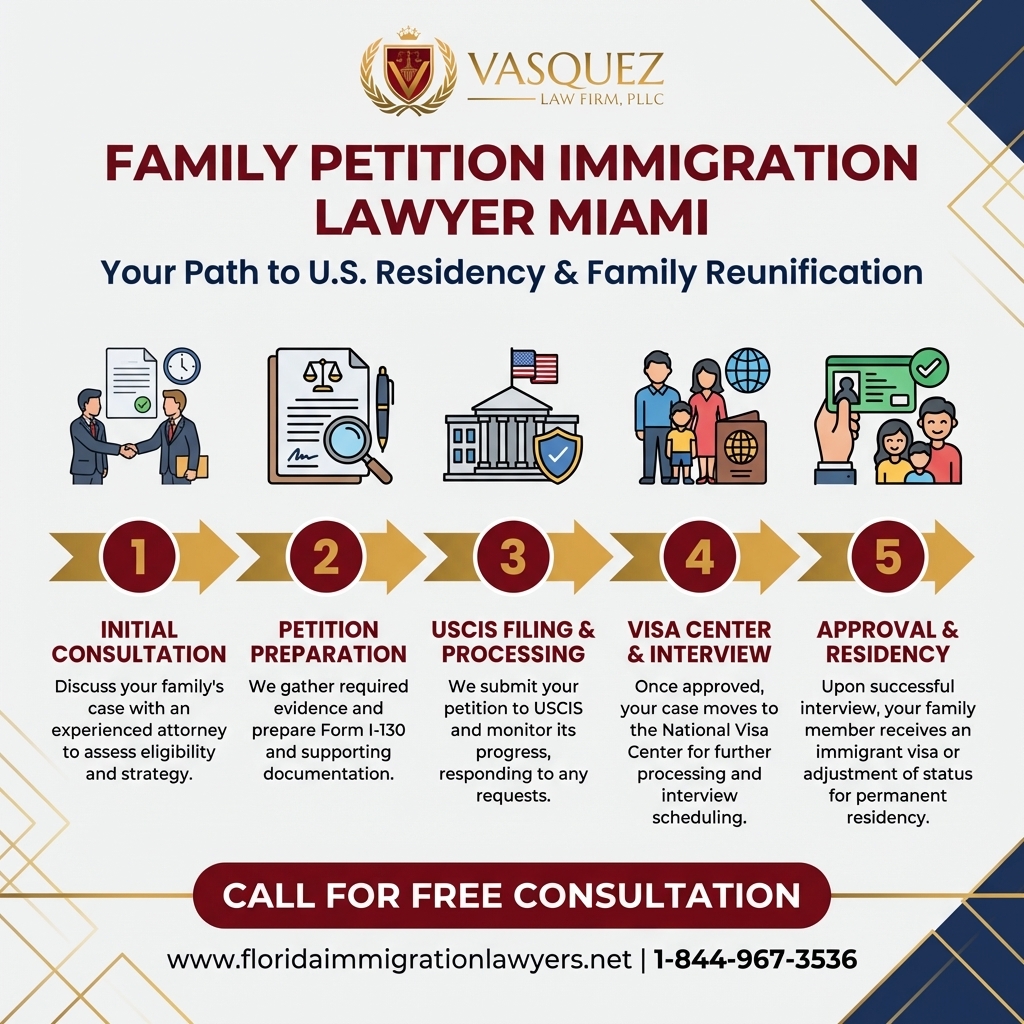
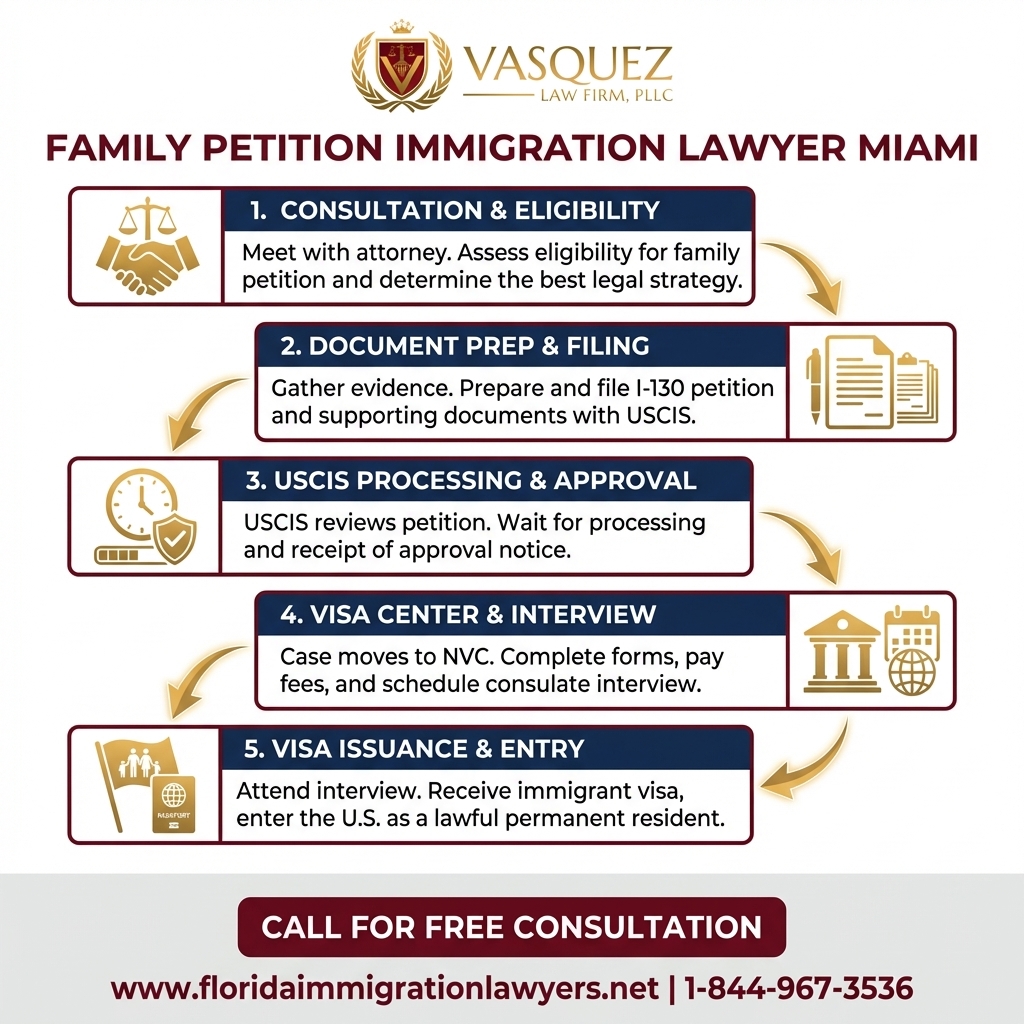
Step-by-Step Guide to Filing an I-130
- Determine Eligibility: Ensure you are eligible to file the I-130 for your relative.
- Gather Required Documents: Collect necessary documents such as birth certificates and proof of relationship.
- Complete the I-130 Form: Fill out the form accurately to avoid delays.
- Submit the Petition: File the form with the USCIS and pay the applicable fee.
- Await USCIS Decision: Wait for the USCIS to process your petition.
Before initiating the I-130 process, it's crucial to confirm that both the petitioner and the beneficiary meet the USCIS eligibility requirements. As the petitioner, you must be a U.S. citizen or a lawful permanent resident (green card holder). The relationship you are petitioning for must also be recognized by immigration law. For example, a U.S. citizen can petition for a spouse, children, parents, and siblings, while a lawful permanent resident can only petition for spouses and unmarried children. Understanding these distinctions is the very first step in avoiding unnecessary delays.
A common scenario involves U.S. citizens petitioning for their parents. If the U.S. citizen is over 21 years old, they can file an I-130 for their mother and father. However, if the U.S. citizen is under 21, they cannot petition for their parents until they reach the age of majority. Similarly, for siblings, both the U.S. citizen petitioner and the sibling beneficiary must share at least one common parent. Florida Immigration Lawyers can help you meticulously review your specific situation to confirm eligibility and identify the correct visa category, preventing potential issues down the line.
The success of your I-130 petition heavily relies on the completeness and accuracy of your supporting documentation. This typically includes proof of your U.S. citizenship or lawful permanent residency (e.g., U.S. birth certificate, naturalization certificate, passport, or green card), and robust evidence of the qualifying relationship. For spousal petitions, this means marriage certificates, joint financial documents, shared property, and affidavits from friends and family. For parent-child relationships, birth certificates linking the petitioner and beneficiary are paramount.
It's not enough to simply collect documents; they must be correctly formatted and, if not in English, accompanied by certified translations. USCIS is very particular about documentation, and any missing or incorrect paperwork will result in a Request for Evidence (RFE), significantly prolonging the process. As a practical tip, create a checklist and organize all documents systematically. Our team at Florida Immigration Lawyers excels at helping clients compile comprehensive and persuasive evidence packages, significantly reducing the risk of RFEs and ensuring a smoother application process.
The I-130 form itself is a detailed document that requires precise information about both the petitioner and the beneficiary. Every question must be answered truthfully and completely. Even minor discrepancies or omissions can lead to scrutiny, delays, or even denial. For instance, ensuring that names, dates of birth, and places of birth match exactly across all submitted documents is critical. If there are any variations, providing explanations and supporting evidence for those variations is necessary.
It's vital to pay close attention to sections regarding previous marriages, immigration history, and any criminal records, as these areas often lead to complications if not addressed properly. While the form appears straightforward, the legal implications of each answer are profound. Many individuals find the task overwhelming, which is where the expertise of Florida Immigration Lawyers becomes invaluable. We meticulously review each section of your I-130 form, ensuring all information is accurate, consistent, and strategically presented to support your petition.
Once the I-130 form is completed and all supporting documents are compiled, the next step is to submit the entire package to the correct USCIS service center. The filing fee must also be included, typically in the form of a check or money order made payable to the "U.S. Department of Homeland Security." It's essential to verify the current filing fee on the USCIS website, as fees can change. Improper payment or submission to the wrong address will result in the return of your petition, causing significant delays.
After submission, you will receive a receipt notice (Form I-797C, Notice of Action) from USCIS, confirming that they have received your petition. This notice will contain your receipt number, which is crucial for tracking the status of your case online. Keep this document safe. Florida Immigration Lawyers assist clients in preparing the complete filing package, ensuring it is correctly addressed and includes all necessary components, thereby streamlining the submission process and preventing initial administrative hurdles.
After submission, the waiting period can be the most anxious part of the process. USCIS will review your petition, conduct background checks, and may issue a Request for Evidence (RFE) if they require further information or clarification. Responding to an RFE promptly and comprehensively is critical, as failure to do so can lead to a denial. If the petition is approved, USCIS will send an approval notice (Form I-797, Notice of Action).
The approval of an I-130 petition is a significant milestone, but it is not the final step towards obtaining a green card. For immediate relatives, the next step is typically adjustment of status (if in the U.S.) or consular processing (if abroad). For family preference categories, the approved petition places the beneficiary in a queue, and they must wait for a visa to become available according to the Visa Bulletin. Throughout this waiting period, Florida Immigration Lawyers provides continuous support, helping clients understand each communication from USCIS and guiding them through the subsequent steps, including preparing for interviews and further applications.
Document Checklist for Family Petition
- Proof of U.S. citizenship or permanent residency
- Birth certificates
- Marriage certificates
- Evidence of relationship (photos, communication records)
Beyond the basic documents,
Do Not Navigate This Process Alone
Our experienced immigration attorneys are ready to fight for you. Get a free, confidential consultation today.
Se Habla Español
Frequently Asked Questions

William J. Vásquez
Founding Attorney · Vasquez Law Firm
U.S. Air Force veteran and immigration attorney with thousands of cases resolved. J.D., NCCU School of Law. AILA member. Admitted to the 4th, 5th, and 11th Circuit Courts.
Available 24/7 - Free Evaluations
Related Legal Services
Our Florida immigration attorneys can help you with experienced immigration attorneys, business immigration and asylum protection. Call today at 1-844-967-3536 for a free consultation.
Related Links
Related Topics
Free Legal Consultation
Discuss your case with our experienced attorneys. We're available 24/7.
Se Habla Español - Estamos aquí para ayudarle.
Related Articles
Understanding the Asylum One-Year Deadline in Florida
The asylum one-year filing deadline is critical for those seeking refuge in the U.S. Understanding exceptions and preparing your application carefully can influence the outcome of your asylum case. Contact Florida Immigration Lawyers for expert guidance.
Citizenship Application Delay in Florida: What to Know
Facing citizenship application delays in Florida? Discover the key reasons behind N-400 processing backlogs in 2026 and learn how to navigate them effectively. Whether you're in Homestead or elsewhere in Florida, our guide provides actionable insights and tips to help manage your citizenship journey. Contact Florida Immigration Lawyers for personalized support.
F-1 Reinstatement Student Visa Process in Florida | VLF Florida
F-1 reinstatement allows students in Coral Springs, Florida, to regain their student visa status if they have fallen out of status. This comprehensive guide covers eligibility, application steps, and common pitfalls, ensuring you are well-prepared. Contact Florida Immigration Lawyers at 1-844-967-3536 for a free consultation.
U Visa for Crime Victims in Florida: Key Insights | VLF Florida
Discover how the U Visa offers critical immigration relief for crime victims in Florida. Learn about eligibility, application steps, and why professional guidance is crucial. Call Florida Immigration Lawyers for expert assistance.