Applying for Citizenship: Father's Family Petitions
For those who have decided to apply for citizenship through their father's family, understanding the family petition process is the critical first step. This guide covers the Form I-130, Petition for Alien Relative, which establishes the necessary family relationship, and the subsequent path to a green card and eventual naturalization. We delve into specific requirements for father-child petitions, including proof of paternity and legitimation, document checklists, and current processing times and costs as of 2026. Navigating USCIS procedures in Florida, especially through the Orlando field office, can be complex. This article also highlights common mistakes to avoid and explains when to seek the expert guidance of an immigration lawyer to ensure a smooth and successful application. Florida Immigration Lawyers is ready to assist you with a free case review.
For individuals who have decided to apply for citizenship through their father's family, the process typically begins with a U.S. citizen or lawful permanent resident (LPR) father filing Form I-130, Petition for Alien Relative, on behalf of their child. This establishes the family relationship. Once approved, the child can then apply for a green card through adjustment of status (if in the U.S.) or consular processing (if abroad). After meeting residency and other naturalization requirements, usually five years with a green card, they can then apply for U.S. citizenship. Navigating this path in Florida requires careful attention to USCIS guidelines and often benefits from legal guidance.
- An I-130 petition is the first step for family-based immigration.
- Paternity and legitimation proof are crucial for father's petitions.
- The process leads to a green card, then potential citizenship after residency.
- Florida immigration lawyers can guide you through local USCIS procedures.
- Timelines and costs vary, making professional advice invaluable.
Deciding to apply for U.S. citizenship is a momentous step, often driven by the desire to unite or solidify a family's future in America. For many, this journey begins with a family petition, specifically when a father seeks to sponsor a child or when an adult child decides to pursue citizenship through their paternal lineage. The process can seem complex, involving multiple forms, strict deadlines, and specific eligibility criteria set forth by U.S. Citizenship and Immigration Services (USCIS). In Florida, a state with a vibrant and diverse immigrant community, understanding the nuances of these family-based petitions is critical for success.
This comprehensive guide from Florida Immigration Lawyers will walk you through the intricacies of the family petition process, focusing on scenarios involving a father's family. We'll cover everything from the initial Form I-130 filing to the final steps toward naturalization, highlighting key requirements, processing times, and potential challenges. Our goal is to provide clear, actionable information to help you navigate this significant journey, ensuring you understand each phase. If you're considering applying for citizenship through your father's family in Florida, you don't have to face it alone. Call Florida Immigration Lawyers at 1-844-YO-PELEO for a free case review today and let us help you achieve your American dream.
What is a Family Petition (Form I-130) and Who Can File It?
A Family Petition, specifically Form I-130, Petition for Alien Relative, is the foundational document used by a U.S. citizen or lawful permanent resident (LPR) to establish a qualifying relationship with an eligible foreign national relative who wishes to immigrate to the United States. This form is the crucial first step in most family-based immigration processes, serving to prove the familial bond between the petitioner and the beneficiary to USCIS. Without an approved I-130, the path to a green card and eventual citizenship through family sponsorship cannot proceed.
The I-130 form initiates the immigration process by formally requesting USCIS to recognize the relationship. A U.S. citizen can petition for immediate relatives (spouses, unmarried children under 21, and parents) and preference relatives (unmarried sons/daughters over 21, married sons/daughters of any age, and brothers/sisters). LPRs can petition for spouses and unmarried children of any age. For a father's family petition, this typically involves a U.S. citizen or LPR father petitioning for his child, or an adult U.S. citizen child petitioning for his or her father. Proving the relationship, especially paternity and legitimation, is paramount. This can involve birth certificates, marriage certificates, and sometimes DNA evidence, as outlined in the Immigration and Nationality Act (INA) sections 201 and 203. The Florida Immigration Lawyers team has extensive experience with family immigration matters, ensuring all necessary documentation is meticulously prepared to establish the bona fide relationship.
In cases where the father is petitioning for a child, it is essential to demonstrate not only the biological relationship but also, if applicable, the legal legitimation of the child under the laws of the child's residence or domicile, or under the laws of the father's residence or domicile. This is particularly relevant if the child was born out of wedlock. USCIS scrutinizes these details carefully to prevent fraud and ensure that only legitimate family relationships are honored for immigration purposes. Our firm assists clients throughout Central Florida, including Orlando, in gathering robust evidence to support these critical aspects of their petition, helping to prevent delays or requests for additional evidence (RFEs) from the USCIS Field Office in Orlando or other processing centers.
How Does a Father's Family Petition Lead to Citizenship in Florida?
A father's family petition leads to citizenship through a multi-stage process: first, the I-130 approval establishes eligibility for a green card, which is then obtained via adjustment of status or consular processing. After holding a green card for typically five years and meeting other statutory requirements, the individual can apply for naturalization, thereby becoming a U.S. citizen.
The journey from an approved I-130 petition to U.S. citizenship is a structured pathway. Once the Form I-130 filed by the father is approved, the beneficiary child becomes eligible to apply for a green card. If the beneficiary is already in the United States and meets eligibility requirements, they can file Form I-485, Application to Adjust Status, with USCIS. This application allows them to obtain lawful permanent residency without leaving the country. For those outside the U.S., the process involves consular processing through the National Visa Center (NVC) and a U.S. embassy or consulate abroad. This typically involves an interview at the embassy in their home country. Florida residents often interact with USCIS field offices in Orlando, Miami, or Tampa for adjustment of status interviews or biometrics appointments.
After obtaining a green card, the path to citizenship, known as naturalization, typically requires the individual to be a lawful permanent resident for at least five years (or three years if married to a U.S. citizen and meeting other criteria). During this period, the applicant must demonstrate continuous residency, physical presence in the U.S., good moral character, and an understanding of English and U.S. civics. The final step is filing Form N-400, Application for Naturalization, and attending an interview and oath ceremony. As of 2026, USCIS processing times can vary, but thorough preparation is key. Florida Immigration Lawyers guides clients through each stage, from initial family petition to the final citizenship application, ensuring compliance with all requirements. For up-to-date information on visa availability and processing, applicants may consult the U.S. Department of State's Visa Bulletin.
Below is a typical timeline for the overall process:
| Stage | Typical Timeframe | Notes |
|---|---|---|
| I-130 Petition Filing & Approval | 6-24 months (varies by relationship/USCIS office) | Establishes family relationship. Immediate relatives generally faster. |
| National Visa Center (NVC) Processing (if applicable) | 3-6 months | For consular processing cases, document collection and fee payment. |
| Adjustment of Status (I-485) or Consular Interview | 6-36 months (varies by office/backlog) | Final step to obtain a green card. Includes biometrics, interviews. |
| Conditional Green Card (if applicable) | 2 years | For certain marriage-based cases, requires I-751 petition to remove conditions. |
| Permanent Green Card Holder | 3-5 years | Period required before eligibility for naturalization. |
| N-400 Naturalization Application | 6-18 months | Application to become a U.S. citizen. Includes interview and civics test. |
What Documents are Required for a Family Petition (I-130) and Adjustment of Status?
For a family petition (I-130) and subsequent adjustment of status (I-485), a comprehensive set of documents is required to prove identity, relationship, eligibility, and financial support. These typically include birth certificates, marriage certificates, proof of the petitioner's U.S. citizenship or LPR status, and financial affidavits.
The success of a family petition hinges on the thoroughness and accuracy of the submitted documentation. For the initial I-130 petition, key documents include: proof of the petitioner's U.S. citizenship or green card (e.g., birth certificate, naturalization certificate, passport, green card copy); the beneficiary's birth certificate; and if applicable, a marriage certificate for the petitioner and their spouse (if petitioning for a spouse). For father-child petitions, specific emphasis is placed on establishing paternity and, if necessary, the child's legitimation. This may require birth certificates listing the father, marriage certificates of the parents, evidence of the relationship prior to the child's 18th birthday, or even DNA test results if other evidence is insufficient or unavailable. All foreign-language documents must be accompanied by certified English translations.
Once the I-130 is approved and the visa becomes available, the adjustment of status (I-485) phase requires an even broader array of documents. This includes: Form I-485 itself; medical examination results (Form I-693); Form I-864, Affidavit of Support, from the petitioner (and potentially a joint sponsor), along with supporting financial documentation like tax returns and employment letters; police clearances from any country lived in for more than six months since age 16; copies of all previous immigration forms, visas, and entry/exit records; and passport-style photos. Applicants must also provide evidence of good moral character. USCIS, in accordance with 8 CFR 204.1, mandates specific evidence for each relationship category. An experienced attorney from Florida Immigration Lawyers can help you compile this extensive list, ensuring no critical document is overlooked and that all submissions meet USCIS standards, particularly important when dealing with the Orlando USCIS Field Office.
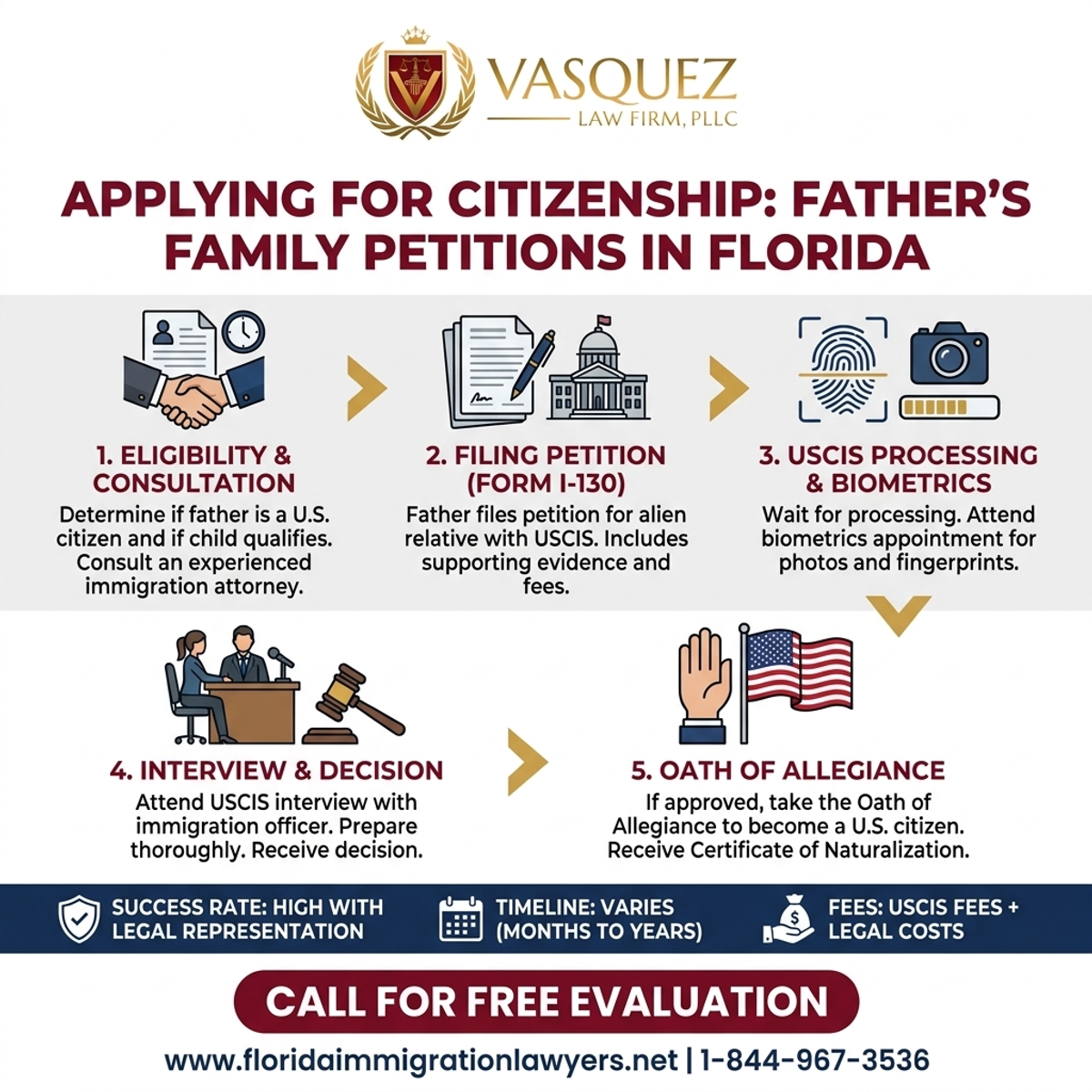
Step-by-Step Process — Applying for Citizenship: Father's Family Petitions in Florida
- Petitioner's proof of U.S. citizenship or LPR status (e.g., birth certificate, passport, naturalization certificate, green card).
- Beneficiary's birth certificate (original or certified copy, with certified English translation if applicable).
- Marriage certificates (if applicable, for both petitioner and beneficiary).
- Proof of termination of prior marriages (e.g., divorce decrees, death certificates).
- Proof of paternity and legitimation (for father-child petitions, especially if child born out of wedlock).
- Passport-style photographs of both petitioner and beneficiary.
- Form I-864, Affidavit of Support, with supporting financial documents (tax returns, employment verification).
- Medical examination results (Form I-693) from a USCIS-approved civil surgeon.
- Police certificates from home country and any country lived in for more than 6 months since age 16.
- Copy of beneficiary's passport, visa, and I-94 arrival/departure record.
- Evidence of good moral character (e.g., no criminal record).
- Any relevant court records (e.g., for prior arrests, convictions, or immigration proceedings).
What Are the Current Processing Times and Costs for Family Petitions in 2026?
As of 2026, processing times for family petitions and subsequent green card applications vary significantly based on the relationship category, the specific USCIS service center or field office, and the country of origin, ranging from several months to many years. Costs typically involve USCIS filing fees for various forms, medical exam fees, and optional attorney fees, which can accumulate to thousands of dollars.
The financial aspect of pursuing a family petition and eventual citizenship can be substantial, encompassing various government filing fees and professional legal services. While specific fee amounts are subject to change by USCIS, it's crucial to budget for them. As of 2026, common fees include those for Form I-130, Form I-485 (if adjusting status), biometrics services, and Form N-400 for naturalization. Additionally, a mandatory medical examination by a USCIS-approved civil surgeon incurs its own cost, which varies by provider. For those undergoing consular processing, there are also National Visa Center (NVC) fees and potentially fees at the U.S. embassy or consulate.
Beyond government fees, many individuals choose to hire an immigration lawyer to navigate the complex process. Attorney fees vary based on the complexity of the case, the services required, and the firm's experience. While an optional expense, legal representation can be invaluable in ensuring proper documentation, timely submissions, and effective responses to USCIS inquiries, potentially saving time and preventing costly errors. At Florida Immigration Lawyers, we offer transparent fee structures and free case reviews to help you understand the financial commitment. Our services extend throughout Central Florida, including Orlando, providing expert guidance for your family petition. Timelines are highly variable, with immediate relative petitions generally being faster than preference categories due to visa quota limitations. The USCIS website provides estimated processing times by form and field office, which should be checked regularly.
Here's a general overview of typical cost factors:
| Item | Typical Fee | Notes |
|---|---|---|
| Form I-130 (Petition for Alien Relative) | USCIS Fee (Varies) | Required to establish relationship. |
| Form I-485 (Application to Adjust Status) | USCIS Fee (Varies) | For beneficiaries already in the U.S. Includes biometrics. |
| Form I-864 (Affidavit of Support) | No separate USCIS fee | Required for financial sponsorship, but may incur notary/copy costs. |
| Medical Examination (Form I-693) | Varies by civil surgeon | Mandatory for adjustment of status. |
| National Visa Center (NVC) Processing Fees | Varies (per form/person) | For consular processing cases. |
| Form N-400 (Application for Naturalization) | USCIS Fee (Varies) | Final step for U.S. citizenship. Includes biometrics. |
| Immigration Attorney Fees | Varies by case complexity/firm | Optional but highly recommended for expert guidance. |
Navigating Complex Family Immigration Cases with an Orlando Immigration Lawyer
Complex family immigration cases often involve intricate legal challenges that can significantly delay or even jeopardize an application. These complexities can stem from various issues, such as prior immigration violations, criminal records, misrepresentations on previous forms, or complicated family structures. Navigating these scenarios requires a deep understanding of immigration law, including waivers and exceptions, which an experienced Orlando immigration lawyer can provide.
For individuals in Central Florida, an immigration attorney from Florida Immigration Lawyers is an invaluable asset when facing such challenges. We have extensive experience dealing with cases involving denials, requests for evidence (RFEs), or notices of intent to deny (NOIDs) from the USCIS Field Office in Orlando. For instance, if a father's family petition involves a child with a past deportation order or a criminal conviction, specific waivers may be available, but they require precise legal arguments and substantial supporting evidence. Our team understands the nuances of these waivers, such as Form I-601, Application for Waiver of Grounds of Inadmissibility, and can strategically prepare your case.
Furthermore, an Orlando immigration lawyer can represent you in immigration court if your case involves deportation defense or appeals before the Executive Office for Immigration Review (EOIR), such as the Miami Immigration Court. This is particularly relevant if there are issues of inadmissibility or deportability that arise during the green card or naturalization process. We provide comprehensive legal support, from initial consultation to representation at interviews and hearings, ensuring your rights are protected and your case is presented effectively. Our firm is dedicated to serving all of Florida, offering personalized strategies for even the most challenging family immigration situations, including those where a father's family petition faces unique hurdles. Don't let complexity deter you from your goal; seek professional legal assistance.
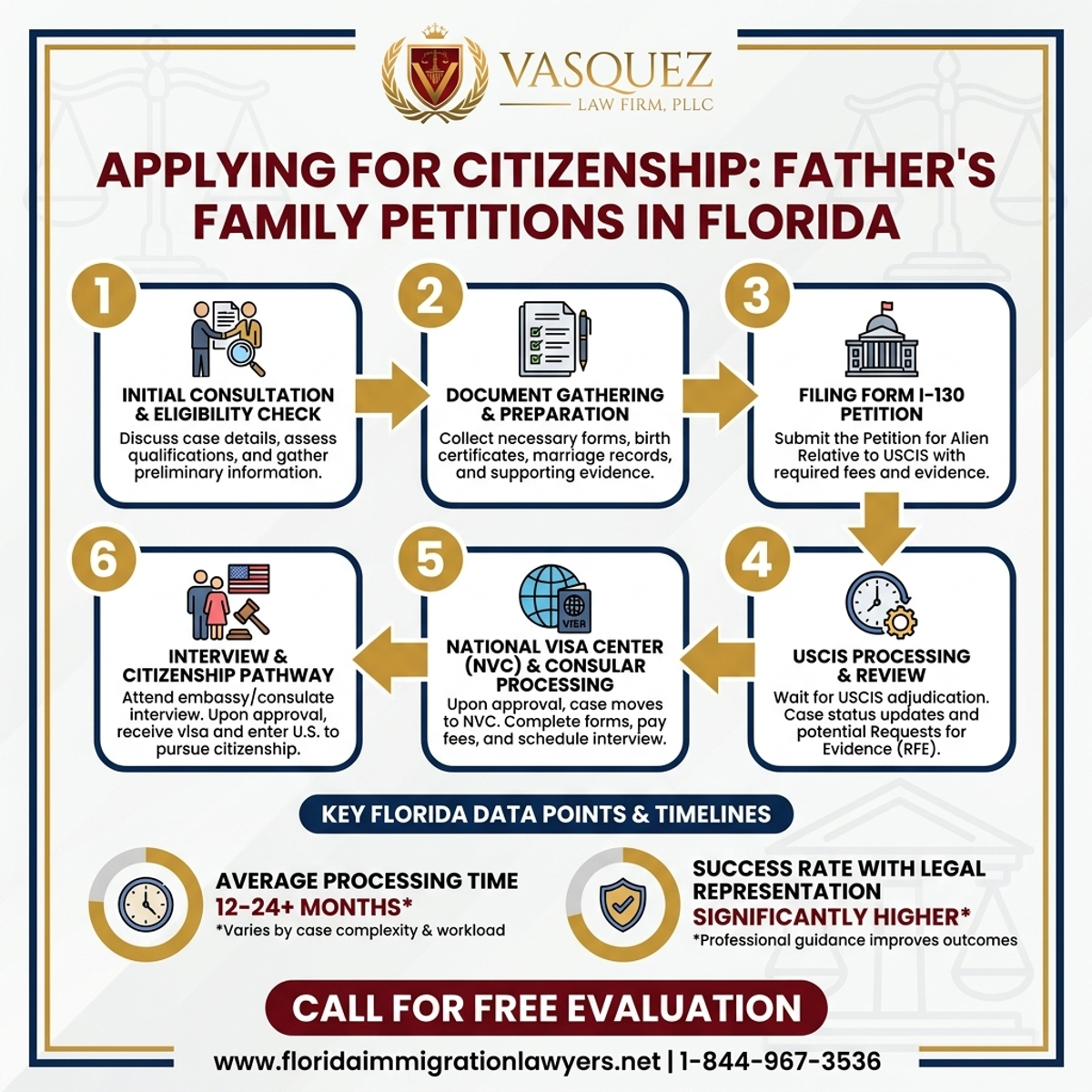
Key Statistics — Applying for Citizenship: Father's Family Petitions in Florida
Do not navigate this process alone. Contact Florida Immigration Lawyers today for expert guidance.
Common Mistakes to Avoid in Family Petitions
The family petition process is fraught with potential pitfalls that can lead to significant delays, denials, or even more serious immigration consequences. Avoiding these common mistakes is crucial for a successful outcome.
- Incomplete or Incorrect Forms: Submitting forms with missing information or errors is a leading cause of RFEs and delays. Ensure every field is accurately filled and all questions are answered truthfully.
- Missing or Insufficient Documentation: Failing to include all required supporting documents, such as birth certificates, marriage licenses, or proof of paternity/legitimation, will halt your application. Always provide certified copies and English translations.
- Ignoring Financial Sponsorship Requirements: The Affidavit of Support (Form I-864) is critical. Not meeting the income threshold or failing to provide sufficient financial evidence can lead to inadmissibility.
- Failing to Disclose All Information: Omitting details about prior arrests, immigration violations, or marriages, even if seemingly minor, can be considered misrepresentation and result in a permanent bar from the U.S. Honesty is paramount.
- Missing Deadlines: USCIS and NVC provide strict deadlines for responding to RFEs or submitting documents. Missing these can lead to the denial of your petition without further consideration.
- Not Updating Address with USCIS: If you move, you must notify USCIS within 10 days using Form AR-11. Failure to do so can result in missed notices, interviews, or even deportation proceedings.
- Assuming Automatic Eligibility: Eligibility for a green card or citizenship is not guaranteed even with an approved I-130. Various factors, including criminal history or past immigration fraud, can render a beneficiary inadmissible.
- Incorrectly Establishing Paternity/Legitimation: For father-child petitions, especially for children born outside of marriage, correctly proving the legal relationship is often complex and requires specific evidence.
- Failing to Prepare for Interviews: Both adjustment of status and naturalization interviews require thorough preparation. Not being able to answer questions about your application or relationship accurately can lead to issues.
- Not Seeking Legal Counsel: Attempting to navigate complex immigration laws without an attorney can be a costly mistake. An attorney can identify potential issues, prepare strong arguments, and ensure compliance.
When to Call a Lawyer for Your Family Petition
While some straightforward family petitions might be manageable for individuals, many situations warrant the expertise of an immigration lawyer. You should consider contacting an attorney if your case involves any complexities or if you feel overwhelmed by the process. An experienced lawyer can provide invaluable guidance, reduce stress, and significantly improve your chances of a successful outcome.
Specifically, you should call Florida Immigration Lawyers if you encounter any of the following scenarios: you or your family member has a criminal record, prior immigration violations, or a history of deportation; if you've previously been denied a visa or green card; if you're concerned about proving paternity or legitimation, especially for children born out of wedlock or in non-traditional family structures; if you have concerns about meeting financial sponsorship requirements; or if you've received a Request for Evidence (RFE) or Notice of Intent to Deny (NOID) from USCIS. Our team also assists with asylum claims and business immigration, demonstrating our broad expertise.
Furthermore, if there are language barriers, if you need to appeal a decision, or if you simply want peace of mind knowing your application is meticulously prepared and strategically presented, legal counsel is advisable. Our attorneys at Florida Immigration Lawyers understand the specific requirements of the USCIS Field Office in Orlando and the broader immigration landscape in Florida. We offer comprehensive support, from preparing and filing all necessary forms to representing you in interviews or immigration court. Don't wait for a problem to arise; proactive legal advice can prevent many common pitfalls. We are here to help you navigate your father's family petition and the path to citizenship with confidence.
About Florida Immigration Lawyers
Florida Immigration Lawyers is a leading immigration law firm dedicated to serving individuals and families across the entire state of Florida. With a deep understanding of U.S. immigration law and a commitment to our clients, we provide compassionate, effective, and personalized legal representation for a wide range of immigration matters. Our experienced attorneys specialize in family petitions, citizenship and naturalization, deportation defense, asylum, and business immigration, among other crucial areas.
We pride ourselves on our client-focused approach, ensuring that every individual receives the attention and strategic counsel their unique case demands. Our firm is available 24/7 to address your urgent immigration needs, and we offer free case reviews to help you understand your options without financial commitment. We are proud to offer bilingual services, with a dedicated team ready to assist clients in both English and Spanish. Whether you are in Orlando or anywhere else in Central Florida, our goal is to simplify complex legal processes and achieve the best possible outcomes for your immigration journey. Contact Florida Immigration Lawyers today to schedule your free consultation and discover how our expertise can make a difference in your case. Your future in the U.S. is our priority.
Sources and References
- U.S. Citizenship and Immigration Services (USCIS)
- Executive Office for Immigration Review (EOIR)
- U.S. Department of State
- 8 U.S.C. Chapter 12 - Immigration and Nationality Act (INA)
- 8 CFR 204.1 - Petitions
- INA Section 201 - Immediate Relatives
- INA Section 203 - Preference Categories
Related services: family-based green cards, fiancé visa (K-1), marriage-based immigration.
This article provides general legal information and is not intended as legal advice. Every case is unique, and outcomes depend on specific facts and circumstances. Contact an attorney for advice about your particular situation.
Ready to take the next step in your family's immigration journey? Don't leave your future to chance. Contact Florida Immigration Lawyers today at 1-844-YO-PELEO for a free, no-obligation case review. Se Habla Español - Estamos aqui para ayudarle.
Do Not Navigate This Process Alone
Our experienced immigration attorneys are ready to fight for you. Get a free, confidential case review today.
Se Habla Español
Or leave your details and we’ll call you:
Free Evaluation in 24 Hours
Or talk to us right now

AI voice assistant — available 24/7
FreeFrequently Asked Questions

William J. Vásquez
Founding Attorney · Vasquez Law Firm
U.S. Air Force veteran and immigration attorney with years of hands-on U.S. immigration experience. J.D., NCCU School of Law. AILA member. Admitted to the 4th, 5th, and 11th Circuit Courts.
Available 24/7 - Free Evaluations
Reviewed for legal accuracy by William J. Vásquez
Licensed in North Carolina; U.S. immigration is federal practice.
Related Legal Services
Our Florida immigration attorneys can help you with family immigration services, immigration lawyer cost in Florida and experienced immigration attorneys. Call today at 1-844-YO-PELEO for a free case review.
Related Links
Related Topics
Free Legal Case Review
Discuss your case with our experienced attorneys. We're available 24/7.
Se Habla Español - Estamos aquí para ayudarle.
Related Articles
DUI Immigration Consequences in Florida 2026
A DUI conviction in Florida can have severe immigration consequences, potentially leading to inadmissibility, deportation, or denial of immigration benefits. For non-citizens, a DUI is not just a traffic offense but a serious criminal matter that federal immigration law scrutinizes closely. Factors like multiple offenses, injury, or property damage can escalate a simple DUI to a Crime Involving Moral Turpitude (CIMT) or even an aggravated felony, triggering mandatory detention and removal proceedings. Understanding the specific nature of your Florida conviction and its interpretation under the Immigration and Nationality Act (INA) is crucial. This article outlines how DUIs impact immigration status, the grounds for inadmissibility and deportation, a step-by-step guide to navigating the process, essential documentation, and expected timelines for 2026. We also highlight common mistakes to avoid and when to seek legal counsel from an experienced immigration attorney. Florida Immigration Lawyers offers comprehensive support for individuals facing these challenging situations, providing expert guidance through complex legal landscapes.
Dual Citizenship Lawyer in Florida: What You Need to Know
For Florida residents, the concept of dual citizenship, or holding two passports, offers a compelling blend of opportunities and challenges. While the U.S. generally permits dual nationality, the path to achieving this status requires a meticulous understanding of both U.S. immigration laws and the citizenship policies of your country of origin. This guide explores the definition of dual citizenship, the detailed step-by-step process for U.S. naturalization, and the significant benefits and potential pitfalls involved. We cover essential documentation, typical timelines, and cost considerations for 2026, providing crucial insights for anyone in Orlando, Miami, or across Florida considering this important legal step. Learn about common mistakes to avoid and understand when to seek professional legal counsel to navigate this complex process successfully. Florida Immigration Lawyers is here to provide expert, bilingual support for your dual citizenship journey.
Immigration Lawyer Orlando Free Consultation in Florida
For individuals and families in Orlando, Florida, navigating the complexities of U.S. immigration law requires expert guidance. An immigration lawyer in Orlando offers crucial support for everything from visa applications and green card processes to naturalization and deportation defense. This comprehensive guide details what a free consultation covers, providing a step-by-step overview of immigration pathways, essential document checklists, and expected timelines in 2026. We also highlight common mistakes to avoid, discuss the critical role of legal counsel in deportation and asylum cases, and explain why choosing a local Orlando immigration attorney is beneficial. Florida Immigration Lawyers is dedicated to serving the diverse community of Orlando with compassionate, effective legal solutions, ensuring you receive personalized advice and robust representation for a successful immigration journey.
EAD Advance Parole Combo Card in Florida: What You Need
An EAD advance parole combo card allows individuals with pending adjustment applications to both work and travel abroad without jeopardizing their green card application. Learn how to apply in Florida, what documents you need, and common mistakes to avoid.