F-1 Visa Florida Universities: Your Guide to Study in Naples
Dreaming of higher education in Florida? Our guide details the F-1 visa process for international students seeking to study at Florida universities, including those in Naples. From understanding eligibility and securing your Form I-20 to preparing for your visa interview and maintaining your student status, we cover every essential step. Learn about document requirements, timeline expectations, and common pitfalls to avoid. Florida Immigration Lawyers provides expert assistance, ensuring you navigate this journey with confidence. Discover how to achieve your academic goals in the Sunshine State with proper legal guidance. Contact us for a free consultation.

An F-1 visa is a non-immigrant visa for individuals wishing to pursue academic studies or language training programs in the United States. For prospective international students eyeing Florida universities, securing an F-1 visa is a crucial step. This visa allows you to live and study in Florida, including vibrant cities like Naples, while maintaining your legal status. It requires acceptance into a SEVP-approved school, proof of financial resources, and an intent to return to your home country.
- Secure acceptance from a SEVP-approved Florida institution.
- Obtain your Form I-20, Certificate of Eligibility for Nonimmigrant Student Status.
- Pay the SEVIS I-901 fee and complete the DS-160 online visa application.
- Attend your visa interview at a U.S. Embassy or Consulate abroad.
- Maintain full-time student status and comply with F-1 visa regulations.
Are you an aspiring international student with dreams of pursuing higher education in the Sunshine State? The prospect of studying at a renowned Florida university, perhaps in a beautiful city like Naples, can be incredibly exciting. However, navigating the complex process of obtaining an F-1 visa can feel overwhelming.
This comprehensive guide from Florida Immigration Lawyers is designed to demystify the F-1 student visa process specifically for those looking to study in Florida. We'll walk you through the essential steps, requirements, and crucial considerations to help you achieve your academic goals. Don't face this journey alone; expert legal guidance can make all the difference. Call Florida Immigration Lawyers at 1-844-967-3536 for a free consultation to discuss your F-1 visa application today.
Understanding the F-1 Student Visa for Florida Universities
The F-1 student visa is the most common non-immigrant visa for individuals who wish to study in the United States. It is specifically designed for international students enrolled in academic programs or English language programs at U.S. institutions approved by the Student and Exchange Visitor Program (SEVP). Florida boasts numerous such institutions, from large public universities to specialized private colleges.
For many international students, Florida offers an attractive destination due to its diverse economy, beautiful weather, and a wide array of top-tier educational institutions. Cities like Naples provide a high quality of life, access to excellent schools, and a welcoming community, making them ideal for those pursuing an education and cultural experience.
To be eligible for an F-1 visa, you must demonstrate several key intentions. You must plan to enter the U.S. solely for the purpose of studying, attend a SEVP-approved institution, and intend to depart the U.S. upon completion of your studies. Proving these intentions is a critical part of your visa application process.
What is an F-1 Visa?
An F-1 visa is a non-immigrant visa that allows foreign nationals to enter the United States to study full-time at a college, university, seminary, conservatory, academic high school, elementary school, or other academic institution, including a language training program. This visa category is governed by Section 101(a)(15)(F) of the Immigration and Nationality Act (INA), specifically INA 101(a)(15)(F)(i) for students and INA 101(a)(15)(F)(ii) for vocational students (M-1 visa).
The duration of your F-1 status is typically 'D/S' or 'Duration of Status,' meaning you can stay as long as you maintain your full-time student enrollment and comply with all visa regulations. This flexibility allows for completion of your academic program, including any authorized practical training like Optional Practical Training (OPT).
Why Choose a Florida University for Your F-1 Visa?
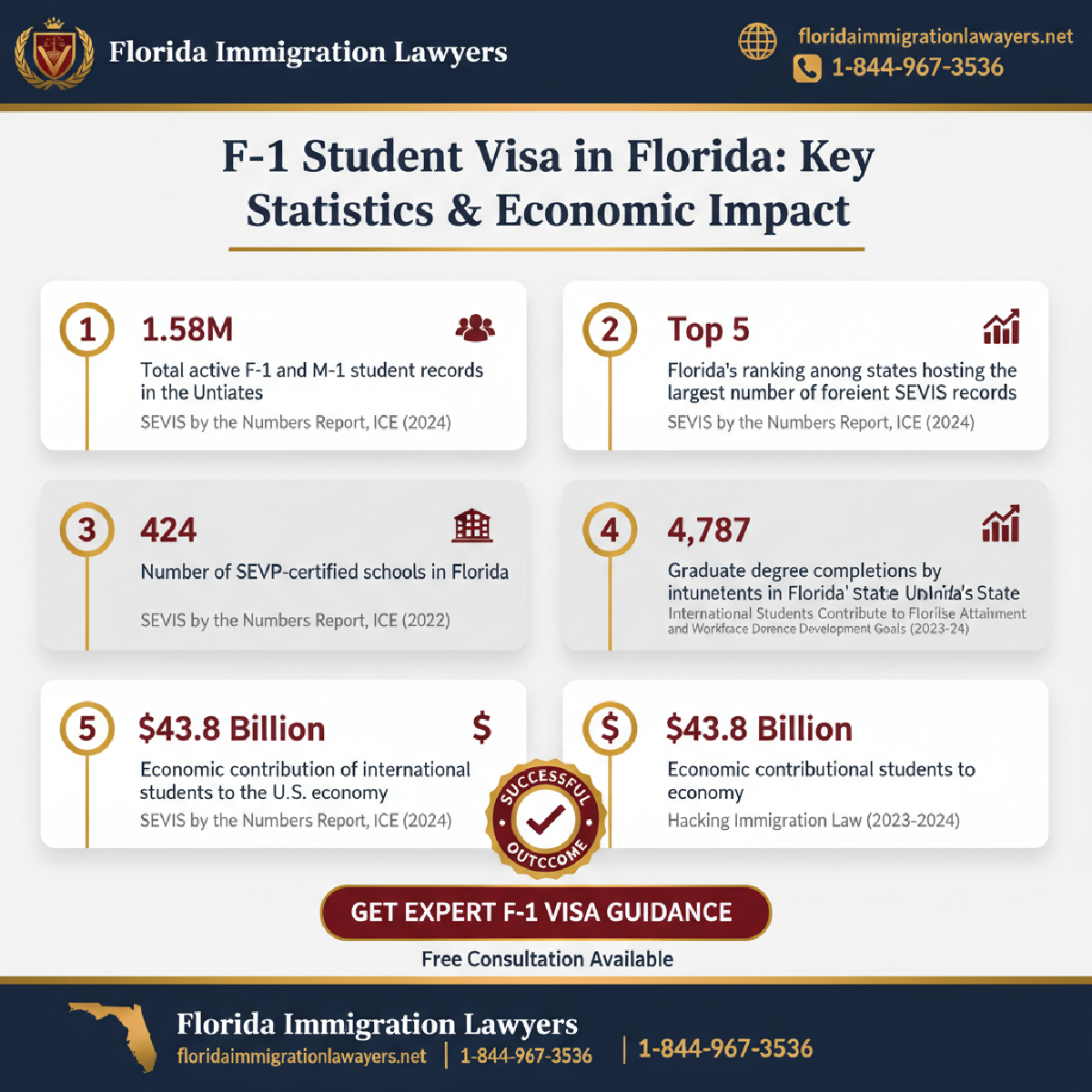
Florida is a popular choice for international students, with some of the largest universities hosting tens of thousands of students from around the globe. Institutions like the University of Florida, University of Central Florida, and Florida International University are consistently ranked among the best and attract a diverse student body. According to the Institute of International Education, Florida consistently ranks among the top states for international student enrollment.
Beyond academic excellence, Florida offers a unique lifestyle. Its vibrant culture, warm climate, and proximity to major attractions make it an appealing place to live and learn. For students in Naples, access to beautiful beaches, cultural events, and a growing job market post-graduation adds to the appeal. Many Florida universities also offer robust international student services, scholarships, and support networks.
Step-by-Step Guide to Obtaining Your F-1 Visa for Florida
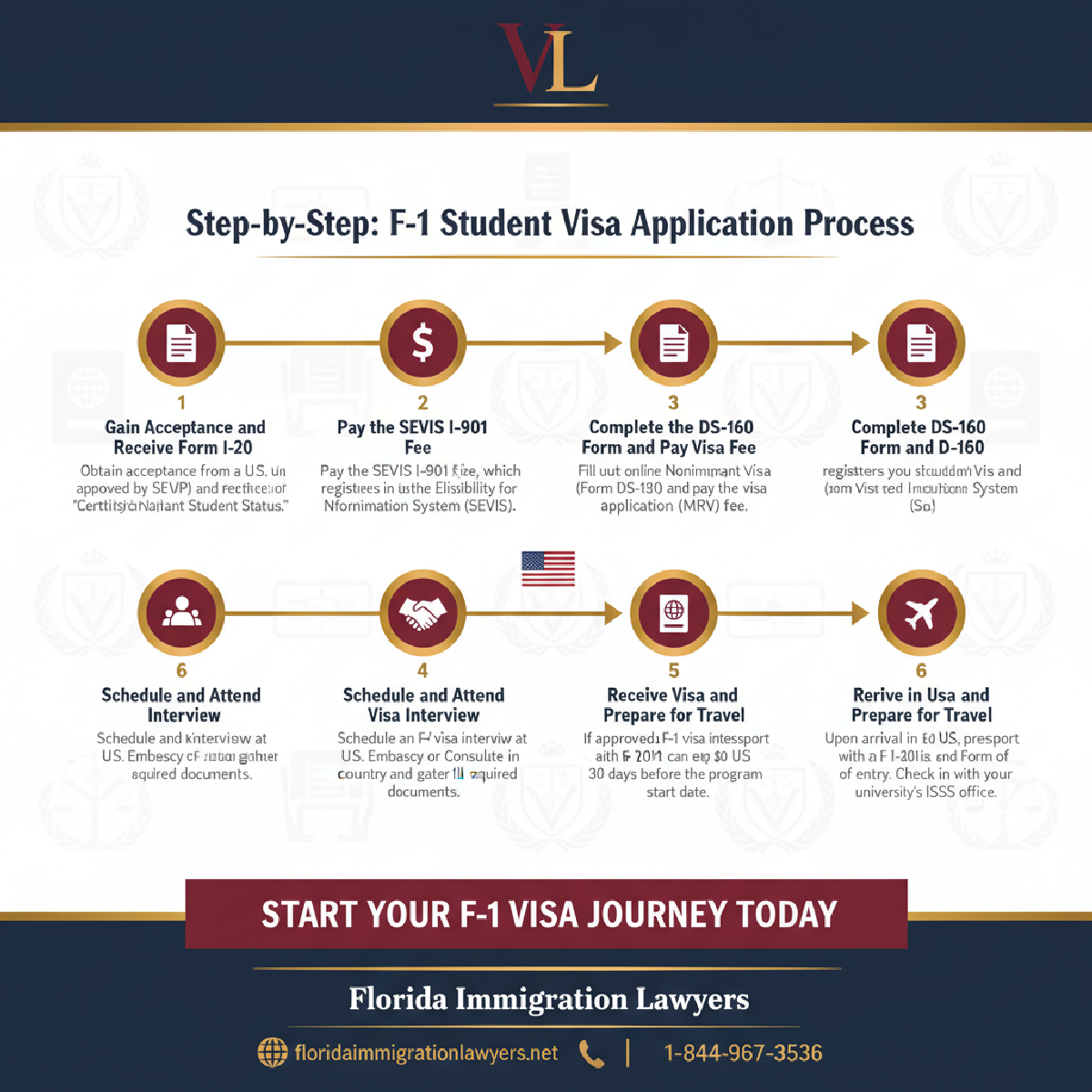
The path to securing an F-1 visa for a Florida university involves several critical steps. Each stage requires careful attention to detail and adherence to specific U.S. government regulations. Let's break down the process into manageable parts.
-
Gain Admission to a SEVP-Approved School in Florida: Your first step is to apply to and be accepted by a Student and Exchange Visitor Program (SEVP) approved school. Most accredited universities and colleges in Florida, including many near Naples, are SEVP-approved. Once accepted, the school will issue you a Form I-20, Certificate of Eligibility for Nonimmigrant Student Status. This document is crucial as it confirms your admission and eligibility for an F-1 visa.
-
Pay the SEVIS I-901 Fee: After receiving your Form I-20, you must pay the SEVIS I-901 fee. This fee supports the Student and Exchange Visitor Information System (SEVIS), which tracks F and M non-immigrant students and exchange visitors. You must pay this fee before your visa interview. The current fee can be found on the ICE SEVIS website.
-
Complete the Online Nonimmigrant Visa Application (DS-160): The DS-160 is an electronic application form for nonimmigrant visa applicants. You will need to complete this form accurately and thoroughly online. Ensure all information matches your passport and I-20. You can find the DS-160 form and instructions on the U.S. Department of State website.
-
Schedule and Attend Your Visa Interview: After submitting your DS-160 and paying the application fee, you will schedule an interview at a U.S. Embassy or Consulate in your home country. Prepare thoroughly for this interview by gathering all required documents and practicing your answers. The consular officer will assess your eligibility and your intent to return home after your studies, as per 8 CFR 214.2(f)(1)(i).
-
Receive Your F-1 Visa: If your interview is successful, the consular officer will approve your F-1 visa application. Your passport will be stamped with the F-1 visa, allowing you to travel to the United States. Remember, the visa allows entry; your I-20 dictates your permitted duration of stay and study.
-
Prepare for Arrival and Port of Entry: You can enter the U.S. up to 30 days before the start date on your Form I-20. At the Port of Entry, a Customs and Border Protection (CBP) officer will review your documents. Ensure you have your passport, F-1 visa, Form I-20, SEVIS I-901 fee receipt, and financial evidence readily available. Your I-94 arrival/departure record will be marked 'D/S' for Duration of Status.
Essential Document Checklist for Your F-1 Visa Application
Gathering the correct documents is paramount for a successful F-1 visa application. Missing or incorrect paperwork can lead to delays or even denial. Use this checklist to ensure you have everything prepared for your interview and travel.
- ✓ Valid passport (valid for at least six months beyond your period of stay in the U.S.).
- ✓ Nonimmigrant Visa Application, Form DS-160 confirmation page.
- ✓ DS-160 confirmation barcode page.
- ✓ Visa application fee payment receipt.
- ✓ Form I-20, Certificate of Eligibility for Nonimmigrant Student Status (issued by your Florida university).
- ✓ SEVIS I-901 fee payment receipt.
- ✓ One 2x2 inch photograph (meeting U.S. visa photo requirements).
- ✓ Academic transcripts, diplomas, degrees, or certificates from institutions you have attended.
- ✓ Standardized test scores required by your U.S. school (e.g., TOEFL, IELTS, SAT, GRE, GMAT).
- ✓ Evidence of financial resources: This is critical and must demonstrate you have sufficient funds to cover your tuition, living expenses, and other costs for your entire period of study. This can include bank statements, scholarship letters, or sponsor affidavits (Form I-134, Affidavit of Support).
- ✓ Evidence of intent to depart the U.S. after your studies: This can include proof of property ownership in your home country, family ties, job offers after graduation, or other strong connections to your home country.
F-1 Visa Timeline and Processing Expectations for Florida Students
Understanding the typical timeline for an F-1 visa application can help you plan your studies at a Florida university effectively. Processing times can vary significantly based on the U.S. Embassy or Consulate where you apply, the time of year, and individual circumstances.
Generally, you should begin your F-1 visa application process as soon as you receive your Form I-20. It's advisable to apply well in advance of your program start date, ideally three to six months prior. Visa interviews are usually scheduled within a few weeks of application submission, but wait times can be longer during peak seasons, such as summer.
After a successful interview, the visa stamping process typically takes a few days to a couple of weeks. In some cases, administrative processing may be required, which can extend the timeline significantly. You can check the current visa wait times for interviews and processing on the Department of State's website. Remember, you can only enter the U.S. up to 30 days before the start date listed on your I-20.
Cost Factors and Fee Breakdown for Your F-1 Visa
Applying for an F-1 visa and studying in Florida involves several financial considerations beyond just tuition. It's essential to budget for all associated costs to avoid any surprises. While specific fee amounts change, here are the general categories of expenses you should anticipate.
Firstly, the SEVIS I-901 fee is a mandatory payment to the U.S. government. This fee is separate from the visa application fee and must be paid before your interview. Secondly, the Nonimmigrant Visa Application (MRV) fee is paid to the U.S. Embassy or Consulate. This fee covers the cost of processing your visa application.
Beyond these government fees, you will also need to consider the tuition and fees charged by your chosen Florida university. These can vary widely depending on the institution, program of study, and whether you are an undergraduate or graduate student. Living expenses in Florida, including housing, food, transportation, and health insurance, also form a significant part of your budget. Many universities, including those in Naples, provide estimated cost of attendance figures on their international student services websites.
Do not navigate this process alone. The complexities of F-1 visa applications, especially regarding financial proof, can be daunting. Contact Florida Immigration Lawyers today for personalized assistance and peace of mind.
Common Mistakes to Avoid in Your F-1 Visa Application
Applying for an F-1 visa requires precision and a thorough understanding of U.S. immigration law. Even minor errors can lead to significant delays or a visa denial. Be aware of these common pitfalls to increase your chances of success.
-
Submitting an Incomplete or Inaccurate DS-160 Form: Any missing information or discrepancies between your DS-160 and supporting documents can raise red flags. Consequences: Delays, requests for more information, or outright denial.
-
Insufficient Proof of Funds: Failing to clearly demonstrate that you have adequate financial resources to cover your tuition and living expenses for your entire program without needing unauthorized employment. Consequences: Automatic denial of the F-1 visa, as financial stability is a core requirement.
-
Lack of 'Nonimmigrant Intent': Not convincing the consular officer that you intend to return to your home country after completing your studies. Consequences: Visa denial, as the F-1 visa is not a path to permanent residency.
-
Applying Too Late: Waiting until the last minute to apply for your visa. Consequences: You may not get your visa in time for your program start date, potentially forcing you to defer your admission.
-
Poor Interview Preparation: Being unable to clearly articulate your academic plans, reasons for choosing a specific Florida university, or how your studies relate to your future career goals. Consequences: The consular officer may doubt your genuine intent to study.
-
Misunderstanding F-1 Status Regulations: Not fully grasping the rules about full-time enrollment, employment restrictions, or grace periods. Consequences: Violation of F-1 status, which can lead to termination of your I-20 and potential deportation from the U.S., as per INA 214(l).
-
Not Paying SEVIS Fee: Forgetting to pay the SEVIS I-901 fee before your interview. Consequences: Your interview will likely be cancelled or rescheduled until proof of payment is provided.
-
Incorrect Photo Specifications: Submitting a photograph that does not meet the strict U.S. visa photo requirements. Consequences: Your application will be delayed or returned, requiring resubmission with a compliant photo.
-
Providing Fraudulent Documents: Any attempt to present false or misleading information or documents. Consequences: Permanent ineligibility for a U.S. visa and severe immigration penalties under 8 USC 1182(a)(6)(C)(i).
When to Call an Immigration Lawyer for Your F-1 Visa
While the F-1 visa process is designed to be navigable, certain situations warrant the expertise of an experienced immigration attorney. Florida Immigration Lawyers are here to provide the support and guidance you need, whether you're in Naples, Miami, Orlando, or anywhere else in Florida.
Consider seeking legal counsel if you have a complicated academic history, previous visa denials, or any criminal record. These factors can significantly impact your eligibility and require careful legal strategy. Our attorneys can help you prepare a stronger application and address potential issues proactively.
Furthermore, if you are unsure about demonstrating your 'nonimmigrant intent' or proving sufficient financial support, an attorney can help you gather and present compelling evidence. We can also assist with responding to Requests for Evidence (RFEs) from USCIS or navigating administrative processing delays after your interview. Our firm specializes in general immigration matters, including family immigration and business immigration, and can advise on various visa types.
If you face a visa denial, it's crucial to understand the reasons and explore your options. An immigration lawyer can review your case, advise on the possibility of reapplication, or discuss alternative immigration pathways. For students who encounter issues maintaining their F-1 status, such as falling out of full-time enrollment or unauthorized employment, we can assist with deportation defense and reinstatement processes. We also handle asylum cases and citizenship applications. Visit our attorneys page to learn more about our team.
Frequently Asked Questions About F-1 Visas for Florida Universities
1. Will you hold an F-1 visa at the USF?
Florida Immigration Lawyers is an independent law firm and does not issue or 'hold' F-1 visas. We assist international students in applying for F-1 visas to study at institutions like the University of South Florida (USF). Once USF accepts you and issues a Form I-20, our role is to guide you through the visa application process with the U.S. government, helping you compile necessary documents, prepare for interviews, and address any potential legal challenges. We help ensure your application meets all requirements for studying at your chosen Florida university.
2. Which university in Florida has the most international students?
While numbers can fluctuate annually, the University of Central Florida (UCF) in Orlando and Florida International University (FIU) in Miami are consistently recognized for hosting a very large number of international students. Other institutions like the University of Florida (UF) in Gainesville also have significant international student populations. These universities offer extensive resources and support services tailored for students from abroad, making them popular choices. Naples, while smaller, also has institutions like Florida Gulf Coast University that attract international scholars.
3. Can you transfer a school in the US if you are an F-1 visa holder?
Yes, F-1 visa holders can transfer between SEVP-certified schools in the U.S. This process involves coordinating with your current Designated School Official (DSO) to release your SEVIS record and then working with the DSO at your new school to issue a new Form I-20. It's crucial to initiate the transfer process correctly and within the specified timelines to maintain your F-1 status. Failing to follow proper transfer procedures can result in falling out of status and facing serious immigration consequences.
4. How do you maintain F-1 status at UF?
Maintaining F-1 status at the University of Florida (UF), or any other SEVP-approved institution, requires strict adherence to immigration regulations. Key requirements include: maintaining full-time enrollment (typically 12 credits for undergraduates and 9 for graduates, with limited exceptions); making normal academic progress; keeping your passport valid; not working without authorization; and notifying your DSO of any changes in address, major, or funding. Your UF International Center advisor is your primary resource for understanding and complying with these rules.
5. What are the English proficiency requirements for Florida universities?
Most Florida universities require international applicants whose native language is not English to demonstrate English proficiency. This is typically done through standardized tests like the TOEFL (Test of English as a Foreign Language) or IELTS (International English Language Testing System). Specific score requirements vary by institution and program. Some universities may waive this requirement if you have completed a degree in an English-speaking country or meet other specific criteria outlined by the university's admissions office.
6. Can I work on an F-1 visa in Florida?
F-1 visa holders have limited work authorization. On-campus employment is generally permitted for up to 20 hours per week while school is in session and full-time during breaks. Off-campus employment requires specific authorization, such as Optional Practical Training (OPT) or Curricular Practical Training (CPT), which must be approved by USCIS or your DSO, respectively. Unauthorized employment is a serious violation of F-1 status and can lead to severe penalties, including deportation.
7. What is Optional Practical Training (OPT) and how does it relate to F-1 visas in Florida?
Optional Practical Training (OPT) allows F-1 students to gain work experience in their field of study. There are two types: pre-completion OPT (before graduation) and post-completion OPT (after graduation). Most F-1 students apply for post-completion OPT for 12 months. STEM (Science, Technology, Engineering, and Mathematics) graduates may be eligible for a 24-month extension. This training must be directly related to your major and is a valuable opportunity for students graduating from Florida universities.
8. How do I prove 'nonimmigrant intent' during my F-1 visa interview?
Proving 'nonimmigrant intent' means convincing the consular officer that you plan to return to your home country after completing your studies. You can do this by demonstrating strong ties to your home country, such as family responsibilities, property ownership, job prospects, or investments. Providing clear, concise answers about your post-graduation plans and how your U.S. education will benefit your career back home is crucial. Avoid giving any impression that you intend to stay in the U.S. permanently.
9. What if my F-1 visa is denied?
If your F-1 visa is denied, the consular officer should provide you with a reason for the denial. Common reasons include insufficient proof of funds, lack of nonimmigrant intent, or incomplete documentation. Depending on the reason, you may be able to reapply after addressing the issues. It is highly recommended to consult with an experienced immigration attorney, like those at Florida Immigration Lawyers, to review your denial reason and strategize your next steps before reapplying.
About Florida Immigration Lawyers
Florida Immigration Lawyers is a leading immigration law firm dedicated to serving individuals and families across the entire state of Florida. With a deep understanding of U.S. immigration law and a commitment to our clients, we provide expert legal representation for a wide range of immigration matters. Our mission is to guide you through complex processes with clarity, compassion, and professionalism.
We offer comprehensive services including F-1 visa applications, family-based petitions, employment visas, deportation defense, asylum claims, and naturalization. Our team is available 24/7 to answer your questions and provide support. We believe everyone deserves access to quality legal advice, which is why we offer free consultations to help you understand your options without financial commitment.
Whether you are pursuing academic dreams in Naples, seeking family reunification in Miami, or building a business in Orlando, our experienced attorneys are here to advocate for your rights and help you achieve your immigration goals. Visit us at https://www.floridaimmigrationlawyers.net or call us anytime at 1-844-967-3536 for dedicated legal assistance.
This article is for general informational purposes only and does not constitute legal advice. Immigration laws change frequently. For advice specific to your situation, please consult with a qualified immigration attorney.
Embarking on your academic journey in Florida is an exciting prospect. Let Florida Immigration Lawyers be your trusted partner in securing your F-1 visa and navigating the legal landscape. We are here to help you every step of the way, ensuring your path to studying at Florida universities is as smooth as possible. Don't hesitate to reach out. Call 1-844-967-3536 for your free consultation today!
Do Not Navigate This Process Alone
Our experienced immigration attorneys are ready to fight for you. Get a free, confidential consultation today.
Se Habla Español
Or leave your details and we’ll call you:
Free Evaluation in 24 Hours
Or talk to us right now
AI voice assistant — available 24/7
FreeFrequently Asked Questions

William J. Vásquez
Founding Attorney · Vasquez Law Firm
U.S. Air Force veteran and immigration attorney with years of hands-on U.S. immigration experience. J.D., NCCU School of Law. AILA member. Admitted to the 4th, 5th, and 11th Circuit Courts.
Available 24/7 - Free Evaluations
Reviewed for legal accuracy by William J. Vásquez
Licensed in North Carolina; U.S. immigration is federal practice.
Related Legal Services
Our Florida immigration attorneys can help you with immigration practice areas, free immigration consultation and experienced immigration attorneys. Call today at 1-844-967-3536 for a free consultation.
Related Links
Related Topics
Free Legal Consultation
Discuss your case with our experienced attorneys. We're available 24/7.
Se Habla Español - Estamos aquí para ayudarle.
Related Articles
Schedule A Nurse Immigration in Florida 2026 Guide
Discover the comprehensive guide to Schedule A nurse immigration in Florida for 2026. This specialized pathway allows foreign registered nurses to bypass the standard labor certification process, leading to an expedited EB-3 Green Card. Learn about eligibility requirements, the step-by-step application process, expected timelines, and associated costs. We also cover unique challenges for foreign nurses in Florida, including state licensing and the vital role of sponsoring hospitals. Avoid common mistakes and understand when professional legal assistance from Florida Immigration Lawyers is essential for a successful permanent residency application. Our firm provides expert guidance for nurses seeking to thrive in Florida's healthcare system.
Orlando Immigration Lawyer: Free Consultation Guide 2026
Discover how an Orlando immigration lawyer can provide essential guidance through complex U.S. immigration processes. This comprehensive guide details the benefits of a free consultation, outlines common immigration services, explains how to prepare for your meeting, and discusses typical timelines and fee structures in Florida for 2026. Learn to avoid common mistakes and understand when professional legal counsel is indispensable, especially amidst evolving immigration policies. Florida Immigration Lawyers offers expert support for visas, green cards, citizenship, and deportation defense across the state.
Removal Conditional Green Card Process in Florida 2026
For individuals with a two-year conditional green card obtained through marriage, the process of removing conditions is a critical next step. This involves filing Form I-751, Petition to Remove Conditions on Residence, within a strict 90-day window before expiration. This guide, relevant for 2026, details the required documentation, filing timelines, potential costs, and crucial waivers for special circumstances like divorce or abuse. It also highlights common mistakes to avoid and emphasizes the importance of demonstrating a bona fide marriage to USCIS. For residents across Florida, from Gainesville to Miami, understanding these requirements is vital to transitioning to permanent residency. Seeking expert legal guidance from Florida Immigration Lawyers can significantly enhance your chances of a successful outcome, providing peace of mind throughout this complex immigration process.
Cancellation of Removal Attorney Fees in Florida 2026
Facing deportation in Florida? Learn about Cancellation of Removal, a vital defense that allows certain non-citizens to remain in the U.S. This guide covers eligibility, the step-by-step process in Florida immigration courts, essential documentation, and typical timelines as of 2026. We delve into the critical differences between LPR and non-LPR cancellation, including the challenging "exceptional and extremely unusual hardship" standard. Understand the factors influencing cancellation of removal attorney fees, common mistakes to avoid, and when to seek expert legal counsel. Florida Immigration Lawyers offers comprehensive deportation defense services to protect your future in Florida.