F-1 Reinstatement Process in Florida 2026
For international students in Florida, falling out of F-1 status can be a daunting experience, threatening academic progress and future immigration prospects. The F-1 reinstatement process offers a vital pathway to regain legal standing without leaving the U.S. This comprehensive guide from Florida Immigration Lawyers details everything you need to know, from understanding eligibility requirements and compiling essential documents to navigating processing times and avoiding common pitfalls. We cover the step-by-step application for Form I-539, provide crucial insights into maintaining your status while your application is pending, and outline the associated costs. Whether your status violation was due to an administrative error, an unforeseen emergency, or a minor misunderstanding, prompt action and meticulous preparation are key. Discover why legal guidance is indispensable for a successful F-1 reinstatement in Florida, ensuring your academic journey remains on track. Contact Florida Immigration Lawyers for a free case review.
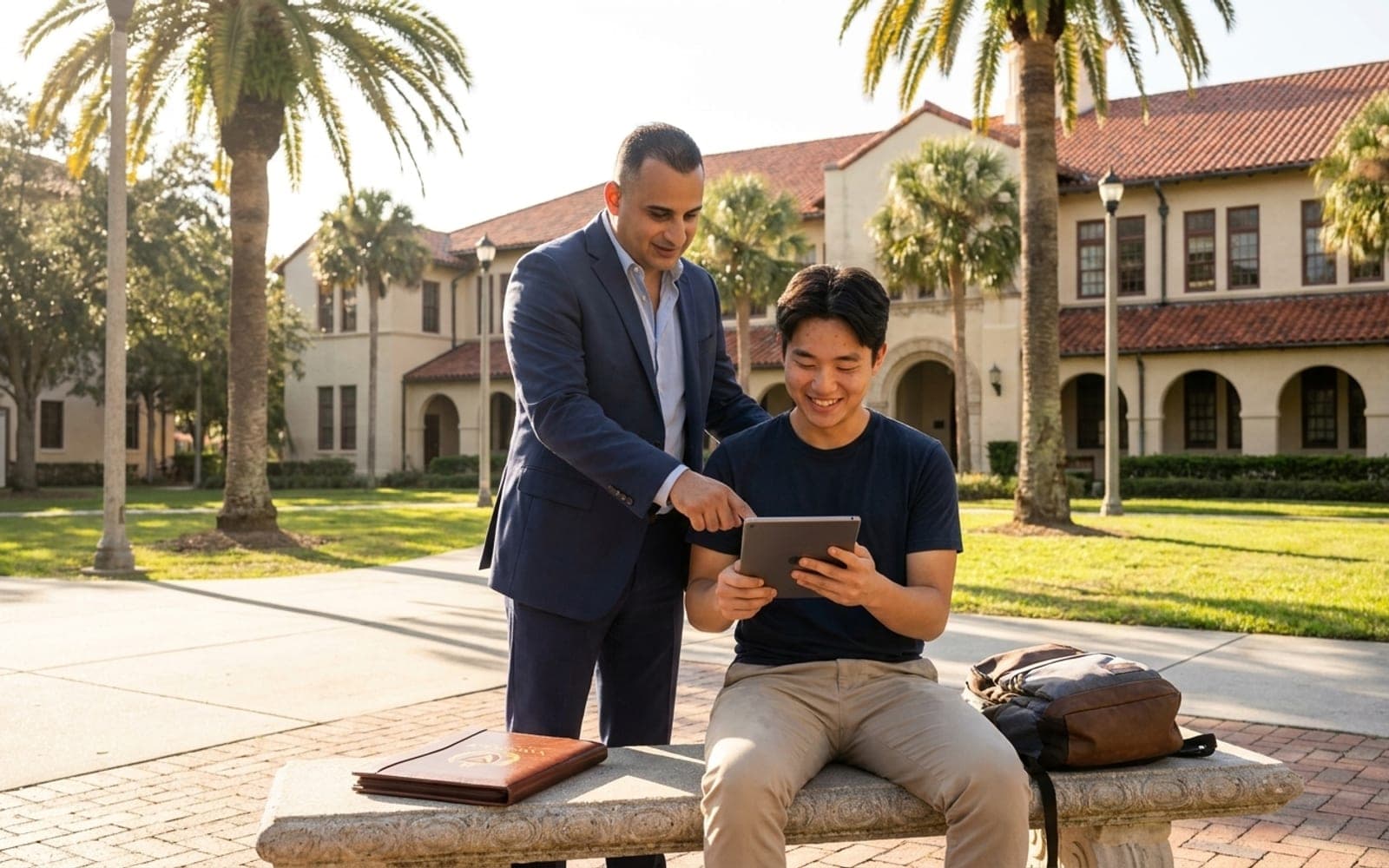
F-1 reinstatement is the formal process by which an international student in the United States, who has fallen out of valid nonimmigrant F-1 status, can regain their legal standing without needing to depart the country. This crucial procedure is necessary when a student has violated their visa terms, often unintentionally, such as by dropping below a full course load or engaging in unauthorized employment. Successful reinstatement allows students to continue their studies, maintain eligibility for benefits like Optional Practical Training (OPT), and avoid severe immigration penalties. It typically involves filing Form I-539, Application to Extend/Change Nonimmigrant Status, with USCIS, supported by a detailed explanation and documentation.
- Eligibility: Must demonstrate violation was beyond control or minor, no willful misconduct.
- Key Form: I-539, Application to Extend/Change Nonimmigrant Status.
- DSO Role: Crucial support and new I-20 from your Designated School Official.
- Consequences: Avoid deportation, maintain academic and future immigration options.
- Legal Help: An immigration attorney can significantly improve your chances of approval.
For international students pursuing their education in Florida, maintaining valid F-1 student status is paramount. The Sunshine State is home to numerous prestigious universities and colleges, attracting thousands of students from around the globe. However, even with the best intentions, circumstances can arise that lead a student to fall "out of status." This could be due to an administrative error, a misunderstanding of complex regulations, an unexpected medical emergency, or even a minor violation like dropping a course without proper authorization. When this happens, the dream of completing your education and building a future in the U.S. can quickly turn into a nightmare, potentially leading to deportation or bars from future re-entry.
Understanding the intricacies of F-1 reinstatement is not just about filing a form; it's about safeguarding your academic journey and your future in the United States. The process can be daunting, filled with strict deadlines, complex documentation requirements, and a need for clear, compelling explanations to U.S. Citizenship and Immigration Services (USCIS). For students in Orlando and across Florida, navigating these challenges alone can be overwhelming. This comprehensive guide will walk you through the F-1 reinstatement process, outlining eligibility criteria, required documents, timelines, and crucial tips to help you regain your legal standing. We'll explore Florida-specific considerations and emphasize why legal guidance is invaluable.
Don't let a lapse in your F-1 status derail your educational and career aspirations. If you find yourself in this challenging situation, immediate action and knowledgeable support are essential. Call Florida Immigration Lawyers at 1-844-YO-PELEO for a free case review and let our experienced team help you understand your options and guide you through the F-1 reinstatement process.
What is F-1 Reinstatement and Why is it Crucial in Florida?
F-1 reinstatement allows international students who have fallen out of valid nonimmigrant F-1 status to regain their legal standing in the United States without leaving the country. As of 2026, this process is crucial for students in Florida to continue their studies, maintain eligibility for benefits like Optional Practical Training (OPT), and avoid severe immigration consequences, often involving filing Form I-539.
Falling "out of status" means you have violated the terms of your F-1 student visa. Common reasons include failing to maintain a full course of study, unauthorized employment, exceeding the grace period after completing your program, or even administrative errors by your school. For the thousands of international students attending institutions like the University of Central Florida in Orlando, the University of Florida in Gainesville, or Florida International University in Miami, understanding the gravity of being out of status is critical. Without a valid F-1 status, you risk accumulating unlawful presence, which can lead to bars from re-entry into the U.S. for several years, and even deportation proceedings.
The F-1 reinstatement process provides a lifeline for students who genuinely wish to continue their education and can demonstrate that their status violation was largely beyond their control or was a minor, excusable offense. Rather than being forced to leave the U.S. and reapply for a new visa from their home country, which can be a lengthy and uncertain process, reinstatement allows students to resolve their status issue while remaining in Florida. This is particularly important for students nearing graduation or those with strong academic ties, as it prevents major disruptions to their studies. The legal framework for F-1 student status and reinstatement is outlined in federal regulations, specifically 8 CFR 214.2(f)(16), which details the conditions under which USCIS may approve an application for reinstatement. Navigating these federal regulations effectively requires a precise understanding of immigration law, which is why many students in Florida seek professional assistance to ensure their application meets all criteria.
What are the Eligibility Requirements for F-1 Reinstatement?
To be eligible for F-1 reinstatement, students must generally demonstrate that their status violation was due to circumstances beyond their control or a minor violation, have no record of repeated or willful violations, be pursuing a full course of study, and have not been employed without authorization. As of 2026, USCIS scrutinizes applications carefully, requiring clear evidence of these conditions.
Meeting the strict eligibility criteria is the cornerstone of a successful F-1 reinstatement application. USCIS evaluates each case individually, focusing on several key factors:
- Violation Beyond Your Control or Minor: This is perhaps the most critical requirement. You must prove that your failure to maintain F-1 status was due to circumstances beyond your control (e.g., a serious illness requiring a reduced course load, natural disaster, administrative error by a DSO, or other compelling reasons) or that it was a minor violation that does not warrant denial. Examples of circumstances beyond your control could include a severe family emergency requiring you to return home temporarily, or an unexpected financial hardship that prevented you from registering for a full course load.
- No Repeated or Willful Violations: USCIS will deny reinstatement if there's evidence of a pattern of repeated violations or a willful disregard for immigration regulations. This means you must not have a history of intentionally breaking F-1 rules.
- Currently Pursuing or Intend to Pursue Full Course of Study: You must either be currently enrolled in a full course of study or demonstrate a clear intent to resume a full course of study at an SEVP-approved institution. This requires a new Form I-20 issued by your Designated School Official (DSO) endorsing your request for reinstatement.
- No Unauthorized Employment: Any unauthorized employment, particularly if it was extensive or purposeful, will likely result in a denial. Limited, inadvertent, and minor unauthorized employment may be overlooked in some cases, but it is a significant hurdle.
- Not Subject to Deportation: You must not be subject to a final order of deportation or removal, nor can you have engaged in any activity that would make you ineligible for a change of status, such as certain criminal offenses.
- Application Submitted Timely: While there is no strict deadline, you should file your I-539 application "as soon as practicable." Generally, USCIS prefers applications filed within five months of falling out of status. Delays beyond this period require a stronger justification in your personal statement.
Each of these points requires substantial evidence and a clear explanation. For example, if your violation was due to a medical condition, you would need doctor's notes and hospital records. If it was an administrative error, a letter from your DSO explaining the mistake would be necessary. The burden of proof rests entirely on the applicant, making thorough preparation crucial. The Immigration and Nationality Act (INA) provides the overarching legal framework for nonimmigrant status, with specific regulations like 8 CFR 214.2(f)(16) detailing the requirements for F-1 students seeking reinstatement.
The Step-by-Step F-1 Reinstatement Process for Florida Students
Navigating the F-1 reinstatement process requires meticulous attention to detail and adherence to specific steps. For students in Florida, understanding each stage is vital to a successful outcome. Here’s a detailed breakdown:
- Consult with Your Designated School Official (DSO): This is the crucial first step. As soon as you realize you are out of status or at risk of falling out, contact your DSO at your Florida institution (e.g., University of Miami, Florida State University). Your DSO will assess your situation, explain your options, and if eligible, issue you a new Form I-20 marked "for reinstatement." This new I-20 is essential as it confirms your school's support for your reinstatement and your intent to continue a full course of study. They can also advise on maintaining your SEVIS record.
- Gather All Required Documents: A comprehensive collection of supporting documents is critical. This includes your new I-20, all previous I-20s, current passport, visa, I-94 Arrival/Departure Record, academic transcripts, proof of financial ability (bank statements, sponsorship letters), and evidence supporting your explanation for falling out of status (e.g., medical records, letters from faculty).
- Prepare Form I-539, Application to Extend/Change Nonimmigrant Status: This is the primary application form for F-1 reinstatement. Complete it accurately and thoroughly. Any errors or omissions can lead to delays or denial. If you have dependents (spouse or children) also seeking reinstatement, they must be included on your Form I-539 or file their own, depending on their visa type.
- Write a Compelling Cover Letter/Personal Statement: This letter is your opportunity to explain in detail to USCIS why you fell out of status. It must be clear, concise, and persuasive. Focus on demonstrating that your violation was not willful and was due to circumstances beyond your control, and articulate your strong desire to continue your studies. Provide a chronological narrative with supporting evidence.
- Pay the Required Fees: As of 2026, the filing fee for Form I-539 is approximately $470, plus an additional biometrics fee of around $85. These fees must be paid to USCIS at the time of filing. Always check the official USCIS website for current filing fees, as they are subject to change.
- Submit the Application to USCIS: Mail your complete application package, including all forms, supporting documents, fees, and your personal statement, to the correct USCIS lockbox facility. Ensure you send it with a tracking number for proof of delivery.
- Maintain Status While Application is Pending: Once your I-539 application for F-1 reinstatement is properly filed, you are generally permitted to remain in the U.S. while USCIS processes your case. However, you cannot work, and you must continue to pursue a full course of study. Avoid traveling outside the U.S. during this period, as it could be seen as abandoning your application.
- Receive a Decision: USCIS will notify you of their decision by mail. If approved, your F-1 status will be reinstated. If denied, you may need to depart the U.S. or explore other legal options, such as deportation defense.
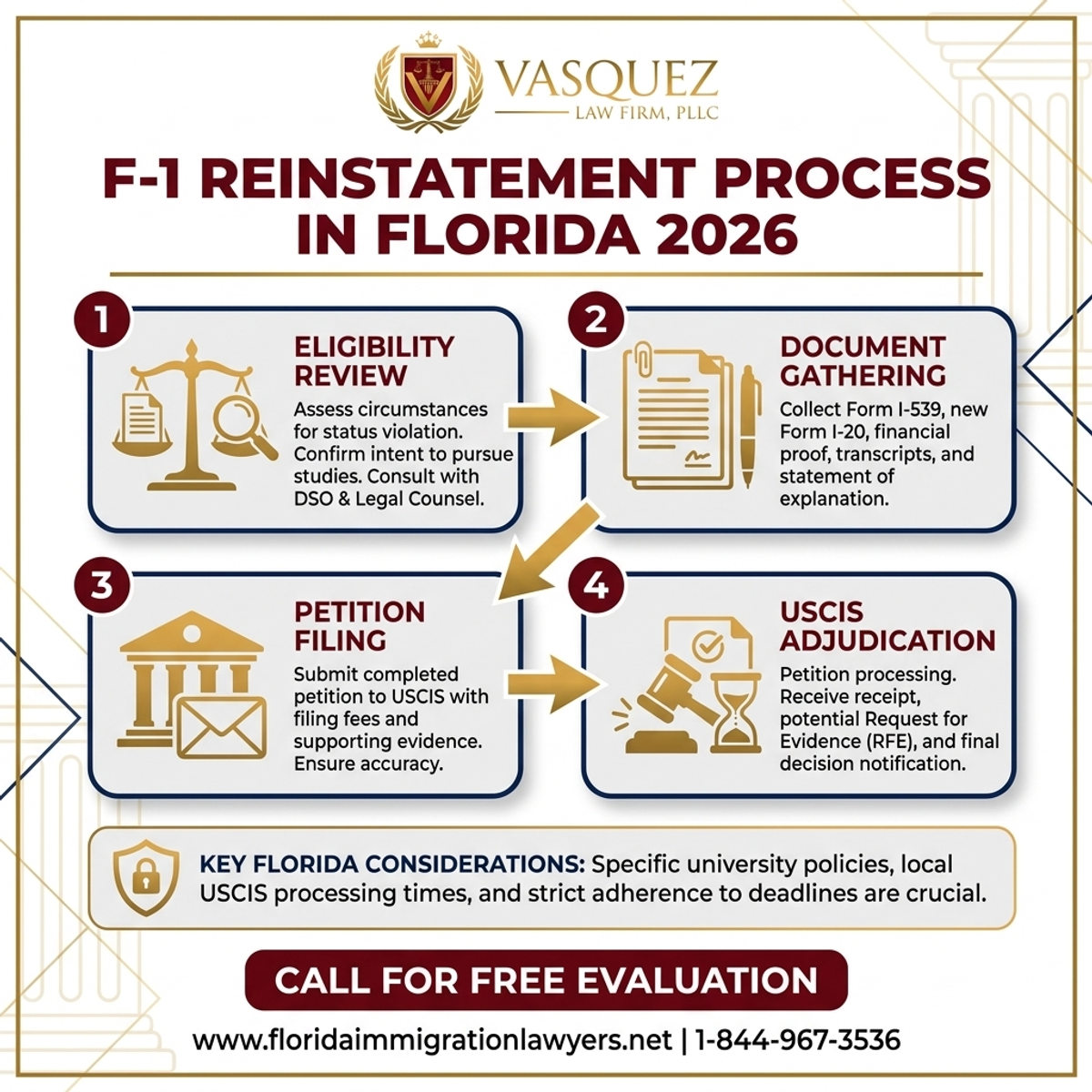
Step-by-Step Process — F-1 Reinstatement Process in Florida 2026
This process can be complex, and any misstep can have severe consequences. For personalized guidance through this intricate journey, consider consulting with Florida Immigration Lawyers who focus on student visa matters.
How Long Does F-1 Reinstatement Take and What are the Associated Costs?
As of 2026, F-1 reinstatement processing times can vary significantly, typically ranging from 6 to 18 months, depending on USCIS caseloads and the complexity of the case. Government filing fees are approximately $470 for Form I-539, with additional costs for legal representation.
Understanding the potential timeline and financial commitment for F-1 reinstatement is crucial for planning your academic and personal life in Florida. Processing times are not static and can fluctuate based on the volume of applications USCIS receives, staffing levels, and the specific service center handling your case. Furthermore, the completeness and clarity of your application can significantly impact how quickly your case is reviewed. An application that requires Requests for Evidence (RFEs) will naturally take longer.
Timeline and Processing Expectations
Here’s a general overview of the expected timeline for the F-1 reinstatement process:
| Stage | Typical Timeframe | Notes |
|---|---|---|
| Initial Consultation & Document Gathering | 1-2 Months | Depends on how quickly you gather documents and your DSO's availability. |
| Application Preparation & Filing | 2-4 Weeks | Thorough preparation of Form I-539, personal statement, and supporting documents. |
| USCIS Receipt & Biometrics Appointment | 1-3 Months after Filing | You'll receive a receipt notice (Form I-797C) and then a biometrics appointment notice. |
| USCIS Processing Time | 6-18 Months | This is the most variable stage; check USCIS processing times online for current estimates. |
| Decision Notification | Varies | Once a decision is made, you will receive a notice by mail. |
During the processing period, you are generally permitted to remain in the U.S. and continue your studies, but you should not travel internationally or engage in unauthorized employment. Keeping track of your application status online through the USCIS website is advisable.
Cost Factors and Fee Breakdown
The financial aspect of F-1 reinstatement includes government filing fees and potentially legal fees. It's important to budget for these:
| Item | Typical Fee (As of 2026) | Notes |
|---|---|---|
| Form I-539 Filing Fee | ~$470 | Mandatory fee for the application itself. Fees are subject to change, always verify with USCIS. |
| Biometrics Services Fee | ~$85 | Mandatory fee for fingerprinting and photo collection. |
| Legal Representation Fees | Varies (typically $1,500 - $5,000+) | Highly recommended for complex cases or if you need guidance. This covers attorney consultation, document review, application preparation, and communication with USCIS. |
| Express Mail/Courier Services | $20 - $50 | Recommended for secure and trackable submission of your application package. |
| Document Translation Costs | Varies (if applicable) | If any supporting documents are not in English, certified translations are required. |
While legal fees represent an additional cost, the value of having an experienced immigration attorney from Florida Immigration Lawyers guide you through the I-539 F-1 process can be immeasurable, potentially saving you from costly errors and ensuring the strongest possible application.
Essential Document Checklist for Your F-1 Reinstatement Application
A complete and well-organized application package is paramount for a successful F-1 reinstatement. Missing documents or insufficient evidence can lead to delays, Requests for Evidence (RFEs), or even denial. Here is a comprehensive checklist of documents typically required for students in Florida:
- Form I-539, Application to Extend/Change Nonimmigrant Status: The original, signed form, fully completed. If applicable, include Supplement A.
- New Form I-20, Certificate of Eligibility for Nonimmigrant Student Status: Issued by your Designated School Official (DSO) with the reinstatement recommendation.
- All Previous Forms I-20: Copies of all I-20s ever issued to you.
- Current Passport: Copy of the biographical page, including expiration date.
- F-1 Visa Stamp (if applicable): Copy of your current F-1 visa stamp.
- Form I-94 Arrival/Departure Record: Printout of your electronic I-94 from the CBP website.
- Proof of Financial Ability: Bank statements, scholarship letters, affidavit of support from sponsors, demonstrating sufficient funds to cover tuition and living expenses for at least one academic year.
- Official Academic Transcripts: From all U.S. institutions you have attended, showing good academic standing and full-time enrollment (if applicable).
- Letter from your DSO: A detailed letter from your Designated School Official explaining the circumstances of your falling out of status and recommending reinstatement. This letter should confirm your enrollment or intent to enroll in a full course of study.
- Personal Statement/Cover Letter: Your detailed, signed letter explaining the circumstances that led to your falling out of status, emphasizing that it was beyond your control or a minor, excusable violation, and expressing your genuine intent to maintain your F-1 status and complete your studies.
- Proof of SEVIS I-901 Fee Payment: Copy of your payment receipt for the SEVIS fee.
- Photocopies of Previous U.S. Visas and Entry Stamps: If applicable.
- Any Supporting Documentation for Your Explanation: This is critical. Examples include:
- Medical records, doctor's notes, or hospital bills if illness was a factor.
- Letters from academic advisors or faculty if administrative error or academic issues were involved.
- Proof of natural disaster impact (e.g., FEMA documents, news reports specific to Florida).
- Any other official documents that corroborate your explanation.
- Payment for Filing Fees: Check or money order payable to "U.S. Department of Homeland Security" for the I-539 and biometrics fees.
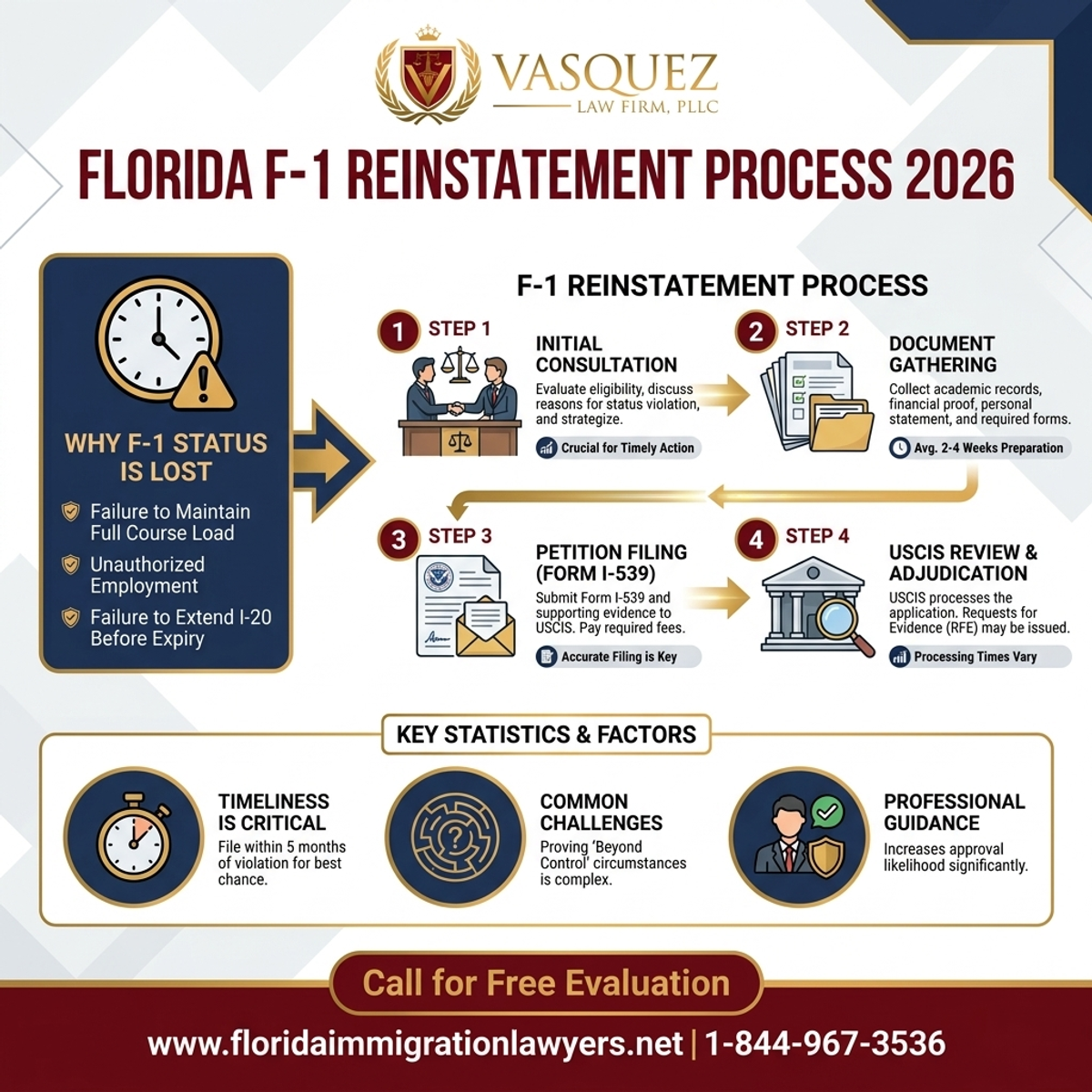
Key Statistics — F-1 Reinstatement Process in Florida 2026
Ensuring every item on this checklist is thoroughly addressed and meticulously organized can significantly strengthen your F-1 reinstatement application. Double-checking all forms for accuracy and consistency is a small effort that can prevent major setbacks.
Navigating Life in Florida While Your F-1 Reinstatement is Pending
Once you've submitted your F-1 reinstatement application, a period of uncertainty begins as you await USCIS's decision. During this time, it's crucial for students in Florida to understand their legal standing and adhere to specific guidelines to avoid further complications. Maintaining your F-1 status means continuing to follow the rules, even when your formal status is pending.
First and foremost, you must continue to pursue a full course of study at your SEVP-approved institution. This demonstrates your genuine intent to remain a student and helps solidify your case for reinstatement. Dropping below a full course load while your application is pending could be viewed negatively by USCIS and jeopardize your chances of approval. Your DSO can provide guidance on maintaining your enrollment during this period, especially if you attend a university in Central Florida like UCF or Rollins College. Academic advising and support services at your school can be invaluable resources during this stressful time.
Secondly, engaging in any form of unauthorized employment is strictly prohibited. While your I-539 F-1 application is pending, you are not authorized to work, even on-campus. Any unauthorized work could lead to an immediate denial of your reinstatement request and severe immigration consequences, including potential deportation. It's vital to be aware of these restrictions, especially for students in tourist-heavy areas of Florida who might be tempted by off-the-books work opportunities. If you face financial hardship, discuss options with your DSO or contact Florida Immigration Lawyers to explore legal avenues for support.
Lastly, international travel should be avoided while your reinstatement application is pending. Leaving the U.S. is generally considered an abandonment of your I-539 application. If you must travel for an extreme emergency, consult with your DSO and an immigration attorney immediately to understand the significant risks involved. Even if you receive permission from your DSO, re-entry into the U.S. without a valid F-1 status can be highly problematic. Staying within Florida and focusing on your studies is the safest course of action during this waiting period. Understanding these limitations and acting responsibly can significantly improve the likelihood of a positive outcome for your F-1 reinstatement.
Do not navigate this process alone. The complexities of immigration law, especially concerning status violations, demand experienced legal counsel. Contact Florida Immigration Lawyers today to schedule a free case review. Our team is ready to provide the dedicated support you need to secure your academic future.
Common Mistakes to Avoid During F-1 Reinstatement
The F-1 reinstatement process is complex, and even minor errors can lead to significant delays or outright denial. Students in Florida must be vigilant to avoid these common pitfalls:
- Failing to Act Quickly: Delaying your application is one of the biggest mistakes. USCIS prefers applications filed "as soon as practicable." The longer you wait after falling out of status, the harder it becomes to justify your delay and prove your intent to maintain status. Prompt action demonstrates good faith.
- Not Consulting Your DSO First: Your Designated School Official is your primary resource. Failing to get a new I-20 with a reinstatement recommendation or neglecting to inform your DSO can undermine your application, as their support is crucial.
- Engaging in Unauthorized Employment: This is a severe violation. Any unauthorized work, even brief or seemingly minor, can lead to an automatic denial of your F-1 reinstatement application and potential future bars to entry.
- Submitting an Incomplete or Inaccurate Form I-539: Errors, omissions, or inconsistencies on your Form I-539 can trigger Requests for Evidence (RFEs) or outright denial. Double-check every field, ensuring all information is current and correct.
- Providing an Unconvincing Personal Statement: Your cover letter must clearly and persuasively explain why you fell out of status, emphasizing that the violation was beyond your control and not willful. Vague or emotional appeals without factual support are often ineffective.
- Assuming Automatic Approval: Reinstatement is not guaranteed. USCIS has the discretion to approve or deny your application. Approaching the process casually or without strong evidence significantly reduces your chances.
- Traveling Outside the U.S. While Application is Pending: Leaving the country while your I-539 F-1 application is pending is generally considered an abandonment of your application, leading to its automatic denial.
- Not Maintaining a Full Course of Study: Even with a pending reinstatement, you must continue to attend classes and maintain a full course load. Failing to do so indicates a lack of intent to continue your student status.
- Ignoring Request for Evidence (RFE) Deadlines: If USCIS issues an RFE, you must respond comprehensively and by the deadline. Failure to do so will almost certainly lead to a denial.
- Failing to Seek Legal Counsel: The complexity of immigration law and the high stakes involved make legal representation invaluable. Many students attempt to navigate the process alone and make avoidable mistakes.
When to Call a Lawyer for Your F-1 Reinstatement
While some straightforward F-1 reinstatement cases might seem manageable, the risks associated with errors are too high to take lightly. Consulting an experienced immigration attorney, particularly one familiar with Florida's immigration landscape, can be the most critical step you take. You should definitely call Florida Immigration Lawyers if you encounter any of the following scenarios:
- Complex Reasons for Falling Out of Status: If your reasons for falling out of status are not straightforward (e.g., a combination of factors, a severe personal crisis, or a long period out of status), an attorney can help craft a compelling narrative and gather the necessary evidence.
- Previous Denials or Immigration Issues: If you have had previous immigration applications denied, have a history of visa violations, or any other negative immigration record, your case is significantly more complex and requires legal strategy.
- Unauthorized Employment: Even minor or inadvertent unauthorized work can be a major hurdle. An attorney can assess the impact and potentially mitigate the consequences.
- Uncertainty About Eligibility: If you are unsure whether you meet all the strict eligibility criteria for F-1 reinstatement, an attorney can provide a thorough assessment and honest advice.
- Difficulty Gathering Documents or Writing Your Statement: The documentation and personal statement are crucial. If you struggle with organizing evidence or articulating your situation clearly and persuasively, legal help is essential.
- Deportation Concerns: If you have received any notice of intent to deport or are concerned about being placed in removal proceedings, immediate legal intervention from deportation defense attorneys is paramount.
- Receiving a Request for Evidence (RFE): An RFE indicates USCIS needs more information or clarification. Responding correctly to an RFE is critical, and an attorney can help ensure your response is comprehensive and timely.
- Long Period Out of Status: If you have been out of status for more than five months, your case is inherently more difficult and requires a stronger justification, which an attorney can help you formulate.
Our experienced attorneys at Florida Immigration Lawyers understand the nuances of student visa Florida regulations and the specific challenges faced by international students in our state. We can help you identify potential red flags, prepare a robust application, and advocate on your behalf, significantly increasing your chances of a successful outcome.
About Florida Immigration Lawyers
Florida Immigration Lawyers is an immigration law firm dedicated to serving individuals and families across the entire state of Florida. With a deep understanding of U.S. immigration laws and a commitment to our clients, we provide compassionate, effective, and results-driven legal representation. Our attorneys focus on a wide range of immigration matters, including F-1 reinstatement, family-based visas, business immigration, asylum, citizenship, and deportation defense. We pride ourselves on offering personalized attention, clear communication, and strategic advice tailored to each client's unique circumstances. We understand the anxieties and complexities that come with immigration challenges, especially for students navigating issues like out of status F-1 situations. Our mission is to simplify these processes for you, offering peace of mind and guiding you toward a favorable resolution. We are available 24/7 to answer your questions and provide support. We offer free case reviews to help you understand your legal options without any upfront cost. Our office is located in Orlando, proudly serving Central Florida and all communities throughout the state.
To learn more about how we can assist you, please schedule a free consultation with our dedicated team today at 1-844-YO-PELEO.
Sources and References
- U.S. Citizenship and Immigration Services (USCIS)
- Executive Office for Immigration Review (EOIR)
- U.S. Department of State
- 8 U.S.C. § 1101 et seq. - Immigration and Nationality Act (INA)
- 8 CFR § 214.2(f)(16) - Reinstatement to student status
- USCIS Policy Manual, Volume 2, Part F, Chapter 3 - Students
Related services: immigration practice areas, immigration lawyer cost in Florida.
This article provides general legal information and is not intended as legal advice. Every case is unique, and outcomes depend on specific facts and circumstances. Contact an attorney for advice about your particular situation.
Don't let the fear of being out of status prevent you from achieving your academic and professional goals in Florida. The path to F-1 reinstatement can be complex, but you don't have to walk it alone. Our dedicated team at Florida Immigration Lawyers is here to provide the guidance and support you need to navigate this critical process successfully. We offer free, confidential case reviews and are available 24/7 to address your concerns. Take the first step towards securing your future by calling us today. Call Florida Immigration Lawyers at 1-844-YO-PELEO for your free case review. Se Habla Espanol - Estamos aqui para ayudarle.
Do Not Navigate This Process Alone
Our experienced immigration attorneys are ready to fight for you. Get a free, confidential case review today.
Se Habla Español
Or leave your details and we’ll call you:
Free Evaluation in 24 Hours
Or talk to us right now
AI voice assistant — available 24/7
FreeFrequently Asked Questions

William J. Vásquez
Founding Attorney · Vasquez Law Firm
U.S. Air Force veteran and immigration attorney with years of hands-on U.S. immigration experience. J.D., NCCU School of Law. AILA member. Admitted to the 4th, 5th, and 11th Circuit Courts.
Available 24/7 - Free Evaluations
Reviewed for legal accuracy by William J. Vásquez
Licensed in North Carolina; U.S. immigration is federal practice.
Related Legal Services
Our Florida immigration attorneys can help you with business immigration, deportation defense and family immigration services. Call today at 1-844-YO-PELEO for a free case review.
Related Links
Related Topics
Free Legal Case Review
Discuss your case with our experienced attorneys. We're available 24/7.
Se Habla Español - Estamos aquí para ayudarle.
Related Articles
DUI Immigration Consequences in Florida 2026
A DUI conviction in Florida can have severe immigration consequences, potentially leading to inadmissibility, deportation, or denial of immigration benefits. For non-citizens, a DUI is not just a traffic offense but a serious criminal matter that federal immigration law scrutinizes closely. Factors like multiple offenses, injury, or property damage can escalate a simple DUI to a Crime Involving Moral Turpitude (CIMT) or even an aggravated felony, triggering mandatory detention and removal proceedings. Understanding the specific nature of your Florida conviction and its interpretation under the Immigration and Nationality Act (INA) is crucial. This article outlines how DUIs impact immigration status, the grounds for inadmissibility and deportation, a step-by-step guide to navigating the process, essential documentation, and expected timelines for 2026. We also highlight common mistakes to avoid and when to seek legal counsel from an experienced immigration attorney. Florida Immigration Lawyers offers comprehensive support for individuals facing these challenging situations, providing expert guidance through complex legal landscapes.
Immigration Lawyer Orlando Free Consultation in Florida
For individuals and families in Orlando, Florida, navigating the complexities of U.S. immigration law requires expert guidance. An immigration lawyer in Orlando offers crucial support for everything from visa applications and green card processes to naturalization and deportation defense. This comprehensive guide details what a free consultation covers, providing a step-by-step overview of immigration pathways, essential document checklists, and expected timelines in 2026. We also highlight common mistakes to avoid, discuss the critical role of legal counsel in deportation and asylum cases, and explain why choosing a local Orlando immigration attorney is beneficial. Florida Immigration Lawyers is dedicated to serving the diverse community of Orlando with compassionate, effective legal solutions, ensuring you receive personalized advice and robust representation for a successful immigration journey.
EAD Advance Parole Combo Card in Florida: What You Need
An EAD advance parole combo card allows individuals with pending adjustment applications to both work and travel abroad without jeopardizing their green card application. Learn how to apply in Florida, what documents you need, and common mistakes to avoid.
Dual Citizenship Lawyer in Florida: What You Need to Know
For Florida residents, the concept of dual citizenship, or holding two passports, offers a compelling blend of opportunities and challenges. While the U.S. generally permits dual nationality, the path to achieving this status requires a meticulous understanding of both U.S. immigration laws and the citizenship policies of your country of origin. This guide explores the definition of dual citizenship, the detailed step-by-step process for U.S. naturalization, and the significant benefits and potential pitfalls involved. We cover essential documentation, typical timelines, and cost considerations for 2026, providing crucial insights for anyone in Orlando, Miami, or across Florida considering this important legal step. Learn about common mistakes to avoid and understand when to seek professional legal counsel to navigate this complex process successfully. Florida Immigration Lawyers is here to provide expert, bilingual support for your dual citizenship journey.