F-1 Visa Requirements for Florida Universities in 2026
Navigating the F-1 visa process for studying at Florida universities can be complex. Learn about eligibility, application procedures, and common pitfalls to avoid for a successful journey as an international student.
- Eligibility requires acceptance into a SEVP-certified program.
- Applicants must prove financial stability and intent to return home.
- Visa interviews are mandatory.
- Understanding the application process is crucial for timely entry.
Introduction
Studying in the United States is a dream for many international students. Florida, with its diverse culture and top-notch universities, is a popular choice. Navigating the F-1 visa application process can be complex, but with the right information, it becomes manageable. This article explores the F-1 visa requirements for studying at Florida universities in 2026, providing insights into eligibility, application processes, and common challenges. Call Florida Immigration Lawyers at 1-844-YO-PELEO for a free case review.
Florida boasts a vibrant academic landscape, from bustling metropolitan campuses in Miami and Orlando to specialized research institutions across the state. Its appealing climate, diverse population, and strong job market in various sectors make it an attractive destination for international students seeking both quality education and valuable life experiences. Understanding the nuances of the F-1 visa is the first critical step toward realizing this academic ambition.
The F-1 visa process, while structured, requires meticulous attention to detail and adherence to strict deadlines. Preparing well in advance can significantly reduce stress and the likelihood of encountering setbacks. From gathering financial documentation to preparing for the visa interview, each stage demands a clear understanding of U.S. immigration law. Seeking guidance from experienced professionals, such as Florida Immigration Lawyers, can provide a significant advantage in successfully navigating these requirements.
What is the F-1 Visa for International Students?
The F-1 visa is a non-immigrant student visa that allows international students to pursue academic studies in the U.S. To qualify, students must be accepted by a SEVP-certified school and demonstrate sufficient financial resources. As of 2026, F-1 visa holders are required to enroll full-time and adhere to specific rules regarding employment.
Florida universities, including those in Orlando, offer a wide range of programs for F-1 visa students. Applicants must prepare for the visa interview by gathering necessary documents and proving ties to their home country.
The F-1 visa is specifically designed for individuals who wish to engage in a full-time academic or language training program at an institution approved by the Student and Exchange Visitor Program (SEVP). This means the chosen university or college must be authorized by the U.S. government to enroll international students. Crucially, F-1 visa holders are expected to maintain a non-immigrant intent, meaning they must demonstrate to consular officers that they plan to return to their home country after completing their studies, despite any potential post-graduation opportunities like Optional Practical Training (OPT).
Maintaining F-1 status involves strict adherence to regulations, including enrolling in a full course of study, making satisfactory academic progress, and not engaging in unauthorized employment. While limited on-campus employment and specific off-campus work authorizations like Curricular Practical Training (CPT) and Optional Practical Training (OPT) are available, any deviation from these rules can lead to severe immigration consequences, including visa revocation. Understanding these regulations thoroughly is paramount for a successful stay in the U.S.
How to Apply for an F-1 Visa in Florida?
Applying for an F-1 visa involves several steps:
- Receive acceptance from a SEVP-certified institution.
- Pay the SEVIS I-901 fee.
- Complete the DS-160 form.
- Schedule and attend a visa interview at a U.S. consulate.
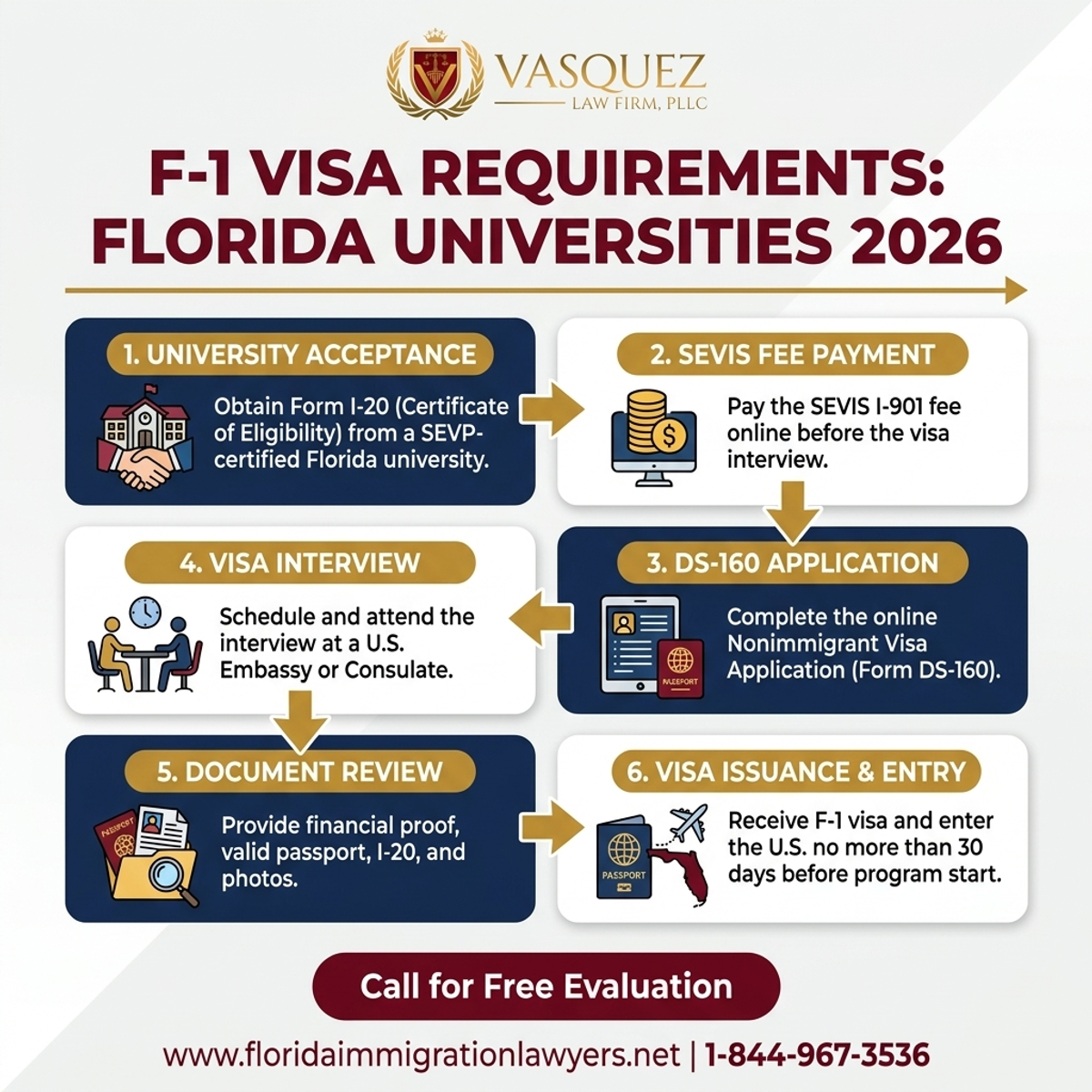
Step-by-Step Process — F-1 Visa Requirements for Florida Universities in 2026
Each step requires careful attention to detail. The DS-160 form must be filled out accurately, and the visa interview is a critical component where applicants must demonstrate their intent to return home after studies.
The journey begins with securing admission to an accredited U.S. institution. Once accepted, the university will issue an I-20 form, Certificate of Eligibility for Nonimmigrant Student Status. This crucial document confirms your enrollment, program of study, estimated costs, and the school's SEVP certification. It's essential to review the I-20 for any discrepancies immediately upon receipt, as errors can cause significant delays in your application process.
Following the I-20, you must pay the SEVIS I-901 fee. The Student and Exchange Visitor Information System (SEVIS) tracks F-1 students throughout their stay. Paying this fee registers you in the system, and proof of payment is required for your visa interview. After this, you'll complete the DS-160, the Online Nonimmigrant Visa Application. This comprehensive form gathers personal, educational, and travel history, and accuracy is paramount. Even minor errors can lead to application delays or rejection, so double-check all information before submission.
Finally, scheduling and attending your visa interview at a U.S. Embassy or Consulate in your home country is the culmination of the application. During this interview, a consular officer will assess your eligibility, primarily focusing on your non-immigrant intent and ability to finance your education. Be prepared to articulate your academic goals, explain why you chose your specific Florida university, and provide compelling evidence of strong ties to your home country, such as family responsibilities, property ownership, or future job prospects.
Document Checklist for F-1 Visa Applicants
- I-20 form issued by the school
- Valid passport
- Proof of financial support
- Visa application fee receipt
- Passport-sized photos
Having all necessary documents ready can help streamline the application process. Missing or incorrect documents can lead to delays or denials.
Beyond the core documents, it's advisable to bring supplementary materials to your interview to strengthen your case. These might include academic transcripts, diplomas, standardized test scores (SAT, ACT, TOEFL, IELTS), and any letters of recommendation or personal statements that highlight your academic commitment. A well-organized folder of documents demonstrates preparedness and seriousness to the consular officer.
For proof of financial support, you should present bank statements, scholarship letters, or affidavits of support from sponsors, clearly indicating sufficient funds to cover your tuition, living expenses, and other costs for at least the first year of study, as outlined on your I-20. If a sponsor is supporting you, they should also provide evidence of their income and financial stability. Remember, the goal is to convince the consular officer that you will not become a public charge and have a reliable source of funds throughout your academic journey in Florida.
What is the Timeline for F-1 Visa Processing?
| Stage | Typical Timeframe | Notes |
|---|---|---|
| SEVP Acceptance | 2-4 weeks | Depends on the institution |
| SEVIS Fee Payment | Immediate | Required before DS-160 |
| Visa Interview Appointment | 1-2 months | Varies by location |
| Visa Approval | 1-2 weeks | After interview |
Understanding the timeline helps in planning and ensuring timely entry into the U.S. for the start of the academic term.
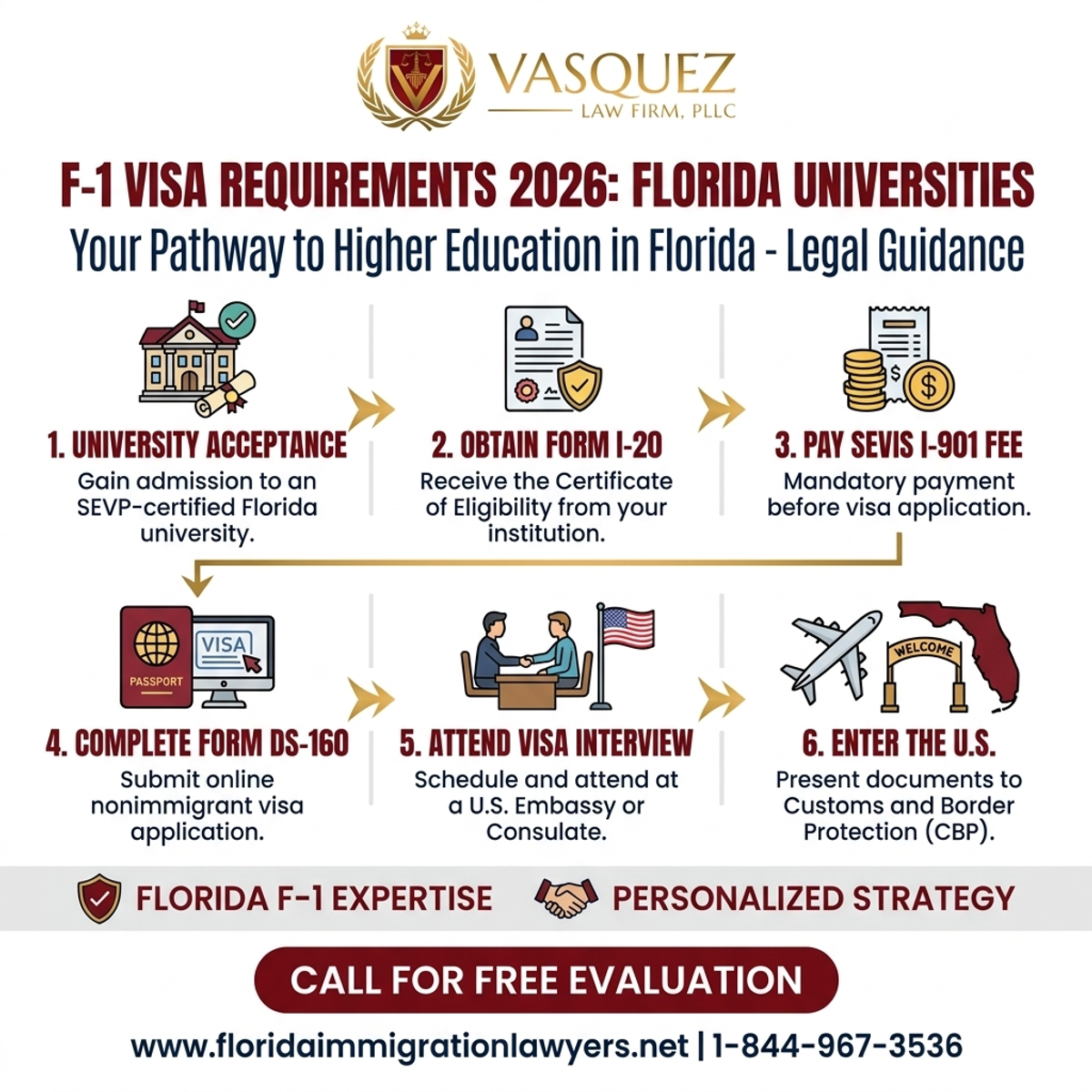
Key Statistics — F-1 Visa Requirements for Florida Universities in 2026
While the typical timeframes provide a general guide, it's crucial to remember that these are estimates. Factors such as the volume of applications, staffing levels at consulates, and specific country regulations can significantly impact processing times. For instance, peak application seasons (summer months before fall semesters) often see longer waits for interview appointments. Starting your application process as early as possible, ideally six to twelve months before your desired start date, is highly recommended to mitigate potential delays.
After your visa interview, the approval process usually takes one to two weeks, but administrative processing or security clearances can sometimes extend this period. You cannot enter the U.S. more than 30 days before the start date listed on your I-20, so plan your travel accordingly. If you face unexpected delays or complex issues, Florida Immigration Lawyers can provide timely advice and intervention to help keep your application on track.
What are the Costs Associated with the F-1 Visa?
| Item | Typical Fee | Notes |
|---|---|---|
| SEVIS I-901 Fee | Varies | Non-refundable |
| DS-160 Application Fee | Varies | Non-refundable |
| Visa Issuance Fee | Varies | Country-specific |
Costs can vary depending on the country of residence. It's crucial to budget for these expenses to avoid delays.
Beyond the mandatory government fees, international students must also consider other significant expenses. These include tuition and university fees, living costs (housing, food, transportation, personal expenses), health insurance (often mandatory for F-1 students), and travel expenses to and from the U.S. Many Florida universities provide detailed estimates of these costs on their websites or with the I-20 form, which is essential for accurate financial planning.
For example, the SEVIS I-901 fee is currently $350 (as of early 2024), and the DS-160 application fee is $185. Visa issuance fees can vary significantly by country based on reciprocity agreements, so it's vital to check the U.S. Embassy or Consulate website in your specific country for the most up-to-date information. Remember, these fees are non-refundable, even if your visa application is denied, emphasizing the importance of a thorough and accurate application from the outset.
Do not navigate this process alone. Contact Florida Immigration Lawyers today.
Frequently Asked Questions About the F-1 Visa
Can F-1 visa holders work in the U.S.?
F-1 visa holders have limited work options. On-campus employment is generally permitted for up to 20 hours per week during the academic year and full-time during breaks. Off-campus work usually requires authorization through Curricular Practical Training (CPT) or Optional Practical Training (OPT), which are directly related to your field of study. Unauthorized employment can lead to severe penalties, including visa revocation and deportation. Always consult your Designated School Official (DSO) before accepting any employment.
What happens if my F-1 visa is denied?
If your F-1 visa is denied, the consular officer should provide a reason for the denial. Common reasons include insufficient proof of non-immigrant intent, inadequate financial documentation, or incomplete application forms. You may be able to reapply if you can address the issues that led to the denial. It's highly recommended to seek legal counsel from Florida Immigration Lawyers to review your previous application and prepare a stronger case for reapplication, addressing all concerns raised by the consulate.
How long can I stay in the U.S. after graduation on an F-1 visa?
Upon completing your program of study, F-1 students are typically granted a 60-day grace period to either depart the U.S., transfer to another academic program, or apply for a change of status, such as Optional Practical Training (OPT). OPT allows you to work in a field directly related to your major for 12 months, with STEM graduates potentially eligible for a 24-month extension. Proper application and adherence to deadlines are crucial for utilizing this post-graduation benefit.
Can my family come with me on an F-1 visa?
Yes, your spouse and unmarried minor children (under 21 years old) may be eligible to accompany you to the U.S. on an F-2 dependent visa. They must apply for their F-2 visas separately, but their applications are linked to your F-1 status. F-2 visa holders are generally not permitted to work or enroll in full-time academic programs, though minor children can attend primary and secondary school. You must demonstrate sufficient financial resources to support your dependents.
What are the requirements for maintaining F-1 status?
Maintaining F-1 status requires full-time enrollment in your academic program, making satisfactory academic progress, and adhering to all U.S. immigration laws. You must also keep your I-20 valid, report any changes in address or program of study to your Designated School Official (DSO) within ten days, and avoid unauthorized employment. Failure to comply can result in loss of status, requiring reinstatement or departure from the U.S. Regular communication with your DSO is vital for compliance.
Common Mistakes to Avoid
- Not verifying SEVP certification of the institution: Leads to ineligibility.
- Incomplete DS-160 form: Causes delays in processing.
- Insufficient financial documentation: Results in visa denial.
- Missing visa interview: Can disrupt travel plans.
- Incorrect passport details: Leads to application rejection.
- Lack of ties to home country: Raises doubts about intent to return.
- Failure to pay SEVIS fee: Prevents interview scheduling.
- Misunderstanding employment rules: Can result in visa revocation.
Beyond simply listing these mistakes, understanding their implications is key. For instance, failing to verify SEVP certification means your I-20 is invalid, and you cannot obtain an F-1 visa for that institution. Always check the official SEVP website for school accreditation. Similarly, an incomplete DS-160 is not just a delay; it can signal a lack of seriousness or attention to detail, which consular officers may view negatively. Double-checking every field is a small effort that yields significant returns.
Regarding financial documentation, remember that consular officers look for clear, liquid, and sufficient funds. Presenting assets that are difficult to convert to cash quickly or showing funds that barely meet the I-20's estimated costs can raise red flags. A strong application demonstrates funds comfortably exceeding the required amount, showing financial stability. For the critical aspect of 'ties to home country,' applicants should prepare a compelling narrative supported by evidence such as property deeds, family responsibilities, letters from future employers, or even a detailed career plan that necessitates returning home after graduation. Florida Immigration Lawyers can help you structure this evidence effectively.
When to Call a Lawyer
Legal assistance is crucial if facing visa denials, complicated immigration history, or if you need help understanding employment restrictions under the F-1 visa. Florida Immigration Lawyers offer expert guidance to navigate these complexities.
Beyond initial denials, a lawyer's expertise becomes invaluable in several other scenarios. If you've previously overstayed a visa, had a prior visa denied, or have any criminal history, even minor infractions, these can significantly complicate your F-1 application. An immigration attorney can assess your specific situation, advise on potential waivers or remedies, and help present your case in the most favorable light to U.S. immigration authorities.
Furthermore, if you encounter issues maintaining your F-1 status while studying in Florida, such as falling out of status due to an administrative error or an unforeseen personal emergency, a lawyer can guide you through the reinstatement process. They can also provide critical advice on post-graduation options like OPT or pursuing other visa categories if you wish to remain in the U.S. for work or further study, ensuring you comply with all regulations and deadlines. Don't hesitate to call 1-844-YO-PELEO for a free case review.
About Florida Immigration Lawyers
Florida Immigration Lawyers are dedicated to providing comprehensive legal services to individuals and families. Our team specializes in various immigration matters, including student visas. We are available 24/7 for a free case review and serve all of Florida. Call 1-844-YO-PELEO or visit our contact page.
Our commitment extends beyond just processing paperwork; we strive to provide peace of mind. We understand the hopes and anxieties that come with pursuing education in a new country. Our experienced attorneys offer personalized attention, meticulously reviewing each aspect of your F-1 visa application to minimize errors and maximize your chances of approval. We stay updated on the latest immigration policies and procedures, ensuring our advice is always current and relevant.
Whether you are just beginning to explore your options for studying in Florida or are facing challenges with an existing application, our team is here to support you every step of the way. From preparing for your visa interview to understanding your rights and responsibilities as an F-1 student, Florida Immigration Lawyers are your trusted partners in achieving your academic dreams in the U.S. Reach out today for a confidential consultation.
Sources and References
- U.S. Citizenship and Immigration Services (USCIS)
- Executive Office for Immigration Review (EOIR)
- 8 U.S.C. Chapter 12 - Immigration and Nationality Act
- U.S. Department of State – Bureau of Consular Affairs
- Student and Exchange Visitor Program (SEVP)
Related services: immigration practice areas, family immigration services, citizenship and naturalization, deportation defense, employment immigration.
This article provides general legal information and is not intended as legal advice. Every case is unique, and outcomes depend on specific facts and circumstances. Contact an attorney for advice about your particular situation.
For assistance with your F-1 visa application or any immigration-related inquiries, contact Florida Immigration Lawyers at 1-844-YO-PELEO. Se Habla Espanol - Estamos aqui para ayudarle.
If you need legal assistance, learn more about Florida immigration legal team, or call us at 1-844-967-3536 for a free case review.
Do Not Navigate This Process Alone
Our experienced immigration attorneys are ready to fight for you. Get a free, confidential case review today.
Se Habla Español
Or leave your details and we’ll call you:
Free Evaluation in 24 Hours
Or talk to us right now

AI voice assistant — available 24/7
FreeFrequently Asked Questions

William J. Vásquez
Founding Attorney · Vasquez Law Firm
U.S. Air Force veteran and immigration attorney with years of hands-on U.S. immigration experience. J.D., NCCU School of Law. AILA member. Admitted to the 4th, 5th, and 11th Circuit Courts.
Available 24/7 - Free Evaluations
Reviewed for legal accuracy by William J. Vásquez
Licensed in North Carolina; U.S. immigration is federal practice.
Related Legal Services
Our Florida immigration attorneys can help you with experienced immigration attorneys, asylum protection and citizenship and naturalization. Call today at 1-844-YO-PELEO for a free case review.
Related Links
Related Topics
Free Legal Case Review
Discuss your case with our experienced attorneys. We're available 24/7.
Se Habla Español - Estamos aquí para ayudarle.
Related Articles
DUI Immigration Consequences in Florida 2026
A DUI conviction in Florida can have severe immigration consequences, potentially leading to inadmissibility, deportation, or denial of immigration benefits. For non-citizens, a DUI is not just a traffic offense but a serious criminal matter that federal immigration law scrutinizes closely. Factors like multiple offenses, injury, or property damage can escalate a simple DUI to a Crime Involving Moral Turpitude (CIMT) or even an aggravated felony, triggering mandatory detention and removal proceedings. Understanding the specific nature of your Florida conviction and its interpretation under the Immigration and Nationality Act (INA) is crucial. This article outlines how DUIs impact immigration status, the grounds for inadmissibility and deportation, a step-by-step guide to navigating the process, essential documentation, and expected timelines for 2026. We also highlight common mistakes to avoid and when to seek legal counsel from an experienced immigration attorney. Florida Immigration Lawyers offers comprehensive support for individuals facing these challenging situations, providing expert guidance through complex legal landscapes.
Dual Citizenship Lawyer in Florida: What You Need to Know
For Florida residents, the concept of dual citizenship, or holding two passports, offers a compelling blend of opportunities and challenges. While the U.S. generally permits dual nationality, the path to achieving this status requires a meticulous understanding of both U.S. immigration laws and the citizenship policies of your country of origin. This guide explores the definition of dual citizenship, the detailed step-by-step process for U.S. naturalization, and the significant benefits and potential pitfalls involved. We cover essential documentation, typical timelines, and cost considerations for 2026, providing crucial insights for anyone in Orlando, Miami, or across Florida considering this important legal step. Learn about common mistakes to avoid and understand when to seek professional legal counsel to navigate this complex process successfully. Florida Immigration Lawyers is here to provide expert, bilingual support for your dual citizenship journey.
Immigration Lawyer Orlando Free Consultation in Florida
For individuals and families in Orlando, Florida, navigating the complexities of U.S. immigration law requires expert guidance. An immigration lawyer in Orlando offers crucial support for everything from visa applications and green card processes to naturalization and deportation defense. This comprehensive guide details what a free consultation covers, providing a step-by-step overview of immigration pathways, essential document checklists, and expected timelines in 2026. We also highlight common mistakes to avoid, discuss the critical role of legal counsel in deportation and asylum cases, and explain why choosing a local Orlando immigration attorney is beneficial. Florida Immigration Lawyers is dedicated to serving the diverse community of Orlando with compassionate, effective legal solutions, ensuring you receive personalized advice and robust representation for a successful immigration journey.
EAD Advance Parole Combo Card in Florida 2026
For individuals with a pending Form I-485, Application to Register Permanent Residence or Adjust Status, the EAD Advance Parole Combo Card is an essential document. This single card combines the authorization to work legally in the U.S. (Employment Authorization Document - EAD) with permission to travel internationally and re-enter without abandoning your green card application (Advance Parole). This guide from Florida Immigration Lawyers provides a comprehensive overview for applicants in Florida in 2026, covering eligibility, the step-by-step application process, required documents, expected processing times, and associated costs. We also highlight common mistakes to avoid and when to seek legal counsel to ensure a smooth and successful immigration journey. Understanding this vital card is key to maintaining stability while awaiting your permanent residency approval.