Expungement Effect on Immigration in Florida
Discover how expungement impacts immigration in Florida. Learn about eligibility, the process, and potential consequences. Contact Florida Immigration Lawyers at 1-844-YO-PELEO for a free consultation.

Expungement Effect on Immigration in Florida | VLF Florida
Navigating the complex intersection of Florida's criminal justice system and federal immigration law can be daunting, especially when a past criminal record is involved. Many individuals in Florida seek to expunge or seal their criminal records, believing this action will erase the incident entirely and remove any potential negative impact on their immigration status or future applications. While expungement and sealing offer significant benefits under Florida state law, their effect on federal immigration proceedings is often misunderstood and can lead to severe, unforeseen consequences for non-citizens. This comprehensive guide will delve into the critical distinctions between state expungement and federal immigration law, exploring how an expunged record can still impact your ability to obtain visas, green cards, or even lead to deportation. Understanding these nuances is paramount for anyone with a criminal history in Florida who is also navigating the U.S. immigration system.
What is Expungement and Sealing in Florida?
In Florida, expungement and sealing are legal processes designed to limit public access to criminal records. While often used interchangeably by the public, they are distinct procedures with different outcomes. Both aim to provide individuals with a fresh start by making their past criminal history less visible to potential employers, landlords, and the general public. However, neither process truly 'erases' a record in the way many imagine.
Record Sealing
When a record is sealed, it means that the criminal history information is not available to the general public. Certain government agencies, such as law enforcement, state attorney's offices, and some licensing boards, can still access sealed records. An individual whose record is sealed can lawfully deny the existence of the arrest or offense in most circumstances, with specific exceptions.
Record Expungement
Expungement is a more comprehensive process than sealing. If a record is expunged, it is physically destroyed or obliterated from public view. Only a few specific agencies, primarily for purposes of employment with law enforcement or for subsequent criminal history checks for certain sensitive positions, may have access to an expunged record. Like sealing, an individual with an expunged record can generally deny the existence of the arrest or offense.
Eligibility for both sealing and expungement in Florida is strict and typically requires that the individual has no prior convictions, has not previously had a record sealed or expunged, and that the charges were dropped, dismissed, or resulted in an acquittal. Certain serious offenses, such as violent crimes or sexual offenses, are generally not eligible for either process. The application involves a petition to the court, a certificate of eligibility from the Florida Department of Law Enforcement (FDLE), and often a hearing before a judge. While these state-level remedies offer considerable relief in everyday life, their impact on immigration matters is a different story entirely.
Does Expungement Erase a Record for Immigration Purposes?
This is perhaps the most critical question for non-citizens. The straightforward answer is: No, an expunged or sealed record in Florida does not erase the incident for federal immigration purposes. This fundamental difference stems from the distinct legal frameworks governing state criminal law and federal immigration law.
Florida state laws dictate how criminal records are managed within the state, including processes like expungement and sealing. However, immigration law is exclusively federal. The U.S. Citizenship and Immigration Services (USCIS), Immigration and Customs Enforcement (ICE), and the Department of State (DOS) operate under federal statutes and regulations. These federal agencies generally do not recognize state-level expungements or sealings as a means to nullify a conviction or arrest for immigration purposes.
The Immigration and Nationality Act (INA) has its own definition of what constitutes a 'conviction' for immigration purposes. Under INA § 101(a)(48)(A), a 'conviction' occurs when there has been a formal judgment of guilt entered by a court, or if adjudication of guilt has been withheld, where:
- A judge or jury has found the alien guilty or the alien has entered a plea of guilty or nolo contendere or has admitted sufficient facts to warrant a finding of guilt, and
- The judge has ordered some form of punishment, penalty, or restraint on the alien's liberty to be imposed.
This broad federal definition means that even if a Florida court expunges your record, and you are no longer considered 'convicted' under state law, the underlying finding of guilt and the imposition of a penalty (like probation, fines, or community service) will almost certainly still be considered a 'conviction' by federal immigration authorities. Therefore, the incident remains relevant and discoverable during any immigration application or proceeding, including visa applications, green card adjustments, naturalization, or deportation defense.
The Critical Distinction: Expungement vs. Immigration Law's View of Convictions
The disparity between state criminal law and federal immigration law regarding convictions is a frequent source of confusion and severe problems for non-citizens. While a state expungement aims to provide a clean slate, federal immigration law often views the original finding of guilt and any imposed sentence as a permanent mark on an individual's record, regardless of subsequent state court actions. This distinction is not merely academic; it has profound implications for an individual's ability to live and work in the United States.
For immigration purposes, the focus is on the original court action: did the individual plead guilty or nolo contendere? Was there a finding of guilt? Was a sentence imposed, even if it was just a fine or probation? If the answer to these questions is yes, then in most cases, federal immigration authorities will consider it a conviction. This holds true even if the state court later vacates the conviction, withdraws the plea, or expunges the record, unless the vacatur was based on a procedural or substantive defect in the original criminal proceedings, rather than merely for rehabilitative purposes. The U.S. Supreme Court's decision in Carachuri-Rosendo v. Holder (2010) clarified some aspects of how foreign convictions are treated, but the general principle remains that state-level rehabilitative actions often do not negate a conviction for immigration purposes.
This means that when you apply for an immigration benefit, such as a visa, adjustment of status to a lawful permanent resident, or naturalization, you are generally required to disclose all arrests and convictions, even those that have been expunged or sealed by a state court. Failure to disclose such information, even if you genuinely believe the record is gone, can be considered misrepresentation or fraud, leading to further immigration penalties, including denial of benefits and potential deportation proceedings. Immigration officers have access to federal databases that often retain records of arrests and dispositions, regardless of state expungement orders. They can and will find these records.
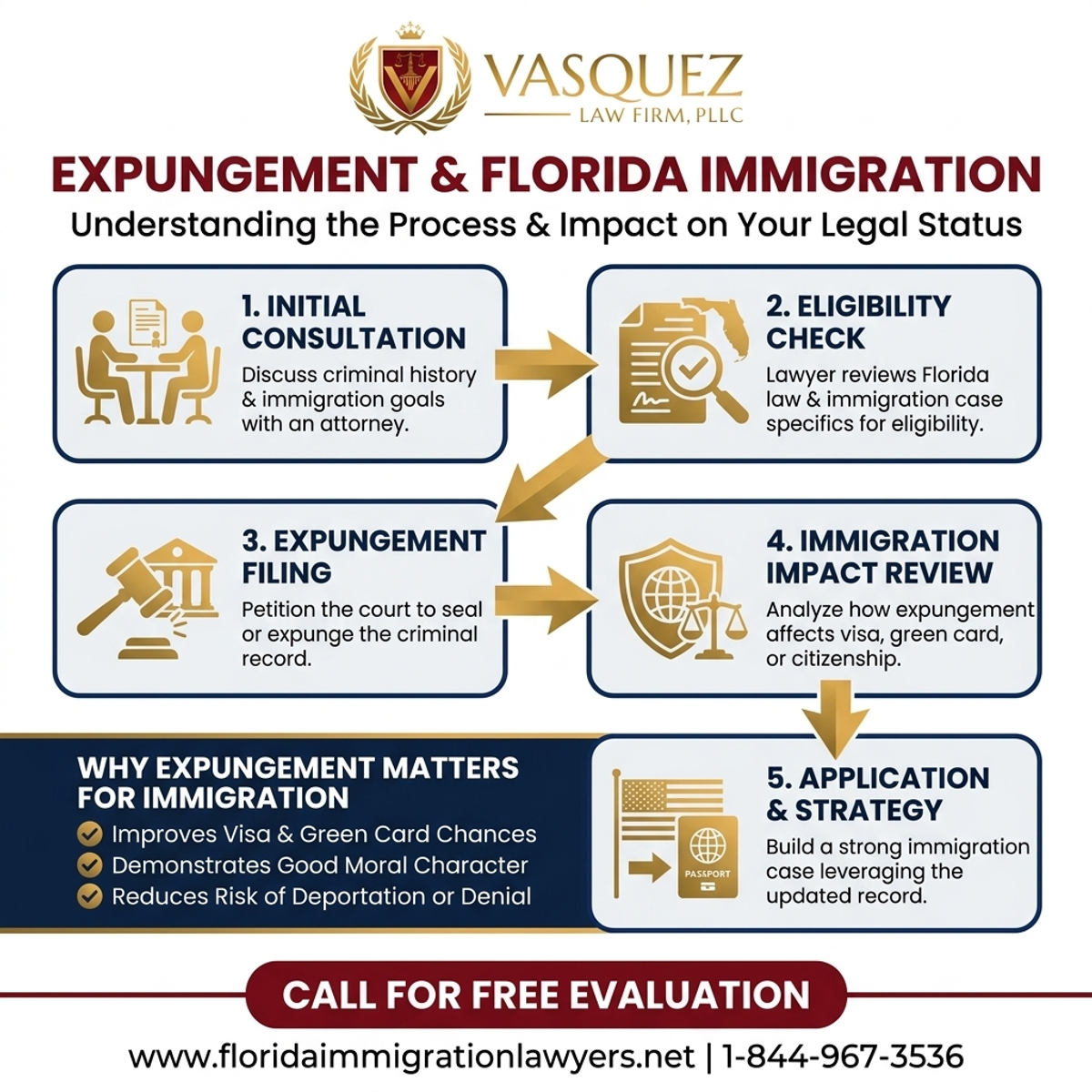
Step-by-Step Process — Expungement Effect on Immigration in Florida | VLF Florida
Understanding this critical distinction is the first step in proactively addressing any potential immigration issues related to a past criminal record. It underscores the absolute necessity of consulting with an attorney who possesses expertise in both criminal defense and immigration law. Only such specialized counsel can accurately assess the specific impact of your expunged record on your immigration goals and guide you through the complex federal requirements.
Specific Immigration Consequences of an Expunged Record
Even an expunged record can trigger a range of adverse immigration consequences, impacting various aspects of a non-citizen's life in the U.S. These consequences can be severe and long-lasting.
Inadmissibility
A criminal conviction, even if expunged, can render an individual 'inadmissible' to the United States. Inadmissibility means you are barred from entering the U.S. or from adjusting your status to a lawful permanent resident (green card holder). Common grounds for inadmissibility related to criminal offenses include:
- Crimes Involving Moral Turpitude (CIMT): This is a broad category that includes offenses involving fraud, theft, assault with intent to harm, and certain drug offenses. Even a single CIMT, depending on the sentence and circumstances, can lead to inadmissibility.
- Controlled Substance Offenses: Convictions related to controlled substances, even for minor possession, can lead to permanent inadmissibility.
- Multiple Criminal Convictions: Two or more convictions of any kind, with an aggregate sentence of five years or more, can also render an individual inadmissible.
If you are found inadmissible, you may be denied a visa, refused entry at a port of entry, or denied adjustment of status. In some limited cases, waivers of inadmissibility may be available, but these are discretionary and often difficult to obtain.
Deportability
For lawful permanent residents (green card holders) or other non-citizens already living in the U.S., certain criminal convictions can lead to 'deportability' (also known as removability). This means the government can initiate proceedings to remove you from the country. Grounds for deportability include:
- Aggravated Felonies: This is a particularly severe category under immigration law, encompassing a wide range of crimes from murder and rape to certain theft offenses, drug trafficking, and even some misdemeanors if the sentence is one year or more. An aggravated felony conviction almost always leads to mandatory deportation and severely limits eligibility for most forms of relief.
- Crimes Involving Moral Turpitude (CIMT): A conviction for a CIMT committed within five years of admission to the U.S., for which a sentence of one year or more may be imposed, can make a non-citizen deportable.
- Controlled Substance Offenses: Similar to inadmissibility, most drug-related convictions can lead to deportability.
- Firearms Offenses: Convictions related to firearms can also be grounds for deportation.
Even if your record was expunged in Florida, the underlying conviction for these types of crimes can still be used by ICE to place you in removal proceedings. This is why having an experienced deportation defense attorney is crucial.
Naturalization (Citizenship)
To become a U.S. citizen through naturalization, applicants must demonstrate 'Good Moral Character' (GMC) for a specified period (typically five years, or three years if married to a U.S. citizen). Criminal convictions, even expunged ones, can be a significant impediment to establishing GMC. Certain crimes, particularly aggravated felonies, can permanently bar an individual from naturalizing. Other convictions might lead to a finding that the applicant lacks GMC, requiring them to wait longer or even denying their application outright. USCIS will review your entire criminal history, regardless of expungement, to make a determination on your GMC.
Asylum and Refugee Status
For individuals seeking asylum or refugee status, criminal convictions can also be problematic. Certain serious crimes, particularly 'aggravated felonies' or 'particularly serious crimes,' can bar an individual from being granted asylum or withholding of removal, even if they have a legitimate fear of persecution in their home country. The determination of what constitutes a 'particularly serious crime' for asylum purposes is complex and often involves a review of the nature of the crime, the sentence imposed, and the danger the individual poses to the community. An expunged record does not negate these bars to relief.
Common Misconceptions and Pitfalls for Non-Citizens
The gap between state and federal law often leads to dangerous misconceptions for non-citizens with expunged records. Avoiding these pitfalls is essential for protecting your immigration future.
Misconception 1: "My record is gone, so I don't need to disclose it."
This is arguably the most dangerous misconception. As discussed, federal immigration authorities do not recognize state expungements as erasing a conviction. You are generally required to disclose all arrests, charges, and convictions on immigration forms, even if they were dismissed, expunged, sealed, or occurred many years ago. Failing to disclose can lead to allegations of misrepresentation or fraud, which carry their own severe immigration penalties, including permanent bars to certain benefits.
Misconception 2: "My lawyer said it wouldn't affect my immigration."
If your criminal defense attorney was not also an immigration law specialist, their advice regarding immigration consequences might have been incomplete or inaccurate. Criminal defense attorneys focus on state criminal outcomes, such as avoiding jail time or getting a record expunged. They may not be fully aware of the distinct and often harsher federal immigration consequences. Always seek advice from an attorney with dual expertise or a dedicated immigration attorney.

Key Statistics — Expungement Effect on Immigration in Florida | VLF Florida
Misconception 3: "I only had adjudication withheld, so it's not a conviction."
While Florida law often treats a withheld adjudication differently from a conviction, federal immigration law typically considers it a 'conviction' if a finding of guilt was made or a plea was entered, and some form of punishment or restraint on liberty was imposed. This is a crucial distinction that often catches individuals off guard.
Pitfall: Not Obtaining Certified Court Dispositions
Even if your record is expunged, you will need certified copies of your court dispositions for any immigration application. These documents provide the details of your arrest, charges, plea, and sentencing. It can be challenging to obtain these records after an expungement, as they are no longer publicly accessible. It's imperative to secure these documents before or during the expungement process, if possible.
The Indispensable Role of Experienced Legal Counsel
Given the complexities and severe potential consequences, navigating expungement and its impact on immigration without legal guidance is highly inadvisable. An experienced attorney, particularly one with a deep understanding of both Florida criminal law and federal immigration law, is essential.
A qualified attorney can:
- Assess Your Specific Situation: They can review your criminal record and immigration history to provide a precise analysis of how an expungement might affect your current and future immigration status.
- Advise on Disclosure: They will guide you on what to disclose, when, and how, ensuring compliance with federal immigration requirements and avoiding allegations of misrepresentation.
- Identify Potential Waivers or Relief: In some cases, even with a conviction, there may be waivers or forms of relief available. An attorney can determine eligibility and assist with the complex application process.
- Represent You in Proceedings: If you face deportation proceedings or an interview with USCIS, an attorney can represent you, advocate on your behalf, and protect your rights.
- Proactive Planning: Ideally, consult an attorney before you even enter a plea in a criminal case. They can advise on plea agreements that minimize negative immigration consequences, a process known as 'crimmigration' defense.
At VLF Florida, our experienced attorneys understand the intricate interplay between Florida's criminal justice system and U.S. immigration law. We are dedicated to providing comprehensive and strategic legal advice to protect your immigration future. Do not leave your immigration status to chance. The stakes are too high.
Proactive Steps and What to Do Next
If you are a non-citizen with a criminal record in Florida, whether expunged, sealed, or active, taking proactive steps is crucial. Ignoring the issue will only lead to greater problems down the line, especially if you plan to apply for any immigration benefit or if you are ever questioned by immigration authorities.
- Gather All Criminal Records: Obtain certified copies of every arrest, charge, and disposition, regardless of whether it was expunged or sealed. These documents are vital for any immigration application.
- Consult with a Dual-Expertise Attorney Immediately: Seek legal advice from an attorney who specializes in both Florida criminal law and U.S. immigration law. This dual expertise is critical to understanding the full scope of your situation. They can help you understand if your expunged record will still be considered a 'conviction' for immigration purposes and what specific consequences it might trigger.
- Always Disclose: When filling out immigration forms or during interviews, always disclose your full criminal history, including expunged or sealed records. It is far better to disclose and explain than to be accused of misrepresentation.
- Understand Your Options: An attorney can help you explore potential waivers of inadmissibility or other forms of relief that might be available depending on the nature of your offense and your immigration history.
- Prepare for Future Applications: With legal guidance, you can strategically plan for future immigration applications, understanding the challenges and preparing the necessary documentation and arguments to mitigate the impact of your past record.
Conclusion
While expungement and sealing offer significant relief under Florida state law, they do not erase a criminal record for federal immigration purposes. Non-citizens must understand that federal immigration authorities operate under their own definitions of 'conviction' and will almost certainly consider an expunged record when evaluating admissibility, deportability, naturalization, or asylum applications. The consequences of misunderstanding this distinction can be severe, ranging from denial of immigration benefits to deportation.
The complexities of this intersection demand the expertise of legal professionals who are well-versed in both criminal and immigration law. If you have an expunged record in Florida and are concerned about its impact on your immigration status, do not hesitate to seek qualified legal assistance. Proactive consultation can make all the difference in protecting your future in the United States. Contact VLF Florida today for a comprehensive consultation to discuss your unique situation and explore your best path forward. Our dedicated legal team is ready to help you navigate these challenging waters.
Sources and References
- U.S. Citizenship and Immigration Services (USCIS)
- Executive Office for Immigration Review (EOIR)
- U.S. Department of State - Bureau of Consular Affairs
- Immigration and Nationality Act (INA), 8 U.S.C. Chapter 12
Do Not Navigate This Process Alone
Our experienced immigration attorneys are ready to fight for you. Get a free, confidential case review today.
Se Habla Español
Or leave your details and we’ll call you:
Free Evaluation in 24 Hours
Or talk to us right now

AI voice assistant — available 24/7
FreeFrequently Asked Questions

William J. Vásquez
Founding Attorney · Vasquez Law Firm
U.S. Air Force veteran and immigration attorney with years of hands-on U.S. immigration experience. J.D., NCCU School of Law. AILA member. Admitted to the 4th, 5th, and 11th Circuit Courts.
Available 24/7 - Free Evaluations
Reviewed for legal accuracy by William J. Vásquez
Licensed in North Carolina; U.S. immigration is federal practice.
Related Legal Services
Our Florida immigration attorneys can help you with citizenship and naturalization, immigration practice areas and free immigration consultation. Call today at 1-844-YO-PELEO for a free case review.
Related Links
Related Topics
Free Legal Case Review
Discuss your case with our experienced attorneys. We're available 24/7.
Se Habla Español - Estamos aquí para ayudarle.
Related Articles
Immigration Lawyer Orlando Free Consultation in Florida
For individuals and families in Orlando, Florida, navigating the complexities of U.S. immigration law requires expert guidance. An immigration lawyer in Orlando offers crucial support for everything from visa applications and green card processes to naturalization and deportation defense. This comprehensive guide details what a free consultation covers, providing a step-by-step overview of immigration pathways, essential document checklists, and expected timelines in 2026. We also highlight common mistakes to avoid, discuss the critical role of legal counsel in deportation and asylum cases, and explain why choosing a local Orlando immigration attorney is beneficial. Florida Immigration Lawyers is dedicated to serving the diverse community of Orlando with compassionate, effective legal solutions, ensuring you receive personalized advice and robust representation for a successful immigration journey.
EAD Advance Parole Combo Card in Florida 2026
For individuals with a pending Form I-485, Application to Register Permanent Residence or Adjust Status, the EAD Advance Parole Combo Card is an essential document. This single card combines the authorization to work legally in the U.S. (Employment Authorization Document - EAD) with permission to travel internationally and re-enter without abandoning your green card application (Advance Parole). This guide from Florida Immigration Lawyers provides a comprehensive overview for applicants in Florida in 2026, covering eligibility, the step-by-step application process, required documents, expected processing times, and associated costs. We also highlight common mistakes to avoid and when to seek legal counsel to ensure a smooth and successful immigration journey. Understanding this vital card is key to maintaining stability while awaiting your permanent residency approval.
Best Immigration Firm for L-1 Transfers in Florida
Explore how Florida Immigration Lawyers can assist with L-1 visa transfers for enterprises in Florida. Learn about the process, common mistakes, and when to seek legal assistance.
Green Card Holders Issued New Warning: Florida Process
Discover the latest updates for green card holders in Florida. Learn about new warnings affecting renewals, steps for filing Form I-90, and common pitfalls to avoid. Ensure a successful renewal by understanding the process and consulting experienced immigration attorneys.